Available Online at www.ijpret.com 77
INTERNATIONAL JOURNAL OF PURE AND
APPLIED RESEARCH IN ENGINEERING AND
TECHNOLOGY
A PATH FOR HORIZING YOUR INNOVATIVE WORK
A BRIEF REVIEW OF COMPUTING THE PERFORMANCE OF EXISTING SOLAR
DRYERS BY OPTIMAZING THE TILT ANGLES OF SOLAR COLLECTORS TO RECEIVE
MAXIMUM SOLAR RADIATION
ABHINAV. D. SARDAR, SAGAR. M. CHARTHAL
Department of Mechanical Engineering [M.E Thermal], Prof. Ram Meghe Institute of Technology & Research, Badnera-Amravati, Lecturer Kirti Polytechnic, Amravati, Amravati, India
Accepted Date: 15/03/2016; Published Date: 01/05/2016
\
Abstract:The tilt position of the solar collector affect the amount of solar radiation that falls on the collector surface over the course of the day and indeed the year. The choice of tilt angle for a solar panel is fundamental to its efficient operation because incorrectly positioning the solar panel leads to an unnecessary loss in potential power. In the past, much work has been done by authors to determine the optimum tilt angle by applying existing models to their locations. This approach has been successful in climates with the most favorable solar potential, where greater than 90 percent of the solar radiation arrives as direct beam radiation.
Keywords: Solar collector, optimum tilt angle, solar radiation, HOMER
Corresponding Author: MR. ABHINAV. D. SARDAR
Access Online On:
www.ijpret.com
How to Cite This Article:
Available Online at www.ijpret.com 78
INTRODUCTION
Drying is an excellent way to preserve food and solar food dryers are appropriate food preservation technology for sustainable development. Drying was probably the first ever food preserving method used by man, even before cooking. It involves the removal of moisture from agricultural produce so as to provide a product that can be safely stored for longer period of time. With cultural and industrial development, artificial mechanical drying came into practice, but this process is highly energy intensive and expensive which ultimately increases product cost. Recently, efforts to improve “sun drying” have led to “solar drying”. In solar drying, solar dryers are specialized devices that control the drying process and protect agricultural produce from damage by insect pests, dust and rain. In comparison to natural “sun drying”, solar dryers generate higher temperatures, lower relative humidity, lower product moisture content and reduced spoilage during the drying process. In addition, it takes up less space, takes less time and relatively inexpensive compared to artificial mechanical drying method. Thus, solar drying is a better alternative solution to all the drawbacks of natural drying and artificial mechanical drying. The amount of solar energy incident on a solar collector in various time scales is a complex function of many factors including the local radiation climatology, the orientation and tilt of the exposed collector surface and the ground reflection properties. The performance of a solar collector is highly influenced by its angle of tilt with the horizon. This is due to the facts that tilt angle change the solar radiation reaching the surface of the collector. our main aim is optimizing the tilt angles of solar collectors to receive maximum radiation
II. LITERATURE REVIEW
Available Online at www.ijpret.com 79 radiation was correlated by Ulgen Koray and Hepbasli Arif [4] with the monthly average hourly clearness index in the form of the polynomial relationships for the city of Izmir in the western part of Turkey. The values of the monthly average daily clearness index ranged from 0.41 to 0.66, averaged for the same period.
III. PROBLEM IDENTIFICATION
Based on the literature survey it is seen that the incident solar radiations on a collector surface are greatest for an optimal tilt angle of the collector at a particular region which is also not constant throughout the year. To obtain maximum power output from the solar collector system it is desirable to tilt the collector to that tilt angle at which the incident solar radiations are maximum. If not monthly, the tilt angles of the collector surfaces can be changed four times in a year to their seasonal optimum tilt angles at which slightly less power is obtained than monthly optimal angles but large compared to yearly optimal tilt angle.
IV. OBJECTIVE OF THE STUDY
The following general objectives for tilt angle study:
i. Daily and monthly Optimum tilt angles.
ii. Seasonal Optimum tilt angles.
iii. Yearly optimum tilt angle.
iv. To compare the different model.
From above objectives we have discuss daily and monthly Optimum tilt angles, yearly optimum tilt angle.
A .SOLAR RADIATION
Solar radiation can best be approximated to the radiation of a black body with a temperature of 5780 K in both intensity and spectrum. Taking this into consideration, the extraterrestrial solar radiation falling on a surface normal to the sun’s rays at the mean sun earth distance, which is also called the solar constant, can be calculated using equation 1:
2 4
2
. s SC
se
r
G T
r
Available Online at www.ijpret.com 80 The solar constant is approximately equal to 1367 W/m2; this value is an approximation based on the distance between the earth and the sun, which is equal to 1AU. And since the earth's orbit around the sun is elliptical, then the Gsc value may change slightly (about +3.3%) due to the change in the distance between the earth and the sun. This value was verified experimentally and the World Meteorological Organization (WMO) chose the average value 1367 W/m2 as the solar constant.
B. DIFFUSION OF SOLAR RADIATION
The solar radiation is subjected to several radiation attenuating effects when it travels across the atmosphere. There are two general cases of attenuating effects: absorption and scattering (reflection is a special case of scattering). The radiation that is neither scattered nor absorbed and reaches the surface directly from the sun disk is called direct radiation, while the scattered radiation that reaches the ground is called diffused radiation. The radiation extinction depends on different factors, such as: humidity, cloud coverage, other residual particles; those factors can only be determined by measurements, while others can be calculated (such as the path length of the solar beam from the top of the atmosphere to a given location on the earth’s surface, which is called the air mass), and it is a function of the geographic altitude of a certain location and the solar zenith angle ϴz at that location, but it can be simplified using Eq. 2:
1
Z
AM
COS
(2)
C. SOLAR RADIATION ON TILTED SURFACES AND RADIANCE DISTRIBUTION OVER THE SKY
Available Online at www.ijpret.com 81
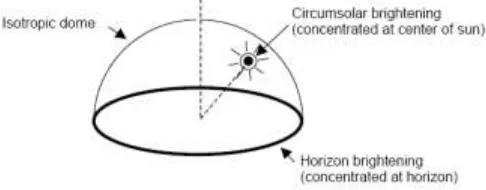
Figure 1. Distribution of diffused radiance
Figure 2. Solar radiation angles
The isotropic model, which assumes that the diffused radiation is uniform over the sky dome, can describe the overcast or cloudy sky, while the anisotropic model, which includes diffused sky radiation in the circumsolar and horizon brightening components of the solar radiation, is more accurate in describing clear sky. Isotropic diffused solar radiation can be obtained by the following equations:
GT GT b, GT d, GT ref, (3)
,
1 cos 2
T b d
G G
(4)
,
1 cos
2
T ref ref
G G
(5)
GT b, G Rb. b (6 )
cos( ) cos sin sin sin 180
cos cos sin sin sin 180
s s
b
s s
R
(7)
1
cos tan . tan s
Available Online at www.ijpret.com 82 The previous equations are based on Liu and Jordan model which is one of the simplest and earliest models. Anisotropic models should take into consideration two more components, as the following equation shows:
, , , , , , , ,
T T b T d iso T d os T d hc T ref
G G G G G G (9)
where,
GT is the global radiation
GT,b is the beam radiation
GT,d,iso is the isotropic component
GT,d,cs is the circumsolar component
GT,d,hz is the Horizontal brightening component
GT,d,ref is the reflected radiation component
Researchers have introduced a variety of isotropic and anisotropic models, suggesting relations to determine the ratio of the average daily diffused radiation incident on an inclined surface to that on a horizontal surface (Rd). A. K. Yadav and S. S. Chandel conducted a review of the solar radiation models, where each model had its own limitations and conditions [6]. Nooriana et al. made an evaluation in which 12 models where investigated to estimate the hourly diffused radiation on inclined surfaces and compared the results to actual measured data [7]. If one of those models can be validated for a certain place and atmospheric conditions, an optimum tilting angle can be reached by varying tilt angle (β) from 0 to 90 until the solar radiation on the tilted surface is maximized.
V- CALCULATION OF GLOBAL SOLAR RADIATION WITH THE HELP OF HOMER SOFTWARE
(Hybrid Optimization of Multiple Energy Resources)
Available Online at www.ijpret.com 83 that can include a combination of renewable power sources, storage, and fossil-based generation HOMER uses the following equation to calculate the hour angle:)
ts 12hr.15 /hr
(10)
Where:
ts is the solar time [hr]
The value of ts is 12hr at solar noon, and 13.5hr ninety minutes later. The above equation follows from the fact that the sun moves across the sky at 15 degrees per hour. HOMER (Hybrid Optimization of Multiple Energy Resources)assumes that all time-dependent data, such as solar radiation data and electric load data, are specified not in solar time, but in civil time, also called local standard time. HOMER calculates solar time from civil time using the following equation:
15 /
s c c
t t Z E
hr
(11)
Where:
tc is the civil time in hours corresponding to the midpoint of the time step [hr]
Λ is the longitude [°]
Zc is the time zone in hours east of GMT [hr]
E is the equation of time [hr]
Note that west longitudes are negative, and time zones west of GMT are negative as well.
The equation of time accounts for the effects of obliquity (the tilt of the earth's axis of rotation relative to the plane of the ecliptic) and the eccentricity of the earth's orbit.
HOMER calculates the equation of time as follows:
3.82 0.000075 0.001868.cos 0.03277.sin 0.014615.cos 2 0.04089.sin 2
E B B B B (12)
Where B is given by:
1
360 365 n
B
Available Online at www.ijpret.com 84 Where n is the day of the year, starting with 1 for January 1st. Now, for a surface with any orientation, we can define the angle of incidence, meaning the angle between the sun's beam radiation and the normal to the surface, using the following equation:
cos sin sin cos
sin cos sin cos cos cos cos cos
cos sin sin cos cos cos sin sin sin
(14 )
Where,
is the angle of incidence
is the slop of the surface
is the azimuth of the surface
is the latitude
is the solar declination
is the hour angle
An incidence angle of particular importance, which we will need shortly, is the zenith angle, meaning the angle between a vertical line and the line to the sun. The zenith angle is zero when the sun is directly overhead and 90° when the sun is at the horizon. Because a horizontal
surface has a slope of zero, we can find an equation for the zenith angle by setting 0 in the
above equation, which yields:
cosz coscoscossinsin (15)
Where:
Z
is the zenith angle.
Available Online at www.ijpret.com 85 amount of solar radiation striking a surface normal (perpendicular) to the sun's rays at the top of the earth's atmosphere, HOMER uses the following equation:
360 1 0.033. cos
365
ON SC
n
G G
(16)
Where:
Gon is the extraterrestrial normal radiation [kW/m2]
Gsc is the solar constant [1.367 kW/m2]
n is the day of the year [a number between 1 and 365]
Table I Solar radiation and clearness in Chhattisgarh throughout the year is given below in table
Month Index Daily Radiation(kWh/m2/d)
January 0.619 4.526
February 0.644 5.123
March 0.622 5.899
April 0.618 5.969
May 0.609 6.445
June 0.579 6.109
July 0.496 4.997
August 0.439 4.336
September 0.488 4.019
October 0.559 3.879
November 0.589 4.465
Available Online at www.ijpret.com 86 To calculate the extraterrestrial horizontal radiation, defined as the amount of solar radiation striking a horizontal surface at the top of the atmosphere, HOMER uses the following equation
cos
O ON Z
G G (17)
Where:
Go is the extraterrestrial horizontal radiation [kW/m2]
Gon is the extraterrestrial normal radiation [kW/m2]
z
is the zenith angle
Since HOMER simulates on a time step by time step basis, we integrate the above equation over one time step to find the average extraterrestrial horizontal radiation over the time step
2 1
0 2 1 0
12
[cos cos (sin sin ) sin sin ] 180
G
(18)
Where:
0
G
is the extraterrestrial horizontal radiation averaged over the time step [kW/m2]
ON G
is the extraterrestrial normal radiation [kW/m2]
1
is the hour angle at the beginning of the time step.
2
is the hour angle at the end of the time step.
The above equation gives the average amount of solar radiation striking a horizontal surface at the top of the atmosphere in any time step.The solar resource data give the average amount of solar radiation striking a horizontal surface at the bottom of the atmosphere (the surface of the earth) in every time step. The ratio of the surface radiation to the extraterrestrial radiation is called the clearness index. The following equation defines the clearness index:
0
T
G K
G
(19)
Available Online at www.ijpret.com 87
Gis the global horizontal radiation on the earth's surface averaged over the time step
[kW/m2].
0
G
is the extraterrestrial horizontal radiation averaged over the time step [kW/m2]
Now let us look more closely at the solar radiation on the earth's surface. Some of that radiation is beam radiation, defined as solar radiation that travels from the sun to the earth's surface without any scattering by the atmosphere. Beam radiation (sometimes called direct radiation) casts a shadow. The rest of the radiation is diffuse radiation, defined as solar radiation whose direction has been changed by the earth's atmosphere. Diffuse radiation comes from all parts of the sky and does not cast shadow. The sum of beam and diffuse radiation is called global solar radiation, a relation expressed by the following equation:
d b
GG G (20)
Where:
b
G
is the beam radiation [kW/m2]
d
G is the diffuse radiation [kW/m2]
The distinction between beam and diffuse radiation is important when calculating the amount of radiation incident on an inclined surface. The orientation of the surface has a stronger effect on the beam radiation, which comes from only one part of the sky, than it does on the diffuse radiation, which comes from all parts of the sky.
VI. OPTIMUM TILT ANGLE CALCULATION
Available Online at www.ijpret.com 88 of Jordan – 32°37′N 36°6′E) was ß = 30.13°, monthly, and the seasonal tilt angles energy gains were 28% and 26%, respectively. A major concern regarding this model was that it took into consideration the varying tilt angle to the maximize extraterrestrial radiation but disregarded the attenuation effects that changes the properties of the solar radiation. Soulayman [10] commented on Skeiker work and set all the negative values of the tilt angles to zero, identifying some other errors in his methodology.
1
, tan tan
sin ss opt d ss h h
(21)
1 , tan opt m X Y (22) 2 0 1 24 2
1 0.034 cos sin
365 n n
ss n n
n
X I h
(23) 2 0 1 24 21 0.034 cos cos sin
365 n n
ss n n
n
Y I h
(24)Agha and Sbita [11] conducted a study for four different locations in Libya to determine the optimum tilt angle for the solar systems using an accurate simple sizing method rather than numerical methods. The selection criterion for the optimum tilt angle was based on an optimization factor (Fopt) as shown in equation:
avg ( )
opt DEV H F S (25)
Available Online at www.ijpret.com 89 of the world and has a high value of solar radiation; it is mostly sunny all year around. Moghadam et al. [12] calculated the monthly, seasonal, semi-annual and annual optimum tilt angles for Zahedan city (latitude = 29.49°). The annual optimum tilt angle for Zahedan was equal to 28°. The study also found that the tilt angle was equal to 5° in the first half of the year and 50° in the second half and if the tilt angle is adjusted two times in a year, the total annual extra received energy will be more than 8%.Talebizadeh [13] developed new correlations to calculate the monthly, seasonal, and yearly optimum slope angles for latitudes of 20° to 40°
north, suggesting that the annual optimum tilt angle was opt 0.68047.203
(26)
Therefore, the optimum for locations in northern Jordan equals 29.17°. The correlations were obtained according to the optimum slope angles predicted by the researcher and using the optimum slope angles achieved by other researchers at locations out of Iran but in the same range of latitudes; the results showed that the optimum azimuth angle is zero for receiving maximum solar energy. It can be noticed that the previous results are consistent with the simple and general correlations to determine the optimum tilt angle depending only on the latitude that can be used as a rule of thumb, such as Heywood [14] who came up with the following equation:
𝛽𝑜𝑝𝑡 = ∅ − 10° (27)
According to equation 27, the optimum tilt angle in the northern part of Jordan is equal to 22.29 degree. Or Lunde [15] suggested the following equation:
𝛽𝑜𝑝𝑡 = ∅ ± 15° (28)
The optimum tilt angle for the northern part of Jordan, according to equation 28, is equal to 17.5 in summer, 47.5 in winter, where the plus and minus signs are used for the winter and summer seasons.
Duffie and Beckman [16] suggested that the optimum tilt is in the range of the latitude plus
10oto the latitude plus 20°, and the variation of 10° either way outside of this range, so,
accordingly, the optimum tilt angle (ß) is equal to 52.29° - 62.29o, in winter, and from 32.29o to
42.29o, in summer. That was determined to insure the visibility of a thermal system
Available Online at www.ijpret.com 90
Table II
Solar radiation for adjusted collectors, fixed collectors, tracking collectors for single day per month
VII. CONCLUSION
The optimum tilt is different for each months of the year. The Collected solar energy will be greater if we choose the optimum panel tilt for each month. Also, we have found that the yearly average of optimum tilt is equal to the latitude of the site. The results show that the average optimum tilt angle at Chhattisgarh for the winter months is 37_ and for the summer months is 12_. So, the yearly average tilt panel is 23.5_ which nearly corresponding to the latitude of Chhattisgarh site (24.5_). This, in general, is in agreement with the results of many
other researchers [15o, 16o].The loss of energy when using the yearly average fixed angle is
Available Online at www.ijpret.com 91 VIII.REFRENCES
1. Ahmad M. Jamil and Tiwari G.N., ―Optimization of Tilt Angle for Solar Collector , The
Open The Open Renewable Energy Journal, 2009; 2: 19-24
2. Renewable Energy Journal, 2009; 2: 19-24Bekker, B. (2004). Methods to extract maximum
electrical energy
3. Mehleri E.D., Zervas P.L., Sarimveis H., Palyvos J.A. and Markatos N.C., ―Determination of
the optimal tilt angle and orientation for solar photovoltaic arrays‖, Renewable Energy, 2010; 35: 2468 – 2475
4. Ulgen Koray and Hepbasli Arif, ―Prediction of Solar Radiation Parameters through Clearness
Index for Izmir, Turkey‖, Energy Sources, Part A: Recovery, Utilization, and Environmental Effects, 2002; 24: 8, 773 - 785.
5. The methods used in calculation of solar radiation in Energy Plus
http://www.designbuilder.co.uk/
6. A. K. Yadav, S.S. Chande, “Tilt angle optimization to maximize incident solar radiation: A
review”. Renewable and Sustainable Energy Reviews, Vol. 23 (2013), 503–513.
7. A. M. Noorian, I. Moradi, G. A. Kamali, “Evaluation of 12 models to estimate hourly diffuse
irradiation on inclined surfaces”. Renewable Energy, Vol. 33 (2008) No. 6, 1406–1412.
8. A. K. Yadav, S.S. Chande, “Tilt angle optimization to maximize incident solar radiation: A
review”. Renewable and Sustainable Energy Reviews, Vol. 23 (2013), 503–513.
9. K. Skeiker “Optimum tilt angle and orientation for solar collectors in Syria”. Energy
Conversion and Management, Vol. 50 (2009), 2439–2448.
10. S. Soulayman, W. Sabbagh, “Comment on ‘Optimum tilt angle and orientation for solar
collectors in Syria’ by Skeiker”. Energy Conversion and Management, Vol. 89 (2015), 1001– 1002.
11. K. R. Agha, M. N. Sbita, “On the sizing parameters for stand- alone solar-energy systems”.
Applied Energy, Vol. 65 (2000) No. 1, 73–84.
12. H. Moghadam, F. F. Tabrizi, A. Z. Sharak, “Optimization of solar flat collector inclination”.
Desalination, Vol. 265 (2011) No. 1, 107–111.
13. P.Talebizadeh,M. A. Mehrabian, M. Abdolzadeh, “Determination of optimum slope angles
of solar collectors based on new correlations”. Energy Sources, Part A: Recovery, Utilization, and Environmental Effects, Vol. 33 (2011) No. 17, 1567-1580.
14. H. Heywood, “Operating experience with solar water heating”. JIHV, Vol. 39 (1971), 63–69.
15. Lunde PJ. Solar thermal engineering. New York: Wiley; 1980.