Original Article
EFFECT OF PEANUT HUSK POWDER AS A NATURAL POLYMER IN THE FORMULATION AND EVALUATION OF GASTRO-RETENTIVE DRUG DELIVERY SYSTEM OF VALSARTAN FLOATING
TABLETS
C.Saravanan*
1, M.Purushothaman
21
Alwar College of Pharmacy, Sun Rise University, Alwar, Rajasthan
–
301030, India
2Vasavi Institute of Pharmaceutical Sciences, Kadapa-
516247, IndiaA RT I C L E I N F O A B S T R AC T
Key words:
Gastro-Retentive drug delivery, Floating drug delivery,
Valsartan
Novel drug delivery system are becoming one of the most important fields in modern pharmaceuticals, formulation technology and several techniques are employed to design the sustained con-trolled drug delivery system. In the present study attempt has been made to develop sustained released drug delivery system by formulat-ing the floatformulat-ing tablets of valsartan usformulat-ing peanut husk powder as a natural polymer (cellulose 35.7%, hemicelluloses 18.7%, lignin 30.2%) which is biodegradable, biocompatible, nontoxic, economi-cally cheap cost, devoid of adverse and side effects and easily availa-bility. Valsartan is effective as antihypertensive agent chemically N-(1-oxopentyl)-N-[[2-(1H-tetrazol-5-yl) [1, 1’-biphenyl]-4[-yl] me-thyl] L-valine.It has a half-life 6hrs, effective plasma concentration is (2-4) hours. The 9 batches of floating tablets (F-1 to F-9) were formu-lated by direct compression method using different ratio of polymers like peanut husk power, HPMC and carbopol. The formulated tablets were evaluated by means of different parameters like shape and den-sity of tablet, hardness, friability, weight variation, drug content uni-formity, In vitro buoyancy, swelling Index, In vitro dissolution stud-ies. The formulation 5 has better sustained release when compared other formulations, it release the drug of about 40% at the 1sthr and
almost 80% release at the end of 8hrs, hence we conclude that the combination of peanut husk powder, HPMC and carbopol shows bet-ter Gastric retention time which sustains the release of the dosage form.
INTRODUCTION
The oral controlled drug delivery systems (DDS) should be primarily aimed to achieving more predict-able and increased bioavailability of drugs. However, the development process is precluded by several phys-iological difficulties, such as an inability to restrain
and localize the DDS within the desired regions of the gastrointestinal (GI) tract and the highly variable na-ture of gastric emptying process.It can be anticipated that, depending upon the physiological state of the subject and the design of pharmaceutical formula-tion, the emptying process can last from a few minutes to 12 hours. This variability, in turn, may lead to unpredictable bioavailability and times to achieve peak plasma levels, since the majority of drugs are preferentially absorbed in the upper part of this small intestine. Furthermore, the relatively brief gastric emptying time (GET) in humans, which normally averages 2-3 hours through the ma-jor absorption zone (stomach or upper part of the
Journal of Global Trends in Pharmaceutical Sciences
An Elsevier Indexed Journal ISSN-2230-7346
C.Saravanan*
Alwar College of Pharmacy,Sun Rise University, Alwar, Rajasthan–301030, India
Saravanan .C et al. / J Global Trends Pharm Sci 2016; 7(2): 3133 -3137 intestine), can result in incomplete drug release
from the DDS leading to diminished efficacy of the administered dose1-5. These considerations have lead to the development of oral controlled release (CR) dosage forms possessing gastric retention ca-pabilities1. Prolonged gastric retention improves bi-oavailability, reduces drug waste, useful for drugs acting locally in the GIT, drugs which are poorly soluble and unstable in intestinal fluids. Recently, various efforts are being made to design gastro re-tentive systems such as, floating, swelling and ex-panding, bioadhesive/mucoadhesive, modified shape, low density/high density and raft systems etc. These systems are advantageous in improving GIT absorption of drug with CR due to specific site absorption limitations. Among the various gastro retentive systems, gastric floating drug delivery systems (GFDDS) offer numerous advantages over the gastric retentive systems. These systems have a density lower than the gastric fluids and thus remain buoyant in the stomach without affecting the gastric emptying rate for a prolonged period. While the system is floating on the gastric contents, the drug is released slowly at a desired rate from the stom-ach6-8. The gastro retentive drug delivery systems can be retained in the stomach and assist in improv-ing the oral sustained delivery of drugs that have an absorption window in a particular region of the gas-trointestinal tract. These systems help in continu-ously releasing the drug before it reaches the ab-sorption window, thus ensuring optimal bioavaila-bility9-10.
Criteria aimed to achieve
1. Tablets should have satisfactory properties. 2. Tablet release more than 90% of drug
within 8 hours.
3. Floating lag time of drug delivery system is reduced to minimum.
4. Tablet remains buoyant for 8 hours in stom-ach and releases the drug in controlled manner.
Valsartan is chemically N-(1-oxopentyl)-N-[[2-(1H-tetrazol-5-yl) [1,1’-biphenyl]-4[-yl] me-thyl] L-Valine which is used as an Anti-hyperten-sive agent and Angiotension 2 receptor antagonist. Valsartan is an angiotensin receptor blocker widely prescribed for hypertension. Valsartan blocks the actions of AngioTension 2, which include constrict-ing blood vessels and activatconstrict-ing aldosterone to re-duce blood pressure. It is absorbed from the upper part of gastrointestinal tract. The oral bioavailabil-ity of Valsartan was reported to be 23% and largely present in unionized form in acidic pH. The recom-mended adult oral dosage of Valsartan is 80 mg for the effective treatment of hypertension. The short
biological half-life of drug (6 hrs) also favors devel-opment of sustained release formulations. Drugs, which are easily absorbed from the gastrointestinal tract and those with short half-life, are quickly elim-inated from the systemic circulation due to which frequent dosing is desired. To reduce this problem, gastro retentive drug delivery systems, which pro-vide effective plasma drug concentration for longer periods thereby reducing the dosing frequency, are being formulated. It also has an advantage of mini-mizing the fluctuations in plasma drug concentra-tion by delivering the drug in a controlled and re-producible manner11-12. Therefore, in the current study, floating tablets of valsartan were prepared using HPMC E50 and Carbopol 934 as the poly-mers, NaHCO3 as gas generating agent and Peanut husk powder as floating enhancer. The aim of the study was to evaluate the effect of Peanut husk powder on drug release and the effect of sodium bi-carbonate on buoyancy.
MATRIALS AND METHODS:
Valsartan was used as the active ingredient was received as a gift sample from Microlabs Pvt. Ltd, Bangalore. HPMC K50 and Carbopol 934 were used as the polymers. Sodium bicarbonate was used a gas generating agent. The other ingredients used were magnesium stearate and Talc were purchased from Nice Chemicals Pvt. Ltd, Cochin. All reagents used were of analytical grade.
Preparation of gastro retentive floating tablets Floating tablets contains valsartan were prepared by direct compression technique using variable concentrations of HPMC-E60 php powder, carbopol and talc with sodium bicarbonate Differ-ent tablets formulations were prepared by direct compression technique. All the powders were passed through 100 mesh sieve. Required quantity of drug, and low-density polymer were mixed thor-oughly. Talc and magnesium stearate were finally added as glident and lubricant respectively. The blend was directly compressed (9mm diameter punches) using tablet compression machine. Each tablet contained 40mg of valsartan and other phar-maceutical ingredients as listed in table No1 in each section.
Evaluation of Floating tablets13-17:
Weight variation test
Drug content
Five tablets were weighed individually and powdered. The powder equivalent to average weight of tablets was weighed and drug was ex-tracted in 0.1 N HCl, the drug content was deter-mined measuring the absorbance at 266.2 nm after suitable dilution using a Shimadzu UV-1601 UV/Vis double beam spectrophotometer.
Hardness
Hardness indicates the ability of a tablet to withstand mechanical shocks while handling. The hardness of the tablets was determined using Mon-santo hardness tester. It is expressed in kg/cm2. Three tablets were randomly picked and hardness of the tablets were determined.
Thickness
The thickness of the tablets was deter-mined by using vernier calipers. Five tablets were used, and average values were calculated.
Friability Test
The friability of tablets were determined using Roche Friabilator. It is expressed in percent-age (%). Ten tablets were initially weighed (Winitial) and transferred into friabilator. The friabilator was operated at 25rpm for 4 minutes or run up to 100 revolutions. The tablets were weighed again (Wfinal). The % friability was then calculated by–
%F = 100 (1-W0/W)
% Friability of tablets less than 1% are considered acceptable.
Tablet Density
Tablet density is an important parameter for floating tablets. The tablet will float when its density is less than that of 0.1N HCL (1.004). The density was determined using following formula.
V =r2h
d = m/v
v = volume of tablet (cc), r = radius of tablet (cm), h = crown thickness of tablet (cm) and m = mass of tablet
In vitro buoyancy studies
The in vitro buoyancy was determined by floating lag time method described by Dave B.S. The tablets were placed in 250 ml beaker containing 0.1 N HCl. The time required for the tablets to rise to the surface and float was determined as floating lag time. The time between introduction of dosage form and its buoyancy in 0.1 N HCl and the time during which the dosage form remain buoyant were measured. The time taken for dosage form to emerge on surface of medium called Floating Lag
Time (FLT) or Buoyancy Lag Time (BLT) and total duration of time by which dosage form remain buoyant is called Total Floating Time (TFT).
In Vitro dissolution studies
The release rate of valsartan from floating tablets was determined using The United States Pharmacopoeia (USP) XXIV dissolution testing apparatus II (paddle method). The dissolution test was performed using 900 ml of 0.1 N HCl, at 37 0.5C and 75 rpm A sample (5 ml) of the solution was withdrawn from the dissolution apparatus hourly for 8 hours, and the samples were replaced with fresh dissolution medium. The samples diluted to a suitable concentration with 0.1N HCl. Absorb-ance of these solutions was measured at 248 nm us-ing a Shimadzu UV-1601 UV/Vis double beam spectrophotometer. Cumulative percentage of drug release was calculated using the equation obtained from a standard curve.
Swelling index
The swelling index of tablets was determined n 0.1 N HCl (pH 1.2) at room temperature. The swollen weight of the tablets was determined at predefined time intervals. The swelling index was calculated by the following equation:
Swelling index WU = (W1–W0) x 100 W0
Where, Wt= Weight of tablet at time t and W0= Initial weight of tablet
RESULTS & DISCUSSION:
Hydrodynamically balanced tablets of Valsartan (gastroretentive drug delivery systems) were prepared and evaluated to increase its local action and bioavailability In the present study 9 formulations with variable concentration of polymer were prepared and evaluated for physio-chemical parameters, invitro buoyancy studies, invitro release studies.
Compatibility studies:
Saravanan .C et al. / J Global Trends Pharm Sci 2016; 7(2): 3133 -3137
Table No 1: Composition of valsartan floating tablets (Batches F1 to F9)
Ingredients FT1 FT2 FT3 FT4 FT5 FT6 FT7 FT8 FT9
Valsartan 80 80 80 80 80 80 80 80 80
PH powder 35 35 - 35 70 70 175 -
-HPMC E50 140 - 140 70 70 35 - 175
-Carbopol - 140 35 70 35 70 - - 175
Sodium bicarbonate 25 25 25 25 25 25 25 25 25
Magnesium Stearate 10 10 10 10 10 10 10 10 10
Talc 10 10 10 10 10 10 10 10 10
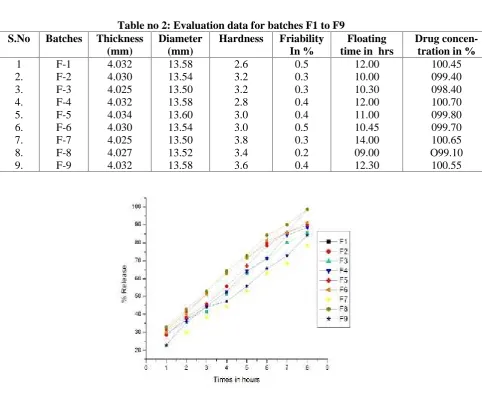
Table no 2: Evaluation data for batches F1 to F9 S.No Batches Thickness
(mm)
Diameter (mm)
Hardness Friability In %
Floating time in hrs
Drug concen-tration in % 1
2. 3. 4. 5. 6. 7. 8. 9.
F-1 F-2 F-3 F-4 F-5 F-6 F-7 F-8 F-9
4.032 4.030 4.025 4.032 4.034 4.030 4.025 4.027 4.032
13.58 13.54 13.50 13.58 13.60 13.54 13.50 13.52 13.58
2.6 3.2 3.2 2.8 3.0 3.0 3.8 3.4 3.6
0.5 0.3 0.3 0.4 0.4 0.5 0.3 0.2 0.4
12.00 10.00 10.30 12.00 11.00 10.45 14.00 09.00 12.30
100.45 099.40 098.40 100.70 099.80 099.70 100.65 O99.10 100.55
Fig no 1: In vitro drug release of batches F1 to F9
It was observed that there were no changes in these main peaks in IR spectra of mixture of drug and pol-ymers, which show there were no physical interac-tions because of some bond formation between drug and polymers. The peaks obtained in thespectra’s
of each formulation correlates with the peaks of drug spectrum. This indicates that the drug was compatible with the formulation components. The formulated floating tablets were evaluated in terms of different parameters like thickness, diameter, hardness, friability, floating lag time, buoyancy, drug content and in vitro drug release, the results of
evaluation parameters were tabulated in the table no 2.
In vitro Drug Release:
5 had better controlled release than the other formu-lation.
CONCLUSION:
The floating time range from 8hours to 14hours and the swelling index of different formulation ranged for thickness from 12.74% to 55.03% and for diam-eter 1.78% to 16. %. Formulation 1 showed a re-lease of about 22% at the first hour and almost com-plete release at end of 8 hour. Formulation 2&3 showed a release of about 31% at the first hour and almost complete release at end of 8hour. Formula-tion 4 showed a release of about 28% at the first hour and almost complete release at end of 8hours. Formulation 5 showed a release of about 40%at the first hour and almost complete at only around 80% release end of 8hours. Formulation 6&7 showed a release of about 22% at the end of first hour and only around 80% release at the end of 7hours and formulation 8&9 showed a release of about 32% at the end of the first hour and only around 90% at the end of 7 hours. From the 9 different formulations we find that the formulation contain combination of Peanut Husk powder, HPMC and Carbopal (i.e F5) were better sustained release when compared the other formulations.
REFERENCE:
1.
Somwanshi BS and Dolas TR. Floating multiparticulate oral sustained release drug delivery system. Journal of Chemical and Pharmaceutical Research. 2011;3(1):547-536.2.
Sharma M, A Review on Floating Multi-particulate System for Gastric Retention. American Journal of Pharmatech Research. 2012;2(6):149-126.3.
Dhole AR, A Review on Floating Multipar-ticulate Drug Delivery System: A Novel Approach to Gastric Retention. Interna-tional Journal of Pharmaceutical Sciences Review and Research. 2011; 6(2):211-205.4.
Chikhalikar, Floating Drug Delivery Sys-tem: An Approach to Oral Controlled Drug Delivery. International Journal of Pharm Tech Research. 2012; 4(4):1826-1812.5.
Patel N Ara, Formulation andcharacteriza-tion of floating tablets of diltiazem hydro-chloride, jpbms, 2011, 9 (21).
6.
Gandhi B and Baheti J. Multiparticulates Drug Delivery Systems: A Review. Inter-national Journal of Pharmaceutical and Chemical Sciences. 2013;2(3):1626-1620.7.
Sirisha VR and Sri VK. A Review ofPel-lets and Pelletization Process: A Multipar-ticulate Drug Delivery System. Interna-tional Journal of Pharmaceutical Sciences and Research. 2013;4(6): 2158-2150.
8.
Ravi kumar, M. B. Patil., “Formulation andevaluation of effervescent floating tablet of
Famotidine”, Int. J. Pharm., 2009 vol.1, no.3, pp 754-763 ,
9.
Kondivanitha,“Formulation and in-vitro evaluation of floating tablets of hydralazine hydrochloride”,Int. J. Pharm., 2012, pp 51-58.10.
N Arunkumar, “Formulation and in vitro evaluation of oral floating tablets of atorvastatin calcium”,Int. J. Pharm., 2008, 492-495.11.
C.P. Jain1,”Formulation and evaluation of fast dissolving tablets of valsartan”,Int. J. Pharm., 2009., 219-22612.
K.Kannan, Development and evaluation of valsartan film coated tablets”, J. Pharm.Sci. & res. Vol.4 (6), 2012, 1866–1871.
13.
Chandra sekhararao. Formulation andeval-uation of floating matrix tablets of ramipril using peanut husk powder, ijpd, 3(2), 2013, 72-79.
14.
Chandra Sekhara Rao G, Formulation and evaluation of floating matrix tablets of ram-ipril using peanut husk powder, Interna-tional Journal of Pharmaceutical Develop-ment & Technology, 2013; 3(2): 72-79.15.
Radke RS, et al. Design and evaluation ofgastroretentive floating tablets of captopril. IJPBS, V1(2), 2010, 1-10.
16.
Streubel A, Siepmann J, Bodmeier R. Floating matrix tablets based on low den-sity foam powder: effects of formulation and processing parameters on drug release. European Journal of Pharmaceutical Sci-ences, 18, 2003, 37-45.17.
Jeetendra Singh N, Development of non-ef-fervescent floating matrix tablets based on Euryale ferox seeds. Asian Journal of Pharmaceutics, 2011, 93-9.All © 2010 are reserved by Journal of Global Trends in Pharmaceutical Sciences. How to cite this article: