ISSN: 2278 7496
VALIDATED ANALYTICAL METHOD DEVELOPMENT FOR THE
DETERMINATION OF MELOXICAM BY UV SPECTROSCOPY IN API AND
PHARMACEUTICAL DOSAGE FORM
Meenu Chaudhary*, Kiran Bhardwaj, Govinda Verma, Praveen Kumar
Division of Pharmaceutical Sciences, Shri Guru Ram Rai Institute of Technology & Sciences, Dehradun, Uttarakhand, India - 248001.
*Corresponding Author’s E mail: [email protected]
Received 24. Feb. 2018; Revised 03 Mar. 2018; Accepted 20 Mar. 2018, Available online 15 Apr. 2018
ABSTRACT
A simple, precise and specific spectroscopy method for quantitative estimation of Meloxicam in API and in pharmaceutical dosage form was developed and validated. Meloxicam showed maximum absorbance at 365 nm by using ethanol as a solvent. The linear calibration curve obeys Beer-Lambert’s law in the concentration range of (2-18µg/ml) with regression equation of curve was y=0.050x-0.005 and the correlation coefficient was found to be (R2=0.997). Validation of this method was done and applied to the estimation of Meloxicam in pharmaceutical dosage form, no interference was found in the absorbance of the drug in the presence of the common excipients and analysis conditions.
Keywords: UV Spectroscopy, Calibration curve method, Analytical Method, Validation, Meloxicam
INTRODUCTION
Meloxicam is a nonsteroidal anti-inflammatory drug (NSAID) a selective cyclooxygenase-2 (COX-2)
inhibitor, belonging to the class of an oxicam derivative. Meloxicam is chemically designated as
4-hydroxy-2-methyl-N-(5-methyl-1,3-thiazol-2-yl)-2H-1,2-benzothiazine-3-carboxamide-1, 1-dioxide).
Its empirical formula is C14H13N3O4S2. The molecular weight is 351.4 g/mol. 1 Chemical structure of
Meloxicam showed in figure1.
Figure1. Chemical structure of Meloxicam
Meloxicam is widely used in the treatment of rheumatoid arthritis, spondylitis, osteoarthritis, joint
disease, in addition to its analgesic and antipyretic effect. It is also considered as a potential drug for the
prevention and treatment of colorectal polyps and/or cancer and also it is approved for the use in
animals.2, 3
Literature survey revealed; Spectrophotometric, 4, 5 spectrophotometric and fluroimetry,6 capillary zone
electrophoresis,7 voltametry,8 calorimetric and FTIR, 9 liquid chromatography, 10 HPLC,11-17 LC/MS, 18-
20 flow-injection analysis, 21 NIR 22 and FTIR and UV-Vis 23 are reported for estimation of Meloxicam in
pure and pharmaceutical dosage forms.
MATERIALS AND METHODS:
Materials:
Chemical and reagents:
Meloxicam was used as a standard. Ethanol as solvent 24, 25, all other chemical reagents and apparatus
were of analytical grade.
Instrumentation and UV spectroscopy condition:
Agilent Carry 60 UV-Vis. Spectroscopy and 1 cm Quartz cells with a fixed slit width (2nm); the
measurement properties wavelength range (200-800) nm, scan speed: 100nm/min, medium sampling
interval: 2.0, scan mode: single, measuring mode: absorbance, digital electric balance.
Methods:
Standard solutions preparation:
Standard solution of Meloxicam was prepared by dissolving 50 mg of Meloxicam with ethanol in 50 ml
volumetric flask, then diluting with ethanol up to the mark. Pipette out 5ml of stock solution and
transfer into a 50 ml volumetric flask to dilute with ethanol 50 ml up to the mark.
Determination of Absorbance spectrum of Meloxicam:
Transfer 1 ml of standard solution into ethanol in 10 ml volumetric flask and dilute up to the mark. The
resulted 10 µg/ml solution was measured at range (200- 400nm) using ethanol as blank, show the
absorbance spectrum and λmax at 365nm.
Preparation of Calibration curve:
From the sample solution, 100µg/ml resulting solution was prepared. From this 100 µg/ml solution
(0.2-2.0 ml) was transferred to 10ml volumetric flasks and dilute with ethanol up to the mark. The method
was determined at different concentration levels ranging (2-20µg/ml) for Meloxicam, the calibration
Tablet 1: Standard solutions of Meloxicam (Concentration and Absorbance) S. No. Concentration (µg/ml) Absorbance at 365nm
1 2 0.1124
2 4 0.1809
3 6 0.2892
4 8 0.3823
5 10 0.5203
6 12 0.5905
7 14 0.6986
8 16 0.7903
9 18 0.9043
Figure 2: Calibration curve of Meloxicam
RESULT AND DISCUSSION 26- 28
Linearity and Range:
The appropriate volume of the aliquot from the meloxicam standard stock solution was transferred to the
volumetric flask of the 10 mL capacity. The volume was adjusted to the mark with ethanol. A calibration
curve was plotted over a concentration range (2-18 µg/ml) of meloxicam. The absorbance of each
solution was measured at 365 nm. The regression analysis was performed for line equation was found to
be y=0.050x – 0.005 and correlation coefficient (R2=0.997), the calibration curve was found to be linear
in the above-stated concentration (Table 1) (Fig. 2).
y = 0.050x - 0.005 R² = 0.997
0 0.2 0.4 0.6 0.8 1
0 5 10 15 20
A
b
so
rb
a
n
ce
a
t
3
6
5
n
m
Concentration (µg/ml)
Calibration Curve of Meloxicam
Precision:
Repeatability
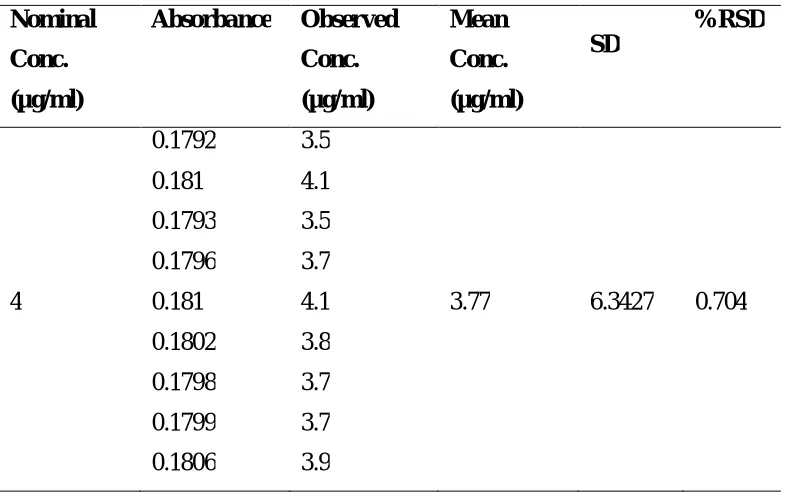
Aliquot stock solutions to further diluted with ethanol to get the solution of same concentration (4µg/ml).
Resultant solutions were measured at 365nm using ethanol as blank (Table 2).
Table No. 2. Repeatability of Meloxicam
Nominal Conc. (µg/ml)
Absorbance Observed Conc. (µg/ml)
Mean Conc. (µg/ml)
%RSD SD
0.1792 3.5
0.181 4.1
0.1793 3.5
0.1796 3.7
4 0.181 4.1 3.77 6.3427 0.704
0.1802 3.8
0.1798 3.7
0.1799 3.7
0.1806 3.9
Intra-day Precision
It is evaluated by assaying sample solution prepared for assay determination 3 times on the same day
Aliquot standard solution in volumetric flasks to further diluted with ethanol Resultant solutions were
measured at 365nm using ethanol as blank (Table 3).
Table No. 3. Intra-day Precision of Meloxicam
Nominal
Conc. (µg/ml)
Absorbance Observed Conc. (µg/ml)
Mean Conc. (µg/ml)
SD %RS D 0hr 3hr 6hr 0hr 3hr 6hr
4 0.1789 0.1776 0.1741 3.38 3.36 3.29 3.34 1.49 0.44
8 0.383 0.3824 0.3819 8.18 8.05 7.98 8.06 1.49 0.19
12 0.5906 0.5905 0.5897 12.05 12.01 11.57 11.87 2.95 0.25
Inter-day Precision
It is evaluated by assaying 3 times of sample solution prepared for assay determination on 3 different
days. The aliquot standard solution in volumetric flasks to further diluted with ethanol. Resultant
solutions were measured at 365nm using ethanol as blank, 3 times on the same day (Table 4).
Table No. 4. Inter-day Precision of Meloxicam
Nominal Conc. (µg/ml)
Absorbance Observed Conc. (µg/ml)
Mean Conc. (µg/ml)
SD %RSD
0hr 24hr 48hr 0hr 24hr 48hr
4 0.1798 0.1792 0.1789 3.8 3.75 3.63 3.72 1.49 0.4
8 0.3825 0.3819 0.3814 8 7.9 7.7 7.86 5.97 0.76
12 0.591 0.5902 0.5998 12 12 11.9 11.96 13.49 1.13
Mean 0.76
Accuracy:
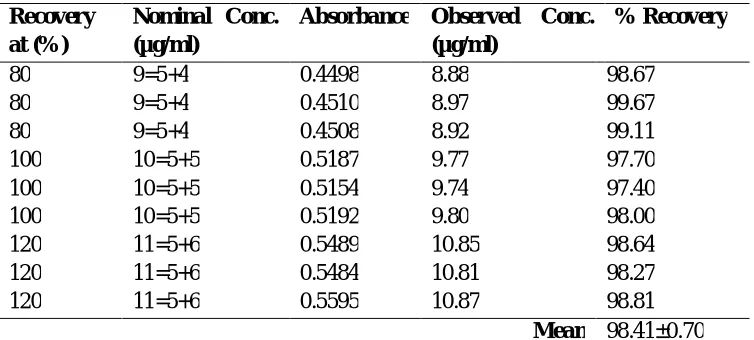
The accuracy of the method was determined in terms of % recovery of standard, with no detectable
impurities at an appropriate concentration. It was performed at three levels 80%, 100% and 120% by
standard addition method.
Aliquots of stock solution were further diluted with ethanol and each concentration analyzed 3 times and
average recoveries were measured at 365 nm using ethanol as blank (Table 5).
Table No. 5. Accuracy of Meloxicam
Recovery at (%)
Nominal Conc. (µg/ml)
Absorbance Observed Conc. (µg/ml)
% Recovery
80 9=5+4 0.4498 8.88 98.67 80 9=5+4 0.4510 8.97 99.67 80 9=5+4 0.4508 8.92 99.11 100 10=5+5 0.5187 9.77 97.70 100 10=5+5 0.5154 9.74 97.40 100 10=5+5 0.5192 9.80 98.00 120 11=5+6 0.5489 10.85 98.64 120 11=5+6 0.5484 10.81 98.27 120 11=5+6 0.5595 10.87 98.81
Specificity:
The specificity of the method for determination of meloxicam in tablet dosage form was determined by
comparing the spectrum of tablet solution with that of standard solution. Aliquots of stock solution were
further diluted with ethanol to get the solution of 10µg/ml concentration with and without excipients.
The resultant solutions were measured at 365nm using ethanol as blank (table 6).
Table No. 6: Specificity of Meloxicam
Nominal Conc.(µg/ ml)
Without Excipients With Excipients %Interferen ce
Absorb ance
Observed Conc.(µg/ml)
Absorb ance
Observed Conc.(µg/ml)
10 0.4874 9.76 0.4964 9.94 1.84
10 0.4824 9.66 0.4864 9.74 0.82
10 0.4934 9.88 0.5023 10.06 1.82
10 0.4944 9.90 0.5003 10.02 1.21
10 0.4894 9.80 0.4944 9.90 1.02
10 0.4854 9.72 0.4939 9.89 1.74
Mean 1.28
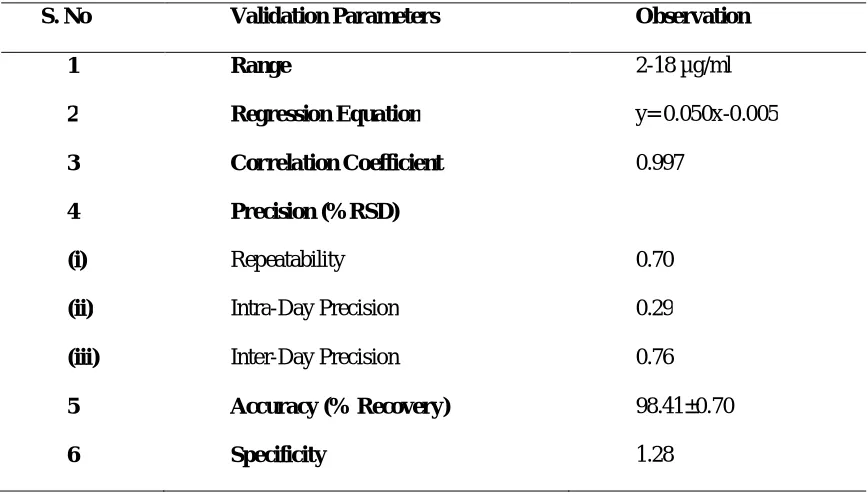
Table No. 7. Validation parameters of Meloxicam
S. No Validation Parameters Observation
1 Range 2-18 µg/ml
2 Regression Equation y= 0.050x-0.005
3 Correlation Coefficient 0.997
4 Precision (%RSD)
(i) Repeatability 0.70
(ii) Intra-Day Precision 0.29
(iii) Inter-Day Precision 0.76
5 Accuracy (% Recovery) 98.41±0.70
Determination of Meloxicam in API form:
Transfer 5mg of the drug to the volumetric flask of 50 mL capacity. The volume was adjusted to the
mark with ethanol. Aliquot the solution was further diluted with ethanol to get the solution of 10µg/ml.
The absorbance of the resultant solution was measured at 365nm using ethanol as blank. Each
concentration analyzed 3 times 29 (Table 8).
Table No. 8. Determination in API
S. No.
Absorbance Conc. (µg/ml) Dil. Factor Content (mg) Weight Taken (mg) %Assay
1 0.4874 9.76 5000 48.80 50.00 97.60
2 0.4914 9.84 5000 49.20 50.00 98.40
3 0.4839 9.69 5000 48.45 50.00 96.90
Mean±SD 97.63±0.75
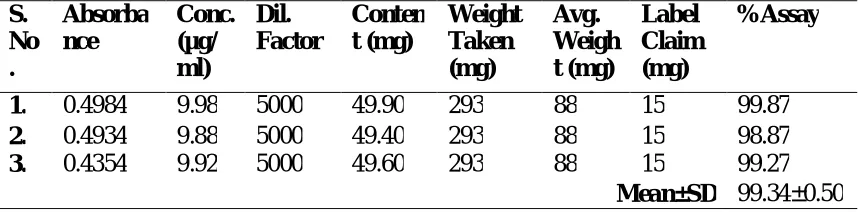
Determination of Meloxicam in Pharmaceutical dosage form (ECWIN, 15mg):
Weigh 20 tablets and calculates the average weight. Powder those tablets. Weigh accurately the quantity
of powdered tablet containing about 50 mg of Meloxicam and transfer into 50 ml volumetric flask. Add
35 ml ethanol and sonication for 15 minutes. Make up the volume up to 50 ml, mix, and filter. Dilute 5
ml of the filtrate to 50 ml of ethanol. Further, dilute 1 ml of the resulting solution to 10 ml of ethanol.
Measure the absorbance of the resulting solution at 365 nm (Table 9) 26-29.
Table No. 9. Determination of pharmaceutical dosage form
S. No . Absorba nce Conc. (µg/ ml) Dil. Factor Conten t (mg) Weight Taken (mg) Avg. Weigh t (mg) Label Claim (mg) %Assay
1. 0.4984 9.98 5000 49.90 293 88 15 99.87
2. 0.4934 9.88 5000 49.40 293 88 15 98.87
3. 0.4354 9.92 5000 49.60 293 88 15 99.27
Mean±SD 99.34±0.50
CONCLUSION:
A simple and sensitive spectroscopy method for quantitative determination of Meloxicam in API form
was developed. Meloxicam showed maximum absorbance at 365 nm in ethanol solution. It has a linear
response in the entire range of (2-18µg/ml) with the correlation coefficient of 0.997. The linear regression
accuracy as 98.41±0.70. No significant interference was observed in the absorbance of the drug in
presence of common excipients.
Quantitative determination of Meloxicam in API as well as tablet dosage form by employed the method,
the assay values found were 97.63±0.75 and 99.34±0.50 respectively.
In conclusion, the developed spectroscopy method is simple, accurate and precise and can be used for
routine analysis of Meloxicam in either API or in tablet dosage form.
REFERENCES:
1. http://www.tandfonline.com/doi/abs/10.1517/14656566.3.10.1501 Fleishmann R., Iqbal I.,
Slobodin GM. J Expert Opinion on Pharmacotherapy. 2005; 3(10):1501-1512.
2. http://europepmc.org/abstract/med/9105543 Turck D, Busch U, Heinzel G and Narjes H. Clinical
pharmacokinetics of Meloxicam. J Arzneimittel- Forchung. 1997; 47(3):253-258.
3. Barner A. Review of clinical trials and benefit/risk ratio of Meloxicam. Scandinavian J of
Rheumatology. 1996; 25(102):29-37.
4. Garcia MS, Sanchez- Pedreno C., Albero MI and Marti J. Spectrophotometric methods for
determining Meloxicam in pharmaceuticals using batch and flow-injection procedures. European J
of Pharmaceutical Sciences. 2000; 9(3):311-316.
5. Jafar M and Ali S. Development and evaluation of Meloxicam solid dispersion loaded buccal
patches. J of Applied Pharmaceutical Sciences. 2011; 01(03):77-82.
6. Hassan EM. Spectrophotometric and fluorimetric methods for the determination of Meloxicam in
dosage form. J of Pharmaceutical and Biomedical Analysis. 2002; 27(5):771-777.
7. Nemutlu E and Kir S. Method development and validation for the analysis of Meloxicam in tablets
by CZE. J of Pharmaceutical and Biomedical Analysis. 2003; 34(5):739-748.
8. Radi A., El Ries MA, El-Anwar F and El-Sherif Z. Electrochemical oxidation of Meloxicam and
its determination in tablet dosage form. J Analytical Letters. 2003; 34(5):739-748. doi:
10.1081/AL-100103216.
9. Isaa AA, Marchidan D, Cojocaru V and Anuta V. Preparation and evaluation of Meloxicam solid
dispersion by melting method. J Farmacia.. 2013; 61(6):1216-1232.
10.Velpandian T, Jaiswal J, Bhardwaj RK and Gupta SK. Development and validation of a new
high-performance liquid chromatographic estimation method of Meloxicam in biological samples. J of
11.Kulkarni V, Patil BS, Hariprasnna RC, Borgaonkar PA, Hogada MG and Rabbani G. Formulation
and development of fast dissolving Meloxicam tablets by solid dispersion technique for the
effective treatment of dental pain. International Journal of Current Pharmaceutical Research. 2010;
2(3):82-85.
12.Zawilla NH, Mohammad MA and Aly SE. Determination of meloxicam in bulk and pharmaceutical
formulations. Journal of pharmaceutical and biomedical analysis. 2003; 32(6):1135-1144.
13.Ahmad S., Deepika S., Amol P, Kapil W and Usman MR. Novel RP-HPLC method development
and validation of Meloxicam suppository. Indian Journal of Pharmaceutical Education and
Research. 2017; 51(4):644-649.
14.Banerjee R, Chakraboty H and Sarkar M. Photophysical studies of oxicam group of NSAIDs:
piroxicam, meloxicam, and tenoxicam. J Spectrochimica Acta. 2003; 59(6):1213-1222.
15.Elbary AA, Foda N and Elkhateeb M. Reversed-phase liquid chromatographic determination of
meloxicam in human plasma and its pharmacokinetic application. J Analytical Letters 2001;
34(7):1175-1187.
16.Sahoo NK, Sahu M., Rao PS, Rani NS, Devi JI and Ghosh G. Validation of assay indicating method
development of meloxicam in bulk and some of its tablet dosage forms by RP-HPLC. J
SpringerPlus. 2014; 3(1):95. doi: 10.1186/2193-1801-3-95.
17.Bae JW., Kim MJ, Jang CG and Lee SK. Determination of meloxicam in human plasma using an
HPLC method with UV detection and its application to a pharmacokinetic study. J of
Chromatography. 2007; 859(1):69-73
18.Ji HY, Lee HW, Kim YH, Jeong DW and Lee HS. Simultaneous determination of piroxicam,
meloxicam and tenoxicam in human plasma by liquid chromatography with tandem mass
spectroscopy. J of Chromatography. 2005; 826:214-219.
19.Siddareddy K, Reddy MA, Suresh B and Sreeramulu J. Development and validation of analytical
method for simultaneous estimation of Bupivacaine and Meloxicam in human plasma using
UPLC-MS/MS. J Pharmaceutical Methods. 2018; 9(1):2-8. doi:10.5530/phm.2018.1.2
20.Yuan Y, Chen X and Zhong D. Determination of meloxicam in human plasma by liquid
chromatography-tandem mass spectroscopy following transdermal administration. J of
Chromatography. 2007; 852:650-654.
21.Al–Momani IF. Indirect flow-injection spectrophotometric determination of meloxicam, tenoxicam
22.Antonoaea P, Sylvester B., Tomuta I, Ciurba A, Redai E, Todoran NI. Et al. Direct quantification
of meloxicam from transdermal therapeutic systems by NIR spectroscopy. J Farmacia. 2017;
65(2):230-236.
23.Marinescu G., Culita DC, Patron L, Stanica N, Nita S, Musuc AM et al. Synthesis, characterization,
and evaluation of the antimicrobial and cytotoxic activity of two novel complexes of Gd(III) with
piroxicam and meloxicam. J Revue Roumaine de Chimie. 2016; 61(10):779-786.
24.Inamdar N., Bhise K., Memon S. Solubility enhancement and development of dispersible tablet of
meloxicam. Asian J of Pharmaceutics. 2014; 2(2):128-132.
25.Delgado DR, Holgun AR, Almanza OA. Martinez F, Marcus Y. Solubility and preferential
solvation of meloxicam in ethanol+water mixtures. J Fluid Phase Equilibria. 2011; 305:88-95.
26.International Conference on Harmonisation of Technical Requirements for Registration of
Pharmaceuticals for Human Use (2005) Harmonised Tripartite Guideline on Validation of
Analytical Procedures: Text and Methodology Q2(R1).
27.Joseph-Charles J and Bertucat M. Determination of meloxicam in tablet formulations by ultraviolet
spectrophotometry and high-performance liquid chromatography. J Analytical Letters. 2008;
32(10):2051-2059. doi:10.1080/00032719908542951
28.Mahmood KT, Khan B., Ashraf M. Haq IU. Specific and simple HPLC assay of Eco-friendly
meloxicam in pharmaceutical formulations. J of Pharmaceutical Sciences and Research. 2010;
2(12):878-883.
29.Nemutlu E and Kir S. Validated determination of meloxicam in tablets by using UV