Available Online at www.ijpret.com 171
INTERNATIONAL JOURNAL OF PURE AND
APPLIED RESEARCH IN ENGINEERING AND
TECHNOLOGY
A PATH FOR HORIZING YOUR INNOVATIVE WORK
LI - FI (LIGHT FIDILITY) –TECHNOLOGY
AMOL JANGIDStudent CSE, PRMIT&R, Amravati
Accepted Date: 05/03/2015; Published Date: 01/05/2015
\
Abstract: Whether you’re using wireless internet in a coffee shop, stealing it from the guy next door, or competing for bandwidth at a conference, you have probably gotten frustrated at the slow speeds you face when more than one device is tapped into the network. As more and more people and their many devices access wireless internet, clogged airwaves are going to make it. One germen phycist. Harald Haas has come up with a solution he calls “data through illumination” –taking the fibber out of fiber optic by sending data through an LED light bulb that varies in intensity faster than the human eye can follow. It’s the same idea band behind infrared remote controls but far more powerful. Haas says his invention, which he calls DLIGHT, can produce data rates faster than 10 megabits per second, which is speedier than your average broadband connection. He envisions a future where data for laptops, smart phones, and tablets is transmitted through the light in a room. And security would be snap – if you can’t see the light, you can’t access the data.
Keywords: LED (Light emitted diode), Wi-Fi, VLC
Corresponding Author: MR. AMOL JANGID
Access Online On:
www.ijpret.com
How to Cite This Article:
Amol Jangid, IJPRET, 2015; Volume 3 (9): 171-176
Available Online at www.ijpret.com 172 INTRODUCTION
Li - Fi is transmission of data through illumination by taking the fiber out of fiber optics by sending data through a LED light bulb that varies in intensity faster than the human eye can follow. Li-Fi is the term some have used to label the fast and cheap wireless-communication system, which is the optical version of Wi-Fi. The term was first used in this context by Harald Haas in his TED Global talk on Visible Light Communication. “At the heart of this technology is a new generation of high brightness light-emitting diodes”, says Harald Haas from the University of Edinburgh, UK,” Very simply, if the LED is on, you transmit a digital 1, if it’s off you transmit a 0,”Haas says, “They can be switched on and off very quickly, which gives nice opportunities for transmitted data.” It is possible to encode data in the light by varying the rate at which the LEDs flicker on and off to give different strings of 1s and 0s.The LED intensity is modulated so rapidly that human eye cannot notice, so the output appears constant. More sophisticated techniques could dramatically increase VLC data rate. Terms at the University of Oxford and the University of Edingburgh are focusing on parallel data transmission using array of LEDs, where each LED transmits a different data stream. Other groups are using mixtures of red, green and blue LEDs to alter the light frequency encoding a different data channel. Li-Fi, as it has been dubbed, has already achieved blisteringly high speed in the lab. Researchers at the Heinrich Hertz Institute in Berlin, Germany, have reached data rates of over 500 megabytes per second using a standard white-light LED. The technology was demonstrated at the 2012 Consumer Electronics Show in Las Vegas using a pair of Casio smart phones to exchange data using light of varying intensity given off from their screens, detectable at a distance of up to ten meters.
WORKING TECHNOLOGY:
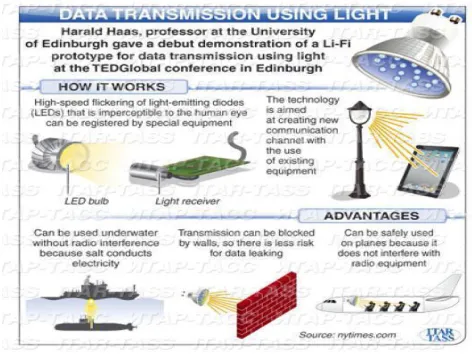
Available Online at www.ijpret.com 173 that code data into those LEDs. We have to just vary the rate at which the LED’s flicker depending upon the data we want to encode. Further enhancements can be made in this method, like using an array of LEDs for parallel data transmission, or using mixtures of red, green and blue LEDs to alter the light’s frequency with each frequency encoding a different data channel. Such advancements promise a theoretical speed of 10 Gbps – meaning you can download a full high-definition film in just 30 seconds. Simply awesome! But blazingly fast data rates and depleting bandwidths worldwide are not the only reasons that give this technology an upper hand. Since Li-Fi uses just the light, it can be used safely in aircrafts and hospitals that are prone to interference from radio waves. This can even work underwater where Wi-Fi fails completely, thereby throwing open endless opportunities for military operations. Imagine only needing to hover under a street lamp to get public internet access, or downloading a movie from the lamp on your desk.
COMPARISION BETWEEN LI-FI & WI-
FI:
Li-Fi is a term of one used to describe visible light communication technology applied to high speed wireless communication. It acquired this name due to the similarity to Wi-Fi, only using light instead of radio. Wi - Fi is great for general wireless coverage within buildings, and Li - Fi is ideal for high density wireless data coverage in confined area and for relieving radio interference issues, so the two technologies can be considered complimentary.
Technology Speed Data density
Wireless (current) Wi-Fi – IEEE 802.11n
150 Mbps *
Bluetooth 3 Mbps *
IrDA 4 Mbps ***
Wireless (future)
Available Online at www.ijpret.com 174
Giga-IR 1 Gbps ***
Li-Fi >1Gbps ****
Table 1.Comparison between current and future wireless Technology
How it is different:
Li - Fi technology is based on LEDs for the transfer of data. The transfer of the data can be with the help of all kinds of light, no matter the part of the spectrum that they belong. That is, the light can belong to the invisible, ultraviolet or the visible part of the spectrum. Also, the speed of the internet is incredibly high and you can download movies, games, music etc in just a few minutes with the help of this technology. Also, the technology removes limitations that have been put on the user by the Wi - Fi. You no more need to be in a region that is Wi - Fi enabled to have access to the internet. You can simply stand under any form of light and surf the internet as the connection is made in case of any light presence. There cannot be anything better than this technology.
Fig: Working and advantages
APPLICATION OF LI-FI:
You Might Just Live Longer:
Available Online at www.ijpret.com 175 fixtures in the room. And, as Haas mentions in his TED Talk, Li-Fi has 10,000 times the spectrum of Wi - Fi, so maybe we can, I don’t, delegate red light to priority medical data. Code Red!
Airlines:
Airline Wi - Fi. Ugh. Nothing says captive audience like having to pay for the "service" of dial-up speed Wi-Fi on the plane. And don’t get me started on the pricing. The best I’ve heard so far is that passengers will "soon" be offered a "high-speed like" connection on some airlines. United is planning on speeds as high as 9.8 Mbps per plane. Uh, I have twice that capacity in my living room. And at the same price as checking a bag, I expect it. Li - Fi could easily introduce that sort of speed to each seat's reading light. I’ll be the guy wowing next to you. Its better than listening to you tell me about your wildly successful son, ma’am.
USES IN VARIOUS AREAS:
Can be used in the places where it is difficult to lay the optical fiber like hospitals. In operation theatre Li - Fi can be used for modern medical instruments. In traffic signals Li - Fi can be used which will communicate with the LED lights of the cars and accident numbers can be decreased. Thousand and millions of street lamps can be transferred to Li - Fi lamps to transfer data. In aircraft Li - Fi can be used for data transmission.
It can be used in petroleum or chemical plants where other transmission or frequencies could be hazardous.
CONCLUSION:
Available Online at www.ijpret.com 176 REFERENCES:
1. seminarprojects.com/s/seminar report-on-Li - Fi
2. http://en.wikipedia.org/wiki/Li-Fi
3. http://teleinfobd.blogspot.in/2012/01/what-is-lifi.html
4. technopits.blogspot.comtechnology.cgap.org/2012/01/ 11/a-lifi-world/