Available Online At www.ijpret.com
INTERNATIONAL JOURNAL OF PURE AND
APPLIED RESEARCH IN ENGINEERING AND
TECHNOLOGY
A PATH FOR HORIZING YOUR INNOVATIVE WORK
AUTHENTICATION USING PASSWORD-ONLY AND KEY EXCHANGE FOR MULTI
SERVER ENVIRONMENT
SHABANA T PIRJADE, PROF. P. K. DESHMUKH, SEEMA SHABADI
Rajarshi Shahu College of Engineering, Tathawade.
Accepted Date:
27/02/2013
Publish Date:
01/04/2013
Keywords
Password authentication,
Guessing attacks,
Multi-Server
Environment.
Corresponding Author
Mrs. Shabana T Pirjade
Abstract
Available Online At www.ijpret.com
I. INTRODUCTION
With the rapid growth of Internet
technologies, the system providing
resources to be accessed over the network
often consists of many different servers
around the world. The distribution of the
remote system hardware in different places
makes the user access the resources more
efficiently and conveniently. In practice, the
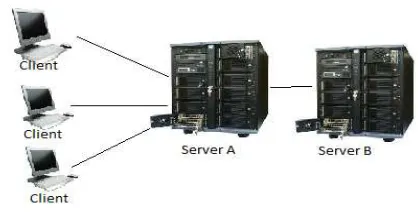
Multi-server model is as shown in Figure1
.Password based authentication is the most
commonly used entity authentication
technique, due to the fact that no secure
storage is required, and a user only needs
to memorize his password and then can
authenticate anywhere, anytime. Protocols
designed and proven secure for the case
when clients use cryptographic secrets are
generally insecure when passwords are
used instead; this is so because these
protocols are typically not resistant to
off-line dictionary attacks in which an
eavesdropping adversary derives
information about the password from
observed transcripts of login sessions. The
dictionary attacks can occur online or
off-line: in an on-line attack, the attacker
repeatedly picks a password from the
dictionary and login with it to the server by
impersonating a legitimate user.
Specifically, the two-server model
comprises a front-end server, called Service
Server (SA), and a back-end server, called
Control Server (SB).
Figure 1. Multi-Server Model
The SA is the actual one providing certain
services to users, and it is thus the one
users communicate with; the SB stays
behind the scene, and its sole responsibility
is to help secret-share user passwords so as
to avoid single point of failure, as well as to
assist the SA for user authentication; users
do not contact the SB during
authentication, and they are even not
necessarily aware of the existence of the
SB. Key agreement protocols (for two
parties) are a fundamental building block
Available Online At www.ijpret.com between two parties over an insecure
network. Generally, key agreement
protocols allow two communicating parties
who never met in advance to establish a
common secret key via public
communication. The agreed secret key,
which is usually called a session key, can
then be used to create a confidential or
integrity-protected communication channel
between the parties. We are motivated to
propose a new scheme that enables a user
to use the same password over multiple
service servers in the Multi-server model.
Our scheme is password-only, and efficient,
achieving slightly better efficiency than the
latest two-server password based
authentication scheme in [12], which is the
most round efficient of its kind in the
literature. The rest of the paper is organized
as follows. Section 2 presents related works
Our new scheme is presented in Section 3,
In Section 4 Security analysis of our protocol
is done and Section 5 concludes this work
II. BACKGROUND AND RELATED WORKS
In recent years, much attention has focused
on designing password based authenticated
key exchange protocols which can resist
offline dictionary attack by an intruder. To
solve this problem, a new kind of
authentication structure called the multiple
server authentications was proposed. In
such schemes, the capability of verifying a
password is split between two or more
servers, thus securing the system from
intruders. In these multiple server
authentication system, the two-server
authentication protocol is the simplest and
the most acceptable to users. Some of the
authentication systems based on two server
concept are discussed below. Mukesh et
al.’s [4] proposed a robust finger print
based two-server authentication and key
exchange system; this is the first biometric
two server authentication scheme. In this
scheme, the user’s password is replaced by
the random string generated by fingerprint
template; the user need not memorize it. In
Brainard et al.’s [2] two-server password
system in which one server (called Blue
Server or Service Server, SS for short)
exposes itself to users and the other (called
Red Server or Control Server, CS for short) is
hidden from the public. While this
two-server setting is very interesting, it is not a
Available Online At www.ijpret.com
have public keys to protect the
communication channel from users to
servers. This setting makes it difficult to
fully enjoy the benefits of a password
system. Subsequently, Katz et al. Proposed
a two-server password-only authenticated
key exchange, the authors claimed that this
is the first provably-secure two-server
protocol for the important password-only
setting (in which the user need remember
only a password, and not the server’s public
keys), and is the first two-server protocol (
in any setting) with a proof of security in the
standard model.
Figure 2. Authentication and Key Exchange
Protocol
Recently, a practical two server architecture
was proposed by Yang et al. and an efficient
password-only two-server authenticated
key exchange system, this scheme is a
password-only variant of the one
introduced by Brainard et al.’s. None of the
existing two-server password based
authentication schemes enables a user to
use the same password over multiple
service servers, which is deemed an
important feature of the two-server model.
Yanjiang Yang proposed a new scheme,
enabling this prominent functionality.
III. THE PROPOSED PROTOCOL
The proposed protocol is divided into three
phases: the system initialization, the client
registration and the authenticated key
exchange phases. We describe each phase
as follows:
A. Initialization Phase
Let G be a multiplicative group with order q,
where q is a big prime. Let H0(.):{0,1}*→G,
and H1(.),H2(.),H3(.):{0,1}*→{0,1}s be
cryptographic hash functions, where s is a
system parameter.
B. Registration Phase
Each Client needs to register in advance his
password to every service server he wants
to communicate with, as well as the control
server SB. To register to a particular service
server SA and SB, a Client C (supposing his
Available Online At www.ijpret.com password shares P1;P2 such that P = p1 +p2
(mod q). C then registers P1 to SA and P2 to
SB through some out-of-band channels.
Note that SB needs to associate P2 not only
with C, but also with that particular SA,
since we allow C to register with different
service servers using the same password P.
C. Authenticated Key Exchange Phase
Suppose a Client C has password P, and the
corresponding shares at a service server SA
and the control server SB are P1 and P2,
respectively.
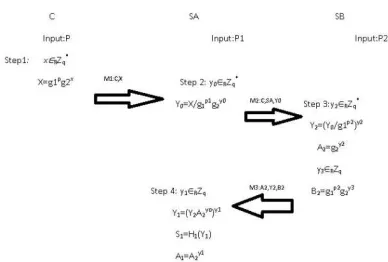
The authentication and key exchange
protocol is depicted in Figure 2, which ends
up allowing C and SA to authenticate each
other and establish a common session key
K. Note that in the protocol, g1; g2 are
generated in real time by each party as
follows. C generates g1 = H0(C; SA; 1), g2 =
H0(C; SB; 2) using his own identity and that
of the service server he wants to
communicate with; following the same
format, SA generates g1 and g2 with its
identity and that of the Requesting user; SB
generates g1 and g2 using the identity of
the requesting SA and the user. Intuitively,
the protocol can be viewed to be composed
of two parts: one part are the messages
associated with X; Y0;A2; Y2;A1; S1 and S2,
which enable C and SA for mutual
authentication and key exchange; the other
part are the messages associated with
B2;B1;B0;A0 and S3, which enable SB to
authenticate C and SA. There are seven
steps for authentication and key exchange
Step 1. The Client C randomly chooses an integer x from Zq*, Compute X=g1pg2x and
then send a request message
M1={C, X} to SA
Step 2. On receiving M1, the Server SA
randomly chooses an integer y0 from Zq*
and computes Y0=X/g1p1g2y0 and then send a
message M2={C, SA, Y0} to the SB
Step 3. After receiving M2 the server SB
randomly chooses y2 from Zq* and
Computes Y2=(Y0/g1p2)y2
A2=g2y2
And then chooses y3 from Zq* and
computes B2=g1p2g2y3 and then send a
message
Available Online At www.ijpret.com
Step 4.After receiving M3 SA chooses randomly an integer y1 from Zq* and
computes
Y1=(Y2A2y0)y1
S1=H1(Y1)
A1=A2y1 and then chooses y4 from Zq* and
computes B1=B2g1p1g2y4 and then send a
message
M4={A1,S1,B1} to Client C.
Step 5.After receiving message M4 Client
checks whether S1 H1(A1x)
S2=H1(A1x,0)
K=H2(A1x,C,SS)
and then randomly select x* from Zq* and
computes B0=(B1/g1p)x*
A0=g2x*
and send message M5={S2,B0,A0} to SS.
Step 6.On receiving M5 from Client,SA checks whether S2 H1(Y1,0)
and computes K=H2(Y1,C,SS)
S3=H3 (B0/A0y4) and send message
M6={A0,S3} to CS
Step 7.After receiving M6 from SA, SB checks
S3 H3(A0y3) and SB authenticates SA and C.
IV. SECURITY ANALYSIS
A. Brute force attacks
In case of any Brute force attacks, it may be
either Dictionary attack or exhaustive
search, this method works. For example
consider a scenario, if an intruder wants to
crack the password, then he is going to try
all the possibilities starting from integer ‘1’.
Here the valid password is “1234567” and
the random number is” 3”. All the single
and two digit tries are easily rejected by the
system since the random number is 3. The
front-end server is compromised after he
entered 123.But the backend server is not
compromised still and his next try will be
‘124’. But in this case the front end server is
decompromised and the user is
blocked.Because, once the front end server
is compromised,again it should not be
decompromised. In this case we can easily
identify the intruder due to the rollback of
front end server from compromised to
Available Online At www.ijpret.com server system is effective against exhaustive
search or brute force attacks.
B. Strengthening Condition
Once the front end server is compromised
in first attempt, the backend should be
compromised within five attempts.
Probably only the legitimate user can
compromise the server in first attempt.
Incase due to some careless, he may enter
the wrong password for backend server.
However the five attempts are too much for
that legitimate user. The next condition is
once the front end server is compromised it
should not be decompromised
again. So from the above mentioned
strengthening conditions it is clear that the
proposed system has good security against
hacking
V. CONCLUSION
In this paper, we present an efficient and
secure authentication scheme for
multi-server environment. We demonstrate that
our scheme can satisfy all of the essential
requirements. Our scheme does not only
manage the secret key associated with the
users but also achieve user's anonymity.
Moreover, our scheme only uses hashing
functions to implement mutual verification
and session key agreement. our protocol is
secure against passive and active attacks in
case that one of the two servers is
compromised.
VI. REFERENCES
1. M. Bellare, D. Pointcheval, and P.
Rogaway. Authenticated key exchange
secure against dictionary attacks.In B.
Preneel,editor, EUROCRYPT 2000, pages
139–155. Springer-Verlag LNCS 1807, 2000.
2. B. Kaliski and M. Szydlo J. Brainard, A.
Juels.Nightingale: “A new two-server
approach for authentication with short
secrets”, in Proceedings of the 12th USENIX
Workshop on Security, pages 1-2. IEEE
Computer Society, 2003.
3. C. Boyd and A. Mathuria. Protocols for
Authentication and Key Establishment.
Springer-Verlag, Berlin, 2003.
4. ]Mukesh, R.Damodaram, A.Subbiah
Bharathi,V. “A robust fingerprint based two
server authentication and key exchange
system”, 3rd International Conference on
Available Online At www.ijpret.com
Middleware And Workshops, 2008
Bangalore, pp. 167-174.
5. D. Boneh and M. Franklin. Identity-based
encryption from the Weil pairing. In J.
Kilian, editor, CRYPTO 2001, pages 213–229.
Springer-Verlag LNCS 2139, 2001.
6. S.D. Galbraith. Super singular curves in
cryptography. In C. Boyd, editor, ASIACRYPT
2001, pages 495–513. Springer-Verlag LNCS
2248, 2001.
7. Yang, Y., Bao, F and Deng, R. H (2005) A
new architecture for authentication and key
exchange using password for federated
enterprise. Proc. SEC’05, pp. 95-111.
8. Yang, Y., Deng, R. H and Bao, F. (2006) A
practical password based two-server
authentication and key exchange system.
IEEE Trans. Dependable and Secure
Computing, 3(2), 105-114.
9. Yang, Y., Deng, R. H. and Bao, F. (2006)
Fortifying password authentication in
integrated healthcare delivery systems.
Proc. ASIACCS’06, pp. 255-265.[10] Yi, X.,
Tso, R. and Okamoto, E. (2009) ID-based
group password authenticated key
exchange. Proc. IWSEC’09, pp. 192-211.
10. S. Halevi, H. Krawczyk: Public-key
Cryptography and Password Protocols. In:
Proc. ACM. Computer and Communication
Security, CCS’98, pp. 122-131, 1998.
11. H. Jin, D. Wong, Y. Xu: An Efficient
Password-Only Two-Server Authenticated
Key Exchange System. In: Proc.
International Conference on Information
and Communications Security, ICICS’07,