Cloud Computing Technologies; Principals
and Fundamentals
Khaled Elbehiery1, Hussam Elbehiery2
1
Visiting Professor, 2Associate Professor
1
Computer Information Systems Department, DeVry University, USA
2
Computer Networks Department, Ahram Canadian University (ACU), Egypt
Abstract
Today’s business demands have far exceeded the
companies’ owned resources, status quo is no longer a valid, luckily with the virtualization and Cloud technology evolution might be the solution. This survey paper leverage understanding the computer and networking evolution that can help determine the next step to take, running the enterprise applications On-Premise or as a service in the Public Cloud can accelerate the business agility, complying with the latest security measures can enhance productivity, and lastly addressing every aspects of Cloud architecture can help reducing the Capital expenditures (CAPEX) and improve the Operation expenditures (OPEX).
Keywords - Virtualization, Cloud Service Providers (CSP), Hybrid Cloud, GovCloud, CAPEX and OPEX.
I. HISTORICALBACKGROUND
The first modern mainframe, the IBM 360, was launched in April 1964. It could perform 229,000 calculations per second; an innovation that helped put man on the moon. In the mid-1980s new technologies started gaining power and threatening the mainframe’s existence. Mid-range systems and enterprise networking evolved into PCs and servers that could be connected together and act as one and by 1990s, PCs reached the level to access the larger back-end systems [1], [2], [23].
A Data Center centralizes the organization’s IT operations and equipment. It houses computer systems and associated components such as telecommunications and storage systems. Also it provides few levels of redundancy with respect to power and location. Data Centers have evolved from physical to virtual infrastructures [2].
The way organizations utilized servers was very much a 1:1 relationship with an average 15% CPU utilization. A decade later, most IT Organizations have virtualized 70-90% of their server environments. A single physical server can handle any number of virtual workloads and CPU utilization can reach 80% or greater.
The demand for scalability these days has begun to be expressed in new words such as “hyperscale” which refers to the ability to scale and grow systems quickly, from a few servers to thousands [10].
The cloud computing revolution is the latest disruptive technology predicted to kill off the mainframe. More and more businesses are shifting their work to cloud-based infrastructures that offer increased collaboration and access to data practically anywhere [5], [9].
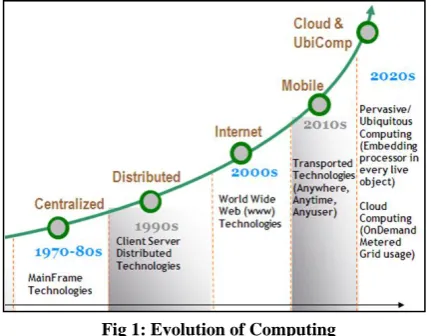
Worth to mention that today more than 10,000 mainframes still run hundreds of thousands of enterprise apps for business, finance, and administrative systems and that’s unlikely to change any time soon because the mainframe is predictable, reliable and scalable and this is the goal of the Cloud computing; the yet to be the replacement of the mainframes [4], [20]. Fig. 1 shows the evolution of the computing.
Fig 1: Evolution of Computing
II. COMPUTERCLOUDEVOLUTION
Virtualization is a term that is commonly used in conjunction with the term Cloud Computing, but the terms are not synonymous. Virtualization has offered the companies the chance to enhance their return on investment (ROI) from computing hardware while decreasing associated costs such as Data Center power, cooling, and support costs [2], [3], [5].
Virtualization not only reduces the amount of money a business spends on hardware but also greatly improves recovery and increase productivity by reducing the amount of Labor an actual Data Center technician will need to do. Instead of manually setting up all those servers you can also just have it automatically configured with the click of a button [6], [18].
expenditures (CAPEX) has increased dramatically and with more power and time needed to accommodate with fast demands, that led to start using the virtualization as a technology but with a new methodology that offer pools of virtual resources orchestrated by management and automation software to quickly adapt to the demands, and there where the word “Cloud” has born. Cloud resources used as a tenant and are not anymore dedicated to certain user or application [6].
For a while, enterprises have operated their own Cloud infrastructure which is synonymous to “Private Cloud” or “On-Premise Cloud” but with the dynamic and growing technology, mind has shifted of outsourcing the workloads to a third-party company that is able to offer the resources immediately, scale out or scale in anytime, just pay for it is used, able to deploy not only within the same metropolitan area but across the country or the world, there when the “Public Cloud” has been brought to life and those third-party companies are called now Cloud Service Providers (CSP) or Cloud Providers (CP). The dominant CSPs that spread their services across the world as of year 2019 are AWS, Microsoft Azure, and GCP (Google Cloud Platform) [3], [23].
Companies and enterprises who had already invested in their Private Cloud infrastructure were very reluctant of course to move their workloads to the Public Cloud despite it reduces CAPEX over time not only because mainly the Total Cost of Ownership (TCO) nor Return of Investment (ROI) would payoff but also many of those companies held databases of customer sensitive information that they did not want to move them to Public Cloud or did not know how to split their workloads between their own virtualized infrastructure and the Public Cloud [16], [19].
Choices are not simple anymore; it is not about storing the data in Private or Public Cloud but there are different sets of data require a new solution. “Hybrid Cloud” has come to the table offering the best of both worlds, virtually connecting the On-Premise architecture to the Public Cloud combining the flexibility and scalability of resources from Public Cloud while using the existed IT infrastructure for critical privacy and security requirements. The Hybrid Cloud offers the solution to store confidential data internally and access it via the application running in the Public Cloud that is closer to the end-users as well which enables the organization to save CAPEX when demand is low [7], [8], [13].
Multi Cloud is newest solution that can benefit organization with different locations and divisions across the country or the world but it would be impossible to tie to one Public Cloud Provider. Basically, Multi Cloud is a strategic utilization of multiple services from multiple Public Cloud Provider with single pain of glass. Workloads can be distributed among one or more providers within the same servicing area or geographically to whichever
Cloud provider availability to offer at the end the best performance and efficiency [28].
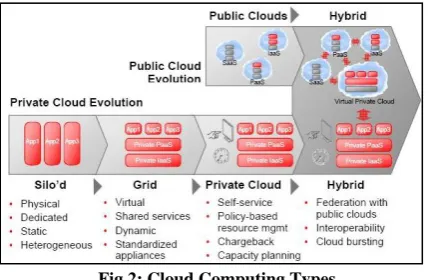
In summary, Public and Hybrid Cloud solutions offer flexible and fast response to immediate operations’ challenges. According to Infoholic Research, the market is expected to grow at a CAGR of 34.3% during the period 2016–2022 to touch an aggregate of $241.13 billion by 2022 [7], [8], [17]. Various types of Cloud Computing are shown in Fig. 2.
Fig 2: Cloud Computing Types
III.CLOUDCOMPUTINGINFRASTRUCTURE
We are going to discuss the evolution of the physical infrastructure technologies available to build the Cloud infrastructure regardless it is Private On-Premise or Public. The need to understand and evaluate the difference between traditional, Converged, and Hyperconverged technologies will assist the Cloud infrastructure architects and designers with the appropriate solution to deploy [5], [9].
Traditional Data Center consists of separate servers, networking, and storage components with systems from different manufacturers but they all comply with the industry’s standards. It is a very well working model but a considerable amount of time is spent by customers on designing and testing compatibility between these devices to ensure reliable operations such as FlexPod developed by Cisco and NetApp [24].
With converged architecture, one or more manufacturers define a validated design which is pre-tested to operate reliably. This reduces the time to build a system and some manufacturers even pre-build the entire system at the factory before shipping it out. Converged systems also tend to come with advanced management tools to further simplify the operations and automate the set-up procedures which make it far faster to roll out new applications and there is the added benefit of a collaborative approach between the manufacturers when it comes to support [29].
component which in turn reduce the hardware costs and complexity. Hyper-converged infrastructure scales out by nature meaning if you want to grow the system you can simply add one or more boxes or nodes to the system [10].
Hyperconvergence is certainly the fast-growing phenomenon and this is being fueled by its low hardware costs, simplicity, and flexibility but it does have some limitations. You cannot grow storage capacity without investing in compute too which you may not need. Performance will be restricted by the network connectivity of all the system nodes, the more you add the greater the inefficiencies. It's relatively cheap hardware but the software to run the solution is not. Although with larger systems, traditional or converged solutions may be lower cost but the technology of hyperconvergence is taking the lead and consequently the prices are going even lower and performance is getting better in the next year or two [10].
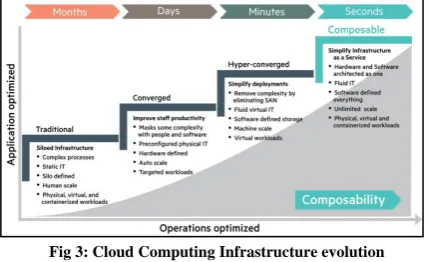
Hyperconvergence is being heavily promoted by vendors such as VMware, Nutanix, and SimpliVity as a new way of packaging Data Center infrastructure which is inherently low cost, simple to manage, and can scale from a small to very large seamlessly [2]. Fig. 3 shows the evolution of Cloud Computing Infrastructure [11].
Fig 3: Cloud Computing Infrastructure evolution
IV.CLOUDCOMPUTINGSECURITYAND GOVCLOUD
Security is voted number one concern of companies and organizations to adopt Pubic Cloud or even connect their On-Premise Private Cloud to the Public Cloud to form a Hybrid or Multi Cloud Model [7], [8]. There are major aspects of security when it comes to making the decision to Public Cloud:
A. Infrastructure
Public Cloud providers implemented what is called shared security agreement which means the provider guarantees the physical security but the customer implements their own security measurements regarding servers and network portion of the design from a stateless network access control list to a stateful firewall rules, or integrating certified third-party security components such as Symantec, Fortinet or else to replace or coexist with the provider security building blocks [13], [15].
B. Attack mitigation
Public Cloud providers are offering free of charge their advanced mechanisms to deal with major kinds of attacks such as DDoS (Distributed Denial of Service). They have their security experts to consult with and deal with other service interrupt behaviors [13].
C. Encryption
Public Cloud providers have spent a fortune to make sure the data can be encrypted “at Rest” which means when it is stored or/and when it is “in Transit” which means during data transfer from an end to another inside the cloud locally and globally across the world [31].
D. Monitoring
Public Cloud providers enable their customers to see and track any event through different level of communication such as emails, phone calls, or even allowing the providers to be proactively deal with any event in behalf of the customer according to a service level agreement.
E. Identity Control
Public Cloud providers are directly responsible for enforcing and managing user access policies for user accounts to automated centralized solutions such as LDAP or ACS, including hardware identity mechanisms such as multi factor authentication. Some of those providers even offer to conduct a penetration test of your Cloud design with support according to the latest security recommendations from experts [13].
There are many organizations have created security standards with respect to different aspects of our lives such as and not limited to, HIPPA to govern manipulation of medical records to assure privacy or FERPA for education, or FIPS for government security standards. Some of those standards are globally means to be followed or adhered to anywhere in the world and some belong to one country such as United States or a region in the world such as Europe or Asia pacific [13], [14].
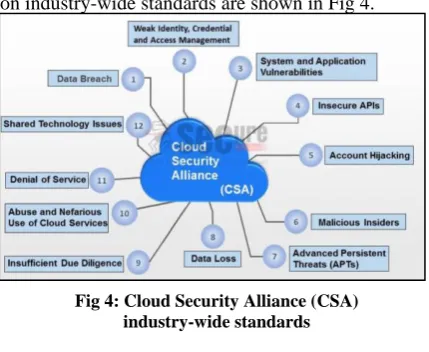
The key points from Cloud Security Alliance (CSA) on industry-wide standards are shown in Fig 4.
Fig 4: Cloud Security Alliance (CSA) industry-wide standards
V. ENTERPRISECLOUDCOMPUTING CAPEXANDOPEX
Basic simple definition of CAPEX is spending up front for acquiring, upgrading or maintaining resources or equipment. On the other hand, OPEX is an expense is seen as day to day operation cost [16], [19].
In terms of Cloud, the On-Premise Private Cloud usually is associated with paying for extra capacity and resources probably enough for a fraction of what is needed in addition to the ongoing expenses such as hardware, power, air conditioning, software licenses to keep the business running. Cloud computing and with all services come with it such as Infrastructure-as-a-Service (IaaS), Software-Infrastructure-as-a-Service (SaaS), Platform-as-a-Service (PaaS) or what is known these days as Everything-as-a-Service (EaaS), all just become exactly as a home utility (water, electricity, or gas) the household do not have to pay for building it upfront but pay as you go for what is needed and important enough, it is scalable, you need more, you get more and you pay for the more you used, no commitment, no up-front contract which makes it financially attractive selling point to the enterprises [9], [22].
Think about it as renting a car for few days when you are traveling somewhere, definitely, you pay high cost for those few days however by far it is way less expensive than buying a car for just those few days. In short, you completely eliminated the CAPEX totally on the cost of the OPEX.
It could seem that it is already a done deal, just move your workloads to the Public Cloud and you are all set. Not too fast, there is a price to pay which is the complexity of the hidden costs that usually get overlooked resulting in significant loss. Some of the hidden costs are the migration of the workloads from
the On-Premise to the Public Cloud,
underprovisioning resources on or in some case overprovisioning, and lastly, ignoring the Inbound and Outbound traffic cost from one location to another when the enterprise applications split among several geo-redundant locations [21], [26].
In short, moving to Public Cloud needs another set of brainstorms, team work, educated personnel familiarity with each aspects of the design, tracking changes, periodic inventory to reduce all those mentioned hidden cost before it is too late as shown in Fig 5 [27].
Fig 5: Public Cloud vs. On-Premise Solutions; The Pros and Cons
VI.CONCLUSION
Moving enterprise’s workloads to Public Cloud and manage your business as a SaaS service is a business model, splitting the workloads between On-Premise Private Cloud and Public is another way to keep the business going. Hyperconvergence, or Converged physical architecture to choose for the On-Premise infrastructure hardware. What should the company’s architects take into consideration regarding Public Cloud security measures. How much CAPEX will be after full or partial migration, and how about the occurring OPEX costs. All these are very important concerns and usually followed by executive decisions by management leadership that govern the enterprise future. Unfortunately, it is not a simple question to be answered with YES or NO; it is in fact a very complex manner [16], [19], [21].
The decision at the end should be based on solid foundation of your business stakeholders’ visions, educational level of architects and engineers, identify the issues and associated risks, and the evolving strategies of integration or migration and important to mention are the rules and regulations should the business be following [12], [25].
ACKNOWLEDGMENT
The authors would like to thank DeVry University, USA and Ahram Canadian University (ACU), Egypt for their support to introduce this research paper in a suitable view and as a useful material for researchers. The authors also would like to thank their colleagues who provided insight and expertise that greatly assisted the research.
REFERENCES
[1] Tom Bice (2018) “Back to the Future: Why the Cloud Won’t Replace the Mainframe,” WIRED.com homepage. [Online]. Available:
https://www.wired.com/insights/2014/04/back-future-cloud-wont-replace-mainframe/
[2] (2018) DesignSpark website. “The Evolution of Data Center models” [Online]. Available:
[3] Mike Troiano (2019) “The Evolution of Virtualization in the Data Center,” ACTIFIO Data Driven 2019 homepage. [Online]. Available:
https://www.actifio.com/company/blog/post/the- evolution-of-virtualization-in-the-data-center/#sthash.IPTICvZJ.vnMQclTL.dpbs
[4] Scott Andersen (2015) “The evolution of IoT–when does it experience the eventual explosive growth?,” DOCANDERSEN'S BLOG. [Online]. Available: https://docandersen.wordpress.com/2015/03/06/the- evolution-of-iotwhen-does-it-experience-the-eventual-explosive-growth/
[5] JAMESMBOND (2015) “The Evolution To Cloud Computing (How Did We Get Here?),” The Enterprise Cloud Blog - Best Practices for Transforming Legacy IT to the Cloud. [Online]. Available:
https://mycloudblog7.wordpress.com/2015/05/29/the-evolution-to-cloud-computing-how-did-we-get-here/ [6] (2019) Red Hat website. “Cloud Computing, What's the
difference between cloud and virtualization?” [Online]. Available:
https://www.redhat.com/en/topics/cloud-computing/cloud-vs-virtualization#
[7] (2019) Citrix website. “What is hybrid cloud?” [Online]. Available:
https://www.citrix.com/glossary/what-is-hybrid-cloud.html
[8] (2016) Infoholic Research LLP website. “Worldwide Hybrid Cloud Computing Market to grow at a CAGR of 34.3% during the period 2016–2022 to aggregate $241.13 billion by 2022” [Online]. Available:
https://www.infoholicresearch.com/press- release/worldwide-hybrid-cloud-computing-market-to- grow-at-a-cagr-of-34-3-during-the-period-2016-2022-to-aggregate-241-13-billion-by-2022
[9] Louis Columbus (2010) “Oracle’s Cloud Computing Vision Meets Reality at OpenWorld – Part I,” Software Strategies Research Blog. [Online]. Available:
[Online]. Available:
https://softwarestrategiesblog.com/2010/09/19/oracle%E 2%80%99s-cloud-computing-vision-meets-reality-at-openworld-%E2%80%93-part-i/
[10] (2016) 2decipher Blog website. “Exploring hyper-converged without the hype,” [Online]. Available: http://itsalesblog.2decipher.com/
[11] Amanda Best (2017) “HPE Synergy and the Buzz About Composable Systems,” Insight global website. [Online]. Available:
https://www.insight.com/en_US/learn/content/2017/041 82017-hpe-synergy-and-the-buzz-about-composable-systems.html#
[12] (2019) Amazon Web Services, Inc. website. “AWS Compliance Programs,” [Online]. Available:
https://aws.amazon.com/compliance/programs/ [13] (2019) Amazon Web Services, Inc. website. “AWS
Cloud Security,” [Online]. Available: https://aws.amazon.com/security/
[14] (2019) Amazon Web Services, Inc. website. “AWS GovCloud (US) & Support FAQs,” [Online]. Available: https://aws.amazon.com/govcloud-us/faqs/
[15] (2016) SecureReading website. “Is My Data Safe in the Clouds? Cloud Computing and Related Security Challenges,” [Online]. Available:
https://securereading.com/is-my-data-safe-in-the-clouds/ [16] (2009) Thinking Out Cloud Blog website. “Stop Saying CapEx Vs. OpEx in Cloud and SaaS Models,” [Online]. Available:
https://gevaperry.typepad.com/main/2009/01/accounting -for-clouds-stop-saying-capex-vs-opex.html
[17] (2019) Cloud Technology Partners CTP (Hewlett Packard Enterprise company) website. “Cloud Economics – Are You Getting the Bigger Picture?” [Online]. Available:
https://www.cloudtp.com/doppler/cloud-economics-getting-bigger-picture/
[18] Bernard Golden (2012) “VIRTUALIZATION AND CLOUD ADVISOR; How to break down the OpEx vs. CapEx cloud computing debate” CIO FROM IDG (IDG Communications, Inc.) website. [Online]. Available: https://www.cio.com/article/2399248/it-organization- how-to-break-down-the-opex-vs-capex-cloud-computing-debate.html
[19] Nemanja Kostic (2018) “CapEx Vs OpEx: Cloud Computing,” Merit Solutions Blog website. [Online]. Available:
https://meritsolutions.com/CAPEX-vs-OPEX-cloud-computing-blog/
[20] (2019) Verity Solutions website. “Go cloud. You won't look back; Move faster, scale bigger, and reap the benefits of cloud computing” [Online]. Available: http://goveritysolutions.com/benefits-of-cloud-computing/
[21] Lee Atchison (2018) “Preparing to Adopt the Cloud: A 10-Step Cloud Migration Checklist,” New Relic, Inc. Blog website. [Online]. Available:
https://blog.newrelic.com/engineering/cloud-migration-checklist/
[22] Rob van der Meulen (2018) “5 Questions to Answer When Building a Cloud Strategy” Gartner, Inc. website. [Online]. Available:
https://www.gartner.com/smarterwithgartner/5-questions-to-answer-when-building-a-cloud-strategy/ [23] (2019) IBM Inc. website. “Cloud computing: A
complete guide; Explore cloud computing and discover what it can bring to your enterprise” [Online]. Available: https://www.ibm.com/cloud/learn/cloud-computing [24] Nisarg Mehta (2018) “Top 7 Technologies Predictions
That Will Dominate 2018” Techtic Solutions Inc. Blog website. [Online]. Available:
https://www.techtic.com/blog/technologies-to-dominate-2018
[25] (2016) Amazon Web Services, Inc. Blog website. “A Practical Guide to Cloud Migration,” [Online]. Available:
https://aws.amazon.com/blogs/publicsector/a-practical-guide-to-cloud-migration/
[26] Tom Nikl (2018) “Choosing your cloud app migration order” Google Cloud Blog website. [Online]. Available: https://cloud.google.com/blog/products/storage-data-transfer/choosing-your-cloud-app-migration-order [27] (2019) Insight global company website. “Develop the
right cloud strategy,” Count on Cloud + Data Center Transformation's proven expertise. [Online]. Available:
https://go.datalink.com/Cloud-Strategy.html?matchtype=b&network=g&device=c&adp osition=1o1&lp=adwordsppc&gclid=CjwKCAiAqaTjB RAdEiwAOdx9xp2KHpHEknF87CVpWlnU8oix0ULM Cafsn16l7xGbIAjkpPOb8s3pbRoCHzAQAvD_BwE [28] Nishu Rana and Pardeep Kumar, “Random Walk based
ACO Load Balancing Algorithm for Cloud Computing Environment,” International Journal of P2P Network Trends and Technology (IJPTT), vol. 8, Issue 6, pp. 8– 15, Nov to Dec 2018.
[29] Neha Thakkar and Rajender Nath, “Discrete Artificial Bee Colony Algorithm for Load Balancing in Cloud Computing Environment,” International Journal of P2P Network Trends and Technology (IJPTT), vol. 8, Issue 6, pp. 1–7, Nov to Dec 2018.
[30] K RupaRani and K. Jagdeeshwara Rao, “An Improved Novel Design for user Authentication and Secure Transmission of Data in End to End Routing in Wireless Sensor Network,” International Journal of P2P Network Trends and Technology (IJPTT), vol. 8, Issue 2, pp. 8– 13, March to April 2018.