S Y S T E M A T I C R E V I E W P R O T O C O L
Open Access
Are soil microbial endpoints changed by Bt crops
compared with conventional crops? A systematic
review protocol
Kaloyan Kostov
1, Paul Henning Krogh
2, Christian Frølund Damgaard
2, Jeremy B Sweet
3and Niels Bohse Hendriksen
4*Abstract
Background:Btcrops have raised environmental concerns over consequences for sustainability of soil biodiversity and ecosystems services in agricultural land. AsBtcrops contain insecticidal proteins potential interactions with non-target organisms are of major concern for the risk assessment. In recent years, numerous field and laboratory studies have been conducted to assess the potential adverse effects of theBtcrops on different non- target organisms including microorganisms living in the soil. Soil microorganisms include primarily bacteria and fungi. They interact with plants and animals and play significant roles in nutrient cycling and energy flow in soils and are actively involved in chemical and biological processes. It is likely that any changes accruing in soil will affect soil microorganisms, and so their abundance/diversity and activities can be used as indicators for many aspects of soil quality, and thus for the assessment of the potential effectsBtcrops on the environment.
Methods:The key review question is: Are abundances/diversity/activities of soil microorganisms changed by Btcrops compared with conventional crops? For this purpose relevant literature will be collected systematically through a comprehensive search strategy in a number of general, specialized and personal databases. The search terms will define the locality or type of laboratory/glasshouse study–the field, soil, rhizosphere, the populations - types of soil microorganisms, the exposure - types ofBtproteins, the assessed outcome -abundances/diversity/activity of microorganisms and the crop, will be used for retrieving of relevant studies. We present the criteria against which studies will be included in the review and how they will be assessed. These criteria include appropriate study designs and comparators. This protocol outlines the type of analyses that will be performed to assess bias of the selected studies and if co-variables describing the heterogeneity of the studies introduces biases. The synthesis will be performed as a quantitative synthesis combining the magnitude of potential effects from the individual studies. The synthesis will include assessments of heterogeneity related to the studied abundances/ diversities/activities, types of exposure, methodology, comparators and publication bias.
Keywords:Soil microorganisms,Btcrops, Risk assessment, Cry toxins, Bacillus thuringiensis,δ-endotoxin, Soil processes
Background
The debate over genetically modified (GM) plants is con-tinuous in the European Union as a consequence of high public sensitivity and complexity of safety issues which they raise. Among the primary concerns are the effects on the environment associated with potential gene flow, weediness or invasiveness of GM plants and possible inter-actions with non-target organisms. Government regulators
in many parts of the world require an assessment of envir-onmental impacts prior to commercialization of GM crops. For that reason many studies analysing the interactions between GM plants and the environment have been carried out, which are of particular interest to professionals -risk assessors or regulators, as well as for many public and non-governmental organizations [1].
The following protocol describes the methodology for conducting a systematic review and evidence synthesis, which will be performed within the EU funded project GRACE (GMO Risk Assessment and Communication of Evidence). The project aims to explore the existing data
* Correspondence:[email protected] 4
Department of Environmental Science, Aarhus University, Frederiksborgvej 399, Roskilde DK-4000, Denmark
Full list of author information is available at the end of the article
about potential health, environmental, and socio-economic impacts of GM plants in a comprehensive, systematic and transparent manner. The primary goal of the pro-ject is to address issues of high public interest, therefore different stockholder groups were invited to take part in the formulation and prioritization of the questions to be reviewed and the review methodology as well. Through face-to-face consultation and online questionnaires sev-eral high priority questions about the environmental im-pact of GM plants were selected, among which is the one related to the interaction of GM crops producing toxins from the bacterium Bacillus thuringiensis (Bt) with non-target soil microorganisms.
The technology for genetic modification of plants provides a tool for crop breeding and has been applied for the development of varieties with novel or improved traits. Insect resistance has been achieved via introduction ofBt genes and is the second most distributed GM trait worldwide after the herbicide tolerance. The only GM plant which is cultivated commercially in the EU is maize designed to produce Bt toxin - Cry1Ab, which provides protection against corn borers (Lepidoptera). GM crops producing different types of Bttoxins against other pest insects or in combination with other GM traits are also in the industry pipeline [2,3]. Because Bt crops contain in-secticidal proteins potential interactions with non-target organisms are of major concern for the risk assessment [4]. In recent years, numerous field and laboratory studies have been conducted to assess the potential adverse effects of the Btcrops on different non-target organisms, including microorganisms living in the soil. Soil microor-ganisms include primarily bacteria and fungi. They inter-act with plants and animals, play significant roles in nutrient cycling and energy flow in soils and are actively involved in chemical and biological processes. It is likely that any changes accruing in soil will affect soil microor-ganisms, and so their abundance/diversity and activities can be used as indicators for many aspects of soil quality [5].
There are two possible ways that theBtcrop can influ-ence soil living organisms: firstly, directly through root depositions, as exudates, cells and mucilage and through litter that contains Cry toxin and/or through unintended changes in the plant due to the genetic modification; and secondly, indirectly through the changes in agri-cultural management practices related to the genetic modification, e.g. changed insecticide regimes. The major concern is related to soil microbial ecology and that any effects ofBtcrop cultivation on soil microorganisms may affect soil ecosystem functioning.
Systematic review and meta-analysis have been applied routinely for synthesis of data from medical studies asses-sing the risk or benefits of treatments or drugs. However the potential to use this methodology for quantitative
synthesis of data from impact assessment of GM plants has also been recognized [6]. Meta-analysis of field and laboratory studies assessing the effects ofBtcrops to non-target organisms have been performed already [7-11]. Most of them, however scrutinize exclusively non-target arthropods and their communities. Although compre-hensive literature reviews exists [12-16] a quantitative synthesis of evidence, with a quality control as required for an SR, of the effects ofBtcrops on soil microorgan-isms is still missing. It will produce firm evidence-based conclusions about impacts on biodiversity of soil living microorganisms and to impacts on the soil microbial ecol-ogy in general. The approach to the systematic review as detailed here is performed in compliance with guidelines of CEE [17].
Objective of the review
This systematic review aims to synthesise the empirical evidence on the potential effects ofBtcrops to soil micro-organisms and their activities.
The review question (RQ) asked by the present system-atic review protocol is:
Are soil microbial endpoints changed byBtcrops compared with conventional crops?
The question has the following components;
Subject populations
Soil microorganisms, including bacteria and fungi, and their associated activities.
Exposure
Genetically modified Bt crops and their concomitant farming practice through the soil environment and in the rhizosphere.
Comparator
The near-isogenic line and their concomitant farming prac-tice through the soil environment and in the rhizosphere.
Outcome
Changes in abundances/diversity and activities of the subject populations contrasted with the comparator.
Methods
The systematic review methodology describes the approach which will be used to find and analyse original articles containing data from field experiments or glasshouse assessing the effects of the Bt crop cultivation to soil microorganisms.
Search strategy
Btcrop cultivation to soil microorganisms. However glass-house studies and studies performed in micro- or meso-cosms with field collected soil will also be included. The main approach will be to conduct comprehensive electronic searches in web databases, search engines for scholarly literature and specialized databases. Additional source will be the personal data collected by experts and stakeholders from the project GRACE network. In addition, the reference lists of related review papers and datasets from previously conducted reviews will be checked manually for the presence of relevant studies.
Search terms
Search terms defining the locality or type of laboratory/ glasshouse study–the field, soil, rhizosphere , the popula-tions - types of soil microorganisms, the exposure - types of Btproteins, the assessed outcome -abundances/diver-sity/activity of microorganisms and the crop, will be used for retrieving of relevant studies. The search terms will be organised in strings which will be modified according to the requirements of each bibliographic database. The used search strings and the results will be documented and pre-sented as an Additional file 1 of the systematic review.
The following search terms will be used:
Locality term- soil* OR field* OR rhizo OR meso* OR micro* or glass* or lab*
Population terms- microorg* OR microb* OR bacteri* OR fung* OR minera*
Exposure terms- Cry1* OR Cry2* OR Cry3* OR thuringiensis OR Bt OR endotoxin
Outcome terms- population* OR biomass OR communit* OR diversity OR respirat* OR enzym* OR decomposition OR biogeochem* OR nitrogen OR immobili* OR coloni* OR abundance OR richness Plant terms- transgen* OR maize Or Corn OR Zea OR cotton OR rice OR soybean OR eggplant OR potato OR poplar
Scoping exercise
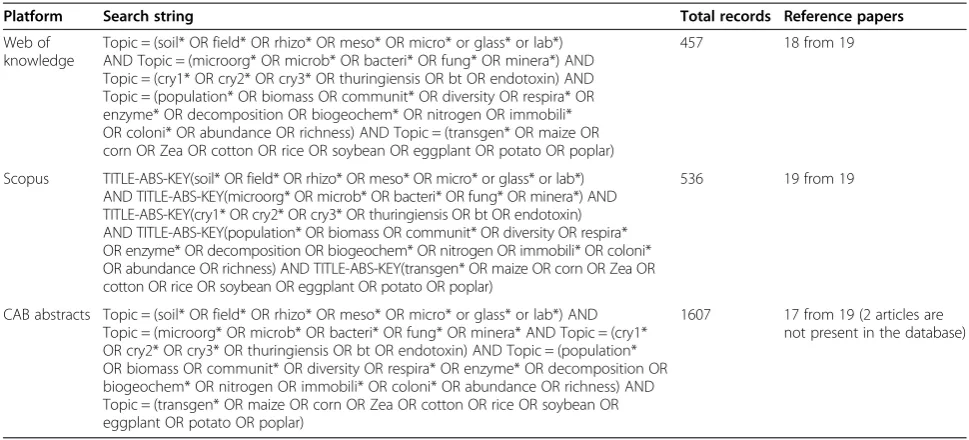
A search exercise to determine the scope and relevance of the search strings to be used in the systematic review was performed. Pilot searches were conducted using three platforms: Web of knowledge, Scopus and CAB abstracts. Prior to the pilot search, 19 studies which contained the necessary elements for inclusion in the sys-tematic review were identified by simplified and focused search strings in the Web of knowledge platform. They were used as references to evaluate the relevance of the results from the pilot search. The content of the pilot search strings was modified by including or excluding terms until all 19 articles (if present in the database) were found among the hits and in the same time have not resulted in excessive amount of irrelevant studies. The
search strings which produced comprehensive and the most relevant results in the three platforms are shown in Table 1.
Web databases
Web databases containing scientific literature including theses, books, abstracts and articles will be searched using the defined strings. The following search service providers and bibliographic databases will be used:
Web of knowledge - search service including the following citation databases and platforms: Web of Science® - platform which consist of nine
databases containing scholarly journals, books, book series, reports, conferences, and more.
BIOSIS Citation IndexSM - comprehensive reference database for life science research which includes cited references to primary journal literature. MEDLINE® - database of the U.S. National Library
of Medicine (NLM) contains over 12 million records of journal articles in all areas of the life sciences. CAB Direct - platform for access to all CABI
database subscriptions.
Scopus - large abstract and citation database of peer-reviewed literature.
AGRIS - Information system for the agricultural sciences and technology
All searches will be performed in English; however no restriction for language or year of publication will be made. In that way all studies which have published an abstract in English will be within the scope of our search. Original full text in either English or German will be included in the analysis. The search results from each of the used sources will be saved and citations will be imported in EndNote citation manager software. All duplicates will be removed and a list containing the
accumulated results will be created and uploaded to the open-access database CADIMA (Central Access Database for Impact Assessment of Crop Genetic Improvement Technologies).
Web search engines
The following search engines will be used: Google Scholar (http://scholar.google.bg/) Jstor (http://www.jstor.org/)
The same searching strings as described above will be used. The first 200 hits will be checked for relevance. The links will be followed once from the original hit.
Specialized databases
Database http://bibliosafety.icgeb.org/) Crop life. Database on Safety and Benefits of Biotechnology (http://biotech benefits.croplife.org/) Biosafety Clearinghouse. Biosafety Information Resource Centre (http://bch.cbd.int/database/ resources/) The same searching strings as described above will be used.
Personal datasets
Experts and stakeholders from the consultation network created within the GRACE project will be asked to provide data relevant to the topic. The complete list of articles received by personal communication and the source will be recorded and will be included in the appendix of the systematic review.
Manual search
Literature datasets or databases from other reviews related to effects ofBtcrops on soil microorganisms, as well as the reference lists of the articles found within the electronic search will be searched manually.
Article screening
Study inclusion criteria
In order to be included the article needs to fulfil each of the following criteria:
Relevant organisms or activities:Soil microorganisms, including bacteria, fungi and microorganisms at other taxonomic levels and their activities, including respiration, decomposition, biogeochemical cycling, enzymatic activities, mineralisation, immobilisation, nitrogen turnover, root colonization etc.
Relevant exposure(s):Exposure to genetically modifiedBtcrops and their associated farming practice through the soil environment and the rhizosphere.
Relevant comparator(s)(if appropriate): Ideally the near-isogenic line, however less related varieties will be accepted. In field experimental design allowing for any of the following comparisons will be accepted:
– Btwith non-Btplots, neither of which received any additional insecticide treatments.
– UnsprayedBtplots with non-Btplots that received insecticides.
– Btwith non-Btcrops when both are subject to insecticide treatments.
Relevant outcomes:Changes in organism abundance, diversity or activity.
Relevant study design:The studies must ideally be conducted under field conditions designed according to any block or plot randomization method,
however other designs might be accepted if the design is explained in details and makes statistical analysis valid. However, glasshouse studies and studies performed in micro- or mesocosms with field sampled soils will also be included, if they apply to the inclusion criteria.
Data:Quantitative data should be available. They include binary and categorical data.
Applying study inclusion criteria
The selection of studies which fulfil the inclusion criteria will be performed at three stages by two reviewers inde-pendently. At first, articles will be selected by their title Table 1 Pilot search results (searches conducted 29.04.2014)
Platform Search string Total records Reference papers
Web of knowledge
Topic = (soil* OR field* OR rhizo* OR meso* OR micro* or glass* or lab*) AND Topic = (microorg* OR microb* OR bacteri* OR fung* OR minera*) AND Topic = (cry1* OR cry2* OR cry3* OR thuringiensis OR bt OR endotoxin) AND Topic = (population* OR biomass OR communit* OR diversity OR respira* OR enzyme* OR decomposition OR biogeochem* OR nitrogen OR immobili* OR coloni* OR abundance OR richness) AND Topic = (transgen* OR maize OR corn OR Zea OR cotton OR rice OR soybean OR eggplant OR potato OR poplar)
457 18 from 19
Scopus TITLE-ABS-KEY(soil* OR field* OR rhizo* OR meso* OR micro* or glass* or lab*) AND TITLE-ABS-KEY(microorg* OR microb* OR bacteri* OR fung* OR minera*) AND TITLE-ABS-KEY(cry1* OR cry2* OR cry3* OR thuringiensis OR bt OR endotoxin) AND TITLE-ABS-KEY(population* OR biomass OR communit* OR diversity OR respira* OR enzyme* OR decomposition OR biogeochem* OR nitrogen OR immobili* OR coloni* OR abundance OR richness) AND TITLE-ABS-KEY(transgen* OR maize OR corn OR Zea OR cotton OR rice OR soybean OR eggplant OR potato OR poplar)
536 19 from 19
CAB abstracts Topic = (soil* OR field* OR rhizo* OR meso* OR micro* or glass* or lab*) AND Topic = (microorg* OR microb* OR bacteri* OR fung* OR minera* AND Topic = (cry1* OR cry2* OR cry3* OR thuringiensis OR bt OR endotoxin) AND Topic = (population* OR biomass OR communit* OR diversity OR respira* OR enzyme* OR decomposition OR biogeochem* OR nitrogen OR immobili* OR coloni* OR abundance OR richness) AND Topic = (transgen* OR maize OR corn OR Zea OR cotton OR rice OR soybean OR eggplant OR potato OR poplar)
to remove highly irrelevant studies from the overall search results, followed by the second stage in which the inclu-sion criteria will be applied against the abstracts of the articles. If there is doubt or lack of enough information for judgement of whether the article will pass to the next stage the full-text will be analysed to ensure it meets the inclusion criteria.
At the beginning of the abstract phase, after the first 100 publications are processed, tests for consistency be-tween two reviewers will be made using Kappa statistics. If the Kappa value is less than 0.6 the inconsistencies will be discussed and the criteria for inclusion will be adjusted taking into account the main reasons for disagreement.
In the third stage, the articles will be reviewed in full text for the presence of each of the elements needed for the inclusion. The reasons for including or excluding of each study at that stage will be recorded.
Study quality assessment
As specified above a study must have
An appropriate comparator (e.g. isogenic or near isogenic line)
experimental procedures which address the microbial abundance/diversity/activity without bias preferentially an experimental design involving
replication and randomisation
The lack of any significant outcome between the Bt -crop and the comparator does not exclude any study, and is not a selection criterion.
Studies which fulfil the inclusion criteria will be assessed for possible bias of one reviewer and a second reviewer and studies that have been excluded will be reassessed by a second reviewer and a conclusion will be reached. The aim of this phase is to ensure that the studies are providing evidence which represent true statistical similarity and level of difference. The internal (design, conduct, and analyses) and external (abun-dance/diversity/activity, interventions, and outcomes) validity will be assessed by applying the five quality domains mentioned below and defined as low, high or uncertain and the results will be reported separately for each domain.
The assessment will be performed using check lists by one reviewer as a random (20%) subsample of the studies will be performed by second reviewer and the results will be compared with Kappa statistics. The inconsistencies (Kappa value less than 0.6) will be discussed and a third reviewer will be asked to judge in case no agreement could be reached. Records with the evaluation results and the reasons for judgment will be made for each article included at this stage.
Selection bias
Pre-treatment differences between the studied groups and in the baseline characteristics of the study will be assessed in the selection bias domain. The following elements will be assessed:
– plot location- low risk if the experimental plots of both the intervention and the control treatment are located in one field or other experimental unit with known history. High risk if the experimental units are located at different fields and there is no nformation about the history of the field.
– comparator- low risk if the comparison isBtcrop vs corresponding isogenic line. High risk if for the control treatment another variety is used.
– randomisation- the randomisation is the best way to avoid selection bias thus studies which are designed by any block or plot randomization method will be considered as low risk. High risk studies will occur if there is no or poor randomization.
– replications- low risk if there is at least three replicates per treatment. High risk if there is no replication.
Performance bias
Performance bias arises if the studied groups are influ-enced by factors different from the intervention, which may have an effect on the measured outcomes. In the field studies, such influences might come from:
– plot size- low risk if the plot size is properly defined in relation to the actual measurements; high risk if plot size is very small.
– field management- low risk if both control and intervention received the same agro-technical management including tillage, fertilizers, pesticides, irrigation, cultivation etc. High risk if there are
differences in the management between the treatments.
Measurement bias
The way the measurement of the outcomes is done can influence the true effect estimation if the selected method is not accurate or can be influenced by the human subjectivity.
– sampling of soil microorganisms- the
experimental procedures are crucial when assessing the abundance/diversity and/or activity of
Attrition bias
Imbalance in the final set of selected studies will be assessed. In theory, an imbalance may occur if studies with the following properties are excluded:
– sampling size- low risk if the sample size is equal between the treatments. High risk if it differs due to loss of samples.
– missing data- low risk if the amount of data for the measured outcomes is equal for all the treatment. High risk if there is imbalance in the presented outcome data between the treatments.
Data extraction strategy
The aim of the data extraction stage is to retrieve infor-mation relevant to the design, performance and mea-sured outcomes, which are intended to be used for the quantitative/qualitative synthesis and the analysis of the variability between studies. Details about the experimen-tal sites and design will be extracted from the text in the sections describing the materials and methods of the study, as well as the description of other experimental procedures and statistical analysis. Numeric/binary/qua-litative data for the measured outcomes and will be ex-tracted from tables and figures in the result section of the study. The most direct original data are always selected; derived data are only selected if the datasets are restricted to these.
All data will be imported in standardised Excel tables. Each measurement of abundance/diversity/activity of the microorganisms as affected by the different treatment (e.g. Bt crop and comparator) will be included in the table as separate records containing all the defining variables. Data extraction will be performed by one review team member and checks will be performed by other review team members of a random 10% subset of the data. If necessary, discrepancies will be resolved by the involve-ment of a third reviewer.
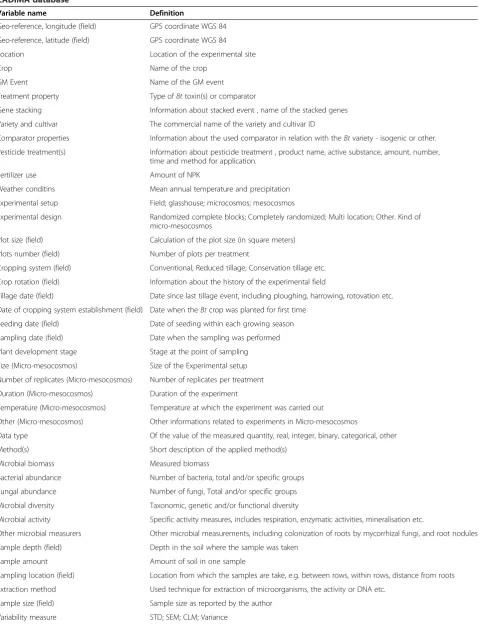
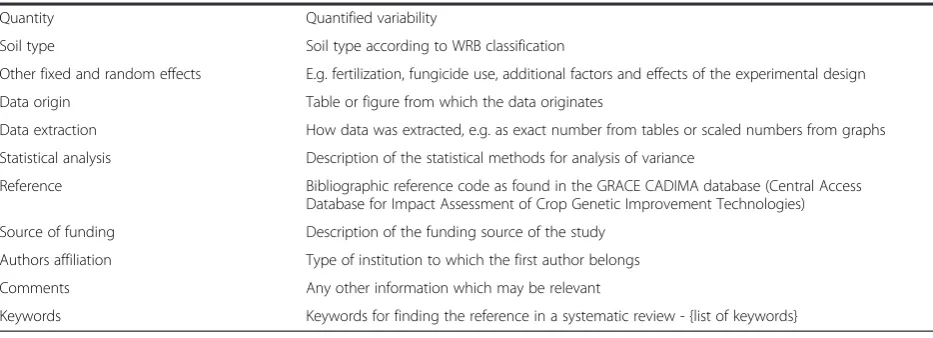
Data to be extracted from the papers is presented in Table 2.
Data analysis
The extracted data will be used to synthesize the evidence provided by the individual studies about the effects ofBt crop cultivation to soil microorganisms, as well as to in-vestigate the heterogeneity among the studies.
The data will include abundances as measured by different techniques and at different taxonomic levels, different measures for diversity and microbial activity as measured by different techniques. The included data will be quantitative, but will include categorical as well as binary data. Initially data of the same kind will analysed together, later data synthesis via meta-analysis will be per-formed. For this purpose data are likely to be transper-formed.
Assessment of statistical power of included studies All data that meet the above requirements will be used in the analysis, irrespective of the statistical power of the individual study.
Measures of treatment effect
Depending on the studied measurements the abundance/ diversity, activity can be measured per volume of soil (measured as volume or gram dry matter) or per plot. The reported values are usually the mean for the treatment and the calculation of the associated variance.
Dealing with missing data
If the measurements of either the treated plots or the control plots are missing then the study is not included in the analysis. In cases when for reporting the variance other values than standard deviation or standard error is used, e.g. t, F, p or z-values, an appropriate mathematical method will be used to calculate the pooled standard deviation, if appropriate. If this is not feasible, authors will be contacted to provide the missing data.
Synthesis
Quantitative synthesis
Quantitative synthesis will be performed to combine the magnitude of the effects from the individual studies. The analysis will include calculation of the pooled effect size for each study accompanied with the corresponding confidence intervals. The results from the analysis will be presented graphically in‘forest plots’, where the esti-mated effect size with the confidence interval of each individual study will be plotted horizontally as the com-bined effect size and confidence interval will be plotted below them.
The complete dataset will be stored in the GRACE CADIMA database for open access after the finalisation of the review. For mixed effects modelling SAS PROC MIXED, PROC GLIMMIX or R ver. 3 [18] will be used.
A range of effect modifiers will be extracted from the selected papers and stored in the database (Table 2). These effect modifiers include comparator properties, pesticide treatment, insect pressure, experimental design, cropping system, crop rotation, tillage date, date of GM experimental cropping system establishment and soil type.
Assessment of heterogeneity
Table 2 Information to be extracted from the papers qualifying for inclusion in the review and to be stored in the CADIMA database
Variable name Definition
Geo-reference, longitude (field) GPS coordinate WGS 84
Geo-reference, latitude (field) GPS coordinate WGS 84
Location Location of the experimental site
Crop Name of the crop
GM Event Name of the GM event
Treatment property Type ofBttoxin(s) or comparator
Gene stacking Information about stacked event , name of the stacked genes
Variety and cultivar The commercial name of the variety and cultivar ID
Comparator properties Information about the used comparator in relation with theBtvariety - isogenic or other.
Pesticide treatment(s) Information about pesticide treatment , product name, active substance, amount, number, time and method for application.
Fertilizer use Amount of NPK
Weather conditins Mean annual temperature and precipitation
Experimental setup Field; glasshouse; microcosmos; mesocosmos
Experimental design Randomized complete blocks; Completely randomized; Multi location; Other. Kind of micro-mesocosmos
Plot size (field) Calculation of the plot size (in square meters)
Plots number (field) Number of plots per treatment
Cropping system (field) Conventional; Reduced tillage; Conservation tillage etc.
Crop rotation (field) Information about the history of the experimental field
Tillage date (field) Date since last tillage event, including ploughing, harrowing, rotovation etc.
Date of cropping system establishment (field) Date when theBtcrop was planted for first time
Seeding date (field) Date of seeding within each growing season
Sampling date (field) Date when the sampling was performed
Plant development stage Stage at the point of sampling
Size (Micro-mesocosmos) Size of the Experimental setup
Number of replicates (Micro-mesocosmos) Number of replicates per treatment
Duration (Micro-mesocosmos) Duration of the experiment
Temperature (Micro-mesocosmos) Temperature at which the experiment was carried out
Other (Micro-mesocosmos) Other informations related to experiments in Micro-mesocosmos
Data type Of the value of the measured quantity, real, integer, binary, categorical, other
Method(s) Short description of the applied method(s)
Microbial biomass Measured biomass
Bacterial abundance Number of bacteria, total and/or specific groups
Fungal abundance Number of fungi, Total and/or specific groups
Microbial diversity Taxonomic, genetic and/or functional diversity
Microbial activity Specific activity measures, includes respiration, enzymatic activities, mineralisation etc.
Other microbial measurers Other microbial measurements, including colonization of roots by mycorrhizal fungi, and root nodules
Sample depth (field) Depth in the soil where the sample was taken
Sample amount Amount of soil in one sample
Sampling location (field) Location from which the samples are take, e.g. between rows, within rows, distance from roots
Extraction method Used technique for extraction of microorganisms, the activity or DNA etc.
Sample size (field) Sample size as reported by the author
Heterogeneity in studied abundances/diversities/ activities The examined measurements will vary among the individual studies. They will even differ in whether abundances, diversity or activity are measured and all kinds of combinations will exist. The techniques used will also vary among the studies.
Heterogeneity in type of exposure A source of
het-erogeneity related to the type of exposure will be the variability of the GM plant species and the type of Bt toxin, i.e. the CRY event, which they produce. Among the most widely studied Bt crops are maize producing Cry1Ab (against lepidopteran pests) and Cry3Bb1 (against coleopteran pests), followed by Cry1Ac producing cotton, also protecting against lepidopteran pests.
Heterogeneity in methodology The main source of
variability between the studies related with the method-ology could be expected from differences in the experiment duration and time of sampling. Some authors report on short-term studies, others on one or two years study with one sampling at the end of the season, while others report multi-year studies with several sampling occasions in the beginning, in the middle and in the end of the season. Another source of variability might be that the effect of different Bt-cultivars differs. Considering the possible cumulative effect of theBt-toxin in the soils, the mea-surements carried out in several subsequent years will be compared separately if corresponding data is found. In addition we will examine cumulative data sets in order to distinguish between cumulative effects ofBt-toxins and the cumulative effectseffect of the cultivation ofBtcrops.
Heterogeneity in comparisons The experimental design of the studies can include one or combination of the following comparisons:Btwith non-Btplots, neither of
which received any insecticide treatments; unsprayed
Bt-plots with non-Btplots that received insecticides and
Btwith non-Btfields when both are subject to insecti-cide treatments.
To deal with the above mentioned contextual heterogen-eity sub-group analysis will be performed if data suitable to calculate the effect size is found in minimum three distinct publications, which contain the same Bt crop producing and type of Cry toxin and the same kind of measurements. Analysis on the finest possible level will be made.
Other sources of heterogeneity which may have effect on the outcomes of the studies could come as a result of differences in the methodology such as plot size, sample size, experimental procedure and field management, or to be caused by the different factors of the environment or the experimental setup.
Statistical analysis of heterogeneity Heterogeneity will be addressed in conventional analyses of correlation, re-gression and mixed modelling ANOVA to reveal if the heterogeneities have any significant impact on theBtcrop effect estimates. E.g. if the studies can be grouped into soil type categories holding sufficient number of replicates, hy-potheses about the effect of soil type on the outcome of effects can be elucidated. This will be one type of sensitiv-ity analysis. In principle all the effects modifiers can be in-cluded in sensitivity analyses, i.e. do their inclusion or exclusion affect the assessment.
Sensitivity analysis
The degree to which the different sources of hetero-geneity influence the results will be estimated.
The following factors will be considered:
– weight of the individual study; – study quality;
Table 2 Information to be extracted from the papers qualifying for inclusion in the review and to be stored in the
CADIMA database(Continued)
Quantity Quantified variability
Soil type Soil type according to WRB classification
Other fixed and random effects E.g. fertilization, fungicide use, additional factors and effects of the experimental design
Data origin Table or figure from which the data originates
Data extraction How data was extracted, e.g. as exact number from tables or scaled numbers from graphs
Statistical analysis Description of the statistical methods for analysis of variance
Reference Bibliographic reference code as found in the GRACE CADIMA database (Central Access Database for Impact Assessment of Crop Genetic Improvement Technologies)
Source of funding Description of the funding source of the study
Authors affiliation Type of institution to which the first author belongs
Comments Any other information which may be relevant
– study funding.
– methodological differences
Assessment of publication bias
In the medical research it is known that“positive”results are more likely to be published [19]. Publication bias will be assessed using “funnel plot” analysis, where the effect size of an individual study will be plotted on the horizontal axis and the standard error or sample size on the vertical axis. The asymmetry in the funnel plot may indicate publi-cation bias [20].
Review teams
The literature searches and data extraction will be con-ducted by teams at ABI and Aarhus University jointly, while the team at Aarhus University will be the main responsible for data analysis and synthesis. Furthermore, “Sweet Environmental Consultants”will provide internal quality assurance of the review process.
Appendix
List of studies used for the relevance check in the search exercise.
1. Title: Field Evaluation of Arbuscular Mycorrhizal Fungal Colonization in Bacillus thuringiensis Toxin-Expressing (Bt) and Non-Bt Maize
Author(s): Cheeke, Tanya E.; Cruzan, Mitchell B.; Rosenstiel, Todd N.
Source: APPLIED AND ENVIRONMENTAL MICRO-BIOLOGY Volume: 79 Issue: 13 Pages: 4078–4086 DOI: 10.1128/AEM.00702-13 Published: JUL 2013
2. Title: Increased microbial activity and nitrogen mineralization coupled to changes in microbial commu-nity structure in the rhizosphere of Bt corn
Author(s): Garcia-Villaraco Velasco, A.; Kowalchuk, G. A.; Gutierrez Manero, F. J.; et al.
Source: APPLIED SOIL ECOLOGY Volume: 68 Pages: 46–56 DOI: 10.1016/j.apsoil.2013.03.010 Published: JUN 2013
3. Title: Importance of rare taxa for bacterial diversity in the rhizosphere of Bt- and conventional maize varieties
Author(s): Dohrmann, Anja B.; Kueting, Meike; Juenemann, Sebastian; et al.
Source: ISME JOURNAL Volume: 7 Issue: 1 Pages: 37–49 DOI: 10.1038/ismej.2012.77 Published: JAN 2013
4. Title: Effect of Cry1Ab Protein on Rhizobacterial Communities of Bt-Maize over a Four-Year Cultivation Period
Author(s): Barriuso, Jorge; Valverde, Jose R.; Mellado, Rafael P.Source: PLOS ONE Volume: 7 Issue: 4 Article Number: e35481 DOI: 10.1371/journal.pone.0035481 Published: APR 30 2012
5. Title: Effect of vegetation of transgenic Bt rice lines and their straw amendment on soil enzymes, respiration,
functional diversity and community structure of soil mi-croorganisms under field conditions
Author(s): Fang, Hua; Dong, Bin; Yan, Hu; et al. Source: JOURNAL OF ENVIRONMENTAL SCIENCES-CHINA Volume: 24 Issue: 7 Pages: 1259–1269 DOI: 10.1016/S1001-0742(11)60939-X Published: 2012
6. Title: Microbial properties, enzyme activities and the persistence of exogenous proteins in soil under consecutive cultivation of transgenic cottons (Gossypium hirsutum L.)
Author(s): Chen, Z. H.; Chen, L. J.; Zhang, Y. L.; et al. Source: PLANT SOIL AND ENVIRONMENT Volume: 57 Issue: 2 Pages: 67–74 Published: 2011
7. Title: Bt corn plants and their straw have no apparent impact on soil microbial communities
Author(s): Tan, Fengxiao; Wang, Jianwu; Feng, Yuanjiao; et al.
Source: PLANT AND SOIL Volume: 329 Issue: 1–2 Pages: 349–364 DOI: 10.1007/s11104-009-0163-2 Pub-lished: APR 2010
8. Title: Impact of coleopteran targeting toxin (Cry3Bb1) of Bt corn on microbially mediated decomposition
Author(s): Lawhorn, C. Nicole; Neher, Deborah A.; Dively, Galen P.
Source: APPLIED SOIL ECOLOGY Volume: 41 Issue: 3 Pages: 364–368 DOI: 10.1016/j.apsoil.2008.12.003 Published: MAR 2009
9. Title: Transgenic Bt-Cotton affects enzyme activity and nutrient availability in a sub-tropical inceptisol
Author(s): Sarkar, B.; Patra, A. K.; Purakayastha, T. J. Source: JOURNAL OF AGRONOMY AND CROP SCIENCE Volume: 194 Issue: 4 Pages: 289–296 DOI: 10.1111/j.1439-037X.2008.00312.x Published: AUG 2008
10. Title: Neither transgenic Bt maize (MON863) nor tefluthrin insecticide adversely affect soil microbial activ-ity or biomass: A 3-year field analysis
Author(s): Devare, M.; Londono-R, L. M.; Thies, J. E. Source: SOIL BIOLOGY & BIOCHEMISTRY Volume: 39 Issue: 8 Pages: 2038-2047 DOI: 10.1016/j.soilbio.2007. 03.004 Published: AUG 2007
11. Title: Transgenic Bt cotton has no apparent effect on enzymatic activities or functional diversity of micro-bial communities in rhizosphere soil
Author(s): Shen, Ren Fang; Cai, Hong; Gong, Wan He Source: PLANT AND SOIL Volume: 285 Issue: 1–2 Pages: 149–159 DOI: 10.1007/s11104-006-9000-z Published: JUL 2006
12. Title: Changes of Bt toxin in the rhizosphere of trans-genic Bt cotton and its influence on soil functional bacteria
Author(s): Rui, YK; Yi, GX; Zhao, J; et al.
Author(s): Mungai, NW; Motavalli, PP; Nelson, KA; et al. Source: NUTRIENT CYCLING IN AGROECOSYS-TEMS Volume: 73 Issue: 1 Pages: 101–109 DOI: 10.1007/ s10705-005-8850-8 Published: SEP 2005
14. Title: Bacterial diversity in rhizospheres of non-transgenic and non-transgenic corn
Author(s): Fang, M; Kremer, RJ; Motavalli, PP; et al. Source: APPLIED AND ENVIRONMENTAL MICRO-BIOLOGY Volume: 71 Issue: 7 Pages: 4132–4136 DOI: 10.1128/AEM.71.7.4132-4136.2005 Published: JUL 2005
15. Title: Field studies on the environmental fate of the Cry1Ab Bt-toxin produced by transgenic maize (MON810) and its effect on bacterial communities in the maize rhizosphere
Author(s): Baumgarte, S; Tebbe, CC
Source: MOLECULAR ECOLOGY Volume: 14 Issue: 8 Pages: 2539–2551 DOI: 10.1111/j.1365-294X.2005.02592.x Published: JUL 2005
16. Title: Changes in soil microbial community struc-ture associated with two types of genetically engineered plants analyzing by PLFA
Author(s): Xue, K; Luo, HF; Qi, HY; et al.
Source: JOURNAL OF ENVIRONMENTAL SCIENCES-CHINA Volume: 17 Issue: 1 Pages: 130–134 Published: 2005 17. Title: Soil microbial communities associated with Bt and non-Bt corn in three soils
Author(s): Blackwood, CB; Buyer, JS
Conference: Symposium on Environmental Impact of Transgenic Crops on Soil Biological Processes and Func-tions Location: Minneapolis, MN Date: 2002
Source: JOURNAL OF ENVIRONMENTAL QUALITY Volume: 33 Issue: 3 Pages: 832–836 Published: MAY-JUN 2004
18. Title: Microbial populations, fungal species diver-sity and plant pathogen levels in field plots of potato plants expressing the Bacillus thuringiensis var tenebrio-nis endotoxin
Author(s): Donegan, KK; Schaller, DL; Stone, JK; et al. Source: TRANSGENIC RESEARCH Volume: 5 Issue: 1 Pages: 25–35 DOI: 10.1007/BF01979919 Published: JAN 1996
19. Title: Changes in levels, species and dna fingerprints of soil-microorganisms associated with cotton expressing the bacillus-thuringiensis var kurstaki endotoxin
Author(s): DONEGAN, KK; PALM, CJ; FIELAND, VJ; et al.
Source: APPLIED SOIL ECOLOGY Volume: 2 Issue: 2 Pages: 111–124 DOI: 10.1016/0929-1393(94)00043-7 Published: JUN 1995
Additional file
Additional file 1:Details on the calculation of Kappa (K).
Competing interests
None of the members of the review team has any financial interest in the outcome of the systematic review nor are they affiliated with any religion or organisation that have expressed a certain position to GMO.
Authors’contributions
KK, PHK, JBS, CFD, NBH prepared this review protocol. NBH made the data extraction of the pilot literature search. PHK and JBS provided study quality criteria and GRACE project management. All authors read and approved the final manuscript.
Acknowledgements
This work is funded within EU-FP7 project GRACE, Grant Agreement KBBE-2011-6-311957. We are grateful for the support and methodological guidance provided by the management and members of GRACE consortium. Michael Urbanczyk’s help with the Word-processor was very useful.
Author details
1Agrobioinstitute, 8 Dragan Tzankov Blvd., Sofia BG-1164, Bulgaria. 2
Department of Bioscience, Aarhus University, P.O. Box 314, Vejlsøvej 25, Silkeborg 8600, Denmark.3Sweet Environmental Consultants, 6 Green Street,
Willingham, Cambridge CB24 5JA, UK.4Department of Environmental Science, Aarhus University, Frederiksborgvej 399, Roskilde DK-4000, Denmark.
Received: 25 February 2014 Accepted: 13 May 2014 Published: 9 June 2014
References
1. Dale PJ, Clarke B, Fontes EMG:Potential for the environmental impact of transgenic crops.Nat Biotech2002,20:567–574.
2. Gatehouse JA:Biotechnological Prospects for Engineering Insect-Resistant Plants.Plant Physiol2008,146:881–887.
3. Marshall A:Existing agbiotech traits continue global march.Nat Biotech 2012,30:207.
4. Romeis J, Bartsch D, Bigler F, Candolfi MP, Gielkens MMC, Hartley SE, Hellmich RL, Huesing JE, Jepson PC, Layton R, Quemada H, Raybould A, Rose RI, Schiemann J, Sears MK, Shelton AM, Sweet J, Vaituzis Z, Wolt JD:
Assessment of risk of insect-resistant transgenic crops to nontarget arthropods.Nat Biotech2008,26:203–208.
5. Lavelle P, Decäens T, Aubert M, Barot S, Blouin M, Bureau F, Margerie P, Mora P, Rossi JP:Soil invertebrates and ecosystem services.ICSZ Soil Animals and Ecosystems Services Proceedings of the XIVth International Colloquium on Soil Biology2006,42(1):S3–S15.
6. Marvier M:Using meta-analysis to inform risk assessment and risk management.J Verbr Lebensm2011,6:113–118.
7. Duan JJ, Lundgren JG, Naranjo S, Marvier M:Extrapolating non-target risk of Bt crops from laboratory to field.Biol Lett2010,6:74–77.
8. Duan JJ, Marvier M, Huesing J, Dively G, Huang ZY:A meta-analysis of effects of Bt crops on honey bees (Hymenoptera: Apidae).PLoS ONE 2008,3(1):e1415.
9. Marvier M, McCreedy C, Regetz J, Kareiva P:A meta-analysis of effects of Bt cotton and maize on nontarget invertebrates.Science2007,
316:1475–1477.
10. Naranjo SE:Impacts of Bt crops on non-target invertebrates and insecticide use patterns.CAB reviews: perspectives in agriculture, veterinary science, nutrition and natural resources2009,4:1–11.
11. Wolfenbarger LL, Naranjo SE, Lundgren JG, Bitzer RJ, Watrud LS:Bt Crop Effects on Functional Guilds of Non-Target Arthropods: A Meta-Analysis.
PLoS ONE2008,3:e2118.
12. Carpenter JE:Impact of GM crops on biodiversity.GM Crops2011,2:7–23. 13. Icoz I, Stotzky G:Fate and effects of insect-resistantBtcrops in soil
ecosystems.Soil Biol Biochem2008,40:559–586.
14. O’Callaghan M, Glare TR, Burgess EPJ, Malone LA:Effects of plants genetically modified for insect resistance on nontarget organisms.
Annu Rev Entomol2005,50:271–292.
15. Cheeke TE:Effects of the cultivation of genetically modified Bt crops on nontarget soil organisms.InMicrobial Ecology in Sustainable
Agroecosystems.Edited by Cheeke TE, Coleman DC, Wall DH. Boca Raton: CRC Press; 2012:153–227.
17. CEE: Collaboration for Environmental Evidence:Guidelines for Systematic Review and Evidence Synthesis in Environmental Management. Version 4.2. Environmental Evidence: www.environmentalevidence.org/ Documents/Guidelines/Guidelines4.2.pdf.InBook Collaboration for Environmental Evidence. Guidelines for Systematic Review and Evidence Synthesis in Environmental Management. Version 4.2. Environmental Evidence; 2013. www.environmentalevidence.org/Documents/Guidelines/ Guidelines4.2.pdf (Editor ed.^eds.). City.
18. A Programming Environment for Data Analysis and Graphics Version 3.0.1. Cary, NC: SAS Institute Inc; 2011. http://www.r-project.org/ SAS Institute Inc.: SAS/STAT® 9.3 User’s Guide.
19. Walker E, Hernandez AV, Kattan MW:Meta-analysis: its strengths and limitations.Cleve Clin J Med2008,75:431–439.
20. Sterne JAC, Egger M:Funnel plots for detecting bias in meta-analysis: guidelines on choice of axis.J Clin Epidemiol2001,54:1046–1055.
doi:10.1186/2047-2382-3-11
Cite this article as:Kostovet al.:Are soil microbial endpoints changed by Bt crops compared with conventional crops? A systematic review protocol.Environmental Evidence20143:11.
Submit your next manuscript to BioMed Central and take full advantage of:
• Convenient online submission
• Thorough peer review
• No space constraints or color figure charges
• Immediate publication on acceptance
• Inclusion in PubMed, CAS, Scopus and Google Scholar
• Research which is freely available for redistribution