C O M M E N T A R Y
Open Access
Commentary to: a cross-validation-based
approach for delimiting reliable home range
estimates
Eric R. Dougherty
1*, Perry de Valpine
1, Colin J. Carlson
2,3, Jason K. Blackburn
4,5and Wayne M. Getz
1,6Abstract
Background: Continued exploration of the performance of the recently proposed cross-validation-based approach for delimiting home ranges using the Time Local Convex Hull (T-LoCoH) method has revealed a number of issues with the original formulation.
Main text: Here we replace the ad hoc cross-validation score with a new formulation based on the total log probability of out-of-sample predictions. To obtain these probabilities, we interpret the normalized LoCoH hulls as a probability density. The application of the approach described here results in optimal parameter sets that differ dramatically from those selected using the original formulation. The derived metrics of home range size, mean revisitation rate, and mean duration of visit are also altered using the corrected formulation.
Conclusion: Despite these differences, we encourage the use of the cross-validation-based approach, as it provides a unifying framework governed by the statistical properties of the home ranges rather than subjective selections by the user.
Keywords: Time local convex hulls, T-LoCoH, Home range, Visitation, Duration, Cross-validation, Etosha national park
Background
Continued exploration of the the cross-validation-based approach proposed in [1] has revealed a number of issues with the original formulation of the optimization equation. This original formulation was ad hoc in its com-bination of two statistical approaches (cross-validation and information criteria), and the result was a metric without a clear basis in statistical theory. As such, we strongly recommend that users rely upon the method described here as opposed to one set forth in the orig-inal publication. In particular, the shortcomings can be summarized as follows:
1. Both cross-validation and information criterion approaches aim to avoid over-fitting. In the case of cross-validation, one attempts to estimate
out-of-sample prediction error, so the score used
*Correspondence:[email protected]
1Environmental Science, Policy & Management, University of California,
Berkeley, USA
Full list of author information is available at the end of the article
should be a measure of prediction errors of the held-out points. If the model usesk too small or s too large, it is likely to overfit the training data and will predict the testing data poorly. On the other hand, if the model usesk too large or s too small, it will underfit the training data by missing the real variations in space use. Thus, cross-validation naturally penalizes model complexity because excessive complexity (smallk ) results in poor predictions. Information criteria approaches include a penalty term that increases with model complexity as measured by larger numbers of parameters. Using such an information criterion as a cross-validation score is not necessary since cross-validation should naturally penalize excessive model complexity. 2. The formulation of the information criterion score
did not follow the rules of probability because probabilities of out-of-sample predictions were not properly normalized, and multiple probabilities were combined by summation. In this sense, it lacked a
firm connection to the statistical theory underlying information criteria approaches.
Here we propose an alternative formulation in which we interpret a normalized version of LoCoH hulls as an esti-mated probability surface and recast the cross-validation score as the total log probability of out-of-sample predic-tions, a common choice in cross-validation schemes. The approach, explained in detail below, results in more appro-priate behavior, but also has the effect of significantly altering the optimal parameter values selected by the algorithm. Thus, in addition to presenting the new cross-validation equation, we include tables and figures with the newly selected parameter values and newly calculated derived metric values (home range area, mean duration, and mean visitation rates). Finally, we offer an alternative R script that searches a much broader parameter space in a more efficient manner (Additional file1).
Updated Cross-Validation Approach
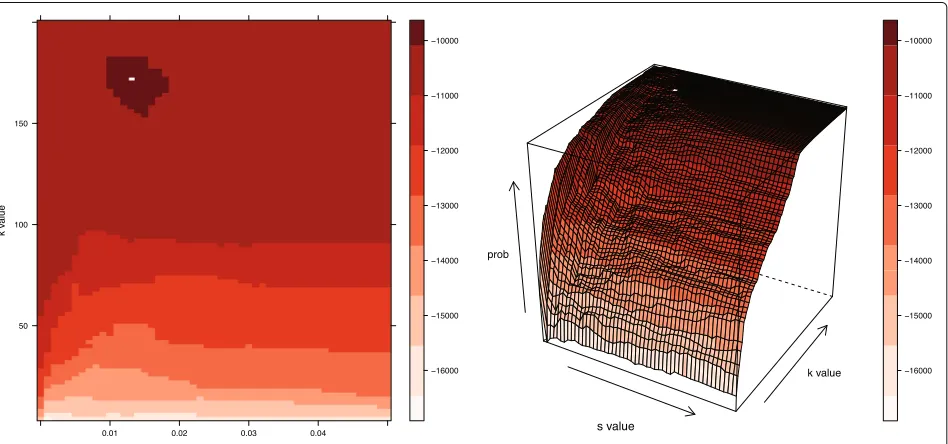
Using the training/testing split as described in the original presentation of the algorithm, a grid-based exploration of parameter space was conducted (Fig.1), whereby each of the training/testing datasets (i = {1, ...,n}) was analyzed at every combination ofk andsvalues on the grid. This analysis entailed the creation of local convex hulls withk nearest neighbors and a scaling factor of s. In all subse-quent analyses, we assume that the scaling of time follows a linear formulation; however, when movement patterns
more closely exemplify diffusion dynamics, an alternative equation for the TSD may be more appropriate [2]. The test points (j= {1, ...,m}) were then laid upon the resulting hulls.
We formulate the probabilities for out-of-sample points by normalizing the LoCoH surface so that the probability of an observation occurring at a particular location can be calculated. This value is obtained by dividing the number of training hulls that contain the test point location (gi,j) by the summed area of all training hulls (Ai). Then, the log probability was calculated for each point per training hullset. To avoid log probability values of -∞, test points that were not contained within any hulls were assigned a probability value equal to the inverse ofA2i, resulting in a substantially lower log probability than that of a test point contained in a single hull. Finally, a single value (Pk,s) was assigned to each combination ofkandsvalue by summing across all of the test points in all of the training/testing datasets:
Pk,s= n
i=1 m
j=1 log
gi,j Ai
Because the probability of each test point is normalized based on the total area contained within all of the training hulls, there exists a natural penalty for highkvalues. For example, akvalue equal to the number of training points (kmax; regardless of thesvalue) will result in all hulls being identical and each test point overlapping all of the hulls.
Table 1Parameter values for analysis
ID Species Sample s(Algo) k(Algo) s(Guide) kRange
Points (Guide)
AG063 Zebra 2111 0.003 355 0.023125 20-25
AG252 Zebra 3601 0.001 485 0.0140625 20-25
AG253 Zebra 3601 0 156 0.0140625 25-30
AG255 Zebra 3601 0.001 405 0.0184375 20-25
AG256 Zebra 3601 0.001 335 0.0171875 15-20
AG205 Springbok 2887 0.05 182 0.003125 25-30
AG206 Springbok 3601 0.023 187 0.00875 25-30
AG207 Springbok 3601 0.036 155 0.01140625 20-25
AG209 Springbok 2887 0.013 171 0.002421875 25-30
AG214 Springbok 2887 0.001 104 0.00265625 15-20
AG215 Springbok 2883 0 554 0.00328125 25-30
Thesandkvalues selected using the algorithm and the guidelines in the T-LoCoH documentation. A range ofkvalues were used for the Guide due to the subjective nature of parameter selection
However, the large total area of the hullset whenk=kmax will result in relatively small probability values for each test point (i.e., independent probability values equal to the inverse of the area of one of the hulls), effectively penal-izing the parameter set containingkmax. The underlying cross-validation procedure could very easily be extended for the optimization of the the adaptive parameter in the a-method (as opposed to the k-method) because of its scaling with the total area of the hullset.
Results
The optimal parameter values selected using the corrected cross-validation method are substantially different from those selected in the original publication (Table1). How-ever, because the original formulation was not supported
Table 2Home range areas (in square kilometers)
ID HR Area (Algo) HR Area (Guide Low) HR Area (Guide High)
AG063 1093 571 603
AG252 1486 913 958
AG253 593 501 513
AG255 871 579 600
AG256 1363 740 798
AG205 370 256 268
AG206 973 558 588
AG207 430 299 318
AG209 347 207 216
AG214 32 23 25
AG215 258 165 177
The total area of the home range obtained using the parameter sets recommended by the algorithm and by the guidelines set forth in the T-LoCoH documentation
Table 3Mean duration (MNLV) values. The derived metrics obtained using the parameter sets recommended by the algorithm and by the guidelines set forth in the T-LoCoH documentation
ID MNLV (Algo) MNLV (Guide Low) MNLV (Guide High)
AG063 48.9 10.0 11.3
AG252 77.3 10.4 11.7
AG253 2.6 10.7 12.5
AG255 75.1 9.5 10.3
AG256 42.0 8.0 9.7
AG205 92.6 24.4 27.1
AG206 80.8 14.3 16.4
AG207 67.9 12.3 14.5
AG209 78.9 23.4 26.0
AG214 24.7 16.5 19.4
AG215 2.6 37.9 42.6
by cohesive statistical theory, we will discuss these new results only in reference to the guideline-based param-eter values rather than comparing them to the results emerging from the published algorithm. The meansvalue selected using the algorithm for springbok was 0.02 (SE = 0.008) and for zebra was 0.0012 (SE = 0.0005). The mean s value selected using the guidelines for springbok was 0.005 (SE = 0.002) and 0.017 (SE = 0.002) for zebra. Thus, thesvalues selected by the algorithm and the guidelines were not significantly different for springbok (p = 0.10), but were for zebra (p<0.001). In the case of thekvalues, the optimal values selected using the algorithm were sig-nificantly higher than those resulting from the guidelines. The meankvalue selected using the algorithm for spring-bok was 225.5 (SE = 66.83) whereas the mean using the
Table 4Mean visitation (NSV) values
ID NSV (Algo) NSV (Guide Low) NSV(Guide High)
AG063 13.8 5.8 6.6
AG252 9.1 5.6 6.3
AG253 61.5 15.0 16.0
AG255 19.7 8.1 9.5
AG256 14.0 7.4 8.6
AG205 7.1 4.2 4.5
AG206 8.2 6.5 6.9
AG207 17.8 14.9 15.7
AG209 5.7 3.6 3.8
AG214 20.2 14.6 16.3
AG215 218.1 6.6 6.8
Fig. 2Comparison of Resulting Home Ranges. An illustration of two sets of home ranges that result from the parameter sets chosen by the algorithm (red), the low range of the guide (blue), and the high range of the guide (black). The home range set on the left is based on the sample points from the springbok AG207, and the largest home range covers 429.81km2. The home range set on the right is based on the GPS fixes from zebra AG256, and the largest home range covers 1363.21km2
guidelines was 22.5 (SE = 1.71;p=0.003). The same trend was observed in zebra where the meankvalue based on the algorithm was 347.2 (SE = 54.36), whereas the mean from the guidelines was 20 (SE = 1.58;p=0.004).
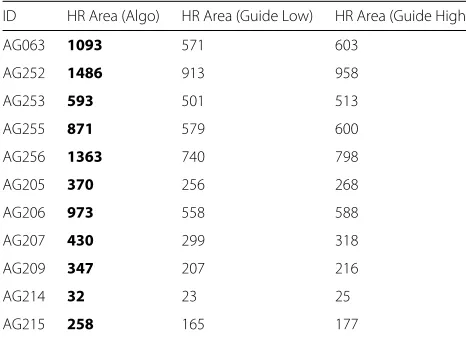
The significantly higher k values emerging from the algorithm gave rise to significantly larger home ranges in both species (Table2). In springbok, the mean home range size was 265.41 km2(SE = 76.23 km2) using the high end of the guideline based range, and 401.64 km2(SE = 127.56 km2) using the algorithm (p= 0.05). In zebra, the mean home range was 694.43 km2(SE = 80.81 km2) using the guidelines and 1081.29 km2(SE = 162.17 km2) when the
algorithm was applied (p=0.01). When the derived met-rics were considered, however, the substantial differences inkvalues did not always result in significantly different duration (Table3) and visitation rates (Table4). Though the duration rates in zebra derived from the algorithm were, indeed, significantly higher than those derived using the high value from the range based on the guidelines (p=0.05), this was not the case for springbok (p=0.08). Similarly, the visitation rates emerging from the parameter sets selected by the algorithm were not significantly dif-ferent from those derived based on the guidelines in either species (p=0.33 in springbok andp=0.15 in zebra).
Conclusion
The results presented here indicate that the effect of selecting parameters using the algorithm rather than the guidelines will be highly contingent upon the focus of the research question. Where home range delineation is the goal, the results are likely to differ significantly (Fig.2). In the case of epidemiological questions, however, the effects will be somewhat less predictable, and in certain cases, similar conclusions might be drawn irrespective of the approach used for selecting optimal parameters. If an element of the analysis involves comparisons across indi-viduals or species, however, the cross-validation-based approach provides a unifying framework governed by statistical properties of the home ranges rather than sub-jective selections by the user.
Additional file
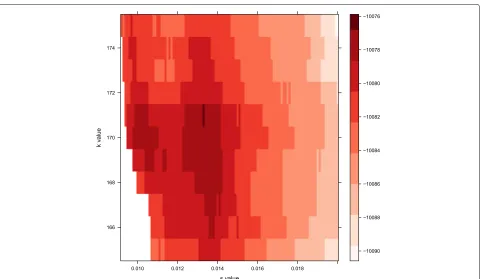
Additional file 1:A new R script for a more efficient grid-based search (Fig.3) can be found at: https://github.com/doughertyeric/Updated_T-LoCoH_Algorithm. As currently parameterized, the grid-based search algorithm coverssvalues from 0 to 0.05 andkvalues between 4 and 800. The algorithm searches across the broadest set ofkvalues in intervals of 20 andsvalues in intervals of 0.01. Upon identifying a peak in the probability surface, the algorithm selects a range of 40kvalues around the peak and refines the search there inkvalue increments of 5. Finally, another range of 10 possiblekvalues is selected and the finest scale grid-search is conducted in intervals of 1 andsvalue intervals of 0.001 before selecting the optimal parameter set. (R 11 kb)
Acknowledgements
The authors would also like to acknowledge Andy Lyons for creating, maintaining, and improving the T-LoCoH package.
Funding
The case study presented here used GPS movement data from zebra and springbok from Etosha National Park, Namibia, which were collected under a grant obtained by WMG (NIH GM083863). In addition, partial funding for this study was provided by NIH 1R01GM117617-01 to JKB and WMG. The funders had no role in study design, data collection and analysis, nor manuscript writing.
Availability of data and materials
Please contact Wayne M. Getz ([email protected]) for data requests.
Authors’ contributions
PDV and ERD developed cross-validation approach. ERD ran analyses on empirical movement paths. All authors contributed to writing and editing the manuscript.
Ethics approval and consent to participate
All movement data were collected according to the animal handling protocol AUP R217-0509B (University of California, Berkeley).
Consent for publication
Not applicable.
Competing interests
The authors declare that they have no competing interests.
Publisher’s Note
Springer Nature remains neutral with regard to jurisdictional claims in published maps and institutional affiliations.
Author details
1Environmental Science, Policy & Management, University of California,
Berkeley, USA.2National Socio-Environmental Synthesis Center, University of
Maryland, Annapolis, USA.3Department of Biology, Georgetown University,
Washington, DC, USA.4Spatial Epidemiology and Ecology Research
Laboratory, Department of Geography, University of Florida, Gainesville, USA.
5Emerging Pathogens Institute, University of Florida, Gainesville, USA.6School
of Mathematical Sciences, University of KwaZulu-Natal, Durban, South Africa.
Received: 27 May 2018 Accepted: 12 June 2018
References
1. Dougherty ER, Carlson CJ, Blackburn JK, Getz WM. A
cross-validation-based approach for delimiting reliable home range estimates. Mov Ecol. 2017;5(1):19.