Open Access
Brief reports
Analysis by siRNA_profile program displays novel thermodynamic
characteristics of highly functional siRNA molecules
Pirkko Muhonen*
1, Ranga N Parthasarathy
2, Anthony J Janckila
2,
Kalman G Büki
1and H Kalervo Väänänen
1Address: 1Institute of Biomedicine, Department of Anatomy, University of Turku, Kiinamyllynkatu 10, FIN-20520 Turku, Finland and 2Veterans
Affairs Medical Center, and University of Louisville, Louisville, KY, USA
Email: Pirkko Muhonen* - [email protected]; Ranga N Parthasarathy - [email protected];
Anthony J Janckila - [email protected]; Kalman G Büki - [email protected]; H Kalervo Väänänen - [email protected] * Corresponding author
Abstract
Objective: Here we report the improved results of a new siRNA design program and analysis tool called siRNA_profile that reveals an additional criterion for bioinformatic search of highly functional siRNA sequences.
Methods: We retrospectively analysed over 2400 siRNA sequences from 34 genes and with known efficacies to categorize factors that differentiate highly, moderately and non-functional siRNA sequences in more detail. We tested the biological relevance of siRNA_profile in CHO cells stably expressing human TRACP.
Results: The highly functional siRNA molecules exhibited lower overall stabilities than non-functional siRNAs after taking into consideration all the nucleotides from 5'-terminus to the 3'-terminus along the siRNA molecule, in addition to the 5'-section of the antisense strand and the region between 9–14 nucleotides as previously has been acknowledged. Comparison of the
siRNA_profile program to five other programs resulted in a wide range of selected siRNA sequences with diverse gene silencing capacities, even when the target was only 197 nucleotides long. Six siRNA design programs selected 24 different siRNA sequences, and only 6 of them were selected by two or more programs. The other 18 sequences were individually selected by these six programs.
Conclusion: Low general stability of dsRNA plays a significant role in the RNAi pathway and is a recommended criterion to consider, in addition to 5'-instability, internal instability, nucleotide preferences and target mRNA position, when designing highly efficient siRNAs.
Introduction
RNA interference (RNAi) is a gene silencing mechanism where short interfering RNA (siRNAs) and microRNA (miRNAs) molecules inhibit the transcription and transla-tion of target genes in a sequence-specific manner [1-3].
siRNAs are exogenously produced ~21 nucleotides long, double stranded RNA molecules with complete comple-mentarity to the target sequence. miRNAs are a family of endogenously encoded small non-coding RNAs, derived by processing of short RNA hairpins, that can inhibit the Published: 21 May 2008
Source Code for Biology and Medicine 2008, 3:8 doi:10.1186/1751-0473-3-8
Received: 13 August 2007 Accepted: 21 May 2008
This article is available from: http://www.scfbm.org/content/3/1/8
© 2008 Muhonen et al; licensee BioMed Central Ltd.
translation of mRNAs bearing partial complementarity to the target sequences. RNAi has been acknowledged as a practical tool for new drug target discovery and RNAi drug development in mammalian cells [4]. Therefore designing highly functional siRNA molecules has become an essen-tial part of RNAi methodology. We have developed a novel and user-friendly siRNA design algorithm siRNA_profile with multiple options for minimizing the identification of non-functional, unspecific and immu-nostimulatory siRNA molecules. The analysis of func-tional and non-funcfunc-tional siRNA molecules were done by the siRNA_profile program to demonstrate in more detail the characteristics of highly functional siRNA molecules to help scientists in their search for theoretically and bio-logically efficient siRNAs.
Conventional siRNA design criteria
The rapid development of RNAi applications has revealed the need for efficient and specific siRNA design and anal-ysis tools to maximize the efficiency while minimizing possible side-effects [5]. Computational methods and neural networks are tools approaching ideal siRNA design; however, so far none of them are perfect. Cur-rently, thermodynamic characteristics of functional siRNA molecules guide siRNA design strategy. First, it has been shown that thermodynamic differences in the base-pair-ing stabilities of the 5'-ends of both siRNA and miRNA molecules play a critical role in determining which strand initiates RNA induced silencing complex (RISC) activa-tion [6,7]. To achieve an efficient RNAi effect, activated RISC should be able to silence multiple copies of the tar-get mRNA. A second criterion for effective siRNAs is low internal stability in the cleavage region between 9 to 14 nucleotides (calculated from the 5'-terminus) of the anti-sense strand. This is believed to have a critical role in mRNA cleavage and it may also help to release RISC from the cleaved target [7]. Third, there are findings of the nucleotide preferences over the length of siRNA sequence [8,9].
siRNA_profile program design
The siRNA_profile program and a full text including addi-tional data and a printable help page are available in the siRNA_profile program web page [10]. Briefly, the siRNA_profile program is based on findings of the asym-metric differences between functional and non-functional siRNAs [6,7,11] and on our studies of positional nucle-otide differences and average dsRNA stability along the siRNA antisense strand. We have also incorporated some recommendations of Elbashir, S.M., et al. [2] and devel-oped a novel, interactive and user-friendly siRNA design algorithm with multiple options for minimizing unspe-cific siRNA design. Previously, it has been recognized that 5'-UGUGU-3' motifs have immunostimulatory potential in synthetic siRNA molecules, in addition to CpG motifs
in single stranded RNAs and DNA oligomers [12-14]. We have incorporated a sensor able to recognize immunos-timulatory motifs intending to avoid unnecessary false phenotypes by siRNA molecules and, additionally, by anti-miRNA oligomers. In addition, a scoring system was integrated into the siRNA_profile program. It was adjusted based on our findings on nucleotide, purine and pyrimi-dine distribution along functional and non-functional siRNA sequences [the scoring system described in siRNA_profile web page].
The siRNA_profile program uses free energy values for cal-culation of average internal stability profiles. The average internal stability profiles were calculated as the sum of sta-bility in five nucleotide windows by using the nearest-neighbour method as previously described [7,11]. Our program browses and calculates the target sequence from the antisense point of view, from the 5' - to the 3'- direc-tion. However, it does not utilize nucleotides on the mRNA beyond the 3'- end of the siRNA as previously has been described [7], because this calculation method may easily lead to false bending of the profile. This unique and beneficial feature of the siRNA_profile program allows the calculation of the factual, not the false dsRNA thermody-namic characters.
The siRNA_profile program was originally developed on Red Hat Linux 9.0 and compiled to an executable file. The algorithm was written in C-programming language and the CGI application was written in Perl programming lan-guage. The application uses the user-given input values from the siRNA_profile website to analyze and display the results.
Findings
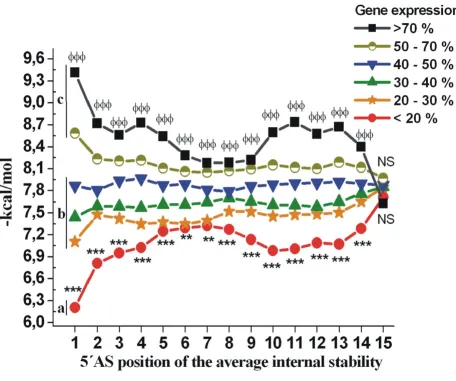
excluding the last one. Noticeably, there was no position along the length of functional and non-functional siRNAs at which energy profiles crossed. This was true for both 5'-region and the 5'-region from nucleotides 9–14. These novel features were found to correlate siRNA energy profiles with their efficiencies. To demonstrate the differences of average internal stabilities of highly functional, moder-ately functional and non-functional siRNAs in more detail, these siRNAs were compared to each other. Average
internal stability of highly functional siRNAs (Figure 1, GE <20%, marked as group a) showed significantly lower internal stability compared to moderately functional siR-NAs (GE 20.1–50%, marked as group b). Non-functional siRNAs (GE 50–100%, marked as group c) exhibited sig-nificantly higher average internal stability than moder-ately functional ones. Here, our results obtained by siRNA_profile program suggest that the thermodynamic characteristics focusing only on the 5'-end stability
prop-Figure 1
erties of the antisense strand are not enough to differenti-ate highly functional siRNAs from the moderdifferenti-ately functional or non-functional ones.
To demonstrate the usefulness of siRNA_profile program as a siRNA candidate search service, the biological effica-cies of siRNA molecules targeting tartrate-resistant acid phosphatase (TRACP) experimentally designed by siRNA_ profile were validated in a Chinese Hamster Ovary (CHO) cell line stably over-expressing human TRACP under a CMV promoter [16] [data shown in siRNA_profile web page].
The siRNA_profile program functionality was compared to five other available siRNA design programs. Human CyclophilinB sequence region 193 – 390 [Gen-Bank:M60857] [8] was fed into the siRNA_profile pro-gram, Deqor [17], siRNA target finder (Ambion, USA), siDesign Center (Dharmacon, USA), EMBOSS explorer (gwilliam © rfcgr.mrc.ac.uk) and siDirect [18], and optimal siRNA candidate search options were used. siRNA design results were compared to results obtained by
siRNA_profile by using the known efficacies of each siRNA sequences targeting the selected human Cyclophilin region (Table 1). The results showed that all tested pro-grams selected functional siRNA sequences with signifi-cant variability. The novel siRNA_profile program showed the highest selectivity. However, we noticed that all six programs tend to select different siRNA sequences even though the mRNA region selected for candidate search was only 197 nucleotides long. Programs selected alto-gether 24 different sequences, and only 6 of them were selected by two or more programs. The other 18 sequences were individually selected by these six programs. This result shows the dilemma, that even for programs that operate with related selection parameters, very different sequences were chosen with a range of siRNA efficacies.
In conclusion, our results suggest that low general stability of dsRNA plays a significant role in the RNAi pathway and is recommended to be used as an additional guideline for highly efficient siRNA design. Additionally, all known immunostimulatory motifs to date are highlighted in col-our to prevent analysis of false phenotypes and the output
of the siRNA_profile program displays the average internal energy profiles for each siRNA candidate. According to our results, the siRNA sequences exhibiting both favoura-ble asymmetric properties and low overall stabilities according to Figure 1 are recommended for gene knock down experiments.
Availability and requirements
siRNA_profile program availability: http://bonebiol ogy.utu.fi/pimaki/main.html
Competing interests
The authors declare that they have no competing interests.
Authors' contributions
PM, KGB, HKV Study concept and design. PM, KGB Acqui-sition of the data. PM Analysis and interpretation of the data. AJJ, RNP CHO cell line stably expressing human tar-trate-resistant acid phosphatase [additional data in the siRNA_profile web page]. PM Drafting of the manuscript. HKV Study supervision. All authors read and approved the final manuscript.
Acknowledgements
The authors thank Dr. Pentti Riikonen (Department of Information Tech-nology, University of Turku), Anne Seppänen and Janne Harjunpää for pro-viding valuable help during development of the siRNA_profile algorithm and the web page application. The authors also thank Dr. Tiina Laitala-Leinonen (Bone Biology Research Consortium, University of Turku) for her assist-ance in formatting the text for publication.
References
1. Lagos-Quintana M, Rauhut R, Lendeckel W, Tuschl T: Identification of novel genes coding for small expressed RNAs. Science 2001,
294(5543):853-858.
2. Elbashir SM, Lendeckel W, Tuschl T: RNA interference is medi-ated by 21- and 22-nucleotide RNAs. Genes Dev 2001,
15(2):188-200.
3. Fire A, Xu S, Montgomery MK, Kostas SA, Driver SE, Mello CC:
Potent and specific genetic interference by double-stranded RNA in Caenorhabditis elegans. Nature 1998,
391(6669):806-811.
4. Soutschek J, Akinc A, Bramlage B, Charisse K, Constien R, Donoghue M, Elbashir S, Geick A, Hadwiger P, Harborth J, John M, Kesavan V, Lavine G, Pandey RK, Racie T, Rajeev KG, Rohl I, Toudjarska I, Wang G, Wuschko S, Bumcrot D, Koteliansky V, Limmer S, Manoharan M, Vornlocher HP: Therapeutic silencing of an endogenous gene by systemic administration of modified siRNAs. Nature 2004,
432(7014):173-178.
Table 1: Comparison of the siRNA_profile program and five other siRNA design programs
siRNA_profile Deqor Ambion siDesign EMBOSS SiDirect
Number of hits 6 (4) 4(1) 3(0) 2(2) 6(4) 9(7)
Average GE%* 10.4 14.8 21.1 13.0 21.6 14.8
Median%* 10.2 13.1 26.9 13.0 16.1 14.9
Minimum GE%* 5.4 10.3 8.1 12.6 6.7 5.8
Maximum GE%* 15.1 22.8 28.3 13.3 54.1 32.2
Publish with BioMed Central and every scientist can read your work free of charge "BioMed Central will be the most significant development for disseminating the results of biomedical researc h in our lifetime."
Sir Paul Nurse, Cancer Research UK
Your research papers will be:
available free of charge to the entire biomedical community
peer reviewed and published immediately upon acceptance
cited in PubMed and archived on PubMed Central
yours — you keep the copyright
Submit your manuscript here:
http://www.biomedcentral.com/info/publishing_adv.asp
BioMedcentral 5. Pei Y, Tuschl T: On the art of identifying effective and specific
siRNAs. Nat Methods 2006, 3(9):670-676.
6. Schwarz DS, Hutvagner G, Du T, Xu Z, Aronin N, Zamore PD:
Asymmetry in the assembly of the RNAi enzyme complex.
Cell 2003, 115(2):199-208.
7. Khvorova A, Reynolds A, Jayasena SD: Functional siRNAs and miRNAs exhibit strand bias. Cell 2003, 115(2):209-216. 8. Reynolds A, Leake D, Boese Q, Scaringe S, Marshall WS, Khvorova A:
Rational siRNA design for RNA interference. Nat Biotechnol
2004, 22(3):326-330.
9. Jagla B, Aulner N, Kelly PD, Song D, Volchuk A, Zatorski A, Shum D, Mayer T, De Angelis DA, Ouerfelli O, Rutishauser U, Rothman JE:
Sequence characteristics of functional siRNAs. Rna 2005,
11(6):864-872.
10. siRNA_profile program [http://bonebiology.utu.fi/pimaki/ main.html]. .
11. Freier SM, Kierzek R, Jaeger JA, Sugimoto N, Caruthers MH, Neilson T, Turner DH: Improved free-energy parameters for predic-tions of RNA duplex stability. Proc Natl Acad Sci U S A 1986,
83(24):9373-9377.
12. Hemmi H, Takeuchi O, Kawai T, Kaisho T, Sato S, Sanjo H, Mat-sumoto M, Hoshino K, Wagner H, Takeda K, Akira S: A Toll-like receptor recognizes bacterial DNA. Nature 2000,
408(6813):740-745.
13. Judge AD, Sood V, Shaw JR, Fang D, McClintock K, MacLachlan I:
Sequence-dependent stimulation of the mammalian innate immune response by synthetic siRNA. Nat Biotechnol 2005,
23(4):457-462.
14. Sugiyama T, Gursel M, Takeshita F, Coban C, Conover J, Kaisho T, Akira S, Klinman DM, Ishii KJ: CpG RNA: identification of novel single-stranded RNA that stimulates human CD14+CD11c+ monocytes. J Immunol 2005, 174(4):2273-2279.
15. Huesken D, Lange J, Mickanin C, Weiler J, Asselbergs F, Warner J, Meloon B, Engel S, Rosenberg A, Cohen D, Labow M, Reinhardt M, Natt F, Hall J: Design of a genome-wide siRNA library using an artificial neural network. Nat Biotechnol 2005, 23(8):995-1001. 16. Janckila AJ, Parthasarathy RN, Parthasarathy LK, Seelan RS, Yam LT:
Stable expression of human tartrate-resistant acid phos-phatase isoforms by CHO cells. Clin Chim Acta 2002, 326(1-2):113-122.
17. Henschel A, Buchholz F, Habermann B: DEQOR: a web-based tool for the design and quality control of siRNAs. Nucleic Acids Res
2004, 32(Web Server issue):W113-20.