R E S E A R C H A R T I C L E
Open Access
Proportion of medication error reporting
and associated factors among nurses: a
cross sectional study
Abebaw Jember
1*, Mignote Hailu
1, Anteneh Messele
2, Tesfaye Demeke
3and Mohammed Hassen
1Abstract
Background:A medication error (ME) is any preventable event that may cause or lead to inappropriate medication use or patient harm. Voluntary reporting has a principal role in appreciating the extent and impact of medication errors. Thus, exploration of the proportion of medication error reporting and associated factors among nurses is important to inform service providers and program implementers so as to improve the quality of the healthcare services.
Methods:Institution based quantitative cross-sectional study was conducted among 397 nurses from March 6 to May 10, 2015. Stratified sampling followed by simple random sampling technique was used to select the study participants. The data were collected using structured self-administered questionnaire which was adopted from studies conducted in Australia and Jordan. A pilot study was carried out to validate the questionnaire before data collection for this study. Bivariate and multivariate logistic regression models were fitted to identify factors associated with the proportion of medication error reporting among nurses. An adjusted odds ratio with 95% confidence interval was computed to determine the level of significance.
Result:The proportion of medication error reporting among nurses was found to be 57.4%. Regression analysis showed that sex, marital status, having made a medication error and medication error experience were significantly associated with medication error reporting.
Conclusion:The proportion of medication error reporting among nurses in this study was found to be higher than other studies.
Keywords:Medication error, Medication error reporting, Federal Level Governmental Hospital, Nurse
Background
Medication therapy is the most common intervention pre-scribed for healthcare consumers [1] and safe medication administration represents one of the routine, highly com-plex and essential nursing care responsibilities [2]. Medica-tion administraMedica-tion is amongst the potentially hazardous nursing tasks in hospitals because of liability to errors [3]. The reporting of error incidents and specific phases of healthcare delivery such as the safe use of medications can improve the safety of patients [4].
A single medication error (ME) may prolong hospital stay or even end up in death. This affects the quality and
continuity of the healthcare services [5] by affecting pa-tient safety which is an important indicator of healthcare quality and encompasses various nursing care procedures. Executing a ME has been seen to be psychologically dev-astating to the nurse and harmful to the patient [6].
Globally, MEs present a substantial contribution to ill health, and even death and are listed as one of the five medical error categories classified by the American Insti-tute of Medicine [7]. Out of estimated patients’deaths of 6000 to 20,000 each year from medical errors in Taiwan, 10% of medical lawsuits were because of MEs where the majority of the errors were grossly underreported [8]. A prospective cross-sectional study conducted in an intensive care unit of a specialized hospital in Ethiopia showed a ME of 51.8% [9].
* Correspondence:[email protected]
1Department of Medical Nursing, School of Nursing, College of Medicine and
Health Sciences, University of Gondar, Gondar, Ethiopia Full list of author information is available at the end of the article
Nevertheless how huge or insignificant the incidence, it is difficult to have a general concept of MEs in less de-veloped and developing countries due to inefficient documentation and error-reporting systems and insuffi-cient research in the area [7]. Analysis and appreciation of the root causes of MEs allows developing complex medication error prevention mechanisms [10] which im-prove patient safety.
Literature review
A medication error is any preventable event that may cause or lead to inappropriate medication use or pa-tient harm [11]. Medication error is a global issue where 5% of the MEs are deadly and almost 50% are preventable [12]. Medication error reporting is one of the major issues in today’s health care and prevention is linked to accurate reporting of errors [7]. Voluntary reporting is indispensable to appreciate the extent and impact of MEs [13]. Nurses’ interception of 86% of the MEs was presented in a descriptive cross-sectional study conducted in one large medical center hospital in southern Taiwan with sample size of 597 nurses using self-administered questionnaires and the significance of error reporting was given a weight as intercepting [8]. Moreover, consideration of nurses’ perceived barriers to medication error reporting (MER) is a crucial step to strengthen medication safety [8] and it was shown in a study that more than 90% of healthcare consumers believe that errors should be reported [3].
Incidence and prevalence of medication errors
Medication errors which are made during prescrip-tion, dispensing and administration [14] are common and preventable causes of patient harm [15]. Precise figure of the incidence and prevalence of MEs is diffi-cult to obtain because the rate varies from study to study [7]. Studies showed a range of rate of serious patient injuries due to medication errors as 1 to 2% [16], 9 to 13% [2], 29% [17], and as high of 51.8% [9], and estimated 30.5% deaths per year in a survey in the United States of America (USA) were attributable to MEs [15]. A study conducted in Southern Iran with the purpose of determining the frequency of MEs in an emergency department of a teaching hos-pital revealed that 96.5% of patients had experienced at least one medication error, making the rate of er-rors 3.5 per patient [18]. A descriptive survey of 300 nurses working in hospitals affiliated to Iran Univer-sity of Medical Sciences using stratified multistage sampling disclosed a mean of 19.5 medication errors that the nurses acknowledged within 3-months period however the mean of error reporting was only 1.3 of error cases [19, 20].
Factors related to medication error reporting
A focus group study on barriers to MER in Canada iden-tified barriers as an individual, organizational and cul-tural [21]. According to a descriptive cross-sectional study with sample size of 799 nurses conducted in Jordan, the proportion of medication error reporting was relatively high among female nurses than male nurses [7]. Twenty-six percent of nurses in a study conducted in Israel indicated that all MEs in their wards were re-ported and 46% of the nurses showed self-reporting of MEs. The nurses emphasized on a personal barrier to non-reporting such as ME experiences and error report-ing experiences [22].
A perception that incidence reports do not result in sig-nificant changes or benefits and errors that did not result in harm were among the factors that affected the attitude of nurses to report medication errors [23, 24]. Perceived barriers which affect attitude of nurses to report medica-tion errors were fear of adverse consequences from reporting and being subjected to disciplinary actions, fear of being blamed, fear of reaction from the nurse manager, from peers and fear of loss of jobs [6–8, 19, 25]. Other barriers for not reporting MEs include nurses not being aware that an error had occurred, process of reporting (detailed paperwork, time constraints, not understanding incident reporting process), forgetting to make a report when the ward is busy, lack of time for reporting and lack of awareness of the importance of reporting [19,23,26].
Two-thirds (66.7%) of nurses involved in a study con-ducted in two state hospitals in Turkey who stated that they involved in medication errors in the preceding 6 months had not reported the errors. The reported rea-sons (social factors) for not reporting MEs included fear of consequences, fear of a culture of blame and the need to cover up for the colleague involved [27].
Modifiable barriers to MER for nurses reported in dif-ferent studies as organizational factors were revealed as lack of feedback to the reporter, lack of a readily avail-able MER system, lack of information on how to report a ME, no positive feedback for giving medication cor-rectly, too much emphasis on ME as a quality indicator of nursing care and motivational factors (such as no en-couragement by management, fear of loss of professional registration), lack of organizational leadership and sup-port [3,8,19,25, 28]. Similarly taking medical responsi-bility and fear of distrust from patients were barriers of medication error reporting [29].
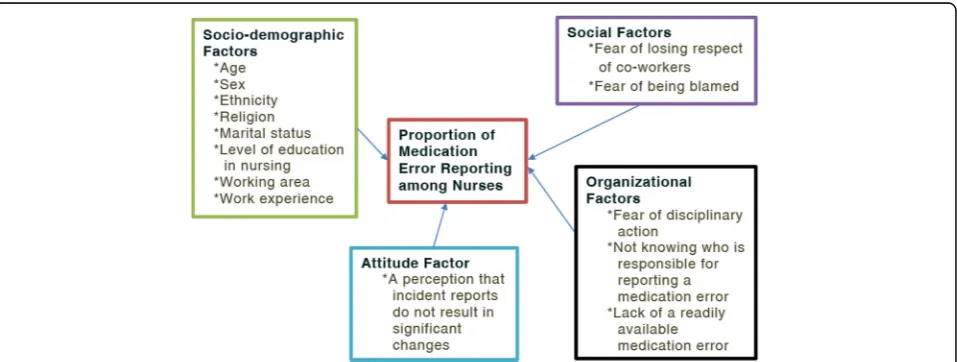
non-punitive approach to reporting medication errors were shown to decrease medication errors and improve pa-tient safety [32]. Proportion of medication error report-ing by nurses might be affected by multiple factors such as socio-demographic, social, attitude of nurses, and organizational factors [7, 8, 12, 19] (Fig. 1 indicates the factors involved in medication error reporting).
Health care systems in most developing countries suffer from serious deficiencies in quality, equity, efficiency and financing [33]. The quality of care is evaluated in the light of the provider’s technical standards and clients’ expecta-tions. Medication administration is among the routine and highly complex nursing care activities which plays a great role in patient care and outcome. Medication safety and medication errors are important concerns for health-care consumers, health-health-care professionals, researchers and policy makers worldwide.
Nurses are more prone to making medication errors because of the increasing demands and pressures placed on them. Critical incidents must be detected and re-ported and turned into positive situations, from which lessons are learned and used to design better patient care practices and systems. So far nurses are at the front line of defense to intercept and report medication errors, yet the errors are severely detected and under-reported in practice.
Medication errors affect the quality of health care de-livery. Improving patient safety and learning from errors relies on voluntary error reporting which gives the complete picture of medication errors. Thus, exploration of the proportion of nurses reporting medication errors and associated factors is important to inform service providers, program implementers and policy makers to improve the quality of the healthcare service.
Aim
The aim of this study was to assess the proportion of medi-cation error reporting and to explore the relationships among the barriers; socio-demographic factors, organizational factors, social factors, and attitude of nurses. Incident reporting represents more appropriate infor-mation about incidents and can detect preventable events if it is supported within the clinical settings. However, many of the incidents are not reported or are simply not recognized and yet it has been shown in the literature that nurses predominantly report incidents compared to other healthcare professionals [34]. Conversely, studies have demonstrated under-reporting of MEs among nurses [35].
Methods
An institution based quantitative cross-sectional study was conducted at three Federal Ministry of Health level governmental hospitals located in the nation’s capital Addis Ababa from March 6 to May 10, 2015. There are four hospitals under the FMoH; Alert, St. Peter, St. Paul and Amanuel. Amanuel Mental Specialized Hospital is the only referral mental hospital in the country which delivers counseling and treatment for patients. St. Paul’s Millennium Medical College Hospital delivers medical services for an annual average of 200,000 patients. St. Peter’s TB Specialized Hospital has been giving services related to tuberculosis treatment. Alert Hospital was ex-cluded because of protocol issues.
Sample size determination
A single population proportion formula was used to cal-culate the sample size:
n¼Z
2α
=2pð1−pÞ d2
Where: n = minimum sample size required for the study.
z = score for 95% confidence interval (z = 1.96). p = prevalence of medication error reporting (50%). d = tolerable error (d = 5%).
Since the proportion of medication error reporting in Ethiopia is unknown, 50% prevalence of medication error reporting was taken:
no¼ 1:96
ð Þ2
0:5 1ð −0:5Þ 0:052
no¼ 0:9604
0:0025¼384:16≈385
For possible non-response, the sample size was in-creased by 10%, thus comprising 38.416 respondents the final sample size became423.
Sampling procedure
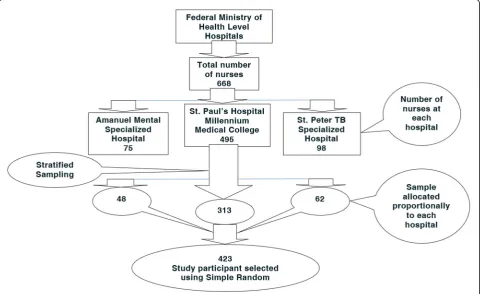
Stratified sampling technique was used to allocate the sample proportionally to each FMoH level governmental hospital and then the study participants who had work experience of six months and above were selected from
the list of all nurses using simple random sampling tech-nique; a lottery method (Fig.2).
Data collection tool and procedure
Data were collected by three nurses who were diploma holders using structured self-administered English-version questionnaire. The data collection tool was adopted from two studies conducted in Australia by Ev-ans [3] and in Jordan by Mrayyan et al. [7] with the au-thors’ permissions and face and content validity were established by two expert nurse advisors. The tool was composed of five parts. The first part contained socio-demographic characteristics of nurses. The second part of the questionnaire was related to error incidence. The third part related to medication error reporting was used to estimate the proportion of medication error reporting. The fourth and fifth parts were used to collect data re-garding the attitudes of nurses on medication error reporting and perceived organizational culture and real-ity of dealing with errors respectively (Additional file1).
Data quality control
Data quality was assured by conducting a pretest among 22 (5%) nurses at Zewditu hospital and appropriate modifications were made after analyzing the ptest re-sult before the actual data collection. The questionnaire
was coded before data collection and cross-checked for consistency and completeness every day.
Data management and analysis
The returned questionnaires were checked for complete-ness, cleaned and the data were entered into EPI Info-7 and then exported to SPSS (Statistical Package for the Social Sciences) version 20.0 for analysis. Frequencies and cross tabulations were used to summarize descrip-tive statistics and tables were used for data presentation. Binary logistic regression was used to identify factors as-sociated with medication error reporting and then the variables were checked for significant association using
p-value, odds ratio and 95% confidence interval.
Result
Socio-demographic characteristics
Out of 423 proposed study participants, 403 participated in the study giving a response rate of 95.27%. Six (1.41%) of the returned questionnaires were found to be incom-plete and excluded and the rest 20 (4.72%) of nurses chose not to participate in the study. 397 (93.85%) of study par-ticipants’ responses were analyzed. The majority (53.7%) of respondents were male. The mean (+ standard devi-ation) age of the respondents was 28.37 (+ 5.55) years. 307 (77.3%) respondents were Orthodox Christian followed by Protestant 48 (12.1%), 208 (52.4%) of the respondents were Amhara in their ethnic background and 291 (73.3%) of the participants were single. On the other hand, 154 (38.8%) of the respondents worked in internal medicine wards and level of education of 237 (59.7%) of the partici-pants was Bachelor of Science in Nursing. Moreover, 182 (45.8%) of the respondents served 1–3 years in the nursing profession (Table1).
Proportion of medication error reporting
The proportion of medication error reporting among nurses in this study was found to be 57.4% (n = 288). Out of the total participants (n = 397), relatively high (74.5%) proportion of medication error reporting was found among female nurses as compared to male nurses (42.7%). A high proportion (70.8%) of medication error reporting was disclosed by married participants than participants who are single (52.6%). On the other hand, 277 (69.8%) of the participants perceived that medication errors should be reported as they occur. Moreover, (70.7%) of the nurses who did not make errors them-selves reported medication errors.
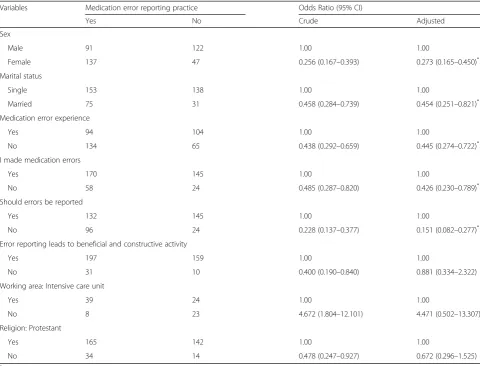
Factors associated with medication error reporting In bivariate logistic regression analysis sex, marital sta-tus, having made a medication error, medication error experience, and working area were associated with medi-cation error reporting. However, in multivariate analysis
sex, marital status, having made a medication error and medication error experience were associated with medi-cation error reporting (Table2).
Table 1Demographic characteristics of nurses at federal level teaching hospitals, Addis Ababa 2015 (n= 397)
Variables n (%)
Sex
Male 213 (53.7)
Female 184 (46.3)
Age
19–29 312 (78.6)
30–39 52 (13.1)
40–49 21 (5.3)
50–59 12 (3.1)
Ethnicity
Amhara 208 (52.4)
Oromia 93 (23.4)
SNNPR 60 (15.1)
Tigray 20 (5.0)
Othersa 16 (4.0)
Religion
Orthodox 307 (77.3)
Protestant 48 (12.1)
Muslim 36 (9.1)
Catholic 6 (1.5)
Marital Status
Singleb 291 (73.3)
Married 106 (26.7)
Level of education in nursing
BSc 237 (59.7)
Diploma 160 (40.3)
Working area
Internal medicine ward 154 (38.8)
Surgical ward 73 (18.4)
Emergency room 63 (15.9)
Psychiatry 47 (11.8)
Intensive care unit 31 (7.8)
Pediatric ward 29 (7.3)
Service year in the nursing profession
< 1 54 (13.6)
1–3 182 (45.8)
4–5 67 (16.9)
6–10 62 (15.6)
> 10 32 (8.1)
a
Others: Benishangul-Gumuz, Harari, Gambella
b
The proportion of medication error reporting was high among female nurses as compared to male nurses. Fe-male nurses were 72.7% times more likely to report medication errors than male nurses (AOR = 0.273; 95% CI = 0.165–0.450). Similarly, marital status was an im-portant predictor of medication error reporting. Nurses who are married were 54.6% times less likely to report medication errors as compared to those who are single (AOR = 0.454; 95% CI = 0.251–0.821).
Having a medication error experience was found to be another important determinant of medication error reporting. Nurses who had no medication error experi-ence were 55.5% times more likely to report medication errors than those who had medication error experiences (AOR = 0.445; 95% CI = 0.274–0.722). The odds of medi-cation error reporting among nurses who have not made errors themselves was 57.4% times higher as compared to those nurses who had previously made medication er-rors (AOR = 0.426; 95% CI = 0.230–0.789).
Discussion
The proportion of medication error reporting among nurses was found to be 57.4%. This finding is slightly higher as compared to studies in Jordan 42.1% [7], Australia 41.9% [3] and California, USA 28.9% [6]. The possible differences could be related to the differences in organizational medication error reporting systems and dif-ferences in the time frame that the studies are bounded.
In this study medication error experience of nurses was significantly associated with medication error reporting. Nurses who had previous experiences of medication errors and their reporting processes that er-rors made by others were 55.5% less likely to report error incidents than those who did not have error expe-riences and those nurses who had previously made medication errors were 57.4% less likely to report error incidents than those who did not make medication er-rors. This result is consistent with the result from Israel [22] and South Korea [26] that ME and having made Table 2Bivariate and multivariate logistic regression analysis of factors associated with proportion of medication error reporting among nurses at selected Federal Ministry of Health level hospitals, Addis Ababa 2015 (n= 397)
Variables Medication error reporting practice Odds Ratio (95% CI)
Yes No Crude Adjusted
Sex
Male 91 122 1.00 1.00
Female 137 47 0.256 (0.167–0.393) 0.273 (0.165–0.450)*
Marital status
Single 153 138 1.00 1.00
Married 75 31 0.458 (0.284–0.739) 0.454 (0.251–0.821)*
Medication error experience
Yes 94 104 1.00 1.00
No 134 65 0.438 (0.292–0.659) 0.445 (0.274–0.722)*
I made medication errors
Yes 170 145 1.00 1.00
No 58 24 0.485 (0.287–0.820) 0.426 (0.230–0.789)*
Should errors be reported
Yes 132 145 1.00 1.00
No 96 24 0.228 (0.137–0.377) 0.151 (0.082–0.277)*
Error reporting leads to beneficial and constructive activity
Yes 197 159 1.00 1.00
No 31 10 0.400 (0.190–0.840) 0.881 (0.334–2.322)
Working area: Intensive care unit
Yes 39 24 1.00 1.00
No 8 23 4.672 (1.804–12.101) 4.471 (0.502–13.307)
Religion: Protestant
Yes 165 142 1.00 1.00
No 34 14 0.478 (0.247–0.927) 0.672 (0.296–1.525)
*
errors hindered nurses from reporting MEs. However, this result was inconsistent with other results from Taiwan [8], Southern Taiwan [29] and Saudi Arabia [25]. The differ-ence may be related to the severity of medication errors since minor errors are less likely to be reported, even though it was difficult to determine the effect of medica-tion errors experienced regarding severity.
Most of the participants (69.8%) perceived that errors should be reported as they occur for the safety of pa-tients and this was consistent with the study from the United Kingdom [23] however lower than the study from Taiwan (87.7%) [8]. The possible difference may be due to the lack of a readily available practice system of medication error reporting.
In this study, the proportion of female nurses who re-ported medication errors was higher than the male nurses and was statistically significant. The result was similar with that of the study from Jordan [7]. In con-trast to other studies, marital status in this study was statistically significant with error reporting (AOR = 0.454; 95% CI = 0.251–0.821) showing that nurses who are married were 54.6% less likely to report medication errors. This might be related to barriers like fear of dis-ciplinary actions since it was put in second place as perceived barrier to reporting by nurses though not sta-tistically significant.
Conclusion
The proportion of medication error reporting among nurses in this study was found to be high. Medication error experience, having made a medication error, sex of partici-pants and marital status were significantly associated.
Limitation
Causes of medication errors were not studied in this re-search. Knowing the causes of medication errors gives a complete picture of medication errors. Therefore, it would be better if the study was triangulated. Response bias and recall bias were not reduced.
Recommendation
To Federal Ministry of Health
It is recommended that the Federal Ministry of Health identify and address gaps in medication error identifica-tion and reporting regarding the establishment of the reporting system to improve patient safety.
To the respected hospitals
The respective hospitals efforts will be significant in iden-tifying and addressing gaps in medication error reporting among nurses and creating a conducive environment for the establishment and maintenance of efficient reporting system. A condition in which reported errors are changed into opportunities to learn from them.
To the respected nurses
Nurses’contribution to the documentation of errors and reporting is an important input for the smooth provision of quality care and improved patient outcome.
To researchers
Further investigation, qualitative in nature, should be made in order to have a complete picture of medication errors in Ethiopia.
Additional file
Additional file 1:Questionnaire Medication Error Reporting. Questionnaire. Questionnaire prepared to collect data for the assessment of the intent of nurses to report medication errors and associated factors at federal level governmental teaching hospitals in Addis Ababa, Ethiopia 2015. (DOCX 26 kb)
Abbreviations
FMoH:Federal Ministry of Health; ME: Medication error; MER: Medication error reporting; MoH’: Ministry of Health; USA: United States of America
Acknowledgements
We would like to express our deepest and heartfelt gratitude to the University of Gondar for funding the research work. Our gratitude further goes to the respective hospitals, Amanuel Mental Specialized Hospital, St. Paul’s Hospital Millennium Medical College, and St. Peter’s TB Specialized Hospital, and the nurses who chose to participate in this study.
Funding
This work was supported by the University of Gondar by funding the expenses of the research work.
Availability of data and materials
The datasets generated and analyzed during this study are available from the corresponding author on reasonable request.
Authors’contributions
AJF: Theorized the research problem, designed the study, conducted field work, analyzed the data and revised the manuscript. MHG: Involved in the supervision of the field work, revision of the research design, data analysis and revision of the manuscript for publication. AMB: Involved in the supervision of the field work, revision of the research design, data analysis and revision of the manuscript for publication. TDA: Involved in the supervision of the field work, revision of the research design, data analysis and revision of the manuscript for publication. MHS: Contributed in the revision of the research design, statistical analysis, and preparation of the manuscript. All authors read and approved the final manuscript.
Ethics approval and consent to participate
Ethical clearance and approval was obtained from Ethical Review Committee of School of Nursing, College of Medicine and Health Sciences, University of Gondar and permission was obtained from the Ethical Review Committees of each respective hospital.
and the publication of the results of the study in a reputable journal with no identifiable information that links to the participants.
Consent for publication
Not applicable.
Competing interests
The authors declare that they have no competing interests.
Publisher’s Note
Springer Nature remains neutral with regard to jurisdictional claims in published maps and institutional affiliations.
Author details
1Department of Medical Nursing, School of Nursing, College of Medicine and
Health Sciences, University of Gondar, Gondar, Ethiopia.2Unit of Community Health Nursing, School of Nursing, College of Medicine and Health Sciences, University of Gondar, Gondar, Ethiopia.3Department of Pediatric and Child Health Nursing, School of Nursing, College of Medicine and Health Sciences, University of Gondar, Gondar, Ethiopia.
Received: 23 November 2016 Accepted: 6 March 2018
References
1. Wakefield DS, Wakefield BJ, Uden-Holman T, Borders T, Blegen M, Vaughn T. Understanding why medication administration errors may not be reported. Am J Med Qual. 1999;14(2):81–8.
2. Anselmi ML, Peduzzi M, dos Santos CB. Errors in the administration of intravenous medication in Brazilian hospitals. J Clin Nurs. 2007;16(10): 1839–47.
3. Evans SM. Attitudes and barriers to incident reporting: a collaborative hospital study. Qual Saf Health Care. 2006;15(1):39–43.
4. Gaal S, Verstappen W, Wensing M. Patient safety in primary care: a survey of general practitioners in the Netherlands. BMC Health Serv Res. 2010;10(1):21. 5. Zeleke A, Chanie T, Woldie M. Medication prescribing errors and associated
factors at the pediatric wards of Dessie referral hospital, Northeast Ethiopia. Int Arch Med. 2014;7(1):18.
6. Ulanimo VM, O’Leary-Kelley C, Connolly PM. Nurses’perceptions of causes of medication errors and barriers to reporting. J Nurs Care Qual. 2007;22(1):28–33. 7. Mrayyan MT, Shishani K, Al-Faouri I. Rate, causes and reporting of medication
errors in Jordan: nurses? Perspectives. J Nurs Manag. 2007;15(6):659–70. 8. Chiang H-Y, Pepper GA. Barriers to nurses’reporting of medication administration
errors in Taiwan. J Nurs Scholarsh. 2006;38(4):392–9.
9. Agalu A, Ayele Y, Bedada W, Woldie M. Medication administration errors in an intensive care unit in Ethiopia. Int Arch Med. 2012;5(1):15.
10. Montesi G, Lechi A. Prevention of medication errors: detection and audit. Br J Clin Pharmacol. 2009;67(6):651–5.
11. Banning M. Medication errors: professional issues and concerns. Nurs Older People. 2006;18(3):27–32.
12. Nuckols TK, Bell DS, Liu H, Paddock SM, Hilborne LH. Rates and types of events reported to established incident reporting systems in two US hospitals. Qual Saf Health Care. 2007;16(3):164–8.
13. Halbesleben JRB, Wakefield BJ, Wakefield DS, Cooper LB. Nurse burnout and patient safety outcomes nurse safety perception versus reporting behavior. West J Nurs Res. 2008;30(5):560–77.
14. Keers RN, Williams SD, Cooke J, Ashcroft DM. Prevalence and nature of medication administration errors in health care settings: a systematic review of direct observational evidence. Ann Pharmacother. 2013;47(2):237–56. 15. Haw C, Stubbs J, Dickens GL. Barriers to the reporting of medication
administration errors and near misses: an interview study of nurses at a psychiatric hospital. J Psychiatr Ment Health Nurs. 2014;21(9):797–805. 16. Nebeker JR, Barach P, Samore MH. Clarifying adverse drug events: a Clinician’s
guide to terminology, documentation, and reporting. Ann Intern Med. 2004; 140(10):795–801.
17. Donchin Y, Gopher D, Olin M, Badihi Y, Biesky M, Sprung CL, et al. A look into the nature and causes of human errors in the intensive care unit. Qual Saf Health Care. 2003;12(2):143–7.
18. Vazin A, Zamani Z, Hatam N. Frequency of medication errors in an emergency department of a large teaching hospital in southern Iran. Drug Healthc Patient Saf. 2014;6:179–84.
19. Joolaee S, Hajibabaee F, Peyrovi H, Haghani H, Bahrani N. The relationship between incidence and report of medication errors and working conditions. Int Nurs Rev. 2011;58(1):37–44.
20. Hajibabaee F, Joolaee S, Peyravi H, Alijany-Renany H, Bahrani N, Haghani H. Medication error reporting in Tehran: a survey. J Nurs Manag. 2014;22(3): 304–10.
21. Hartnell N, MacKinnon N, Sketris I, Fleming M. Identifying, understanding and overcoming barriers to medication error reporting in hospitals: a focus group study. BMJ Qual Saf. 2012;21(5):361–8.
22. Kagan I, Barnoy S. Factors associated with reporting of medication errors by Israeli nurses. J Nurs Care Qual. 2008;23(4):353–61.
23. Sanghera IS, Franklin BD, Dhillon S. The attitudes and beliefs of healthcare professionals on the causes and reporting of medication errors in a UK intensive care unit. Anaesthesia. 2007;62(1):53–61.
24. Kingston M, Evans S, Smith B, Berry J. Attitudes of doctors and nurses towards incident reporting: a qualitative analysis.http://www.mja.com.au/public/issues/ 181_01_050704/kin10795_fm.html[Internet]. 2004 [cited 2015 Jun 20]; Available from:https://digital.library.adelaide.edu.au/dspace/handle/2440/9952. 25. Almutary HH, Lewis PA. Nursesʼwillingness to report medication
administration errors in Saudi Arabia. Qual Manag Health Care. 2012;21(3): 119–26.
26. Kim KS, Kwon S-H, Kim J-A, Cho S. Nurses’perceptions of medication errors and their contributing factors in South Korea: nurses’perceptions of medication errors. J Nurs Manag. 2011;19(3):346–53.
27. GüneşÜY, Gürlek Ö, Sönmez M. Factors contributing to medication errors in Turkey: nurses’perspectives. J Nurs Manag. 2014;22(3):295–303.
28. Handler SM, Perera S, Olshansky EF, Studenski SA, Nace DA, Fridsma DB, et al. Identifying modifiable barriers to medication error reporting in the nursing home setting. J Am Med Dir Assoc. 2007;8(9):568–74. 29. Lin Y-H, Ma S. Willingness of nurses to report medication administration
errors in southern Taiwan: a cross-sectional survey. Worldviews Evid-Based Nurs. 2009;6(4):237–45.
30. Institute of Medicine (US) Committee on Quality of Health Care in America. In: Kohn LT, Corrigan JM, Donaldson MS, editors. To Err is Human: Building a Safer Health System [Internet]. Washington (DC): National Academies Press (US); 2000. [cited 2018 Mar 9]. Available from:http://www.ncbi.nlm.nih.gov/ books/NBK225182/.
31. Brady A-M, Malone A-M, Fleming S. A literature review of the individual and systems factors that contribute to medication errors in nursing practice. J Nurs Manag. 2009;17(6):679–97.
32. Petrova E, Baldacchino D, Camilleri M. Nurses’perceptions of medication errors in Malta. Nurs Stand. 2010;24(33):41–8.
33. Assefa F, Mosse A, Hailemichael Y. Assessment of clients’satisfaction with health service deliveries at Jimma University specialized hospital. Ethiop J Health Sci. 2011;21(2):101.
34. Bohomol E, Ramos LH, D’Innocenzo M. Medication errors in an intensive care unit. J Adv Nurs. 2009;65(6):1259–67.
35. Mayo AM, Duncan D. Nurse perceptions of medication errors: what we need to know for patient safety. J Nurs Care Qual. 2004;19(3):209–17.
• We accept pre-submission inquiries
• Our selector tool helps you to find the most relevant journal • We provide round the clock customer support
• Convenient online submission • Thorough peer review
• Inclusion in PubMed and all major indexing services • Maximum visibility for your research
Submit your manuscript at www.biomedcentral.com/submit