A Power Efficient Rake Receiver for Interference
Reduction in the Mobile Communication Systems
I. A. Alimi, J. J. Popoola, and K. F. Akingbade
Department of Electrical and Electronics Engineering, School of Engineering and Engineering Technology, Federal University of Technology, Akure, Nigeria
Email: {compeasywalus2, jidejulius2001}@yahoo.com, [email protected]
Abstract—The multipath fading is one of the major problems in wireless communications especially in the mobile communication systems. The effect of multipath fading leads to significant impairment in the received signal by the mobile units. The effect is more severe when the path delays of multipath structures are less than the chip delay. The RAKE receiver has been used to reduce multipath fading in wideband code division multiple access (WCDMA) systems and achieve better performance in terms of bit error rate (BER) and system throughput. Nevertheless, the RAKE receiver consists of sub-components which make the system to be computationally complex and power consuming. In this paper, we proposed a simplified and power efficient system based on Sorted QR decomposition (SQRD) that is applicable in a realistic mobile scenario for base and mobile units of WCDMA systems to reduce multipath fading. The proposed scheme is compared with the conventional approach. The simulation results obtained show that significant performance improvement in both BER and power dissipation when compared with the conventional approach.
Index Terms—wideband code division multiple access (WCDMA), third generation (3G), RAKE receiver, sorted QR decomposition (SQRD), multiuser detection (MUD)
I. INTRODUCTION
The next generation of mobile communication systems aim at seamless integration of wide variety of communication services such as high speed data, video, multimedia traffic and voice signals [1]. The viable technology to make these services available is known as the Third Generation (3G) Cellular Systems in which wideband code division multiple access (WCDMA) is employed to support competitive high data rate and low latency multimedia services over wireless cellular networks [2] with the aim of preventing interference among users in additive white Gaussian noise (AWGN) channels in the CDMA downlink, Walsh-Hadamard codes or orthogonal variable spreading factor (OVSF) codes are used but in a typical wireless environment, the orthogonality is destroyed by multipath fading and intracell interference between users [3], [4]. This is due to the fact that received signal in mobile radio communication environment is subject to the statistical nature of the channel and is the sum of various
Manuscript received July 24, 2014; revised December 20, 2014.
transmitted signals which have been delayed, phase shifted and scaled according to the strengths of the multipath channel. This is as a result of multipath transmission introduced by the wireless channels that hinders signal propagation. The multipath transmission occurs when a transmitted signal arrives at receiver at different paths and with different time delays. Multipath fading degrades the quality of the received signal and leads to poor performance in mobile communication systems. In spite of the fact that advanced technique such as multiuser detection (MUD) can significantly improve the overall performance of a WCDMA system, the RAKE receiver is still the receiver structure of choice for 3G systems [5], [6]. Furthermore, RAKE receiver is the fundamental building block of some receiver structures that employ serial or parallel multiuser interference cancellation [5]. According to [7] Multi Access Interference (MAI), Inter Symbol Interference (ISI), Spreading Factor (S.F) are the issues which limits the BER performance of Rake Receiver. The numbers of fingers of the RAKE receiver, type of channel as well as the spreading factor have significant impact on the network capacity of the wireless communication system. The overall performance also requires accurate calculation of bit error rate [8]. The bit-error-rate performance of a receiver is the Figure of merit that allows different designs to be compared in a fair manner. In general, a RAKE receiver consists of matched filter and channel estimator which make the system to be computationally complex and power consuming [9]. Consequently, there is need for less complex and power efficient system. This paper focuses on mitigating multipath effect with the aid of RAKE receiver to improve the bit errors rate caused by signal interference and proposes a simplified and power efficient RAKE receiver which is based on Sorted QR decomposition (SQRD) scheme.
II. SYSTEM OVERVIEW
One of the applications of the RAKE receiver is in wideband code division multiple access systems (WCDMA). In a WCDMA system all the users transmit in the same band concurrently and each transmitted bit is spread by the transmitter by orthogonal variable spreading factor (OVSF) and scrambling code. The length of the scrambling code is known as the spreading factor and larger spreading factors give a better resistance against interference. Furthermore, at the receiver, the RAKE receiver de-spreads the received multipath signal by multiplying it by the same spreading sequence. The code generator gives the spreading sequence which is employed by the RAKE receiver in de-spreading and correlation operations. The RAKE receiver has multiple fingers to correlate different delayed signals that are received from different paths and combines the results to produce one output signal [4].
Impulse responses of the multipath channel are obtained by a matched filter for signal de-spreading. The filter tracks and monitors multipath channel peaks with respect to the speeds of mobile station and also on the propagation environment. The number of RAKE fingers is determined by the chip rate and the channel profile. Higher chip rate gives more resolvable paths nevertheless, it causes wider bandwidth. In order to exploit all energy from the channel, more RAKE fingers are required but large number of fingers results in implementation problems and combination losses. There are two primary methods that can be employed to combine the receiver finger outputs. One method weighs each output equally and it is known as equal-gain combining. The second method uses the data to evaluate weights, which maximize the Signal-to-Noise Ratio (SNR) of the combined output [4], [10], [11].
III. SYSTEM MODEL
The wireless mobile communication systems transmitted and received signals in a realistic mobile scenario for base and mobile units of WCDMA systems can be model in stages. The signal emanates from the transmitter and passes over the multipath channel to the receiver. The models for each of these communication elements are presented.
A. Transmitter Model
The CDMA transmitter sends the complex valued data sequence xn which are spread by the spreading factor Nc
using the effective spreading sequence qv. The complex valued spread sequence is transmitted using a pulse shaping filter p t( ). The Third-Generation Partnership Program (3GPP) specification for the pulse shaping filter is the root-raised-cosine (RRC) function also known as the square-root-raised-cosine (SRRC) filter with a roll-off factor of 0.22. The resultant baseband transmit signal is given in [3], [12] as,
1 ( )
c
N
s t x q p t nT vT
(1)where T and Tc are the symbol and chip duration respectively. According to [3] the spreading sequence qv can be replaced by q Nn c v in order to incorporate effective spreading sequences with a periodicity longer than one symbol.
B. Channel Model
With reference to the wide-sense stationary uncorrelated scattering (WSSUS) model, the transmitted signals propagate through multipath channel with L independent paths characterized by different delay l and the time-variant complex multipath fading coefficient cl [3]. Since a WSSUS channel is assumed, the fading coefficients of different paths are independent. Therefore, the impulse response of the multipath channel between the mobile station and the base station is modeled by [8], [11] as,
1
0
( ) ( )
L
l l
l
h c t
(2)where δ is the impulse function. Depending on the specific propagation environment, cl is a positive random variable with density function that can be represented by include Rayleigh, Rician or more generally a Nakagami distribution [11].
C. Receiver Model
The received signal is the sum of signal transmitted through the multipath fading channel and the additive white Gaussian noise (AWGN) z t( ) with
power-spectrum-density of 0
2
N
. Therefore, the received signal at time, t is expressed in [3], [8] as,
1 1
0 0
( ) ( ) ( )
c
N L
l n n c T c l
l n v
r t c t x q N v p t nT vT z t
(3)For simplicity, but without loss of generality, a
generalized MIMO scheme with Nt transmit antennas
and Nr receive antennas is assumed. According to [13],
[14] the received signal ( )r t can be modeled in matrix notation as,
r = Hs + z (4)
where s is the transmitted data symbol vector, r is the received signal vector, H is the channel matrix which contains the channel information of all users and z is the complex additive white, Gaussian noise (AWGN) vector.
IV. INTERFERENCE CANCELLATION TECHNIQUES
each layer can be performed with a ZF or an MMSE equalizer. Subsequently, when the transmitted symbol vector has been detected, a decision on the vector is made either by quantization or by calculating the log-likelihood ratios (LLR) of the transmitted bits. The linear detectors are optimal if the channel matrix is orthogonal. However, this is not usually the case in practice. Method such as lattice reduction (LR) can be used to transform the channel matrix into a more orthogonal one. Furthermore, in fading channels, linear detectors suffer significant performance degradation especially when there is spatial correlation between the antenna elements [15], [16].
The linear interference cancellation techniques have the disadvantage that some of the diversity potential of the receiver antenna array is lost in the decoding process. Therefore, their performances are not up to that of maximum likelihood (ML) decoder. There are some nonlinear techniques such as ordered successive interference cancellation (OSIC), parallel interference cancellation (PIC) and sorted QR decomposition (SQRD) that have been shown to have significant performance improvements by taking the advantage of diversity potential of receive antennas.
In the parallel interference cancellation (PIC), all the layers are detected simultaneously and then cancelled from each other followed by another stage of detection. PIC was proposed to reduce the latency from SIC but has a higher computational complexity. The SQRD algorithm performance is extremely close to that of OSIC but the SQRD algorithm always requires less computation effort to decode multiple antennas symbols compared to the OSIC decoder. Furthermore, performance of the SQRD scheme can be enhanced when implemented with the linear detector [16], [17]. The implementation is illustrated in the following sub-section.
A. Sorted QR Decomposition (SQRD)
In this study, we proposed a simplified and power efficient system based on Sorted QR decomposition (SQRD) that is applicable in a realistic mobile scenario for reducing multipath fading. The SQRD scheme is centered on the QR decomposition decoding method. The QR decomposition decoder is a decoder that is based on linear algebra decomposition of the channel matrix H.
The nr×ni channel matrix H is decomposed into a nrnr dimensional unitary matrix Q and a nrnt dimensional upper (right) triangular matrix R. The decomposition of the channel matrix H is given by [17] as,
H = Q R (5)
Equation (5) can be represented column-wise by
denoting the column i of H by hi, and column i of Q by i
q , therefore,
t t
t t
t
n n
n 1
n 1 n
1 h q q
h
, , 1
, 1
0 r
r r
(6)
The received symbol vector y is multiplied with QH prior to the symbol detection step to obtain a nt×1
modified received vector given by:
H H
y = Q y = Q Hx + w (7)
H
= Q QRx + w (8)
H
= Rx + Q w (9)
Since Q is a unitary matrix, the variance of the noise vector will not be affected. Furthermore, elimination algorithm can be employed to detect the transmitted symbol vector x from vector y and matrix R. This is easily implemented since R is an upper triangular matrix and on assumption that vector y is known. This technique is similar to singular value decomposition (SVD) process in which individual component of the transmitted symbols is separated from others. Conversely, in SVD, decomposition leads to a diagonal matrix. Therefore, using elimination algorithm the transmitted symbol from the last antenna is detected first and detection process continues until all symbols are detected. Since R is an upper triangular matrix, the kth element of y is express mathematically as,
, ,
1
T
N
k k k k k i i k i k
y r x r x w
(10)Hence, yk is free of interference from layers 1, 2, …,
k−1. As interference is canceled in each step of detection process, diversity is increased. Other elements of y can be detected in this order,
1, , 2, 1
k
y y y (11)
The sequence of detection is important because of the probability of error propagation. In the QR scheme, to improve performance, the sequence can be modified by permuting the columns of H prior to the decomposition. This process leads to different Q and R matrices. The method involves searching for the optimum R that maximizes the SNR in each step of the detection process. The computational effort involved in finding the optimum detection sequence can be reduce by adopting technique that can enhance performance of the QR decomposition scheme. The Sorted QR decomposition (SQRD) gives enhanced performance.
V. SIMULATION RESULTS AND DISCUSSIONS
The simulation results for the WCDMA system at different wireless environmental conditions and varying number of the RAKE receiver fingers are obtained. The simulation was run for over 104 transmitted blocks of data with varying signal-noise ratio values ranging from 0-12dB. The plot of the bit error rate (BER) against the signal to noise ratio (SNR) for a conventional RAKE receiver is shown in Fig. 1. According to the plot, to achieve BER of 10-3 for a finger of RAKE receiver, 7dB SNR is needed. Conversely, about 3.2dB SNR is required to achieve the same BER for 5 fingers of RAKE receiver. This implies that 3.8dB more increase in signal power is required for a finger to achieve the same BER as 5 fingers of RAKE receiver. Therefore, it is observed that as number of RAKE receiver fingers increases the bit error rate decreased. This can be translated to enhancement in the received signal with increase in numbers of the RAKE receiver fingers.
0 2 4 6 8 10 12
10-4 10-3 10-2 10-1 100
SNR (dB)
B
it
E
rr
o
r
R
a
te
BER for 1 Finger BER for 2 Fingers BER for 3 Fingers BER for 4 Fingers BER for 5 Fingers
Figure 1. Comparisons of conventional rake receivers BER performance for different fingers schemes.
0 2 4 6 8 10 12
10-4 10-3 10-2 10-1 100
SNR (dB)
B
it
E
rr
o
r
R
a
te
BER for 1 Finger Conventional RX BER for 1 Finger Proposed RX BER for 5 Fingers Conventional RX BER for 5 Fingers Proposed RX
Figure 2. Comparisons of BER performance for different Rake receiver (RX) schemes.
Furthermore, the plot of the BER against SNR for a
and 5 fingers is shown in Fig. 2. In relation to the plot, to achieve BER of 10-3 for 5 fingers of conventional receiver, 3.2dB SNR is needed. Conversely, about 2.15dB SNR is required to achieve the same BER for 5 fingers of the proposed receiver. This implies that 1.05dB more increase in signal power is required for the conventional to achieve the same BER as the proposed RAKE receiver. This can be translated to enhancement in the received signal with the SQRD based RAKE receiver. Also, demand for 1.05dB more increase in signal power by the conventional scheme shows that, the proposed scheme comparatively dissipates low power.
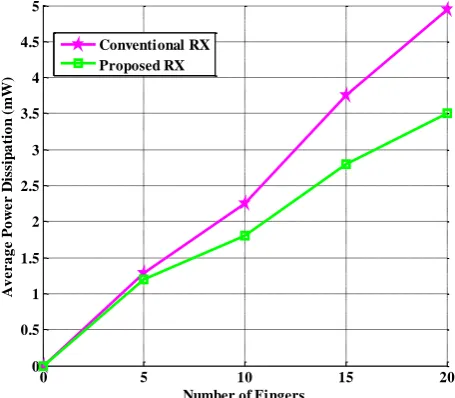
Moreover, the plot of power dissipation for different Rake Receiver (RX) schemes depicted in Fig. 3 buttress the result that the proposed receiver comparatively dissipates low power with increase in the number of Rake receiver’s fingers. From the plot, with 10 fingers of the proposed scheme, 1.8mW average power is dissipated while for the same number of fingers of the conventional scheme, 2.3mW is dissipated.
0 5 10 15 20
0 0.5 1 1.5 2 2.5 3 3.5 4 4.5 5
Number of Fingers
A
v
e
r
a
g
e
P
o
w
e
r
D
is
si
p
a
ti
o
n
(
m
W)
Conventional RX Proposed RX
Figure 3. Comparisons of power dissipation for different Rake receiver (RX) schemes.
VI. CONCLUSION
REFERENCES
[1] R. Manish and S. S. Amanpreet, “Performance evaluation of rake and pre-rake receiver for a wireless DSCDMA system,”
International Journal of Engineering and Technology, vol. 2, no. 7, pp. 1333-1335, Jul. 2012.
[2] G. E. Bottomley, T. Ottosson, and Y. E. Wang, “A generalized rake receiver for interference suppression,” IEEE Journal on Selected Areas in Communications, vol. 18, no. 8, pp. 1536-1545, Aug. 2000.
[3] T. Ojanperä and R. Prasad, Wideband CDMA for Third Generation Mobile Communications,Norwood MA, USA: Artect House Inc., 1998, pp. 439.
[4] H. Lee and D. S. Ha, “An area and power efficient rake receiver architecture for DSSS systems,” in Proc. 2003 International SOC Conf., Portland, Oregon, 2003, pp. 103-106.
[5] G. Fock, J. Baltersee, P. Schulz-Rittich, and H. Meyr, “Channel tracking for rake receivers in closely spaced multipath environments,” IEEE Journal on Selected Areas in Communications, vol. 19, no. 12, pp. 2420-2431, Dec. 2001. [6] Y. Sung, Y. Lim, L. Tong, and A. Veen, “Signal processing
advances for 3G WCDMA: From rake receivers to blind techniques,” IEEE Communications Magazine, vol. 47, no. 1, pp. 48-54, Jan. 2009.
[7] P. Kumar, B. K. Kanaujia, and M. Gangadharappa, “BER performance analysis of rake receiver in Rayleigh fading channel for UMTS environment,” International Journal of Engineering Science and Technology, vol. 2, no. 6, pp. 1690-1698, Jun. 2010. [8] K. Ohno, M. Itami, and T. Ikegami, “Iterative rake reception
scheme using multi-carrier pulse for pulse based UWB system,” in
Proc. 2013 IEEE International Conference on Ultra-Wideband,
Sydney, NSW, 2013, pp. 249-254.
[9] J. Gu and R. C. de Lamare, “Joint parallel interference cancellation and relay selection algorithms based on greedy techniques for cooperative DS-CDMA systems,” in Proc. 2014 IEEE International Conference on Acoustics, Speech and Signal Processing, Florence, Italy, 2014, pp. 2754-2758.
[10] T. S. Rappaport, Wireless Communications Principles and Practice,New Jersey: Prentice Hall, 1996, pp. 336-338.
[11] K. M. Krishna, A. Mitra, and C. Ardil, “A simplified single correlator rake receiver for CDMA communications,”
International Journal of Electrical, Robotics, Electronics and Communications Engineering, vol. 4, no. 2, pp. 13-16, 2010. [12] B. S. Kim, J. Bae, L. Song, S. Y. Kim, and H. Kwon, “A
comparative analysis of optimum and suboptimum rake receivers in impulsive UWB environment,” IEEE Trans. on Vehicular Techn., vol. 55, no. 6, pp. 1797-1804, Nov. 2006.
[13] I. A. Alimi, J. J. Popoola, K. F. Akingbade, and M. O. Kolawole, “Performance analysis of bit-error-rate and channel capacity of MIMO communication systems over multipath fading channels,”
International Journal of Informatics and Communication Technology, vol. 2, no. 2, pp. 57-63, Jul. 2013.
[14] J. Zhan, B. Nazer, U. Erez, and M. Gastpar, “Integer-Forcing linear receivers,” in Proc. 2010 IEEE International Symposium on Information Theory Proceedings, Austin, TX, 2010, pp. 1022-1026.
[15] W. Qu, K. Niu, Z. He, and J. Lin, “A low complexity approach of chip-level MMSE equalization,” in Proc. 2013 IEEE 5th International Symposium on Microwave, Antenna, Propagation and EMC Technologies for Wireless Communications, Chengdu, 2013, pp. 500-504.
[16] J. Ming and L. Hanzo, “Multiuser MIMO-OFDM for next-generation wireless systems,” Proceedings of the IEEE, vol. 95, no. 7, pp. 1430-1469, Jul. 2007.
[17] V. Namboodiri, H. Liu, and P. Spasojevic´, “Successive interference cancelation and MAP decoding for mobile MIMO OFDM systems and their convergence behavior,” EURASIP Journal on Wireless Communications and Networking, vol. 2012, pp. 1-12, Oct. 2012.
Alimi Isiaka Ajewale received B.Tech.
(Hons) and M.Eng. in Electrical and Electronics Engineering respectively from Ladoke Akintola University of Technology, Ogbomoso, Nigeria in 2001, and the Federal University of Technology, Akure, Nigeria in 2010. He is a Lecturer in the Department of Electrical and Electronics Engineering, Federal University of Technology, Akure, Nigeria. He has published 3 refereed international journals. He is currently pursuing his PhD at the Federal University of Technology, Akure, Nigeria. He has extensive experience in radio transmission, as well as in Computer Networking. His areas of research are in Computer Networking and Security, Advanced Digital Signal Processing and Wireless communications. He is a COREN (Council for the Regulation of Engineering in Nigeria) registered engineer, a member of the Nigerian Society of Engineers (NSE).
Jide Julius Popoola received B. Eng. (Hons)
and M.Eng. (Communication) degrees from the Federal University of Technology, Akure, Nigeria in 1999 and 2003 respectively and PhD from the School of Electrical and Information Engineering, University of the Witwatersrand, Johannesburg, South Africa in 2012. He is a Lecturer in the Department of Electrical and Electronics Engineering, Federal University of Technology, Akure, Nigeria. He has published over 10 refereed international journals and conference papers. He is a member of IEEE. His research interests are in signal fading mitigation, radio spectrum management and cognitive radio technology.
Kayode Francis Akingbade received Master
of Engineering (MEng) and PhD degrees in Electrical Engineering (Communication) from the Federal University of Technology, Akure, Nigeria in 2003 and 2011, respectively. He is a Lecturer in the Department of Electrical and Electronics Engineering, Federal University of Technology, Akure, Nigeria. He has published over 4 refereed international journals and conference papers. His research interests are in Biomedical Engineering and Satellite Communication.