ISSN1392-2785ENGINEERINGECONOMICS.2005.NO 5(45)
THEECONOMICCONDITIONSOFENTERPRISEFUNCTIONING
The Development of Enterprises Network in a Region: Theoretical Aspects
Egl
ė
Kazlauskien
ė
1, Vilma Tamulien
ė
2, Raimonda Minkut
ė
-Henrickson
11 Kauno technologijos universitetas K. Donelaičio g. 20, LT-44239, Kaunas
2 VU Kauno humanitarinis fakultetas Muitinės g. 8, LT-44280, Kaunas
The article presents theoretical substantiation of the aspects enterprise network development: to prove, on the one hand, that peculiarities of enterprise network forma-tion and funcforma-tioning influence the possibilities of its devel-opment in a region, on the other hand, the develdevel-opment of enterprise network gives positive incentives for the region to renovate as well as it influences regional development.
Theoretical premises of enterprise network formation and development are related to the statements and atti-tudes developed in the theories of interorganisational re-lationship network and clusters. The discussed theories are not analysed completely, here are presented only the statements that allow best disclosing the theoretical premises of enterprise network formation and develop-ment in a region. Different definitions of enterprise net-work are formulated in the process of theory and concep-tion analysis, causal coherences of enterprise network and regional development are considered.
The theoretical analysis has shown that the positive regional development can depend on interorganisational relationship, which, by increasing flexibility of territorial structure of enterprises, determine that partnership of en-terprises (long-term cooperation) positively influences the development of the region when it is treated as the network of enterprises well accommodating to the needs of local community.
Keywords: network, enterprises network, interorga-nisational relationship, clusters, development of region.
Introduction
Tendencies of post-industrial society development change the character of economics. The long-prevailed so-lution of regional problems, when the establishment of new economic objects and improvement of infrastructure condi-tions were considered the greatest contribution into re-gion’s development, becomes insufficient. The develop-ment of a region can be defined by the conditions of both life quality improvement, and economy growth. The level of the development of enterprises network in a region be-comes of great importance from this viewpoint. The devel-opment of enterprises network, stressing its role in a post-industrial society, growth of productivity and competitive-ness, makes influence upon the economic development of different levels of regions (district, city, etc.). The network of enterprises as a new form of enterprises interaction and
organisation of economic activity is the reply to globalisa-tion tendencies, orientaglobalisa-tion to knowledge economy, devel-opment of services, and fast changes of the environment in the processes of regional development. In some territories the development of enterprises network is affected by fa-vourable (stimulating), and in the others – by opponent (suppressive) environments; thus the conditions for devel-opment in various regions can be unequal.
From the standpoint of interorganisational relation-ship, the network of enterprises is treated not only as the system of enterprises. It forms on the basis of long-term relationship of partnership, cooperation among separate but related and influencing enterprises (suppliers, agents, competitors, etc.). Studies of scientific literature showed that the development of enterprises network is not theo-retically and empirically analysed enough in the context of regional development; it involves wide complex of theoretical premises of interorganisational relationship.
The research goal – to distinguish basic theoretical premises, which enable the substantiation of the features of formation, functioning and development of enterprises network in the region from the standpoint of interorgani-sational intercourse.
Conceptual conditions of the formation and devel-opment of enterprises network, which determine peculi-arities of interaction and enable answering the following research aims:
• the networks of enterprises based formation on in-terorganisational relationship form,
• differences between the networks of enterprises based on interorganisational relations and other forms of organisation of economic activity,
• the importance of the networks of enterprises based on interorganisational relations for eco-nomical and social development of regions, • the definition of the network of enterprises
formu-lation, referring to the conception of interorganisa-tional relation network.
The research method: system, logic and compara-tive literature analysis of scientific conceptions.
The Networks Based formation on
Interor-ganisational Relationship Form
K.G. Provan (1993), G. Thompson, J. Frances, R. Le-vačic, J. Mitchell (1993), E. M. Bergman, G. Maier, F. Tödling (1993), H. Hakansson, J. Johanson (1989) ana-lysed the interaction of participants of network of inter-organisational relationship as well as their behaviour rea-sons in detail. According to them, the network of enter-prises interorganisational relationship is based on the sys-tem of related enterprises of production, supply, distribu-tion, use of goods and services. In this network the activ-ity distribution determines interdependence of enter-prises. The activity in the network is not coordinated ac-cording to the common plan formed in the hierarchy of an organisation or it is conditioned by price mechanism as in the models of free market, and it refers to partnership of enterprises.
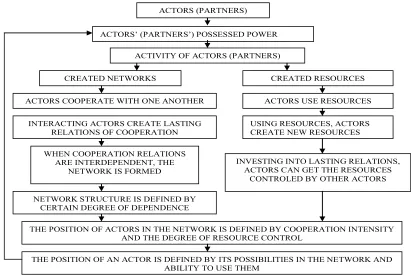
In formation of the network of interorganisational re-lationship (Fig. 1), every enterprise chooses partners in the market freely, but, wishing to find external sources of resources and possibilities for realisation of goods, it has to cooperate with other enterprises, i.e. to make contacts. In order to consolidate the relationship and to develop them, a lot of time, efforts and resources is necessary, and
this does not allow simple and rapid change of partners (transactional costs). Thus every enterprise of the net-work directly communicates with clients, suppliers, part-ners, and sometimes competitors. It is evident that the po-sition of the enterprise in the network is characterised by intensity of cooperation relationship (interaction) and the level of resource control, what determines its possibilities in the network as well as the ability to use them.
In answering the question how the networks of enter-prises based on interorganisational relations form, it is necessary to single out the aspects of inter-adaptation of enterprises and formation of position in the network. In fact, intercourse of enterprises is reciprocal orientation of two enterprises. It means that one company is ready to cooperate with another and it believes that this party will do the same. Intercourse of cooperation forms in the process of resource exchange taking place between the partners. Partners’ interests are an important part of the exchange process. Lasting interrelationship can appear when the partners perceive certain complexity and het-erogeneity of the exchange (G. Thompson, J. Frances, R. Levačic, J. Mitchell (1993)).
ACTORS (PARTNERS)
ACTORS’ (PARTNERS’) POSSESSED POWER
ACTIVITY OF ACTORS (PARTNERS)
CREATED NETWORKS CREATED RESOURCES
ACTORS COOPERATE WITH ONE ANOTHER ACTORS USE RESOURCES
INTERACTING ACTORS CREATE LASTING
RELATIONS OF COOPERATION USING RESOURCES, ACTORS CREATE NEW RESOURCES
WHEN COOPERATION RELATIONS ARE INTERDEPENDENT, THE
NETWORK IS FORMED
INVESTING INTO LASTING RELATIONS, ACTORS CAN GET THE RESOURCES
CONTROLED BY OTHER ACTORS
NETWORK STRUCTURE IS DEFINED BY CERTAIN DEGREE OF DEPENDENCE
THE POSITION OF ACTORS IN THE NETWORK IS DEFINED BY COOPERATION INTENSITY AND THE DEGREE OF RESOURCE CONTROL
THE POSITION OF AN ACTOR IS DEFINED BY ITS POSSIBILITIES IN THE NETWORK AND ABILITY TO USE THEM
Figure. Formation of intergonisational relationship network (O.J. Sorrensen, 1996)
Onetime exchange is a constituent of the formation of the interorganisational relation network of enterprise, when partners gradually develop mutual confidence. Business exchange between a supplier and a client in-volves the notion of social exchange too. Social exchange means that a human element is important for long-term cooperation relationship, though technical, logistics, ad-ministrative and time elements are not devalued. Ex-change process is the process not only of learning but also of adaptation. The exchange usually causes a lot of problems, when partners do not fit each other, or a part of efforts are wasted for eliminating incongruities. The
con-fidence and mutual cognition, which can involve re-sources, strategies and needs of partners as well as form the possibilities of the enterprise that determine the posi-tion in the network. The position defines relations of the enterprise with other enterprises; it is the result of earlier activity of the enterprise (as well as of other enterprises) and creates the basis for further development possibilities of the enterprise in the network. Referring to F. Janszen (2000), it is possible to state that position of a company depends on how the enterprise controls internal and ex-ternal resources as well as it is able to turn them into products successfully. Resource control is closely related to the position of a company in the network. This means that resource control and ability to turn them into prod-ucts of higher value (to give them surplus value) deter-mines enterprise’s power and position in the network, what, in its turn, influences the possibility to control re-sources. As time and efforts are necessary for consolida-tion of the posiconsolida-tion, and the posiconsolida-tion determines possibili-ties and limitations of strategic development of the enter-prise in the future, it is possible to treat the position of the enterprise as partly controlled non-material assets (resources) of the market.
It is possible to state that enterprises are the parts of the networks based on interorganisational relationship, which allows transforming resources into service prod-ucts more effectively. The relative position that an enter-prise takes in the network can provide certain advantage in respect of other interacting enterprises due to more op-erative access to new information or knowledge, new ma-terials, services or better financing sources. However the network can limit the mobility of an enterprise, as net-work partners anticipate certain behaviour. The space of manoeuvres, which the enterprise possesses, depends on its power or influence upon the network partners. There-fore the analysis of interorganisational relationship net-work would involve not only the identification of part-ners, determination of critical parameters of their interre-lationship (e.g., resource exchange, cooperation dura-tion), but also the research of participants trust, power in respect of other participants or influence upon them.
Differences between the networks of
enterprises based on interorganisational
relations and other forms of organisation of
economic activity
The main question is how do the networks of enter-prises based on interorganisational relations differ from other forms of organisation of economic activity? (What are peculiarities of their functioning?)Analysing the de-velopment of interorganisational relationship networks from historical retrospection, R. S. Achrol and P. Kotler (1999) drew the conclusion that, when industrial revolu-tion took place, hierarchy-related enterprises changed in-dependent enterprises freely functioning in the market. However, when the technologies used for releasing pro-duction (or providing services) became very complicated, the expenditure of the control of all market fields became too large for them. In the knowledge and progress-based environment large, vertically integrated, hierarchy-related enterprises became ineffective, too dependent on
differ-ent specialised structures using both progressive, and non-progressive technologies. W. Powell (1991) states that the network structure as alternative postbueraucratic form of business organisation is between the market and hierarchy.
The market functions as coordinative mechanism, which gives rationality and consistency for the actions of individuals or enterprises. According to B. A. Toffler, J. Imber (1994), the market – is an economic system, in which supply and demand forces of certain goods or ser-vice manifest. It consists of clients, suppliers, distribution channels, mechanisms of price-fixing and transaction-making, it allows choosing, gives a possibility to profit by the occasion, to warrant fast and simple communica-tion.
In the classical market, the information is got freely, potential buyers or sellers easily enter the market and leave it, it is proceeded from one transaction to another without great outcomes. However, when changes become frequent and complicated, the costs of transaction man-agement and control increase, determining the need for structural changes and new forms of activity organisation. Provan G.K. (1993) states that in the hierarchy-based business, individual employees work according to admin-istrative procedures, their positions are determined by employees of higher managerial level. The essence of management of these enterprises – is to rationally distrib-ute tasks, to determine positions of employees, to create reliable system of orders. As tasks become very special-ised, the activity is also very related. Thus a large verti-cally integrated enterprise distinguishes in routine, per-sonal expectations and detailed specialised knowledge. High-volume, repeated-operation needs require constant attention of managerial group. In such a case, the advan-tage of hierarchical organisation is a) its reliability, i.e. the ability to produce plenty of goods of uniform quality and to provide a lot of services; and b) accountability, i.e. the ability to analyse whether the resources were opti-mally used.
Thus clear functions of subdivisions, clear structure of subordination, detailed mechanisms of messages, for-mal procedures of decision-making are characteristic for hierarchical business organisation; it is especially fit to mass production and distribution. But when such business faces big fluctuations of the need (demand) as well as un-expected changes, it becomes ineffective.
con-tracts (ex ante costs) and supervise that they would be ful-filled (ex post costs). In respect of all these approaches it is attempted to diminish uncertainty and increase the control of their transactions. O. Williamson assumes that in the firm’s life there is a moment when transaction costs of trade with external firms become too big and can be de-creased by forming networks of interorganisational rela-tionship. From this standpoint, the networks of interorgani-sational relationship of enterprises/organisations, referring to W. Powell (1991), S. P. Robbins, R. Stuard-Kotze (1990), are possible to be called a new form of
organisa-tion of economic activity.
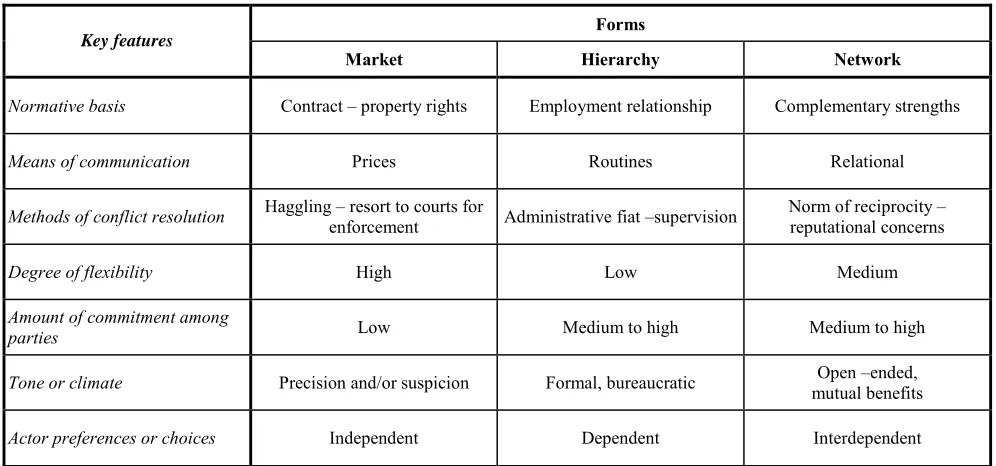
The activity based on market mechanism, hierarchy and network structures does not in fact involve the analy-sis of all economic relations, but it allows substantiating the reasons of formation of complicated relations, as well as business organisation of a different type in the modern world. Table 1 presents basic peculiarities of expression of business based on market, hierarchy and network. In market transactions the exchange normative basics of transactions and ways of conflict resolution are condi-tioned by law and order sanctions.
Table 1 Stylised comparison of forms of economic organization
Forms
Key features
Market Hierarchy Network
Normative basis Contract – property rights Employment relationship Complementary strengths
Means of communication Prices Routines Relational
Methods of conflict resolution Haggling – resort to courts for enforcement Administrative fiat –supervision Norm of reciprocity – reputational concerns
Degree of flexibility High Low Medium
Amount of commitment among
parties Low Medium to high Medium to high
Tone or climate Precision and/or suspicion Formal, bureaucratic mutual benefits Open –ended,
Actor preferences or choices Independent Dependent Interdependent
Source: THOMPSON G., FRANCES J., LEVAČIC R., MITCHELL J. Markets Hierarchies& Networks edited by SAGE Publications London. Newbury Park. New Delhi 1993. 269 p.
In the network the transactions are based on the norms accepted by all participants, but necessarily juridi-cal. In the market the exchangeable value of goods (price) is more important than the relation between transaction parties. Meanwhile in the networks the very relations are treated as if they were consumer goods. In the formal hi-erarchical structure of management communication is based on working agreements, and relationship is formed on the basis of common position.
Participation in the networks most frequently gives enterprises more stability than market transactions, and this is especially important in the context of R&D and in-novations. On the other hand, networks give more flexi-bility than internal organisational hierarchy can give. Consequently, participation in networks betters the ability to accept innovations and to successfully adjust to chang-ing conditions of the environment.
In the market business is organised seeking to make appropriate transactions under fast changing conditions. Commitments and reciprocal trust are the most important when exchanging goods (resources) in the networks. In the hierarchy, communication or necessary changes can be limited or completely eliminated due to personal inter-ests of managers. Here internal communication takes place among parties, which got some experience, know
each other well, as well as possess specific knowledge necessary for a company. Thus for the hierarchy-related companies the interdependence is characteristic, alike network organisations.
Referring to W. Parsons (2001), it should be empha-sised that the forms of activity organisation cannot be re-solved into market, hierarchical and network organisa-tions, among them there are no strict margins, and any organisation involves all the elements. According to the author, supply systems – are perceived as the mix of all three forms of activity, they can be presented as trinomial ratio, the content of which changes in the time and space. As the mix is not uniform in all organisations, the goal is to identify the caharacter of the mix (activity orientation), but not to put organisations on to shelves.
The importance of the networks of enterprises
based on interorganisational relations for
economical and social development of regions
Berg-man, G. Maier, F. Tödling (1993) the conception of the network of interorganisational relations is developed in the context of regional development. According to the above-mentioned authors, consolidation of enterprises of different activity nature into the network involves devel-opment process at local, national and/or international level. The researchers assume that in the process of re-gional development cultural, technological, institutional, political and resource flows’ exchange take place in the networks of enterprises.
Regional development, to which it is characteristic that, when new forms of economic activity organisation (systems, network) are created, the region changes quali-tatively, can be related to the development of the network of enterprises. The participation in the network can be-come strong and critical factor and incentive of develop-ment, as it allows both certain network of enterprises, and the region, where it is situated, to mobilize resources, to get important information and knowledge. In this case cooperation of participants, inter-compatibility of mutual and proprietary interests of participants, as well as net-work accessibility (attainability) and other features of its expression, as well as advantages allow orienting to more flexible model of regional development.
It is possible to state that networks of interorganisa-tional relationship become the prevailing form of eco-nomical activity organisation, enabling enterprises of the region to take certain position in the enterprises’ network of the same or different sector (activity nature), on the one hand, keeping certain part of one’s activity functions, on the other hand, transferring some functions (e.g., sup-ply, distribution, support, finance management) to other enterprises. In this way independent specialised but rela-tion-related enterprises, which provide functional services – frequently even to the sectors of the same group of ser-vices, – emerge. It is possible to distinguish (1) expres-sion features and (2) advantages of networks of enter-prises, which have a very great importance for renewal and development of regions in the future. (1) From the standpoint of interorganisational relationship, the synergy effect emerging due to surplus value, flows of easier ob-tained, more effectively distributed and used resources both in the system (network of enterprises), and beyond its borders (networks of regions, groups of enterprises’ networks), is characteristic to the network as adaptive business system. (2) Lasting economic benefit of the network manifests in diminishing large transaction costs. Participation in networks, relationship and cooperation with other enterprises helps to overcome limitations of localisation (problems of territory), gives the enterprises in the region more stability and flexibility.
Having discussed the most important theoretical premises of formation and development of enterprises’ network in the context of the conception of interorganisa-tional relations, it is evident that the network of prises could be defined as follows: the network of enter-prises is an adaptive system, which emerges when long-term cooperation relationship is made between enter-prises in order to avoid transaction costs related to mar-ket uncertainty and inflexibility of hierarchy.
The conception of interorganisational relationship of enterprises network as the object of scientific analysis is
particularly important at the juncture of economics and management sciences; it has recently been developing, it is closely related to other theories, which refers to it and expands it by revealing the particularity of groups of en-terprises and impact upon regional development disclos-ing the particularity of the groups of enterprises related by the network in the territory and influence upon re-gional development.
Clusters and their importance for the development of enterprise network. Analysing the role of enterprises’ network formation and development for the development of regions from the viewpoint of interorganisational rela-tionship, the scientific contribution of D.J. Ketchen, Ch.C. Snow, V.L. Hoover (2004), M. Porter, S. Chowd-hury, D. Keeble and F. Wilkinson, R. Waters and H. Lawton Smith, etc., to the conception of the network of interorganisational relationship, which was extended con-sidering territorial principles of activity organisation, should be emphasised. R. Waters and H. Lawton Smith (2002) assume that the importance of territory for the spread of innovations and learning of organisa-tions/enterprises is very great when knowledge and other resources are concentrated in certain localities.
S. Chowdhury et al. (2000) think that networks of in-terorganisational relationship (the author gives the term creative network) become geographical networks when such features of the network as creativity and innova-tions, certain geographical localisation of the network are stressed.
One of the forms of the network – cluster – exists in geographical borders of the region where close location of the enterprises allows creating of the forms of appro-priate interaction and increases the frequency of enter-prise’s contacts as well as cohesion. According to D. Keeble and F. Wilkinson (1999), an enterprise can be a partner of the other enterprise in one cluster but a petitor – in another cluster. In other words, a lot of com-plicated and different types of interrelationship can to-gether exist. As M. Porter (2001) states, in a certain terri-tory clusters – groups of enterprises related by networks – are found in branches, to which high technologies are characteristic, as well as in such traditional branches as industry or the field of providing services, both in large, and in local business fields, for example restaurant busi-ness. They exist in large-scale and small-scale econom-ics, urban and rural localities as well as different geo-graphical levels. Borders of clusters seldom enough cor-respond classification standards of the branches. Due to the reason that groups of these enterprises are often at-tributed to different traditional categories of branches or services, important combinations of groups can be rec-ognisable wrongly or not recrec-ognisable at all. The borders of clusters can change depending on the emergence of new enterprises or branches, contraction or reduction of present branches, as well as on development and changes of local organisations.
Why is it better to look at economics through clusters but not through grouping of traditional branches and sec-tors such as industry and service enterprises? It is be-cause:
in-terchange technologies, skills, information, market ex-perience, as well as understand the needs of client enter-prises;
Secondly, the development depends on productivity, the factors influencing, which do exists and are improved in a certain locality. Thus the aim is to increase produc-tivity of all branches, to heighten welfare both directly, and indirectly, as the increase of the productivity in one field of activity raises the productivity of all other fields of activity. Consequently regional development depends on the productivity of the field, the enterprises of which function in it.
Thirdly, competitive advantages of the group of en-terprises related by the network are valid in all fields. Re-cently the nature of agglomeration economics has changed very much: it became more important at the level of the group of enterprises related by networks in a certain territory, but not only in the branch narrowly de-fined.
Contemporary scientific literature pays a lot of atten-tion to competitiveness. The competitiveness is defined as ability to produce goods or services, meeting market requirements and warranting the growth of country’s and its population’s welfare (F.Bradley, 1995), in addition, as ability of enterprises, regions and nations to keep high level of income and employment under the conditions of international competition (H. Wienert, 1997). It is possi-ble to consider business competitiveness from the posi-tions of both a particular enterprise, and economical branches or country economics (H. Hughes, 1989), as well as enterprises network. These levels are only rela-tively independent, as their internal and external relation-ship is close enough. Thus high level of competitiveness of enterprise, economy field or national economics can be
reached by developing networks of interorganisational re-lationship in a specific territory. According to M. Porter (2001), this theory of development, on one hand, analyses how competitiveness of enterprises and regions is influ-enced by close position of enterprises/organisations re-lated by economical relationship in particular geographi-cal zone, on the other hand, it states that increasing trust, benefit and self-discipline due to constant interaction and influence of mutual understanding in a region or city evi-dently contributes to the interaction of the group of enter-prises related by networks, increases productivity, in-duces innovations and finally emergence of new types of business.
The theory of interorganisational relationship net-work can contribute to the understanding how clusters function in the territory and how their activity can be-come more productive. Clusters give new possibilities to investigate the mechanisms, by means of which the net-works, social capital and activity of the society influence competition and market. Thus the theory of clusters helps to reveal the origins of network structure, the essence of the activity in the relationship- and territory-based net-work as well as the interface between netnet-work character-istics and results of its functioning.
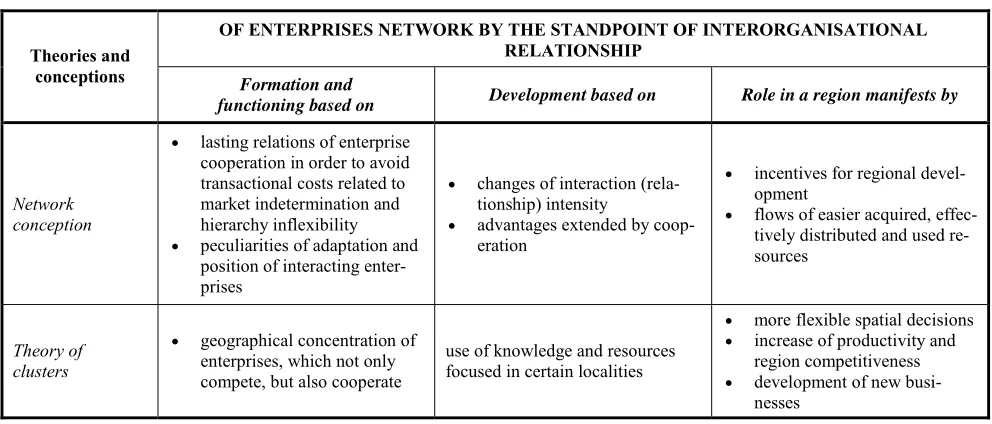
From this standpoint the network of enterprises is the structure increasing the competitiveness of the region and productivity of enterprises, it formed having enterprises and their groups being situated (not necessarily on the ba-sis of economical branches) in the territory of a particular region and/or on the basis long-term cooperation relation beyond its borders. It should be stressed that in every theory of different topic more or less different features of formation, functioning, development and influence upon the region prevail (Table 2).
Table 2 The features defining formation, functioning,
development of enterprises network and influence upon regional development
OF ENTERPRISES NETWORK BY THE STANDPOINT OF INTERORGANISATIONAL RELATIONSHIP
Theories and
conceptions Formation and
functioning based on Development based on Role in a region manifests by
Network conception
• lasting relations of enterprise cooperation in order to avoid transactional costs related to market indetermination and hierarchy inflexibility
• peculiarities of adaptation and position of interacting enter-prises
• changes of interaction (rela-tionship) intensity
• advantages extended by coop-eration
• incentives for regional devel-opment
• flows of easier acquired, effec-tively distributed and used re-sources
Theory of clusters
• geographical concentration of enterprises, which not only compete, but also cooperate
use of knowledge and resources focused in certain localities
• more flexible spatial decisions
• increase of productivity and region competitiveness
• development of new busi-nesses
Conclusions
Occupying insufficiently defined and explored niche in the system of economical, regional and managerial sci-ences, the conception of the development of enterprises’
network unites wide complex of theoretical premises of interorganisational relationship.
mecha-nisms, interrelationship and possibilities of self-organisation of business systems were actively develop-ing, allows to found in principle new tendencies of net-work formation of modern enterprises based on relations in processes of regional development.
Referring to the theory of clusters it is possible to state that the competitiveness of enterprises and regions is influ-enced by the close position of enterprises/organisations re-lated by economical relations in a particular territory. In-creasing trust, profit due to reciprocal understanding and influence of lasting relations of cooperation in the region or city influences the interaction the group of enterprises related by networks and the development of enterprises network in the region. This theory contributes to revealing the essence of activity in the network based on interorgani-sational relationship and territory as well as the coherence between the network characteristics and such results of its functioning as productivity and competitiveness.
Thus positive regional development can depend on interorganisational relationship, which, by increasing flexibility of territorial structure of enterprises, determine that partnership of enterprises (long-term cooperation) positively influences the development of the region when it is treated as the network of enterprises well accommo-dating to the needs of local community. The networks of enterprises based on the partnership stimulate the activity not only of the enterprises but also of most institutions supporting business and related to the enterprises, ori-ented to certain sector or geographical place of the activ-ity, having the possibility to form the market as well as provide products and services.
References
1. Barringer, B.R. Walking a Tightrope: Creating Value Through
Inter-organizational Relationships / B.R.Barringer, J.S.Harrison // Journal of Management, 2000, Vol.26, p. 367–403.
2. Bergman, E.M. Regions Reconsidered Economic Networks,
Innova-tion, and Local Development in Industrialized Countries / E.M.Bergman, G. Majer, F.Mansell. F.Todling, 1993. 312 p.
3. Bradley, F. International Marketing Strategy. London: Prentice Hall,
1995. 650 p.
4. Chowdhur, Y.S. Management 21C / Y.S. Chowdhur, P. Senge, K.
Kaufer, R. Kanter // Financial Times. Prentice Hall, 2000, 448 p.
5. Dacin, T.M. The Embeddedness of Organizations: Dialogue and
Di-rections / T.M. Dacin, M.J.Ventresca, B.D.Beal // Journal of Man-agement, 1999, Vol.25, p. 317–356.
6. Dess, G.G. Conducting and Integrating Strategy Research at the
In-ternational, Corporate and Business Levels: Issues and Directions / G.G.Dess, A.Gupta, J.F.Hennart, Ch.W.Hill // Journal of Manage-ment, 1995, Vol. 21, p.357–393.
7. Hakansson, H. A model of industrial networks / H.Hakansson,
J.Johanson / In B.Axelsson, G.Easton. Industrial networks: a new of re-ality. London: Routledge, 1992, p. 28–36.Hughes, H.L. Regional
De-velopment and Planning for the 21st Century. London, 1988. 221 p.
8. Janszen, F. The Age of Innivitation. Financial Times Prentice Hall,
2000. 308 p.
9. Keeble, D. Collective learning and knowledge development in the
evolution of regional clusters of high technology SMES in Europe / D.Keeble, F.Wilkinson // Regional Studies, 1999, Vol.33, 295 p.
10. Ketchen, D.J. Research on Competitive Dynamics: Recent
Accom-plishments and Future Challenges / D.J.Ketchen, Ch.C.Snow, V.L.Hoover // Journal of Management, 2004, Vol. 30, p.779–804.
11. Kotler, Ph. Marketing in the Network Economy / Ph.Kotler, R.Achrol
// Journal of Marketing, 1999, Special Issue, 286 p.
12. Lyles, M.A. Venture Survival in a Transitional Economy / M.A.
Lyles, T.Saxton, K.Watson // Journal of Management, 2004, Vol. 30, p. 351–375.
13. McElroy, J.C. Attribution Theories of Leadership and Network
Analysis / J.C.McElroy, C.B.Shrader // Journal of Management, 1986, Vol.12, p. 351–362.
14. Parsons, W. Viešoji politika: politikos analizės teorijos ir praktikos
įvadas. Vilnius: Eugrimas, 2001. 607 p.
15. Porter, M. Konkurencija. Sankt Peterburg, Moskva, Kijev: Izdatelskij
dom, Viljams, 2001. 495 p.
16. Provan, K.G. Embeddedness, Interdependence and Opportunism in
Organizational Supplier-Buyer Networks // Journal of Management, 1993, Vol. 19, p.841–856.
17. Powell, W. Neither Market nor Hierarchy: Network Forms of
Or-ganization / In G.Thompson G.Frances, R.Levacis, J.Mitchell. Mar-kets Hierarchies & Networks. SAGE Publications, London: Newbury Park, New Delhi, 1993. 244 p.
18. Robbins, S.P. Mangement / S.P.Robbins, R.Stuard-Kotze.
Scarbor-ough: Prentice Hall Canada, Inc., 1990. 796 p.
19. Simsek, Z. Inter-Firm Networks and Entrepreneurial Behavior: A
Structural Embeddedness Perspective / Z.Simsek, M.H. Lubatkin, W. Floyd // Journal of Management, 2003, Vol. 29, p. 427–442.
20. Sorensen, O.J. The Network Theory: an Introduction to Its
Concep-tual World // International business economics, 1996, Vol. 8, p.1–16.
21. Thompson, G. Markets Hierarchies & Networks / G.Thompson,
J.Frances, R.Levacic, J.Mitchell. SAGE Publications, London: New-bury Park, New Delhi, 1993. 244 p.
22. Toffler, B.A. Dictionary of Marketing Terms / B.A. Toffler, J.Imber.
2nd ed. Barron’s Educational Series, Inc., 1994. 579 p.
23. Waters, R. Regional Development Agencies and Local Economic
Development: Scale and Competitiveness in High-technology Ox-fordshire and Cambridgeshire / R.Waters, L.H.Smith // European Planning Studies, 2002, Vol.10, No 5, p.633–648.
24. Weinert, H. Regulation and Industrial Competetiveness: a
Perspec-tive for Regulatory Reform. OECD, 1997.
25. Williamson, O.E. Hierarchies, Markets and Power in the Economy:
An Economic Perspective // Industrial and Corporate Change, 1995, Vol. 4, No 1, p.21–49.
26. Williamson, O.E. Tranzaction Cost Economics and Organization
Theory // Industrial and Corporate Change, 1993, Vol. 2, issue 2, p.107–156.
Eglė Kazlauskienė, Vilma Tamulienė, Raimonda Minkutė-Henrickson
Įmonių tinklo plėtros regione teoriniai aspektai
Santrauka
Straipsnyje teoriškai pagrindžiami įmonių tinklo plėtros aspektai
regione: siekiama įrodyti, kad, viena vertus, įmonių tinklo
formavi-mosi bei funkcionavimo savitumai daro įtaką tinklo plėtros regione
galimybėms, kita vertus, įmonių tinklo plėtra teikia pozityvių paskatų
regionui atsinaujinti ir veikia regiono plėtrą. Remiantis mokslinės
lit-eratūros studijomis, atskleidžiamas skirtingas įmonių tinklo ir jo
plėtros supratimas. Įmonių tinklo, kaip ekonominės veiklos
organi-zavimo formos, plėtra sąlygojama lengviau įgyjamų, efektyviau
pasiskirstančių ir panaudojamų išteklių srautų, įmonių sąveikos,
lemiančios kompleksą pozityvių įmonių tarporganizacinių ryšių
raiškos požymių, regione pokyčių. Įmonių tinklas, kaip nauja įmonių
sąveikos bei ekonominės veiklos organizavimo forma, yra atsakas į
globalizacijos tendencijas, orientaciją į žinių ekonomiką, paslaugų
plėtrą, sparčius aplinkos pokyčius regionų raidos procesuose.
Tarpor-ganizacinių ryšių požiūriu įmonių tinklas traktuojamas ne tik kaip
įmonių visuma. Jis susiformuoja ilgalaikių partnerystės,
bendradar-biavimo ryšių tarp atskirų, tačiau susijusių ir viena kitai darančių
įtaką, įmonių (tiekėjų, tarpininkų, konkurentų) pagrindu. Įmonių
tin-klo formavimosi priežastys, jo raiškos požymiai ir plėtotės kryptys
mokslinio tyrimo teoriniu lygmeniu tampa svarbiu tyrimo objektu.
Mokslinės literatūros studijos (Simsek, Lubatkin, Floyd, 2003;
Bar-ringer, Harrison, 2000; Sorrensen, 1996; Dess, Gupta, Hennart, Hill,
1995; Provan, 1993; Thompson, Frances, Levačic, Mitchell, 1993;
Bergman, Maier, Tödling, 1993; Hakansson, Johanson, 1989 ir kt.)
parodė, kad įmonių tinklo plėtra regiono raidos kontekste
nepakank-amai teoriškai ištirta ir apima platų tarporganizacinių ryšių teorinių
kokie tarporganizaciniais ryšiais pagrįstųįmonių tinklų formavimosi
bei funkcionavimo bruožai veikia regionų pozityvią raidą.
Tyrimo tikslas – išskirti pagrindines teorines prielaidas,
leidžiančias pagrįsti įmonių tinklo formavimosi, funkcionavimo ir
plėtros regione bruožus tarporganizacinių ryšių požiūriu.
Tyrimo metodai – mokslinėje literatūroje paskelbtų koncepcijų
sisteminė, loginė ir lyginamoji analizė.
Tarporganizacinių ryšių tinklo koncepcija yra esminė ir turinti
didžiausiąįtakąįmonių tinklo plėtros teoriniam pagrindimui. Pabrė
žia-mos tos įmonių tinklo formavimosi ir plėtros konceptualiosios sąlygos,
kurios nulemia įmonių tinklo dalyvių sąveikos ypatumus ir leidžia
su-formuluoti šiuos tyrimo uždavinius: (1) atskleisti tarporganizaciniais
ryšiais grįstųįmonių tinklų formavimąsi (formavimosi ypatumus); (2)
apibrėžti tarporganizaciniais ryšiais grįstų įmonių tinklų ir kitų
eko-nominės veiklos organizavimo formų skirtumus; (3) aptarti
tarporgani-zaciniais ryšiais grįstųįmonių tinklų reikšmę ekonominei bei socialinei
regionų plėtrai; (4) vadovaujantis tarporganizacinių ryšių tinklo
kon-cepcija, suformuluoti įmonių tinklo definiciją.
Tarporganizaciniais ryšiais grįstųįmonių tinklų
formavima-sis.Z. Simsek, M.H. Lubatkin, S.W. Floyd, 2003; B.R. Barringer,
J.S.Harrison, 2000; O. J. Sorrensen, 1996; K.G. Provan, 1993; G.
Thompson, J. Frances, R. Levačic, J. Mitchell, 1993; E. M. Bergman,
G. Maier, F. Tödling, 1993; H. Hakansson, J. Johanson, 1989 ir kt.
manymu, įmonių tarpusavio ryšių tinklas yra pagrįstas susijusių
ga-mybos, tiekimo, paskirstymo, prekių bei paslaugų naudojimo įmonių
sistema. Veiklos pasiskirstymas šiame tinkle lemia įmonių tarpusavio
priklausomybę. Veikla tinkle remiasi įmonių partneryste,
bendradar-biavimo santykiais, išteklių mainais, pasitikėjimu. Verslo mainai tarp
tiekėjo ir kliento apima ir socialinių mainų sampratą. Socialiniai
mainai reiškia, kad ilgalaikiams bendradarbiavimo santykiams svarbu žmogiškasis elementas, nors nenuvertinami techniniai, logistikos,
administraciniai bei laiko elementai. Mainų procesas yra ne vien tik
mokymosi, bet ir adaptacijos procesas. Sąveikos procesai skatina
partnerių žinių bei požiūrių adaptaciją vieno su kitu, t. y. susidaro
abipusė orientacija. Pagrindinis abipusės orientacijos bruožas yra
pasitikėjimas bei abipusis pažinimas, kuris gali apimti partnerių
išteklius, strategijas, poreikius bei formuoti įmonės galimybes
lemiančiąpadėtį tinkle. Padėtis apibūdina įmonės santykius su
kito-mis įmonėmis; yra įmonės (taip pat ir kitųįmonių) ankstesnės veiklos
tinkle rezultatas bei sudaro pagrindą toliau plėtoti įmonės galimybes
tinkle. Kadangi padėčiai įtvirtinti reikia laiko bei pastangų, o esama
padėtis lemia įmonės strateginės plėtros galimybes ir apribojimus ateityje, įmonės padėtį tinkle galima traktuoti kaip iš dalies kon-troliuojamus nematerialiuosiusrinkos aktyvus (išteklius). Įmonės yra
tarporganizaciniais ryšiais grįstų tinklų dalys, kurios leidžia
efekty-viau transformuoti išteklius į paslaugų produktus. Santykinėįmonės
padėtis tinkle gali suteikti pranašumo prieš kitas sąveikaujančias
įmones dėl operatyvesnio priėjimo prie naujos informacijos ar žinių,
naujų medžiagų, paslaugų ar geresnių finansavimo šaltinių. Tačiau
tinklas gali riboti įmonės manevringumą, nes tinklo partneriai tikisi
tam tikros elgsenos. Įmonės manevrų erdvė priklauso nuo jos galios
arba įtakos tinklo partneriams. Todėl tarporganizacinių ryšių tinklo
analizė apimtų ne tik partnerių identifikavimą, jų tarpusavio santykių
kritinių parametrų (pvz., išteklių mainų, bendradarbiavimo trukmės) nustatymą, bet ir dalyvių pasitikėjimo, galios kitų dalyvių atžvilgiu ar
įtakos jiems tyrimą.
Tarporganizaciniais ryšiais grįstųįmonių tinklų ir kitų eko-nominės veiklos organizavimo formų skirtumai. Tarporganizaciniais
ryšiais grįsti įmonių tinklai, anot O. Williamson (1995), kaip verslo
or-ganizavimo forma, yra tarpinė tarp rinkos ir organizacinės hierarchijos.
Pagrindiniai skirtumai sietini su sandorių specifika, įmonių pastovumu,
lankstumu bei pasitikėjimu. Rinkos sandoriuose mainų normatyviniai
susitarimų pagrindai ir konfliktų sprendimo būdai sąlygojami teisė
tvar-kos sankcijų. Tinkle sandoriai paremti visiems dalyviams priimtinomis,
nebūtinai teisinėmis normomis. Rinkoje daug svarbesnė prekių
maino-moji vertė (kaina) nei ryšys tarp sandorio dalyvių. Tuo tarpu tinkluose
ir patys ryšiai dažniausiai traktuojami taip, lyg būtų plačiai vartojamos
prekės. Formalioje hierarchinėje valdymo struktūrojekomunikacija yra
pagrįsta darbiniais susitarimais, o ryšiai formuojami bendros pozicijos
pagrindu. Dalyvavimas tinkluose įmonėms dažniausiai suteikia daugiau
pastovumo nei rinkos sandoriai, o tai ypač svarbu tyrimų ir plėtros
(R&D) bei inovacijų kontekste. Kita vertus, tinklai teikia daugiau
lankstumo nei jo gali suteikti vidinė organizacinė hierarchija. Todėl
da-lyvavimas tinkluose pagerina gebėjimą priimti inovacijas bei sėkmingai
prisitaikyti prie kintančių aplinkos sąlygų. Rinkoje verslas organizuotas
siekiant sudaryti tinkamus sandorius sparčiai kintančiomis sąlygomis.
Tinkluose keičiantis prekėmis (ištekliais) svarbiausia yra į
sipareigoji-mai ir tarpusavio pasitikėjimas. Hierarchijoje komunikacija ar
rei-kalingi pokyčiai gali būti ribojami ar visai atmetami dėl asmeninių
va-dovų interesų. Vidinė komunikacija čia vyksta tarp šalių, kurios yra į
gi-jusios patirties, gerai viena kitą pažįsta bei turi specifiniųįmonei
rei-kalingų žinių. Taigi hierarchija susijusioms įmonėms būdinga stipri
tar-pusavio priklausomybė, panašiai kaip ir tinklo organizacijose.
Tarporganizaciniais ryšiais grįstųįmonių tinklų reikšmė eko-nominei bei socialinei regionų plėtrai. Pasak E. M. Bergman, G.
Maier, F. Tödling (1993), regiono plėtros procese įmonių tinkluose
vyksta kultūriniai, technologiniai, instituciniai, politiniai bei išteklių
srautų mainai. Regiono plėtra, kuriai būdinga tai, kad, kuriantis
nau-joms ekonominės veiklos organizavimo formoms (sistemoms, tinklui),
regionas kokybiškai persitvarko, gali būti susijusi su įmonių tinklo plė
-tojimusi. Dalyvavimas tinkle gali tapti stipriu ir lemiamu plėtros
veik-sniu ir paskata, nes leidžia tiek tam tikram įmonių tinklui, tiek re-gionui, kuriame jis yra, mobilizuoti išteklius, gauti svarbios
informaci-jos bei žinių. Šiuo atveju dalyvių bendradarbiavimas, bendrų ir
savin-inkiškų dalyvių interesų tarpusavio suderinamumas, taip pat tinklo
prie-inamumas (pasiekiamumas) bei kiti jo raiškos požymiai bei pranašumai
leidžia orientuotis į kur kas lankstesnį regiono plėtros modelį.
Tarpor-ganizacinių ryšių tinklai tampa vyraujančia ekonominės veiklos
organi-zavimo forma, leidžiančia regiono įmonėms užimti tam tikrą padėtį to
paties ar skirtingo sektoriaus (veiklos pobūdžio) įmonių tinkle, viena
vertus, išlaikant tam tikrą dalį savo veiklos funkcijų, kita vertus,
per-leidžiant kai kurias funkcijas (pvz., tiekimo, paskirstymo, rėmimo,
fi-nansų valdymo) kitoms įmonėms. Taip atsiranda nepriklausomos
spe-cializuotos, bet ryšiais susijusios įmonės, kurios teikia funkcines
paslaugas dažnai netgi tos pačios paslaugų grupės sektoriams.
Aptarus svarbiausias įmonių tinklo formavimosi bei plėtros
te-orines prielaidas tarporganizacinių ryšių koncepcijos kontekste, į
mo-nių tinklas, manytume, galėtų būti apibrėžtas taip: įmonių tinklas yra
adaptyvi sistema, susidaranti tarp įmonių užsimezgus ilgalaikiams bendradarbiavimo ryšiams, siekiant išvengti su rinkos neapibrėžtumu ir hierarchijos nelankstumu susijusių transakcinių kaštų.
Užimdama nepakankamai apibrėžtą ir ištirtą nišą ekonomikos,
regionų ir vadybos mokslų sistemoje, įmonių tinklo plėtros
koncep-cija apima platų tarporganizacinių ryšių teorinių prielaidų kompleksą.
Lyginamoji tarporganizacinių ryšių tinklų ir įmonių grupių (klasterių)
teorijų ir koncepcijų analizė leidžia teigti, kad jose vyrauja
daugia-lypis ir įvairiapusiškas įmonių tinklo supratimas. Įmonių tinklo
sam-prata skirtingų teorijų ir koncepcijų interpretacijoje leidžia išskirti
esminius įmonių tinklo požymius, kaip tam tikromis koncentracijos
teritorijoje charakteristikomis; dideliu sąveikaujančiųįmonių
neprik-lausomybės ir kooperacijos lygiu; įmonių tinklas yra veikiamas
ap-linkos ir organizacinių pokyčių; veikia kaip tarp skirtingo ir to paties
veiklos pobūdžio (tiekėjų, tarpininkų, konkurentų) įmonių ilgalaikių
bendradarbiavimo ryšių pagrindu; didina įmonių regione
konkurenc-ingumą bei produktyvumą. Įmonių tinklo, kaip ekonominės veiklos
organizavimo formos, plėtra sąlygojama lengviau įgyjamų,
efekty-viau pasiskirstančių ir panaudojamų išteklių srautų, įmonių sąveikos,
lemiančios kompleksą pozityvių įmonių tarporganizacinių ryšių
raiškos požymių, regione pokyčiais. Taigi pozityvi regionų raida gali
priklausyti nuo tarporganizacinių ryšių, kurie, didindami teritorinės
įmonių struktūros lankstumą, lemia tai, jog įmonių partnerystė
(il-galaikis bendradarbiavimas), kai ji traktuojama kaip įmonių tinklas,
gerai prisiderinantis prie vietinės bendruomenės poreikių, teigiamai
veikia regiono raidą. Tokia partneryste grįsti įmonių tinklai skatina
ne tik pačiųįmonių, bet ir daugelio verslą remiančių ir su pačiomis
įmonėmis susijusių institucijų, orientuotųį tam tikrą veiklos sektorių
ar geografinę vietą, turinčių galimybę formuoti rinką bei teikti
pro-duktus ir paslaugas, veiklą.
Raktažodžiai: tinklas, įmonių tinklas, tarporganizaciniai santykiai,
klas-teriai, regiono plėtra.
The article has been reviewed.