Research Paper
Application of Dispersive Liquid Microextraction and Dispersive
Liquid-Liquid Microextraction Based on Solidification of Floating Organic Drop for the
Preconcentration of Crocin in the Saffron Samples
Accepted 23rd October 2016
ABSTRACT
Two approaches based on dispersive liquid-liquid micro-extraction (DLLME) and dispersive liquid-liquid micro-extraction based on solidification of floating organic drop (DLLME-SFO) were compared for the extraction and pre-concentration of crocin from saffron and biological samples. Different DLLME and DLLME-SFO parameters influencing the extraction efficiency were studied and optimized. The results showed that both extraction methods exhibited good linearity, precision, enrichment factor and detection limit. Under optimal conditions, the limits of detection were 0.008 and 0.005 ngmL-1for DLLME and DLLME-SFO, respectively.
The pre-concentration factors were 88 and 95 for DLLME and DLLME-SFO, respectively. The applicability of the proposed methods was examined by analyzing crocin in saffron, urine and milk samples and good results were obtained.
Key words: Dispersive liquid–liquid micro-extraction, dispersive liquid-liquid micro-extraction based on solidification of floating organic drop, crocin, saffron, biological samples.
INTRODUCTION
Digentiobiosyl 8, 8’-diapocarotene-8, 8’-oate; C44H64O24
belongs to a group of natural carotenoid obtained commercially from the dried trifid stigma of the culinary spice Crocus sativus L. It is the diester formed from the disaccharide gentiobiose and the dicarboxylic acid crocetin. It had a deep red color and formed crystals with a melting point of 186°C, one of the few naturally occurring carotenoids easily soluble in water. Crocin is the chemical ingredient primarily responsible for the color of saffron. Structure of Crocin was elucidated by Karree (1932) though, its presence was reported by Aschoff as long ago as the 19th centuary is the main pigment in the
saffron (approximately, 80%). With water as a stationary phase and butanol as mobile phase, crocin can be isolated in pure form from the saffron extract and directly crystallized.
Crocin scavenge free radicals, especially superoxide anions and as such may protect cells from oxidative stress.
Crocin is useful as sperm cryoconservation and in protecting hepatocytes from toxins. Because of its powerful antioxidant activity, it could be useful in the therapy of neurodegenerative disorders (Manuchair, year; Shinji et al., 2007).
UV-vis spectroscopy was widely used for the determination of crocin in saffron samples because it is a relatively simple technique and inexpensive equipment. However, the direct determination of crocin by UV- vis spectroscopy is limited not only by insufficient sensitivity, but also by matrix interference especially in biological samples, therefore, suitable extraction methods are required for determining low concentrations of crocin in saffron and biological samples.
Liquid–liquid extraction (LLE) (Foster et al., 1993) and solid-phase extraction (SPE) (Jönsson and Mathiasson, 1999) are important techniques for extraction of analytes from liquid samples. Recently, several different types of
Somayeh Heydari
Department of Chemistry, Faculty of Science, University of Torbat-e jam, Torbat-e jam, Iran.
liquid-phase microextraction (LPME) methods have been developed, including dispersive liquid–liquid microextraction (DLLME) (Rezaee et al., 2006) and dispersive liquid–liquid microextraction based on solidification of floating organic drop (DLLME-SFO) (Leong and Huang, 2008).
DLLME involves the use of a mixture of two solvents (extraction and dispersive), which is injected into the aqueous sample forming a cloudy solution. The high dispersion of extraction solvent accelerates the analyte extraction and after a centrifugation step is possible to collect the organic phase (extract) (Rezaee et al., 2006; Pereira et al., 2013; Soares et al., 2013). The main characteristics of DLLME are simplicity, low cost, suitable analyte recovery, high preconcentration factors, low solvent consumption and short time for extraction (Rezaee et al., 2010).
DLLME-SFO use solvents with the densities lower than water and lower toxicity as extractant solvent. Since, the melting point of extraction solvent is low (in the range of 10 to 30°C); the organic drop could be solidified at low temperatures, so it was easily scoped out from the water sample. The vast contact area between the extraction solvent and the sample resulted in a faster mass transfer and shorter extraction time (Lopez-Garcia and Rivas, 2010). The advantages of DLLME-SFO are simplicity, high efficiency, rapidity, high recovery and higher extraction efficiency for heavy metal ions. Other advantages are low cost, simple extraction apparatus and consumption of very small amounts of less-toxic organic solvents. In addition, the extraction time is even shorter than SFODME. In this method, there is no need to use conical bottom glass tubes, which are easily damaged and difficult to clean. The floated extractant is solidified and easily collected for analysis.
To the best of our knowledge, there is no publication related to the comparison between the efficiencies of two types of LPMEs (DLLME and DLLME-SFO). The goal of this study is to compare the suitability of DLLME and DLLME-SFO for the pre-concentration and determination of trace amounts of crocin in saffron and biological samples. Several factors affecting the extraction efficiencies of the methods were scrutinized. Finally, the developed methods were validated through the analysis of crocin in saffron, urine and milk samples.
MATERIALS AND METHODS
Chemicals and reagents
All reagents were of analytical reagent grade and deionized water was used throughout. Stock solution (1000 mgL−1) of crocin was prepared by direct dissolution
of proper amounts of crocin from Merck (Darmstadt, Germany) in deionized water and stored in the dark at 4°C and diluted with deionized water to obtain working standard solution with a concentration of 0.1 μg/ml. Other
reagents including 1-undecanol, carbon tetrachloride, dichloroethane, dichloromethane, chloroform, Ortho-xylene, acetone, ethanol and acetonitril were purchased from Merck. The pH of solutions was adjusted by NaOH (0.5 mol L−1) and dropwise addition of HCl (0.5 mol L−1).
Sodium chloride (Merck) was of the highest purity available.
Apparatus
Absorbance measurements were carried out on a UV–vis spectrophotometer model JENWAY 6300 using quartz microcell. A digital pH meter Metrohm, Model NANO Technique was used for all pH measurements. A Denley bench centrifuge model BS400 (Denley Instruments Ltd., Billingshurst, UK) was used to accelerate the phase separation. A Hamilton syringe was used for rapid injection.
Extraction procedure
Dispersive liquid–liquid micro extraction
A 10 ml of a standard solution or real sample and the pH was adjusted to 9 and then placed into 10 ml test tube and a mixture of 200 μl dichloromethane as extraction solvent and 400 μl aceton as dispersive solvent was rapidly injected into the aqueous sample containing crocin using 1.0 ml syringe. A cloudy solution resulting from the dispersion of fine dichloromethane droplets in the aqueous solution was formed in the test tube. In order to accelerate phase separation, the solution was centrifuged for 8 min at 4000 rpm. After this step, the dispersed fine droplets of dichloromethane were settled at the bottom of the tube. The aqueous phase was discarded with syringe and the remaining organic phase transported to a UV–vis spectrophotometer using quartz microcell to measure its absorbance at λmax (440 nm) for the determination of
crocin.
Dispersive liquid–liquid microextraction based on solidification of floating organic drop
solidified after 10 min and the solidified solvent was thereafter transferred into a conical vial where it immediately melted. After this process, the extract was collected and transported to a UV–vis spectrophotometer.
Preparation of real samples
Saffron samples obtained from different areas of Khorasan state of Iran contained 3 regions (Ttorbatheydariyeh, Ghaen and Bakharz) in the year 2015. Saffron samples were milled to make a fine powder before spectrophotometery. 50 mg of saffron was dissolved in 70 ml water slowly using magnetic shaker for 1 h and the final volume made to 100 ml. 10 ml of this sample was taken and dilution made to 100 ml. pH of the saffron sample was adjusted to pH 9 using concentrated NaOH; thereafter, 10 ml of the sample was applied to DLLME as described.
Milk and urine samples were pretreated by adding 3 ml methanol and 5 ml water to a 3 ml portion of the solutions and centrifuged for 20 min. After filtration, pH of the 5 ml solutions was then adjusted to pH 9.0 using NaOH and diluted to 50 ml. Then, 10 ml of the diluted sample was applied to DLLME and DLLME-SFO.
RESULTS AND DISCUSSION
In order to obtain the optimized extraction condition, extraction recovery (ER) was used to evaluate the optimum condition. ER% was defined as the percentage of the total analyte (n0) extracted into the supernatant phase
(nsup). Accordingly, calculation of the extraction recovery,
as analytical response, was carried out using the following equation:
ER%= nsup/n0= Csup×Vsup /C0×Vsam×100 (1)
Where Csup and C0 are the concentrations of analyte in the
supernatant phase and initial concentration of analyte in aqueous sample, respectively. Csup is determined from a
calibration curve obtained using direct injection of standard solutions. Vsup andVsam are the volumes of
supernatant phase and aqueous sample, respectively. The pre-concentration factor (PF) was defined as the ratio between the analyte concentration in the supernatant phase (Csup) and the initial concentration of analyte (C0) in
the aqueous sample, as follows:
PF= C sup / C0 (2)
Combination of Equations (1) and (2) gives: ER%=PF×Vsup / Vsam×100 (3)
To obtain good sensitivity and precision for extraction and determination of crocin, the various experimental
parameters which influence the efficiency of DLLME and DLLME-SFO procedures including extracting and disperser solvents as well as their volume, pH of the solution, centrifugation time and salt addition were optimized.
Extraction of crocin by DLLME
Optimization of DLLME
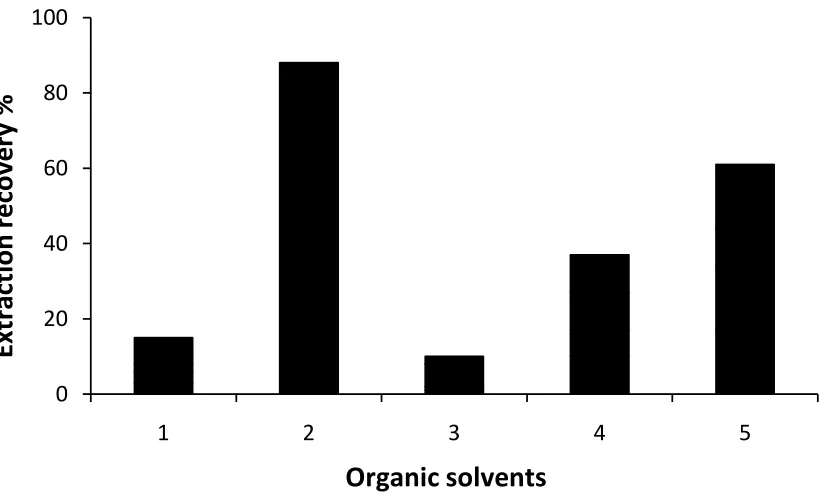
The type of dispersive and extraction solvents used in DLLME is an essential consideration for efficient extraction. The extraction solvent should be higher density than water, high extraction capability of the interested compounds and low solubility in water and dispersive solvent should be miscible with both water and the extraction solvent (Liang and Zhao, 2009). Therefore, acetonitrile, acetone, ethanol and methanol were tested as the dispersive solvents and chloroform, Dichloromethane, Ortho-xylene, Dichloroethane and carbon tetrachloride were studied as the extraction solvents in the extraction of crocin. For obtaining good efficiency, all combinations using chloroform, Dichloromethane, Ortho-xylene, Dichloroethane and carbon tetrachloride (400 µl) as extractants with acetone, acetonitrile, ethanol and methanol (1 ml) as dispersive solvent were tried. Figure 1 and Table 1 indicated acetone as the disperser solvent and Dichloromethane as the extracting solvent providing maximum extraction recovery of 87.86%. Therefore, aceton/dichloromethane as a suitable set for subsequent experiment was selected.
Solvent volume is a key parameter affecting the extraction kinetics and also the pre-concentration factor. To consider the effect of disperser solvent volume on extraction recovery, different volumes of aceton were tested. Therefore, the volume of the extracting solvent (dichloromethane) was fixed at 200 µl and the volume of aceton was changed from 200 to 1000 µl. The represented results in Figure 2a, shows that with increasing the volume of aceton, extraction recovery first increased till it reached a maximum point at 400 µl and then gradually decreased by further increasing its volume. It can be attributed to the fact that, at a lower volume of aceton consumption, cloudy state was not well formed and the extracting solvent (Dichloromethane) could not be well dispersed among aqueous solution in the form of very little droplet, which resulted in poor extraction recovery. Therefore, in the following experiments, 400 µl aceton was used as optimal disperser solvent volume.
Figure 1. Effect of type of extraction solvent on DLLME extraction recovery of crocin (Acetone disperser solvent). 1. Chloroform; 2. Dichloromethane; 3. Ortho-xylene; 4. Dichloroethane; 5. Tetrachloridcarbon.
Table 1. Effect of type of the disperser solvent and extraction solvent on DLLME extraction recovery of crocin (n=3).
////////////////////////// Methanol Acetone Acetonitrile Ethanol
Chloroform 13.05±1.51 10.00±1.31 9.69±1.11 14.12±1.12
Dichloromethane 65.71±1.41 87.86±1.12 14.28±1.10 43.00±0.95
Ortho-xylene 5.65±0.60 2.86±0.95 10.71±0.98 6.22±0.98
Dichloroethane 37.91±1.01 14.29±1.51 21.93±1.22 20.92±1.11
Tetrachloridcarbon 51.81±1.60 61.00±0.52 20.09±2.10 49.12±1.98
for the subsequent experimental work.
pH of the sample is an important factor during liquid– liquid extraction (LLE) process involving analytes that possess an acidic or basic moiety. The ionic form of a neutral molecule formed upon deprotonation of a weak acid or protonation of a weak base normally does not extract through the organic solvent as strongly as its neutral form does. Thus, pH should be adjusted to ensure that neutral molecular forms of the analytes are present prior to performing the microextraction step. In this step, effect of pH of the solution on the amount of extracted crocin was investigated in the range of 3 to 12. Figure 2c shows that the best pH for extraction of crocin is 9 and that crocin is completely in its molecular form.
The influence of ionic strength on the efficiency of microextraction of the proposed (DLLME) procedure was investigated by adding different concentrations of NaCl in the range of 0 to 10% (w/v). According to the experimental results obtained, salt addition has no significant effect on the extraction efficiency of crocin.
Therefore, all the extraction experiments were carried out without the addition of salt.
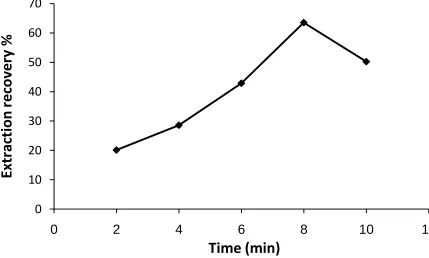
The effect of centrifugation time upon extraction efficiency was studied in the range of 2 to 10 min. Figure 2d shows a centrifugation time of 8 min was selected as optimum since complete phase separation occurred at the end of this period, while at lower or higher centrifuge time, the recoveries were both lower.
Extraction of crocin by DLLME-SFO
Optimization of DLLME-SFO
In order to obtain high recovery, the selection of extraction solvent has an important role in the DLLME-SFO system. Extraction solvent should have special characteristics; it should have lower density rather than water, high efficiency in the extraction of the interested compounds and low solubility in water and it should have a melting
0
20
40
60
80
100
1
2
3
4
5
Ext
ra
ct
ion
r
eco
ve
ry
%
Figure 2a. Effect of volume of disperser solvent, aceton on DLLME efficiency. Extraction conditions: volume of the aqueous solution, 10 ml (containing 0.1 µg ml−1of crocin); and volume of Dichloromethane, 200 µl.
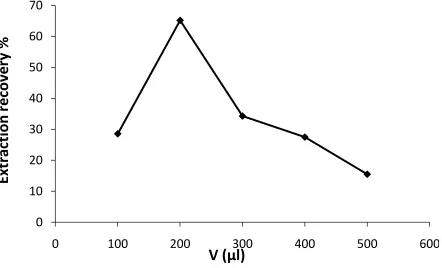
Figure 2b. Effect of volume of extraction solvent, dichloromethane on DLLME efficiency.Extraction conditions: as in Figure 2a, except that volume of disperser solvent, aceton is 400 µl.
point near room temperature floated on the surface of aqueous solution. According to these considerations, 1-undecanol was chosen as the extracting solvent.
Miscibility of a disperser with organic phase (extraction
solvent) and aqueous phase (sample solution) is the most important point for the selection of a disperser. Therefore, acetone, acetonitrile, methanol and ethanol, which have this ability, are selected for this purpose. For obtaining
60
65
70
75
80
85
90
0
0.2
0.4
0.6
0.8
1
1.2
Ext
ra
ct
ion
r
eco
ve
ry
%
V (ml)
0
10
20
30
40
50
60
70
0
100
200
300
400
500
600
V (µl)
Ext
ra
ct
ion
r
eco
ve
ry
Figure 2c. Influence of sample pH on DLLME efficiency. Extraction conditions: as in Figure 2a, except that volume of disperser solvent, acetone, is 400 µl
Figure 2d. Effect of centrifuge time on the extraction recovery of crocin. Extraction conditions: as in Figure 2c, except that pH value of the aqueous solution is 9.
maximum extraction recovery, all combinations using 1-undecanol as extractant with acetone, acetonitrile, methanol and ethanol as dispersive solvent, were
examined. Table 2 shows methanol as the disperser solvent provided maximum extraction recovery.
To study the effect of disperser volume on the extraction
0
10
20
30
40
50
60
70
2
4
6
8
10
12
14
pH
Ext
ra
ct
ion
r
eco
ve
ry
%
0
10
20
30
40
50
60
70
0
2
4
6
8
10
12
Time (min)
Ext
ra
ct
ion
r
eco
ve
ry
Table 2. Effect of type of the disperser solvent on DLLME-SFO extraction recovery of crocin (n=3).
////////////////////////// Methanol Acetone Acetone Ethanol
1- undecanol 22.14 ± 1.43 9.58 ± 1.22 18.75 ± 1.51 14.2 ± 1.32
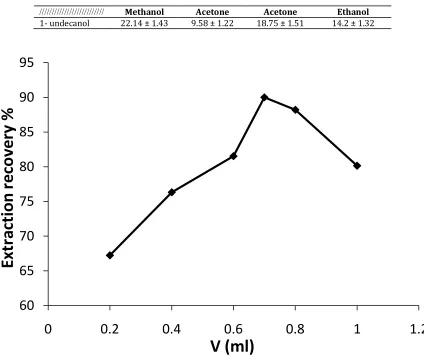
Figure 3a. Effect of volume of disperser solvent, methanol on DLLME-SFO efficiency. Extraction conditions: volume of the aqueous solution, 10 mL (containing 0.1 µg ml−1 of crocin); and volume of 1-undecanol, 200 µl.
recovery of crocin, all experimental conditions were fixed except volume of methanol (0.2 to 1 ml) (Figure 3a). According to the obtained results, the extraction recovery increased till 0.7 ml and then decreased by increasing the volume of methanol for crocin. Therefore, A 0.7 ml volume was chosen as an optimum volume for disperser.
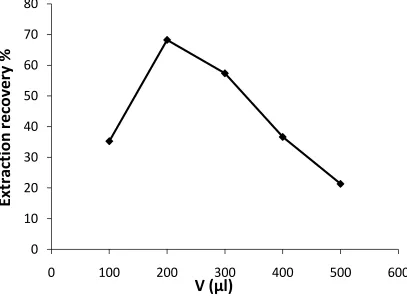
To examine the effect of the extraction solvent volume, solutions containing different volumes of 1-undecanol were subjected to the same DLLME-SFO procedures. The experimental conditions were fixed and included the use of 700 μl methanol and different volumes of 1-undecanol (100.0, 150.0, 200.0, 250.0, 300.0, 350.0 and 400 μl). Figure 3b showed that by increasing the volume of 1-undecanol, the extraction recovery increased till it attained 200 μl. With the increase of extractant volume, the concentration of crocin in the sediment phase decreased due to the dilution effect. Therefore, 200 μl was the reasonable volume for the experiment.
The effect of sample pH on the extraction of crocin was studied by varying the pH within the range of 4 to 12. Figure 3c shows the influence of the sample pH on the
analytical signal intensity. As it is demonstrated, the highest extraction recovery of crocin was obtained at pH 9. To study the effect of salt addition on the analytical signal of the cadmium, the concentration of NaCl was changed in the range of 0 to 10% (w/v). The results showed that extraction efficiency of the analyte was independent of NaCl concentration. Thus, the strategy of no salt addition was performed.
If the centrifugation time is not enough, the organic phase cannot be completely collected on top of vial. The effect of centrifugation time on the extraction efficiency was performed using 0.7 ml of methanol and 200 μl 1-undecanol added to the aqueous solution in the range of 2 to 10 min. The results (Figure 3d) showed that the maximum extraction recovery was obtained for 6 min centrifugation time.
Quantitative analysis
To evaluate practical applicability of the proposed DLLME
60
65
70
75
80
85
90
95
0
0.2
0.4
0.6
0.8
1
1.2
Ext
ra
ct
ion
r
eco
ve
ry
%
Figure 3b. Effect of volume of extraction solvent, 1-undecanol on DLLME-SFO efficiency. Extraction conditions: as in Figure 3a, except that volume of disperser solvent, methanol is 700 µl.
and DLLME-SFO techniques, linear range (LR), determination coefficient (R2), limit of detection (LOD) and
pre-concentration factors (PFs) were investigated by extraction of the crocin from water samples under the optimal conditions, whose results are summarized in Table 3.
For the purpose of quantitative analysis, calibration curves for crocin were obtained by spiking the standard directly into distilled water and extracting under the optimal conditions by the aforementioned techniques. Linearities were observed over the range of 0.01 to 150 ng ml−1 crocin in the initial solution with the limits of
detection of 0.008 and 0.005 ng ml−1 through DLLME and
DLLME-SFO, respectively. Pre-concentration factors, defined as the ratio of the slopes of calibration curve after and before extraction were attained at 88 for DLLME and 95 for DLLME-SFO under the optimized conditions.
Analysis of real samples
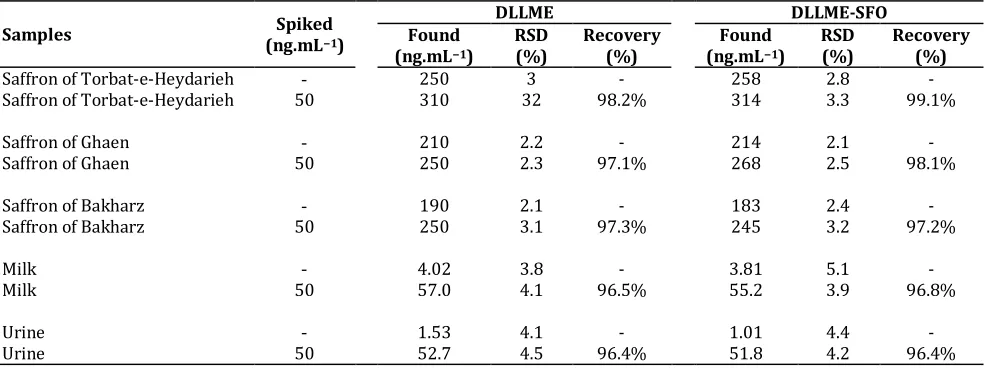
To verify the applicability of the developed methods, the extraction and determination of crocin in three different saffron samples (Ttorbatheydariyeh, Ghaen and Bakharz) and biological samples (urine and milk), were performed. All the samples were spiked with crocin standard at 50 ng/mL; subsequently, they were extracted using the
DLLME and DLLME-SFO techniques and finally the extracts were analyzed by UV- vis method.
For determination of crocin in human milk and urine, 0.5 mg of saffron was prescribed to a 28-year-old healthy nursing mother. Milk sample (3.0 ml) was collected just before and at 6 h after administration, as well as urine samples. After hydrolysis and filtration, determination of crocin was performed using standard addition method.
For each concentration level, three replicate experiments with the whole analysis process were made and experimental results are shown in Table 4. Relative recovery (RR) was calculated as follows:
(4)
Where Cspiked, Cunspiked and Cadded represents the
concentration of the analyte after adding a known amount of standard to the real sample. The concentration of the analyte in the real sample and the concentration of a known amount of the standard were spiked in the real sample, respectively. These results proved that the different matrices of saffron and biological samples employed in this experiment had little effects on the
0
10
20
30
40
50
60
70
80
0
100
200
300
400
500
600
V (µl)
Ext
ra
ct
ion
r
e
co
ve
ry
Figure 3c. Influence of sample pH on DLLME-SFO efficiency. Extraction conditions: Extraction conditions: as in Figure 3a, except that volume of disperser solvent, methanol, is 700 µl.
Figure 3d. Effect of centrifuge time on the extraction recovery of crocin. Extraction conditions: as in Figure 3c, except that pH value of the aqueous solution is 9.
0
10
20
30
40
50
60
70
2
4
6
8
10
12
14
E
x
tract
ion
recovery
%
pH
0
10
20
30
40
50
60
70
0
2
4
6
8
10
12
Time (min)
Ext
ra
ct
ion
r
e
co
ve
ry
Table 3. DLLME and DLLME-SFO performance and validation data.
////////////////////////// DLLME DLLME-SFO
Linear range (ng.mL−1) 0. 01-150 0. 01-150
Correlation of coefficient 0.9921 0.9937
Detection limit (ng.mL−1) 0. 008 0. 005
Pre-concentration factor 88 95
Table 4. The application of DLLME and DLLME-SFO for determination of crocin in the saffron and biological samples (n=3).
Samples (ng.mLSpiked −1)
DLLME DLLME-SFO
Found
(ng.mL−1)
RSD
(%) Recovery (%) (ng.mLFound −1)
RSD
(%) Recovery (%)
Saffron of Torbat-e-Heydarieh - 250 3 - 258 2.8 -
Saffron of Torbat-e-Heydarieh 50 310 32 98.2% 314 3.3 99.1%
Saffron of Ghaen - 210 2.2 - 214 2.1 -
Saffron of Ghaen 50 250 2.3 97.1% 268 2.5 98.1%
Saffron of Bakharz - 190 2.1 - 183 2.4 -
Saffron of Bakharz 50 250 3.1 97.3% 245 3.2 97.2%
Milk - 4.02 3.8 - 3.81 5.1 -
Milk 50 57.0 4.1 96.5% 55.2 3.9 96.8%
Urine - 1.53 4.1 - 1.01 4.4 -
Urine 50 52.7 4.5 96.4% 51.8 4.2 96.4%
proposed methods.
Conclusions
In this study, two liquid phase microextractions, namely, DLLME and DLLME-SFO were compared to determine the crocin in saffron and biological samples. The results confirmed that both extraction methods exhibited good linearity, precision, pre-concentration factor and detection limit for extraction of the analytes from the samples. In addition, both methods were simple, sensitive and inexpensive and allowed sample extraction and pre-concentration to be done in a single step. Moreover, DLLME-SFO was faster and the toxicity of extraction solvent (1- undecanol) in this method was lower than that of DLLME (dichloromethane).
ACKNOWLEDGEMENTS
The author acknowledged the support by University of Torbat-e Heydariyeh, Torbat-e Heydariyeh, Iran.
REFERENCES
Foster GD, Gates PM, Foreman WT, McKenzie SW, Rinella FA (1993). Environ. Sci.Technol. 27: 1911.
Jönsson JA, Mathiasson L (1999). Trends Anal. Chem. 18:318.
Karrer P, Benz F, Morf R, Raudnitz H, Stoll M, Takahashi T (1932).Helvetica ChimicaActa. 15- 1399.
Leong MI, Huang SD (2008). Dispersive Liquid-Liquid Microextraction Method Based on Solidification of Floating Organic Drop Combined with Gas Chromatography with Electron-Capture or Mass Spectrometry Detection. J. Chromatogr. A, 1211, p. 8.
Liang P, Zhao E, Li F (2009). Dispersive liquid–liquid microextractionpreconcentrationof palladium in water samples and determination by graphite furnace atomicabsorption spectrometry, Talanta 77 (5): 1854–1857.
Lopez-Garcia I, Rivas RE, Hernadez-cordoba M (2010). Liquid-phase microextraction with solidification of the organic floating drop for the preconcentration and determination of mercury traces by electrothermal atomic absorption spectrometry. Anal. Bioanal. Chem. 39(6): 3097–3102.
Manuchair Ebadi Pharmacodynamic Basis of Herbal medicine. 2nd edition,
525-527.
Pereira ER, Soares BM , Maciel JV, Caldas SS, Andrade CFF, Primel EG, Duarte FA (2013). Development of a dispersive liquid-liquid microextraction method for iron extractionand preconcentration in water samples with different salinities, Analytical Methods, 5:2273-2280.
Rezaee M, Assadi Y, MilaniHosseini MR, Aghaee E, Ahmadi F, Berijani S (2006). J.Chromatogr. A 1116,p.1.
Rezaee M, Assadi Y, Hosseinia MRM, Aghaee E, Ahmadi F, Berijani S (2006). Determination of organic compounds in water using dispersive liquid-liquid microextraction. J. Chromatogr. A, 1116 1-9.
Rezaee M, Yamini Y, Faraji M (2010). Evolution of dispersive liquid-liquid microextractionmethod. J. Chromatogr. A. 12(17): 2342-2357. Shinji S, Ochiai T, Shimeno H, Saito H, Abe K, Tanaka H, Shoyama Y
(2007). Pharmacological activities of crocin in saffron. J. nat. med. 61, 102-111