Organized by C.O.E.T, Akola. Available Online at www.ijpret.com
378
INTERNATIONAL JOURNAL OF PURE AND
APPLIED RESEARCH IN ENGINEERING AND
TECHNOLOGY
A PATH FOR HORIZING YOUR INNOVATIVE WORK
MOTION DETECTION ANALYSIS USING STATIC AND NOT STATIC IMAGES
DR. SHRIKANT L. SATARKAR
1, DR. SACHIN S. AGRAWAL
21. Associate Professor and Head (Computer Science & Engineering), College of Engineering & Technology, Akola. 2. Assistant Professor (Computer Science & Engineering), College of Engineering & Technology, Akola.
Accepted Date: 05/09/2017; Published Date: 10/10/2017
Abstract:
Visual analysis of human motion is currently one of the most active research topics in computer vision. This strong interest is driven by a wide spectrum of promising applications in many areas such as virtual reality, smart surveillance, perceptual interface, etc. Human motion analysis concerns the detection, tracking and recognition of people, and more generally, the understanding of human behaviors, from image sequences involving humans. It provides a comprehensive survey of research on computer vision based human motion analysis. The emphasis is on three major issues involved in a general human motion analysis system, namely human detection, tracking and activity understanding. Various methods for each issue are discussed in order to examine the state of the art.Keywords
: Human motion analysis; Detection; Tracking; Behavior understanding; Semantic description..
Corresponding Author: DR. SHRIKANT L. SATARKAR
Co Author: - DR. SACHIN S. AGRAWAL
Access Online On:
www.ijpret.com
How to Cite This Article:
Shrikant L. Satarkar, IJPRET, 2017; Volume 6 (2): 378-385
PAPER-QR CODE
SPECIAL ISSUE FOR
INTERNATIONAL LEVEL CONFERENCE
"ADVANCES IN SCIENCE,
Organized by C.O.E.T, Akola. Available Online at www.ijpret.com
379
INTRODUCTIONAs one of the most active research areas in computer vision, visual analysis of human motion attempts to detect, track and identify people, and more generally, to interpret human behaviors, from image sequences involving humans. Human motion analysis has attracted great interests from computer vision researchers due to its promising applications in many areas such as visual surveillance, perceptual user interface, content-based image storage and retrieval, video conferencing, athletic performance analysis, virtual reality, etc.
Human motion analysis has been investigated under several large research projects worldwide. For example, DARPA (Defense Advanced Research Projects Agency) funded a multi-institution project on Video Surveillance and Monitoring (VSAM), whose purpose was to develop an automatic video understanding technology that enabled a single human operator to monitor activities over complex areas such as battlefields and civilian scenes. The real-time visual surveillance system employed a combination of shape analysis and tracking, and constructed the models of people’s appearances to make itself capable of detecting and tracking multiple people as well as monitoring their activities even in the presence of occlusions in an outdoor environment. Researchers in the UK have also done much research on the tracking of vehicles and people and the recognition of their interactions. In addition, companies such as IBM and Microsoft are also investing on research on human motion analysis.
In recent years, human motion analysis has been featured in a number of leading international journals such as IJCV (International Journal of Computer Vision), CVIU (Computer Vision and Image Understanding), PAMI (IEEE Transactions on Pattern Recognition and Machine Intelligence) and IVC (Image and Vision Computing), as well as prestigious international conferences and workshops such as ICCV (International Conference on +6Computer Vision), CVPR (IEEE International Conference on Computer Vision and Pattern Recognition), ECCV (European Conference on Computer Vision), WACV (Workshop on Applications of Computer Vision) and IWVS (IEEE International Workshop on Visual Surveillance). All the above activities have demonstrated a great and growing interest in human motion analysis from the pattern recognition and computer vision community. The primary purpose of this paper is thus to review the recent developments in this exciting research area, especially the progress since previous such reviews.
A motion detection algorithm begins with the segmentation part where foreground or moving objects are segmented from the background. The simplest way to implement this is to take an image as background and take the frames obtained at the time t, denoted by I(t) to compare with the background image denoted by B. Here using simple arithmetic calculations, we can segment out the objects simply by using image subtraction technique of computer vision meaning for each pixels in I(t), take the pixel value denoted by P[I(t)] and subtract it with the corresponding pixels at the same position on the background image denoted as P[B].
In mathematical equation it is written as;
P[F(t)]=P[I(t)] – P[B]……(1)
Where, F refers to the foreground or resulted image after the computation at time t.
Organized by C.O.E.T, Akola. Available Online at www.ijpret.com
380
Figure 1: Overview of a basic motion detection application systemAs shown in Fig. 1, the basic human motion detection would have an alarm system integrated. Thus, to get a clearer picture of the system developed, Fig. 2 is shown below:
Figure 2: Overview of the prototype human motion detection application system
I. MOTIVATION
Human motion analysis has been investigated under several large research projects worldwide. For example, DARPA (Defense Advanced Research Projects Agency) funded a multi-institution project on Video Surveillance and Monitoring (VSAM), whose purpose was to develop an automatic video understanding technology that enabled a single human operator to monitor activities over complex areas such as battlefields and civilian scenes. The real-time visual surveillance system employed a combination of shape analysis and tracking, and constructed the models of people’s appearances to make itself capable of detecting and tracking multiple people as well as monitoring their activities even in the presence of occlusions in an outdoor environment. Researchers in the UK have also done much research on the tracking of vehicles and people and the recognition of their interactions. In addition, companies such as IBM and Microsoft are also investing on research on human motion analysis.
II. OBJECTIVES
Organized by C.O.E.T, Akola. Available Online at www.ijpret.com
381
technique that we prefer to use in this project and also that detects motion effectively and record it down with one or more objects that are moving and causing motions.
The objective of the system is to increase the accuracy of the system. Input video is used to detect the motion at a primary stage i.e. in the developing stage. A binary subtraction method which is applied to primary stage for extraction of the desired portion. The detection of motion based on the different techniques which used to find the motion as quickly as possible and also as accurate as possible. Detection is as accurate as possible so that the there is no false in the detection.
III. LITERATURE REVIEW
Motion detection and tracking algorithm for human and car activity surveillance is presented and evaluated by using the Pets’2000 test sequence. Proposed approach uses a temporal fusion strategy by using the history of events in order to improve instantaneous decisions. Normalized indicator updated at each frame summarizes history of specific events. For the motion detection stage a fast updating algorithm of the background reference is proposed. The control of the updating at each pixel is based on stability indicator estimated from inter-frame variations [1].
A motivated and comprehensive comparative evaluation methodology is described and used to compare their proposed motion detection algorithm to two well-known techniques [2].
Motion detection is the first essential process in the extraction of information regarding moving objects and makes use of stabilization in functional areas, such as tracking, classification, recognition, and so on [3].
The development of an efficient real time video motion detection system is motivated by their potential for deployment in the areas where security is the main concern.
IV. BACKGROUND SUBTRACTION
Background subtraction involves calculating a reference image, subtracting each new frame from this image and thresholding the result. What results is a binary segmentation of the image which highlights regions of non-stationary objects. The simplest form of the reference image is a time-averaged background image.
1. Estimate the background for time t.
2. Subtract the estimated background from the input frame.
3. Apply a threshold, Th, to the absolute difference to get the foreground mask.
Figure 3: Background subtraction
Organized by C.O.E.T, Akola. Available Online at www.ijpret.com
382
the foreground image and separate them. Some noise filtering functions may also be used to remove noise from the foreground images before proceeding to obtain a binary image and labeling the objects.
Figure 4: Regions
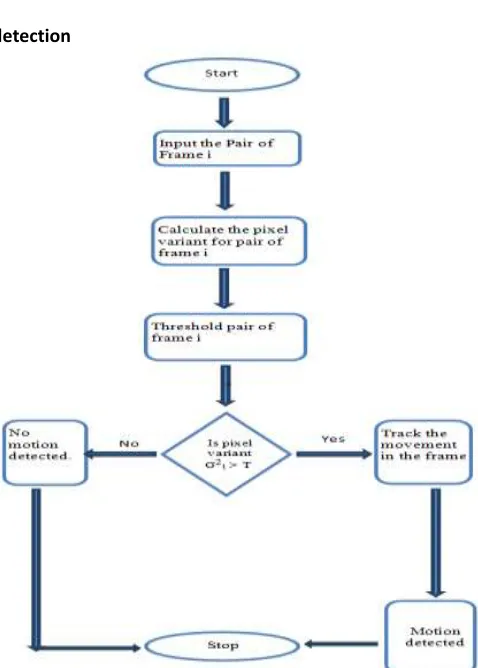
Flow diagram for Motion detection
Organized by C.O.E.T, Akola. Available Online at www.ijpret.com
383
V. RESULTS
Output of Image:-
Organized by C.O.E.T, Akola. Available Online at www.ijpret.com
384
VI. CONCLUSION
One such shortcoming is that the model of human motion contains a static representation of what a human figure should look like. Although this static representation was built using statistics over a certain period of time, the model is a time-average of these statistics and inherently cannot contain information about the periodic nature of the human gait. Thus, any moving object that has roughly the shape of a human and moves with the speed expected of a human will be detected as a human. A second limitation is that of the background subtracter. We make the fundamental assumption that the background will dominate most scenes and will be stationary. This is unacceptable for more crowded environments where surveillance is desired. In addition, the requirement for a stationary background rules out situations where the camera is in motion, such as on vehicles or robotic cameras.
Future work
There are a variety of enhancements that could be made to this system to achieve greater detection accuracy and increased robustness:
Objects could be tracked between frames rather than simply performing human motion detection on single frames.
As described above, the current model of motion does not take into account the time dependent nature of a
walking human. Much greater accuracy would be possible with a detector and model that takes advantage of this periodicity in time.
The current background subtraction algorithm can be confused by fast lighting changes or moving shadows. A
better algorithm would use a technique based on optical flow for the image segmentation. This approach would also allow the camera to be in motion relative to the background.
Modeling different types of human motion should be explored, such as walking seen from different viewpoints.
Organized by C.O.E.T, Akola. Available Online at www.ijpret.com
385
REFERENCES1. CinaMotamed, “Motion detection and tracking using belief indicators for an automatic visual-surveillance system” June, 2005.
2. J. Renno, N. Lazarevic-McManus, et.al, “Evaluating Motion Detection Algorithms: Issues and Results”. 3. SahuManoj Kumar, Ms. S. Jaiswal, et.al, “Survey- Visual Analysis of Human Motion” April, 2012,
4. David Moore, “A real world system for human motion detection and tracking” June, 2003,
5. Nan Lu, Jihong Wang, Q.H. Wu and Li Yang,, “An improved Motion Detection method for real time Surveillance “International Journal of Computer Science February, 2008,
6. S. Birchfieldl, “Derivation of Kanade-Lucas-Tomasi tracking equation”, January 1997,
7. R. Shaalini& C. Shanmugam, R. Niranjan Kumar, et.al, “Human Motion Detection and Tracking for Real- Time Security System”Vol.3, Issue 12, December 2013,
8. Neelam Patel, “Motion Detection based on Multi Frame Video under Surveillance System” Vol.2, Issue 1, January 2012,
9. Brajesh Patel, Neelam Patel, “Motion Detection based on multi frame video under surveillance systems” International Journal of Computer Science and Network Security, Vol.12 No.3, March 2012,
10. Shih Chia Huang, “An Advanced Motion Detection Algorithm with Video Quality Analysis for Video Surveillance
Systems” IEEE Transaction on Circuits and Systems for Video Technology, Vol. 21, January. 2011,
11. Sumita Mishra, Prabhat Mishra, et al, “A Novel comprehensive method for real time Video Motion Detection Surveillance” April, 2011,
12. SooKuo Yang, “Human Motion Detection System”, University Tunku Abdul Rahman, March, 2005,
13. Thomas B. Moesland, Erik Granum et.al, “A Survey of Computer Vision- Based Human Motion Capture”, Computer Vision and Image Understanding, 2001,
14. D. M. Gavrila, “The Visual Analysis of Human Movement: A Survey” Vol. 73, No. 1, January 1999,
15. Johansson, “Visual perception of biological motion and a model for its analysis”, Perception &Psychophysics Vol. 14. No.2, 1973