ISSN 1392-2785 ENGINEERING ECONOMICS. 2009. No 1 (61) COMMERCE OF ENGINEERING DECISIONS
E-Business or E-Technology?
Donata Jovarauskien
ė
, Vaida Pilinkien
ė
Kauno technologijos universitetas K. Donelaičio g. 73, LT-44029, Kaunas
Nowadays prosperous conditions for electronic business development have been formed due to intensive processes of globalization and increasing extents of competition. Development of traditional business processes is not sufficient in order to reach long-lasting effect and wishes to survive in competitive surrounding determine use of electronic business potential, which can help to get a competitive advantage. The basis of electronic business is application of information and communication technologies having changed the usual conception of business and having formed the conditions for business development worldwide. The extents of business partners’ cooperation determine improving of electronic business models.
The term ”business model” is used in the context of traditional and Internet business. In a general sense business model is a method of business organization in a company and its major aim is profit. As the processes of globalization have been taking place, development of information technologies determines the changes in the processes of business organization and in the conception of traditional business models. The importance of Electronic business models increases due to constant broadening of extents of corporations’ activity.
The analysis of the conception of Electronic business models working and the problem aspects is presented in the article. With the reference to the analysis of academic works the conceptions of traditional business and Internet business are summarized, the structure of electronic business model is described. The classification of electronic business models according to the consumer’s type is offered. Considering Electronic business models, which are used in usual practice, the analysis of four business models, their characteristics, advantages and disadvantages is presented. The greatest attention in the article is focused on the models business-to-business, business-to-consumer, government-to-business, government-to-consumer.
Use of electronic business models gives companies possibility to survive under the conditions of competition, to reach greater markets, educate loyal consumers. However, it is impossible to single out one concrete electronic business model in most companies’ activity as in practice several Electronic business models are combined in order to get the greatest efficiency. So the backgrounds of interaction between Electronic business models are emphasized in the article. Considering to the analysis of academic literature it is possible to maintain that interaction between Electronic business models takes place in the context of globalization, educated society and government.
Keywords: electronic business model, business processes.
Introduction
Business model defines the method of business organization, which ensures the company’s profit, specifies the corporation’s difference from its rivals also the principles of declaration of goods and services in the market. Some companies use clear and primitive business models whereas it seems to be impossible to single out a certain model in other companies’ activity. Considering business processes and international corporations’ work, business processes can be based on the interaction between several business models till the product reaches the final consumer. Scientific literature doesn’t focus enough on interaction between electronic business models in business processes.
Electronic business models, their characteristics, advantages and disadvantages of working are analyzed by Lithuanian and foreign authors. Electronic business models and their topics are researched in the works of such authors as Baršauskas, Šarapovas, Cvilikas (2006), Šarapovas (2005), Markevičienė and others (2002), Simanavičiūtė
(2003).
Considering the market extents and possibilities of application of new technologies to business processes, foreign authors focus on these issues. The conception of Electronic business models working, problem aspects, possibilities to use Electronic business models in practice are analyzed by the following scientists: Afuan, Tucci (2001), Elliot (2002), Hamel (2000), Timmers (2000), Chesbrough, Rosenbloom (2002), Dubosson-Torbay, Osterwalder, Pigneur (2002), Karmakar (2005), Kinder (2002), Lambert (2003), Liegl and others (2007), Meagher (2000), Osterwalder (2004), Pandya Vinodrai, Arenyeka-Diamond, Bhogal (2000), Rappa (2003), Sawhney (2002), Schneider (2008), Walsh (2000-2001), Wimmer (2002), Zhiyuan (2002).
The aim of the article are to analyze the aspects of the application of Electronic business models in the company’s business processes.
The goals of the article are to generalize the term “business model” on the ground of various authors’ works, to define structurally the framework of Electronic business model, to analyze the classification of Electronic business models and offer the general characteristics of the selected models and the backgrounds of their interaction.
The object of the article is Electronic business models. The methods used in the article are as follows: analysis of academic literature, comparative analysis.
in business processes is not researched enough in academic literature. So the definition and the importance of business models are summarized in this article with the reference to the analysis of academic literature, also the backgrounds of interaction between Electronic business models are presented.
The conception of the electronic business model The term “business model” is often used by scientists and business experts while talking about traditional business or electronic commerce. It is said to be the least apprehensible aspect despite being discussed a lot. Most of the common terms are applied to various situations and their meanings are corrected according to individual demands or a concrete situation. The term “business model” is used in different contexts and sometimes it is difficult to understand what its real meaning is. It is difficult to define the concept of business model due to a great variety of contexts it is used in. So it is important to define the meaning of business model and to single out concrete characteristics, which are typical for researched business models in the context of traditional and electronic business. (Markevičienė and others, 2002).
In a common sense the term “business model” is defined as a method of business organization, which is used by a corporation in order to get profit. Various authors define this term differently, although the general opinion about the features, which are typical for business model, dominates. Two main viewpoints on this definition can be marked: according to the first, only internal business processes are assessed; according to the second, value creation is assessed.
According to Timmers (2000), business model is a structure of flows of products, services or information including all business participants and their roles in business process, assessing advantages of business participants and possible sources of profit. Hamel (2000) defines business model as a business conception, which is used in practice. According to Afuan and Tucci (2001), it is a method, which is used by a company in order to form and realize its resources seeking to meet consumers’ requirements better than rivals and to get profit due to it. Business model can be formed as a system, including elements and relations between them, assessing the dynamics of these relations. According to Torbay, Osterwalder and Pigneur (2002), business model is a structure of an organization and its relations with business partners, which forms the value of the product, meeting consumers’ requirements best, and this value ensures the constant flows of incomings. Chesbrough and Rosenbloom maintain that business model is clearly defined when the company is going to form value in the market. It includes a combination of unique products, services, image and distribution, which the organization uses in its work. Besides, it includes people organization and operative infrastructure, which is used for business operations.
Summarizing the works of most researchers the conclusion that one definition of the term ”business model” does not exist can be made. Some of the authors give concrete definitions, the others – abstract ones. Mostly the definitions of business model offered in academic literature can be treated as modern variations of the definition of
classical business strategy. Despite that most authors agree that this term defines the course of business processes, emphasize business contacts between participants of this process in the market.
The structure of the electronic business model The purpose of business model is to define structurally how the company creates and lends value to participants of business process and how these participants contact in further chain of value. It should be external model, which is not connected with the details appreciated in internal processes of the company, because it influences directly the features of the business model. Business model is a set of characteristics defining the conception of business. Business model itself doesn’t show how its application to the company’s business aims influences their realization. It is necessary to know marketing strategy of the company and it would be possible to assess commercial validity of the model, to understand how competitive advantage is formed in the market, what product-market strategy is used by the company (Osterwalder, 2004; Rappa, 2003; Karmaka, 2005).
Considering the company’s business model, the origin and the structure of resources, the strategy of the company’s activity can be created. Having coordinated business model with present resources, the company should create the strategy, which would help to implement business model. During this process the company can see that concrete strategic decisions may change the demand of resources and certain doubts about business model can arise (Lambert, 2003).
So having assessed relations between a company’s business model, importance of its disposable resources and business strategy and their influence on successful business model of the company it is possible to point the following general functions of business model: to emphasize the value based on technology; to identify an objective segment of the market; to find out the structure of the company’s value chain in order to form the suggested value and distribute it, to estimate possible expenses and potential profit, emphasizing the certain benefit of the product and taking the certain structure of value chain and others (Kinder, 2002).
Classification of the electronic business model Business model improvement has been influenced lately by expanding partnership, which stimulates creation of more effective and productive business models. The conception of business model describes informative and monetary flows of product or service and outlines the roles and obtained benefit for business partners performing in the business process. Business model defines the method of business organization, which is used to get profit, emphasizing how the company gets its incomings (Pandya Vinodrai, Arenyeka-Diamond, Bhogal, 2000).
The usual ways of business models classification are connected with business partners. Although a general classification of business models has not existed up to now the following business models are commonly- used:
• Business-to-business (B2B) model: business processes take place between business objects.
• Business-to-consumer (B2C) model: business processes take place directly between business representatives and final consumers.
• Consumer-to-consumer (C2C) model: business operations are realized between consumers themselves.
• Government-to-business (G2B) model; business operations are realized between state institutions and economy (business) objects.
• Government-to-consumer (G2C) model: business processes take place between government and consumers.
• Government-to-government (G2G) model: state institutions cooperate one with another.
At present moment three major categories of business models dominate in traditional and Electronic business: business-to-business, business-to-consumer, consumer-to-consumer. However, other above mentioned categories of business models are also used quite often.
Business-to-business (B2B) model
Business-to-business is one of the most popular commercial models. Business-to-business model is often defined as a process of bargaining between enterprises’ bodies by Internet or other technologies. In other works this model is defined as follows: it is a business model, when business processes take place between two companies. While performing operations standard business models can be improved because of new technologies in order to reach higher efficiency. So assessing application of new technologies (Internet) to trade business-to-business is defined as a dealership between two partners, which is realized by Internet. This business model or type of trade plays a decisive part in modern “digital economics”. This category of business model has been one of the most popular and progressive parts of wholesale business in traditional as well as in electronic business so far. Such traditional competitive advantages as lower expenses, modern technologies, convenient location have become less important due to intensive processes of globalization, so companies are searching for new possibilities to enhance an efficiency of business. Using the business-to-business model creates favorable conditions for companies to perform internal operations efficiently, to cooperate expeditiously, to enhance efficiency of operations, to create new business services. Use of electronic commerce implementing this model makes conditions for direct cooperation with business partners (Šarapovas, 2005; Baršauskas, Šarapovas, Cvilikas, 2006).
The markets based on use of the business-to-business model allow to reach higher capacity and to estimate every stage of trade process, also enable sellers and customers to concentrate beside them with their strong sides (general competence), that allow to reach the highest efficiency. This business model is one of the most popular and
commonly-used by the companies belonging to the same segment of economy as well as by representatives of other various segments (Sawhney, 2002; Schneider, 2008).
Business-to-business commerce model enables to create companies with the reference to the markets, which perform worldwide, also enables to transfer information during the process of buying or selling products. So it is possible to maintain that efficient market of business-to-business means much more than saving money or time. This model makes conditions for companies’ improvement, stimulates durable capacity and creating of global relations between companies. Business-to-business commerce becomes an important part of business strategy and is used in different segments of economy.
To sum up the following advantages of business-to-business commerce model can be emphasized: it allows to save time due to customer and seller interaction and performed trade processes, to lower expenses connected with autonomic selling and direct selling pipelines, also enhances and fastens return, allows to simplify the process of selling and make it more comfortable for customers (Walsh, 2000 -2001).
However, despite wide spread of business-to business commerce model there are some disadvantages and obstacles, which influence domination of this conception in various segments of economy. One of the main problems connected with this model and its practical use is how fast various divisions of economy adapt to changing technologies. In the market, where companies don’t use new technologies, application of this model is complicated and does not form advantages or enhance efficiency of business operations. Also the company’s capability to find business partners and to start contacting with them becomes vital. Only few companies performing in the market can use the business-to-business model efficiently so that it became profitable. For others sharp competition becomes unconquerable and determines their decline. Eventually markets using business-to-business model must prove their profitability and new attitude towards business sectors, where they perform, and withstand investors’ and society’s criticism (Sawhney, 2002; Schneider, 2008).
Business-to-consumer (B2C) model
easily, save their time, because goods can be ordered at any time and in any part of the world that is very comfortable for customers. Electronic commerce introduced in business based on business-to-customer model allows the company to control relations with customers more efficiently, to enhance the quality of ordered goods and services also to broaden audience of customers and, as a result, to increase the amount of selling. Companies using this model make a lot of efforts in order to attract more customers with the help of publicity
.
So, as it was mentioned above, new information technologies inevitably influence traditional business, its transformation. As traditional business has used Internet, lately it becomes vital for companies, which aim to survive in competitive environment. If this technology is used properly in ordinary business processes, it allows to control business efficiently, to broaden the audience of customers and to increase selling. The following advantages of the model businesstocustomer can be pointed (Walsh, 2000 -2001; Simanavičiūtė, 2003): instant communication, worldwide accessibility, adaptability (the goods, required by customers, are offered at the very time when they are required), personalized products and services (products and services are adapted to customers’ requirements), cooperation.
However, implementation of the business model business-to-customer can face some difficulties (Walsh, 2000-2001, Simanavičiūtė, 2003): management transformation, reorganization of business processes, integration obstacles of the system, credibility gap between technologies and business requirements.
To sum up, it is possible to maintain that business-to-customer model is commonly-used in the firms, which introduce electronic commerce performing business operations. It helps to broaden the audience of consumers, broadcast and collect information using information technologies, educate loyal customers and improve the results of the business process.
Government-to-business (G2B) model
The state and state institutions, which aim to offer beneficial and efficient, at the point of expenses, services (use innovative information technologies) in constantly developing environment, face a relevant problem, connected with transformation and changes in the system. Increasing intensity of business relations between companies to national and international extent determines strengthening of the role of the state and its institutions in business processes. Communication between government and business objects is especially important in order to ensure realization of state interests and legality of business processes. Government, as well as business objects seeking greater efficiency of their work, use innovative information technologies: create websites, where juridical acts and other relevant information for business objects are available. The model government-to-business outlines cooperation between business organizations and government in common ways as well as using Internet.
Nowadays in most countries this sphere is supposed to be very important, because declaration of state acts in Internet, returning, sending and registration of various
business documents using electronic technologies permit faster communication, enable to lower transactions expenses and government coordination. Use of business model government-to-business in practice stimulates the development of states’ activity in such important for business fields as information broadcasting, taxes, and others (Meagher, 2000).
In most countries governments liaise with business using traditional pipelines and Internet is used as an additional remedy for information broadcasting, but in future most institutions should concede more possibilities to business subjects (Simanavičiūtė, 2003).
Considering the previous analysis of academic literature, the following advantages of business model government-to-business can be emphasized: a better quality of offered services; effectiveness of expenses, better relations with business representatives and other stakeholders.
The major aim of this model implementation is immediate cooperation between business and government. In the network created by government three types of services are singled out: information service, relations service, cooperation service. Information service is used to meet a person’s or a body’s requirements indirectly. Relations service is intended for the same objective groups to provide feedback with them. Information or cooperation services are mostly offered by state institutions. Cooperation service enables business representatives and persons to cooperate with government while performing various official operations (for example, to inform about the loss occurred during goods transportation from one country to another). While using the model government-to-business, these two objects can communicate directly as well as by Internet. As most business representatives want to communicate with government using Internet such connections become complicated. Large companies usually tend to use interactive and communicative remedies created by state organizations and apply them to their business system. However, such connection between two different systems must be regularized very well so that it brought maximum benefit (Liegl and others, 2007).
To sum up, it is possible to make a conclusion that the realization of business model government-to-business is connected with many aspects: juridical base must be clear and correctly defined, information systems must be regularized, interests of business partners must be constantly coordinated. Only coherent application of this model can ensure its possible advantages and efficient working.
Government-to-consumer (G2C) model
State institutions in developed countries must pay more attention to the control of communication with consumers, higher quality of services at lower expenses. Use of innovative information technologies stimulates democracy development and increasing responsibility of government offering various services to business and persons either (STCT Study, 2006; Wimmer, 2002).
Background of interaction between electronic business models
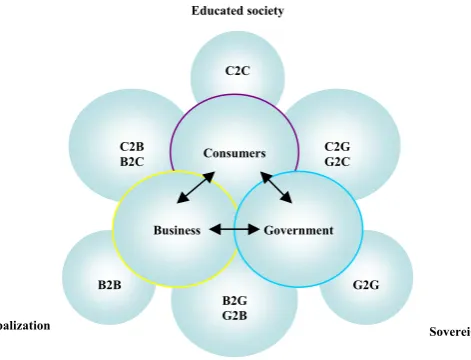
Having researched the selected models of traditional and electronic business and their general characteristics, it is possible to maintain that in the theory these models are usually closely connected. Interaction among government,
business objects and consumers takes place in the context of globalization, sovereignty and educated society (Figure 1). Business objects and their activity are abridged by government, passed juridical acts, various requirements for concrete business objects, when observance of them is supposed to be obligatory in order to survive and perform properly. Business contacts with government on the issue of taxes as well as juridical and management ones.
Government, in their turn, also influence consumers’ behavior in business processes, for example, work of patients’ funds i.e. partly paid service (with the help of public competition consumers can choose certain medicines or remedies, which are partly paid from the state budget).
Figure 1. Background of interaction among business models
Consumers can communicate with state institutions directly and by Internet, they have possibility to get information about various juridical acts, which are presented throughout government database, and to perform other operations.
Interaction between consumers and business objects is sure to exist. It usually takes place in retail trade and is defined as bargains between business organizations and an individual consumer, which are made directly or by Internet.
Academic researches show that interaction between different electronic business models often takes place in organizations’ work till the company’s product reaches its final consumer.
Conclusions
The analysis of interaction between electronic business models determines the following conclusions:
1. Electronic business constantly develops. Processes of globalization determine companies’ activity in national as well as in international markets. Advantages connected with electronic business application to traditional business processes allow to get competitive advantages and entrench in international market. The general background of electronic business working is the application of information and communication technologies in traditional business processes.
2. It is found out that two different attitudes towards the definition of business model are offered by Lithuanian and foreign authors in their academic works: 1) only internal business processes of a company are assessed; 2) more attention is concentrated on the processes of value creating emphasizing business relations between business participants in the market. It is possible to maintain that a one general attitude towards internal business processes and estimation of resources is not presented in academic literature. This fact determines different definitions of business model offered by various authors.
3. The researches show that the general purpose of a business model is to define structurally how the company creates and lends value to participants of business process and how these participants contact in further chain of value. Considering the previous analysis of academic literature it is possible to maintain that the structure of business model depends on the company’s disposable resources, the structure of management and chosen strategy. Harmonization of these three factors has decisive influence on realization of the business model and its effectiveness in the market.
4. Having analyzed the conceptions of electronic business models classification and methods, it is found out that electronic business models as an object of research are not considered enough. Different
C2B B2C
B2G G2B
C2G G2C
B2B
C2C
G2G Consumers
Business Government Educated society
academic works analyze electronic business models and their characteristics on different levels emphasizing different numbers of electronic business models used in practice, giving them different denominations and matter. With the reference to the previous analysis of academic literature, it is possible to maintain that traditional business models are analyzed without any connection with electronic business models although in practice application of both models in traditional and electronic business processes are closely connected. 5. Having researched electronic business models
presented in academic literature, it was found:
• Business-to-business (B2B) is considered to be one of mostly mentioned in literature and used in practice electronic business models, which allows to save sellers’ and customers’ time while interacting, to lower expenses connected with autonomic selling and direct selling pipelines, also to fasten return. However, only a few companies performing in the market can reach possible efficiency and benefit using this model.
• The model business-to-consumer is mostly spread among retail organizations, which introduce electronic business performing business operations. Using this model the company is able to broaden consumers audience, educate loyal clients, improve the results of its activity.
• Government-to-business (G2B) and government-to-consumer (G2C) models have been used recently with the purpose to seek more efficient communication between government, business and consumers. This electronic business model development is important in educating sophisticated society, knowing and understanding its rights, also coordinating business processes considering participants interests.
6. Having analyzed the background of interaction between electronic business models, it is possible to maintain that interaction between government, business objects and consumers takes place in the context of globalization, sovereignty and educated society. Interaction between electronic business models is determined by relations between participants of business operations connected with the process of delivering the product to its final consumer.
References
1. Šarapovas, T. Elektroninės komercijos modeliai verslo efektyvumui didinti / T. Šarapovas // Daktaro disertacija. Kaunas: Kauno technologijos universitetas, 2005.
2. Afuah, A. Internet business models and strategies: text and cases /
A. Afuah, C. L.Tucci. Boston: McGraw-Hill, 2003.
3. Rappa, M. Business Models on the Web / M. Rappa // Managing the Digital Enterprise, 2008, January.
4. Markevičienė, A. Verslas ir e. verslas. Integravimas, galimybės, metodai
/ A. Markevičienė, M. Kriaučionienė, G. Dapkus, R. Gatautis, M. Slivinskas, D. Valiukonytė. Kaunas: Technologija, 2002.
5. Osterwalder, A. The Business Model Ontology – a proposition in a design science approach / A. Osterwalder. Switzerland: Universitete de Lausanne, 2004.
6. Timmers, P. Electronic commerce: strategies and models for business-to-business trading / P. Timmers. Chichester: Wiley & Sons Ltd, 2000.
7. Hamel, G. Leading the Revoliution / G. Hamel. USA: Harvard Business Press, 2000.
8. Karmakar, L. Nitya. E-Business for Creating Wealth: The Hype or Reality / Nitya L. Karmakar. Australia: University of Western Sydney, 2005.
9. Lambert, S. Making Sense of Business Models / S. Lambert. Australia: Flinders University South Australia, 2003 a, October, Research paper series 03-10.
10. Simanavičiūtė, E. Elektroninės komercijos modeliai bei jų taikymas Lietuvoje / E. Simanavičiūtė. Vilnius: The Faculty of Communication of Vilnius University, 2003.
11. Lambert, S. A Review of the Electronic Commerce Literature to Determine the Meaning of the Term „Business Model” / S. Lambert. Australia: Flinders University South Australia, 2003 b, Research paper series 03-5.
12. Schneider, A. Insight: B2B marketplaces / A. Schneider // Webzeit, 2008.
13. Sawhney, M. B2B: Execution of the Concept Is Key to Success / M. Sawhney // CIO, 2002, May 15.
14. Walsh, K. Business-to-business E-Commerce / K. Walsh. 2000 a, 2001. 15. Walsh, K. Business-to-consumer E-Commerce / K. Walsh. 2000 b,
2001.
16. Liegl, P. Modeling E-Government processes With UMM / P. Liegl, R. Schuster, M. Zapletal, C. Huemer, B. Hofreiter, R. Mosser // Informatica, 2007, No. 31, p. 407–417.
17. Zhiyuan, F. E-Government in Digital Era: Concept, Practice, and Development / F. Zhiyuan. Thailand, 2002.
18. STCT Study. Basic concept of e-government / STCT Study //The New Nation, 2006, August 20.
19. Meagher, T. M. Business-to-Government / Government-to-Consumer Internet / T. M. Meagher // BB&T Capital Markets, 2000, August 22.
20. Kinder, T. Emerging e-commerce business models: an analysis of case studies from West Lothian, Scotland / T. Kinder // European Journal of Innovation Management, 2002, Vol. 5, No. 3, p. 130–151 (22). 21. Chesbrough, H. The role of business model in capturing value from
innovation: evidence from Xerox Corporation‘s technology spin – off companies / H. Chesbrough, S. R. Rosenbloom // Industrial and Corporate Change, 2002, Vol. 11, No. 3, p. 529–555.
22. Baršauskas, P. Elektroninės komercijos modeliai verslo efektyvumui didinti / P. Baršauskas, T. Šarapovas, A. Cvilikas. Kaunas: ISM Vadybos ir ekonomikos univarsitetas, 2006.
23. Dubosson-Torbay, M. E-Business model design, classification and measurements / M. Dubosson-Torbay, A. Osterwalder, Y. Pigneur. Switzerland: Universitete de Lausanne, 2001, April 18.
24. Pandya Vinodrai, K. Research Issues in e-Business / K. Pandya Vinodrai, A. Arenyeka-Diamond, R. Bhogal // Management of Engineering and Technology, 2001. PICMET apos;01. Portland International Conference, Vol. 1.
25. Wimmer, M. A. Towards Knowledge Enhanced E-Government: Integration as Pivotal Challenge / M. A. Wimmer. Linz, 2002.
Donata Jovarauskienė, Vaida Pilinkienė
Elektroninis verslas ar elektroninė technologija?
Santrauka
Lietuvos ir užsienio autoriai savo moksliniuose darbuose analizuoja elektroninio verslo modelius, jų charakteristikas, funkcionavimo pranašumus ir trūkumus. Šio verslo modelius ir jų problematiką savo darbuose aptaria tokie Lietuvos autoriai: P. Baršauskas; T. Šarapovas; A. Cvilikas (2006), T. Šarapovas (2005), A. Markevičienė ir kt. (2002), E. Simanavičiūtė
(2003).
Liegl ir kt. (2007), M. T. Meagher (2000), A. Osterwalder (2004), K. Pandya Vinodrai; A. Arenyeka-Diamond; R. Bhogal (2000), M. Rappa (2003), M. Sawhney (2002), A. Schneider (2008), K. Walsh (2000 – 2001), M. A. Wimmer (2002), F. Zhiyuan (2002).
Tyrimo tikslas – išanalizuoti elektroninio verslo modelių taikymo
įmonės verslo procesuose aspektus.
Tyrimo objektas – elektroninio verslo modeliai.
Pastaraisiais metais nuolat intensyvėjant globalizacijos procesams, didėjant konkurencijos mastams, susidaro palankios sąlygos elektroninio verslo plėtrai. Tradicinių verslo procesų plėtra yra nepakankama siekiant ilgalaikio efekto, o noras išlikti konkurencingoje aplinkoje sąlygoja elektroninio verslo galimybių taikymą, kuriuo remiantis įgyjamas konkurencinis pranašumas.
Elektroninio verslo pagrindas – informacinių ir bendravimo technologijų taikymas, pakeitęs įprastinį verslo suvokimą ir sudaręs sąlygas verslo plėtrai pasauliniu mastu. Elektroninio verslo modelių
tobulėjimą sąlygoja verslo partnerių bendradarbiavimo mastai, verčiantys
įmones ieškoti efektyvesnių ir našesnių verslo modelių.
Terminas „verslo modelis“ vartotinas tradicinio ir elektroninio verslo kontekste. Bendrąja prasme verslo modelis – tai įmonės verslo organizavimo metodas. Pagrindinis jo tikslas – pelnas.
Vykstant globalizacijos procesams, informacinių technologijų plėtra sąlygojo verslo organizavimo procesų ir tradicinio verslo modelių
suvokimo kaitą. Nuolat plečiantis bendrovių veiklos mastams, elektroninio verslo modeliai tampa vis svarbesni.
Šiame straipsnyje atliekama elektroninio verslo modelių funkcionavimo koncepcijos ir probleminių aspektų analizė. Remiantis mokslinių darbų
analize, apibendrinama tradicinio verslo ir elektroninio verslo samprata, apibrėžiama elektroninio verslo modelio struktūra. Pateikiama elektroninio verslo modelių klasifikacija pagal vartotojo tipą.
Atsižvelgiant į praktikoje dažniausiai vartojamus elektroninio verslo modelius atliekama keturių verslo modelių savybių, pranašumų ir trūkumų analizė. Straipsnyje didžiausias dėmesys skiriamas verslo modeliams verslas – verslui, verslas – vartotojui, valstybinė institucija – verslui, valstybinė institucija – vartotojui.
Elektroninio verslo modelių naudojimas įmonėms suteikia galimybę
išlikti konkurencinėmis sąlygomis, pasiekti didesnes rinkas, ugdyti lojalius vartotojus. Tačiau daugelio įmonių veikloje vieno konkretaus elektroninio verslo modelio išskirti neįmanoma, nes siekiant didžiausio efektyvumo praktikoje gali būti derinami keli elektroninio verslo modeliai. Taigi šiame straipsnyje svarbus vaidmuo tenka elektroninio verslo modelių sąveikos prielaidoms. Pagal atliktą mokslinės literatūros analizę galima teigti, kad elektroninio verslo modelių sąveika vyksta globalizacijos, žinių visuomenės ir aukščiausios valdžios kontekste.
Raktažodžiai: elektroninio verslo modelis, verslo procesai.