University of New Orleans University of New Orleans
ScholarWorks@UNO
ScholarWorks@UNO
University of New Orleans Theses and
Dissertations Dissertations and Theses
8-7-2008
Application of the Method of Least Squares to a Solution of the
Application of the Method of Least Squares to a Solution of the
Matched Field Localization Problem with a Single Hydrophone
Matched Field Localization Problem with a Single Hydrophone
Sean R. Chapin
University of New Orleans
Follow this and additional works at: https://scholarworks.uno.edu/td
Recommended Citation Recommended Citation
Chapin, Sean R., "Application of the Method of Least Squares to a Solution of the Matched Field Localization Problem with a Single Hydrophone" (2008). University of New Orleans Theses and Dissertations. 854.
https://scholarworks.uno.edu/td/854
This Dissertation is protected by copyright and/or related rights. It has been brought to you by ScholarWorks@UNO with permission from the rights-holder(s). You are free to use this Dissertation in any way that is permitted by the copyright and related rights legislation that applies to your use. For other uses you need to obtain permission from the rights-holder(s) directly, unless additional rights are indicated by a Creative Commons license in the record and/ or on the work itself.
This Dissertation has been accepted for inclusion in University of New Orleans Theses and Dissertations by an
Application of the Method of Least Squares to a Solution of the Matched Field Localization Problem with a Single Hydrophone
A Dissertation
Submitted to the Graduate Faculty of the University of New Orleans in partial fulfillment of the requirements for the degree of
Doctor of Philosophy in
Engineering and Applied Science
by
Sean R. Chapin
B.S. Western Michigan University, 1998 M.S. University of New Orleans, 2001
ii
Acknowledgements
A special thanks to the co-chairs of my dissertation committee, Dr. George Ioup and Dr.
Juliette Ioup of the Department of Physics at the University of New Orleans. They always had
their door open to provide help and support through this journey, and they were (and are)
outstanding teachers. I'd also like to thank Dr. George Smith of the Naval Research Laboratory
for taking the time to provide guidance on my research. Thank you to the other members of my
dissertation committee for their feedback: Dr. Jinke Tang, Dr. Edit Bourgeois, and Dr. Ken
Holladay.
Infinite thanks to Aisling for putting up with the long hours and for cheering me up when
the going got tough. Thank you to my supervisor Anne for making the completion of this
dissertation possible. Thank you to my co-workers in the RAWG team for giving me the space I
needed to get my research done. Thank you to the U.S. Navy for providing the time and the
funds to complete this project. Finally, thank you to my friends and family for always providing
iii
Table of Contents
List of Figures ... v
List of Tables ... viii
Abstract ... ix
Chapter 1. Introduction ... 1
1.1 Matched Field Processing ... 1
1.2 Single Hydrophone Localization ... 2
1.3 Preliminary Considerations ... 3
1.3.1 Equations of Ocean Acoustics ... 3
1.3.2 Acoustic Propagation Models ... 5
1.3.3 Discrete Time Signal Model ... 7
1.3.4 Other Definitions and Notation ... 8
1.4 Literature Review of Single Hydrophone Localization ... 10
1.4.1 Li and Clay (1987) ... 10
1.4.2 Frazer and Pecholcs (1990) ... 10
1.4.3 Lee (1998)... 18
1.4.4 Porter et al. (1998) ... 22
1.4.5 Jesus et al. (2000) ... 22
1.4.6 Tiemann et al. (2006) ... 24
1.4.7 Other Localization Techniques ... 25
Chapter 2 A New Technique for Single Hydrophone Localization ... 26
2.1 Description ... 26
2.2 Algorithm ... 27
2.3 Analysis of Algorithm ... 29
2.4 Discussion ... 31
2.5 Analysis Plan ... 32
Chapter 3 Simulation Results... 33
3.1 Introduction ... 33
3.2 Source Signal Bandwidth Parameterization ... 37
3.2.1 10 Hz Source Signal Bandwidth ... 37
iv
3.2.3 200 Hz Source Signal Bandwidth ... 47
3.2.4 Summary of Source Signal Bandwidth Parameterization ... 52
3.3 Signal to Noise Ratio Parameterization ... 53
Chapter 4 Experimental Results... 62
4.1 Introduction ... 62
4.2 Receiver at depth 129 meters ... 65
4.3 Receiver at depth 250 meters ... 74
4.4 Summary ... 81
Appendix ... 82
References ... 107
v
List of Figures
`
Figure 1.1a. The LFM source signal ...13
Figure 1.1b. The Green's function ...13
Figure 1.1c. The measured signal ...13
Figure 1.2a. The source signal spectrum ...15
Figure 1.2b. The Green's function spectrum ...15
Figure 1.2c. The measured signal spectrum...15
Figure 1.3a. Magnitude of D/G(X) for the correct source location ...16
Figure 1.3b. Magnitude of D/G(X) for the incorrect source location ...16
Figure 1.4a. The inverse FFT of D/G(X) for the correct source location ...17
Figure 1.4b. The inverse FFT of D/G(X) for the incorrect source location ...17
Figure 1.5. Cross correlation for correct source location...19
Figure 1.6. Cross correlation for incorrect source location ...20
Figure 3.1 (a-f). The source signals in time and frequency domain ...36
Figure 3.2a. Time domain Green's function ...38
Figure 3.2b. Frequency domain Green's function ...38
Figure 3.3 (a-f). Received signals in time and frequency domain ...39
Figure 3.4. Ambiguity plot of new localizer ...40
Figure 3.5. Close up of ambiguity plot of new localizer ...42
Figure 3.6. Analytical and BELLHOP Green's functions for Pekeris waveguide ...43
Figure 3.7 (a-f). Ambiguity plots for 10 Hz source signal bandwidth ...45
Figure 3.8 (a-f). Ambiguity plots for 10 Hz source signal bandwidth ...46
Figure 3.9 (a-f). Ambiguity plots for 100 Hz source signal bandwidth ...48
vi
Figure 3.11 (a-f). Ambiguity plots for 200 Hz source signal bandwidth ...50
Figure 3.12 (a-f). Ambiguity plots for 200 Hz source signal bandwidth ...51
Figure 3.13 (a-f). 60 dB SNR measured signals in time and frequency domains ...55
Figure 3.14 (a-f). 40 dB SNR measured signals in time and frequency domains ...56
Figure 3.15 (a-f). 20 dB SNR measured signals in time and frequency domains ...57
Figure 3.16 (a-f). 0 dB SNR measured signals in time and frequency domains ...58
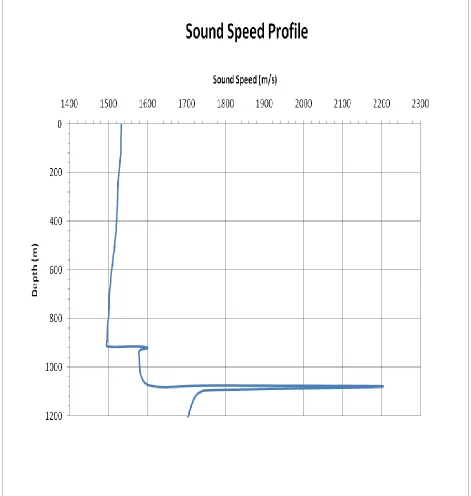
Figure 4.1. Sound speed profile of the water column and the bottom ...63
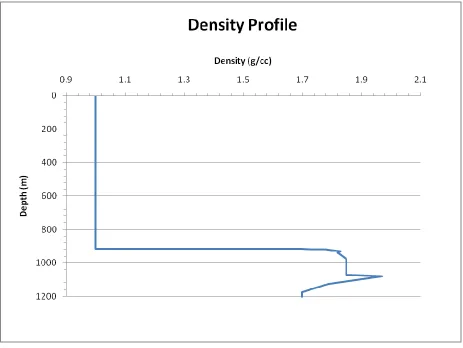
Figure 4.2. Density profile of the water column and the bottom ...64
Figure 4.3a. Correlated source signal in the time domain ...66
Figure 4.3b. Correlated source signal in the frequency domain ...66
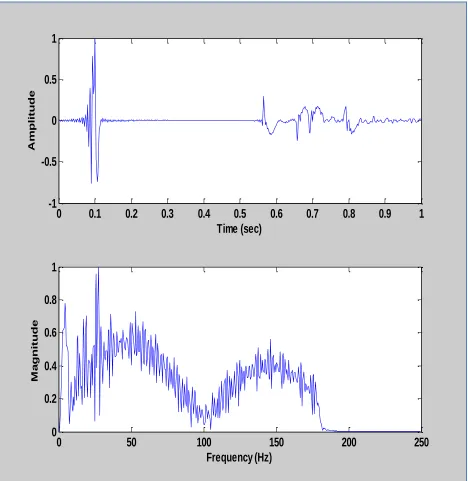
Figure 4.4a. Correlated measured signal in the time domain for 129 m case ...67
Figure 4.4b. Correlated measured signal in the frequency domain for 129 m case ...67
Figure 4.5a. Green's function in time domain calculated with SPARC for 129 m case ...69
Figure 4.5b. Spectrum of Green's function calculated with SPARC for 129 m case ...69
Figure 4.6. Ambiguity plot of new localizer for 129 m case ...70
Figure 4.7. Ambiguity plots for 129 m case ...72
Figure 4.8. Ambiguity plots for 129 m case ...73
Figure 4.9a. Correlated measured signal in the time domain for 250 m case ...75
Figure 4.9b. Correlated measured signal in the frequency domain for 250 m case ...75
Figure 4.10a. Time domain Green's function calculated with SPARC for 250 m case ....76
Figure 4.10b. Spectrum of Green's function calculated with SPARC for 250 m case ...76
Figure 4.11. Ambiguity plot of new localizer for 250 m case ...78
Figure 4.12. Ambiguity plots for 250 m case ...79
Figure 4.13. Ambiguity plots for 250 m case ...80
vii
Figure A.2. Ambiguity plots for 10 Hz bandwidth and SNR=60 dB ...84
Figure A.3. Ambiguity plots for 100 Hz bandwidth and SNR=60 dB ...85
Figure A.4. Ambiguity plots for 100 Hz bandwidth and SNR=60 dB ...86
Figure A.5. Ambiguity plots for 200 Hz bandwidth and SNR=60 dB ...87
Figure A.6. Ambiguity plots for 200 Hz bandwidth and SNR=60 dB ...88
Figure A.7. Ambiguity plots for 10 Hz bandwidth and SNR=40 dB ...89
Figure A.8. Ambiguity plots for 10 Hz bandwidth and SNR=40 dB ...90
Figure A.9. Ambiguity plots for 100 Hz bandwidth and SNR=40 dB ...91
Figure A.10. Ambiguity plots for 100 Hz bandwidth and SNR=40 dB ...92
Figure A.11. Ambiguity plots for 200 Hz bandwidth and SNR=40 dB ...93
Figure A.12. Ambiguity plots for 200 Hz bandwidth and SNR=40 dB ...94
Figure A.13. Ambiguity plots for 10 Hz bandwidth and SNR=20 dB ...95
Figure A.14. Ambiguity plots for 10 Hz bandwidth and SNR=20 dB ...96
Figure A.15. Ambiguity plots for 100 Hz bandwidth and SNR=20 dB ...97
Figure A.16. Ambiguity plots for 100 Hz bandwidth and SNR=20 dB ...98
Figure A.17. Ambiguity plots for 200 Hz bandwidth and SNR=20 dB ...99
Figure A.18. Ambiguity plots for 200 Hz bandwidth and SNR=20 dB ...100
Figure A.19. Ambiguity plots for 10 Hz bandwidth and SNR=0 dB ...101
Figure A.20. Ambiguity plots for 10 Hz bandwidth and SNR=0 dB ...102
Figure A.21. Ambiguity plots for 100 Hz bandwidth and SNR=0 dB ...103
Figure A.22. Ambiguity plots for 100 Hz bandwidth and SNR=0 dB ...104
Figure A.23. Ambiguity plots for 200 Hz bandwidth and SNR=0 dB ...105
viii
List of Tables
Table 1.1. Frazer and Pecholc's localizer values...21
Table 3.1. Localization errors for all SNRs and 10 Hz source signal bandwidth ...59
Table 3.2. Localization errors for all SNRs and 100 Hz source signal bandwidth ...59
ix
Abstract
The single hydrophone localization problem is considered. Single hydrophone
localization is a special case of matched field localization where measurements from only one
hydrophone are available. The time series of the pressure at the hydrophone is compared with
predicted times series calculated using an ocean acoustic propagation model for many different
source locations. The source location that gives the best match between the predicted time series
and the measurement is assumed to be the correct source location. Single hydrophone
localization algorithms from the literature are reviewed and a new algorithm is introduced. The
new algorithm does not require knowledge of the source signal and does not assume the use of a
particular ocean acoustic model, unlike some algorithms in the literature.
Source location estimates calculated from the new algorithm are compared with ground
truth using simulated ocean acoustic measurements and experimental measurements. Source
location estimates calculated using other algorithms from the literature are shown for
comparison. The simulated measurements use three source signals with bandwidths of 10 Hz,
100 Hz, and 200 Hz and the ocean is modeled as a Pekeris waveguide. The new algorithm
estimates the source location accurately for all three source signals when several of the
localization algorithms from the literature give inaccurate estimates. Gaussian white noise
signals are added to the measured signals to test the impact of signal-to-noise ratio (SNR) on the
algorithm. Four signal-to-noise ratios of 60 dB, 40 dB, 20 dB, and 0 dB are used. The new
algorithm gives accurate source location estimates down to an SNR of 20 dB for two of the
source signal bandwidths. Source location estimates using other algorithms from the literature
x
Source location estimates are calculated using two hydrophone measurements taken at
different depths in an experiment conducted near the Bahamas. The new algorithm accurately
estimates the source location in both cases. In one case, only two other localization algorithms
from the literature locate the source accurately. In the other case, only one other localization
algorithm succeeds.
1
Chapter 1. Introduction
1.1 Matched Field Processing
Matched field processing in underwater acoustics refers to methods of using spatial
measurements of the underwater pressure to detect and locate an acoustic source, or to infer
environmental parameters of an ocean waveguide. The large collection of techniques developed
over the last few decades can be traced to Hinich (1973) and Bucker (1976), who developed
algorithms based on comparing spatial measurements of pressure on an array of hydrophones
with the measurements predicted by an ocean acoustic propagation model. The spatial pressure
distribution of the acoustic field is determined by the location of the source and the
environmental parameters such as the sound speed profile of the water and the sound speed in the
ocean bottom. If the environmental parameters are known for a given experiment, they can be
entered into an acoustic propagation model and the pressure distribution can be predicted for
various trial locations of the source. The pressure patterns measured at the hydrophones are then
matched to the patterns estimated by the acoustic model. The basic idea is that the source is
located, or localized, when the predicted acoustic field using the correct source location matches
the measurements of the field at the receivers.
Similar techniques exist for estimating the ocean acoustic environmental parameters such
as the sound speed. In this case the source location is known but the environmental parameters
are unknown. The acoustic propagation model is run for different combinations of
environmental parameters and the resulting pressure patterns are predicted at the hydrophones.
2
parameters by looking for the best match between the predicted pressures and the measured
pressures. A large body of literature exists on matched field processing and two reviews, with
extensive references, are given by Baggeroer et al. (1993) and Tolstoy (1993).
1.2 Single Hydrophone Localization
In this dissertation we examine a special case of matched field processing where pressure
measurements from only one hydrophone are available to locate a source. The problem is
different from the matched field processing problem described above because we have no
information on the spatial distribution of the acoustic field in our measurements. We assume we
have one time series of the pressure measured at a single point in space where the hydrophone is
located. The location of the source producing the disturbance is unknown, and we assume the
source produces a broadband signal at the hydrophone. The assumption of a broadband source is
necessary because a continuous wave source of a single frequency provides no useful
information on the source location without accompanying spatial measurements. In other words,
a continuous wave source would produce a sine wave of constant amplitude at the receiver,
giving us no insight into the propagation paths of the acoustic energy. If we know the
environmental parameters of the ocean waveguide, we can use ocean acoustic propagation
models to predict the measurement at the hydrophone for different source locations. We call
these replica signals. The location that gives the best match between the replica signal and the
measured time series at the hydrophone is assumed to be the correct location of the source. This
is conceptually similar to matched field processing techniques using arrays of hydrophones.
Single hydrophone localization techniques are important not only for their intrinsic
interest, but also for their computational and experimental simplicity. Using a single hydrophone
3
the measurements. This gives researchers on tight budgets flexibility to put their resources into
other parts of the experiment if they can do the job with one hydrophone.
In the following sections we define the terminology and notation used throughout the
dissertation. This is followed by a review of the literature on single hydrophone localization
techniques discussing their assumptions and implementations.
1.3 Preliminary Considerations
1.3.1 Equations of Ocean Acoustics
The propagation of sound in the ocean is governed, to a good approximation, by the following
linear inhomogeneous partial differential equation (Jensen, et al. 1994):
, (1.1)
where p is the pressure, c(z) is the sound speed at depth z, t is time, and s(X,t) is a function
describing the source producing the disturbance at some location X. Ocean acoustic modeling
concerns itself with analytical and numerical techniques of solving equation (1.1) under different
boundary conditions. The solution to the equation will give the time dependent pressure at some
point in the water (e.g., the location of a hydrophone).
The ocean is generally a time varying medium because environmental factors affecting
the ocean are constantly changing. For example, weather conditions, time of day, and the season
all affect the sound speed profile in the ocean. Equation (1.1) shows that the pressure measured
at a point explicitly depends on the sound speed profile. The reason is that the sound will refract
in the ocean as it travels through layers with different sounds speeds. This is analogous to how
light will refract as it travels from one medium to another with a different index of refraction. If
4
performed, the ocean can be regarded as a time invariant system. The response of any linear
time invariant (LTI) system to a given input can be expressed by a convolution relation
(Bracewell 2000)
(1.2)
where t is the time, s(t) is the source signal (i.e., the input), g(t) is called the Green's function or
impulse response of the system, and p(t) is the pressure measured at the hydrophone (i.e., the
output or response of the system). We have suppressed the spatial dependence of the terms in
the equation for clarity; p(t) is the pressure measured at a location Y, s(t) is the source signal
located at X, and g(t) is a function of both X and Y. Equation (1.2) is the solution of equation
(1.1) expressed as an integral equation. The Green's function g(t) is defined to be the solution of
equation (1.1) when the source function s(X,t) is a delta function. In other words it is the
response of the ocean at Y to a point source located at X emitting a very short duration pulse.
The Green's function depends on the location of the source and the receiver and will generally
change with different source and receiver locations, with one exception. The principle of
reciprocity (Jensen, et al. 1994) states that if the source and receiver locations are interchanged,
the Green's function will not change. This is a key fact that makes localization in ocean
acoustics possible. In solving the localization problem, we can treat the location of our receiver
as the source location in equation (1.1). The source we are trying to locate in our experiment
becomes the receiver in the model. Matched field processing takes advantage of this by
repeatedly solving equation (1.1) for different receiver locations and compares each solution to
our hydrophone measurement. The location that gives the closest match is the location of the
5
Equation (1.2) provides us the means to model a hydrophone measurement at any
location we choose in an ocean environment. We use ocean acoustic models to solve equation
(1.1) for an impulsive point source and obtain the Green's functions for different source and
receiver locations. The next section will describe two acoustic models we will use in this
dissertation.
1.3.2 Acoustic Propagation Models
There is a wide variety of acoustic propagation models available today to calculate the
Green's functions in an ocean environment. Many of them are based in the frequency domain
where the source function is assumed to be radiating at a single frequency. To form the time
dependent Green's function from these models, the model must be run repeatedly at all
frequencies forming a Green's function in the frequency domain. This function is then inverse
Fourier transformed to the time domain yielding the time dependent Green's function. Other
models solve equation (1.1) directly in the time domain giving the Green's function immediately.
The acoustic models we will use in this dissertation are BELLHOP and SPARC. The
BELLHOP model is a Gaussian beam tracing model (Porter and Bucker 1987) that implements
the ray tracing approximation of acoustics by associating a narrow Gaussian beam with each ray.
The ray approximation models the sound as narrow beams of acoustic energy traveling through
the ocean, similar to the geometric rays used in optics. The advantage of Gaussian beams over
standard ray tracing is that it eliminates unrealistic features such as perfect shadows and caustics
in the acoustic field. BELLHOP is a frequency domain model that assumes a point source
radiating at a single frequency. The radiating point source is approximated by propagating
beams over a range of angles from the source location. Those beams arriving at the receiver
6
arrival time is a function of the sound speed and the amplitude is a function of both geometrical
spreading and losses of energy from bottom bounces. Two of the single hydrophone localization
techniques in the literature that we will discuss explicitly incorporate the ray approximation into
their algorithms and use BELLHOP for calculations.
In the time domain, the ray approximation gives the received signal as scaled and delayed
replicas of the source signal (Jesus, Porter, et al. 2000; Jensen, et al. 1994). The Green's function
is written as
(1.3)
where m is a ray arrival at the receiver, am is the amplitude of arrival m, and τm is the time at
which arrival m reaches the receiver. The ray model outputs are the arrival times of the rays and
their amplitudes. Once the Green's function is constructed using equation (1.3), it is convolved
with the source function to model the signal at the hydrophone.
The other model we will use is SPARC (SACLANT Pulse Acoustic Research Code), a
time domain acoustic propagation model (Porter 1990, 2008). SPARC is ideally suited for
calculating time dependent Green's functions because the model works in the time domain
solving equation (1.1) directly. A short duration pulse can be input at any location in the model
and allowed to propagate through the ocean. The time dependent Green's function at any desired
location can be extracted to use in localization algorithms. Frequency domain acoustic models
are more cumbersome to deal with because they need to be repeatedly run at the frequencies in
7
1.3.3 Discrete Time Signal Model
Digital signal processing on experimental data is done with discrete time signals of finite
length. The approximation of equation (1.2) for these signals is (Brigham 1988)
(1.4)
where m and n are integer indices labeling the values of s and g at discrete times m and n.
Equation (1.4) will serve as our fundamental model of the pressure measurement at a
hydrophone throughout this dissertation. A convenient shorthand for equations (1.2) and (1.4) is
(Bracewell 2000)
(1.5)
where the asterisk represents the convolution operation.
Another way to express convolution is in matrix notation (Bracewell 2000)
(1.6)
or for short. The source signal vector s is of length M, the Green's function vector g is of
length N, and G is an M+N-1 by M matrix formed from the elements of g. The convolution
matrix is of full column rank (Tong, Xu and Kailath 1993).
8
1.3.4 Other Definitions and Notation
The cross correlation of signal s with signal g is defined as
(1.7)
or in pentagram notation (Bracewell 2000)
(1.8)
The cross correlation is useful for comparing two signals. If the two signals are very similar at
lag m as signal g is displaced over signal s, a peak will appear in the cross correlation. This is a
useful tool in matched field processing when comparing a replica signal with a measured signal.
We will use the following definition for calculating the Discrete Fourier Transform Fr of
a discrete time function fk:
(1.9)
Many software packages are equipped with Fast Fourier Transform (FFT) algorithms to calculate
equation (1.9) very efficiently.
An analytic signal is the complex valued signal associated with the real valued
signal f(t) defined by the following Fourier transform pair (Bracewell 2000)
(1.10)
where f is the frequency, H(f) is the unit step function, and F(f) is the Fourier transform of f(t).
The negative frequency portion of the frequency spectrum of f(t) is suppressed by the step
9
analytic signal is called the envelope of f(t). Intuitively the envelope is the function that
touches the peaks of f(t) showing how the general shape of its amplitude varies with time.
The following two facts about matrix algebra will be used in this dissertation:
1). Given an matrix A, the shortest least squares solution to the linear system Ax = b is
(1.11)
where A+ is the pseudoinverse of the matrix A (Strang 1993).
2). If the rank of the matrix A is n (A is full column rank), then A+A=In where In is the
identity matrix (Lutkepohl 1996).
The p-norm of a vector f is defined as
(1.12)
One exception to this notation is for the square of the 2-norm, i.e., the sum of the squares of the
elements of a vector. We will omit the subscript in those cases because it is easier to read and it
is consistent with notation used in the literature,
(1.13)
The -norm of the vector f is
10
1.4 Literature Review of Single Hydrophone Localization
1.4.1 Li and Clay (1987)
In 1987 Li and Clay (Clay 1987, Li and Clay 1987) proposed a localizer using the cross
correlation function. They construct replica signals by convolving the Green's functions for
different source locations with the source signal. Then they cross-correlate the replica signals
with the measured signal over a grid of trial source locations. The cross-correlation peaks at the
true source location because the replica signal closely matches the measured signal. The
equation describing this in our notation is
(1.15)
where t is the time, X is a trial source location, h(X,t) is the replica signal for location X, and d(t)
is the measured signal. The function in the brackets is calculated for all trial source locations and
the location X corresponding to the maximum value of the bracketed function is the estimate of
the source location.
1.4.2 Frazer and Pecholcs (1990)
The Frazer and Pecholcs technique (Frazer and Pecholcs 1990) is distinct from the others
because it does not rely on a measurement or estimate of the source signal. The information
required is the measured signal at the hydrophone and the predicted Green's functions for each
trial source location. Frazer and Pecholcs (1990) proposed a family of localizers listed below.
The notation is as follows: h(X) is the replica signal for trial source location X, d is the measured
signal, D is the FFT of the measured signal, is the Green's function for source location X,
and G(X) is the FFT of the Green's function for source location X. A discussion of the localizers
11
(1.16)
(1.17)
(1.18)
(1.19)
(1.20)
12 where is the inverse FFT of D/G(X).
(1.22)
where .
The first thing we want to point out is that the localizer is the same as the one
developed by Li and Clay described in the previous section. The and localizers are
variations of this with different normalization factors in the denominator. The norm works in
the time domain on the inverse FFT of the Fourier deconvolution. The
localizers all work in the frequency domain on the Fourier deconvolution of D and G(X). The
idea is that the Fourier deconvolution D/G(X) will give an estimate of the source signal spectrum,
assumed to be smooth compared to G(X). G(X) typically has many nulls in it for underwater
acoustic problems. If the correct G(X) is put in, the resulting Fourier division will be relatively
smooth. When the incorrect G(X) is put in, the division will result in a spiky spectrum because
of the nulls of G(X) in the denominator. This drives the value of the norm of the division higher
when G(X) is not correct. If the norm of the division is put in the denominator of the localizer
function, then the localizer will reach a peak value at the true source location.
To gain a better understanding of how the Frazer and Pecholcs localizers work, we will
go through a numerical example comparing the values of the localizers when the trial source
location is correct with when it is incorrect. Figure 1.1 shows the source signal, Green's
function, and measured signal we will use for this example. The source signal is a linear
13
Figure 1.1 (a)The source signal. (b) Green's function. (c) Measured signal.
0 0.05 0.1 0.15 0.2 0.25 0.3 0.35 0.4 0.45 0.5
-1 0 1
Time (sec)
A
m
pl
i
t
ud
e
(a)
0 0.05 0.1 0.15 0.2 0.25 0.3 0.35 0.4 0.45 0.5
-5 0 5x 10
-5
Time (sec)
A
m
pl
i
t
ud
e
(b)
0 0.1 0.2 0.3 0.4 0.5 0.6 0.7 0.8 0.9 1
-1 0 1
Time(sec)
A
m
pl
i
t
ud
e
14
modulated with a Hamming window and the duration of the signal is 0.5 seconds. The sampling
interval is 0.002 seconds, giving a cutoff frequency of 250 Hz. The Green's function is
representative of what would be found in a shallow underwater acoustic environment. Notice
that there are several arrivals representing reflections of the source signal energy from the ocean
surface and the bottom. The measured signal was calculated by convolving the source signal
with the Green's function. In this case the Green's function significantly distorts the source
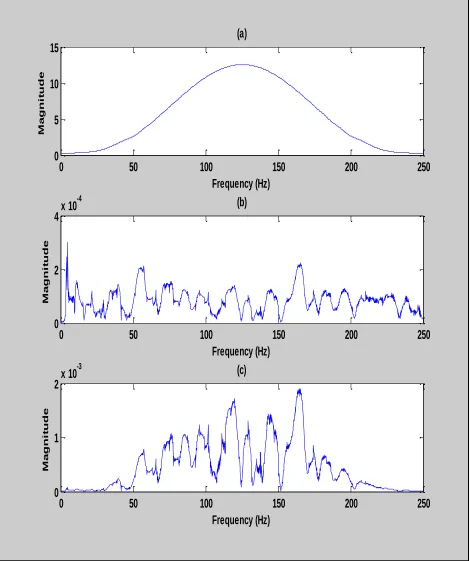
signal on its way to the receiver. Figure 1.2 shows the energy spectra of the source signal,
Green's function, and measured signal in the frequency domain. The source signal spectrum is
very smooth and centered at 125 Hz. The Green's function spectrum is irregular in shape and
features a number of nulls. By the convolution theorem (Bracewell 2000), the spectrum of the
measured signal is the product of the source spectrum and the Green's function spectrum. The
irregular shape and the nulls of the Green's function show in the frequency band where the
source signal is most prominent.
The next task is to calculate the Frazer and Pecholcs localizer functions when the correct
Green's function from Figure 1.1 is used, and for an incorrect Green's function corresponding to
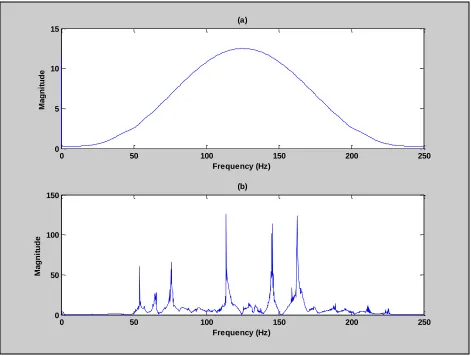
a different source location. Figure 1.3 shows the result of D/G(X) for each case where D is the
measured signal spectrum and G(X) is the Green's function. When the correct Green's function is
used, the smooth spectrum of the source signal is deconvolved out. If the incorrect Green's
function is used, a spectrum with a number of large peaks results. These peaks are there because
the nulls in the spectrum of the Green's function cause large values in the division operation
where there are not corresponding nulls in the measured signal's spectrum. This is the essential
feature for understanding Frazer and Pecholc's frequency domain based localizers. The Fourier
15
Figure 1.2. (a) The source signal spectrum. (b) Spectrum of Green's function, (c) Spectrum of measured signal.
0 50 100 150 200 250
0 5 10 15
Frequency (Hz)
M
a
gn
i
t
ud
e
(a)
0 50 100 150 200 250
0 2 4x 10
-4
Frequency (Hz)
M
a
gn
i
t
ud
e
(b)
0 50 100 150 200 250
0 1 2x 10
-3
Frequency (Hz)
M
a
gn
i
t
ud
e
16
Figure 1.3. (a) Magnitude of D/G(X) for the correct source location; (b) magnitude of D/G(X) for the incorrect source location
locations as those in the measured signal's spectrum can prevent these large peaks from
appearing.
To understand the time domain localizer we need to look at the inverse FFT of these
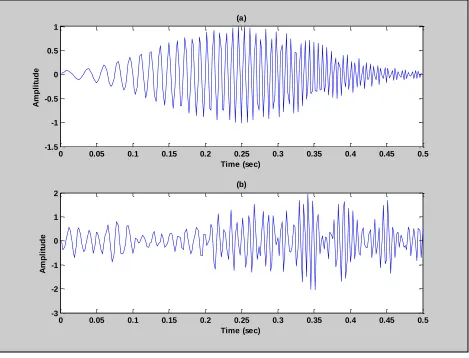
Fourier deconvolutions to see what happens in the time domain. Figure 1.4 (a) shows the result
when the correct Green's function is used. The Hamming windowed LFM pulse is retrieved just
as the frequency domain picture in Figure 1.3 (a) suggested. Figure 1.4 (b) shows the recovered
signal with the incorrect Green's function. An irregular function results bearing little
resemblance to the original source signal. The localizer works on a different principle than
0 50 100 150 200 250
0 5 10 15
Frequency (Hz)
M
a
gn
it
ud
e
(a)
0 50 100 150 200 250
0 50 100 150
Frequency (Hz)
M
a
gn
it
ud
e
17
Figure 1.4. (a) The inverse FFT of D/G(X) for the correct source location; (b) the inverse FFT of D/G(X) for the incorrect source location shown in Figure 1.3(b).
the frequency domain localizers. It is sensitive to the duration of the signal in the time domain.
Shorter duration source signals tend to give lower values in the denominator of this localizer. If
the original source signal is sufficiently compressed in the time domain, this localizer will have
higher values when the deconvolution is correct. As Figure 1.4 (b) shows, the incorrect result
gives a ragged and spread out signal estimate that tends to decrease the value of the localizer.
We are now left to discuss the χ and μ localizers. These localizers work with the cross
correlation of the replica signal with the measured signal. They are the only localizers in the
0 0.05 0.1 0.15 0.2 0.25 0.3 0.35 0.4 0.45 0.5 -1.5
-1 -0.5 0 0.5 1
Time (sec)
A
m
pl
it
ud
e
(a)
0 0.05 0.1 0.15 0.2 0.25 0.3 0.35 0.4 0.45 0.5 -3
-2 -1 0 1 2
Time (sec)
A
m
pl
it
ud
e
18
family that rely on knowledge of the source signal for their calculation. The localizer is
idential to the Clay localizer; and are similar but with different normalizations. Figure
1.5 shows the cross correlation with the incorrect Green's function; Figure 1.6 shows the cross
correlation with the correct Green's function. Qualitatively both waveforms look similar
suggesting these localizers are less sensitive to the different Green's functions. The peak value
of the cross correlation and the 1-norms are similar too. The similarity of the localizers suggests
that a calculation of the localizers over all source locations could result in many false peaks.
The results in Table 1.1 summarize the values of the Frazer and Pecholc's localizer
functions for our sample case. All of the localizers in this example showed higher values at the
correct location except the localizer. Both the χ and μ localizers are based on the cross
correlation of the replica signal with the measured signal but have different normalization
factors. The failure of the μ localizer but not the χ localizers suggests that the normalizations
used in these localizers are very important. Notice the strong differences between the θ and φ
localizers. Those are sensitive to the smoothness of the source signal spectrum estimate from the
Fourier division. The assumption that the source signal spectrum be smooth compared to G(X) is
important for these localizers.
1.4.3 Lee (1998)
The next localizer we will look at is by Lee (1998) and is another one based on cross
correlation. The source signal is assumed to be known and the Green's function is measured
directly by calculating the cross correlation of the measured signal and the source signal, as in
equation (1.7). The result of this calculation is equivalent to the received signal resulting from
the transmission of the autocorrelation of the source signal through the ocean environment.
19
Figure 1.5. The cross correlation of the replica signal with the measured signal for the incorrect source location.
0 0.2 0.4 0.6 0.8 1 1.2
-1.5 -1 -0.5 0 0.5 1 1.5x 10
-7
Time (sec)
A
m
pl
it
ud
20
Figure 1.6. The cross correlation of the replica signal with the measured signal for the correct source location.
0 0.2 0.4 0.6 0.8 1 1.2
-1.5 -1 -0.5 0 0.5 1 1.5x 10
-7
Time (sec)
A
m
pl
it
ud
21
Localizer Incorrect Source Location Correct Source Location
0.2267 0.2784
0.0011 0.0014
0.0091 0.0079
0.0404 0.4409
113.4 889.0
0.0051 0.0118
0.0003 0.0004
Table 1.1. Frazer & Pecholcs localizer values for the correct and incorrect source locations.
should give a good approximation of the Green's function. The Green's function estimate can
then be directly compared to the Green's functions calculated from an acoustic propagation
model using the cross correlation again. The localizer will reach a peak value when the
estimated Green's function most resembles the Green's function from the model corresponding to
the correct source location. This localizer is very similar to the Clay localizer except that the
cross correlation is calculated between the Green's functions, rather than between a replica signal
and the measured signal. Here is the Lee localizer in our mathematical notation:
22
where is the Green's function estimate from cross correlating the measurement with the source
signal, and ) is the Green's function calculated from the acoustic propagation model for
location X.
1.4.4 Porter et al. (1998)
Porter et al. (1998) developed another localizer based on the cross correlation of the
measured signal with a replica signal with one important difference from the previous localizers
we've looked at: they cross correlate the logarithm (log10) of the envelopes of the replica signal
and measured signal rather than the signals themselves. The principle behind this is that in many
environments only the first few arrivals at the receiver dominate the measured signal energy.
The later arrivals are attenuated more from multiple bottom interactions on their journey to the
receiver. The localizers by Porter et al. use the envelope of the signals to put less emphasis on
the fine details of the signal. They use the logarithm to emphasize the larger energy portions of
the signal. The hypothesis is that the localizer will be more robust. The equation is as follows
(1.24)
where rle is the logarithm of the envelope of the measured signal and is the logarithm of
the envelope of the replica signal for location X. Again we calculate the replica signal over all
trial source locations X and look for where the localizer peaks.
1.4.5 Jesus et al. (2000)
The localizers developed by Jesus et al. (Jesus, Porter, et al. 1998, 2000) are the first
we've discussed that explicitly assume that the acoustic propagation model used is a ray tracing
model (they used BELLHOP). This is often desirable because ray models run very quickly and
23 First we define some notation:
X: the source location.
y: measurement signal vector at the hydrophone.
S[τ(X)]: matrix of source signal replicas; each column contains one replica of the source signal
delayed by an amount defined by τ(X).
τ(X): vector defining arrival times from a ray based acoustic propagation model for source
location X.
a(X): amplitude vector defining amplitudes of arrivals from ray based acoustic propagation
model for source location X.
ε: random noise vector (representing measurement noise).
The signal model is
(1.25)
The received signal model is composed of scaled and delayed replicas of the source signal as
predicted by acoustic ray theory. The localizer calculates the product of the measurement signal
vector y with the matrix S. The resulting vector's elements are squared and summed for all trial
source locations. In other words, they calculate the inner product of the measurement vector
with scaled and delayed replicas of the source signal. The idea is that the localizer will peak
when the τ(X) time delay vector has the correct arrival times in it corresponding to the true
source location. The localizer equation is written
(1.26)
where X is the source location and H is the Hermitian transpose (complex valued signals are
admissible). Jesus et al. generalize their localizers to the case of N snapshots of the measured
24
to use in the algorithm. We will not be looking at this case, however, and will focus on the case
where only a single measurement is available.
1.4.6 Tiemann et al. (2006)
A recent paper by Tiemann et al. (2006) looked at marine mammal localization with a
single hydrophone. Ray theory was explicitly assumed for this technique by assuming source
signal arrivals in the measurement can be clearly identified. Localization is done by matching
arrival times estimated from the measured signal to arrival times calculated from a ray tracing
model. The sperm whale clicks they measured were broadband and of very short duration. The
ray model of propagation is ideal for signals like this and arrivals at the receiver can be easily
identified. Their method was to match the arrivals at the receiver to the arrivals calculated by a
ray propagation model (they used BELLHOP). To do the matching, they created bins with a
width of 15 milliseconds across the length of the measurement and the arrival time vector from
the ray model. They considered any arrivals in a particular bin that are present in both the
measured signal and the calculated arrivals to be overlapping. This process is continued across
the entire measurement tabulating the overlaps. If there are arrivals that do not overlap in a bin,
they are considered nonoverlapping and those are tabulated. A net overlap score is calculated by
summing the overlaps and then subtracting the sum of the nonoverlapping arrivals. The score is
calculated for each trial source location. The location with the highest net overlap score is the
location of the source.
This technique is similar to other techniques where ray arrival times in the measurement
are compared to those calculated by a model. Instead of calculating a cross correlation as in
many of the methods described above, or through matrix algebra, Tiemann et al. (2006) use a
25
1.4.7 Other Localization Techniques
There are other papers in the literature that use geometric ray tracing techniques to
calculate the ray arrival times at a hydrophone for different source locations (Hassab 1976; Cato
1998; Aubauer, Lammers and Whitlow 2000). This would be a useful technique for broadband
source signals in environments that can be approximated by a constant sound speed profile. A
paper by Unpingco et al. (1999) describes a synthetic aperture technique for tracking moving
sources under certain assumptions. Kuperman and D'Spain (2001) describe a technique for
localizing in range only for broadband sources in deep water. We will not examine these
26
Chapter 2 A New Technique for Single Hydrophone Localization
2
.1 Description
Although we described several approaches to single hydrophone localization from the
literature, the amount of work done on single sensor localization is small when compared to the
voluminous literature on matched field processing with multiple receivers. Most of the methods
we described from the literature are variations on the basic idea of comparing replica signals
generated using the source signal and an acoustic model, with the measurement at the receiver.
A maximum or a minimum in the resulting metric is used to quantify the correlation and
determine the true source location. All of the above methods, except the algorithm by Frazer and
Pecholcs (1990), rely on knowledge of the source signal that is transmitted, and this might be a
limitation in some situations where this information may not be available or easily obtained.
We propose a new single hydrophone localization algorithm using the method of least
squares. Least squares is well established and can be implemented efficiently using matrix
algebra packages. This algorithm does not require knowledge of the source signal. The Green's
function estimate can be calculated from any acoustic propagation model. There is no
assumption built into the new algorithm requiring that a particular model be used (e.g., a ray
model). This frees up researchers to use any model that is appropriate for their experiment and it
gives them options to balance their resources. This can be important because some propagation
27
2.2 Algorithm
First we will establish some notation and then lay out the steps of the algorithm. Recall
equation (1.6) describing a discrete time LTI system for underwater acoustics
(2.1)
where G is the convolution matrix of the Green's function for a source and receiver in the
environment of the experiment, s is the discrete time source signal vector, and m is the
measurement vector at the receiver. Generally there will be some interfering noise that we will
model as a random vector n added to the measurement vector
(2.2)
We know the location of our receiver but do not know the location of the source. Using the
environmental information our propagation model requires, such as the sound speed profile of
the water, we can calculate a set of trial Green's functions over a grid of possible source
locations. Each trial Green's function represents the propagation characteristics for a particular
source and receiver geometry. For example, in a two dimensional problem where the
coordinates are range and depth, we can calculate the Green's functions over a rectangular grid of
ranges and depths where the source might be located. If the grid is sufficiently large to include
the source, our algorithm should identify the range and depth of its location. The source signal is
assumed to be unknown. The question is how can we find the location without knowing either
the signal or the Green's function? The answer is that we will simultaneously estimate the source
28
(2.3)
is a trial Green's function from our search grid and is our estimate of the source signal that
we obtain by solving the equation:
(2.4)
is the pseudo-inverse of . The pseudo-inverse creates the shortest least squares solution to
the problem, as we pointed out in equation (1.11). Now that we have our source signal estimate
, we can use it to calculate a replica signal , assuming that is the correct Green's function:
(2.5)
To summarize the last few steps, we create a replica signal by temporarily assuming that our trial
Green's function is the correct one. Then we estimate the source signal using the least squares
solution to equation (2.3). The resulting least squares estimate of the source signal is then
convolved with the trial Green's function in equation (2.5) to give us a replica signal . The
final step is to compare our replica signal with the measured signal and calculate the squared
difference between them:
(2.6)
The process in equations (2.4) through (2.6) is repeated for every trial source location X. The
localizer function is denoted
(2.7)
The localizer will achieve a minimum value when the Green's function corresponding to the
29
2.3 Analysis of Algorithm
There are two possibilities when a trial Green's function is input into the algorithm:
either it is the correct Green's function describing the system or it is not.
Case 1: (the Green's function for the correct source location is used). Substituting
into equation (2.4) gives
(2.8)
Recall from equation (2.2) that and substitute it into equation (2.8):
(2.9)
Assuming that the signal to noise ratio is high enough to render the contribution of the second
term to be negligible, we have
(2.10)
Using the fact that if and only if G is full column rank (Lutkepohl 1996), eq. (2.10)
becomes
(2.11)
Finally we have for the replica signal vector
(2.12)
30
(2.13)
Case 2: (a Green's function for an incorrect source location is used). Substituting
equation (2.2) into equation (2.4) gives
(2.14)
where we assume again that the noise term n is negligible and neglect that term.
The replica signal vector becomes,
(2.15)
The matrix product for a full column rank matrix (Lutkepohl 1996). The product is
equal to the identity matrix only when the system is full row rank (Lutkepohl 1996). Calculating
the difference between the measured signal and the replica signal gives
(2.16)
We simplify equation (2.16) into a more convenient form:
(2.17)
Therefore in Case 2 showing that our localizer should achieve a minimum only when
the Green's function for the correct source location is put into the algorithm. The assumptions
we made in equations (2.10) and (2.14) that the noise vector n is small is important and we will
look at the impact of a larger n in Chapter 3.
Another notable case is when the Green's function has very few arrivals close together in
31
When this happens the Green's function resembles a delta function and therefore the convolution
matrix will resemble an identity matrix. In other words, there is not much distortion of the
source signal on its way to the receiver. Inspection of equation (2.3) shows that the source signal
estimate will be very close to the measured signal. This will propagate through the algorithm
and give a replica signal that is very close to the measured signal. The localizer output will take
on very small values in these cases and give unreliable location estimates. Cases like this could
pose a problem for any single hydrophone localization algorithm because they all generally rely
on multiple interactions of the source signal energy with the surface and the bottom. To function
properly, these algorithms require unique Green's functions for different source and receiver
geometries. Researchers must be aware of this in their experimental planning and should try to
put the hydrophone in an advantageous position. It is also important to keep this case in mind
when interpreting the localization data.
2.4 Discussion
The algorithm we've described is based on solving the least squares problem, giving it the
benefit of the fast algorithms that have been developed over the years. The Levinson-Durbin
recursion (Levinson 1947; Durbin 1960) is a very popular algorithm used to solve equation (2.3)
in a computationally efficient and stable manner. Another benefit is that the least squares
formulation naturally accommodates the presence of some random noise in the measured signal.
Least squares finds a solution to minimize and therefore will minimize the effects of the
noise vector n (Strang 1993).
Our algorithm makes no assumptions about the nature of the source signal. Only four of
32
require no knowledge of the source signal. However Frazer and Pecholcs do make assumptions
on the smoothness of the source signal spectrum and on its duration in the time domain for one
of their localizers. This potentially limits the application of their localizer if the source signal
does not meet their assumptions. Although Tiemann et al. (2006) and other localizers based on
ray arrival times do not explicitly rely on knowledge of the source signal, they do make the
assumption that the source signal is of a wide enough bandwidth that distinct arrivals are
measured at the hydrophone. We propose our localizer as the only one among the ones we've
reviewed in this dissertation that is both model independent and source signal independent.
As with any matched field processing algorithm, our algorithm shares the same potential
sensitivity to inaccuracies in the acoustic modeling. This could be caused by the inaccuracies in
the model itself or by coarse environmental information fed into the model. Researchers should
also experiment with the search grid of trial source locations to determine the appropriate grid
spacing. There may be a balance of the fineness of the grid required for localization and the
computational resources available to run the algorithm over the whole grid.
2.5 Analysis Plan
In the next chapter we present results from simulation data to explore the capability and
sensitivity of our new algorithm. First we look at an initial case with simulated data to
demonstrate the algorithm in a simple environment and compare it with the other localizers
described in Chapter 1. Sensitivities we explore parametrically include signal to noise ratio and
source signal bandwidth. With that understanding, we test the localization algorithm on some
experimental ocean acoustic data to show it can be successfully used in a real ocean
33
Chapter 3 Simulation Results
3.1 Introduction
In this chapter we test the new method developed in Chapter 2 on some simulated data
sets, look at some of its sensitivities, and compare its localization accuracy to the existing
techniques described in Chapter 1. To minimize any possible biases from the particular acoustic
propagation model selected, we use a closed form analytical solution to the Pekeris waveguide
problem (Pekeris 1948; Jensen, et al. 1994) to calculate the Green's functions. We look at the
sensitivity of our localization algorithm to source signal bandwidth and signal to noise ratio
(SNR).
The source signal is a linear frequency modulated pulse described by the following
equation:
(3.1)
where t is the time, w(t) is the amplitude, f1 is the frequency at which the sweep begins and k is a
constant that determines the rate of increase of the sweep. The instantaneous frequency fi at time
t is given by fi (t) = f1 + kt. The frequency of the signal increases linearly as a function of time.
The constants f1 and k can be chosen to get the desired frequency sweep over the period of the
signal. We choose a Hamming window (Harris 1978) for the amplitude function w(t),
(3.2)
The Hamming window smoothes the sharp rise and fall of the amplitude of the LFM pulse
34
window to use because it is a built in function of Matlab, the software package we used to do
most of the calculations in this dissertation.
The ocean environment we simulate is a Pekeris waveguide (Pekeris 1948; Jensen, et al.
1994), a model of a single water layer over an infinitely deep fluid bottom layer. Each layer is
characterized by a sound speed and a density. Although the Pekeris waveguide model may be
too simple an approximation for some environments, we use it here to simplify the computations
and to minimize biases that may creep into the sensitivity analysis from assumptions built into
the particular acoustic propagation model used to calculate Green's functions. The Pekeris
waveguide model is well understood and has a relatively simple closed form solution. This
makes the Green's function calculations simple and fast over a grid of trial source locations.
The Green's function is synthesized from the following frequency dependent solution to
the Pekeris waveguide problem (Pekeris 1948; Jensen, et al. 1994):
(3.3)
where r is the range of the receiver, z is the depth of the receiver, zs is the source depth, D is the
water depth, f is the source frequency, krn is the radial wave number of mode n, and kzn is the
vertical wave number of mode n. To obtain the time dependent Green's function, we calculate
Equation (3.2) at every discrete frequency f over the bandwidth defined by the problem and take
the inverse FFT of the result. This process is repeated for every trial source location and the
Green's functions are stored for input into the localization algorithm. For our experiment, we
used the following parameters to characterize the waveguide:
35 Receiver depth z: 150 meters.
Receiver range: 2100 meters.
Water depth D: 300 meters.
Sound speed in the water: 1500 meters/second.
Sound speed in the bottom: 1650 meters/second.
Density of the water: 1 kg/m3.
Density of the bottom: 1.9 kg/m3.
The sound speed and density of the bottom are representative of a sandy bottom and the water
depth is shallow enough to allow for many interactions of the sound in the water column with the
bottom. The grid over which we calculated the trial Green's functions began at a range of 500
meters from the receiver and went out to 3000 meters, at intervals of 10 meters. The grid
extended over the entire 300 meter water column at intervals in depth of 2 meters.
To simulate the signal measurement at the hydrophone, we convolved the Green's
function for the true source location using equation (3.2) with the source signal from equation
(3.1). We input the result into the localization algorithms as the measured signal. Figure 3.1
shows the three source signals we used, each with different bandwidths. Different bandwidths
were achieved by adjusting the constants f1 and k in equation (3.1). The first bandwidth was a 10
Hz LFM sweep from 120 Hz to 130 Hz. The second bandwidth was a 100 Hz sweep from 75 Hz
to 175 Hz. The third bandwidth was a 200 Hz sweep from 25 Hz to 225 Hz. The durations of
36
Figure 3.1. The source signals in the time domain and frequency domain. (a) Time domain view of 10 Hz LFM sweep over 0.5 seconds; (b) Frequency domain view of 10 Hz LFM sweep from 120 Hz to 130 Hz; (c) Time domain view of 100 Hz LFM sweep over 0.5 seconds; (d) Frequency domain view of 100 Hz LFM sweep from 75 Hz to 175 Hz; (e) Time domain view of 200 Hz LFM sweep over 0.5 seconds; (f) Frequency domain view of 200 Hz LFM sweep from 25 Hz to 225 Hz. All of the signals are modulated by a Hamming window.
0.1 0.2 0.3 0.4 0.5
-0.5 0 0.5 (a) A m p li t u d e
0 50 100 150 200 250
0.2 0.4 0.6 0.8 1 (b) M a g n it u d e
0.1 0.2 0.3 0.4 0.5
-0.5 0 0.5 (c) A m p li t u d e
0 50 100 150 200 250
0.2 0.4 0.6 0.8 1 (d) M a g n it u d e
0.1 0.2 0.3 0.4 0.5
-0.5 0 0.5 Time (sec) (e) A m p li t u d e
0 50 100 150 200 250
37
different bandwidths is to test the sensitivity of our new algorithm to the bandwidth of the source
signal, and to compare this sensitivity with that of the other localizers we described in Chapter 1.
Bandwidth is an essential consideration in the single hydrophone localization problem because
we are trying to exploit variability of the Green's function with frequency to locate the source.
The more frequencies we have available in our data, the greater the chance we can calculate
unambiguous replica signals and locate the source.
Figure 3.1 shows the time domain and the frequency domain representations of the three
LFM source signals we use. Figure 3.2 shows the Green's function for the correct source and
receiver pair calculated from equation (3.3) in the time domain and the frequency domain.
Notice the presence of multiple spikes in the time domain representing reflections of the sound
from the surface of the water and the bottom. The frequency domain plot illustrates that the
interaction of the sound with the surface and the bottom strongly attenuates some frequencies,
but not others. Figure 3.3 shows the convolution of each of the source signals with the Green's
function in both the time and the frequency domain. There is significant distortion of the source
signal when it travels to the receiver because of the multiple interactions with the surface and the
bottom. It is the uniqueness of this distortion for each source and receiver pair that we want to
exploit in the localization problem.
3.2 Source Signal Bandwidth Parameterization
3.2.1 10 Hz Source Signal Bandwidth
The first case we look at is the localization results for the 10 Hz LFM sweep from 120
Hz to 130 Hz. Figure 3.4 shows the ambiguity plot for this case using our localization algorithm.
38
Figure 3.2. (a) Time domain view of the correct Green's function; (b) Frequency domain view of the correct Green's function.
0 0.05 0.1 0.15 0.2 0.25 0.3 0.35 0.4
-1 -0.5 0 0.5 1
Time (sec)
A
m
p
li
tu
d
e
0 50 100 150 200 250
0 0.2 0.4 0.6 0.8 1
Frequency (Hz)
M
a
g
n
itu
d
39
Figure 3.3. The receiver signals calculated by convolving the source signals in Figure 3.1 with the Green's function in Figure 3.2. (a) Time domain measured signal for the 10 Hz LFM sweep; (b) Frequency domain measured signal for 10 Hz LFM sweep; (c) Time domain measured signal for the 100 Hz LFM sweep; (d) Frequency domain measured signal for the 100 Hz LFM sweep; (e) Time domain measured signal for the 200 Hz LFM sweep; (f) Frequency domain measured signal for the 200 Hz LFM sweep.
0.2 0.4 0.6 0.8
-1 -0.5 0 0.5 (a) A m p li t u d e
0.2 0.4 0.6 0.8
-0.5 0 0.5 1 (c) A m p li t u d e
0.2 0.4 0.6 0.8
-0.5 0 0.5 1 Time (sec) (e) A m p li t u d e
0 50 100 150 200 250
0.2 0.4 0.6 0.8 1 (b) M a g n it u d e
0 50 100 150 200 250
0.2 0.4 0.6 0.8 1 (d) M a g n it u d e
0 50 100 150 200 250
40
Figure 3.4. Ambiguity plot of our new single hydrophone localization algorithm over a grid of trial source locations for the 10 Hz case. The colors correspond to the reciprocal of the value of the localizer function in each bin. The peak of the localizer function occurs at a range of 2100 meters and a depth of 100 meters. The true location of the source is a range of 2100 meters and a depth of 99 meters.
Peak Value -- Range: 2100 m Depth: 100 m
Range (m)
D
e
p
th
(m
)
500 1000 1500 2000 2500 3000
50
100
150
200
250
41
of the source and range of the source from the receiver. We plotted the reciprocal so that the
peak value will represent the source location estimate, to be consistent with the other localizers
we discussed in Chapter 1. Our grid spacing was 10 meters in range and 2 meters in depth.
There is a clear peak at a range of 2100 meters and a depth of 100 meters. Recall that the true
location of the source is at a range of 2100 meters and depth of 99 meters. The localizer
successfully located the source within 1 meter despite the source being slightly off of the grid of
trial source locations, and having only a 10 Hz signal bandwidth. Note that localization within 1
meter is the best possible because of the discrete grid of locations over which the calculations are
done. Figure 3.5 gives a close up view of the localizer peak and shows that the peak quickly
tapers off in both range and depth. The peak drops off within about 20 meters in range and 4
meters in depth.
We now consider the performance of the other single hydrophone localizers for
comparison. One issue to consider first is that the localizers by Jesus et al. (2000) and Tiemann
et al. (2006) require their Green's functions be calculated using a ray model. We used
BELLHOP to do this by modeling the Pekeris waveguide using a constant sound speed profile in
the water column and a constant sound speed in the bottom. Figure 3.6 overlays the analytical
Green's function for the Pekeris waveguide with the estimated ray arrivals from BELLHOP.
There is good agreement between the two models in timing and sign for many of the arrivals.
There are two arrivals in the 0.2 to 0.25 second range where BELLHOP's estimate is misaligned
in time and opposite in sign to the analytical solution. These disagreements are not surprising
because the ray approximation of acoustics is most accurate with broadband, high frequency