DEMOGRAPHIC RESEARCH
VOLUME 31, ARTICLE 26, PAGES 779
812
PUBLISHED 7 OCTOBER 2014
http://www.demographic-research.org/Volumes/Vol31/26/ DOI: 10.4054/DemRes.2014.31.26
Research Article
Assimilation effects on infant mortality among
immigrants in Norway:
Does maternal source country matter?
Jonas Minet Kinge
Tom Kornstad
© 2014 Jonas Minet Kinge & Tom Kornstad.
This open-access work is published under the terms of the Creative Commons Attribution NonCommercial License 2.0 Germany, which permits use, reproduction & distribution in any medium for non-commercial purposes, provided the original author(s) and source are given credit.
1 Introduction 780
1.1 Theoretical background 781
1.1.1 Pre-arrival effects 781
1.1.2 Post-arrival effects 782
1.1.3 Selection effects 783
1.2 Related literature 783
2 Methods 785
2.1 Data and variables 785
2.2 Analysis 787
2.3 Further details 789
3 Results 790
3.1 Descriptive statistics 790
3.2 Regression model results 794
4 Discussion 803
4.1 Shortcomings of the analysis 807
5 Acknowledgements 808
Assimilation effects on infant mortality among immigrants in
Norway: Does maternal source country matter?
Jonas Minet Kinge1,2 Tom Kornstad2
Abstract
BACKGROUND
Assimilation models of infant outcomes among immigrants have received considerable attention in the social sciences. However, little effort has been made to investigate how these models are influenced by the source country.
OBJECTIVE
We investigate the relationship between infant mortality and the number of years since maternal migration and whether or not this relationship varies with maternal source country.
METHODS
We use an extensive dataset which includes all of the births in Norway between 1992– 2010, augmented by information on the source country and other maternal characteristics. By measuring the source country infant mortality rate at the time the mother came to Norway, we are able to account for circumstances in the country the mother left behind. We apply assimilation models which allow for interactions between source country characteristics and maternal years since migration. We also fit models in which age at maternal migration replaces maternal years since migration.
RESULTS
Our analyses generated three main findings. First, an assimilation process has taken place, as the infant mortality rate declined with the number of years since maternal migration. Second, maternal source country characteristics are significantly associated with infant mortality rates in Norway. Mothers from countries with high infant mortality rates (e.g., countries in Africa and Asia) had higher infant mortality rates than mothers from countries with low infant mortality rates (e.g., countries in Europe). Third, the
assimilation process varied by maternal source country: i.e., the assimilation process was more pronounced among mothers from countries with high infant mortality rates than among those from countries with low infant mortality rates.
CONCLUSIONS
The source country is an important predictor of the assimilation profiles. This study contributes to the existing literature on assimilation by emphasising the significance of the source country.
1. Introduction
Immigrants to advanced economies in Europe and other continents come from countries with very diverse characteristics in terms of, for example, nutrition, health care services, and cultural practices in relation to pregnancy and childbirth. Hence, international migration to industrialised countries has been accompanied by disparities in the health outcomes of infants born to migrant women and those born to non-migrant women. Previous studies have shown that infant mortality rates depend on the immigrant’s destination country, and that different effects are associated with different source countries (Bollini et al. 2009; Naimy et al. 2013). However, little effort has been made to investigate whether the source country influences the degree of assimilation. This factor is important in light of assimilation and acculturation theory, which generally assumes that over time immigrants increasingly adapt their behaviours to those of non-immigrants, and that the effects of the source country gradually disappear (Blau 1992; Jasso et al. 2004). The results of studies on outcomes other than infant mortality support the assimilation theory. For example, a number of studies have found that female labour force participation and fertility converge towards non-immigrant levels with length of stay (Antecol 2000; Mayer and Riphahn 2000).
the infant health of second-generation immigrants is key to understanding the transmission of health across generations (Teitler, Hutto, and Reichman 2012). Third, our findings could have strong implications for health policy interventions, as they may suggest that the targeting of interventions by source country is warranted.
The structure of the paper is as follows. We start by discussing the theoretical background and some related literature. The data and analysis are outlined in the methods section. The descriptive statistics and empirical results are then described in the results section. Finally, we summarise and discuss the results in light of the related literature and their relevance for policy. The shortcomings of the study are also described in this discussion section.
1.1 Theoretical background
In this study, we investigate the so-called assimilation model (Blau 1992). According to this model, the infant mortality rate of recently arrived immigrants will differ from the rate of their non-immigrant counterparts (reflecting the conditions in the country of maternal origin), but with increasing length of residence the immigrants’ infant mortality rate will approach that of the mean infant mortality rate in the host country. This process can be caused by a number of effects, which may be categorised into pre-arrival effects and post-pre-arrival effects.
1.1.1 Pre-arrival effects
1.1.2 Post-arrival effects
Acculturation theory suggests that as exposure to the host country environment causes immigrants to adopt native-born behaviours (Blau 1992; Jasso et al. 2004), the influence of the source country diminishes. Norway has practically free access to public health services. As in the other Nordic countries, the social security network is also well developed, offering disability benefits, unemployment benefits, housing support, and social benefits for poor people outside of the labour market. If immigrants gradually start using such services, the association between the infant mortality rate of the source country and the infant mortality rate in Norway may be expected to decrease over time.
In addition to the circumstances in the host country, the speed of the assimilation process depends on the extent to which the health-seeking behaviours and cultural practices relating to pregnancy and childbirth in the source country influence women in the host country. Such factors can include consanguinity, (Stoltenberg et al. 1998), nutrition (Essen et al. 2000b), and the utilisation of health care services (Goth and Godager 2012; Grytten, Skau, and Sørensen 2013). At least in the short run, women from countries with good access to health care services might be expected to be more frequent users of these services in the host country. Indeed, two studies have shown that women’s utilisation of health care services varies by the source country (Goth and Godager 2012; Grytten, Skau, and Sørensen 2013).
1.1.3 Selection effects
Care is required when the assimilation framework is applied in the analysis of infant mortality. As described above, a range of factors may be at work which could hide the actual underlying process. Many scholars who have described the acculturation process have noted that because it is complex and not uniformly experienced, the process cannot be characterised by a single measure (Berry 2003). One reason for this complexity is the selection of immigrants, which might bias the estimates of the assimilation model. First, immigrants may self-select on characteristics which make them more comparable to those of the host country (Blau 1992). This may reduce the gap in infant mortality between immigrants from different countries, as well as the gap between immigrants and non-immigrants. Second, immigrants may differ from other people in their source country, as they tend to be better educated and more entrepreneurial than the general population (Chiswick, Lee, and Miller 2008). In addition, immigrants may start to adapt their behaviour prior to immigration in anticipation of the conditions in the host country (Blau 1992). Such effects may lead to a downward bias in the effects of the assimilation model.
1.2 Related literature
Most of the studies which have investigated assimilation and infant health outcomes were conducted using North American data. This is important because the healthy migrant effect seems to be more pronounced in this part of the world than it is elsewhere.3 Landale, Oropesa, and Gorman (2000) used pooled origin/destination data from the Puerto Rican Maternal and Infant Health Study to investigate the association between maternal years in the US and infant mortality. Their analysis showed that the infant mortality rate among immigrant women was initially lower than the rate among native-born women, but that the rate increased with maternal years since migration (YSM). Using natality data from metropolitan areas of Ontario, Canada, Urquia et al. (2010) investigated the association between maternal duration of residence and the
3 Studies of European countries have frequently found that immigrants have inferior infant outcomes (Garssen
likelihood that a baby would be born preterm or small for the gestational age. They found significant associations between maternal YSM and preterm birth. Recent immigrants were at lower risk of having a preterm birth than native Canadians, but the risk increased with YSM. However, no significant association was found between maternal YSM and the probability of having an infant who was small for the gestational age. Urquia, O’Campo, and Heaman (2012) used Canadian cross-sectional survey data for women who gave birth in 2006 to 2007 to analyse the association between pregnancy outcomes and maternal YSM. Recent immigrant (<10 years) women were found to have had a lower risk of preterm delivery than non-immigrants. No significant difference was found between non-immigrants and immigrants with a longer residence period (>10 years).
In the studies described above, the estimates were based on a linear assimilation profile. Other studies have found a highly non-linear pattern between YSM and infant health. Ceballos and Palloni (2010) used a dataset consisting of a sample of Mexican immigrant women living in the US to analyse the association between maternal YSM and infant health. Infant health was measured using a composite measure of having a low birth weight, being small for the gestational age, and being born after fewer than 37 weeks’ gestation. They found a nonlinear U-shaped relationship between maternal duration of residence in the US and infant health. Having spent either three or fewer years or 13 or more years in the US was associated with less favourable birth outcomes than having spent four to 12 years in the US. Teitler, Hutto, and Reichman (2012) used three US datasets to examine the association between the birth weights of the children of immigrants and the maternal duration of residence. Looking at immigrants overall and Hispanics in particular, they found a non-linear U-shaped relationship in which birth weight declined over the first few years of maternal residence and then increased thereafter. This relationship was observed among all of the immigrants across the three datasets. Although they did not specifically test whether the assimilation profiles differed between all immigrants and Hispanics, they described a similar pattern.
To the best of our knowledge, few studies have considered whether the assimilation profiles on infant health measures differ by maternal source country. Of specific relevance in this context is the study by Troe et al. (2006), who looked at infant mortality by maternal age at migration in the Netherlands separately for Turkish and Surinamese mothers. They found that while both immigrant groups had higher infant mortality rates than natives upon arrival, the association between maternal age at migration and infant mortality differed by maternal source country: i.e., that the infant mortality rate rose with a lower age at immigration among Turkish mothers, but declined with a lower age at immigration among Surinamese mothers.
Our study will make important contributions to the literature discussed above for the following reasons. First, in addition to investigating infant mortality assimilation, we will study how the assimilation process varies by the characteristics of the maternal source country. Hence, we will use source country characteristics to investigate heterogeneity in the immigrant population. Second, our comprehensive dataset, which consists of register data for all births from 1992 to 2010 in Norway, ensures that there are sufficient observations for conducting the analysis, and specifically allows for a detailed analysis of population subgroups. In addition, we have no issues relating to sample selection and missing responses, which are common in survey data. Third, most of the above-mentioned studies which analysed YSM and infant health were conducted in the US or Canada. In both of these countries the healthy migrant effect is the main topic of analysis, whereas in European studies some immigrant groups have been consistently found to have worse health than the native population.
2. Methods
2.1 Data and variables
Using a unique identification key, we link several register datasets from Statistics Norway which cover the entire Norwegian population from 1992 to 2010. The final dataset consists of records of all of the live births in Norway during this period, together with information about the characteristics of each mother, including her source country and her date of arrival in Norway. Individuals for whom there is missing information about the source country, the date of birth, or the maternal characteristics were excluded from the sample (1.11% of the sample).
zero otherwise. We generate dummy variables for the region of maternal origin (Africa, Asia, Europe, North America, and South America; respectively). In addition, we generate variables for the 10 largest source countries of origin based on the number of births given (Sweden, Pakistan, Denmark, Somalia, United Kingdom, Vietnam, Turkey, Germany, USA, and Poland). These variables take the value of one if the maternal origin is from one of the specified regions/countries, and zero otherwise.
To investigate the implications of the maternal source country for the assimilation profiles we need a design that will allow us to characterise the interface between conditions in the source country and the assimilation profiles. We have chosen to use the infant mortality rate in the maternal source country as a measure of source country characteristics. This variable has been found to correlate with women’s health (Setia et al. 2011). It was selected because it is likely to represent the cultural and health factors which influence infant mortality in the source country, as well as the factors which might continue to influence health and mortality in the host country. It is measured at the point in time when each woman came to Norway. This is appropriate because we want to measure the conditions the mother left behind when deciding to migrate, and changes in their effects over time in Norway (Blau, Kahn, and Papps 2011). A dataset of source country infant mortality rates (SIMR) was assembled from the United Nations, Department of Economic and Social Affairs, Population Division (2011). The data contain the number of deaths per 1,000 newborns in five-year intervals from 1950 until 2010. These data were merged into the register data based on maternal country of origin and maternal date of arrival in Norway. Hence, each child born to a mother who has immigrated was assigned a value for SIMR at the time the mother arrived in Norway. We used the continuous SIMR to generate tertiles (low, medium, and high SIMR), and then used these tertiles in the regression models.
The analysis also includes a range of other covariates. The following variables are included in each specification: maternal age at birth, maternal age at birth squared, and gender. In addition, depending on the model, we control for maternal education (four categories), maternal marital status (two categories), birth year (dummy variables in 1-year intervals), maternal immigration cohort (10 dummy variables in five-1-year intervals), and county of residence (19 dummy variables). We also generate a variable for the mean infant mortality rate in Norway in the year of birth (continuous variable) by dividing the number of deaths by the number of births each year. Finally, we generate categorical variables for the number of years since maternal migration (five categories) and maternal age at migration (0‒16 and >16).4
4
2.2 Analysis
We investigate infant mortality within the framework of a standard logit model, and estimate nine different specifications. In the first models, the aim is to estimate whether there are differences in infant mortality between children born to mothers who are natives and children born to mothers with immigrant backgrounds. We investigate whether any observed difference depends on the maternal source region of origin. We also explore whether there are differences across the immigrants by maternal YSM and maternal age at migration. To do this we estimate the association between infant mortality and source region of origin (Ri), source country of origin (Ci), a categorical variable for SIMR (Si), maternal YSM (Ti) and maternal age at immigration (Ei) by fitting the following equations:
0 1 2 3 1
i i i i i
M R Y X [1]
0 1 2 3 1
i i i i i
M C Y X [2]
0 1 2 3 1
i i i i i
M S Y X [3]
0 1 2 3 1
i i i i i
M T Y X [4]
0 1 2 3 1
i i i i i
M E Y X , [5]
where i indexes the individual; Mi is a dummy for infant mortality; Yi is a vector of dummy variables for year of birth; Xi is a vector of maternal and individual characteristics; and ε 1i is the error term. Moreover,
0is a constant term and
1,
2,3
are vectors of parameters. The main parameters of interest are the ones associated with Ri, Ci, Si, Ti, and Ei. These are denoted by and capture the mean difference in infant mortality between children born to native mothers and children born to non-native mothers with a specific immigrant background.
In the second analysis, we further investigate the interplay between source country characteristics and maternal YSM/age at immigration. Here we focus on SIMR ‒ instead of, for example, source region of origin ‒ for three reasons. First, it simplifies the analysis by providing fewer interactions. Second, focusing on SIMR ensures that we have a sufficient number of births within each combination of interactions to conduct the analyses. Third, this specification can capture potentially large within-continental differences. To do this, we use a subsample consisting of children of non-native maternal background, and we fit the following two models:
1
0 1 2 3 4 5 2
i i i i i i i
M S T PA X [6]
0 1 2 3 4 5 2
i i i i i i i
M S E PA X . [7]
Pi is the continuous variable for mean infant mortality rate in Norway in the year of birth and Ai is a vector of cohort-of-arrival dummy variables. Eq.[6] includes maternal YSM (Ti), while Eq.[7] includes maternal age at immigration (Ei).
To investigate whether the relationship between YSM/age at migration and infant mortality varies with maternal source country, we also fit a model in which the coefficients of the YSM/age at migration are allowed to vary with SIMR. We fit the following regression models:
0 1 ( ) 2 3 4 5 3
i i i i i i i i
M S S T PA X [8]
0 1 ( ) 2 3 4 5 3
i i i i i i i i
M S S E PA X . [9]
Eq.[8] includes interactions between Si and Ti, but we do not include a separate term for
Ti. Similarly, Eq.[9] includes interactions between Si and Ei, but we do not include a separate term for Ei. This means that the coefficients for the interactions are actually simple effects (See UCLA: Statistical Consulting group n.d.). A similar approach was used by Blau, Kahn, and Papps (2011) in testing the impact of source country characteristics on assimilation profiles of labour force participation. Omitting Ti in Eq. [8] and Ei in [9] has two advantages. First, it displays directly the association between YSM (Ti) and infant mortality (Mi) at different levels of SIMR (Si) in Eq. [8]. In Eq. [9] it displays directly the association between age at migration (Ei) and infant mortality (Mi) at different levels of SIMR (Si). Second, because the interactions are interpreted as simple effects, we do not need to worry about the interpretation of interactions in nonlinear models (see, e.g., Ai and Norton 2003).
In the following tables, we present the estimated logit coefficients, as well as the marginal effects (MEs). The marginal effects are the change in the probability that an event (infant death) will occur. For expositional reasons, we multiply the MEs by 1,000 so that they represent the change in the infant mortality rate (deaths per 1,000 live births). Using the results of the regression models, we also plot curves for predicted infant mortality by YSM at “low” and “high” values of SIMR, while the other covariates are fixed at the population mean values.
source country level/year of arrival, since this is the level of variation of our group-level explanatory variable SIMR. We regard p-values below the 5% level as statistically significant. Values between 5% and 10% are regarded as weakly significant.
2.3 Further details
As women are fertile only up to a certain age, immigrant women who have lived in Norway for a long period of time before giving birth must have been young at the point of migration. Consequently, age at arrival and YSM are negatively correlated. We cannot include both measures of assimilation in our models, as we want to control for maternal age at birth, and this would have led to a perfect correlation between the assimilation measures.5 As we cannot separate these measures from each other, they are essentially two different approaches for representing a similar assimilation measure. To illustrate this, we fit two separate models using either YSM or age at migration as our measure of assimilation.
Because the immigrants who arrive in a particular year may be influenced by unique shocks/forces in that year, it is essential to control for arrival-cohort effects when investigating the relationship between YSM and infant mortality. Examples of such effects include the relative economic conditions, a refugee crisis, or legislative amendments to the rules governing immigration. Hence, studies conducted without controlling for these effects present a joint measure of cohort effects and YSM. As described, we control for maternal immigration-cohort effects by including five-year period of arrival dummies in Eqs. [6]‒[9].
It is also important to control for time effects. However, we cannot include both cohort effects and time (birth year) effects if we want to investigate YSM. As we include cohort effects, we need an alternative method to account for time effects. In order to provide a measure of time effects, we include a measure for the infant mortality rate in the year of birth. This measure is constructed by calculating the mean infant mortality rate each year and merging it with the register data based on year of birth. We assume that this variable will pick up time-dependent factors that influence infant mortality, such as developments in medical technology. A related approach has been used in labour economics, where the unemployment rate is used to reflect the general economic development over time (Barth, Bratsberg, and Raaum 2004).
3. Results
3.1 Descriptive statistics
Table 1 contains descriptive statistics of infant mortality for the full dataset and stratified by the source region of origin. Out of a total of 1,109,932 births, 194,426 were children born to mothers who immigrated. The table illustrates that the infant mortality rate differs by the maternal region of origin. The highest infant mortality rate of 5.67 per 1,000 live births was found among children born to mothers from Africa, and the lowest infant mortality rate of 1.72 deaths per 1,000 live births was found among children born to mothers from Oceania. Compared with the infant mortality rate among children born to mothers from Norway, the rate among children born to mothers from Africa and Asia was higher, while the infant mortality rate among children born to mothers from Europe, Oceania, North America, and South America was lower. Table 1 also shows the mean source country infant mortality rate (SIMR) upon migration for each region. On average, the mean SIMR was highest among mothers from Africa (104 per 1,000 liveborn) and lowest among mothers from Europe (18 per 1,000 liveborn) and Oceania (14 per 1,000 liveborn). As there were only 1,164 births and two infant deaths among mothers from Oceania, we do not show results for this region in the following analysis. The results further indicated that children born to mothers from Pakistan and Somalia had the highest infant mortality rates, and that children born to mothers from Germany and USA had the lowest rates (Table 1). Overall, we observed that those countries with the highest mean SIMR were also those with the highest infant mortality rates; however, there were some deviations from this pattern. For example, the SIMR was highest among mothers from Somalia, while the infant mortality rate in Norway was higher among mothers from Pakistan.
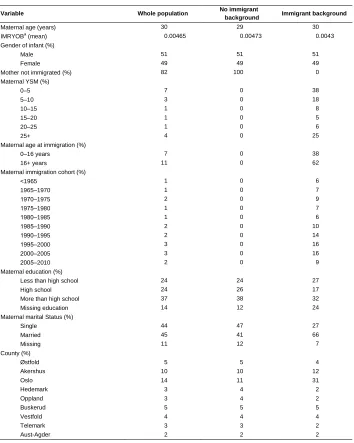
is divided into 19 counties which vary considerably in terms of population density. According to the table, most of the children were living in Oslo. However, a larger proportion of children with immigrant mothers were living in Oslo (31%) than children whose mothers were not immigrants (11%). The majority of the immigrants who gave birth in Norway arrived in the country after the age of 16 (62%).
Table 1: Number of births and deaths by maternal source region of origin
All births Deaths Deaths/(1000
live births)
Mean SIMRa
Norway 915506 3372 3.68 -
Africa 25590 145 5.67 103.95
Asia 61519 297 4.83 55.09
Europe (excluding Norway) 89363 279 3.12 18.03
North America 9531 27 2.83 21.59
Oceania 1164 2 1.72 13.98
South America 7259 20 2.76 44.39
Total sample 1109932 4142 3.73 -
By the 10 largest countries of origin
Sweden 19757 61 0.31 7.67
Pakistan 12325 88 0.71 93.97
Denmark 11009 43 0.39 11.0
Somalia 9358 64 0.68 122.55
United Kingdom 8106 24 0.30 14.91
Vietnam 6944 27 0.39 51.1
Turkey 6630 25 0.38 82.12
Germany 6437 14 0.22 13.28
USA 6243 16 0.26 16.02
Poland 5764 24 0.42 11.60
By SIMRb
Low 69739 215 0.31 8.75
Medium 60239 227 0.38 25.95
High 64448 328 0.51 93.60
a
SIMR: source country infant mortality rate
b
Table 2: Summary statistics variables by maternal background
Variable Whole population No immigrant
background Immigrant background
Maternal age (years) 30 29 30
IMRYOBa (mean) 0.00465 0.00473 0.0043
Gender of infant (%)
Male 51 51 51
Female 49 49 49
Mother not immigrated (%) 82 100 0
Maternal YSM (%)
0‒5 7 0 38
5‒10 3 0 18
10‒15 1 0 8
15‒20 1 0 5
20‒25 1 0 6
25+ 4 0 25
Maternal age at immigration (%)
0‒16 years 7 0 38
16+ years 11 0 62
Maternal immigration cohort (%)
<1965 1 0 6
1965‒1970 1 0 7
1970‒1975 2 0 9
1975‒1980 1 0 7
1980‒1985 1 0 6
1985‒1990 2 0 10
1990‒1995 2 0 14
1995‒2000 3 0 16
2000‒2005 3 0 16
2005‒2010 2 0 9
Maternal education (%)
Less than high school 24 24 27
High school 24 26 17
More than high school 37 38 32
Missing education 14 12 24
Maternal marital Status (%)
Single 44 47 27
Married 45 41 66
Missing 11 12 7
County (%)
Østfold 5 5 4
Akershus 10 10 12
Oslo 14 11 31
Hedemark 3 4 2
Oppland 3 4 2
Buskerud 5 5 5
Vestfold 4 4 4
Telemark 3 3 2
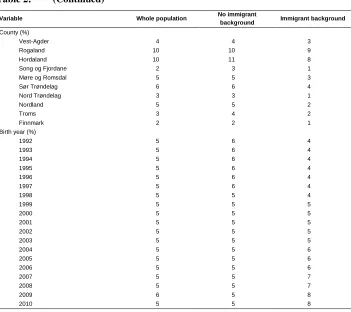
Table 2: (Continued)
Variable Whole population No immigrant
background Immigrant background
County (%)
Vest-Agder 4 4 3
Rogaland 10 10 9
Hordaland 10 11 8
Song og Fjordane 2 3 1
Møre og Romsdal 5 5 3
Sør Trøndelag 6 6 4
Nord Trøndelag 3 3 1
Nordland 5 5 2
Troms 3 4 2
Finnmark 2 2 1
Birth year (%)
1992 5 6 4
1993 5 6 4
1994 5 6 4
1995 5 6 4
1996 5 6 4
1997 5 6 4
1998 5 5 4
1999 5 5 5
2000 5 5 5
2001 5 5 5
2002 5 5 5
2003 5 5 5
2004 5 5 6
2005 5 5 6
2006 5 5 6
2007 5 5 7
2008 5 5 7
2009 6 5 8
2010 5 5 8
All statistics are either mean (for continuous variables) or % (categorical variables).
a
IMRYOB: infant mortality rate in Norway the year of birth
comparison is flawed to some extent. As the mean Norwegian population infant mortality rate (represented by the reference line) was kept constant at 3.68, there were factors which varied systematically with maternal YSM among immigrants. One such factor was the average maternal age of the immigrant population, which increased with maternal YSM.
Figure 1: Observed infant mortality among infants with non-native maternal background by maternal YSM
3.2 Regression model results
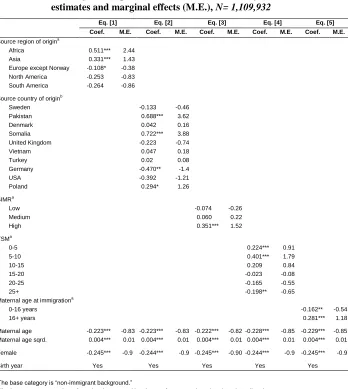
adjusted model in Table 3 illustrate that mortality was significantly higher among infants with mothers from Africa and Asia and weakly significantly lower among infants with mothers of European origin. The ME was largest for those with mothers from Africa; on average, there were 2.4 additional deaths per 1,000 live births among children with African mothers than among children with non-immigrant mothers. The MEs were negative for North America and South America, but the logit coefficients were non-significant. Infant mortality and maternal age had a convex relationship, and females (girls) were significantly less likely to die within the first year of birth.
Based on the results of Eq. [2] ‒ i.e., the 10 selected countries ‒ we observed that mortality was significantly higher among infants with mothers from Pakistan and Somalia and weakly significantly higher among children with mothers from Poland. We found a significantly lower mortality rate among infants whose mothers were from Germany. It should be noted that in this regression the base category was infants with Norwegian mothers and those with mothers who were immigrants from source countries other than the 10 listed.
If we look at the results for SIMR tertiles in Table 3, based on Eq. [3], we can see that the infants of immigrants from countries with a high SIMR has a significantly higher mortality rate in Norway than infants with a non-immigrant maternal background.
Table 3: Less adjusted logit estimation of infant mortality. Parameter estimates and marginal effects (M.E.), N= 1,109,932
Eq. [1] Eq. [2] Eq. [3] Eq. [4] Eq. [5]
Coef. M.E. Coef. M.E. Coef. M.E. Coef. M.E. Coef. M.E.
Source region of origina
Africa 0.511*** 2.44
Asia 0.331*** 1.43
Europe except Norway -0.108* -0.38
North America -0.253 -0.83
South America -0.264 -0.86
Source country of originb
Sweden -0.133 -0.46
Pakistan 0.688*** 3.62
Denmark 0.042 0.16
Somalia 0.722*** 3.88
United Kingdom -0.223 -0.74
Vietnam 0.047 0.18
Turkey 0.02 0.08
Germany -0.470** -1.4
USA -0.392 -1.21
Poland 0.294* 1.26
SIMRa
Low -0.074 -0.26
Medium 0.060 0.22
High 0.351*** 1.52
YSMa
0-5 0.224*** 0.91
5-10 0.401*** 1.79
10-15 0.209 0.84
15-20 -0.023 -0.08
20-25 -0.165 -0.55
25+ -0.198** -0.65
Maternal age at immigrationa
0-16 years -0.162** -0.54
16+ years 0.281*** 1.18
Maternal age -0.223*** -0.83 -0.223*** -0.83 -0.222*** -0.82 -0.228*** -0.85 -0.229*** -0.85
Maternal age sqrd. 0.004*** 0.01 0.004*** 0.01 0.004*** 0.01 0.004*** 0.01 0.004*** 0.01
Female -0.245*** -0.9 -0.244*** -0.9 -0.245*** -0.90 -0.244*** -0.9 -0.245*** -0.9
Birth year Yes Yes Yes Yes Yes
a
The base category is “non-immigrant background.”
b
The base category consists of non-immigrants and immigrants from countries other than those listed.
Table 4: Fully adjusted logit estimation of infant mortality. Parameter estimates and marginal effects (M.E.), N= 1,109,932
Eq. [1] Eq. [2] Eq. [3] Eq. [4] Eq. [5]
Coef. M.E. Coef. M.E. Coef. M.E. Coef. M.E. Coef. M.E.
Source region of origina
Africa 0.401*** 1.81
Asia 0.241** 1
Europe except Norway -0.117* -0.41
North America -0.228 -0.76
South America -0.286 -0.93
Source country of originb
Sweden -0.115 -0.40
Pakistan 0.603*** 3.04
Denmark 0.056 0.21
Somalia 0.544*** 2.66
United Kingdom -0.189 -0.64
Vietnam -0.033 -0.12
Turkey -0.075 -0.27
Germany -0.426** -1.29
USA -0.349 -1.10
Poland 0.287* 1.23
SIMRa
Low -0.1 -0.35
Medium -0.007 -0.03
High 0.255*** 1.06
YSMa
0‒5 0.128* 0.50
5‒10 0.324*** 1.40
10‒15 0.146 0.58
15‒20 -0.066 -0.24
20‒25 -0.179 -0.60
25+ -0.176** -0.59
Maternal age at immigrationa
0‒16 years -0.158** -0.54
16+ years 0.202*** 0.82
Maternal age -0.163*** -0.60 -0.166*** -0.60 -0.160*** -0.60 -0.166*** -0.62 -0.166*** -0.62
Maternal age sqrd. 0.003*** 0.01 0.003*** 0.01 0.003*** 0.01 0.003*** 0.01 0.003*** 0.01
Female -0.245*** -0.90 -0.244*** -0.90 -0.244*** -0.90 -0.244*** -0.90 -0.244*** -0.90
Maternal marital status
Single Base category Base category Base category Base category Base category
Married 0.004 0.01 0.010 0.03 0.013 0.05 0.008 0.03 0.005 0.02
Table 4: (Continued)
Eq. [1] Eq. [2] Eq. [3] Eq. [4] Eq. [5]
Coef. M.E. Coef. M.E. Coef. M.E. Coef. M.E. Coef. M.E.
Maternal education
Less than high school Base category Base category Base category Base category Base category
High school -0.345*** -1.34 -0.350*** -1.35 -0.353*** -1.37 -0.352*** -1.38 -0.355*** -1.40
More than high school -0.415*** -1.56 -0.419*** -1.57 -0.430*** -1.60 -0.431*** -1.63 -0.435*** -1.66
Missing education -0.041 -0.19 -0.026 -0.12 0.200 0.10 -0.061 -0.28 -0.100 -0.45
County Yes Yes Yes Yes Yes
Birth year Yes Yes Yes Yes Yes
a
The base category is “non-immigrant background.”
b
The base category consists of non-immigrants and immigrants from countries other than those listed.
The population consists of all births between 1992-2010. ***, ** and * denotes significance at the 1%, 5%, and 10% levels; respectively. Standard errors are clustered at the country/arrival year level. The MEs are rescaled so that they are interpreted as deaths/1,000 live births.
Table 5 presents the estimated coefficients and the MEs for Eqs. [6]‒[9], which were fitted using a subsample of individuals of non-native maternal origin. The estimates from the less adjusted Eq. [6] in Table 5 show that infant mortality was significantly higher among children born to mothers from medium and high infant mortality countries than for children born to mothers from low infant mortality countries (base category). The results also illustrate that there was an assimilation process among immigrants whereby infant mortality decreased as the number of years the mother had been living in Norway increased. Compared with mortality rates among infants born to mothers with 0‒5 YSM, rates were significantly lower among children born to mothers with 10‒15, 15‒20, 20‒25, and 25+ YSM; respectively. The MEs showed, for example, that there were three fewer deaths per 1,000 live births among mothers with 25 or more years since migration than among mothers with 0‒5 YSM.
In Eq. [7] we have replaced the YSM with maternal age at migration. We can see that maternal age at migration was significantly associated with infant mortality. The MEs illustrate that women who had immigrated after the age of 16 had 1.76 more deaths per 1,000 live births in Norway than women who had immigrated before or at the age of 16. The estimated coefficients of the SIMR variables were still significant, and their MEs were similar to the corresponding MEs in Eq. [6].
coefficients of YSM were not statistically significant at any value among those from countries with a low SIMR. However, YSM was significantly associated with a lower risk of infant mortality at values of 20‒25 and 25+ among women from countries with a medium SIMR. Among women from high SIMR countries, YSM was significantly associated with lower infant mortality at 10‒15, 15‒20, 20‒25, and 25+ YSM. We have also conducted tests, illustrated by the ‡s in the table, of the difference between the indicated coefficients and the corresponding effect of YSM in the low SIMR countries. The results of these tests indicated that the association between YSM of 20‒25 and infant mortality was significantly more pronounced among women from medium SIMR countries than in those from low SIMR countries. In addition, the coefficients of YSM of 20‒25 and 25+ were significantly larger among women from high SIMR countries than among those from low SIMR countries. For example, the coefficient for YSM of 25 or more years of -1.176 among women from high SIMR countries was significantly different from the coefficient of -0.526 among women from low SIMR countries. Thus, it appears that YSM is an important predictor of infant mortality among women from countries with a high SIMR. However, the association with YSM decreased significantly with maternal SIMR.
Table 5 also shows the estimation results of Eq. [9], which is the specification that includes interactions between SIMR and maternal age at migration. Based on the results from the less adjusted Eq. [9], we can see that including the interaction reduced both the absolute value and the significance of the SIMR main effects. However, a maternal age at immigration of 16 or older was significantly associated with an increased infant mortality rate among women from medium and high SIMR countries. The tests, illustrated by the ‡s in the table, also showed that the association between maternal age at migration and the infant mortality rate differed significantly by SIMR. This means that while age at migration was an important predictor of infant mortality among women from medium and high SIMR countries, there was no evidence of this association among women from low SIMR countries.
Table 5 also shows the estimation results of Eqs. [6]‒[9] based on the fully
adjusted model. By comparing the results for the less adjusted and fully adjusted model
specifications, we can see that similar results were obtained in each specification. However, the MEs were slightly reduced. In Eq. [6], for example, the less adjusted
model showed an ME of -3.12 for YSM of 25+, while the corresponding figure in the
fully adjusted model was -2.64. Hence, the inclusion of the additional covariates did not
was an assimilation process among immigrants whereby they became more and more similar to non-immigrant women with respect to infant mortality over time.
Table 5: Logit estimation of infant mortality. Parameter estimates and marginal effects (M.E.). N= 194,426
Less adjusted
Eq. [6] Eq. [7] Eq. [8] Eq. [9]
Coef. M.E. Coef. M.E. Coef. M.E. Coef. M.E.
SIMR
Low Base category Base category Base category Base category
Medium 0.208** 0.68 0.208** 0.68 0.364** 1.52 -0.101 -0.27
High 0.508*** 1.94 0.503*** 1.92 0.802*** 4.26 0.126 0.38
YSM
0‒5 Base category
5‒10 -0.005 -0.03
10‒15 -0.365** -1.59
15‒20 -0.635*** -2.44
20‒25 -0.781*** -2.82
25+ -0.918*** -3.12
SIMR*YSM
Low*5‒10 0.095 0.35
Low*10‒15 -0.104 -0.34
Low*15‒20 -0.197 -0.62
Low*20‒25 -0.166 -0.53
Low*25+ -0.526 -1.42
Medium*5‒10 0.146 0.78
Medium*10‒15 -0.500 -1.96
Medium*15‒20 -0.691 -2.49
Medium*20‒25 -0.868**‡ -2.9
Medium*25+ -0.992*** -3.15
High*5‒10 -0.181 -1.27
High*10‒15 -0.464** -2.86
High*15‒20 -0.808** -4.28
High*20‒25 -1.095***‡‡‡ -5.14
High*25+ -1.176***‡‡ -5.34
Maternal age at immigr.
0‒16 years Base category
16+ years 0.500*** 1.76
SIMR* Maternal age at im.
Low*16+ years 0.114 0.34
Medium*16+ years 0.537**‡ 1.83
High*16+ years 0.643***‡‡ 2.90
Maternal marital status No No No No
Maternal education No No No No
Table 5: (Continued)
Fully adjusted
Eq. [6] Eq. [7] Eq. [8] Eq. [9]
Coef. M.E. Coef. M.E. Coef. M.E. Coef. M.E.
SIMR
Low Base category Base category Base category Base category
Medium 0.163 0.53 0.162 0.53 0.315** 1.25 -0.126 -0.36
High 0.419*** 1.55 0.413*** 1.53 0.718*** 3.55 0.051 0.16
YSM
0‒5 Base category
5‒10 -0.001 -0.01
10‒15 -0.347** -1.42
15‒20 -0.594** -2.17
20‒25 -0.693** -2.42
25+ -0.787** -2.64
SIMR*YSM
Low*5‒10 0.110 0.39
Low*10‒15 -0.075 -0.25
Low*15‒20 -0.170 -0.53
Low*20‒25 -0.088 -0.28
Low*25+ -0.421 -1.17
Medium*5‒10 0.147 0.73
Medium*10‒15 -0.468 -1.73
Medium*15‒20 -0.630 -2.17
Medium*20‒25 -0.753 ‡ -2.46
Medium*25+ -0.851** -2.66
High*5‒10 -0.187 -1.18
High*10‒15 -0.465** -2.57
High*15‒20 -0.778** -3.75
High*20‒25 -1.022*** ‡‡‡ -4.44
High*25+ -1.043** ‡‡ -4.49
Maternal age at immigr.
0-16 years Base category
16+ years 0.403** 1.39
SIMR* Maternal age at im.
Low*16+ years 0.027 0.08
Medium*16+ years 0.425*‡ 1.41
High*16+ years 0.542**‡‡ 2.29
Maternal marital status Yes Yes Yes Yes
Maternal education Yes Yes Yes Yes
County Yes Yes Yes Yes
Each model also adjusts for maternal age, gender, infant mortality rate in Norway in the year of birth, immigration cohort. The population consists of all births to mothers with a non-native background between 1992-2010. ***, ** and * denotes significance
Figure 2 illustrates the association between infant mortality and maternal YSM. It was estimated based on the results for the less adjusted Eq. [8] in Table 5, which includeed the interactions between SIMR and maternal YSM. The predicted mean infant mortality rate by YSM was computed by fixing the covariates at the whole population mean values. Hence, the variation in the predicted infant mortality rate was a function of the association between YSM and infant mortality rate and how this varied with SIMR, and it was not affected by the values of the other covariates. The figure illustrates the predicted infant mortality rate by YSM for the high SIMR countries and from low SIMR countries
.
As above,the
horizontal reference line shows the mean infant mortality rate among children with non-immigrant mothers. The “whiskers” show the 95% confidence intervals of the estimates.Figure 2: Predicted infant mortality among infants with non-native maternal background by maternal YSM
Figure 2 illustrates the importance of the maternal source country characteristics. Those with a high SIMR had a higher infant mortality rate than those with a low SIMR. For example, at 0-5 YSM, the mean infant mortality rate was above eight per 1,000 live births in the high scenario, while it was below four in the low scenario. The 95% CIs show that this difference was significant. Figure 2 also shows that there was an association between maternal YSM and the infant mortality rate. Those infants born to mothers with fewer YSM had a higher risk of mortality than those born to mothers with more YSM.
Finally, Figure 2 illustrates that those from high SIMR countries caught up with those from low SIMR countries. The slope of the curve was steeper among those who initially had a higher infant mortality rate. Hence, the gap between the curves narrowed with maternal YSM. This finding is important because it shows that the source country characteristics influenced the assimilation process. The assimilation pattern therefore differed depending on “how different” in terms of the infant mortality rate the source country was from Norway. Women from countries with high infant mortality rates saw greater reductions in their infant mortality rates with more YSM than those from countries with low infant mortality rates.
One potential limitation of using the SIMR variable for introducing heterogeneity among the immigrants is that it does not capture continental differences in factors like race and language. To investigate this issue further, we included region of origin variables in Eq. [6], together with the SIMR dummy variables (results are available from authors upon request). The region of origin variables remained significant in this specification. This suggests that factors other than the mechanisms related to SIMR may be related to infant mortality among immigrants in Norway.
4. Discussion
low infant mortality rates. Hence, the maternal source country was found to be a significant predictor of the infant mortality assimilation profiles in Norway.
We applied duration of residence as our measure of assimilation because most of the previous studies used this measure (Landale, Oropesa, and Gorman 2000), and we wanted our research to be comparable. However, age at immigration may be favoured, as it conceptually allows us to locate the critical event (migration) within the life course of a woman. For example, women who migrated at a young age might have received more education in the host country, regardless of the number of YSM (Troe et al. 2006). In addition, younger individuals might have found it easier to adopt the lifestyle in the host country than older individuals. We reran our analysis, replacing YSM with maternal age at immigration with a cut-off point at age 166 as our measure of assimilation. Those who migrated after the age of 16 had significantly higher infant mortality rates. These results were more pronounced among those with a maternal origin from countries with a high infant mortality rate compared with those from countries with a low infant mortality rate. However, as we noted above, age at migration is negatively correlated with YSM. Hence, our model did not allow us to separate the effects of age at immigration from YSM.
We will now discuss our findings in light of the related literature. Our results are supported by those of other studies conducted in Scandinavia, which indicated that infant mortality varies depending on the maternal source country. For example, Villadsen, Mortensen, and Andersen (2009) found that the Pakistani, Somali, and Turkish populations had substantially higher infant mortality rates than the Danish population. While Vangen et al. (2002), using a Norwegian dataset, found significantly higher mortality rates among infants whose mothers were from Pakistan, they found no significant effects for infants whose mothers were from Vietnam and North Africa. Similarly, Essen at al. (2000a), found using a Swedish dataset that infants born to mothers who had migrated had a higher mortality risk than those born to ethnic Swedish mothers. They also found that the risk was particularly high if the mother was from Sub-Saharan Africa, and pointed out that these findings could not be explained by maternal health and smoking status. All of these studies also controlled for SES, which did not alter the conclusions. Although these studies showed that the infant mortality rate varied by the mother’s country of origin, they did not investigate whether the host country infant mortality rate varied by the mother’s years since migration.
A number of studies have been conducted on assimilation and infant health (see: Landale, Oropesa, and Gorman 2000; Urquia et al. 2010; Ceballos and Palloni 2010; Teitler, Hutto, and Reichman 2012; Urquia, O’Campo, and Heaman 2012). As we noted in the introduction, the results of these studies were mixed. Our findings differed from
those of these studies in that we were the first to find a clear and negative association between maternal YSM and infant mortality. There might be a number of reasons for why our findings diverged. Most importantly, we used data on the Norwegian population, which has a different mix of immigrants and is subject to a different set of immigration policies than the populations examined in these previous studies (Belot and Hatton 2012). A second, related reason is that we looked at immigrants who had worse infant outcomes in general, while the studies described above investigated immigrants who generally had better infant outcomes than the native population (the healthy migrant effect). Third, we controlled for maternal immigration cohort effects. Fourth, we included maternal source country characteristics in the analysis, which allowed the assimilation process to vary with conditions in the maternal source country. Fifth, as we had register data that included all of the individuals in Norway, we did not have survey data and sample selection problems that might be related to infant mortality.
Our findings showed that although there were differentials in infant mortality by source country among newly arrived immigrants, these differentials were reduced with YSM, and after 20+ years in Norway the differentials in infant mortality by source country were eliminated. These results are compelling, and suggest that environmental and cultural factors in Norway are negatively associated with infant mortality rates. Although we can only speculate about the reasons why these infant mortality differentials disappeared, we provide some potential explanations below. The discussion is based on earlier literature which suggested that health assimilation profiles might be affected by immigrants’ initial health, health care access, and assimilation in terms of SES factors.
As we observed in the introduction, the health levels of newly arrived immigrants may differ from those of the native population due to conditions in the source country. For example, immigrants’ diets may be different, and some individuals might be affected by malnutrition (Naimy et al. 2013). However, when these immigrants are exposed to the host country environment, they will gradually adopt the behaviours of the native-born population (Antecol and Bedard 2006). As a consequence, infant mortality rates among immigrant groups from countries with low health levels and high rates of infant mortality should decline. Such effects will not be present among immigrants from countries with health levels comparable to those of Norway.
system; thus, their use of health care services will not be affected by years since migration. A related factor that may also be important is language. As a key mechanism cited in the literature on wage assimilation (Galloway and Aaberge 2005), language acquisition may facilitate communication with health care providers both inside and outside of hospitals, and facilitate understanding of written information (Chiswick, Lee, and Miller 2008).
As we previously noted, a number of studies have found evidence of assimilation on SES. For example, Galloway and Aaberge (2005), using Norwegian data, found a negative association between years since migration and the probability of being poor in Norway among all immigrants by ethnic origin. Similarly, Hansen and Lofstrom (2003), using Swedish data, found that refugees displayed substantially higher welfare participation rates upon arrival than non-refugee immigrants. They also found, however, that refugees assimilate out of welfare at a faster rate than non-refugee immigrants. Given this assimilation pattern and the general finding that health is positively related to socioeconomic position, immigrants should become healthier the longer they remain in the country (Antecol and Bedard 2006; Jasso et al. 2004). This effect might be especially strong in immigrant groups who have lower SES upon arrival.
The main implication of our findings is that more attention needs to be devoted to maternal assimilation and the maternal source country in the maternity and follow-up care of immigrants in Norway. A higher rate of infant mortality among children of immigrants is primarily an issue in the short- to medium-term period following migration from source countries with high infant mortality rates. Our findings not only narrow the time span during which these children can be seen as constituting an at-risk group, they can also help us identify which groups are most likely to have a high infant mortality risk based on the maternal source country. This suggests that the health service should devote particular attention to immigrant women from countries with a high infant mortality rate who give birth soon after immigration. Furthermore, the findings suggest that immigrants should become integrated into Norwegian society and learn how to make use of the public health care system. This integration process is more important for immigrants from countries which differ greatly from Norway (in terms of infant mortality rate). However, more research needs to be done to investigate whether this pattern exists for other types of health outcomes and other types of health services. Future research should also address the question of whether second-generation immigrants are more similar to majority-background individuals.
origin). However, the infant mortality rate will approach the mean infant mortality rate in the host country with increasing length of residence in the host country.
4.1 Shortcomings of the analysis
5. Acknowledgements
References
Adanu, R.M.K. and Johnson, T.R.B. (2009). Migration and women’s health.
International Journal of Gynecology & Obstetrics 106(2): 179–181.
doi:10.1016/j.ijgo.2009.03.036.
Ai, C. and Norton, E.C. (2003). Interaction terms in logit and probit models. Economics
Letters 80(1): 123–129. doi:10.1016/S0165-1765(03)00032-6.
Antecol, H. (2000). An examination of cross–country differences in the gender gap in labor force participation rates. Labour Economics 7(4): 409–426. doi:10.1016/ S0927-5371(00)00007-5.
Antecol, H. and Bedard, K. (2006). Unhealthy assimilation: why do immigrants converge to American health status levels? Demography 43(2): 337–360.
doi:10.1353/dem.2006.0011.
Arntzen, A., Samuelsen, S.O., Bakketeig, L.S., and Stoltenberg, C. (2004). Socioeconomic status and risk of infant death. A population-based study of trends in Norway, 1967–1998. International Journal of Epidemiology 33(2): 279–288. doi:10.1093/ije/dyh054.
Barth, E., Bratsberg, B., and Raaum, O. (2004). Identifying the Eranings Assimilation of Immigrants under Changing Macroeconomic Conditions. Scandinavian
Journal of Economics 106(1): 1–22.
doi:10.1111/j.0347-0520.2004.t01-1-00345.x.
Belot, M.V.K., and Hatton, T.J. (2012). Immigrant Selection in the OECD.
Scandinavian Journal of Economics 114(4): 1105–1128.
doi:10.1111/j.1467-9442.2012.01721.x.
Berry, J.W. (2003). Conceptual approaches to acculturation. In Chun, K.M., Organista, P.B., and Marin, G. (Eds.). Acculturation: Advances in theory, measurement and
applied research. Washington, DC: American Psychological Association: 17–37.
Blau, F.D. (1992). The Fertility of Immigrant Women: Evidence from High Fertility Source Countries: in: Borjas, G.J. and Freeman, R. (Eds.). Immigration and the Workforce: Economic Consequences for the United States and Source Areas.
Chicago: University of Chicago Press: 93–133.
Blau, F.D., Kahn, L.M., and Papps K.L. (2011). Gender, Source Characteristics and Labor Market Assimilation among Immigrant. The Review of Economics and
Bollini, P., Pampallona, S., Wanner, P., and Kupelnick, B. (2009). Pregnancy outcome of migrant women and integration policy: A systematic review of the international literature. Social Science & Medicine 68(3): 452–461. doi:10.1016/ j.socscimed.2008.10.018.
Borjas, G. (1985). Assimilation, changes in cohort quality and the earnings of immigrants. Journal of Labour Economics 3(4): 463–489. doi:10.1086/298065. Ceballos, M. and Palloni, A. (2010). Maternal and infant health of Mexican immigrants
in the USA: the effects of acculturation, duration, and selective return migration.
Ethnicity and Health 15(4): 377–396. doi:10.1080/13557858.2010.481329.
Chiswick, B.R., Lee, Y.L., and Miller, P.W. (2008). Immigrant selection systems and immigrant health. Contemporary Economic Policy 26(49: 555–578. doi:10.1111/ j.1465-7287.2008.00099.x.
Essen, B., Hanson, B.S., Östergren, P.O., Lindquist, P.G., and Gudmundsson, S. (2000a). Increased perinatal mortality among sub-Saharan immigrants in a city population in Sweden. Acta Obstetrica et Gynecologica Scandinavia 79(9): 737– 743. doi:10.3109/00016340009169187.
Essen, B., Johnsdotter, S., Hovelius, B., Gudmundsson, S., Sjöberg, N.O., Friedman, J., and Östergren, P.O. (2000b). Qualitative study of pregnancy and childbirth experiences in Somalian women resident in Sweden. BJOG 107(12): 1507–1512.
doi:10.1111/j.1471-0528.2000.tb11676.x.
Galloway, T.A. and Aaberge, R. (2005). Assimilation effects of poverty among immigrants in Norway. Journal of Population Economics 18(4): 691–718.
doi:10.1007/s00148-005-0002-6.
Garssen, J. and van der Meulen, A. (2004). Perinatal mortality in the Netherlands. Backgrounds of a worsening international ranking. Demographic Research
11(13): 357–394. doi:10.4054/DemRes.2004.11.13.
Goth, U.S. and Godager, G. (2012). Use of Primary Care Emergency Services in Norway: Impact of Birth Country and Duration of Residence. Nordic Journal of
Health Economics 1(2):171-186.
Grytten, J., Skau, I., and Sørensen, R. (2013). Do mothers decide? The Impact of Preferences in Healthcare. The Journal of Human Resources 48(2): 142–168.
Hamilton, T.G. and Hummer, R.A. (2011). Immigration and the health of U.S. black adults: Does country of origin matter? Social Science & Medicine 73(10): 1551– 1560. doi:10.1016/j.socscimed.2011.07.026.
Hansen, J. and Lofstrom, M. (2003). Immigrant Assimilation and Welfare Participation: Do Immigrants Assimilate Into or Out of Welfare? The Journal of
Human Resources 38(1): 74–98. doi:10.2307/1558756.
Iversen, T., Ma, C.A., and Meyer, H,E. (2013). Immigrants’ acculturation and changes in Body Mass Index. Economics and Human Biology 11(1): 1–7. doi:10.1016/ j.ehb.2012.02.003.
Jasso, G., Massey, D., Rosenzweig, M., and Smith, J. (2004). Immigrant health: selectivity and acculturation. In Anderson, N., Bulatao, R., and Cohen, B. (eds.).
Critical perspectives on racial and ethnic differences in health late in life.
Washington, D.C: The National Academy of Sciences: 227–266.
Kennedy, S., McDonald, J.T., and Biddle, N. (2006). The Healthy Immigrant Effect and Immigrant Selection: Evidence from Four Countries. SEDAP Research Paper (No. 164).
Landale, N.S., Oropesa, R.S., and Gorman, B.K. (2000). Migration and infant death: Assimilation or selective migration among Puerto Ricans? American
Sociological Review 65(6): 888–909. doi:10.2307/2657518.
Mayer, J. and Riphahn, R.T. (2000). Fertility assimilation of immigrants: Evidence from count data models. Journal of Population Economics 13(2): 241–261.
doi:10.1007/s001480050136.
Naimy, Z., Grytten, J., Monkerud, L., and Eskild, A. (2013). Perinatal mortality in non-western migrants in Norway compared to their countries of birth and to Norwegian women. BMC Public Health 13(1): 37. doi:10.1186/1471-2458-13-37.
Pamuk, E.R., Fuchs, R., and Lutz, W. (2011). Comparing Relative Effects of Education and Economic Resources on Infant Mortality in Developing Countries.
Population and Development Review 37(4): 637–664.
doi:10.1111/j.1728-4457.2011.00451.x.
Stoltenberg, C., Magnus, P., Lie, R.T., Daltveit, A.K., and Irgens, L.M. (1998). Influence of consanguinity and maternal education on risk of stillbirth and infant death in Norway 1967–1993. American Journal of Epidemiology 148(5):452– 459. doi:10.1093/oxfordjournals.aje.a009670.
Teitler, J.O., Hutto, N., and Reichman, N.E. (2012). Birthweight of children of immigrants by maternal duration of residence in the United States. Social
Science & Medicine 75(3): 459–468. doi:10.1016/j.socscimed.2012.03.038.
Troe, E.-J.W.M., Kunst, A.E., Bos, V., Deerenberg, I.M., Joung, I.M.A., and Mackenbach, J.P. (2006). The effect of age at immigration and generational status of the other on infant mortality in ethnic minority populations in The Netherlands. European Journal of Public Health 17(2): 134–138. doi:10.1093/ eurpub/ckl108.
Tysse, T.I., and Keilman, N. (1998). Utvandring blant innvandrere 1975–1995. (Return migration 1975–1995). Norway: Statistics Norway (Reports 98/15).
UCLA: Statistical Consulting Group (n.d.). What happens if you omit the main effect in a regression model with an interaction? http://www.ats.ucla.edu/stat/stata /faq/no_main_effect.htm.
United Nations (2011). World Population Prospects: The 2010 Revision. New York: Department of Economic and Social Affairs, Population Division.
Urquia, M.L., Frank, J.W., Moineddin, R., and Glazier, R.H. (2010). Immigrants’ duration of residence and adverse birth outcomes: a population-based study.
BJOG 117(5): 591–601. doi:10.1111/j.1471-0528.2010.02523.x.
Urquia, M.L., O’Campo, P.J., and Heaman, M.I. (2012). Revisiting the immigrant paradox in reproductive health: The roles of duration of residence and ethnicity.
Social Science & Medicine 74(10): 1610–1621. doi:10.1016/j.socscimed.
2012.02.013.
Vangen, S., Stoltenberg, C., Skjaerven, R., Magnus, P., Harris, J.R., and Stray-Pedersen, B. (2002). The heavier the better? Birthweight and perinatal mortality in different ethnic groups. International Journal of Epidemiology 31(3): 654– 660. doi:10.1093/ije/31.3.654.
Villadsen, F.S., Mortensen, L.H., and Andersen, A.M.N. (2009). Ethnic disparity in stillbirth and infant mortality in Denmark 1981–2003. Journal of Epidemiology