in the population sciences published by the Max Planck Institute for Demographic Research Konrad-Zuse Str. 1, D-18057 Rostock · GERMANY www.demographic-research.org
DEMOGRAPHIC RESEARCH
VOLUME 12, ARTICLE 8, PAGES 173-196
PUBLISHED 22 APRIL 2005
www.demographic-research.org/Volumes/Vol12/8/
Research Article
Labor force plans and labor force status:
U.S. women of the college class of 1957
Karen Leppel
1 Introduction 174
2 Determinants of labor force status 176
3 Descriptive statistics for labor force expectations 177
4 Logit estimation results 181
5 1964 Expectations of the future 184
6 Many years later… 185
7 Current Population Survey estimation 187
8 Summary and conclusions 191
9 Acknowledgements 192
Labor force plans and labor force status:
U.S. women of the college class of 1957
Karen Leppel 1
Abstract
Many U.S. women who were in their late 60s at the turn of the century were still employed. These women graduated from college in the 1950s, an era when women’s labor force participation was low. Data from the U.S. Department of Labor Women's Bureau Survey of the college class of 1957 was used to examine labor force expectations of these women when they completed college. Logit analysis was applied to four labor force categories: full-time, part-time, unemployed, and not in the labor force. In 1957, many women underestimated their future labor force participation. By 1964, though, the trend toward increasing future work expectations may have begun. After examining the retirement literature and factors encouraging older women to continue working, Current Population Survey data on college-educated women aged 65 to 69 in 2003 were used to explore the labor force participation of this cohort later in life.
1 Associate Professor of Economics in the School of Business Administration at Widener University, in Chester, PA, 19013.
1. Introduction
At the end of the twentieth century, women who were born in the early 1930s were in their late 60’s. These women were in an age category that was eligible for full Social Security benefits. Furthermore, most of them who completed college did so in the 1950s, an era when only about one in three women were in the labor force (Fullerton, 1999). It is therefore surprising that in 1997, 38% of U.S. women aged 65 to 69 who had a college degree were still in the labor force, as were 49% of those with more than a college degree (Hill, 2002). It would be interesting to go back to the 1950s and examine these women’s expectations about their labor force participation as they finished college and stepped out into the “real world.”
In 1968, the National Longitudinal Survey (NLS) of Young Women in the United States first asked respondents about their labor force plans for when they reached age 35. Several researchers have subsequently explored women's expectations of their future work involvement. (See Sandell & Shapiro, 1980, Shaw & Shapiro, 1987, and Goldin, 1990.) It was determined that young women considerably underestimated their future work involvement. The labor force expectations of women aged 14 to 24 in 1968 were more similar to their mothers' labor force participation in 1968 than to their own 16 years later (Goldin, 1990, pp. 154-157). The NLS data show that the proportion of young women who expected to be in the labor force at age 35 increased considerably between 1968 and 1978. Furthermore, women who attended college were more likely than those who had not attended college to anticipate working at age 35, and the gap in work expectations between college and noncollege women widened over time (Shaw & Shapiro, 1987).
An important focus of the literature has been human capital investment. The shorter the expected duration of work experience the less the incentive to invest in skills that would increase earning potential (Mincer & Polachek, 1974 and Weiss & Gronau, 1981). In addition, since women's labor force expectations are too low, they are likely to underinvest in human capital. The reduced human capital results in lower wages.
Women's labor force participation has been found by researchers to be correlated also with husband's attitude toward his wife's employment.2 According to Weil (1961), a positive attitude of the husband is strongly correlated with both wife's participation in the labor force and her plans to participate in the labor force. Ferber (1982) found that husband's and wife's attitudes at the time of marriage are both statistically significant determinants of the number of years that the wife works, but the coefficient of the latter is twice as large as that of the former.3
Women who were in their late 60s at the turn of the century graduated from college in the 1950s, before the National Longitudinal Survey began collecting data on labor force expectations. However, in 1957, the Women's Bureau of the United States Department of Labor surveyed almost 6,000 women college graduates in 131 colleges and universities in the United States. Approximately 5,000 of the women responded to a follow-up survey in 1964. Both the 1957 and 1964 data included information on future employment plans. That data set can supply complementary information on future employment plans of women college graduates.4 It can provide insights on whether changes in women’s labor expectations date back farther than those documented by the NLS data. It can also show whether there seemed to be changes in attitudes within that cohort of women.
Researchers of labor force expectations have generally focused on whether or not women were in the labor force. Using multinomial logit analysis, the current study examined the relation between women's labor force plans and four labor force statuses, employed full-time, employed part-time, unemployed, and not in the labor force. In addition, expectations of future employment in 1957 and 1964 were compared. Factors encouraging older women to continue working were also explored, and Current Population Survey March 2003 data were used to examine the labor force behavior of college-educated women aged 65 to 69.
2 This correlation may be due to the influence of the husband's attitudes upon his wife's actions. Alternatively, people with similar attitudes may be
more likely to marry each other.
3 Ferber found that while the husband's current attitude is related to his attitude at the time of marriage, it also appears to be influenced by his wife's
employment.
4 Many of the women in the Women's Bureau data set were having sons and daughters in the late 1950s and early 1960s; these offspring would
have been teenagers in the 1970s. Thus, it is interesting to note that the daughters were part of the cohort of women for whom the changes in
2. Determinants of labor force status
Labor force status was categorized in two different ways. In one categorization, labor force status was divided into four statuses: employed full-time, employed part-time, unemployed, and not in the labor force. The other categorization consisted of two statuses: in the labor force (which included both full- and part-time employment, in addition to unemployment) and not in the labor force.
Labor force status is an outcome of the interaction of supply and demand. Labor supply and demand are in turn characterized by personal preferences and the availability of different types of employment. Opportunities are determined by the characteristics of the individual. Preferences are reflected in part by plans for the future. In a reduced form equation, then, potential influences on a woman's labor force status include marital status, the presence of young children, education, husband's attitude toward his wife's employment, and future employment plans.5 The employment plans made in the year of college graduation indicate the direction in which the graduates planned to head. It was expected that women who planned to have a career would be more likely to pursue continued full-time employment.
For two reasons, it was anticipated that marriage would decrease the probability that a woman would be employed. First, because the husbands were usually employed full-time, the income effect would lead women to perform less market work. Second, the social expectations of the time led many women to drop out of the labor force or to work only part-time after marriage. In addition, it was expected that women whose husbands supported their working would be more likely to be employed full- or part-time rather than not in the labor force.
Women with young children were expected to be less likely to be employed and, if employed, to work only part-time. This expectation was due to social expectations and to the high cost and lack of availability of good childcare.
The effect of a post-college degree was explored as well. Women who continued their education after college had made a greater investment in their human capital and were expected to have greater labor force commitment. Furthermore, their earnings were likely to be higher as a result of the additional education. Consequently, their
5 These variables represent exogenous characteristics that shape a woman's preferences and employment opportunities. The woman's wage is
endogenous and consequently excluded. Mincer (1962) and Shaw and Shapiro (1987) found that other family income was negatively related to
whether or not a woman was in the labor force. The current study does not provide family income information. While the husband's
personal interests and market options would tend to point in the direction of greater employment.
3. Descriptive statistics for labor force expectations
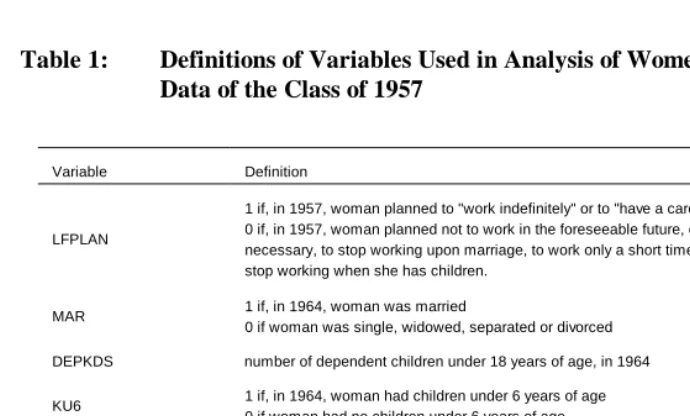
In addition to information on future employment plans, the 1957 Women's Bureau survey collected data on college major, marital status, number and ages of children, whether the woman had a graduate degree, husband's attitude toward wife's working, whether the woman lived in a metropolitan area, and husband's employment status. Data were available in computerized form for a randomly selected subsample of 763 women who were surveyed in both 1957 and 1964. Complete data on the variables used here were available for 610 women. For convenience, the variables used in this analysis are summarized in Table 1.
The variable LFPLAN was set equal to one for women who in 1957 planned to "work indefinitely" or to "have a career." (These women will be referred to as the "CAREER women.") LFPLAN was set equal to zero for the women who in 1957 planned (a) to stop working upon marriage, (b) to work only a short time after marriage (c) to stop working when they have children, (d) only to work as necessary for economic reasons, or (e) not to work in the foreseeable future. (These women will be referred to as the "NON-CAREER women.")
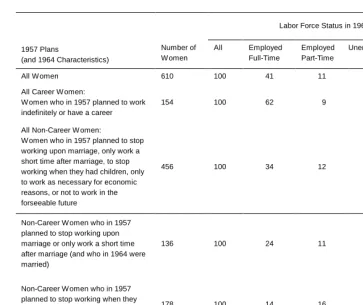
In the 1964 survey follow-up, the labor force statuses of the women in the sample used in this analysis were as follows: 41% were employed full-time, 11% were employed part-time, and 2% were unemployed, and 45% were not in the labor force. (See Table 2.) Not surprisingly, a greater percentage of the CAREER women than of the NON-CAREER women were employed full-time and fewer were not in the labor force. In addition, fewer of the CAREER women were employed part-time and more were unemployed.
Labor force plans of two of the groups of NON-CAREER women were related to marital status (those who planned to stop working upon marriage, and those who planned to work only a short time after marriage). Focusing only on married women in these two groups, it is seen that while most of these women appear to have done as planned, more than one in three remained in the labor force. Of the single women in those two groups, 88% were working full-time and an additional 4% were part-time (not shown).
women planned to stop working when they had children; the question did not indicate whether they planned to return to work later. It should be noted, however, that 99% of this group of women with dependent children under 18 years of age have children under six years of age. Therefore, even if some of these women had planned to go to work later, it is probable that some of them had not planned to be in the labor force at this time in their lives.
Table 1: Definitions of Variables Used in Analysis of Women’s Bureau Survey Data of the Class of 1957
Variable Definition
LFPLAN
1 if, in 1957, woman planned to "work indefinitely" or to "have a career" 0 if, in 1957, woman planned not to work in the foreseeable future, only to work as necessary, to stop working upon marriage, to work only a short time after marriage, or to stop working when she has children.
MAR 1 if, in 1964, woman was married
0 if woman was single, widowed, separated or divorced DEPKDS number of dependent children under 18 years of age, in 1964
KU6 1 if, in 1964, woman had children under 6 years of age 0 if woman had no children under 6 years of age
GRADDEG 1 if, in 1964, woman had a masters or doctoral degree 0 if highest degree was the bachelors
HUSBPOS 1 if, in 1964, husband’s attitude toward wife's working was "favorable" 0 if "neutral" or "opposed" or if woman was not married
Table 2: 1964 Labor Force Status by 1957 Plans
Labor Force Status in 1964 (%)
1957 Plans
(and 1964 Characteristics)
Number of W omen
All Employed Full-Time
Employed Part-Time
Unemployed Not in Labor Force
All W omen 610 100 41 11 2 45
All Career W omen:
W omen who in 1957 planned to work indefinitely or have a career
154 100 62 9 4 25
All Non-Career W omen:
W omen who in 1957 planned to stop working upon marriage, only work a short time after marriage, to stop working when they had children, only to work as necessary for economic reasons, or not to work in the forseeable future
456 100 34 12 2 52
Non-Career W omen who in 1957 planned to stop working upon marriage or only work a short time after marriage (and who in 1964 were married)
136 100 24 11 2 63
Non-Career W omen who in 1957 planned to stop working when they had children (and who in 1964 had dependent children under 18)
178 100 14 16 2 68
Non-Career W omen who in 1957 planned only to work as necessary for economic reasons or not to work in the foreseeable future
52 100 40 13 2 44
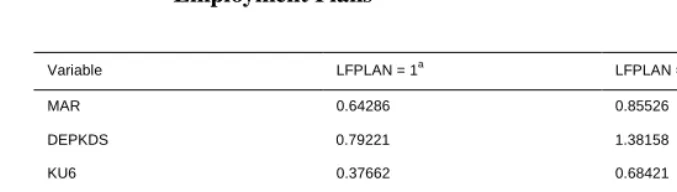
Table 3: Means of Variables for Women With and Without Long Term Employment Plans
Variable LFPLAN = 1a LFPLAN = 0a
MAR 0.64286 0.85526
DEPKDS 0.79221 1.38158
KU6 0.37662 0.68421
GRADDEG 0.23377 0.12881
HUSBPOSb 0.67677 0.55385
HUSBNEGb 0.09091 0.16923
a LFPLAN is equal to 1 if in 1957 woman planned to "work indefinitely" or to "have a career;" 0 if in 1957 woman planned not to work in the foreseeable future, only to work as necessary, to stop working upon marriage, to work only a short time after marriage, or to stop working when she has children.
b Values of this variable in this table were calculated for married women only.
Among the women who had no children but who planned to stop working when they did, 82% were employed full-time and an additional 6% were part-time (not shown).
Members of two groups of NON-CAREER women planned to stay primarily out of the labor force (those who planned only to work as necessary for economic reasons, and those who planned not to work in the foreseeable future). However, most of these women were in the labor force in 1964. Furthermore, almost as many of them were employed full-time as were not in the labor force. Clearly, a large percentage of these women underestimated their future labor force participation.
The discrepancy between the labor force expectations and labor force behaviors of the women of the college class of 1957 can be viewed as a combination of effects. These women based their future labor force expectations in 1957 on the behavior of the generation before them. But the characteristics of different generations are not identical and those differences can influence work opportunities and preferences. Thus, part of the gap between the expectations and behavior of the class of 1957 could be attributed to a cohort effect. In addition, attitudes and institutions change over time, leading to a period effect.
4. Logit estimation results
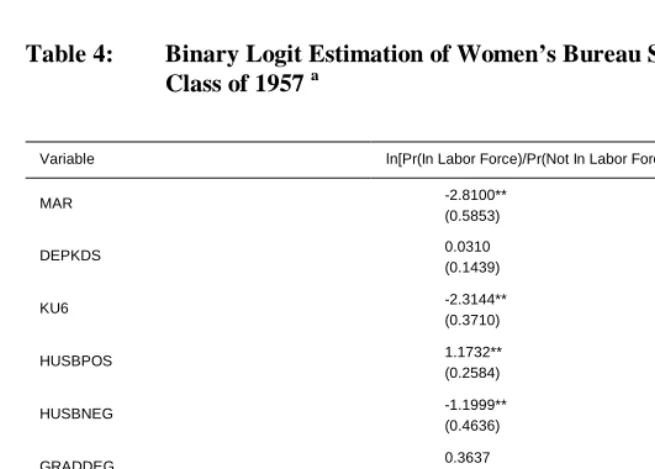
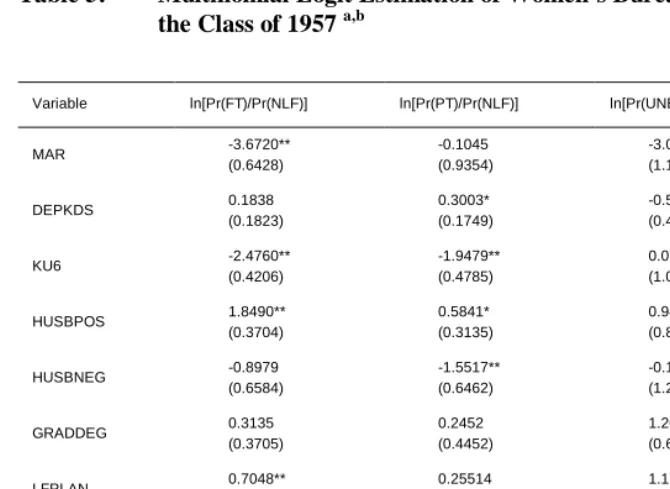
The effects of the variables were generally as expected. In the interest of brevity, only some of the more noteworthy results are discussed. The LFPLAN variable had significant effects in both binary and four-way logit categorizations. (See Tables 4 and 5.) In the binary model, women who in 1957 planned to have a career or to work indefinitely were significantly more likely to be in the labor force in 1964. In the four-way categorization, not surprisingly, CAREER women were more likely to employed full-time rather than out of the labor force. They were also relatively more likely to be unemployed; apparently, the discouraged worker effect was smaller among women who planned to remain in the labor force. Women who in 1957 planned to work indefinitely or in a career were not significantly more likely than other women to choose part-time employment over being out of the labor force in 1964.
Table 4: Binary Logit Estimation of Women’s Bureau Survey Data of the Class of 1957 a
Variable ln[Pr(In Labor Force)/Pr(Not In Labor Force)]
MAR -2.8100**
(0.5853)
DEPKDS 0.0310
(0.1439)
KU6 -2.3144**
(0.3710)
HUSBPOS 1.1732**
(0.2584)
HUSBNEG -1.1999**
(0.4636)
GRADDEG 0.3637
(0.3305)
LFPLAN 0.5610**
(0.2755)
CONSTANT 3.5404**
(0.5448)
Number Of Observations 610
Percent Correctly Predicted 78.53
Log-Likelihood Ratio Test Statistic 321.7** a Standard errors are in parentheses.
In specifications that omitted the LFPLAN variable, the coefficients and t-statistics of the other explanatory variables remained substantially the same. Furthermore, the log-likelihood ratio test indicated that the estimation was significantly worse when the LFPLAN variable was not included.6 Thus, this variable had important direct effects on labor force participation.
The four-way logit analysis showed asymmetric effects of positive and negative attitudes of the husband. Having a husband who supported his wife's working had a more significant positive effect on wife's full-time employment than on her part-time employment. Having a spouse who opposed his wife's working had a more significant negative impact on wife's part-time employment than on her full-time employment.
Whether a woman had a graduate degree was found to have little effect on her labor force status. There was, however, a significant positive effect on the probability of unemployment relative to being out of the labor force.
The lack of impact of the education variable indicates that, for the cohort of women graduating college in 1957, there was little difference in labor force behavior between those who earned a graduate degree and those who did not. Shaw and Shapiro found that education also had no significant impact on labor force participation for the NLS women who had consistently indicated plans for work at age 35. Logit analysis of the probability of employment versus non-employment among married women was conducted by Charles, Buchmann, Halebsky, Powers, and Smith (2001). They found that education was positively related to employment for U.S. women but not for the Swiss. Hakim (2002) found that lifestyle preferences were more important than education in the determination of full-time employment of British women.
The insights provided by the four-category analysis demonstrate the value of employing this breakdown rather than a two-category analysis. Smith and Rubery (1998) also stressed the importance of distinguishing between types of employment in their work on European employment. Blank’s (1989) U.S. study showed that women’s part-time employment spells differed from their full-time employment spells. In particular, part-time employment spells were shorter. Drobnic, Blossfeld, and Rohwer (1999) stated that while German women used part-time employment as a strategy for
6 The log-likelihood ratio test statistic, comparing the binary logit specifications with and without the LFPLAN variable, was 4.18, which is
significant at the five percent level. The test statistic comparing the four-way logit specifications with and without the LFPLAN variable was 6.88,
combining employment and childrearing, for U.S. women, part-time employment represented a stopgap solution.
Table 5: Multinomial Logit Estimation of Women’s Bureau Survey Data of the Class of 1957 a,b
Variable ln[Pr(FT)/Pr(NLF)] ln[Pr(PT)/Pr(NLF)] ln[Pr(UNEMPL)/Pr(NLF)]
MAR -3.6720**
(0.6428)
-0.1045 (0.9354)
-3.0641** (1.1098)
DEPKDS 0.1838
(0.1823)
0.3003* (0.1749)
-0.5443 (0.4994)
KU6 -2.4760**
(0.4206)
-1.9479** (0.4785)
0.0779 (1.0059)
HUSBPOS 1.8490**
(0.3704)
0.5841* (0.3135)
0.9454 (0.8282)
HUSBNEG -0.8979
(0.6584)
-1.5517** (0.6462)
-0.1059 (1.2554)
GRADDEG 0.3135
(0.3705)
0.2452 (0.4452)
1.2049* (0.6421)
LFPLAN 0.7048**
(0.3117)
0.25514 (0.3676)
1.1711* (0.6044)
CONSTANT 3.6350**
(0.5640)
-0.3769 (0.8960)
-0.4781 (0.8709)
Number Of Observations 610
Percent Correctly Predicted 74.92
Log-Likelihood Ratio Test Statistic 428.9**
a FT is full-time employment, PT is part-time employment, UNEMPL is unemployed, and NLF is not in the labor force.
5. 1964 Expectations of the future
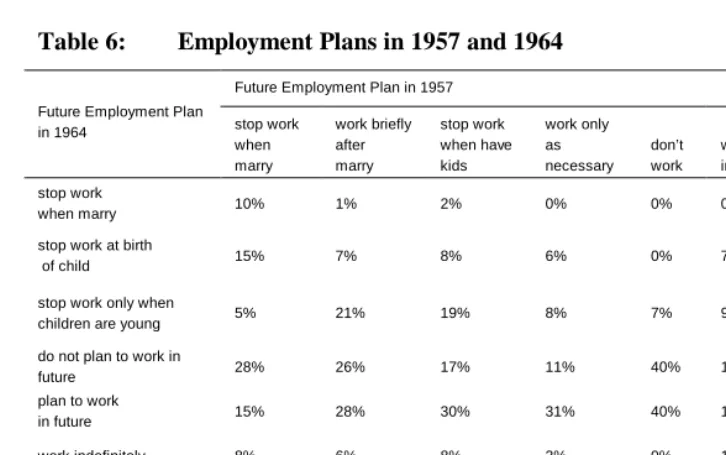
In 1964, the women in the survey were again asked about their future employment plans. While the categorization was not precisely the same as in 1957, there were sufficient similarities to draw some conclusions. Options in 1964 were (a) plan to continue work, interested in a career, (b) expect to continue work indefinitely, but no interest in a career, (c) plan to stop work when married, (d) plan to stop work at birth of child, (e) plan to stop work only while children are young, (f) plan to go to work in future, and (g) do not plan to work in future.7 In 1957, 25% of the women planned to work indefinitely or to pursue a career; in 1964, 32% planned to work indefinitely or to pursue a career. In 1964, an additional 25% planned to go to work. Thus, 75% planned no work or intermittent work in 1957, but only 43% had such plans in 1964.
Table 6 indicates for each work plan chosen in 1957, the percent choosing the various 1964 options. The most significant point visible from this table is that the most common answer for almost all of the categories was that the women planned to go to work or to continue working. The only group for which the most common answer in 1964 was that they did not plan to work was the group of women who stated in 1957 that they planned to stop working when they married. While 40% of the women who in 1957 did not plan to work in the foreseeable future stated in 1964 that they did not plan to work in the future, an equal proportion stated that they did plan to go to work in the future. In general, it is apparent that the women had plans for greater labor force participation in 1964 than they had in 1957. This increase was probably partly a life-cycle or age effect; some of these women had likely completed their childbearing and were planning to return to the workforce. However, part of the increase may have been a period effect, reflecting an overall rise in work expectations.
One important event that occurred between 1957 and 1964 could have substantially impacted the plans of the young women at that time. The oral contraceptive, or “the pill” was approved by the Food and Drug Administration in 1960. By 1965, 40% of young married women who were using some form of contraception were using the pill (Goldin & Katz, 2000). The reliability, ease of use, and female control enabled women to better control their reproduction and consequently better plan their professional lives. Oral contraception had additional
7 There was also an option for "other," which was chosen by only a small fraction of the women. In the analysis of future plans, those women
effects on the plans of later cohorts when legal changes in the late 1960’s and early 1970’s enabled young single women to gain access to the pill (Goldin & Katz).
6. Many years later…
About forty years have elapsed since the college class of 1957 was last surveyed. In 2003, most of the college class of 1957 would be in their late 60s and able to retire with full Social Security benefits. Women in their late twenties and those in their late sixties do not have the same opportunities and preferences and do not exhibit the same work behaviors. An age effect is operating, compounded by a period effect as, once again, attitudes and institutions change.
What factors explain the labor force participation of older women? Earlier research has shown that health has a significant impact on retirement (Haider & Loughran, 2001; O’Rand & Henretta, 1982; and Williamson & McNamara, 2001). Access to health insurance affects labor supply and retirement decisions as well (Buchmueller & Valletta, 1999 and Quinn, 1999).
Table 6: Employment Plans in 1957 and 1964
Future Employment Plan in 1957 Future Employment Plan
in 1964 stop work
when marry work briefly after marry stop work when have kids work only as necessary don’t work work indefinitely have a career stop work
when marry 10% 1% 2% 0% 0% 0% 4%
stop work at birth
of child 15% 7% 8% 6% 0% 7% 3%
stop work only when
children are young 5% 21% 19% 8% 7% 9% 13%
do not plan to work in
future 28% 26% 17% 11% 40% 12% 6%
plan to work
in future 15% 28% 30% 31% 40% 18% 15%
work indefinitely 8% 6% 8% 3% 0% 14% 1%
interested in a career 18% 10% 16% 42% 13% 40% 58%
total percent 100% 100% 100% 100% 100% 100% 100%
Marital status and spouses are additional determinants of women’s retirement. O’Rand & Henretta (1982) found that when unmarried older women marry, they tend to retire earlier. That study also showed that widows and women who are separated or divorced are more likely than never-married women to retire before age 62. Timing of retirement is sometimes influenced by the retirement of a spouse. Henretta, O’Rand, and Chan (1993) found that among couples with early joint work roles, the retirement rate of wives is higher after the husband exits the labor force. However, husbands’ retirement status had no significant impact on the retirement rate of women who had little or no employment experience when their children were young. Husband’s health is another factor influencing a woman’s retirement plans. While the poor health of a spouse increases the value of nonmarket time, it has a larger effect on income needs, thereby increasing expectations of working past age 62 (Honig, 1996).
Elderly white women have been found to be more likely to be in the labor force than elderly black women (Hill, 2002). Results concerning family income, excluding wife’s earnings, are mixed. While Honig (1998) found a significant negative impact of family income on women’s expectations of full-time work after age 62, Hill (2002) found that family income had no significant effect on whether a woman over 65 works, or on her usual hours or usual weeks worked. According to Haider and Loughran (2001), it is wealthier men and women who are more inclined to work after age 65, and they work for relatively low pay in exchange for greater flexibility in hours. For older workers, non-pecuniary returns appear to be more important than financial returns.
The elimination of mandatory retirement in 1986 increased options available to older employees and sent a message about the appropriateness of work for older Americans (Burtless & Quinn, 2000). Social Security amendments in 1977 and 1983 changed Social Security rules in ways that encourage later withdrawal from the labor force. The amount that a recipient can earn without losing any Social Security benefits was increased and the benefit lost for each dollar earned over the exempt amount was reduced (Burtless & Quinn). In 2000, another work disincentive was removed with the passage of the Senior Citizen’s Freedom to Work Act; workers who are past full retirement age (currently 65) no longer have their Social Security benefits reduced if their earnings are over a particular limit (U.S. Social Security Administration, 2001). According to Honig (1996 and 1998), however, Social Security benefits do not seem to have significantly influenced plans of white, married women to work full-time past age 62. Duggan (1984) found significant negative impacts of Social Security benefits on women aged 55-64 but not on women over 65.
then falls, creating a retirement incentive at that point. Defined-contribution plans are age-neutral and do not have the age-specific work disincentives of defined-benefit plans. The simulations of Friedberg and Webb (2003) demonstrated that workers with contribution pension plans retire significantly later than workers with benefit plans. In the past two decades, there has been a shift away from defined-benefit plans and toward defined-contribution plans. Younger workers, therefore, increasingly are covered by the latter. As these workers reach retirement, Friedberg and Webb expect that employment rates among people in their 60s will rise. In addition, Friedberg and Webb conclude that the change in pension structure has already contributed to such a trend among people currently in their 60s. Honig (1996) included a dummy variable for whether pension wealth increases with additional work after age 62. Consistent with the findings of Friedberg and Webb, that variable had a statistically significant, positive impact on expected continuation of work past age 62.
7. Current Population Survey estimation
Unfortunately, recent information on the Women’s Bureau sample is not available. Data on samples of the cohort of women in a similar age bracket and with the same educational attainment can be obtained, however. DataFerrett provides information online for the Current Population Survey (CPS) March Supplement. The survey respondents included college-educated women who were aged 65 to 69 in 2003.8 Hence, it is possible to see what the cohort of the Women’s Bureau sample were doing more than 40 years after graduation. The data set for that group contained 470 observations with information on labor force status, marital status, health, race, post-graduate degrees, and income (U.S. Census Bureau and Centers for Disease Control, 2005). Of the women in the CPS group, 27% remained in the labor force (17% full-time, 9% part-full-time, and 1% unemployed).
Some of the CPS college-educated women in the cohort examined would have received their degrees considerably after 1957, as the trend of increasing numbers of nontraditional-aged women attending college indicates. Among women born between 1932 and 1936 whose highest level of education was a bachelor’s degree, Morgan (1986) found that 18.6% received that degree after 1962, when they would have been at least 26 years old. Some of these women probably postponed college because they
were raising families. For the same reason, they may have also delayed their careers. Researchers have found that women who delay career entry tend to retire later (Henretta, O’Rand, & Chan, 1993; and O’Rand & Henretta, 1982), partly due to a need to build pensions and other savings. Similarly, women who completed college but waited to enter the labor force until their children were older would have felt a need to work later in life too.9
Using the CPS data, it was possible to explore some of the factors influencing the labor force status of the college-educated women in their late 60s. Even when the unemployed category was omitted, the lopsidedness of the sample led to poor results for a multinomial logit analysis that treated full- and part-time statuses as separate categories. Therefore, two separate equations were estimated. First, a logit equation was estimated for being in versus out of the labor force. Then using just the employed women, a second equation was estimated for full-time versus part-time status.
The results of the estimation, which are shown in Tables 7 and 8, are generally consistent with the findings of studies not restricted to college-educated women. Holding other characteristics constant, married women are less likely to be in the labor force and, when they are, they are less likely to be employed full-time rather than part-time. Widows were more likely to be in the labor force and more likely to be employed full-time. (The reference category consisted of women who were divorced, separated, or never married. The separated and never-married subgroups were too small to be handled separately.) Women whose health limited the amount or type of work they could perform were less likely to be in the labor force. Surprisingly, however, when they were working, they were more likely to be employed full-time. This finding may not be reliable, however, since the number of women who had health limitations and were in the labor force was small. White women and women with graduate degrees were more likely to be in the labor force and more likely to be employed full-time. Women who had higher family income, excluding their own earnings, were less likely to be in the labor force and less likely to be employed full-time.
Table 7: Logit Estimation – In vs Out of the Labor Force Current Population Survey 2003 Data a
Variable ln[Pr(In Labor Force)/Pr(Not In Labor Force)]
MARRIEDb -0.5288**
(0.0039)
W IDOW EDb 0.3027**
(0.0047)
HEALTH LIMITATIONS -0.6915**
(0.0058)
W HITE 0.2390**
(0.0040)
GRADDEG 0.3385**
(0.0028) INCOME OTHER THAN
W IFE’S EARNINGS
-0.000001** (0.00000006)
CONSTANT -1.4498**
(0.0068)
Number of observations 470
Percent correctly predicted 72.77
Log-likelihood ratio test statistic 53,461.9** a Standard errors are in parentheses.
b Reference category is never married, divorced, or separated.
Table 8: Logit Estimation – Full-Time vs Part-Time, Current Population Survey 2003 Data a
Variable ln[Pr(Full-Time)/Pr(Part-Time)]
MARRIEDb -0.8708**
(0.0080)
W IDOW EDb 0.2990**
(0.0095)
HEALTH LIMITATIONS 0.0667**
(0.0152)
W HITE 0.1330**
(0.0079)
GRADDEG 0.1251**
(0.0054) INCOME OTHER THAN
W IFE’S EARNINGS
-0.000003** (0.0000001)
CONSTANT 1.0795**
(0.0171)
Number of observations 125
Percent correctly predicted 69.60
Log-likelihood ratio test statistic 22,594.1** a
Standard errors are in parentheses.
b Reference category is never married, divorced, or separated.
8. Summary and conclusions
Recent statistics show that many older women are still employed. These women entered the labor force in an era when women’s labor force participation was low, even among college-educated individuals. Data from the U.S. Department of Labor Women's Bureau Survey of the college class of 1957 was used to examine the labor force expectations of these women when they completed college. By employing that data set, our understanding of women's labor force expectations is extended back prior to the 1968 National Longitudinal Survey. Hence, we are able to see what women in their late 60s at the turn of the century anticipated when they graduated from college more than four decades ago.
Unlike previous research on labor force plans and labor force status, this work employed four-category multinomial logit analysis, in addition to binary logit. The binary specification indicated simply whether a woman was in or out of the labor force. The multinomial specification used four statuses: full-time, part-time, unemployed, and not in the labor force. Therefore, impacts of the explanatory variables on labor force status could be better understood.
In the binary analysis, women who upon graduation from college planned to have a career or to work indefinitely were significantly more likely to be in the labor force seven years later. In the four-way categorization, those women were more likely to be employed full-time or unemployed rather than out of the labor force. The relative probability of being employed part-time, however, was not significantly affected by the women's plans.
Finding different impacts of husband's attitude on full- and part-time employment is one advantage of the four-way logit analysis over the binary analysis. Also, lost in the binary analysis are findings of smaller discouraged worker effects for women with graduate degrees and for women who planned to have careers or to work indefinitely. Unfortunately, in this data set, the group of unemployed women was fairly small. Further research corroborating the discouraged worker findings with larger data sets would be useful.
Women of the college class of 1957 were found to have more labor force plans in 1964 than in 1957. The trend of increasing work expectations may have already begun, at least among the college-educated women.
to work full-time. In addition, women who were not restricted by health problems were also more likely to be in the labor force. These findings are generally in agreement with the results of other studies not limited to college-educated women. Prior research has also concluded that elimination of mandatory retirement, changes in Social Security policy and trends in employer pension plans have been instrumental in increasing labor force participation among older individuals.
So history has painted a very different picture than was reflected in the expectations of the women of the college class of 1957 a few decades ago. Women’s employment was becoming more socially acceptable and their expectations of market work were increasing. In addition, institutional factors have increased the range of possible choices of retirement timing. Consequently, workers are more frequently able to retire on their own terms and at their own pace (Han and Moen, 1999). The result is increased variability in retirement age. While some people retire early, many work well into their sixties, especially those women who entered the labor force relatively late. So the women of the class of 1957 who planned to work usually did. However, many who did not plan to work did so as well and many were still working into the next century.
9. Acknowledgements
References
Blank, R. (1989). The role of part-time work in women’s labor market choices over time. American Economic Review, 79, 295-299.
Buchmueller, T.C. & Valletta, R.G. (1999). The effect of health insurance on married female labor supply. Journal of Human Resources, 34, 42-70.
Burtless, G. & Quinn, J. F. (2000). Retirement trends and policies to encourage work among older Americans. Chestnut Hill, MA: Center for Retirement Research at Boston College. Paper prepared for the annual conference of the National Academy of Social Insurance, Washington, DC, January 26-27, 2000.
Charles, M., Buchmann, M., Halebsky, S., Powers, J.M., & Smith, M.M. (2001). The context of women’s market careers: A cross-national study. Work and Occupations, 28, 371-396.
Drobnic, S., Blossfeld, H., & Rohwer, G. (1999). Dynamics of women’s employment patterns over the family life course: A comparison of the United States and Germany. Journal of Marriage and the Family, 61, 133-146.
Duggan, J.E. (1984). The labor-force participation of older workers. Industrial and Labor Relations Review, 37, 416-430.
Ferber, M. A. (1982). Labor market participation of young married women: Causes and effects. Journal of Marriage and the Family, 44, 457-468.
Friedberg, L. & Webb, A. (2003). Retirement and the evolution of pension structure. NBER Working Paper No. w9999. Cambridge MA: National Bureau of Economic Research.
Fullerton, H.N., Jr. (1999). Labor force participation: 75 years of change, 1950-98 and 1998-2025. Monthly Labor Review, 122, 3-12.
Goldin, C. (1990). Understanding the gender gap: An economic history of American women. New York: Oxford University Press.
Goldin, C. & Katz, L.F. (2000). Career and marriage in the age of the pill. American Economic Review, 90, 461-465.
Hakim, C. (2002). Lifestyle preferences as determinants of women’s differentiated labor market careers. Work and Occupations, 29, 428-459.
Han, S.-K. & Moen, P. (1999). Clocking out: Temporal patterning of retirement. American Journal of Sociology, 105, 191-236.
Henretta, J.C., O’Rand, A.M. & Chan, C.G. (1993). Joint role investments and synchronization of retirement: A sequential approach to couples’ retirement timing. Social Forces, 71, 981-1000.
Hill, E.T. (2002). The labor force participation of older women: retired? working? both? Monthly Labor Review, 125, 39-48.
Honig, M. (1996). Retirement expectations: Differences by race, ethnicity, and gender. The Gerontologist, 36, 373-382.
Honig, M. (1998). Married women’s retirement expectations: Do pensions and Social Security matter? American Economic Review, 88, 202-206.
Mincer, J. (1962). Labor force participation of married women: A study of labor supply. In National Bureau of Economic Research, Aspects of labor economics. Princeton, NJ: Princeton University Press, 63-97.
Mincer, J. & Polachek, S. (1974). Family investments in human capital: Earnings of women. Journal of Political Economy, 82, S76-S108.
Morgan, W.R. (1986). Returning to school at midlife: Mature women with educational careers. In L.B. Shaw (ed.), Midlife Women at Work. Lexington, MA: D.C. Heath and Company, 51-71.
O’Rand, A.M. & Henretta, J.C. (1982). Delayed career entry, industrial pension structure, and early retirement in a cohort of unmarried women. American Sociological Review, 47, 365-373.
Quinn, J.F. (1999). Retirement patterns and bridge jobs in the 1990s. EBRI Issue Brief no. 206, Employee Benefit Research Institute, Washington, DC.
Sandell S.H. & Shapiro, D. (1980). Work experience, human capital accumulation, and the wages of young women. Journal of Human Resources, 15, 335-353.
Shaw, L.B. & Shapiro, D. (1987). Women's work plans: Contrasting expectations and actual work experience. Monthly Labor Review, 110, 7-13.
U.S. Census Bureau and Centers for Disease Control. http://dataferrett.census.gov/ TheDataWeb/index.html . (Retrieved January 12, 2005.)
U.S. Social Security Administration. (2001). Annual Statistical Supplement, 2001, to the Social Security Bulletin. http://www.ssa.gov/policy/docs/statcomps/ supplement/2001/oasdi.pdf . (Retrieved March 1, 2005.)
Weil, M.W. (1961). An analysis of the factors influencing married women's actual or planned work participation. American Sociological Review, 26, pp. 91-96.
Weiss, Y. & Gronau, R. (1981). Expected interruptions in labor force participation and sex related differences in earnings growth. Review of Economic Studies, 1968, 607-619.