IPA
International Journalof Psychology Vol. 6, No. 1, Winter & Spring 2012
PP. 1-18
Iranian Psychological Association
A Comparison of Natives and Non-natives’
Attachment to their Place: A Case
Study in Iran
Maryam Charkhchian, PhD
Department of Art and Architecture Payam Noor University
All over the world, there are many people who migrate in search of better situations. The relationship between immigrants and their new situations is an important issue that must be taken into consideration by architects and urban planners. In Iran cities, like Qazvin, receive many immigrants from other cities due to their special agricultural, economic and academic potentials. In such cases, different cultures and sub-cultures of Iran co-exist within these cities. In the current study, the rate of emotional bonds to place, “place attachment”; is investigated in two groups: native and non-native inhabitants of Qazvin city in its most important public space. In this study, 598 Qazvin- citizen participants were chosen for interviews by the systematic non-random sampling. The data were analyzed using analysis of variance (ANOVA) and multivariate analysis of variance (MANOVA). The results indicated that belonging to a non-native group is not a significant factor in anticipating place attachment. However, place identity, a dimension of place attachment, had a significant correlation with this factor. In addition, participants' age and income have a significant relationship with place attachment among native and non-native groups.
Keywords: place attachment, native, non-natives, emotional bond, functional bond, behavioral bond, cognitive bonds.
1970s. These studies explore the association between individuals and their immediate environment as well as the impact of environmental quality on human health. The psychology of place assumes that individuals require an adequate environment in order to form an emotional bond to this environment. People are linked to their environment through three key psychological processes: familiarity, attachment and identity. Familiarity refers to the processes by which people develop detailed cognitive knowledge of their environments. Attachment refers to the bond between a person and a beloved place. Place identity is concerned with the extraction of a sense of self based on the places in which one has lived and explored life’s journey (Fullilove, 1996).
Displacement breaks these emotional connections. The ensuing disorientation, nostalgia, and alienation may undermine the sense of belonging and mental health (Fullilove, 1996; Dixon & Durrheim, 2004). When immigrants with different cultures and subcultures must co-exist in the same environment, it is important that they share an emotional bond to that environment.
Although many Iranians encounter various cultures migrating from one region to another in Iran, their attachment to new places upon relocation has not yet been studied. This aspect of a person to place relationship tends to be neglected in cities with heterogeneous areas. The current study explores non-natives’ place attachment and will examine two hypotheses:
- There is a lack of emotional bonds between people and their
environment in urban public places in heterogeneous communities.
- Native groups have stronger place attachment to urban areas than
non-natives groups.
Literature Review
This term has been defined by Low & Altman (1992) as a positive emotional bond with a particular place). Low & Altman (1992) explain
that, “place attachment subsumes or is subsumed by a variety of
analogous ideas, including topophilia, place identity, insidedness, genres of place, sense of place or rootedness, environmental embeddedness, community sentiment and identity to name a few” (p. 3). In addition, place attachment facilitates a sense of security and well-being, defines group boundaries, and stabilizes memories (Halbwachs, 1980) over the passage of time (Logan & Molotch, 1987; Chawla, 1992; Marcus 1992; Reed, Payton & Bond 1997; Rubinstein & Parmelee 1992).
Gieryn (2000) argues that place attachment results from many factors including accumulated geographical experience, socially and culturally shared activities and the geography and architecture of the place.
Experiences that produce place attachment are described as “fulfilling,
terrifying, traumatic, triumphant, secret events that happen to us there” (Gieryn, 2000, p. 481). The longer people have lived in a place, the more rooted they feel, and the greater their attachment will be (Elder, King & Conger, 1996; Hartig, Kaiser & Bowler, 1997). Gieryn (2000) stated that the loss of place and its meaning have negative implications for individuals’ collective identity, memory and history. In a study about the workplace, Milligan (1998) found that place attachment is based on nostalgic memories of past experiences in a physical setting and anticipations that positive encounters might continue in the future.
Giuliani and Feldman (1993) defined place attachment as the multiple affective, cognitive, and behavioral relationships between people and the socio-physical environment. Similarly, Low and Altman (1992) considered the range of place attachment definitions in literature and noted that one consistently defining aspect of the concept was its emotional quality. They did not overemphasize this quality, but pointed to others in the field who had argued that place attachment also includes
knowledge and beliefs, and behaviors and actions in reference to place” (Low and Altman, 1992, p. 5).
Theorists have tried to categorize place attachment. For example, Schreyer Jacob, and White (1981) considered place attachment in terms of two dimensions; functional and emotional. Williams and Roggenbuck (1989) also empirically defined place attachment as consisting of two-dimensions: place identity and place dependence.
Place identity. The notion of place identity is described as “those dimensions of self that define the individual’s personal identity in relation to the physical environment by means of a complex pattern of conscious and unconscious ideas, beliefs, preferences, feelings, values, goals and behavioral tendencies and skills relevant to this environment. While an individual’s place identity reflects the specific experiences and socialization unique to that individual, place identity also reflects those experiences common to all individuals and groups of individuals living in particular kinds of settings” (Proshansky, 1978, p. 155). Place identity is also described as the symbolic connection between an individual and a place (Stedman, 2002). Place identity is a psychological investment in a place that has developed over time. In this regard, place affirms individual or group identity referring to indicators of emotional or affective attachment. Place identity can be both cognitive and affective; yet it remains unclear how these separate factors operate in defining place
identity (Williams & Patterson, 1999). “These cognitions represent
memories, ideas, feelings, attitudes, values, preferences, meanings, and conceptions of behavior and experience, which relate to the variety and
identity. They developed key aspects of identity: esteem, self-efficacy, distinctiveness and continuity; based on Breakwells’ (1986) identity process model. Their study can be used as a means of conceptualizing the relationship between individuals or groups and places (Austin, 2003).
Place dependence. The second component of Williams and Roggenbuck’s (1989) scale, place dependence is conceptually similar to both Schreyer et al. (1981) and Stokols and Shumaker’s (1981) components. Functional attachments, or what Stokols and Shumaker (1981) describe as place dependence, have to do with the opportunities the setting affords for fulfillment of specific goals or activity needs? Place dependence is a functional attachment associated with the capacity or potential of a place to support the needs, goals, or intended activities of a person (Stokols & Shumaker, 1981; Williams & Vaske, 2003).
Williams and Roggenbuck (1989) developed instrumentation to measure these two components of place attachment that has been shown to be valid and reliable over time (Jorgensen & Stedman, 2001; Williams & Vaske, 2003). Williams and Vaske (2003) developed a valid and reliable 12-item, 5-point Likert-scale place-attachment survey, initially used in recreational settings. However, it can be generalized to other situations. Internal-consistency reliability (Cronbach’s alphas ranging from .81 to .94) for the final 12-item survey was also reported (Table 1). We adopted this valid and reliable instrument verbatim to measure place attachment in a public space discussed below.
Several studies have shown that place attachment is associated with environmentally responsible behavior (Vaske & Kobrin, 2001). In fact, positive attachments to a place may be linked to individuals’ willingness to participate in the protection of that place (Relph, 1976; Schultz, 2000; Tuan, 1977; Walker & Chapman, 2003). Therefore, place attachment
study has another important dimension that, in this study, was named
effects of place attachment on enhancing participant’s behaviors in a place.
Table1
12 Items for Surveying Place Attachment (Williams and Vaske, 2003)
1. I feel that this place is a part of me.
2. This place is the best place for what I like to do.
3. This place is very special to me.
4. No other place can compare to this place.
5. I identify strongly with this place.
6. I get more satisfaction out of being at this place than at any other.
7. I am very attached to this place.
8. Doing what I do at this place is more important to me than doing it
in any other place.
9. Being at this place says a lot about who I am
10. I wouldn’t substitute any other area for doing the types of things I
do at this place.
11. This place means a lot to me.
12. The things I do at this place I would enjoy doing just as much at a
similar site.
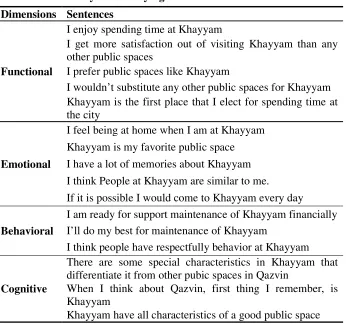
Table 2
Model of this Study for Surveying Place Attachment
Dimensions Sentences
Functional
I enjoy spending time at Khayyam
I get more satisfaction out of visiting Khayyam than any other public spaces
I prefer public spaces like Khayyam
I wouldn’t substitute any other public spaces for Khayyam Khayyam is the first place that I elect for spending time at the city
Emotional
I feel being at home when I am at Khayyam Khayyam is my favorite public space I have a lot of memories about Khayyam I think People at Khayyam are similar to me.
If it is possible I would come to Khayyam every day
Behavioral
I am ready for support maintenance of Khayyam financially I’ll do my best for maintenance of Khayyam
I think people have respectfully behavior at Khayyam
Cognitive
There are some special characteristics in Khayyam that differentiate it from other pubic spaces in Qazvin
When I think about Qazvin, first thing I remember, is Khayyam
Khayyam have all characteristics of a good public space
Method
analysis of variance (MANOVA) and analysis of variance (ANOVA) tests.
Study Setting
Qazvin, Iran, is approximately 165 km northwest of Tehran and south of the rugged Alborz range, in the province of Qazvin. It is about 1800 meters above the sea level, and has a cold but dry climate. The city was the location of the former capital of the Persian Empire and contains over 2000 architectural and archeological sites. It is a provincial capital today and has been an important cultural center throughout the history.
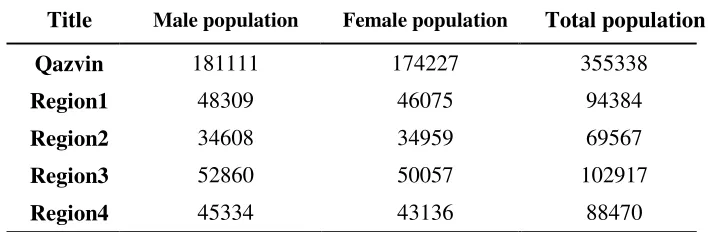
Today, Qazvin is a city with various industrial, academic and agricultural potentials that attract many immigrants from other cities. Due to the differing subcultures that exist within the city, Qazvin has a very heterogeneous population. In 2007, it had a population of 355,338 in its four urban regions; 96,000 of them were immigrants (Table 3).
Table 3
Qazvin Population (Administration of Management and Planning of Iran, 2007)
Total population Female population
Male population Title
355338 174227
181111 Qazvin
94384 46075
48309 Region1
69567 34959
34608 Region2
102917 50057
52860 Region3
88470 43136
45334 Region4
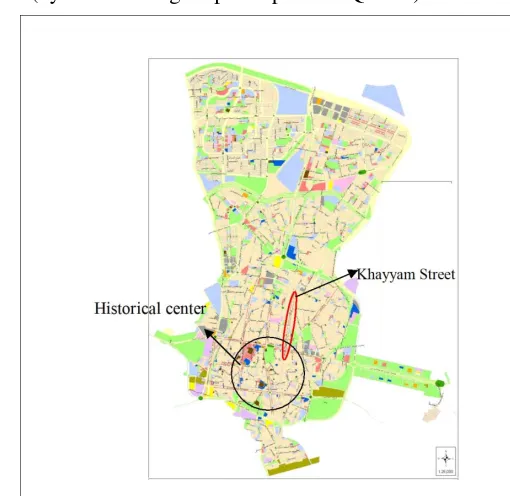
selected for this study based on its attractiveness and the opinions of
locals (by interviewing 70 participants in Qazvin).
Figure 1
Qazvin Map (Municipality of Qazvin, 2007)
Design and Sample
male and 49% female) and marital status (58.2% married and 47.8% single) were interviewed. The interviews took approximately 25 minutes each. The sample consisted of 181 non-natives and 417 natives (30.3% non-natives and 69.7% native). Though, non-native groups come from different regions of Iran with different cultures and languages, they are able to speak Persian as the Iranian national language.
Table 4
Social Characters of Participants
Social Character Mean Std. Dev. Min Max N
Age 27.94 11.326 14 80 598
Education 12.70 3.030 0 20 598
Results
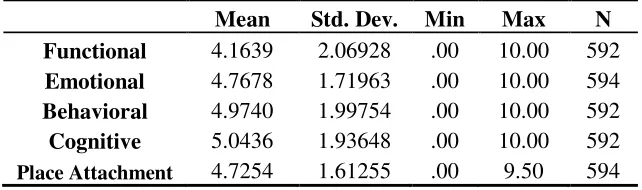
In order to analyze the data we first calculated the internal consistency of the scale used. The results indicated a high degree of reliability with a Cronbach's alpha of 0.83 for the scale as a whole. Based on the comparison of the responses to different dimensions of place attachment, we found that cognitive bonds have the highest score among the different dimensions (see Table 5).
Table 5
Mean Scores of Place Attachment and its Dimensions
Mean Std. Dev. Min Max N Functional 4.1639 2.06928 .00 10.00 592 Emotional 4.7678 1.71963 .00 10.00 594 Behavioral 4.9740 1.99754 .00 10.00 592 Cognitive 5.0436 1.93648 .00 10.00 592 Place Attachment 4.7254 1.61255 .00 9.50 594
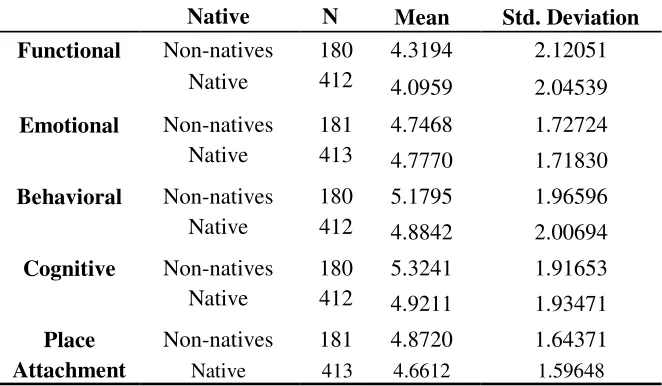
mean attachment scores of these two groups vary according to the total as well as the dimensions. We compared the degree of place attachment between non-native and native citizens. After analyzing the means of place attachment for each group, it was found that in all of the dimensions (except for the emotional bond); the highest means belong to the non-natives groups (Table 6). This means that, the scores of the non-natives’ emotional bonds in this case are higher than those of the non-natives. Table 6
Mean Scores of Place Attachment and its Dimensions in Natives and Non-Natives
Native N Mean Std. Deviation
Functional Non-natives 180 4.3194 2.12051
Native 412 4.0959 2.04539
Emotional Non-natives 181 4.7468 1.72724
Native 413 4.7770 1.71830
Behavioral Non-natives 180 5.1795 1.96596
Native 412 4.8842 2.00694
Cognitive Non-natives 180 5.3241 1.91653
Native 412 4.9211 1.93471
Place Attachment
Non-natives 181 4.8720 1.64371
Native 413 4.6612 1.59648
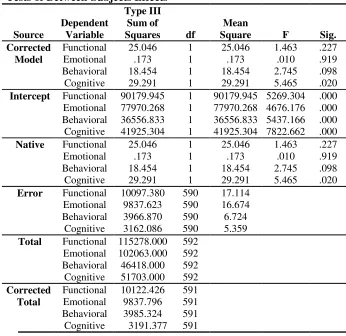
between belonging to native group and cognitive bonds to place (F=5.465 and P =.020).
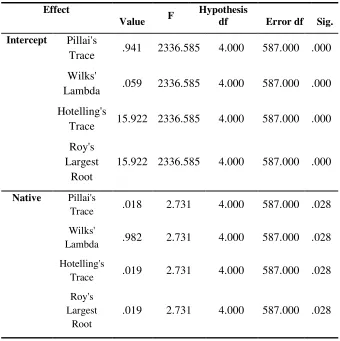
Table 7
Multivariate Tests
Effect
Value F
Hypothesis
df Error df Sig.
Intercept Pillai's
Trace .941 2336.585 4.000 587.000 .000
Wilks'
Lambda .059 2336.585 4.000 587.000 .000
Hotelling's
Trace 15.922 2336.585 4.000 587.000 .000
Roy's Largest
Root
15.922 2336.585 4.000 587.000 .000
Native Pillai's
Trace .018 2.731 4.000 587.000 .028 Wilks'
Lambda .982 2.731 4.000 587.000 .028 Hotelling's
Trace .019 2.731 4.000 587.000 .028 Roy's
Largest Root
Table 8
Tests of Between-Subjects Effects
Source
Dependent Variable
Type III Sum of
Squares df
Mean
Square F Sig.
Corrected Model
Functional 25.046 1 25.046 1.463 .227
Emotional .173 1 .173 .010 .919
Behavioral 18.454 1 18.454 2.745 .098 Cognitive 29.291 1 29.291 5.465 .020 Intercept Functional 90179.945 1 90179.945 5269.304 .000 Emotional 77970.268 1 77970.268 4676.176 .000 Behavioral 36556.833 1 36556.833 5437.166 .000 Cognitive 41925.304 1 41925.304 7822.662 .000 Native Functional 25.046 1 25.046 1.463 .227
Emotional .173 1 .173 .010 .919
Behavioral 18.454 1 18.454 2.745 .098 Cognitive 29.291 1 29.291 5.465 .020 Error Functional 10097.380 590 17.114
Emotional 9837.623 590 16.674 Behavioral 3966.870 590 6.724
Cognitive 3162.086 590 5.359 Total Functional 115278.000 592
Emotional 102063.000 592 Behavioral 46418.000 592 Cognitive 51703.000 592 Corrected
Total
Functional 10122.426 591 Emotional 9837.796 591 Behavioral 3985.324 591
Cognitive 3191.377 591
Discussion
However, we added the dimension of behavioral bonds which are the result of place attachment in the form of responsible behavior. We designed a questionnaire for evaluating place-attachment with a Cronbach's alpha of 0.83 which indicated a high degree of reliability. It consisted of 12 sentences in a 5-point Likert-scale. Our model of evaluating place attachment has been done for the first time in Iran in the Persian language.
As we anticipated in the first research hypothesis, emotional bonds between people and place have the lowest scores among other place attachment dimensions. This result shows that public places are just the means to meet individuals’ daily life needs rather than their higher needs. While feeling emotional bonds with people and the environment is an essential human need in urban public places. In this regard, architects and urban planners should find and improve dimensions of the environment so that citizens can experience more of an emotional bond with others and with the environment.
Finally, future studies can focus on discovering physical elements of places (especially public places) which cause non-natives to feel higher emotional bonds with that place. As mentioned before; non-natives’ motivations and their efforts to adjust and identify with new situations should be investigated in the future. To generalize the findings of this study, it needs to be applied in other similar cases in different areas.
References
Austin, E. (2003). The social bond and place, Doctoral Dissertation in
Communication science, Virginia Polytechnic Institute and State university Falls Churchl, USA.
Bisharat G. E. (1997). Exile to compatriot: transformations in the social
identity of Palestinian refugees in the West Bank. See Gupta & Ferguson 1997a, pp. 203–33.
Breakwell, G. M. (1986). Coping With Threatened Identity. London:
Methuen.
Brown, B. B., & Perkins, D. D. (1992). Disruptions in Place Attachment,
In I. Altman and S. Low (Eds.), Place Attachment, New York, Plenum.
Elder, G. H., King, V., & Conger, R. D. (1996). Attachment to place and
migration prospects: a developmental perspective. J. Res. Adolesc. 6: 397-425.
Erikson, K. (1967). Everything in its Path. New York: Simon & Schuster
Fullilove, M. T. (1996). Psychiatric implications of displacement:
contributions from the psychology of place. American Journal of
Psychiatry, 153(12): 1516-1523.
Gans, H. J. (1962). The urban villagers. New York: The Free Press.
Gieryn, T. F. (2000). A space for place in sociology, Annu. Rev. Sociol, 26: 463–96.
Giuliani, M. V., & Feldman, R. (1993). Place attachment in a
Halbwachs, M. (1980). The Collective Memory. New York: Harper & Row.
Hartig, T., Kaiser, F. G., & Bowler, P. A. (1997). Further development of
a measure of perceived environmental restorativeness (Working Paper No.5). Gavle, Sweden: Uppsala University, Institute for Housing Research.
Hidalgo, M. C., & Hernandez, B. (2001). Place attachment: Conceptual
and empirical questions, Journal of Environmental Psychology, 21,
273-281.
Kasinitz, P. (1992). Caribbean New York: Black Immigrants and the
Politics of Race. Ithaca, NY: Cornell Univ. Press
Logan, J. R., & Molotch, H. (1987). Urban fortunes: the political
economy of place, Berkeley, CA: University of California Press. Low, S. M., & Altman, I. (1992). Place attachment: a conceptual inquiry,
In Low, S. M. and Altman, I. (Eds.) Place Attachment, New York,
Plenum Press, 12, 1–12.
MacCannell, D. (1976). The Tourist: A New Theory of the Leisure Class.
New York: Schocken Books
Malkki, L. H. (1995). Purity and Exile: Violence, Memory, and National
Cosmology among Hutu Refugees in Tanzania. Chicago: Univ. Chicago Press.
Milligan, M. J. (1998). Interactional past and potential: the social
construction of place attachment, Symbolic Interaction, 21:1, 1–33.
Mitchell, D. (1996). The Lie of the Land: Migrant Workers and the
California Landscape. Minneapolis: Univ. Minn. Press
Moore, R. L., & Graefe, A. R. (1994). Attachments to recreation settings:
The case of rail-trail users, Leisure Sciences, 16, 17-31.
Portes, A., & Stepick, A. (1993). City on the Edge: The Transformation of
Miami. Berkeley: Univ. Calif. Press
Proshansky, H. M. (1978). The City and Self-Identity, Environment and
Behavior, 10: 2, 147-169.
physical world socialization of the self, Journal of Environmental Psychology, 3, 57–83.
Reed, J., Payton, V. R., & Bond, S. (1997). The importance of place for
older people moving into care homes. Soc. Sci. Med.46:859–67
Relph, E. (1976). Place and placelessness, London, Pion Limited.
Rubinstein, R. L., & Parmelee, P. A. (1992). Attachment to place and representation of the life course by the elderly, In I. Altman and S. M.
Low (Eds.), Place Attachment, New York, Plenum Press.
Schreyer, R., Jacob, G., & White, R. (1981). Environmental meaning as a determinant of spatial behavior in recreation, In J. Frazier and B.
Epstein (Eds.), Proceedings of the Applied Geography Conferences.
Binghamton, Dept. of Geography, SUNY Binghamton, 294-300. Schultz, P. W. (2000). Empathizing with nature: The effects of
perspective taking on concern for environmental issues, Journal of
Social Issues, 56(3), 391-406.
Stedman, R. C. (2002). Toward a social psychology of place: predicting behavior from place based cognitions, attitude and identity.
Environment and Behavior, 34:5, 561–581.
Stokols, D., & Shumaker, S. A. (1981). People in places: a transactional
view of settings, In Cognition, Social Behavior and the Environment.
J. Harvey, ed. Hillsdale, N. J. : Erlbaum.
Tuan, Y. F. (1977) Space and place: The perspective of experience,
Minneapolis, University of Minnesota Press.
Twigger-Ross, C. L., & Uzzell, D. L. (1996). Place and identity
processes, Journal of Environmental Psychology, 16, 1996
Vaske, J. J., & Kobrin, K. C. (2001). Place attachment and
environmentally responsible behavior, The Journal of Environmental
Education, 32:4, 16-21.
Walker, G. J., & Chapman, R. (2003). Thinking like a park: The effects of sense of place, perspective-taking, and empathy on pro-environment
71-Williams, D. R., & Patterson, M. E. (1999). Environmental psychology: Mapping landscape meanings for ecosystem management, in Cordell,
H. K, and J. C. Bergstrom (eds.), Integrating social sciences and
ecosystem management: Human dimensions in assessment, policy and management, Sagamore Press, Champaign, IL., P. 141–160.
Williams, D. R., & Roggenbuck, J. W. (1989). Measuring place attachment: Some preliminary results, In L. H. McAvoy & D. Howard
(Eds.), Leisure Research Symposium, National Recreation and Park
Association, Arlington, 32.
Williams, D. R., & Vaske, J. J. (2003). The measurement of place attachment: Validity and generalizability of a psychometric approach,
Forest Science, 49:6, 830-840.
Williams, D. R., Patterson, M. E., Roggenbuck, J. W., & Watson, A. E. (1992). Beyond the commodity metaphor: Examining emotional and
symbolic attachment to place, Leisure Sciences, 14, 29-46.