Patron: Her Majesty The Queen Rothamsted Research Harpenden, Herts, AL5 2JQ
Telephone: +44 (0)1582 763133 Web: http://www.rothamsted.ac.uk/
Rothamsted Repository Download
A - Papers appearing in refereed journals
Keen, B. A. and Rackowski, H. 1921. The relation between the clay
content of certain physical properties of a soil. The Journal of Agricultural
Science. 11 (4), pp. 441-449.
The publisher's version can be accessed at:
•
https://dx.doi.org/10.1017/S0021859600004469
The output can be accessed at:
https://repository.rothamsted.ac.uk/item/95z70/the-relation-between-the-clay-content-of-certain-physical-properties-of-a-soil
.
© 1 October 1921, Cambridge University Press (CUP).
AND CERTAIN PHYSICAL PROPERTIES OF A SOIL.
BY BERNARD A. KEEN
{Goldsmiths' Company's Soil Physicist),
AND HENRY RACZKOWSKI
(Rothamsted Experimental Station).
(With Five Text-figures.)
INTRODUCTION.
IT is well known that the behaviour of most soils is largely determined by the percentage of clay they contain. A considerable amount of work has been done from this point of view, some of which has been already discussed by one of us1 and hence need not be repeated here.
In the present paper a simple method is described for measuring various fundamental properties of soil, such as pore space, apparent and real specific gravity, volume expansion and so on. The results for suc-cessive depths of one soil are given here for illustrative purposes. They have proved of sufficient promise to warrant the application of the method to a large variety of soils, and we have been fortunate in enlisting the aid of the Science Masters Association who have arranged for tests to be made at a number of schools.
DESCRIPTION OF SOIL USED.
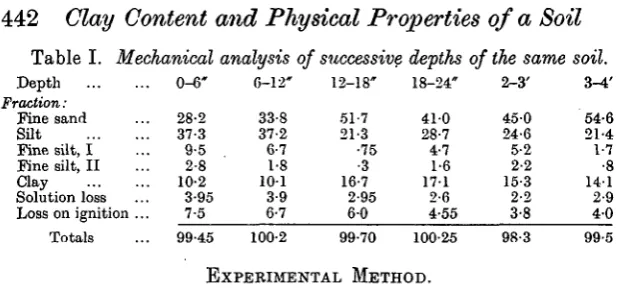
The soil was obtained from Mr Alfred Amos, of Spring Grove, Wye, Kent, from a deeply cultivated portion of a hop garden. It was taken some years ago, and was kept tightly corked in an air-dry condition until used. Six successive depths of the soil were separately stored as follows: 0-6", 6-12", 12-18", 18-24", 2-3', 3-4'. The mechanical analysis of each depth is shown in Table I. For reasons which are mentioned below, each sample was passed through a sieve of 100 meshes to the linear inch before use and the figures refer to the soil passing the sieve.
1
442 Clay Content and Physical Properties of a Soil
Table I. Mechanical analysis of successive depths of the same soil.
Depth
Fraction:
Fine sand Silt Fine silt, I Fine silt, II Clay Solution loss Loss on ignition .
Totals . 0-6-28-2 37-3 9-5 2-8 10-2 3-95 7-5 99-45 0-12' 33-8 37-2 6-7 1-8 101 3-9 6-7 100-2 12-18' 51-7 21-3 •75 •3 16-7 2-95 6-0 99-70 18-24"
4 1 0
28-7 4-7 1-6 171 2-6 4-55 100-25 2-3'
4 5 0
24-6 5-2 2-2 15-3 2-2 3-8 98-3 3-4' 54-6 21-4 1-7 •8 141 2-9 4-0 99-5 EXPERIMENTAL METHOD.
A number of small brass boxes are used, made as follows: a piece of stout brass sheet 8" x 1" is bent into four sides of a box, 2" square by 1" deep, and the join carefully soldered. Another portion of the metal is made into a detachable bottom piece slightly larger than 2" square and provided with a turned up edge about \" high which should fit closely round the first portion. The bottom is pierced with 11 rows of 11 holes each about -75 mm. in diameter and -5 cm. apart. A square of filter paper which is cut to the internal measurement of the box-bottom is placed therein, and held firmly by the lower edge of the sides of the box when this is placed in position. The box is weighed and is then filled with the sieved and air-dry soil in a systematic manner, so that the method of packing may be as uniform as possible. From 8-10 grms. are added at a time and the box tapped on the bench after each addition. When the box is nearly full, sufficient soil is added to allow the surface to be struck off flat with a spatula. The upper edges of the box are then in turn tapped smartly with the edge of the spatula, and more soil is added. This is struck of! flat as before and the process repeated until very slight settling of the soil occurs, when the surface is finally struck off flat and the box and contents weighed. The box and contents are then placed in a flat bottomed dish containing about \" depth of distilled water and left over night. When a number of boxes are placed in the same dish, additions of water must be made at intervals to keep the level constant. The behaviour of the soil while moistening is taking place is interesting. Considerable movement takes placex, the top of the block of soil retreating from the sides of the box before it becomes moist, and at the same time rising in height. Eventually when the interstices are saturated the wet soil expands back to the sides of
1 In some cases this initial movement is accompanied by a cracking of the surface soil.
the box but the vertical expansion remains. The next morning the boxes are rapidly dried on the outside, weighed, and replaced in the water for a few minutes. The portion of the soil which has expanded above the top of the box is then removed as follows: an ordinary razor blade held at a slight angle with the horizontal is placed along one edge of the box and then drawn across the top. The removal of the soil is facilitated if, previous to the use of the razor, a flat-edged spatula is used to divide the expanded soil into three rectangular blocks, of approximately equal volume. Each block is then removed in turn with the razor. This surplus soil is transferred from the razor to a small glass or metal dish as cleanly as possible, and weighed. Any soil adhering to the under side of the razor should not be put into the dish but replaced on soil in the brass box, to which it belongs. The box and residual soil are weighed after the outside has been dried, and then placed, together with the' dish containing the surplus soil, in a water oven for 24 hours1. At the end of this period they are cooled in a desiccator and weighed again.
In addition to these weighings it is necessary to measure carefully the internal volume of each brass box, which is done by taking a series of measurements of the height, breadth and length, and averaging; also to determine in the usual way the moisture present in the air-dry soil used in the experiments; to measure the amount of water taken up by the wet filter paper which is best done by taking six squares, saturating them with water, removing the surplus, with a glass rod, and measuring the increase of weight due to the water remaining.
It will be found convenient to have a rectangular metal box and lid in which the brass box and soil—whether air-dry or saturated—are placed for weighing purposes.
The necessary weighings and measurements are therefore:
Weight of weighing box, brass box, and filter paper a grms. » „ „ „ air-dry soil ... b „
„ „ „ wet „ saturated soil... c „
saturated) . " residual { " -" "
i oven-dry)
" d r y " (residual j e " „ metal dish (or watch glass) / „
„ „ „ „ saturated surplus soil ... g „
„ „ „ „ oven-dry „ „ ... h „
Percentage of moisture present in air-dry soil x% Internal volume of brass box «c.c.
1
444 Clay Content and Physical Properties of a Soil
From these weighings the following results are obtained:
(1) Weight of unit volume (100 c.c.) of air-dry soil (apparent specific gravity) x 100.
(2) Amount of water taken up by unit weight of soil = jj-—*-r -.
Note. Correct (6 - o) for the a; % of water contained in the air-dry condition, and (c-a) for the water in the filter paper.
,„. _ Volume of water in box Id - a) - (e - a) (3) P o r e space = ^zr-. j - r =• —! -•
Volume of box r Note. Correct (d - a) for the water in the filter paper.
(c — a) (4) Specific gravity of soil = ————. (5) Volume expansion of 100 c.c. of soil
Volume of water in saturated surplus soil + volume of surplus soil Volume of box
= ( g-7 t ) +8p . gravity x l 0 Q V
As mentioned above, the soil on which these measurements are made is that passing the sieve having 100 meshes to the inch. A number of trials were made with the soil passing the 1 mm. sieve, but concordant results could not be obtained. This is due not so much to the larger soil particles but to the varying amounts of soil crumbs or compound particles passing the sieve. The presence of these particles undoubtedly affects the packing of the soil into the boxes, and consequently all the subsequent weighings. The results discussed below apply therefore to a soil whose mechanical analysis differs somewhat from that of the un-sieved soil in having a greater percentage of the finer particles. For the majority of ordinary soils the difference is not serious, but it is appreciable on soils containing a larger percentage of fine sand. It is probable that in this case the better experimental procedure would be to sieve the soil through the 100 mesh sieve so as to break up any compound particles, and then to remix this portion with that which passed the 1 mm. sieve but was held by the 100 mesh. It is intended to experiment in this direction not only on sandy soils but on those containing more clay.
DISCUSSION OF RESULTS.
average loss is under -25 grm. and well within experimental error from other sources. After a little practice, the maximum loss can be kept well below -25 grm. From the values in Table II the various constants
(1) (2)
Vol. of Depth brass
of box in soil cu.cms. 0-6* 6-12' 12-18' 18-24' 2-3' 3-4' 68-7 66-7 67-9 68-2 6 7 1 67-9 68-4 67-4 67-8 68-3 681 68-1 (3) Wt. of air-dry soil in grms. (b-a) 79-93 7916 79-26 79-39 78-86 79-34 79-39 76-62 8016 81-98 85-21 87-82 (4) Table II. (5)
moisture Wt. of in air- satd. soil dry soil in grms.
x (c - a) 116-55 114-86 115-44 115-49 120-96 121-38 121-75 118-63 120-60 122-75 124-67 12712 3-2 3-2
3 1 5
3-3 (6) Wt. of satd. soil less surplus in grms. (d-a) 111-60 109-50 111-46 111-91 10589 105-38 106-80 104-69 107-66 109-94 11206 113-77 (7) Wt. of satd. surplus soil in grms. (g-f) 4-82 5-24 3-88 3-57 14-44 15-62 14-72 13-55 12-65 12-57 12-37 1313 (9) Wt. of (8) Wt. of oven-dry
soil less oven-dry surplus surplus in grms.
( e - o ) 7509 7413 7514 75-49 6801 67-69 68-05 6615 70-21 7214 75-66 77-47 in grms. 2-99' 3-23 2-41 2-20 8-97 9-70 9-08 8-24 7-99 7-90 8-04 8-58 Table III. Constants I
Wt. of unit vol. (lOOcc.) of air-dry soil. (Apparent specific gravity)
II
Amount of water taken up by unit weight of soil
III Poro space
IV Specific gravity
Volume expansion of unit volume of soil
Depths
j->upiicates-|118.7
Average... 117-5
0-6* 6-12* 12-18' 18-24'
1 1 7 5 1 1 6 0
116-8 113-7 1171 114-8
Duplicates • •50 •50
• 5 0
53-1 530 Average... 53 05 Duplicates ( 2-33 "| 2-36 2-345 ( 4-53 "l 5-07 Average... 4'80 Duplicates Average... Duplicates 116-4 116-5 •49 •49 •49 53-5 53-4 53-45 2-38 2-38 2-38 3-65 3-36 3-50 2-3' 3-4' 118-2 125-0 1200 129-0 119-1 1270 •58 -58 •58 -60 •58 -59 56-4 56-7 55-5 57-2 55-95 56-95 2-33 2-29 2-24 2-29 2-285 2-29 13-9 14-0 151 13-2 14-5 13-6 •55 •54 •545 55-3 55-3 55-3 •51 •49 •50 53-5 53-5 53-5 2-31 2-39 2-36 2-44 2-335 2-415 11-95 11-3 11-75 11-85 11-85 11-57
446 Clay Content and Physical Properties of a Soil
130
12 14 16 18 Percentage of clay
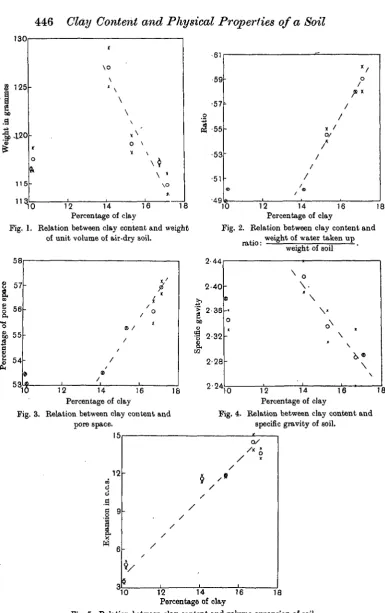
Fig. 1. Relation between clay content and weight of unit volume of air-dry soil.
• 0 1
•59
•57 o
1 -55
•53
•51
•4.P
/
x / o/ X
/
/
o
"10 12 14 16 18 Percentage of clay
Fig. 2. Relation between clay content and weight of water taken up ratio: —2 ——-.— i-.
weight of sou
12 14 16
Percentage of clay
Fig. 3. Relation between clay content and pore space.
15
12 14 16 Percentage of clay
mean of each pair as a circle. In interpreting the relations of the experi-mental results to the percentage of clay it must be remembered that the soil contains considerably more organic matter in the top 12" than in the lower depths; hence the top layer will in some respects behave as if its clay content were in excess of the value given in Table I. Ignoring for the moment the values for the 0-6" and 0-12" layers and paying attention to the remaining four depths, it will be seen that in each of the Figs. 1-5 there exists a general relationship between the amount of clay and the variations in the given constant. The straight line in each figure is, of course, only an indication of the general trend of the values. The apparent and real specific gravities (Figs. 1 and 4 respectively) show an inverse relationship with the percentage of clay, while the amount of water taken up by the soil (Fig. 2), the pore space (Fig. 3), and, to a lesser extent, the volume expansion (Fig. 5) are directly related to the clay percentage. The effect of the organic matter is shown in Figs. 1-5 by the soils corresponding to the 0-6" and 6-12" layers, which contain just over 10 % of clay. These two layers give values for the various constants very similar to those of the layers containing more clay except in the case of the volume expansion (Fig. 5). Elsewhere it will be shown that, if the bottom layer of this soil be assumed devoid of organic matter, the approximate percentages in the top two layers are 3-7 and 3-95 respectively. Inspection of Figs. 1-5 in detail shows that the apparent and real specific gravities (Figs. 1 and 4) of the top two layers are equivalent to the values given by the layer with 15 % of clay, while the pore space (Fig. 3) and amount of water taken up by the unit weight of soil (Fig. 2) correspond to 14 % of clay. The volume expansion (Fig. 5) is apparently not affected by the organic matter. The organic matter therefore is, weight for weight, equivalent to clay except in the volume expansion measurements, where its possible effect is within the experi-mental error.
The fraction fine silt II (upper limit of diameter -005 mm.) possesses similar properties to the clay, and if included with it, does not appreciably affect the order of the above results. In most soils this fraction is not present in considerable quantity.
There are a number of other points brought out by the further inspection of the tables and diagrams.
448 Clay Content and Physical Properties of a Soil
remaining in the box). These ratios are obtained from Table II in the forms
column 7 — column 9 , column 6 — column 8 column 9 column 8 ' respectively.
It will be found that the values for the residual soil are slightly below those for the total soil given in Table III, while those for the surplus soil are considerably in excess. There are a number of possible causes which may account for this. In addition to the water taken up by the surplus soil there is an obvious film of water on the surface of the soil which will increase the above ratio for the surplus soil; the lower layers of soil, being confined by the rigid brass box, can only swell vertically against the resistance of the superincumbent layers so that the ratio for the residual soil will be diminished; there is probably some air trapped in the interstices of the soil as the water ascends. It is not likely that the presence of air is the sole cause of difference, because the amount of air so trapped would be very variable from box to box, whereas the experimental results show very little erratic variation. It is possible by suitably manipulating the figures to obtain an idea of the amount of trapped air, as follows:
The calculation of the absolute specific gravity of the soil was obtained from the expression:
wt. of residual soil vol. of box — vol. of water"
The low values of the specific gravity (Table III) can be explained by the presence of air, which reduces the volume of water. Taking the true value of the specific gravity to be 2-70, it is easy to calculate for any given soil what should be the volume of water completely rilling the pore space. The difference between this volume and the experimental figure may be regarded as the volume occupied by the trapped air. Taking for illustration the first duplicate of the 0-6" depth {i.e. the top row of figures in Table II) we obtain
o 7Q 75-09 2 7 0 - 6 * 7 ^ '
i.e. x = 40-9 c.c. of water.
1 .DO
Table II that in the surplus soil it is o-jrjr = -61 and in the residual soil 36-51 _.
75-09" *y
-Assuming that the value for the residual soil has been reduced solely owing to the air entrapped, and that the true value is -61, 75-09 grins, of soil should take up 45-8 grms. of water, instead of 36-51, the experi-mental value. Using this value of 45-8 grms. of water for x in the calcula-tion of the specific gravity immediately above, we obtain the figure 3-28. This is obviously incorrect. Hence the diminished value in the residual soil of the ratio of weight of water taken up to weight of soil, cannot be wholly due to the entrapping of air within the box. The other possible causes have been already mentioned above.
SUMMARY.
A simple experimental method has been described for measuring certain physical constants of soil, using small brass boxes into which soil passing a sieve of 100 meshes to the inch has been packed by hand. The quantities determined are:
(1) The weight of unit volume (100 c.c.s.) of air-dry soil, or the apparent specific gravity.
(2) Amount of water taken up by unit weight of soil. (3) Pore space.
(4) Specific gravity of the soil.
(5) The volume expansion of unit volume (100 c.c.) of soil when saturated.
The results for one soil only are given, and discussed, to illustrate the method. With the co-operation of the Science Masters Association it is being applied to a number of soils by various schools.
The particular soil used was obtained in six depths as follows: 0-6", 6-12", 12-18", 18-24", 2-3', 3-4', and the above constants were deter-mined on each depth. It was shown that (1) and (4) varied inversely with the percentage of clay in the soil, while (2), (3), and (5) varied directly with the clay percentage. The effect on the constants of the larger quantities of organic, matter present in the top two layers of soil was, weight for weight, approximately equal to that of the clay, except in the volume expansion results where the effect if any was within experimental error.
It is possible that the fraction fine silt II, whose upper limit of diameter is -005 mm., has similar effects to the clay fraction.
(Received August Zlst, 1921.)