G. Griffiths1, I. Tarricone2 3, Study group*
1 University Hospitals Bristol NHS Foundation Trust, Bristol, United Kingdom;
2 Department of Medical and Surgical Sciences, Alma Mater Studiorum, Psychiatry Unit, Bologna University, Italy; 3 Department of Mental Health and Pathological Addictions, Local Health Trust, Bologna, Italy
* Study group: D. Berardi2 3, I. Donegani3, A. Fioritti3, R. Maisto2, M. Braca2 3,
M. Menchetti2 3, L. Tonti3, M. Nolet3, A. Piazza3, V. Spigonardo3
Correspondence
Georgina Griffiths
University Hospitals Bristol NHS Foundation Trust, Bristol Royal Infirmary, Upper Maudlin St, Bristol BS2 8HW, UK • Tel +0117 923 0000 • E-mail:[email protected]
The provision of mental health services to
immigrants and refugees in Italy: the barriers
and facilitating factors experienced by mental
health workers
Summary
Objective
To explore the barriers and facilitating factors to the provision of mental health services to immigrants and refugees by exploring the experiences of mental health workers (MHWs.)
Method
A qualitative study was performed in May 2013 in a city in the Emilia Romagna region. Par-ticipants were recruited using purposive sampling and 14 semi-structured interviews were performed with MHWs. Framework Analysis was used to interpret the data.
Results
Five facilitating factors were identified: language skill of patients, involvement of patients’ family, specialist cultural psychiatric services, voluntary services and organisation of the mental health system.
Five barriers were identified: patients’ perceptions, lack of family support, cultural knowledge of MHWs, language skill of MHWs and funding of the mental health system.
Conclusions
The barriers and facilitating factors identified reflect findings from research in both European and non-European countries. Nevertheless, the results of this study highlight the fact that a national mental health policy for immigrants and refugees needs to be implemented along-side cultural competence training programmes and specialist cultural psychiatric services.
Key words
Italy • Immigrants • Refugees • Mental health workers
Key concepts
For the purpose of this study, immigrants were defined as people who: – originate from a country outside the European Union (EU);
– (EU as of 2013);
– Have acquired citizenship in Italy;
– Have chosen freely to emigrate out of his/her country of origin. (Appendix 1 shows the countries that are members of the 2013 EU)
For the purpose of this study, refugees were defined as people who: – originate from any country in the world;
– have acquired refugee status in Italy;
– have been forced to flee out of his/her country of origin.
This study did not include immigrants without citizenship as they have different entitlements to the Italian National Health Service (INHS) in comparison to immigrants with citizenship
and refugees 1 2. EU immigrants and asylum seekers were not included, as it was deemed that
the scope of this study would then be too wide.
Introduction
Migration and mental health
however, show that MHWs face barriers when providing care 28 29. For example a United Kingdom (UK) study
reports that MHWs face funding issues and receive in-sufficient cultural training 29. Evidently, more research is
needed regarding the experiences of MHWs in the pro-vision of care to immigrants and refugees in Italy.
Method
Study site
The study was conducted in the city of Bologna (locat-ed in the Emilia Romagna region in Northern Italy). In Bologna there are two specialist cultural psychiat-ric services: the Bologna Transcultural Psychosomat-ic Team (BoTPT) and a Cultural Consultation Centre (CCC) 18 30.
The BoTPT is a multidisciplinary study and research Centre of the Department of Medical and Surgical Sci-ences- Bologna University. The team provides consulta-tions in partnership with the Department of Mental Health of Bologna designed to identify the mental and psycho-social needs of migrants and to direct them to appro-priate services. The consultation includes psychiatrist researchers, psychologists, medical doctors, students, psychiatry registrars and medical anthropologists, and if needed, a cultural mediator joins the team 18. In
addi-tion, the BoTPT delivers training and support activities to informal carers, general practitioners, psychiatrists and mental health operators social workers, medical students and psychiatric trainees. Training is specially directed to social and voluntary workers working with asylum seekers and traumatized immigrants 31 32.
The Cultural Consultation Centre (CCC) started in 2010 as an experimental project in partnership with the Department of Mental Health of Bologna, the Centre for International Health, the Department of Social Anthropology of Medical Knowledge of Bologna University and professionals in the field of ethnopsychiatry and social care 33.
The CCC is based on a multidisciplinary approach to the psycho-social distress that immigrants, refugees and members of ethno-cultural communities experi-ence. The CCC acts as a consultation liaison service with the aim of transferring knowledge and supporting health and social workers in the evaluation and assis-tance of migrants.
Sampling
Expert sampling was used to recruit participants and elicit the views of those with specific experiences or expertise in providing care to immigrants and refugees. This was achieved by targeting MHWs in both Community Mental Health Centres (CMHCs) and mental health hospitals who had extensive experience of working with immigrants and refugees or who worked for the CCC or BoTPT.
Migration in Italy
During the last three decades, Italy has become a popu-lar destination for non-EU immigrants and refugees due to the collapse of the Soviet Union and political unrest in Northern Africa 7.
The majority of non-EU immigrants and refugees set-tle in Central and Northern Italy 8. In 2012 there were
3,637,724 non-EU immigrants holding residence per-mits and 58,060 refugees 9 10.
The Italian government is yet to implement a programme that collects data about the health of migrants 7.
Mental health disorders of migrants
Migrant groups are all at increased risk of developing mental health conditions, however the rates of mental health conditions are often twice as high in refugee pop-ulations in comparison with economic migrants 4.
Sev-eral studies have shown that immigrants and refugees suffer from somatization disorder, post-traumatic stress disorder, psychotic disorder, anxiety disorder, and de-pression 11–17.
Immigrants and refugees experiences of mental health services
In Italy, immigrants and refugees are entitled to access mental health services 1 2 18. Research has shown that
they encounter barriers when accessing services, for ex-ample: individual health beliefs and discrimination from health workers 1 7 19-27. Furthermore, mental health
fund-ing that specifically addresses immigrants’ and refugees’ mental health needs has not been implemented 24.
Mental health workers experiences of providing care to immigrants and refugees
In Italy, there is limited research about the experiences of mental health workers (MHWs) in the provision of care to immigrants and refugees 25. Studies in Europe,
TABLE I. Stages of migration and related mental health risk factors (da Carta, et al., 2005, Lindert et al., 2008, Bhugra et al., 2011, mod.) 3 4 6.
Migratory stage Risk factors
Pre-migration Persecution in country of origin Experiences of violence or war Migration Extensive application process
to obtain citizenship or refugee status
Poor travelling conditions Post-migration Cultural bereavement
Language
Ten participants stated that if the patient was able to speak Italian then this was a facilitating factor as trans-lators were then not required for appointments and to build a relationship.
“… they often learn Italian quickly, and then it is not nec-essary to involve the translator in the relationship, and this is good …” (Interviewee 14- BoTPT worker)
Family support
Four participants stated that family support was a fa-cilitating factor and that good relationships had been established with family members.
“I have good relationships with families, they are often very helpful…”(Interviewee13- BoTPT worker)
Provider level
Specialist cultural psychiatric services
Eight participants; five of which worked at either the BoTPT or the CCC, stated that the specialist cultural psychiatric services were a facilitating factor. All of the psychiatrists working within the BoTPT or the CCC, ex-plained how the teams provided them with support to deliver appropriate care.
“… The BoTPT is very helpful; if you have a problem with an immigrant patient; you can ask the team to help you with the problem” (Interviewee 11- BoTPT and CCC worker)
“If I have difficulties I can request a consultation with the CCC … and I can discuss the case with the Experts” (Interviewee 7)
Voluntary services
Eight participants said that the voluntary services, such as ethnic community support groups, helped to facili-tate care provision. Participants explained how the ser-vices provided them with an opportunity to learn valu-able information and support when discharging immi-grant patients.
“From 2007 we have meetings every month with work-ers from volunteer services … they give us information so we can learn how to better care for immigrants” (In-terviewee 9- BoTPT worker)
“When the patient was discharged from hospital we contacted a community group to help him … it would have been difficult without them” (Interviewee 14- BoT-PT worker)
Participants
Overall thirteen consultant psychiatrists and one psy-chiatry registrar were recruited from seven facilities: five CMHCs and two inpatient hospitals. Five of the fourteen participants worked in either the BoTPT or the CCC. The mean age of participants was 46.4 years and the mean time participants had worked in Bologna was 11.3 years. Due to the selection criterion the majority of participants were recruited from CMHCs, as MHWs at CMHCs are responsible for coordinating treatment programmes for patients; therefore have regular patient contact 19 34.
Data collection
The study was conducted in May 2013 and semi-struc-tured interviews were used to collect data. Interviews were held at CMHCs and the psychiatry institute. The main researcher who conducted all of the interviews only spoke English; four interviews were conducted in English and ten interviews required an interpreter. In total three interpreters were used, all of which had no conflicts of interest. All participants were provided with an information sheet and an explanation of the key con-cepts of the study. Only one question guide was used and leading questions were not included. All interviews were audio recorded and field notes were documented.
Data analysis
Interviews were transcribed and six interviews (two per interpreter) were back-translated by an independent in-terpreter. No discrepancies were reported.
Data was analysed using Framework Analysis 35 36.
Firstly data familiarisation was performed and then a coding framework was developed, which included a-priori themes from the question guide and themes that emerged from the data 35 36. The data was then indexed,
and each time the coding framework was modified all of the transcripts that had been indexed were re-ana-lysed 35 36. Charting was then performed, which involved
data being summarised under relevant 36. Finally, the
data was organised into charts and interpreted. All data was independently analysed by the lead researcher.
Ethical considerations
Ethical approval was obtained from Leeds University (UK) and the lead consultant psychiatrist.
Consent forms were translated into Italian and back-translated to ensure consistency. Written consent was obtained from all participants.
Results
Facilitating factors
Barriers
Patient level
Patients’ perceptions
All fourteen participants stated that immigrant and refu-gee patients’ perceptions of mental health and MHWs caused difficulties when providing care. In addition, all fourteen participants stated that it was difficulty to es-tablish doctor-patient relationships with immigrants or refugees because of their misconceptions of MHWs.
“The development of the doctor-patient relationship is more difficult and a problem … immigrants have differ-ent expectations and ideas of psychiatrists” (Interview-ee 12)
In addition, all of the participants explained how im-migrants’ and refugees’ perceptions of mental health caused difficulties when discussing symptoms.
“Immigrants don’t understand mental health …” (Inter-viewee 8)
“… Some immigrants consider depression as a punish-ment of gods. It is very difficult to talk with immigrants about this issue” (Interviewee 7)
Family involvement
Ten participants explained that it was difficult to pro-vide care to immigrant and refugee patients, because they did not receive the necessary family support. Eight participants stated that it was difficult to involve families because they did not live in Italy.
“… There are immigrant patients that are alone, they don’t have family in Italy, which then makes it difficult for me of course, because they don’t have support” (Inter-viewee 6)
Five participants, however, said that they had not worked with any of the voluntary services, and one par-ticipant was unaware of any voluntary services existing.
“I don’t know if voluntary services exist, do they exist?” (Interviewee 3)
The six participants that did not describe voluntary ser-vices as a facilitating factor did not have contact with ei-ther the BoTPT or CCC. This indicates that ei-there are dif-ferent knowledge levels among the participants about voluntary services.
System level
Organisation of the mental health system
All fourteen participants referred to the organisation of the mental health system when discussing facilitating factors. Participants said that the registration and ap-pointment systems were well-coordinated.
“Registration services are good, it works very well … I can easily organise appointments with immigrant pa-tients” (Interviewee 12)
“The appointment system is good … consultations can easily be arranged with refugee patients” (Interview-ee 6)
In addition, ten participants said that the mental health service had established a good working relationship with the local health authority (LHA).
“There is good communication with us and the LHA… if medical fees are a problem we can talk to them and or-ganise for immigrants to be excused…” (Interviewee 5)
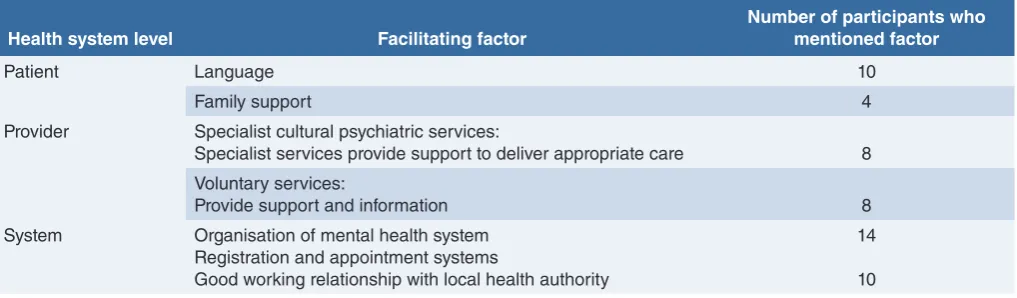
See Table II for a summary of the facilitating factors found.
TABLE II. Summary table: Facilitating factors.
Health system level Facilitating factor
Number of participants who mentioned factor
Patient Language 10
Family support 4
Provider Specialist cultural psychiatric services:
Specialist services provide support to deliver appropriate care 8 Voluntary services:
Provide support and information 8
System Organisation of mental health system Registration and appointment systems
Good working relationship with local health authority
14
“I don’t have any special cultural knowledge, and this is a problem… I treat immigrants the same way as I treat Italian people” (Interviewee 4)
All fourteen participants stated that they had not re-ceived any cultural training during their undergraduate medical education, as it was not recognised as an es-sential part of their education.
“I received no cultural training at University… back then it was not important…” (Interviewee 5)
Ten participants mentioned that the LHA did provide four annual lectures about health related issues, which sometimes included topics about immigrants’ mental health. Nevertheless, the majority of participants sug-gested that more training was needed.
“…There are conferences provided by the LHA about ethnopsychiatry…” (Interviewee 13- BoTPT worker)
“Training is very important… an organised training pro-gramme is needed here…” (Interviewee 1)
Participants who worked at either the BoTPT or the CCC did not mention personal cultural knowledge as a bar-rier; indicating that they may be more confident in their abilities to provide care to immigrants and refugees.
System level
Mental health funding
Twelve participants stated that the absence of mental health funding specifically for immigrants and refugees was an issue. Most participants explained that the main drawback was that there were no funding specifically for the provision of mental health care.
“The problem is that there is no specific funding strate-gies for immigrants….so there are no funding plans for them…” (Interviewee 11- BoTPT and CCC worker)
“… There are no funding strategies for the care of im-migrant patients… which is why the health service does not fund the BoTPT…” (Interviewee 9- BoTPT worker)
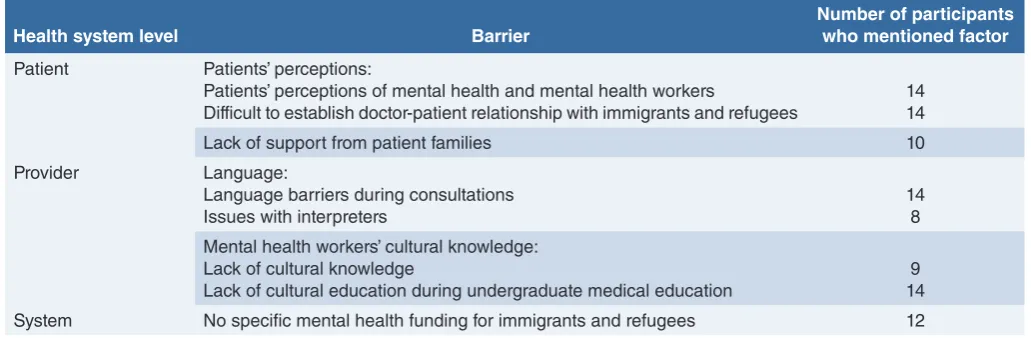
See Table III for a summary of the barriers found.
Discussion
Facilitating factors
Over half of the participants explained how the BoTPT and CCC provided them with the support needed to de-liver care for immigrants and refugees. Other studies have shown similar findings; such as a study in Cana-One participant mentioned that lack of family
involve-ment had caused difficulties when checking immigrant patients were adhering to their medication programmes.
“… Because I can’t speak with immigrants’ families I cannot make sure that medications are taken correctly, this is an issue …” (Interviewee 4)
Provider level
Language skills of mental health workers
All fourteen participants expressed that they faced lan-guage barriers during consultations with immigrants and refugees. The majority of participants explained how language barriers caused issues when attempting to determine an accurate diagnosis.
“Often immigrants and refugees do not speak Italian… so I have problems; sometimes you think you see major symptoms, but actually they are not …” (Interviewee 10- CCC worker)
One participant even said that they could not provide psychotherapy due to language issues.
“Because of language difficulties immigrants do not re-ceive psychotherapy” (Interviewee 3)
Thirteen participants mentioned that they used inter-preting services to help them overcome language bar-riers. When participants were questioned about their experiences eight participants said that they had en-countered issues. The most common issue, expressed by six participants was that interpreters did not always accurately interpret patients’ responses.
“Psychiatry is made of words… and I find that interpret-ers can sometimes miss important aspects” (Interview-ee 2)
“… The main problem is language, even if there is an interpreter, they miss something sometimes” (Interview-ee 1)
Seven out of the eight participants who expressed that they had issues when using the interpreting services did not work at either the BoTPT or the CCC; indicating that participants who work at the BoTPT or the CCC may have better working relationships with interpreters.
Cultural knowledge of mental health workers
difficulties when providing care; for example when developing the doctor-patient relationship. Thus this barrier could potentially affect the quality of treatment provided. In addition, a UK study reports that providers were less likely to identify Punjabi patients with depres-sive symptoms because of the way Punjabi patients’ ex-press their symptoms 38. Clearly, it would be valuable to
perform a qualitative study to find out about immigrants’ and refugees’ knowledge, attitudes, and experiences of mental health and mental health services in Italy. The data from this study could be used to develop culturally relevant training programmes for MHWs. The majority of participants also identified family involvement as a bar-rier; which may affect success rates of treatment and rates of recovery. There is limited evidence however to support this finding; further research about family mem-bers’ experiences and involvement with mental health services is needed to validate this finding.
MHWS’ language skills and lack of cultural knowledge were also identified as barriers to providing care, and literature across Europe highlights this issue 23 25 39. Both
of these barriers could result in immigrants and refu-gees receiving inaccurate diagnoses. More research is indicated regarding MHW’s experiences and immi-grants’ and refugees’ knowledge, attitudes, and experi-ences of mental health care.
Cultural training was not provided to any participants during their undergraduate education. Although, this can be explained by the fact that the majority of par-ticipants attended university between the 1970s and 1990s; during this period of time immigration to Italy was only just beginning 7. Cultural training, therefore,
would not have been perceived as an essential aspect of medical education.
Optional courses about immigrants’ and refugees’ mental health are now provided by the BoTPT to un-da which shows that MHWs and General Practitioners,
found a CCC helpful when treating immigrants 37.
Six participants, however, did not mention specialist cultural psychiatric services as a facilitating factor. This could be because these participants may have not fre-quently come into contact with the BoTPT. In addition, these participants may have been unaware of the CCC, as it was only recently established in 2010.
Consequently, some immigrants and refugees may be receiving inadequate care. Clearly, more specialist cul-tural psychiatric teams are needed in Bologna and so it is recommended that a transcultural team and CCC are established in all CMHCs and inpatient hospitals. Fund-ing should be obtained from the LHA and a monitorFund-ing system should be implemented to evaluate the perfor-mance of each BoTPT and CCC. This recommendation should be feasible if funding is secured as both services are already established. The main task required would be to recruit professionals to deliver the new services. All the participants stated that the organisation of the mental health system was a facilitating factor. It is im-portant to consider that participants may have stated that the organisation of the mental health system was a facilitating factor because they wanted to portray the system as a well-managed organisation rather than the reality of daily practice. In addition, patient level facili-tating factors may have not been mentioned because participants wanted to project a positive image of the mental health system; therefore participants may have only chosen to vocalise facilitating factors at provider and system levels. Information about service delivery and immigrant and refugee patients’ experiences is re-quired to corroborate these findings.
Barriers
All participants expressed that immigrants’ and refu-gees’ perceptions of mental health and MHWs caused TABLE III. Summary table: barriers.
Health system level Barrier Number of participants who mentioned factor
Patient Patients’ perceptions:
Patients’ perceptions of mental health and mental health workers
Difficult to establish doctor-patient relationship with immigrants and refugees 1414
Lack of support from patient families 10
Provider Language:
Language barriers during consultations Issues with interpreters
14 8 Mental health workers’ cultural knowledge:
Lack of cultural knowledge
In addition, participants may have given responses that they thought would be viewed favourably by the lead researcher, a phenomenon known as social desirabil-ity 44 45. To avoid social desirability bias occurring
par-ticipants were encouraged to respond freely.
Conclusions
The results of this study provide a foundation for fur-ther investigations regarding the experiences of MHWs in the provision of care to immigrants and refugees in Italy. Nevertheless, it cannot be ignored that the find-ings of this study have highlighted that a national mental health funding strategy specifically for immigrants and refugees needs to be implemented in Italy. Furthermore, cultural competence training programmes, Transcultur-al Psychiatric Teams and CulturTranscultur-al Consultation Centres need to be established across mental health facilities, and more research needs to be performed.
Funding
This research received no specific grant from any fund-ing agency in the public, commercial, or not for-profit sectors.
Acknowledgements
We would like to thank Rosemary Morgan, for her con-stant support and suggestions. We thank all of the men-tal health workers in Bologna for their time and willing-ness to share their experiences. Finally, we would like to thank the three interpreters for their help and commit-ment: Leslie Alfaro, Giulia Montardi, and Elena Soravia.
Contributors
Georgina Griffiths: Performed all 14 interviews, ana-lysed data, and composed manuscript.
Ilaria Tarricone: oversaw research study and provided guidance, also helped to compose the manuscript.
Conflict of interest
None to declare. dergraduate and postgraduate students; nevertheless,it is vital to establish an annual cultural competence training programme for all MHWs who have contact with immigrants and refugees. The programme could be de-livered by the BoTPT and CCC. Cultural competence training has been successful in Australia and Canada; reports show that MHWs are more responsive to immi-grants’ and refugees’ needs after receiving training 37 40.
All participants stated that the absence of a mental health funding specifically for immigrants and refugees was a barrier; the main drawback identified was the absence of funding guidelines. Similarly, a Canadian study reports that MHWs face difficulties providing care to immigrants and refugees due to limited mental health policies 41. It is vital therefore that the Italian government
implements national mental health funding specifically for immigrants and refugees. The implementation of funding would allow resources to be allocated to the mental health sector to meet the needs of immigrants and refugees; allowing further research and cultural competence training programmes to commence. The INHS is regionally and locally managed, therefore, implementing a national funding strategy will be chal-lenging 1. Nevertheless, evidence from Spain and the
UK shows that it is possible to establish national mental health policies and funding strategies for immigrants and refugees 24.
Limitations
A major limitation was that an interpreter was required, which may have caused relevant data to be lost, as it can be difficult for an interpreter to constantly translate everything a respondent says. To minimise the effect of this limitation, an independent interpreter back-translat-ed six interviews. No discrepancies were reportback-translat-ed. Time restriction was another major limitation as it pre-vented data saturation and respondent validation be-ing achieved; ideally, it would have been preferable to interview a range of MHWs 42 43. In addition, investigator
triangulation was not achieved due to time constraints and consequently the coding framework used to per-form the analysis could not be verified; in an attempt to compensate the lead researcher strived to perform a thorough analysis 42 43.
References
1 Lo Scalzo A, Donatini A, Orzella L, et al.
Italy: health system review. Health Syst Transit 2009;11:1-216.
2 Italian Ministry of Health.
Informasalute-Guide to the National Health Service by Foreign Citizens. Italian Ministry of Health 2010.
3 Carta MG, Bernal M, Hardoy MC, et al.
Migration and mental health in Europe (the state of the mental health in Europe working group: appendix 1). Clin Pract Epidemiol Ment Health 2005;1:13.
4 Lindert J, Schouler-Ocak M, Heinz A, et
al. Mental health, health care utilisation of migrants in Europe. Eur Psychiatry 2008;23(Suppl 1):14-20.
5 World Health Organization. Fact Sheet
Number 220-Mental Health:
strengthen-ing our response. 2010. http://www.who. int/mediacentre/factsheets/fs220/en/.
6 Bhugra D, Gupta S, Bhui K, et al. WPA
guidance on mental health and mental health care in migrants. World Psychiatry 2011;10:2-10.
7 Kordrupel A. Italian immigration policy:
ness.ceu.hu/sites/default/files/publica- tions/cps-research-report-italian-immigra-tion-policy-2010.pdf.
8 Italian National Institute of Statistics.
Non-EU citizens holding a residence permit. 2011. http://www.istat.it/en/archive/57903.
9 United Nations High Commissioner for
Refugees. UNHCR: What is a refugee? 2012. http://www.unrefugees.org/site/c. lfIQKSOwFqG/b.4950731/k.A894/What_ is_a_refugee.html.
10 Italian National Institute of Statistics.
Non-EU citizens holding a residence permit years 2011-2012 - 2013. http://www.istat.it/ en/archive/67847.
11 Favaro A, Maiorani M, Colombo G, et al.
Traumatic experiences, post traumatic stress disorder, and dissociative symptoms in a group of refugees from former Yugosla-via. J Nerv Ment Dis 1999;187:306-8.
12 Aragona M, Tarsitani L, Colosimo F, et al.
Somatization in primary care: a compara-tive survey of immigrants from various eth-nic groups in Rome, Italy. Int J Psychiatry Med 2005;35:241-8.
13 Aragona M, Pucci D, Carrer S, et al. The
role of post-migration living difficulties on somatization among first-generation im-migrants visited in a primary care service. Ann Ist Super Sanita 2011;47:207-13.
14 Aragona M, Rovetta E, Pucci D, et al.
So-matization in a primary care service for im-migrants. Ethn Heal 2012;17:477-91.
15 Naimo M, Massagli A, Degortes D, et al.
The psychometric and psychosocial di-mension of Albanian immigration: data from a preliminary study. G Ital Med Lav Ergon 2006;28(Suppl 2):104-10.
16 Tarricone I, Atti AR, Salvatori F, et al.
Psy-chotic symptoms and general health in a socially disadvantaged migrant com-munity in Bologna. Int J Soc Psychiatry 2009;55:203-13.
17 Bogic M, Ajdukovic D, Bremner S, et al.
Factors associated with mental disorders in long-settled war refugees: refugees from the former Yugoslavia in Germany, Italy and the UK. Br J Psychiatry 2012;200:216-23.
18 Tarricone I, Atti AR, Braca M, et al.
Mi-grants referring to the Bologna Transcul-tural Psychiatric Team: reasons for drop-out. Int J Soc Psychiatry 2011;57:627-30.
19 Piccinelli M. Focus on psychiatry in Italy.
Br J Psychiatry 2002;181:538-44.
20 de Girolamo G, Bassi M, Neri G, et al. The
current state of mental health care in Italy: problems, perspectives, and lessons to learn. Eur Arch Psychiatry Clin Neurosci 2007;257:83-91.
21 Italian Society of Migration Medicine
(SIMM). Migration and Health - 2010. http://www.simmweb.it/fileadmin/docu- menti/Simm_x_news/2010/6-SINTE-SI_PROGETTOMigrazione_e_Salute_ CONVEGNO.pdf.
22 Bethke M, Ender D. The Living Conditions
of Refugees in Italy - 2011: http://www. proasyl.de/fileadmin/fm-dam/q_PUBLIKA- TIONEN/2011/Italyreport_en_web_END-VERSION.pdf.
23 Priebe S, Sandhu S, Dias S, et al. Good
practice in health care for migrants: views and experiences of care professionals in 16 European countries. BMC Public Health 2011;11:187.
24 Vázquez M-L, Terraza-Núñez R, Vargas I, et
al. Health policies for migrant populations in three European countries: England; Italy and Spain. Health Policy 2011;101:70-8.
25 Sandhu S, Bjerre N V, Dauvrin M, et al.
Ex-periences with treating immigrants: a quali-tative study in mental health services across 16 European countries. Soc Psychiatry Psy-chiatr Epidemiol 2013;48:105-16.
26 Tarricone I, Morgan C, Boydell J, et al.
Occu-pation and first episode psychosis in North-ern Italy: better outcomes for migrants. Early Interv Psychiatry 2016 May 19 [Epub ahead of print].
27 Tarricone I, Boydell J, Kokona A, et al. Risk
of psychosis and internal migration: results from the Bologna First Episode Psychosis study. Schizophr Res 2016;173:90-3.
28 Mucic D. Telepsychiatry pilot-project in
Denmark Videoconference by distance by ethnic specialists to. World Cult Psychiatry Res Rev 2007;2:3-9.
29 MIND. A civilised society: mental health
provision for refugees and asylum-seek-ers in England and Wales - 2009. http:// www.mind.org.uk/assets/0000/5695/refu-gee_report_2.pdf.
30 Rucci P, Piazza A, Perrone E, et al.
Dispari-ties in mental health care provision to im-migrants with severe mental illness in Italy. Epidemiol Psychiatr Sci 2015;24:342-52.
31 Braca M, Berardi D, Mencacci E, et al.
Un-derstanding psychopathology in migrants: A mixed categorical-dimensional approach. Int J Soc Psychiatry 2014;60:243-53.
32 Tarricone I, Mencacci E, Braca M, et al.
Work of the Bologna Transcultural Psychi-atric Team (BoTPT) with refugees and asy-lum seekers: when remembering helps. J Psychopathol 2013;19:234-41.
33 Spigonardo V, Piazza A, Tarricone I, et al.
Salute mentale, migrazione e competenza
culturale: l’esperienza di Bologna. Polit Sanit 2014;15:1-10.
34 Fioritti A. Development of community
mental health services: the case of Emilia Romagna Italian Region. Psilogos 2008;6:67-76.
35 Pope C, Ziebland S, Mays N. Analysing
qualitative data. BMJ 2000;320:114-6.
36 Gale N, Heath G, Cameron E, et al. Using the
framework method for the analysis of qualita-tive data in multi-disciplinary health research. BMC Med Res Methodol 2013;13:117.
37 Kirmayer L, Groleaud D, Guzder J, et al.
Cultural consultation: a model of mental health services for multicultural societies. Can J Psychiatry 2003;48:145-53.
38 Bhui K, Bhugra D, Goldberg D, et al.
Cul-tural influences on the prevalence of common mental disorder, general prac-titioners’ assessments and help-seeking among Punjabi and English people visit-ing their general practitioner. Psychol Med 2001;31:815-25.
39 Blignault I, Ponzio V, Rong Y, et al. A
quali-tative study of barriers to mental health services utilisation among migrants from Mainland China in South-East Sydney. Int J Soc Psychiatry 2008;54:180-90.
40 Renzaho A. Re-visioning cultural
compe-tence in community health services in Vic-toria. Aust Health Rev 2008;32:223-35.
41 Hansson E, Tuck A, Lurie S and McKenzie
K, for the Task Group of the Services Sys-tems Advisory Committee, Mental Health Commission of Canada. Improving men-tal health services for immigrant, refugee, ethno-cultural and racialized groups: Is-sues and options for service improvement - 2010. http://www.mentalhealthcommis-sion.ca/SiteCollectionDocuments/Key_ Documents/en/20 10/Issues_Options_FI-NAL_English%2012Nov09.pdf.
42 Lacey A, Luff D. Trent focus for research
and development in primary health care qualitative data analysis. United Kingdom: Trent Focus 2001.
43 Guion L. Triangulation: establishing the
validity of qualitative studies. University of Florida 2002. https://sites.duke.edu/ niou/files/2014/07/W13-Guion-2002-Tri- angulation-Establishing-the-Validity-of-Qualitative-Research.pdf.
44 Nederhof A. Methods of coping with
so-cial desirability bias: a review. J Soc Psy-chol 1985;15:263-80.
45 Van De Mortel T. Faking it: social