Purdue University
Purdue e-Pubs
International Compressor Engineering Conference
School of Mechanical Engineering
2018
A feature extraction method based on LMD and its
application for fault diagnosis of reciprocating
compressor annular valve
Yue SHU
Hefei General Machinery Research Institute, Hefei, P.R. China, [email protected]
Qian Zhang
State Key Laboratory of Compressor Technology, Hefei General Machiney Research Institude, People's Republic of China, [email protected]
Chuandong Xie
State Key Laboratory of Compressor Technology, Hefei General Machiney Research Institude, People's Republic of China, [email protected]
Le Wang
State key laboratory for compressor technology, Hefei General Machinery Research Institute, People's Republic of China, [email protected]
Zegang Qian
State Key Laboratory of Compressor Technology, Hefei General Machiney Research Institude, People's Republic of China, [email protected]
Follow this and additional works at:
https://docs.lib.purdue.edu/icec
This document has been made available through Purdue e-Pubs, a service of the Purdue University Libraries. Please contact [email protected] for additional information.
Complete proceedings may be acquired in print and on CD-ROM directly from the Ray W. Herrick Laboratories athttps://engineering.purdue.edu/ Herrick/Events/orderlit.html
SHU, Yue; Zhang, Qian; Xie, Chuandong; Wang, Le; and Qian, Zegang, "A feature extraction method based on LMD and its application for fault diagnosis of reciprocating compressor annular valve" (2018).International Compressor Engineering Conference. Paper 2572.
A Feature Extraction Method Based on LMD and its Application for Fault
Diagnosis of Reciprocating Compressor Annular Valve
Yue SHU*, Qian ZHANG, Chuandong XIE, Le WANG, Zegang QIAN
State Key Laboratory of Compressor Technology, Hefei General Machinery Research Institute
Co., Ltd.,
Hefei, Anhui Province, P. R. China
Phone: +86-0551-65335669. E-mail address: [email protected].
* Corresponding Author
ABSTRACT
Taking the reciprocating compressor annular valve as the research object, the vibration signal of the reciprocating compressor ring valve was tested by the accelerometer vibration sensor. Through local mean decomposition (LMD), several PF (Product Function) components corresponding to the signal were obtained. Three characteristic parameter factors of these PF components are extracted, including the skewness coefficient (gi), kurtosis coefficient (qi) and total energy ratio (Ei/E). Then the valve is
damaged to various degrees, including sawing the valve plate, removing some springs from the valve and drilling the valve plate. The same analysis on the operating vibration signal of the damaged valve plate was carried out to obtain the corresponding parameter factors, and compared with the corresponding parameter factors of the normal valve. The results show that under the circumstances of valve sawing and part spring removing, the valve vibration signal obtained by the corresponding characteristic parameter factor will reflect the abnormal value of the fault, but the valve disc perforated state is not obvious. The above shows that although the LMD method has some limitations, it can accurately and effectively evaluate the vibration signals of reciprocating compressor valves, and classify the working status and the fault type of the valve, so it is a practical method to study the diagnosis of valve failure.
1. INTRODUCTION
Reciprocating compressor is one of the most commonly used machines in the chemical production process of the oil and gas industry. With the increasing requirements of high performance and high security, the operational safety has become an important research topic [1-3]. Vibration-based
measurement and analysis techniques have been proven to be very effective in mechanical health monitoring and fault diagnosis, because the vibration signals [4-6] can reflect a large amount of operating
state information when the equipment is in operation, and can be successfully analyzed using some analysis methods. Vibration signals detects the faults in rotating machineriessuch as gearboxes and bearings under certain conditions[7-9]. However, because of the factors such as the gap, the nonlinear
stiffness of the bearing, and the unbalanced and time-varying forces of the multi-component coupling components, the vibration signal of the reciprocating compressor has the characteristics of non-linearity and non-stationarity, using traditional analysis techniques, such as time domain statistics, Fourier transform may not be able to extract effective signal characteristics from the vibration signals of reciprocating compressor [10, 11].
Local mean decomposition (LMD) is a new adaptive time-frequency analysis method proposed by Smith [12]. It can adaptively decompose complex multi-component signals into multiple sets of PF
components. It is the product of the envelope signal and the pure frequency-modulated signal and has real physical meaning. The time-frequency distribution result can be clearly and accurately reflected. The signal energy distributes at various spatial scales. Therefore, LMD is a suitable method to deal with non-stationary, nonlinear and multi-component problems, especially suitable for the coupled vibration signal of rotary reciprocating machinery. Recently, many scholars have studied the fault signal feature extraction method based on LMD. Wang et al. [13] proposed a demodulation method
based on LMD, and extracted the characteristics of a gas turbine system to successfully identify its friction impact fault from the actual vibration signal. Tian et al. [14] used the LMD to diagnose bearing
and gear failures and achieved good results.
The valve is the most critical part in a reciprocating compressor because it has a crucial influence on the efficiency, power, displacement and reliability of the compressor. According to the statistics data, about 60% of failures of reciprocating compressors are caused by gas valves. Therefore, the research on fault diagnoses of gas valves is of practical significance. However, till now there is no perfect fault diagnosis method for the valve vibration signal. The LMD method was used by many scholars to study the rotor components of fluid machineries. In this paper, the LMD method is used to decompose and analyze the vibration signal of the valve of the reciprocating compressor, and the characteristic parameters reflecting the failure state of the valve are obtained so as to realize the fault diagnosis of the valve of the reciprocating compressor.
2. LMD METHOD THEORY
The LMD method is actually to decompose the signal into envelope signals and pure frequency modulation signals of different scales. By multiplying the envelope signal and the pure frequency modulation signal, one can obtain the PF component with instantaneous physical meaning, and then obtain the time-frequency distribution of the signal. For any signal x(t), the PF component can be obtained as follows:
1) Determine all local extreme points ni of the signal x(t), including all local maximum and minimum
points in the signal;
2) Calculate the mean value mi and the estimated envelope value ai of the two extreme points ni and ni+1
from the obtained extreme points ni. The calculation method is as Equation (1); 1 1 2 2 i i i i i i n n n n m ,a (1)
3) Connect each adjacent local mean mi with a straight line and obtain the local mean function m11(t) of
the signal x(t) by linear interpolation. Connect the envelope estimate ai also with a straight line and
envelope the estimation function with linear interpolation a11(t);
4) Separate the local mean function m11(t) from the original signal to obtain the stripping function h11(t),
as Equation (2);
11 11
h t x t m t
(2)
5) The stripping function h11(t) is demodulated by the envelope estimation function a11(t) to obtain the
frequency-modulated signal s11(t). The calculation formula is shown as Equation (3);
11 11 / 11
s t h t a t
(3)
6) Determine if s11(t) is a pure FM signal. The judgement method is to consider s11(t) as the original
signal, and then calculate the envelope estimation function a12(t) of s11(t) according to the steps 1) to 3)
above. It is determined whether a12(t)=1 is satisfied. If the condition is not satisfied, the above steps 1)
to 5) are repeated as the original signal with s11(t) until the pure frequency modulation signal s1n(t) is
obtained. The iterative termination condition of the loop is shown as Equation (4);
1
lim n 1
na t (4)
In practical applications, in order to reduce the number of iterations and reduce the operation time, a variable Δ may be set. Δ may be selected according to the calculated accuracy requirement, and is generally selected between 10-5 and 10-9. When the condition 1−Δ≤a
1n(t)≤1+Δ is satisfied, the above
iterative process terminates;
7) Multiply all the envelope estimation functions produced during the iteration to obtain the envelope signal a1(t) (also called the instantaneous amplitude function), as Equation (5);
1 11 12 1 1 1 n n i i a t a t a t a t a t
(5)8) Multiply the envelope signal a1(t) and the resulting pure frequency-modulated signal s1n(t) to obtain
the PF component PF1(t), as Equation (6);
1 1 1n
PF t a t s t
(6)
PF1(t) is called the first PF component of signal x(t) and contains the highest frequency component of
the original signal, which is a single-component AM-FM signal;
9) The first PF component PF1(t) is separated from the original signal x(t) to obtain the remaining
signal u1(t), as Equation (7);
1 1
u t x t PF t
(7)
the original data in steps 1) to 8) to decompose it to obtain the second PF component PF2(t) and the
second remaining signal u2(t). Then repeat this process with u2(t) as the original signal until uk(t) is a
monotonic function, so that a certain amount of PF components can be obtained. The final signal x(t) can be expressed as the sum of the kPF components and the margin uk(t), as Equation
1 k i k i x t PF t u t
(8)It shows that this method does not cause the original signal to be lost, uk(t) is a residual function, which
represents the average trend of the signal.
11) After obtaining the PF components of the original signal decomposition, characteristic parameters of each PF component PFi(t) are extracted, the PF component skewness coefficient gi, the kurtosis
coefficient qi, and the total energy ratio Ei/E are obtained, and the skewness coefficient gi is normalized.
The third-order center moment is calculated and the kurtosis coefficient qi is calculated using the
normalized fourth-order center moment. The total energy ratio Ei/E is obtained by performing the
full-wave integral of the square values of the PF components. The specific formula is as Equation (9) to Equation (11).
3 3 3 1 1 N k i k E x u x u g N
(9)
4 4 4 1 1 N k i k E x u x u q N
(10)
2 2 d d i i PF t t E E x t t
(11)Where N denotes the total number of signal points in the PF component, u denotes the average of the
PF component signals, σ denotes the standard deviation of each PF component signal, and operator E[x] denotes the averaging operation for x.
The skewness coefficient is a characteristic number that describes the degree of deviation from the symmetry of the distribution. When the distribution is symmetrical, the coefficient of skewness is zero. When the skewness coefficient is greater than 0, ie, the heavy tail is on the right side, the distribution is right-biased. When the skewness coefficient is less than 0, that is, when the heavy tail is on the left, the distribution is left-biased; the kurtosis index reflects the statistical value of the random variable distribution characteristics and is a dimensionless parameter because it has nothing to do with bearing speed, size, load, etc. It is particularly sensitive to impact signals and is particularly suitable for the diagnosis of surface-damage faults, especially early failures. The energy ratio is an optimal design method. Can be used as one of the criteria for function optimization. The ratio of the main lobe energy to the total spectral energy under the condition of the width of the main lobe of the given frequency spectrum is called the energy ratio of the function. Through the analysis of the above three kinds of characteristic parameters, the judgment of the PF component is more specific, and the effective characteristic parameters corresponding to different faults can be more clearly and intuitively judged, which is more accurate than the existing method that only uses the correlation coefficient as the determination index. higher.
Through the above analysis methods, comparing the characteristic parameters of the normal state and different fault states, the corresponding characteristic parameters reflecting different faults are obtained, and the fault diagnosis of the annular gas valve of the reciprocating compressor is realized.
The beneficial effects of this method are:
1) The method can use linear interpolation mean decomposition method to analyze the valve vibration signal with nonlinear and non-stationary characteristics. At present, there is no perfect universal fault diagnosis method for the valve vibration signal. Scholars use similar methods to study the rotating parts of fluid machinery.
2) This method extracts the characteristic parameters from the PF component that is decomposed from the valve vibration signal, which serves as a basis for fault diagnosis and warning of the valve. At present, there is no intuitive and reasonable trade-off parameter for fault diagnosis and warning of gas valve in the project.
3. LMD ANALYSIS OF VIBRATION SIGNAL OF RECIPROCATING
COMPRESSOR VALVE
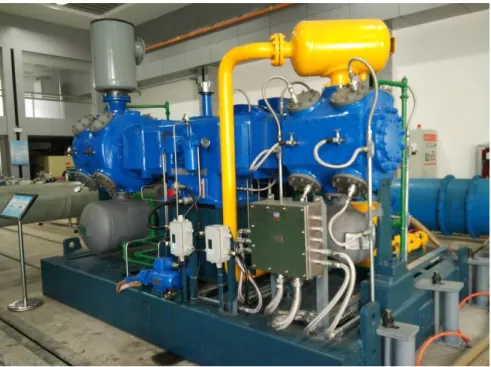
In order to study the fault diagnosis method of the reciprocating compressor, a reciprocating compressor fault diagnosis experiment platform is established in the State Key Laboratory of Compressor Technology of Hefei General Machinery Research Institute. The reciprocating compressor studied in this experiment is shown in the Figure 1. The reciprocating compressor is a DW-8/10 two-stage air compressor manufactured by Sichuan Venus Compressor Co., Ltd. with a volumetric flow of 8 m3, an air supply of 480 Nm3/h, and an exhaust pressure of 1.0 Mpa.
Figure 1: Reciprocating compressor fault diagnosis platform
The gas valve used in this compressor is a three-ring annular gas valve,which mainly consists of valve cover, valve seat, valve plate and spring. The valve plate is divided into the outer ring, middle ring and inner ring, as shown in Figure 2.
Figure 2: Reciprocating compressor circular air valve structure
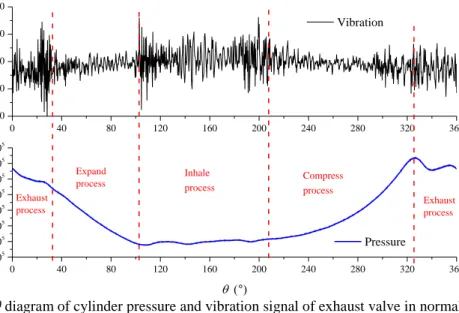
The experimental study of the gas valve is a two-stage exhaust gas valve, and its vibration signal is collected by the PCB EXM 608A11 and the NI 9234 board. The P-θ diagram of the secondary cylinder of the compressor and the vibration acceleration signal of the valve cap of the valve are shown in Figure 3 .
0 40 80 120 160 200 240 280 320 360 2x10⁵ 3x10⁵ 4x10⁵ 5x10⁵ 6x10⁵ 7x10⁵ 8x10⁵ 9x10⁵ Exhaust process Exhaust process Compress process Inhale process Pressure Dynamic pres sure (Pa) ° Expand process 0 40 80 120 160 200 240 280 320 360 -40 -20 0 20 40 Vibration Cylinder vibr ation (m/ s 2 )
Figure 3:P-θ diagram of cylinder pressure and vibration signal of exhaust valve in normal operation
It is shown in Figure 3 that the vibration signal of the exhaust valve reflects the operating status of the compressor intuitively, and the operating status of the compressor in different processes can be visually seen from the vibration signal.
3.2 Valve vibration signal in different failure states
To discover the difference between the vibration signals of the valve under different faults, and to simulate different fault signal classifications, including: a) valve fracture; b) valve spring failure; c) valve leakage, we did all these different damages on exhaust valves respectively. The valve plate has been damaged to various degrees. The failure mode corresponds to the type of failure, including: a) sawing off the valve plate; b) removing part of the spring; c) machining open holes on the valve plate. Among them, a) The effect chart after the saw blade is broken, as shown in the Figure 4(a), the three rings are sawed at the same time to obtain better vibration analysis data. For b), the 1/3 spring in the valve is removed. For c) Four holes were drilled on the inner ring valve of the valve, as shown in the Figure 4(b), to simulate the effect of valve leakage. The comparison of the vibration signals of the valve under the three different faults is shown in the Figure 5.
(a) three rings fracture (b) inner ring leakage
-60 -40 -20 0 20 40 60 0 40 80 120 160 200 240 280 320 360 -60 -40 -20 0 20 40 60 -60 -40 -20 0 20 40 60 0 40 80 120 160 200 240 280 320 360 -60 -40 -20 0 20 40 60 Vibration ( m/s 2 ) Valve is normal Vibration ( m/s 2 ) Valve fracture Vibration ( m/s
2 ) Valve springs failure
Vibration (
m/s
2 )
(°)
Valve leakage
Figure 5: Different valve fault vibration signals
Although we can see some differences in the vibration signal from Figure 5, it is difficult to directly distinguish the characteristics of each group of signal, and it is also hard to identify the fault type directly through the fault vibration signal, so we need to use the LMD method to analyze different fault signals, by decomposition to find out the characteristic parameter values corresponding to different faults.
3.3 Feature parameter extraction of different fault signals by LMD method
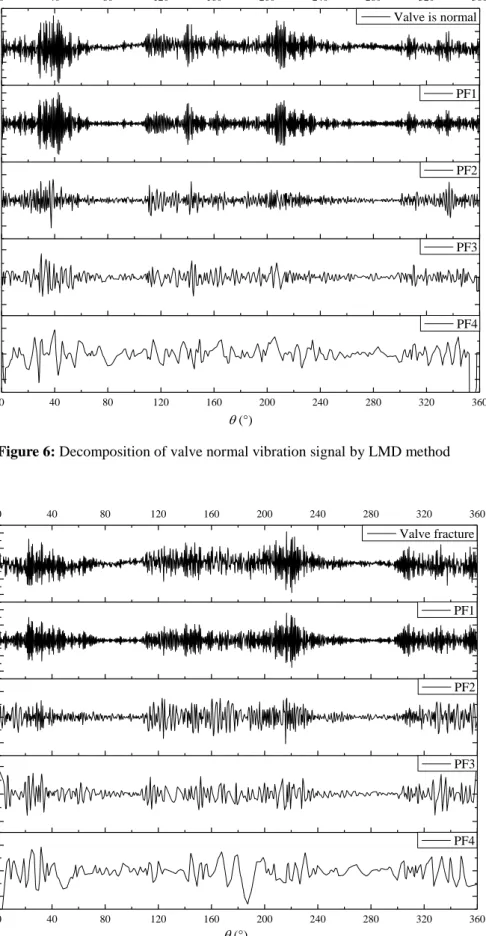
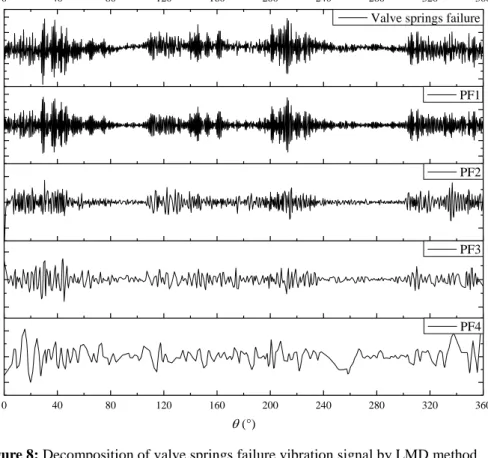
In order to obtain more characteristic parameter values, we performed three experiments on the normal operating mode of the compressor and each group of failure modes. The LMD method was performed on all measured valve vibration data in one cycle. Each group of vibration data for four PF components are obtained, as shown in the Figure 6 to Figure 9 (Only one LMD method figure is shown in the same normal or failure mode).
-40 -20 0 20 40 0 40 80 120 160 200 240 280 320 360 -40 -20 0 20 40 -10 0 10 -5 0 5 0 40 80 120 160 200 240 280 320 360 -2 0 2 x ( t ) Valve is normal PF1 PF1 PF2 PF2 PF3 PF3 PF4 (°) PF4
Figure 6: Decomposition of valve normal vibration signal by LMD method
-40 -20 0 20 40 0 40 80 120 160 200 240 280 320 360 -40 -20 0 20 40 -10 0 10 -5 0 5 0 40 80 120 160 200 240 280 320 360 -2 0 2 x ( t ) Valve fracture (°) PF1 PF1 PF2 PF2 PF3 PF3 PF4 PF4
-40 -20 0 20 40 0 40 80 120 160 200 240 280 320 360 -40 -20 0 20 40 -10 0 10 -5 0 5 0 40 80 120 160 200 240 280 320 360 -2 0 2 x ( t )
Valve springs failure
PF1 PF1 PF2 PF2 PF3 PF3 PF4 (°) PF4
Figure 8: Decomposition of valve springs failure vibration signal by LMD method
-40 -20 0 20 40 0 40 80 120 160 200 240 280 320 360 -40 -20 0 20 40 -10 0 10 -5 0 5 0 40 80 120 160 200 240 280 320 360 -2 0 2 x ( t ) Valve leakage PF1 PF1 PF2 PF2 PF3 PF3 PF4 (°) PF4
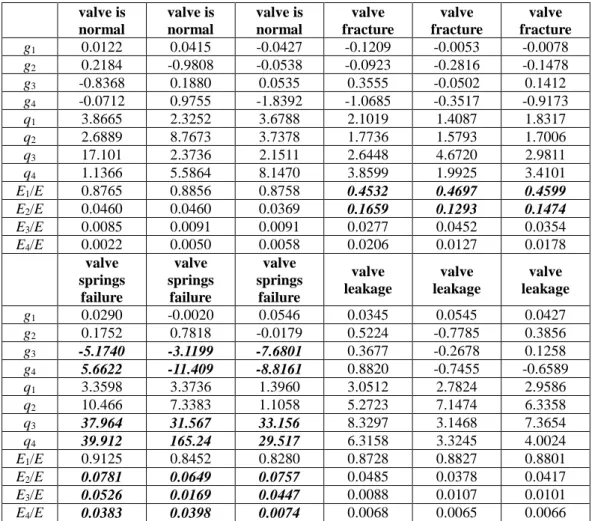
After obtaining the vibration dataof PF components, we calculated the characteristic parameter values of all PF components in each fault state, including the skewness coefficient gi, the kurtosis coefficient
qi, and the total energy ratio Ei/E. By the calculation method, described in Equation (9) to Equation (11),
all calculation results are summarized in Table 1, and each figure in the calculation result retains 5 effective numbers.
Table 1: Characteristic parameter values of all PF components in each normal and fault state
valve is normal valve is normal valve is normal valve fracture valve fracture valve fracture g1 0.0122 0.0415 -0.0427 -0.1209 -0.0053 -0.0078 g2 0.2184 -0.9808 -0.0538 -0.0923 -0.2816 -0.1478 g3 -0.8368 0.1880 0.0535 0.3555 -0.0502 0.1412 g4 -0.0712 0.9755 -1.8392 -1.0685 -0.3517 -0.9173 q1 3.8665 2.3252 3.6788 2.1019 1.4087 1.8317 q2 2.6889 8.7673 3.7378 1.7736 1.5793 1.7006 q3 17.101 2.3736 2.1511 2.6448 4.6720 2.9811 q4 1.1366 5.5864 8.1470 3.8599 1.9925 3.4101 E1/E 0.8765 0.8856 0.8758 0.4532 0.4697 0.4599 E2/E 0.0460 0.0460 0.0369 0.1659 0.1293 0.1474 E3/E 0.0085 0.0091 0.0091 0.0277 0.0452 0.0354 E4/E 0.0022 0.0050 0.0058 0.0206 0.0127 0.0178 valve springs failure valve springs failure valve springs failure valve leakage valve leakage valve leakage g1 0.0290 -0.0020 0.0546 0.0345 0.0545 0.0427 g2 0.1752 0.7818 -0.0179 0.5224 -0.7785 0.3856 g3 -5.1740 -3.1199 -7.6801 0.3677 -0.2678 0.1258 g4 5.6622 -11.409 -8.8161 0.8820 -0.7455 -0.6589 q1 3.3598 3.3736 1.3960 3.0512 2.7824 2.9586 q2 10.466 7.3383 1.1058 5.2723 7.1474 6.3358 q3 37.964 31.567 33.156 8.3297 3.1468 7.3654 q4 39.912 165.24 29.517 6.3158 3.3245 4.0024 E1/E 0.9125 0.8452 0.8280 0.8728 0.8827 0.8801 E2/E 0.0781 0.0649 0.0757 0.0485 0.0378 0.0417 E3/E 0.0526 0.0169 0.0447 0.0088 0.0107 0.0101 E4/E 0.0383 0.0398 0.0074 0.0068 0.0065 0.0066
From Table 1, it can be seen that compared with the characteristic parameters of the PF component extracted by the LMD decomposition of the normal signal, there are obvious differences in several parameters of the sawing-off signal characteristics, mainly focusing on the characteristics of the high-order decomposition PF3 and PF4. In the parameters, these characteristic parameters are generally much higher than those of the normal signal. Therefore, among the PF components obtained after the valve vibration signal is decomposed, PF3 and PF4 can be used as important discriminating indexes for whether the valve is broken or not. As a means of fault identification and diagnosis. The
E1/E characteristic parameter extracted from the vibration signal of some valve springs are significantly
lower than that of the normal signal, while the E2/E values are much higher. These two criteria can be
used in the valve spring failure identification and diagnosis method. However, for the valve opening vibration signal, it is difficult to find the characteristic parameters that are particularly different from each other. This shows that in the case of valve opening, although the valve leaks, the vibration signal does not change too much, which is a very reasonable phenomenon in this failure mode. The observation of the reciprocating compressor intake and exhaust pressure, PV diagram and valve cover temperature rise and other parameters should identify the fault more effective and reasonable.
4. Conclusion
This paper presents a vibration signal feature extraction method based on the LMD method, which is applied to the fault diagnosis of the reciprocating compressor valve.
components, and the terms of the skewness coefficient gi, the kurtosis coefficient qi, and the total
energy ratio Ei/E are used as the basis for extracting the characteristic parameters of the PF component.
2) Among the characteristic parameters of the extracted PF components, the characteristic parameters of PF3 and PF4 can be used as the diagnosis indexes for the rupture of the valve disc, and E1/E and
E2/E can be used as the diagnosis indexs for the failure of the valve spring.
3) This method is suitable for the fault diagnosis, and is sensitive to the vibration signal of the reciprocating compressor. If the influence of the valve vibration caused by the fault is not significant, the fault cannot be identified. Therefore, this method still has a certain limitation for the fault diagnosis of the valve.
REFERENCES
[1] J. Zheng, J. Cheng, Y. Yang, Generalized empirical mode decomposition and its applications to rolling element bearing fault diagnosis, Mech. Syst. Signal Process. 40 (1) (2013) 136–153.
[2] W. Liu, J. Han, J. Jiang, A novel ball bearing fault diagnosis approach based on auto term window method, Measurement 46 (10) (2013) 4032-4037.
[3] N. Nikolaou, I. Antoniadis, Rolling element bearing fault diagnosis using wavelet packets, NDT & E Int. 35 (3) (2002) 197-205.
[4] Z. Wang, C. Lu, Z. Wang, J. Ma, Health assessment of rotary machinery based on integrated feature selection and Gaussian mixed model, J. Vibroeng. 16 (4) (2014) 1753-1762.
[5] C. Lu, J. Hu, H. Liu, Application of EMD-AR and MTS for hydraulic pump fault diagnosis, J. Vibroeng. 15 (2) (2013).
[6] C. Lu, H. Yuan, Y. Tang, Bearing performance degradation assessment and prediction based on EMD and PCA-SOM, J. Vibroeng. 16 (3) (2014) 1387-1396.
[7] Z. Peng, P.W. Tse, F. Chu, A comparison study of improved Hilbert-Huang transform and wavelet transform: application to fault diagnosis for rolling bearing, Mech. Syst. Signal Process. 19 (5) (2005) 974-988.
[8] Y. Lei, J. Lin, Z. He,M. Zuo, A review on empiricalmode decomposition in fault diagnosis of rotating machinery, Mech. Syst. Signal Process. 35 (1) (2013) 108–126.
[9] S.G. Mallat, A theory for multiresolution signal decomposition: the wavelet representation, IEEE Trans. Pattern Anal. Mach. Intell. 11 (7) (1989) 674–693.
[10]Z. Peng, F. Chu, Application of the wavelet transform in machine condition monitoring and fault diagnostics: a review with bibliography, Mech. Syst. Signal Process. 18 (2) (2004) 199–221.
[11] N.E. Huang, Z. Shen, S.R. Long, M.C. Wu, H.H. Shih, Q. Zheng, N.C. Yen, C.C. Tung, H.H. Liu, The empirical mode decomposition and the Hilbert spectrum for nonlinear and non-stationary time series analysis, Proc. R. Soc. Lond. Ser. A Math. Phys. Eng. Sci. 454 (1971) (1998) 903-995.
[12] J.S. Smith, The local mean decomposition and its application to EEG perception data, J. R. Soc. Interface 2 (5) (2005) 443-454.
[13] Y. Wang, Z. He, Y. Zi, A comparative study on the local mean decomposition and empirical mode decomposition and their applications to rotating machinery health diagnosis, J. Vib. Acoust. 132 (2) (2010) 021010.
[14] Y. Tian, J. Ma, C. Lu, Z. Wang, Rolling bearing fault diagnosis under variable conditions using LMD-SVD and extreme learning machine, Mechanism and Machine Theory 90 (2015) 175-186.
ACKNOWLEDGMENTS
This work was funded by the National Key Research Development Plan of China (grant no 2016YFF0203300), and Youth Science and Technology Fund of Hefei General Machinery Research Institute Co., Ltd. (No. 2016010472).