J
Journal ofA S T
Aerospace Science and TechnologyJAST. Vol. 9, No. 2, pp 71-81
© Iranian Aerospace Society, Summer - Fall 2012
1 Introduction
Radial Basis Function Neural Network (RBFNN) is !" #! " #
Novel Radial Basis Function Neural Networks based on Probabilistic
Evolutionary and Gaussian Mixture Model for Satellites Optimum Selection
$%!
1$$ "
2&$
3In this study, two novel learning algorithms have been applied on Radial Ba-sis Function Neural Network (RBFNN) to approximate the functions with high non-linear order. The Probabilistic Evolutionary (PE) and Gaussian Mixture of Gradient Descent (GD) in terms of the input feature vectors. The probability !""# $#%$%$ &'*%$#'+# mathematically controlled. So, a combined RBFNN based on novel PE algorithm has been proposed which has a soft behavior through the learning of non-linear /% ## in the space of extracted features as a Gaussian distribution correspondence to each chromosome. Then, it estimates the entire probabilities of local minima in # robust satellites subset selection. Geometric Dilution of Precision (GDOP) is the main factor to estimate the strength of goodness of each satellites subset. Then, the subset with the lowest value has been selected for improving the positioning performance, but it is so non-linear and imposes computational burden on navi-gation systems. These techniques have been implemented and the results on mea-/012/0 GDOP comparison with the other conventional approaches.
Keywords: Neural Networks, Probabilistic Evolutionary, Gaussian Mixture, Sat-ellites Selection.
1. M.Sc. Student, [email protected]
2. (Corresponding Author), Professor, Department of Electrical En-gineering, Iran University of Science and Technology, Narmak, Teh-ran 16846-13114, ITeh-ran, Email: [email protected]
3. Professor, [email protected]
72 M. Saraf , M. R. Mosavi and K. Mohammadi
+CD4 "! ' ! " !5 !: '! E " !" ; <# ! !" !" G "!! G 5 " ! ! " G $ $ ;$$< = !$$ " ! H !5!! ! !$$ J !" ! !":! 6: 6: ! " # "L 6" ;L6< ! " ! ! L6 ! !
= ! L ;=EL< ! ! %" L%=EL " "L% +O/P4 " ! J +///>4 # =EL!%6% ! !! ! ! +/Q4
! L% =EL ! 6 5 L L%=EL T H +/?4 5 ! ! 6: +/C/D4
! ' ! # ## 5 E ### % #U " H U
2 Preliminary Backgrounds
# 5 !
2.1 Radial Basis Function Neural Network
! 5 ! ! ! ! # ! = ! ! ! ! " ! +/O4 " !
" W1XNY
" W1XNY !
!;< "" !;n)=tn
![/X " !;< ! \
(1)
GL ! ci]i2
"!i-thb !
! ' * ! = ' ! "^ ! J! ! "\
%= !"!\
H J
73
Novel Radial Basis Function Neural Networks based on Probabilistic Evolutionary and Gaussian Mixture Model for Satellites Optimum Selection
# 5 " J " # ! "
2.2 Gaussian Mixture Model
$$ ! " ! ! "\
GK ! qkzk{k
! ""
!k-th "%
5 '* "5 : !!5 ! $$ 6 $' ;6$<@!6$ +/|/}4\
Step 1: #' zk " {k and
! qk""!
5\
Step 2: 6" " ; <\
Step 3: ;' <\
G\
(13)
Step 4: 6"5!" >
! !
2.3 GPS GDOP
=EL ! !! ! # "!J! %!L%" " ! H J !! '=EL!
~ ' L% =EL
J 'L% J'=@" " +>P4\
;/?<
G !@ ? ? H ' J !! J!"
;/C<
O? M. Saraf , M. R. Mosavi and K. Mohammadi
G" ' " ! \
;/D<
G6WY "#! !" ""
26W""Y[2I J\
(17)
=EL! \
;/|<
! J;/|< ! =EL !
! !&%
9&T& !"
" 123?: M
L%=EL +>/4\
;/}<
" !" " !" !! J ! "
H " !
" % " >P
" ! /D " ! /D ;? /> <[/|>P =EL " ! %L%=EL ! L%
# L% =EL J;/}<%6%! !! +/Q4\
J M
%"\
5 =EL ! !
2.4 GA for RBFNN Learning
"!= ! ! U " ! " G ! ! 5! '6: :;'< " ! ! ' & " ! ! : !6 !
G !n
need n+/ ! :!"
: ! "! ! \
Step 1:6 " ! ! ;! <
Step 2:#' ; <
Step 3: H $ %J 6 ;$%6<!!
Step 4:: " erators
Step 5: H $%6 ! !
OC
Novel Radial Basis Function Neural Networks based on Probabilistic Evolutionary and Gaussian Mixture Model for Satellites Optimum Selection
#! ?
3 Proposed Methods
# " $$L6 ! "
3.1 GMM-Guided GD for RBFNN Learning
H = ! " !!" # " G != 5 ! !!! # $$ '! !!" ! ! !5 \
Step 1: 6 ! ! !"$$'6$
Step 2: G !!" !" " ! \
[
P;/<
;>C<
Step 3:= 5 ;" ! ! & <
Step 4: H5! ! >
3.2 Probabilistic Evolutionary for RBFNN Learning
# 5 ! L6 ! ! ! " ! 6: " " !
L6 ! ! ! ;! ! < ' ! " ! ' ! \
;>D<
" "! \
#2 9#2 <=>?2 (27)
2 92 2H>2 ;>|< ! " ! ! G ' !\
m
i=m
i;
i)
;>}<
! ! "#! " " ! ' E " ! "" : ! ! ! ' !L6 / " ~56: ' 5 "% ! !
OD M. Saraf , M. R. Mosavi and K. Mohammadi
4 Experimental Results
#
Changing the chromosome, initializing the variance and checking for the minimum
probability
Chromosome initialization (Gaussian distribution centers)
Computing the cost function
Evaluating the normalized distance from best chromosome
Updating the occurrence probabilities
Moving the Gaussian centers toward best chromosome
Selecting new point with Gaussian distribution and evaluating cost
function
New value < Old value
Decreasing the probability density, increasing the variance
and checking for the minimum probability
Criteria condition
End of optimization
No Yes
No
Yes
77
Novel Radial Basis Function Neural Networks based on Probabilistic Evolutionary and Gaussian Mixture Model for Satellites Optimum Selection
4.1 Embedded Measurement System
#" L%=EL! ! L% "' !5 L:! L% LH^%!~6:CL% !
^ ~6:C
!!^C ~6:!! " " "!! " ! ! 5!!" ' J # CP "/!!" ?@' LH ! #E ^% 5 "L: :! L% ! ^: ! ! " L: =:$ ^%! L: U@=~ "
'#%6/P/ !LH
" ~:U#6G$:~: ! "! : ! ! L% ! 5 ! /> ! "" " L%=EL" L% >
Serial Interface USB
Interface
DRAMs Main
Program
LEA-5 GPS Module
LEA-5 GPS Module FIFO-USB
Controller
FPGA
Power-CLK Manager
PROM
of embedded system.
4.2 GPS GDOP Approximation using GMM based RBFNN
G$$ : $$ ' " 6$ '5^ ! " ! !! " Q '$$ ! !!!" $$
! ! !Qrd and
?! !
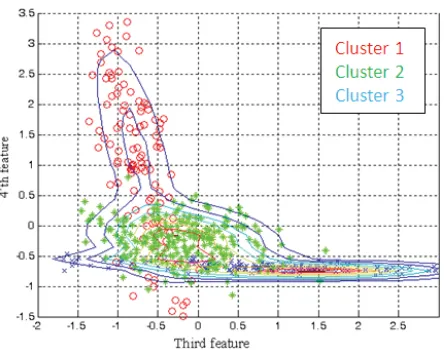
" !% ! ! " ! " # ! = ! ; 5 <
Figure 3. Data clusters and probability densities have been esti-mated utilizing GMM procedure.
' P[ P>
"[P;/p<!!"
= ! ! ! !5 ! " !"
O| M. Saraf , M. R. Mosavi and K. Mohammadi
= #= * /PPP! /P: ! " ' " !$$ " " !
' ! #! ! ' G! "
4.3 GPS GDOP Approximation using GA based RBFNN
' & " ! : !6 ! !5% ! " ! ' " ! " CP ! ! " ! !! 6" " ! " ! P? 6" ! ! " " ! '! ? "! !L%=EL ': ! QPP QPP # ! ! 5 ! : ? ! ! //: !$%6! 5 " $ %6 ! " 5 ": J ?PP ! " ! "
Figure 4. The searching convergence of the local minima of GDOP RMSE is shown utilizing GA based RBFNN.
4.4 GPS GDOP Approximation using PE based RBFNN
O}
Novel Radial Basis Function Neural Networks based on Probabilistic Evolutionary and Gaussian Mixture Model for Satellites Optimum Selection
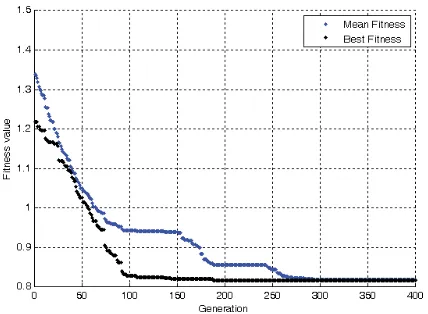
Figure 5. The GDOP RMSE convergence in terms of the number of generations.
Fig. 6. The GPS GDOP approximation using PE based RBFNN.
" !P># $%6$ $! "/: L6 " ! : '$$= "$%6D>
Table 1. Evaluation of the performance of four GPS GDOP approximation methods.
Methods
Parameters
RBFNN GMM-RBFNN GA-RBFNN PE-RBFNN
Min // P} /D >Q
$ CQ Q/ >OD >/
$%6 1.45 0.89 1.1 0.81
: ! " L% =EL ! ! L% =EL" ! # ! +/>/Q/?>>4 ! "
5 Conclusion
# '! !L%=EL \/<$$ >< : Q<L6 ! \/< !!" !! >< !6:' ! ! !!" $$ " !6: ! ! L% L% =EL " ! " $%6 " "D> Q/O} "
References
/ T L & ~ = % @ : @ : ! 5 H #666 5 U/OD/?Q}/?C/>PPD
|P M. Saraf , M. R. Mosavi and K. Mohammadi
Q @~@&~%@~L&% !%L ! 5^ #": #666 5 U/?/O}||>PPQ
? & ! 5 = #666 5 U/P QDCODO//}}}
C &&%5:6! : ! %" ! 5 T ! H 6 6U>CQ/}C>/|/}}}
D %@"&'$:6&: L%E G $ ! ~ H ! 5 T ! H 6 6 UQD C ||D|}?>P/P
O H % H % ~ % 5L 5 ! : >= =EL $! ! 6 H% /C>P/P
| T H ! = ! L #666 : 6 % U>| Q |}Q|}C /}}>
} $ % L5 " $ ! E L% % % #666 : 6% UQO> OC/OC?>PP/
/P $T: %% :\ % #666 T!% %L UQCO?PO?O>PP}
// =@ = !L !U! % #666 % L ~"DD}DOD/}}?
/> H@GG@%G@:% L% =EL: ^ %U $ #666 # $ UDP / /QO /?C>P//
/Q = % @ 6%! " % % 5 T! UO>?O>C|/}}C
/? =TT&LH:5L 5 =EL: T!"UCC/}O /P|>PP>
/C $ $ " & $ ! E: ! = ! L T ! H # : U}>/CQ/OP >P/P
/D $$ "$%!L $! L%=EL 5# "$% UQ ?DDCDO/>P/P
/O E = ^ & : 6 !: 5 T ! H 6 6 UQO QQ}>?P>>P//
/| : L = $ ~ = $~5!#=" 6$:;G= <T! % % % /Q| /}OO
/} $#T:T @$ !6 6$:T !H/|/>/?/}}?
>P #: := T @ L%=EL$#66L% "U/?OC>C}>D?>PPP
>/ %@=:H !L% =ELHT!L%% U/QQ/|Q/}P>PP}
>> =TTHH~5
L% =EL : H
|/
Novel Radial Basis Function Neural Networks based on Probabilistic Evolutionary and Gaussian Mixture Model for Satellites Optimum Selection
Authors
Morteza Saraf " %6
6 != ! 6 H
6 ' ^" ' #
>PP} @ $ ! %
= ! 6 6 ! #^%
H" % % #L$ @ : # % H" % L
Mohammad-Reza Mosavi " % $%
L= != ! 6 6
# ^" ! %
;#^%< # /}}O /}}| >PP?
"@ !=
! 6 6 ! #^% ! @
!/DP * ! @ :#% L % #!% %
Karim Mohammadi" L=!
=!66E5^"
^%:/}|/@ !!
=!66!#^%