*Corresponding author.
Email address: [email protected] DOI: 10.22051/JITF.2018.18628.1016
Investigation of structural effects of Bi nanoparticle addition on HTSC BSCCO-2223,
through the sol-gel method
M. Ahangari, V. Daadmehr*
Department of Physics, Alzahra University, Tehran, I. R. Iran
ARTICLE INFO ABSTRACT
Article history:
Received 25 December 2017 Revised 2 January 2018 Accepted 11 March 2018 Available online 18 March 2018
Keywords:
High Temperature Superconductor
BSCCO-2223 Topological Insulator Sol-gel method
Binanoparticles MAUD software
In this research, the influence of Bi nanoparticles addition on the high temperature superconductor BSCCO-2223 is studied. For this purpose, the samples were synthesized by the conventional sol-gel method before adding the Bi nanoparticles with x= 0.00, 0.03, 0.06, 0.12wt% to the superconductor BSCCO-2223. The structural characterization of all the samples was done by X-ray diffraction pattern (XRD). Also, the microstructural and grain connectivity of the samples were investigated with the “Scanning Electron Microscope” (SEM). In addition, the volume fraction of all the samples was estimated by the “Material Analysis Using Diffraction” (MAUD) software. The results show that the sample with non-added Bi has the highest volume fraction of Bi-2223 phase (77.3%) compared to the samples with added Bi nanoparticles. Furthermore, the SEM photographs show that when Bi nanoparticles addition increases, the porosity and voids increase. Therefore, the experimental results indicate that structural properties and crystallographic of samples weaken by the increase of Bi nanoparticles as an additive in the high temperature superconductor BSCCO-2223.
1 Introduction
After the discovery of high temperature superconducting in the BSCCO system by Maeda et. al. in 1988 [1], it was found that Bi-compounds (BSCCO) with a general formula of (Bi,Pb)2Sr2Ca n-1CunO10+ δ (n= 1, 2, 3), has three basic phases and variable critical temperature values: Bi-2201 phase (n= 1 and TC ~ 20K), Bi-2212 phase (n= 2 and Tc ~ 85K) and Bi-2223 phase (n= 3 and Tc~ 110K) [2]. In recent years, many studies have been carried out to improve the superconducting properties of BSCCO-2223 by adding different nanoparticles in order to improve the critical current density (Jc) and the critical transition temperature (Tc) [3-8]. However, the influence of
nanoparticles on superconductors is very important from the viewpoint of practical application.
Since Bismuth compounds provide topological conductivity properties, the interest of physicists has been taken into account in the industrial applications of high temperature superconductors. Therefore, in this study, Bi nanoparticles are added to BSCCO-2223 superconductor before observing the phase formation and the microstructural of all the samples by X-ray diffraction pattern (XRD) and SEM images, respectively.
2 Experimental details
52 stoichiometry of Bismuth nitrate Bi(NO3)3.5H2O (98%), Lead nitrate Pb(NO3)2 (99.5%), Strontium nitrate Sr(NO3)2 (99%), Calcium nitrate Ca(NO3)2.4H2O (99%), Copper nitrate Cu(NO3)2.3H2O (99.5%), amount of the precursor materials were dissolved separately in deionized water were 0.5M solutions were made. Then, the Gluconic acid (C6H12O7) was used as the chelating agent. The mole ratio of metal nitrates to Gluconic acid was taken as 1.7: 0.3: 2: 2: 3. When used the Gluconic acid, all compounds dissolved in deionized water. Therefore, preparation time of the sol-gel method was reduced. Afterwards, the Bi nanoparticles with x= 0.00, 0.03, 0.06, 0.12wt% was added to the sol. The sol was heated continuously at 80°C under stirring to form a green dried gel. Then, the gel was fired and was grained into powders. To obtain BSCCO-2223 powders, the powders were calcined at 800-820°C exposed to the air for 24h to remove any remaining volatile materials. After completing the process, the powders were pressed under pressure 5Kg/m2 into circular pellet with a diameter of 10mm. Afterwards, the pellet was sintered between 800-840°C in exposure of oxygen for 48h.
3 Characterization
The X-ray diffraction patterns (XRD) of all the samples were identified by using the PANalytical Company X’Pert PRO MPD PW3050/60 X-ray diffractometer with CuKα1 and CuKα2 radiation (λ= 1.54060Å, λ= 1.54443Å) and CuKβ1 (λ= 1.39225Å) in the range 2θ= 10°-80° operated at 40kV and 40mA. The volume fraction of all the samples was refined by using the “Material Analysis Using Diffraction” (MAUD) software [10]. The grain connectivity and the microstructural of the samples were investigated by the VEGA3 TESCAN “Scanning Electron Microscope” (SEM).
4 Results and discussion
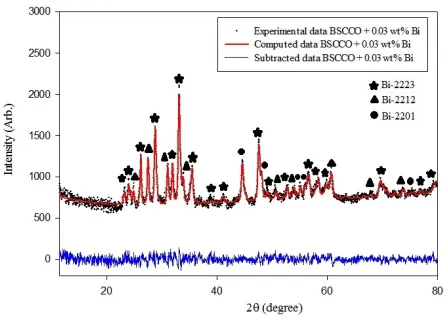
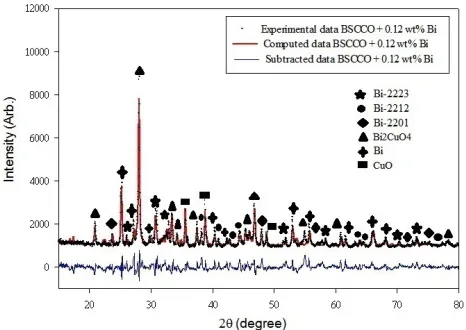
The X-ray diffraction patterns of the synthesized BSCCO-2223 samples with x= 0.00, 0.03, 0.06, 0.12wt% Bi nanoparticles that were refined by the MAUD software are shown in Figs. 1-4. In these pictures, the experimental data, computed data, and subtracted data have been shown with black points, red
line and blue line, respectively. Also, the volume fraction of all the samples have been listed in Table 1. The existence of Bi-2223, Bi-2212, Bi-2201, Bi2CuO4, Bi and CuO phases in the XRD patterns, are consistent with the powder diffraction file of “JCPDS” (JCPDS 1540770 for Bi1.6Ca2Cu3O10Pb0.4Sr2 (Bi-2223), JCPDS 1540940 for Bi2CaCu2O9.07Sr2 (Bi-2212), JCPDS 1001691 for Bi1.916CuO5.482Sr1.84 (Bi-2201), JCPDS 1006028 for Bi2CuO, JCPDS 4002409 for Bi, JCPDS 1011194 for CuO). Furthermore, the pattern fitness can be checked for all XRD data with the MAUD software. There are several parameters for the calculation of pattern fitness in the MAUD software. The goodness of fit (S) is described by S = (Rwp / Rexp),
where Rwp is the weighted residual error and Rexp is the
expected error. Refinement has been continued until a convergence was reached for a value of S close to 1, which confirms the goodness of refinement. These parameters for the samples are written in Table 2.
Fig 1. XRD of BSCCO-2223 (pure) sample.
53 The results showed that the BSCCO-2223 pure sample has the majority volume fraction of Bi-2223 tetragonal structure with I4/mmm space group (77.3%) and the minority volume fraction of Bi-2212 orthorhombic structure with Amaa:cab space group (13.7%) and Bi-2201 monoclinic structure with C2/c:-b1 space group (8.9%). Also, the results indicated that the sample with x= 0.12wt% Bi nanoparticles has the lowest volume fraction of Bi-2223 phase (11.1%). However, this sample has the highest volume fraction of Bi2CuO4 tetragonal structure with P4/ncc:2 space group (31.1%). In other words, when 0.12 weight percent of Bi nanoparticles was added in BSCCO-2223, it forms the Bi2CuO4 tetragonal structure with P4/ncc:2 space group (31.1%), Bi triclinic structure with P1 space group (21.4%) and CuO monoclinic structure with C2/c:b1 space group (2.3%). Thus, the volume fraction of main Bi-2223 phase decreased and the volume fraction of Bi-2212 and Bi-2201 and unwanted phases increased.
Fig 3. XRD of BSCCO-2223+ 0.06wt% Bi sample.
Fig 4. XRD of BSCCO-2223+ 0.12wt% Bi sample.
Table 1. The volume fraction of samples.
Composition Bi-2223
(%) Bi-2212
(%) Bi-2201
(%)
Bi2CuO4
(%) Bi (%)
CuO (%)
BSCCO-
2223 (pure) 77.3
(68)
13.7
(18) 8.9
(13)
_ _ _
BSCCO+
0.03wt% Bi 65.4
(99)
33.6
(92) 0.8
(08)
_ _ _
BSCCO+
0.06wt% Bi 25.8
(05)
26.3
(17)
12.9
(25)
_ _ 34.9
(53)
BSCCO+
0.12wt% Bi 11.1
(86)
25.6
(92) 8.1
(68)
31.1
(54) 21.4
(9) 2.3
(07)
Table 2. The calculation of pattern fitness for samples.
Composition Rwp (%) Rb (%) Rexp (%) S
BSCCO-2223 (pure) 6.3(56) 4.9(28) 3.2(62) 1.9(4)
BSCCO+0.03wt% Bi 4.6(36) 3.5(94) 3.5(17) 1.3(1)
BSCCO+0.06wt% Bi 6.4(17) 4.6(13) 2.7(73) 2.3(1)
BSCCO+0.12wt% Bi 10.1(39) 7.2(03) 2.8(55) 2.5(5)
Electrical measurements of pure specimens and 0.03%wt are given in Figs. 5 and 6. The onset critical temperature Tc (onset), the offset critical temperature TC (offset), the middle critical temperature Tc (mid), and the zero electrical resistivity temperature Tc (R=0) of the samples are shown in pictures.
54 It could be readily noticed that the electrical resistivity of samples shows metallic behavior (a linear variation of resistivity with respect to temperature) in the normal state. Another feature represented by the figures is that the pure BSCCO-2223 sample has sharp superconducting transition with Tc (onset)= 104.8K, Tc (offset)= 88.2K and Tc (R=0) = 88.2K. However, the added sample has two stages of superconducting transition, i) Tc (onset)= 102.8K for Bi 2223 and ii) Tc (onset)= 85.9K and Tc(offset)= 83.6K for Bi 2212. This implies with additive Bi nanoparticles where the transition temperature of superconductivity decreases. The reason may be due to the difference between structural phases characteristic and their coupling.
Fig 6. Electrical measurement ρ(T) for BSCCO+0.03wt% Bi.
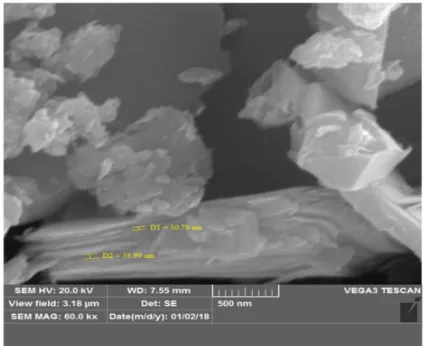
In addition, microstructure and the grain connectivity of the samples are observed by SEM images. The SEM images of the samples are shown in Figs. 7-8.
Fig 7. SEM image of synthesized BSCCO-2223 (pure).
The SEM measurements indicated that when Bi nanoparticles addition increases, the porosity and voids decrease up to 0.03 before increasing. On the other hand, the increase of porosity and voids may be related to the formation of Bi-2212 phase, Bi-2201 phase, and other secondary phases.
Fig 8. SEM image of synthesized BSCCO+0.03wt% Bi.
5 Conclusions
In this research, the structural properties and microstructure of Bi nanoparticles (x= 0.00, 0.03, 0.06, 0.12wt%) addition in the BSCCO-2223 superconductor were investigated. For this purpose, the samples were prepared by the conventional sol-gel method. The X-ray diffraction patterns were refined with the MAUD software. Analysis of the X-ray diffraction patterns showed that the BSCCO-2223 pure sample has the highest volume fraction of Bi-2223 phase (77.3%) compared to added samples with Bi nanoparticles. In addition, the SEM images indicated that when Bi nanoparticles addition increases, the
porosity and voids increase. Electrical
measurements show that with increasing Bi
additive, the transition temperature of
55
Acknowledgments
The authors acknowledge Alzahra University and the Niroo Research Institute for financial support.
References
[1] H. Maeda, Y. Tnaka, M. Fukutomi, and T. Asano. “A new High-TC oxide superconductor without a rare earth element.” Japanese J. Applied Physics, 27 (1988)
L209.
[2] H. Abbasi, J. Taghipour, and H. Sadeghi. “The effect of MgCO3 addition on the superconducting properties of Bi-2223 superconductors.” J. Alloys and Compounds, 482 (2009) 552.
[3] E. Guilmeau, B. Andrzejewski, and J. G. Noudem. “The effect of MgO addition on the formation and the superconducting properties of the Bi2223 phase.” Physica C, 387 (2001) 382.
[4] I. H. Gul, F. Amin, A. Z. Abbasi, M. Anis-ur-Rehman, A. Maqsood. “Effect of Ag2CO3 addition on the morphology and physical properties of Bi-based (2223) high-TC superconductors.” Physica C, 449
(2006) 139.
[5] H. Najafipour, S. H. R. Shojaei, and S. M. Shojaei. “The effect of AgNO3 addition on the formation and
superconducting properties of the Bi-2223 phase.” J. Superconductivity and Novel Magnetism, 23 (2010)
487.
[6] W. Kong and R. Abd-Shukor, “Enhanced electrical transport properties of nano NiFe2O4-added (Bi1.6, Pb0.4)Sr2Ca2Cu3O10 superconductor.” J. Superconductivity and Novel Magnetism, 23 (2010)
257.
[7] A. Rojek, B. Cendlewska, “Effect of Sb additions on the formation of the high-TC phase in the Bi-Pb-Sr-Ca-Cu-O superconducting thick films.” Solid State Communications, 86 (1993) 735.
[8] M. Annabi, A. M’Chirgui, F. Ben Azzouz, M. Zouaoui, M. Ben Salem. “Addition of nanometer Al2 O3 during the final processing of (Bi,Pb)-2223 superconductors.” Physica C, 405 (2004) 25.
[9] F. S. Moghadasi, V. Daadmehr, and M. Kashfi. “Characterization and frequency-thermal response of electrical properties of Cu nanoferrite prepared by sol– gel method.” J. Magnetism and Magnetic Fields, 416
(2016) 103.