39
The Effect of Training with a Foam Roller on Ankle and Knee
Range of Motion, Hamstring Flexibility, Agility, and Vertical
Jump Height
Olivia Stovern1, Carley Henning1, John P. Porcari1, Scott Doberstein1, Kari Emineth1, Blaine E. Arney1, Carl Foster1 1Department of Exercise and Sport Science, University of Wisconsin-La Crosse, La Crosse, WI, USA
Abstract
Introduction: Foam rolling (FR) is a popular tool for providing self-myofascial release. The long-term
use of FR is suggested to improve range of motion (ROM), flexibility, and a variety of performance measures. Purpose: This study was designed to evaluate the training effects of foam rolling on ankle and knee range of motion, hamstring flexibility, agility, and vertical jump height. Methods: Twenty subjects (8 male, 12 female) completed 6 weeks of foam rolling, which was held three days per week. Fourteen volunteers (6 males 8 females) with similar characteristics served as a control group. Pre and post-testing evaluation included measurement of ankle dorsiflexion and knee flexion range of motion, hamstring flexibility (sit-and-reach test), agility (T-test), and vertical jump height. Results: There were no significant changes in knee range of motion, vertical jump height, or T-test time in either group from pre to post-testing. Ankle range of motion increased for both the foam rolling (3.1o) and the control
groups (4.2o) over the course of the study. Hamstring flexibility improved significantly (1.9 cm) in the
foam rolling group. Conclusion: Six weeks of foam rolling had a positive effect on hamstring flexibility and did not negatively affect agility or vertical jump height.
Key Words: Recovery, Stretching.
Introduction
Self-myofascial release (SMR) has become more widely used by athletes and fitness enthusiasts in the last decade. It has become so popular that it was listed as the 14th most popular worldwide fitness trend in 20191. Fascia is a dense, irregular
connective tissue that surrounds and connects every muscle and organ in the body. Therapeutic treatments for fascia claim to alter either the density, tonus, viscosity, or arrangement of individual fibers through manual pressure2. It is
40 following SMR are brought about by
changing the thixotropic property of the fascia. This occurs when the friction between the targeted soft tissue and SMR device generates heat, which changes the fascia to a more fluid like state3. As a result,
tissue becomes less resistant when a stretch is applied, allowing for greater range of motion (ROM) in joints4.
One of the most popular SMR devices is the foam roller. A foam roller is a foam cylinder that varies in density, shape, and surface texture. These structural differences may influence how the myofascial tissues are being massaged during treatment. For instance, a high-density foam roller may provide a more effective massage to the tissue than a less dense roller5. Individuals
use their own body mass directly on the foam roller to exert pressure on the soft tissue.
Foam rollers are most often used during warmup or recovery following exercise. A number of studies have investigated the
acute benefits of foam rolling (FR) and the
results are inconclusive. Studies by Hsuan, Nai-Jen, Wen-Lan, Lan-Yuen, and I-Hua6 and
MacDonald et al.7 found that FR improved
hamstring flexibility/knee ROM, but had no significant impact on muscular force. Conversely, a study by Couture, Karlik, Glass and Hatzel8 did not find significant changes
in knee ROM, but a study by Halperin, Aboodarda, Button, Andersen and Behm9
did report increases in maximal force production. Peacock, Krein, Silver, Sanders,
and Von Carlowitz10 had subjects foam roll
the entire body, which led to improvements in power, agility, strength, and speed. Lastly, Škarabot, Beardsley, and Štirn11
found that both static stretching and FR increased passive ankle ROM.
Several studies have also studied the effectiveness of FR training on flexibility and ROM. Miller and Rockey12 studied the
effect of thrice weekly FR sessions on hamstring flexibility over an 8-week time period. They found that FR did not increase hamstring flexibility. Although there were gains in ROM in the treatment group, they were not significant when compared to the control group. Scherer13 also examined the
use of a foam roller on hamstring flexibility in a group of university students over the course of 4 weeks. They found no
significant differences in hamstring
flexibility compared to the control group. However, every individual in the FR group had positive changes. A 4-week study by Junker and Stöggl14 found increases in
hamstring flexibility following both FR and contract-relax PNF stretching. Mohr et al.4
compared the effects of FR to static stretching on passive hip-flexion ROM over the course of 2 weeks. They had a FR group, a static stretching group, and a FR plus static stretching group. They found an increase in hip-flexion ROM in all three treatment groups, with the greatest gains observed in the combination group. Lastly,
Bushell, Dawson and Webster15
41 lunge following each of three sessions of FR.
There were no significant increases in hip extension angle between the control group and FR group acutely or across time.
Because the long-term benefits of FR are inconclusive, the purpose of this research study was to examine the effects of a 6-week FR program on ankle and knee ROM, hamstring flexibility, agility, and vertical jump height.
Methods
ParticipantsThirty-four volunteers (13 male, 21 female) were recruited from the University of Wisconsin- La Crosse campus to participate in this study. Due to the physical demands of the testing and training procedures, participants were required to be at least recreationally active (i.e., exercise at least 3 times per week for at least 30 minutes) and have no current lower-leg injuries. Potential subjects completed the Physical Activity Readiness Questionnaire (PAR-Q) and a health history questionnaire to screen for
cardiovascular and orthopedic
contraindications to exercise. Those eligible then provided written informed consent before undergoing any testing or training procedures. Subjects were placed into FR (n=20) or control (n=14) groups based upon their availability to attend supervised training sessions. The protocol was approved by the University of Wisconsin-La Crosse Institutional Review Board for the Protection of Human Subjects.
Procedures
All subjects attended an initial orientation session where the purpose and procedures of the study were explained to them. At this session subjects then had a chance to practice all of the tests administered as part of the study. Subjects underwent a series of tests at the beginning and end of the study period. Height was measured using a wall-mounted stadiometer. Weight was assessed using a Rice Lake 150-10-7 Floor Level Digital Scale (The Rice Lake Weighing Systems, Rice Lake, WI). Subjects then completed a 5-minute warm-up on a Schwinn Airdyne at a self-selected speed. Following the warm-up, subjects were immediately assessed for ankle and knee ROM, hamstring flexibility, vertical jump height, and agility. All the tests were administered in the order listed, with approximately 5 minutes between tests.
Ankle dorsiflexion and knee flexion, on the right leg, were measured using a Medigauge 900105 Dual-scale Electronic Digital Goniometer (Taylor Toolworks LLC,
Columbia, MO). To measure ankle
dorsiflexion, subjects sat on a table in an upright sitting position with their legs straight. Only their ankles were off the edge of the table. Instructions were given to dorsiflex their ankle as far back as possible. A measurement was taken when they could not go any further. The test was performed
three times and the two closest
42 knees at the edge of the table. The subjects
were instructed to flex their knee as far back as possible. A measurement was taken when they could not go any further. The test was performed three times and the closest two measurements were averaged for data analysis.
Hamstring flexibility was assessed using a sit-and-reach test. Subjects removed their shoes and sat with their hips against a wall, with their legs extended straight out in front of them, with their feet flat against the sit-and-reach box (Novel Products Inc, Addison, IL). The subjects slowly reached forward as far as possible with their hands stacked on top of each other. Instructions were given to not lead with one hand or use jerky movements in an attempt to reach further. The investigator placed her hands on the subject’s knees to ensure the legs did not bend or leave the ground during the reach. The test was performed three times and the average of the two closest measurements was used in the data analysis.
Vertical jump was measured using a Just Jump Meter mat (Probotics Inc, Huntsville, AL). The mat was placed flat on a hard surface and was programmed on “1 jump mode.” Subjects were instructed to stand with both feet flat on the mat, shoulder width apart. Instructions were given to jump as high as possible and land with both feet on the mat. The subjects were encouraged to use countermovement of the arms during their jumps. The test was
performed three times with a 30-second rest between each jump. The two closest measurements were averaged and used for data analysis.
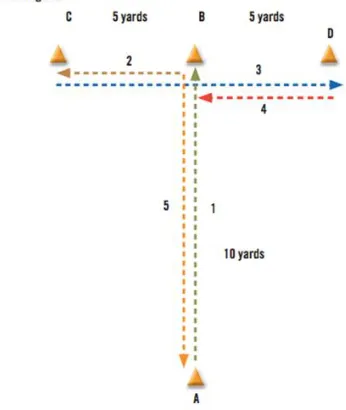
Agility was measured using a T-test (American Council on Exercise, San Diego, CA), which includes forward, lateral, and backward movements (See Figure 1).
Figure 1. T-Test directions.
43 period between trials. The average of the
two closest times was used for data analysis.
Training
Subjects in the FR group participated in instructor-led FR sessions 3 days a week for 6 weeks. The foam roller used during this study was a 5.5” x 13” GRID foam roller
(TriggerPoint, Durham, NC). Subjects
assigned to the FR group were given specific instructions on how to foam roll each body part, including demonstrations by the researchers to ensure correct technique. The subjects then foam rolled their lower back and bilaterally their buttocks, quadriceps, hamstrings, calves, and IT band. Each body part was foam rolled for 20 seconds. The entire sequence was repeated
three times. Each session lasted
approximately 15 minutes. Subjects in both groups were instructed not to change their dietary or exercise habits over the course of the 6-week period. After the 6-week training period, subjects were re-evaluated using the same testing battery as was administered pretesting. Additionally, at the post testing, subjects in the FR group were asked to fill out a Perceived Performance Improvement Questionnaire that consisted of the six questions listed in Table 3.
Statistical analyses
Independent t-tests were performed to
identify any pre-testing differences
between the FR and control groups for each variable. A 2-way (pre-post x group) ANOVA with repeated measures was used to determine differences subsequent to the training period for each variable. When there was a significant F ratio, Tukey’s post-hoc tests were used to make pairwise comparisons. Significance was set at an alpha level of 0.05 to achieve statistical significance. All analyses were conducted using the Statistical Package for the Social Sciences (SPSS, Version 25; SPSS Inc., Chicago, IL.).
Results
All 34 subjects completed the testing and training protocol. Descriptive characteristics of the subjects, subdivided by group, are presented in Table 1. The FR and control groups were similar in age, height, and weight at the start of the study. All subjects in the FR group completed 18 foam rolling sessions during the 6-week training period. If a session was missed during the week, make-up sessions were held on the weekends
Table 1. Descriptive characteristics of subjects in the foam rolling and control groups at the start of the
study (N=34).
44 There was no change in body weight over
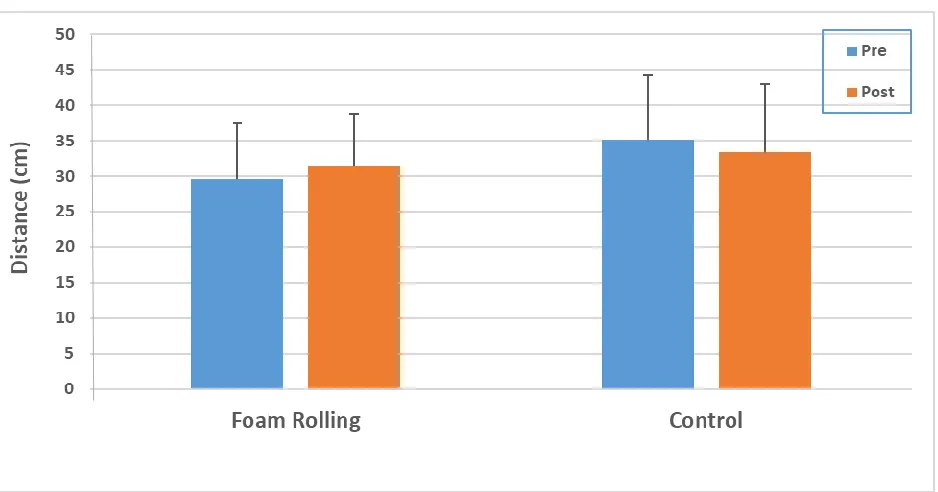
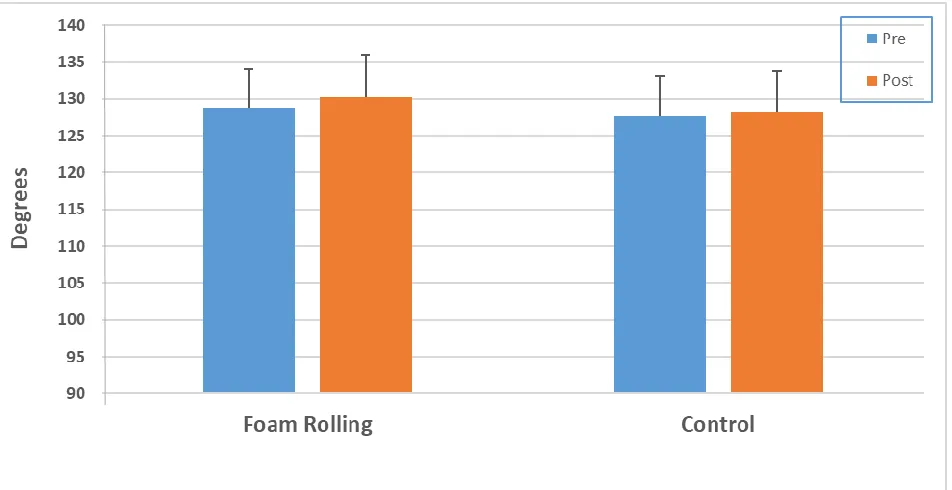
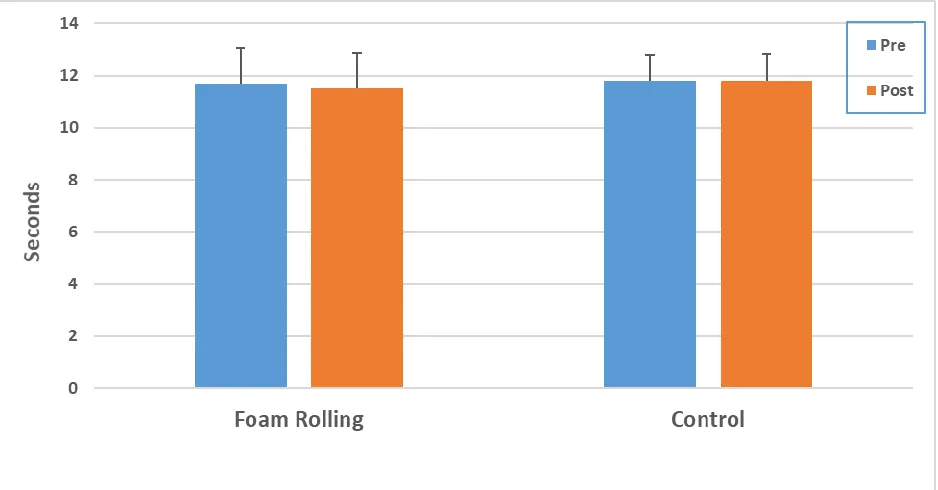
the course of the study for either group. Data for all of the criterion measures are presented in Table 2 and Figures 1-5, respectively. There were no significant pre-testing differences between the FR and control groups for any variable. There were no significant changes in knee ROM, vertical
jump, or T-test time over the course of the study for either group. The FR group had a significant increase in sit-and-reach distance from pre to post testing which was significantly greater than the change in the control group. Both groups had significant improvements in ankle ROM over the course of the study.
Table 2. Changes before and after 6 weeks of foam rolling.
Foam Rolling Control
Pre Post Δ Pre Post Δ Ankle ROM (degrees) 104.3 ± 4.95 107.4 ± 3.75* +3.1 103.0 ± 4.19 107.2 ± 4.69* +4.2
Knee ROM (degrees) 128.8 ± 5.16 130.2 ± 5.81 +1.4 127.6 ± 5.51 128.3 ± 5.39 +0.7 Sit-and-Reach (cm) 29.6 ± 7.78 31.5 ± 7.35* +1.9# 35.1 ± 9.10 33.4 ± 9.65* -1.7
Vertical Jump (cm) 49.5 ± 12.95 50.0 ± 13.74 +0.5 50.0 ± 10.62 49.0 ± 9.42 -1.0 T-Test (sec) 11.7 ± 1.36 11.5 ± 1.38 -0.2 11.8 ± 1.00 11.8 ± 1.04 -0.0 Values represent mean ± standard deviation.
*Significantly different than pre (p<.05). #Change significantly different than change for control group (p<.05).
Figure 2. Change in hamstring flexibility from pre to post-testing. The foam rolling group had a
45
Figure 3. Change in ankle range of motion from pre to post-testing. Both groups had a significant
increase from pre to post-testing.
46
Figure 5. Change in vertical jump height from pre to post-testing.
Figure 6. Change in speed during T-Test from pre to post-testing.
Answers to the Perceived Performance Improvement Questionnaire are presented in Table 3. It was found that the FR group
47
Table 3. Questionnaire answered by foam rolling group asking if they felt improvement in all
performance areas after 6 weeks of foam rolling (N=20).
Yes No
I feel more flexible 17 3
I feel more agile 9 11
I feel like I have more range of motion in my ankle 9 11
I feel like I have more range of motion in my knee 10 10
I feel stronger 10 10
I feel like I can jump higher 15 5
Discussion
The purpose of this study was to determine the training effect of FR on ankle and knee ROM, hamstring flexibility, agility, and vertical jump height. We found no significant changes in knee ROM, vertical jump height, or T-test time over the course of the study. We did find a significant improvement in hamstring flexibility as measured by the sit-and-reach test. The results for ankle ROM were inconclusive, since both the FR and control groups had significant increases over the course of the study.
Several studies have examined the
effectiveness of FR training on
performance. Collectively, the results are inconclusive. Our results are in agreement with two other studies that found significant improvements in hamstring flexibility after completing a FR training
program. Junker and Stöggl14 found
increases in hamstring flexibility after performing 30-40 seconds of FR or 3 sets of contract-relax PNF stretching over the
course of 4-weeks. Mohr et al.4 also found
increases in passive hip-flexion ROM after 2 weeks of FR, static stretching, or after doing a combination of the two, with greater gains observed in the combination group.
In contrast to the findings of the present study, a number of studies did not find significant improvements in hamstring flexibility after completing a FR training program. Bushell et al.15 measured hip
extension angle via functional lunge after three weeks of FR and found no significant improvements acutely or across time. Similarly, it was also found that hamstring flexibility did not increase after 413 or 812
weeks of FR when compared to the control groups. Both groups had subjects FR for 30-60 seconds at a time.
One of the biggest problems when trying to compare the results of different studies is the tremendous variation in study design.
For example, Junker and Stöggl14
incorporated a 5-10 minute general jogging warm-up prior to testing. Bushell et al.15
48 protocols, but subjects were not allowed to
practice. Miller and Rockey12 measured
hamstring flexibility by active knee extension, performed lying supine on a table. Mohr et al.4 measured passive range
of motion, whereby the researchers forced the joint to point of “discomfort” prior to making ROM measurements. Similar to the present study, Scherer13 used a
sit-and-reach test to assess hamstring flexibility, while Junker and Stöggl14 used a
stand-and-reach test, which is the same action as the sit-and-reach, but is done from a standing position.
One of the most common methods used to improve flexibility and joint ROM is static stretching16. Static stretching for 15-60
seconds has been shown to increase flexibility and ROM in a number of studies6.
However, static stretching during warm-up has also been found to decrease force production and muscular force10. It is felt
that the decreased neuromuscular
performance after static stretching may be attributed to stretching-induced sarcomere damage. Damaging the sarcomeres would logically result in reduced force production and muscular performance17. Although FR
may not have resulted in a significant improvement in muscular power in the present study, positively speaking, it did not decrease performance as is seen with static stretching. Foam rolling is thought to enhance soft-tissue pliability, which allows increased joint ROM without causing any
damage to the cross-bridges and
sarcomeres of the muscle7.
There were several limitations involving the methodology of this study which could have impacted results. This study was only
conducted on active, college-aged
individuals. It is possible that additional benefits may be seen in physically inactive
or older adults. Participants were
encouraged not to change their dietary or exercise habits while being a part of this study. However, this was not monitored. The participants in the FR group were instructed how to foam roll each body part, however the amount of pressure exerted by individuals could not be monitored. Subjects foam rolled each body part three times for 20 seconds at a time, for a total of 60 seconds. Other studies typically incorporated longer FR times. Ankle and knee ROM were measured actively meaning the participants flexed their ankle or knee as far as possible. Several other studies had research assistants apply external force to passively move joints into a greater ROM.
Conclusions
49
Disclosures
This study was funded by the American Council on Exercise (ACE). However, ACE was not involved in the design of this study, collection or analysis of the data, or the preparation of this manuscript.
Address for Correspondence
John Porcari, Ph.D., Department of Exercise and Sport Science, 141 Mitchell Hall, University of Wisconsin- La Crosse, La Crosse, WI, United States, 54601. Phone: 608-785-8684; Email: [email protected].
References
1. Thompson WR. (2018). Worldwide survey of fitness
trends for 2019. ACSMs Health Fit J, 22, 10-17.
2. Schleip R, Müller DG. (2013). Training principles for
fascial connective tissues: scientific foundation and suggested practical applications. J Bodyw Mov Ther, 17, 103-115.
3. Hansen A, Beltz NM, Janot J, Martenson A, Siegmann A,
Jagielo A, Erdmann A, Wiggins M. (2016). A dose-response relationship between myofascial release and anaerobic power output in active college-aged males. J
Fit Res, 5, 10-17.
4. Mohr A, Long B, Goad C. (2014). Effect of foam rolling
and static stretching on passive hip-flexion ROM. J Sport
Rehabil, 23, 296-299.
5. Curran PF, Fiore RD, Crisco JJ. (2008). A comparison of
the pressure exerted on soft tissue by 2 myofascial rollers. J Sport Rehabil, 17, 432-442.
6. Hsuan S, Nai-Jen C, Wen-Lan W, Lan-Yuen G, I-Hua C.
(2017). Acute effects of foam rolling, static stretching, and dynamic stretching during warm-ups on muscular flexibility and strength in young adults. J Sport Rehabil, 26, 469-477.
7. MacDonald GZ, Penney MDH, Mullaley ME, Cuconato
AL, Drake CDJ, Behm DG, Button DC. (2013). An acute bout of self-myofascial release increases range of motion without a subsequent decrease in muscle activation or force. J Strength Cond Res, 27, 812-821.
8. Couture G, Karlik D, Glass SC, Hatzel BM. (2015). The
effect of foam rolling duration on hamstring ROM. Open
Orthop J, 9, 450-455.
9. Halperin I, Aboodarda SJ, Button DC, Andersen LL, Behm
DG. (2014). Roller massager improves range of motion of plantar flexor muscles without subsequent decreases in force parameters. Int J Sports Phys Ther, 9, 92.
10. Peacock CA, Krein DD, Silver TA, Sanders GJ, Von
Carlowitz KPA. (2014). An acute bout of self-myofascial release in the form of foam rolling improves performance testing. Int J Exerc Sci, 7, 202-211.
11. Škarabot J, Beardsley C, Štirn I. (2015). Comparing the
effects of self‐myofascial release with static stretching on ankle range‐of‐motion in adolescent athletes. Int J Sports
Phys Ther, 10, 203.
12. Miller JK, Rockey AM. (2006). Foam rollers show no
increase in the flexibility of the hamstring muscle group.
UW-L Undergraduate Research IX.
13. Scherer E. (2013). Effects of utilizing a myofascial foam
roll on hamstring flexibility. Master’s Thesis. Eastern
Illinois University.
14. Junker DH, Stöggl TL. (2015). The foam roll as a tool to
improve hamstring flexibility. J Strength Cond Res, 29, 3480-3485.
15. Bushell JE, Dawson SM, Webster MM. (2015). Clinical
relevance of foam rolling on hip extension angle in a functional lunge position. J Strength Cond Res, 29, 2397-2403.
16. Kalichman L, David CB. (2017). Effect of self-myofascial
release on myofascial pain, muscle flexibility, and strength: a narrative review. J Bodyw Mov Ther, 21, 446-451.
17. Langevin HM. (2006). Connective tissue: a body-wide