ISSN: 2349-7300
ISO 9001:2008 Certified
International Journal of Innovative Research in Engineering & Multidisciplinary Physical Sciences (IJIRMPS)
Volume 1, Issue 2, December 2013
39
Implementation of Six Sigma for Process
Improvement-A Review
Shrikant S Chohan, Ghanshyam
Abstract: at the present time most of the organizations are showing keen interestin using Six Sigma approach to improve their operationsperformance. Motorola coined the concept of Six Sigma andGeneral Electric popularized it. There are two methodologies toimplement Six Sigma: define measure, analyze, improve andcontrol; (DMAIC); and define measure, analyze, design andverify; (DMADV). DMAIC should be used when a product orprocess is in existence at a company but is not as percustomer specifications or is not performing adequatelyDMADV should be used when a product or process is not inexistence and one needs to be developed or when theexisting product or process has been optimized and still doesnot meet the level of customer specification or six sigmalevel. This paper deal with six sigma its implementation for improvement.
Keywords: Six Sigma; DMAIC; defects per million opportunities; DPMO; DMADV;
I. INTRODUCTION
Six Sigma is a business performance improvement strategy that aims to reduce the number of mistakes/defects to as low as 3.4 occasions per million opportunities. Sigma is a measure of “variation about the average” in a process which could be in manufacturing or service industry. Six Sigma improvement drive is the latest and most effective technique in the quality engineering and management spectrum.
Six Sigma seeks to improve the quality of process outputs byidentifying and removing the causes of defects (errors) andminimizing variability in manufacturing and business processes.It uses a set of quality management methods, includingstatistical methods, and creates a special infrastructure of peoplewithin the organization ("Black Belts", "Green Belts", etc.) whoare experts in these methods. Each Six Sigma project carried outwithin an organization follows a defined sequence of steps and has quantified financial targets.The term Six Sigma originated from terminology associated withmanufacturing, specifically terms associated with statistical modeling of manufacturing processes. The maturity of amanufacturing process can be described by a sigma ratingindicating its yield, or the percentage of defect-free products itcreates. A six sigma process is one in which 99.99966% of theproducts manufactured are statistically expected to be free ofdefects (3.4 defects per million). Motorola set a goal of "sixsigma" for all of its manufacturing operations, and this goalbecame a byword for the management and engineering practicesused to achieve it.The six sigma approach was first introduced and developed atMotorola in early 1990s. Later in the mid-nineties, it wasadopted by General Electric and Allied Signal. According toJack Welch CEO of GE "Six sigma is the most challenging andpotentially rewarding strategy GE has ever undertaken". Sixsigma was originally centered around manufacturingimprovements. The reason for this was knowledge of thestatistical tools in the manufacturing functions and the ease withwhich we can quantify the benefits. However theseimprovements were not readily seen by the customers. Theapproach was therefore broadened to all business operations.The success of these companies with the six sigma approachcaught the attention of Wall Street making it a popular strategythat is being adopted by many organizations worldwide. Indianorganizations such as Wipro, Hero Motors, Godrej-GE, ICICIPrudential, and Wipro have also adopted six sigma strategy toimprove their businesses.Six Sigma is a data-driven structured problem solvingmethodology for solving chronic issues facing a business. Sixsigma is a highly disciplined approach used to reduce theprocess variations to the extent that the level of defects aredrastically reduced to less than 3.4 (DPMO). The approach reliesheavily on advanced statistical tools. While these tools havebeen known earlier, these were primarily limited to thestatisticians and quality professionals. Sigma (σ) is Greek letterthat is used to describe variability. In statistical quality control, this means "standard deviation".
II. SIX SIGMA SUCCESS STORY
The BBC has produced a documentary on Mumbaidabbawalas, andPrince Charles, during visit to India, visited
ISSN: 2349-7300
ISO 9001:2008 Certified
International Journal of Innovative Research in Engineering & Multidisciplinary Physical Sciences (IJIRMPS)
Volume 1, Issue 2, December 2013
40
transactions. The Americanbusiness magazine Forbes gave a Six Sigma performance ratingfor the precision of dabbawalas. This rating indicates a 99.9999accuracy percentage of correctness.
III. THE SIX SIGMA APPROACH
Six Sigma is different and its approach is also unique because ofthe following characteristics:
1. Focus on bottom line results
The focus on financial and business results is to some extentunique. Six Sigma usually requires financial returns from mostprojects and from each full-time Six Sigma specialist. Six Sigmaplaces a clear focus on getting bottom line results. Identificationof the business impact is part of the methodology. Six Sigmaprojects are approved only when bottom line impact is shown.
2. Data driven approach
As said by W. Edward Deming “In God we trust, all others mustbring data”, data is the most important resource forimplementation of Six Sigma. Use of specific metrics is alsonew with Six Sigma. Measurement of DPMO, critical-to-quality (CTQ), or process sigma highlights the importance ofimprovement and encourages difficult but attainable goals forimprovement. Six Sigma requires a disciplined approach towardmeasurement and improvement.
3. Human resources
Six Sigma utilizes full-time specialist in the projects contrast topart-time staff in the earlier improvement approaches. Six Sigmaemphasizes on training to Black Belts, Green Belts, etc. SixSigma creates an infrastructure of Champions, Master BlackBelts, Black Belts and Green Belts that lead deploy andimplement the approach.
4. Structured approach
In Six Sigma the deployment approach and structure are new.Six Sigma DMAIC and DMADV methodology sequences andlinks in useful way key statistical and other tools have beenfound to be effective in improving processes.
IV. SIX SIGMA METHODOLOGY
Six Sigma projects follow two project methodologies inspiredby Deming’s Plan-Do-Check-Act cycle. Six Sigma is comprised of various methods that help in increasing the effectiveness andefficiency of business processes. The two approaches to SixSigma are:
1. Define, Measure, Analyze, Improve and Control (DMAIC)
2. Define, Measure, Analyze, Design and Verify (DMADV) DMADV is part of Design for Six Sigma (DFSS).
A. THE SIMILARITIES
Although DMAIC and DMADV are designed for differentbusiness processes, both the methodologies have some basicsimilarities. These are listed below:
-Both the methodologies are used for reducing the number ofdefects to less than 3.4 per million opportunities available forsuch defects to occur.
-Both the methodologies use facts and statistical tools forfinding solutions to common problems, related to quality. Boththe methodologies require the services of Green Belts, BlackBelts and Master Black Belts during the implementation stage.
-Both concentrate on achieving the financial and businessobjectives of an organization.
-Both the methodologies require support from a Champion andProcess Owner during the implementation stage.
B. THE DIFFERENCES
Both the methodologies may share the same first initials, butthat is where the similarities end. The major differences arelisted below:
-DMAIC is associated with defining a business process and itsapplicability whereas DMADV helps in defining customer needsin relation to a product or service.
-DMAIC is used for measuring the current performance of abusiness process whereas DMADV is used for measuring thecustomer needs and specifications.
ISSN: 2349-7300
ISO 9001:2008 Certified
International Journal of Innovative Research in Engineering & Multidisciplinary Physical Sciences (IJIRMPS)
Volume 1, Issue 2, December 2013
41
-In DMAIC, improvements are made in the business process foreliminating or reducing defects whereas in DMADV, anappropriate business model is designed that helps in meetingcustomer requirements.
-In DMAIC, control systems are put in place to keep a check onfuture performance of a business process. In DMADV, thesuggested business model is put through simulation tests forverifying efficacy in meeting customer needs and specifications.DMAIC should be used when a product or process is inexistence at a company but is not as per customerspecifications or is not performing adequately.
-DMADV should be used when a product or process is not inexistence and one needs to be developed or when theexisting product or process has been optimized (either byDMAIC or not) and still does not meet the level of customerspecification or six sigma level. In other words, when theprocess or product, needs overhauling.
C. DMAIC METHODOLOGY
The DMAIC project methodology has five phases:
· Define the problem, the voice of the customer, and theproject goals, specifically. · Measure key aspects of the current process and collectrelevant data.
· Analyze the data to investigate and verify cause-andeffectrelationships. · Improve or optimize the current process based upondata analysis
· Control the future state process to ensure that anydeviations from target are corrected before they result indefects.
STEP 1- DEFINE :Define in the DMAIC process focuses on selecting high-impactprojects and understanding which underlying metric(s) willreflect project success. It defines the goals of the improvementactivity. At the top level, the goals will be strategic objectives ofthe organization such as higher Return on Investment (ROI) ormarket share. At the operations level, a goal might be to increasethe throughput of the production department. At the projectlevel, goals might be to reduce the defect level and increasethroughput.
Important tools used: 1. Brainstorming 2. Pareto Analysis
3. Quality Function Deployment (QFD) 4. Process mapping
5. Project Management tools 6. Voice of Customer 7. Priority Matrix
STEP 2- MEASURE: Measure in DMAIC is about documenting the current process, validating how it is measured, and assessing baselineperformance. It measures the existing system. Establish validand reliable metrics to help monitor progress towards the goalsdefined. The important processes influencing the CTQs areidentified and performance measurement techniquesareestablished for these processes.
Important tools used: 1. Cause and Effect Matrix 2. Creativity Techniques 3. 7 Quality Control tools
4. Gauge Repeatability and Reproducibility( R and R) studies 5. Analysis of Variance (ANOVA)
STEP 3- ANALYZE: The Analyze phase in DMAIC isolates the top causes behind themetric or Critical to Quality (CTQ) that the team is tackling. Itanalyses the system to identify ways to eliminate gap betweenthe current performance of the system or process and the desiredgoal.
Important tools used: 1. Creativity Techniques 2. 7 Quality Control tools 3. ANOVA
4. 5-Why
5. Test of Hypothesis 6. Regression Analysis 7. Multi Variant Analysis
ISSN: 2349-7300
ISO 9001:2008 Certified
International Journal of Innovative Research in Engineering & Multidisciplinary Physical Sciences (IJIRMPS)
Volume 1, Issue 2, December 2013
42
STEP 4- IMPROVE:The phase focuses on fully understanding the top causesidentified in the Analyze phase, with the intent of eithercontrolling or eliminating those causes to achieve breakthroughperformance. This step use creative ways to find new ways todo things better, cheaper or faster. Improvisations in the process are done in order to keep the variables within the specificationlimits.
Important tools used:
1. Design of Experiments (DOE) 2. Confirmation and validation studies 3. Test of Hypothesis
4. ANOVA
5. Regression Analysis
STEP 5- CONTROL: DMAIC’s Control phase is about sustaining the changes made inthe Improve phase to
guarantee lasting results. The best controlsare those that require no monitoring (irreversible product orprocess design changes). Controls are required to ensure thatthe improvements are maintained over time. The modifiedprocess is subjected to vigil at regular intervals of time to ensure that the key variables do not show any unacceptable variations.Important tools used:
1. Control Charts 2. Control Plan 3. Poka YokeTable
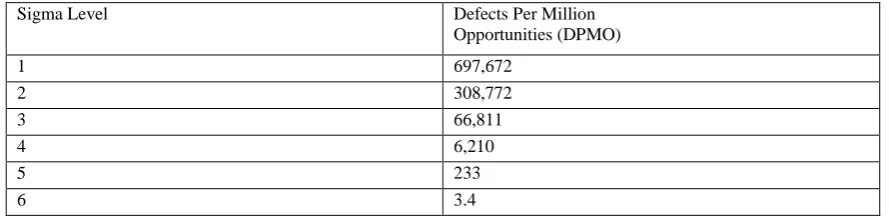
Table 1: Sigma Performance levels
Sigma Level Defects Per Million
Opportunities (DPMO)
1 697,672
2 308,772
3 66,811
4 6,210
5 233
6 3.4
As can be seen from Table 1 six sigma is an improvement ofover twenty thousand times over 3 sigma. An opportunity isdefined as any chance for non-conformance or not meeting the required specifications. Opportunities are the total number ofchances per unit to exhibit a defect. A defect is defined as anypart of a product or service that does not meet customerspecifications or does not fulfill the functional or physicalrequirements.
V. CONCLUSION
A well-defined business process/implementation process can increase customer satisfaction with a company’s high-quality products or services, and be regarded as a key factor to a company’s success as well as long-term competitiveness in the market. The breakthrough improvement using Six Sigma can be achieved, however, to sustain this the organization will have to continue with rigorous implementation and sustenance of the same.The success stories are important to motivate the organization to implement the six sigma .
REFERENCES
[1] Dr. R.L. Shrivastava, K.I. Ahmad, T.N. Desai, “Engine Assembly Quality Improvement using Six Sigma”, WCE2008, July 2-4,2008,London,U.K.
[2] Dr. R.L. Shrivastava, T.N. Desai, “Six Sigma- A New Direction to Quality and Productivity Management”, WCECS 2008, Oct. 22-24, 2008, San Francisco, USA.
[3] H. Wang, “A Review of Six Sigma Approach: Methodology, Implementation and Future Research”, Zhejiang Normal University, Jinhua City, China, pp.1-4.
ISSN: 2349-7300
ISO 9001:2008 Certified
International Journal of Innovative Research in Engineering & Multidisciplinary Physical Sciences (IJIRMPS)
Volume 1, Issue 2, December 2013
43
[5] Y.H. Kwak, F.T. Anbari, “Benefits, Obstacles and Future of Six Sigma Approach”, George Washington University, DC 20052, USA.
[6] J.E. Ferreira, I.S. Lopes, “Improvement of Scrap Request with Six Sigma Methodology”, WCE 2010, June 30-2 July, 2010, London, U.K.
[7] Dr. Larkin Dudley, Dr. J. Wolf, “Six Sigma: A Multidimensional TQM Methodology”, V.P. Institute and State University, Washington, May 10, 2004.
[8] Pande Peter S., “The Six Sigma Way”, Tata McGraw- Hill Edition.
[9] J Antony, A. Kumar, “World Class Application of Six Sigma”, Butterworth-Heinemann Edition.