Agon: a Gamification-Based
Framework for Acceptance
Requirements
Luca Piras
Advisor
Prof. John Mylopoulos
University of Trento (Italy)
Advisor
Prof. Paolo Giorgini
University of Trento (Italy)
We live in the days of social software where social interactions, from simple notifications to complex business processes, are supported by software platforms such as Facebook and Twitter.
But for any social software to be successful, it must be used by a sizeable portion of its intended user community. This is fundamental for social software, but also a crucial point for most of
the software systems in general, and the fulfillment of such (Usage) Acceptance Requirements critically depends on psychological, behavioral and social factors which may influence intrinsic and extrinsic motivations of the user. Operationalization techniques for Acceptance Requirements
largely consist of making a game out of software usage where users are rewarded depending on the degree of their participation. The game, for instance, may be competitive or non-competitive,
depending on the anticipated personality traits of intended users. Making a game out of usage is often referred to Gamification. It has attracted significant attention in the literature for the past
few years because it offers a novel approach to software usage.
Gamification is a powerful paradigm and a set of best practices used to motivate people carrying out a variety of ICT-mediated tasks. Designing gamification solutions and applying
them to a ICT system is a complex and expensive process (in time, competences and money) as software engineers have to cope with heterogeneous stakeholder requirements on one hand, and
Acceptance Requirements on the other, that together ensure effective user participation and a high level of system utilization. As such, gamification solutions require significant analysis and design as well as suitable supporting tools and techniques.
In this thesis, we describe Agon, an Acceptance Requirements Framework based on
Gamifi-cation, for supporting the requirements engineer in the analysis and design of engaging software systems. The framework adopts concepts and design techniques from Requirements Engineer-ing, Human Behavior and Gamification. Agon encompasses both a method and a meta-model
capturing acceptance and gamification knowledge. In particular, the framework consists of a generic acceptance goal meta-model that characterizes the problem space by capturing possible
refinements for acceptance requirements, and a generic gamification meta-model that captures possible gamified operationalizations for acceptance requirements.
The framework is illustrated with the Meeting Scheduler Exemplar and different heterogeneous case studies. In particular, we describe Agon through a real case study concerning the gamification
of a system for collaborative decision-making, within the Participatory Architectural Change MAnagement in ATM Systems (PACAS) European Project. We describe also the Agon-Tool, a tool for enabling the requirements engineer in carrying out the systematic acceptance requirements
analysis of the Agon framework in a semi-automatic supported way.
Keywords
In a world where kindness and the valuable words ‘‘Thank you’’ are becoming more and more rare, I think that this acknowledgments Section is as important as the contributions of this PhD Thesis. Furthermore,Acceptance and Gamification are important topics of this Thesis, and can be used in combination for promoting behavior change, possibly for a positive change. Therefore, I hope that this Section could set also a good example towards fostering people to the positive behavior of saying ‘‘Thank you’’ more often.
I would like to express my deepest gratitude to my supervisors, Professor John Mylopoulos and Professor Paolo Giorgini, for accepting me under their supervision - it has been an incredible honor for me -, and for driving me towards excellent results, for stimulating my research curiosity, for inspiring me, for providing me with very critical, valuable, precious suggestions, decisive for our research work.
Especially, thank you very much Professor John Mylopoulos for your kindness, for influencing me continuously with an incredible enthusiasm and approval towards my research progression, for being decisive, and always tirelessly present, with very precious comments, feedback, suggestions and crucial contributions during my entire path.
In particular, thank you very much Professor Paolo Giorgini for offering me continuously new opportunities for my professional improvement, for supporting our research with all your strengths, for finding unexpected solutions, fixing also the worst situations, for motivating me in continuing in the academic career also after my PhD.
Thanks to the professors who served on my thesis committee: Professor Alistair Sutcliffe, Professor Anna Perini and Professor Fabiano Dalpiaz. Special thanks to Professor Alistair Sutcliffe and Professor Fabiano Dalpiaz, which have been also my referees, for giving me very precious and precise comments that helped me in further improving this Thesis. Many thanks to Professor Anna Perini for inspiring me and collaborating with me concerning very promising, and interesting, future research for integrating my framework with other interesting ones. For the same work, many thanks also to Professor Angelo Susi, in particular for his very original and clever ideas, and Daniele Dellagiacoma for his tireless, worthwhile work.
solution we designed with the framework of this Thesis.
I am extremely thankful to Professor Haris Mouratidis, Professor Michalis Pavlidis, and Dr. Siobhan O’Dowd for believing in me, and offering me the possibility to continue in this ‘‘crazy’’, but very satisfactory academic career at the University of Brighton, with new stimulating challenges.
I am thankful to Professor Roberta Cuel and Professor Diego Ponte for offering me an interdisciplinary vision on the very complex topics of Acceptance andGamification, giving me very valuable suggestions, and for collaborating in future works, we already started, related to the evolution of our framework, by including even more concepts and new theories from other far disciplines.
I am extremely thankful to Professor Nicu Sebe that, in a very tragic moment of my PhD, supported me, and motivated me, to find solutions for not stopping my PhD, and for continuing my PhD career. In fact, thanks to him, this Thesis is a reality. An immeasurable thanks to you, Professor Nicu Sebe.
I am thankful also to Professor Marco Pistore and Dr. Annapaola Marconi for giving me the possibility to start this adventure, to supporting me in the first phase of it, and for giving me opportunities of professional development.
I am very grateful to Dr. Giuseppe Valetto for our very long and interesting discussions on gamification, and on research in general, and for giving an important contribution to the development of my research skills and of my research background, concerning gamification, and research in general.
Many thanks also to the other members of the groups of Professor Marco Pistore and Dr. Annapaola Marconi, that contributed to a fruitful collaboration, in particular: Dr. Antonio Bucchiarone, Dr. Raman Kazhamiakin, Dr. Heorhi Raik, Dr. Martina De Sanctis, Mattia Bortolamedi, Mirko Perillo and Nawaz Khurshid.
Furthermore, It has been an honor for me to co-supervise Master and Bachelor students, concerning their Theses and internships, with Professor John Mylopoulos, Professor Paolo Giorgini, Professor Anna Perini and Professor Angelo Susi. Thank you very much to these Professors for giving me such opportunities. Special thanks to the students I co-supervised, i.e. Daniele Dellagiacoma, Gedefew Mehari Melaku, Feleke Alie Gedibew, Carlo Nicol´o, Federico Calabrese and Enrico Micheli, for taking part to some case studies of this Thesis, and for carrying out some interesting activities by proposing good ideas.
at international conferences our works, and for spending worthwhile time together. Special thanks to Martina for sharing with me the first part of my PhD, and for supporting together continuously, and this also now from time to time.
I am very grateful to Mattia (Bortolamedi) for having shown me many nice places of Trento (Italy), for his special kindness, very rare to find in a common person, and for our amazing, and sometimes crazy, rides in the wonderful bike lanes of Trentino Alto Adige. Special thanks to the very nice city of Trento for hosting me.
Furthermore, it is nice to notice that I have written this thesis really everywhere. In all kinds of transports, i.e. planes, trains and even ships!!! And in many wonderful Countries, for instance Greece, Spain, The Netherlands, UK, Germany, Italy, my Sardinia island (Italy), etc. I have encountered many nice people and researchers, probably I am forgetting somebody, so I would like to say thank you also to all of them, and to every person that I could have forgot here, thank you.
Finally, last but not the least, the following lovable people. First of all Patrizia, my girlfriend that lives with me, and with me tackled all the challenges related to this amazing, but very tough adventure. She gave me immeasurable help concerning everything, mental and physical support. I am extremely grateful to you, thank you so much Patrizia :)
The same for my parents, Consolata and Roberto that motivate and support me in all the imaginable ways, and even more, with unconditional love. I am extremely grateful to you both, thank you so much mum and dad :) Furthermore, special thanks to Roberto, my father, for supporting me in the statistical analysis of some experimental data collected.
Special thanks to my entire family (especially, my aunt Palmira and uncle Benedetto, my cousins Andrea, Fabio and Daniela), the family of Patrizia, our friends in Trento, Cagliari and Birmingham, for continuously motivating me. Especially, thank you Al´ı, Alessio, Carlo and Giorgio, some of my best friends. Special thanks to my CSI swimming pool group in Trento (Italy) for our very nice, useful group workouts, dinners and speech.
Thank you very much also to my beloved that are no more with us. In particular, to my aunt Teresa, uncle Luigi and Mrs. Tonina, the mother of Patrizia that, unfortunately, passed away during my PhD and, above all, writing this Thesis.
Finally, I would like to dedicate this thesis to the most important people of my life: Patrizia, mum Consolata and dad Roberto.
Luca
Foundations for Software Evolution’’.
This work has received funding from the SESAR Joint Undertaking under grant agreement No 699306 (PACAS) under European Union’s Horizon 2020 research and innovation programme.
This work was partially supported by the European Union’s Horizon 2020 research and innovation programme under grant agreement No 653642 (VisiOn).
This work was partially supported by the European Union’s ICT 2014 (Informa-tion and Communica(Informa-tion Technologies Programme) under grant agreement No 644018 (SUPERSEDE).
This work was partially supported by the European Union Seventh Framework Pro-gramme (FP7/2007-2013) under grant agreement No 608991 (STREETLIFE).
1 Introduction 1
1.1 Acceptance Analysis and Gamification Engineering . . . 1
1.1.1 Acceptance Analysis . . . 2
1.1.2 Gamification Engineering . . . 3
1.1.3 A Successful Example of Acceptance and Gamification Engineering 5 1.2 Research Questions and Challenges . . . 6
1.3 Research Approach and Contributions . . . 12
1.4 Research Overview . . . 20
1.4.1 The Agon Framework . . . 21
1.4.2 Acceptance Requirements Analysis . . . 24
1.4.3 Acceptance Requirements Analysis with an Example . . . 24
1.5 Structure of the Thesis . . . 25
1.6 Published Work . . . 28
2 State of the Art 31 2.1 Acceptance and Acceptance Requirements . . . 32
2.1.1 Acceptance Requirements and Operationalization Techniques . . . 32
2.1.2 Acceptance Requirements and Agon . . . 33
2.1.3 Acceptance Models . . . 34
2.2 Gamification Engineering . . . 41
2.2.1 Importance of Gamification for Heterogeneous Fields . . . 42
2.2.2 Main Gamification Activities, Challenges and Concepts . . . 45
2.2.3 Gamification Frameworks . . . 51
2.3 Acceptance, Gamification and Requirements Engineering . . . 54
2.3.1 Acceptance and Requirements Engineering . . . 55
2.3.2 Gamification and Requirements Engineering . . . 55
2.4.1 Human and Organizational Behavior Studies . . . 58
2.4.2 Agon and the Motivational Antecedents Framework . . . 59
2.5 Chapter Summary . . . 60
3 Gamification of Software Systems 61 3.1 Gamification for Sustainable Urban Mobility . . . 62
3.1.1 Using Gamification to Incentivize Sustainable Urban Mobility . . . 62
3.1.2 Research Context . . . 64
3.1.3 Technical solution . . . 65
3.1.4 The Experiment and The Gamified ViaggiaRovereto App . . . 68
3.1.5 Evaluation . . . 73
3.1.6 Summary and Future Work . . . 78
3.2 Gamification for Mobility Assistance for Children . . . 78
3.2.1 Virtual Coaches for Mission-Based Gamified Smart Communities . 79 3.2.2 Research Context . . . 80
3.2.3 Mobility Assistance for Children . . . 81
3.2.4 Characteristics of the Virtual Coaches . . . 82
3.2.5 Summary and Future Work . . . 84
3.3 Requirements of a Framework for the Design of Engaging Software . . . . 84
3.4 Chapter Summary . . . 90
4 Agon: an Acceptance Requirements Framework Based on Gamification 91 4.1 Acceptance Requirements and Agon . . . 91
4.1.1 Acceptance Requirements Definition . . . 92
4.1.2 Acceptance Requirements Examples . . . 93
4.2 An Acceptance Requirements Framework and Its Multi-Layer Meta-Model 94 4.2.1 The User Context Model . . . 97
4.2.2 The Acceptance Meta-Model . . . 99
4.2.3 The Tactical Meta-Model . . . 104
4.2.4 The Gamification Meta-Model . . . 106
4.2.5 The Instantiation Model . . . 110
4.3 Chapter Summary . . . 111
5 The Agon Method and Tool 113 5.1 The Agon Method . . . 114
5.1.1 The Doodle-Like Meeting Scheduler Exemplar (DLMSE) . . . 115
5.1.5 Phase 4: Context-Based Analysis of Acceptance Requirements . . . 119
5.1.6 Phase 5: Acceptance Requirements Refinement . . . 121
5.1.7 Phase 6: Context-Based Operationalization via Gamification . . . . 124
5.1.8 Phase 7: Domain-Dependent Instantiation of Incentive Mechanisms 125 5.1.9 The Gamified Doodle-Like Meeting Scheduler in a Nutshell . . . 126
5.1.10 Final Remarks . . . 129
5.2 The Agon-Tool . . . 129
5.2.1 The Agon-Tool Architecture and Technologies . . . 129
5.2.2 Using the Agon-Tool . . . 134
5.3 Chapter Summary . . . 147
6 Applying Agon to a Real Case 149 6.1 Participatory Architectural Change MAnagement in ATM Systems (PACAS)149 6.1.1 The PACAS European Project . . . 150
6.1.2 The PACAS Platform . . . 150
6.2 Gamification for Architectural Change Management in ATM Systems . . . 151
6.2.1 Case Study: Agon Applied to the PACAS Platform . . . 151
6.3 Gamification of the PACAS Platform . . . 162
6.3.1 Acceptance Analysis, Gamification Design and Implementation . . 165
6.3.2 The Challenger Path . . . 169
6.3.3 The Problem Solver Path . . . 178
6.3.4 The PACAS Platform Expertise Path . . . 180
6.3.5 Gamified Tutorials . . . 181
6.3.6 The Co-Pilot Avatar . . . 182
6.3.7 The Gamification Experience in the PACAS Platform . . . 182
6.4 Chapter Summary . . . 195
7 Evaluation 197 7.1 Evaluation Approach . . . 197
7.1.1 Evaluation Phases Overview . . . 198
7.2 Phase 1: Evaluation with Non-Experts in Realistic Cases . . . 202
7.2.1 Gamification for Meeting Scheduling . . . 203
7.2.2 Gamification for Food Services (the Smart Canteen) . . . 205
7.3.1 Gamification for Sustainable Urban Mobility (SUM) . . . 211
7.3.2 Gamification for Mobility Assistance for Children (MA4C) . . . 211
7.3.3 Gamification for Project Management . . . 212
7.3.4 Gamification for Privacy Requirements (VisiOn EU Project) . . . . 213
7.3.5 Gamification for Collaborative Requirements Prioritization (SUPER-SEDE EU Project) . . . 214
7.4 Phase 3: Evaluation with Experts in a Real Case . . . 215
7.5 Phase 4: Evaluation with Users in a Real Case . . . 217
7.6 Discussion . . . 218
7.6.1 Results of the Case Studies and Experiments . . . 219
7.6.2 Ideas, Potential Improvements and Considerations . . . 234
7.6.3 Threats to Validity . . . 240
7.7 Chapter Summary . . . 245
8 Conclusions and Future Work 247 8.1 Summary . . . 248
8.2 Limitations, Ongoing and Future Work . . . 252
8.2.1 Agon Meta-Model Evolution . . . 252
8.2.2 Agon Method Evolution: Functional Improvements . . . 254
8.2.3 Agon Method Evolution: Usability Improvements . . . 256
8.2.4 Context Dependency . . . 256
8.2.5 Enhanced Automation: System Typologies . . . 257
8.2.6 User Case Studies and Experiments . . . 258
8.3 Importance of Extending and Integrating Agon . . . 258
8.4 Agon Extension Guidelines and Integration with the MAF Framework . . 259
8.4.1 Requirements Engineering and Organizational Behavior Techniques for Software Acceptance Analysis and Gamification Design . . . 261
8.4.2 The Motivational Antecedents Framework (MAF) . . . 264
8.4.3 Case Study Using Agon and MAF . . . 267
8.4.4 Comparison of Agon and MAF . . . 270
8.4.5 Guidelines for Extending and Integrating Agon . . . 274
8.4.6 Discussion and Conclusions . . . 276
8.5 Integrating Agon with Design Thinking . . . 277
8.5.1 Towards Identifying Key Requirements for a Collaborative Gamifi-cation Design Method . . . 279
8.6.1 A Full Stack Framework . . . 284 8.6.2 An Adaptive Gamification Framework for Long-Term Engagement 284 8.6.3 A Holistic Framework for The Design of Engaging Software . . . . 286 8.6.4 A Collaborative Method for the Design of Engaging Software . . . . 286 8.6.5 Future Operationalizations of Acceptance Requirements . . . 287
1.1 Evaluation activities and research methods [Wohlin et al., 2012] of this thesis 17 2.1 Acceptance models . . . 36 3.1 Sustainable mobility recommendation acceptance [Kazhamiakin et al., 2015] 75 3.2 Trips using bike sharing and car modes [Kazhamiakin et al., 2015] . . . 76 6.1 Gamification design of the Challenger Path within the PACAS platform
[Pi-ras et al., 2017b] . . . 169 6.2 Gamification design of the Problem Solver Path within the PACAS
plat-form [Piras et al., 2017b] . . . 179 6.3 Gamification design of the PACAS Platform Expertise Path within the
PACAS platform [Piras et al., 2017b] . . . 180 7.1 Experts and non-experts involved in the evaluations . . . 198 7.2 Case studies and experiments of this thesis . . . 200 7.3 Evaluation activities of Eval1 (Table 1.1 and Table 7.2) with non-experts 204 7.4 Experiment activities of Eval2 (Table 1.1 and Table 7.2) with non-experts 207 7.5 High-level pattern of evaluation activities for Eval3 (Table 1.1 and
Ta-ble 7.2) with non-experts . . . 210 7.6 Evaluation activities of Eval4 (Table 1.1 and Table 7.2) with experts . . . 216 7.7 Evaluation activities of Eval5 (Table 1.1 and Table 7.2) with real users . 218 7.8 Answers to a question of the Eval2 questionnaire, Phase 1: Evaluation
7.9 Answers to a question of the Eval2 questionnaire, Phase 1: Evaluation with Non-Experts in Realistic Cases, confirming that participants, without using Agon, realized that they were selecting concepts that, actually, were not the most suitable ones for the intended users . . . 221 7.10 Answers to a question of the Eval2 questionnaire, Phase 1: Evaluation
with Non-Experts in Realistic Cases, confirming that participants, without using Agon, realized that they were selecting concepts that, actually, were not the most suitable ones for fulfilling psychological factors and strategies fitting the intended users . . . 222 7.11 Answers to a question of the Eval2 questionnaire, Phase 1: Evaluation
with Non-Experts in Realistic Cases, confirming that Agon gamification suggestions inspire the analyst, by giving more elements to consider than the ones an analyst can have in mind . . . 222 7.12 Answers to a question of the Eval2 questionnaire, Phase 1: Evaluation
with Non-Experts in Realistic Cases, confirming that Agon gamification suggestions provide the analyst with more details, and useful guidelines, concerning characteristics of gamification concepts to consider during the design of a gamification solution . . . 223 7.13 Answers to a question of theEval2questionnaire, Phase 1: Evaluation with
Non-Experts in Realistic Cases, confirming that employing a systematic approach, e.g. the one of Agon, for gamifying a system is better, because al-lows the analyst to design more exhaustive, complete and effective solutions for motivating the intended users . . . 224 7.14 Answers to a question of theEval2questionnaire, Phase 1: Evaluation with
Non-Experts in Realistic Cases, confirming that by using Agon, an analyst can execute a systematic acceptance requirements analysis for gamifying a system . . . 224 7.15 Answers to a question of the Eval2 questionnaire, Phase 1: Evaluation
with Non-Experts in Realistic Cases, confirming that the systematic method of Agon supports the analyst in considering most of the psychological factors and strategies, which can affect positively intended users . . . 225 7.16 Answers to a question of the Eval2 questionnaire, Phase 1: Evaluation
of Eval2 with non-experts . . . 228 7.18 Answers to a question of the Eval5 questionnaire, Phase 4: Evaluation
with Users in a Real Case, confirming that the requirement considering the importance of stimulating the user to collaborate with the others, in the PACAS platform, is relevant . . . 230 7.19 Answers to a question of theEval5questionnaire, Phase 4: Evaluation with
Users in a Real Case, confirming that the anti-requirement considering the importance of avoiding competition among users, in the PACAS platform, is relevant . . . 231 7.20 Answers to a question of the Eval5 questionnaire, Phase 4: Evaluation
with Users in a Real Case, confirming that the anti-requirement considering the importance of avoiding time pressure among users, in the PACAS platform, is relevant . . . 231 7.21 Answers to a question of the Eval5 questionnaire, Phase 4: Evaluation
with Users in a Real Case, confirming that the gamification design of the PACAS platform can stimulate the user in participating actively to the PACAS activities . . . 232 7.22 Answers to a question of the Eval5 questionnaire, Phase 4: Evaluation
with Users in a Real Case, confirming that the gamification design of the PACAS platform can favor collaboration among users . . . 232 7.23 Answers to a question of the Eval5 questionnaire, Phase 4: Evaluation
with Users in a Real Case, confirming that the gamification design of the PACAS platform can favor communication among users . . . 233 7.24 Answers to a question of the Eval5 questionnaire, Phase 4: Evaluation
with Users in a Real Case, confirming that the gamification design of the PACAS platform can stimulate the user in checking and improving, more frequently, the PACAS solutions . . . 233 7.25 Answers to a question of theEval5questionnaire, Phase 4: Evaluation with
1.1 Abstraction layers of Agon with a simple example: an extract from the Doodle-Like Meeting Scheduler Exemplar [Piras et al., 2016, 2017a] . . . . 22 3.1 Architecture of the gamification framework [Kazhamiakin et al., 2015] . . . 66 3.2 Software features of theNot Gamified ViaggiaRoveretomobile app
[Kazhami-akin et al., 2015, Nurminen et al., 2014b] . . . 70 3.3 Certificate of attendance with game results (left) [Kazhamiakin et al., 2015]
and recommendations from Viaggia Rovereto App (right) [Kazhamiakin et al., 2015] . . . 71 3.4 Gamified software features of theGamified ViaggiaRoveretomobile app
[Kazhami-akin et al., 2015, 2016, Nurminen et al., 2014b] . . . 72 3.5 Distribution of saved trips per user during the experiment [Kazhamiakin
et al., 2015] . . . 74 3.6 Percentage of Km traveled for each mode of transport [Kazhamiakin et al.,
2015] . . . 76 4.1 Agon models at different abstraction layers, and the context model,
com-posing the Agon Multi-Layer Meta-Model [Piras et al., a, 2016, 2017a,b] . . 95 4.2 Context dependent rules, gamification goals and tactics [Piras et al., 2017b] 98 4.3 TheUser Context Model of the Agon Multi-Layer Meta-Model, also available
at [Piras et al., a] . . . 100 4.4 An extract of the Agon acceptance meta-model [Piras et al., 2017b] based
on UTAUT [Venkatesh et al., 2003] . . . 101 4.5 Graphical notation followed by main elements of the Acceptance Meta-Model102 4.6 The Agon multi-layer meta-model with a project management example
4.9 Left part of an extract of the Gamification Meta-Model (right part in Figure 4.10) related to the gamification concept of Levels [Piras et al., 2017b]108 4.10 Right part of the extract of the Gamification Meta-Model (left part in
Figure 4.9) related to the gamification concept of Levels [Piras et al., 2017b]109 4.11 Graphical notation offered by Agon for instantiating the gamification
solu-tions suggested by building the instantiation model . . . 110 5.1 The target group of users (professors), of the Doodle-Like Meeting Scheduler
case study [Piras et al., 2017a], defined by instantiating the User Context Model of Agon [Piras et al., a, 2016, 2017a] . . . 116 5.2 Acceptance Need contributions annotated by CDRs [Piras et al., 2016] . . 119 5.3 Example of elements discarded by the analyst during ‘‘Phase 4:
Context-Based Analysis of Acceptance Requirements’’ [Piras et al., a, 2016, 2017a] 120 5.4 Example of elements confirmed by the analyst during ‘‘Phase 4:
Context-Based Analysis of Acceptance Requirements’’ [Piras et al., a, 2016, 2017a] 120 5.5 Elements proposed by Agon to the analyst during ‘‘Phase 5: Acceptance
Requirements Refinement’’ [Piras et al., a, 2016, 2017a] . . . 121 5.6 Operationalizations proposed by Agon to the analyst during ‘‘Phase 5:
Ac-ceptance Requirements Refinement (red Xs are the analyst’s decisions)’’ [Pi-ras et al., a, 2016, 2017a] . . . 121 5.7 Additional elements proposed by Agon to the analyst during ‘‘Phase 5:
Acceptance Requirements Refinement’’ (the elements circled in green are the additional ones selected now, and the elements circled in orange are the ones chosen previously) [Piras et al., a, 2016, 2017a] . . . 123 5.8 Solution proposed by Agon, after reasoning over the gamification model
(‘‘Phase 6: Context-Based Operationalization via Gamification’’), in relation to the Badge gamification concept [Piras et al., a, 2016, 2017a] . . . 125 5.9 Example of customization and instantiation of gamification solutions
pro-posed by Agon, performed in ‘‘Phase 7: Domain-Dependent Instantiation of Incentive Mechanisms’’, regarding the Leader-boards gamification con-cept [Piras et al., a, 2016, 2017a] . . . 126 5.10 Example of instantiation and customization of gamification solutions
of Incentive Mechanisms’’, concerning Redeemable Points (RP) achievable through Leader-boards [Piras et al., a, 2016, 2017a] . . . 128 5.12 Acceptance solution obtained at the conclusion of ‘‘Phase 4: Context-Based
Analysis of Acceptance Requirements’’, i.e. the result of Context-Based reasoning over the Acceptance Model and analyst’s decisions [Piras et al., 2016, 2017a] (elements discarded by the reasoning or by the analyst have been removed to have a clear view of the result); Figure available at [Piras et al., a] . . . 130 5.13 Solution obtained at the conclusion of ‘‘Phase 5: Acceptance Requirements
Refinement’’ (elements circled in orange and green are the selected tac-tics; green ones are the additional tactics chosen in the last part of this phase) [Piras et al., a, 2016, 2017a] . . . 131 5.14 Agon-Tool: the prototype that supports the usage of Agon and its method 132 5.15 Architecture of the Agon-Tool Java web application . . . 133 5.16 Support provided by the Agon-Tool to the requirements analyst in ‘‘Phase
1: Base System Requirements’’ [Piras et al., a, 2016, 2017a] . . . 135 5.17 Support provided by the Agon-Tool to the requirements analyst in ‘‘Phase
2: Acceptance Requirements Elicitation and Analysis (first part: guide-lines)’’ [Piras et al., a, 2016, 2017a] . . . 137 5.18 Support provided by the Agon-Tool to the requirements analyst in ‘‘Phase 2:
Acceptance Requirements Elicitation and Analysis (second part: functions selection)’’ [Piras et al., a, 2016, 2017a] . . . 138 5.19 Support provided by the Agon-Tool to the requirements analyst in ‘‘Phase
3: Context Characterization’’ [Piras et al., a, 2016, 2017a] . . . 139 5.20 Support provided by the Agon-Tool to the requirements analyst in ‘‘Phase
4: Context-Based Analysis of Acceptance Requirements’’ [Piras et al., a, 2016, 2017a] . . . 140 5.21 Support provided by the Agon-Tool to the requirements analyst in ‘‘Phase 5:
Acceptance Requirements Refinement (part ‘‘a’’: selection of tactics)’’ [Pi-ras et al., a, 2016, 2017a] . . . 142 5.22 Support provided by the Agon-Tool to the requirements analyst in ‘‘Phase
5.23 Support provided by the Agon-Tool to the requirements analyst in ‘‘Phase 6: Context-Based Operationalization via Gamification’’ [Piras et al., a, 2016, 2017a] . . . 145 5.24 Support provided by the Agon-Tool to the requirements analyst in ‘‘Phase
7: Domain-Dependent Instantiation of Incentive Mechanisms’’ [Piras et al., a, 2016, 2017a] . . . 147
6.1 Example of elements suggested by Agon during ‘‘Phase 4: Context-Based Analysis of Acceptance Requirements’’ [Piras et al., a] . . . 153 6.2 Example of analyst’s decisions on elements suggested by Agon during
‘‘Phase 4: Context-Based Analysis of Acceptance Requirements’’, related to keeping the Improve Perceived Ease of Useneed [Piras et al., a] . . 154 6.3 Example of analyst’s decisions (represented by red Xs) on elements
sug-gested by Agon during ‘‘Phase 4: Context-Based Analysis of Acceptance Requirements’’, related to discarding theImprove Ease of Useneed [Piras et al., a] . . . 154 6.4 Elements proposed by Agon to the analyst during ‘‘Phase 5: Acceptance
Requirements Refinement’’ and analyst’s decisions as red Xs [Piras et al., a]155 6.5 Operationalizations proposed by Agon to the analyst during ‘‘Phase 5:
Ac-ceptance Requirements Refinement (red Xs are the analyst’s decisions)’’ [Pi-ras et al., a] . . . 156 6.6 Additional elements proposed by Agon to the analyst during ‘‘Phase 5:
Acceptance Requirements Refinement’’ (the elements circled in green are the additional ones selected now, and the elements circled in orange are the ones chosen previously) [Piras et al., a] . . . 157 6.7 Solution proposed by Agon, after reasoning over the gamification model
(‘‘Phase 6: Context-Based Operationalization via Gamification’’), in relation to the kinds of user roles to use in the gamification design [Piras et al., a, 2017b] . . . 158 6.8 Example of decision taken by the analyst, regarding the Leader-boards
of Incentive Mechanisms’’, regarding the Path gamification concept [Piras et al., a, 2017b] . . . 159 6.10 Example of customization and instantiation of gamification solutions
pro-posed by Agon, performed in ‘‘Phase 7: Domain-Dependent Instantiation of Incentive Mechanisms’’, regarding Levels of the PACAS Challenge Proposer Path (also called Challenger Path) [Piras et al., a, 2017b] . . . 160 6.11 Some of the gamification elements implemented in the PACAS platform
according to the Agon solution [Piras et al., 2017b] . . . 163 6.12 Pillars of the PACAS platform and some of the gamification elements
implemented in the PACAS platform according to the Agon solution [Paja et al., 2018, Piras et al., 2017b] . . . 164 6.13 Customization and instantiation of gamification solutions proposed by
Agon, performed in ‘‘Phase 7: Domain-Dependent Instantiation of Incentive Mechanisms’’, regarding the Path gamification concept [Piras et al., a, 2017b]167 6.14 Sequence diagram showing the gamification mechanism of challenges
imple-mented in the PACAS platform [Piras et al., 2017b] . . . 168 6.15 The high-level part of the instantiation of rules specifying conditions for
progressing in theChallenge Proposer Path through theChallenges gam-ification concept (‘‘Phase 7: Domain-Dependent Instantiation of Incentive Mechanisms’’) [Piras et al., a, 2017b] . . . 171 6.16 The high-level part of the instantiation of rules specifying conditions for
progressing in theChallenge Proposer Path through theChallenges gam-ification concept (‘‘Phase 7: Domain-Dependent Instantiation of Incentive Mechanisms’’); specifically, this instantiate the rules for the Novice Lev-els [Piras et al., a, 2017b] . . . 172 6.17 The high-level part of the instantiation of rules specifying conditions for
6.18 The high-level part of the instantiation of rules specifying conditions for progressing in theChallenge Proposer Path through theChallenges gam-ification concept (‘‘Phase 7: Domain-Dependent Instantiation of Incentive Mechanisms’’); specifically, this instantiate the rules for the Expert Lev-els [Piras et al., a, 2017b] . . . 174 6.19 The high-level part of the instantiation of rules specifying conditions for
progressing in theChallenge Proposer Path through theChallenges gam-ification concept (‘‘Phase 7: Domain-Dependent Instantiation of Incentive Mechanisms’’); specifically, this instantiate the rules for the Master Lev-els [Piras et al., a, 2017b] . . . 175 6.20 The high-level part of the instantiation of rules specifying conditions for
progressing in theChallenge Proposer Path through theChallenges gam-ification concept (‘‘Phase 7: Domain-Dependent Instantiation of Incentive Mechanisms’’); specifically, this instantiate the rules for the Guru Lev-els [Piras et al., a, 2017b] . . . 176 6.21 The screen that is shown after the first time login in the gamified PACAS
platform, and the PACASCo-Pilot(theAvatargamification concept) [Dalpiaz et al., 2017, Giorgini et al., 2017, Piras et al., 2017b] . . . 184 6.22 The Co-Pilot (the Avatar gamification concept) of the gamified PACAS
platform guiding the user in managing invitations [Dalpiaz et al., 2017, Giorgini et al., 2017, Piras et al., 2017b] . . . 185 6.23 The Co-Pilot (the Avatar gamification concept) of the gamified PACAS
platform and the STS-ML Editor (one of the modeling editors of PACAS) [Dalpiaz et al., 2017, Giorgini et al., 2017, Piras et al., 2017b] . . . 187 6.24 The Co-Pilot (the Avatar gamification concept) of the gamified PACAS
platform showing to the user her game results, and guiding her concerning how to progress in the game [Dalpiaz et al., 2017, Giorgini et al., 2017, Piras et al., 2017b] . . . 188 6.25 The Co-Pilot (the Avatar gamification concept) of the gamified PACAS
platform showing achieved results, and rewarding the user [Dalpiaz et al., 2017, Giorgini et al., 2017, Piras et al., 2017b] . . . 189 6.26 Gamified Tutorialsof the gamified PACAS platform [Dalpiaz et al., 2017,
Giorgini et al., 2017, Piras et al., 2017b] . . . 189 6.27 A Gamified Tourin the gamified PACAS platform [Dalpiaz et al., 2017,
2017b] . . . 191 6.29 Button for throwing Gamified Challenges, in the top right corner of the
screen, in the gamified PACAS platform [Dalpiaz et al., 2017, Giorgini et al., 2017, Piras et al., 2017b] . . . 193 6.30 Form for throwing a Gamified Challenge in the gamified PACAS
plat-form [Dalpiaz et al., 2017, Giorgini et al., 2017, Piras et al., 2017b] . . . . 193 6.31 Page of theGamified Challengesin the gamified PACAS platform [Dalpiaz
et al., 2017, Giorgini et al., 2017, Piras et al., 2017b] . . . 194 6.32 Dialog for voting a Gamified Challenges in the gamified PACAS
plat-form [Dalpiaz et al., 2017, Giorgini et al., 2017, Piras et al., 2017b] . . . . 195 7.1 Answers scale of the semi-structured questionnaires related to the
experi-ments/case studies (Table 1.1 and Table 7.2) of this thesis . . . 220 8.1 The big picture including graphical representations of ongoing, future work
and future lines of research that could be started on the basis of this thesis 252 8.2 Screenshot of the big picture focusing on the Agon Meta-Model Evolution . 253 8.3 Screenshot of the big picture focusing on the Agon Method Evolution . . . 255 8.4 Context variables relevant for the acceptance and gamification requirements
analysis and design [Piras et al., 2017a] . . . 262 8.5 The Motivational Antecedents Framework and its context variables [Piras
et al., 2017a] . . . 265 8.6 Motivational Antecedents Framework and its elements highlighted (in bold)
for this study [Piras et al., 2017a] . . . 268 8.7 Comparison of the context variables of the two frameworks [Piras et al.,
2017a] . . . 271 8.8 Screenshot of the big picture focusing on future lines of research for making
Agon a Full Stack Framework and an Adaptive Framework . . . 285 8.9 Screenshot of the big picture focusing on future lines of research for
inte-grating Agon with other Frameworks and Methodologies coming from other fields . . . 287 8.10 Operationalizations of acceptance requirements related to future lines of
Introduction
The success of software systems highly depends on the user engagement. Thus, to deliver engaging systems, software has to be designed carefully taking into accountAcceptance Requirements [Piras et al., 2017b] such as ‘‘70% of users will use the system’’ [Piras et al., 2016], and the psychological factors that could influence users to use the system [Piras et al., 2017a]. Analysis can then consider mechanisms that affect these factors, such as Gamification (making a game out of system use) [Piras et al., 2017a,b], advertising, incentives and more [Piras et al., 2016].
In this thesis, we propose a Systematic Acceptance Requirements Analysis Framework
based onGamification for supporting the requirements engineer in analyzing and designing engaging software systems [Piras et al., 2016, 2017a,b]. Our framework, namedAgon [Piras et al., 2016], encompasses both a method [Piras et al., 2017a] and a meta-model [Piras et al., 2017b] capturing acceptance and gamification knowledge.
The rest of this chapter is structured as follows. Section 1.1 discusses Software Acceptance Analysis and Gamification Engineering. Section 1.2 states our research objective, presents related research questions and challenges. Section 1.3 outlines our research approach, adopted to address research questions, by highlighting our contributions and research methods used. Section 1.4 provides an overview of our research. Section 1.5 illustrates the structure of this thesis. Section 1.6 concludes listing the publications this research has produced.
1.1
Acceptance Analysis and Gamification Engineering
1.1. ACCEPTANCE ANALYSIS AND GAMIFICATION ENGINEERING
acceptance and gamification. Finally, we conclude with a real example of a successful app designed considering both acceptance and gamification concepts.
1.1.1 Acceptance Analysis
Usage is becoming the main factor that determines the success of a software system [Hamari et al., 2014, Pedreira et al., 2015, Zichermann and Cunningham, 2011], especially so for social software such as Twitter and Facebook. In fact, the human aspect has to be deeply taken into account and addressed by building into a system strategies for stimulating the user to carry out activities that the system supports. For instance, if we consider Facebook, its success resides mainly on people’s participation in platform activities. In fact, if people stop posting videos, comments, etc., the entire system would be deemed a failure. Thus, to guarantee the success of such a system, it is essential that users use functions of the system [Pedreira et al., 2015, Zichermann and Cunningham, 2011]. According to this, in order to maximize the usage and participation, favoring the success of a system, it is important to analyze and design a system considering also requirements for engaging the user [Zichermann and Cunningham, 2011]. Such requirements deal with acceptance aspects [Davis et al., 1989, Hamari et al., 2014, Venkatesh and Davis, 2000, Venkatesh et al., 2003], and, thus, we can call them Acceptance Requirements.
Acceptance Requirements and how to fulfill them have been receiving much attention in the literature [Deterding et al., 2011, Hamari, 2015, Koivisto and Hamari, 2014b, Sakamoto et al., 2014, Schell, 2014, Zichermann and Cunningham, 2011]. Fulfilling such requirements calls for expertise such as the one of psychologists, sociologists or marketing experts [Zichermann and Cunningham, 2011], and this makes the design process even more complex, error-prone and time-consuming than for vanilla software. Unfortunately, few requirements engineering studies and practices consider adequately such strategical concerns [Deterding et al., 2011, Hamari et al., 2014, Zichermann and Cunningham, 2011].
Therefore, to tackle these difficult acceptance requirements problems, we need tool supported methods for carrying out the related complex analysis, i.e. Acceptance Analysis. These methods should help the analyst to consider systematically as many as possible aspects belonging to the vast space of acceptance concepts, to individuate more easily and precisely the most appropriate techniques (operationalizations) for fulfilling the acceptance concepts selected. Specifically, we need tool supported methods able to:
1. guide the analyst in properly and accurately analyzing and eliciting Acceptance Requirements;
3. provide suggestions concerning which acceptance (e.g., psychological) strategies and operationalization (e.g., gamification) best practices to employ, on the basis of sup-porting knowledge bases (e.g., acceptance and gamification knowledge conceptualized and modeled as meta-models); an example is: suggestions obtained by taking into account the typologies of users the analyst has to engage;
4. reason on acceptance knowledge bases (e.g., represented as conceptual models, as mentioned in the previous point) to supply the analyst with proper suggestions.
1.1.2 Gamification Engineering
Gamification is a design technique that makes a game out of using a software system in order to enhance user experience thereby encouraging its user acceptance. Over the last decade, gamification has been drawing growing interest among scholars and practitioners in many fields Hamari et al. [2014]. Indeed, gamification has been considered as a useful tool to enhance participation, social interaction, motivation and performance when certain software-intensive activities and tasks are carried on. As such, gamification has been applied widely to many heterogeneous fields, among others collaborative activities Simperl et al. [2013], education Kapp [2012], urban mobility Kazhamiakin et al. [2015] and software engineering Pedreira et al. [2015].
Most of the successful gamification solutions [Hamari et al., 2014, Pedreira et al., 2015] offer users a gamified experience, typically by using mobile and web applications or, in some cases, also through other IT technologies Sakamoto et al. [2014]. Thus, building a gamification solution means to carry on a complete software engineering process delivering a gamified software solution. In general, such software engineering needs complex, difficult and error-prone activities requiring specialized expertise, beyond what is expected by the average software engineer.
1.1. ACCEPTANCE ANALYSIS AND GAMIFICATION ENGINEERING
As a result, many gamification attempts fail due to the lack of systematic approaches and supporting tools able to provide [Pedreira et al., 2015, Zichermann and Cunningham, 2011]: (i) the multidisciplinary knowledge required to consider and analyze most of the relevant aspects; (ii) an adequate support to reason over the vast space of available heterogeneous game elements and mechanics fulfilling the aspects; (iii)an adequate support for finding strategies able to put all these elements together in a homogeneous, engaging and operating gamification design.
Therefore, in order to overcome these problems, an increasing amount of studies regard-ing Gamification Engineering have been proposed Herzig et al. [2012, 2013], Kazhamiakin et al. [2015], Matallaoui et al. [2015], Monterrat et al. [2014], Piras et al. [2016, 2017a,b], Sripada et al. [2016], aiming to improve the gamification process, making it more sys-tematic. For instance, Gamification Frameworks help in making it more systematic and reducing the workload required, thus, a huge effort has been undertaken to develop those frameworks Herzig et al. [2012, 2013], Kazhamiakin et al. [2015], Matallaoui et al. [2015], Monterrat et al. [2014], Piras et al. [2016, 2017a,b], Sripada et al. [2016] (we discuss Gamification Engineering and frameworks, more in detail, in Chapter 2).
Definition 1.1(Gamification Engineering). Gamification Engineering is the Software Engineering of Gamification [Piras et al., 2017a].
Definition 1.2 (Gamification Framework). A Gamification Framework is a software system that supports the analyst/designer/developer during software engineering activities (e.g., analysis, design, development) by applying gamification to a system and by offering well-established gamification procedures and ready-to-use tools [Piras et al., 2017a]. Gam-ification Frameworks in the literature are also called platforms, engines or systems [Piras et al., 2017a].
in the gamification process and, above all, during the crucial phase of RE analysis. In fact, most of the important variables, to take into account during such analysis, concern
Human Behavior and related context [Deterding et al., 2011, Zichermann and Cunningham, 2011]. Practitioners tend to use available gamification guidelines and resources, which are provided in commercial platforms or in publicly available wikis1. However, research literature on gamification design and on the evaluation of the effectiveness of the resulting solutions, points out the limits of current practices, identifies key concepts and discuss the need of specific methods to design engaging software, e.g. [Hamari, 2015, Koivisto and Hamari, 2014b]. In particular, systematic methodologies should guide designers in the exploration of a design space of alternatives. Such a design space is defined in terms of motivational, psychological, cognitive, behavioral factors that influence the fulfillment of
Acceptance Requirements.
In summary, in order to produce an extensive high-quality gamification solution from acceptance requirements, the following activities need to be conducted:
1. analysis and characterization of context variables;
2. analysis, selection of psychological/cognitive strategies for stakeholder acceptance requirements;
3. analysis and design of gamification best practices for the problem-at-hand.
In the scientific literature and in the software development market, before producing the research results of this thesis, there were the important gaps, discussed before, regarding the existence of tool supported methods for helping and driving the analyst in systematically applying gamification during the RE process.
1.1.3 A Successful Example of Acceptance and Gamification Engineering A noteworthy real example, from the industry, of a successful game, a mobile app, including intriguing game elements and mechanisms, designed considering both software acceptance and gamification techniques, is Pok´emon GO2. In the last few years, Pok´emon GO has become very popular counting millions of users per day. This huge success resides on the fact that its gamification design is based on accurate analysis of players and related psychological factors [Piras et al., b]. In a nutshell, Pok´emon GO is an application based on the usage of the own smartphone, it envisages the capture of pok´emons (by following
1.2. RESEARCH QUESTIONS AND CHALLENGES
them through geo-localized immersive virtual reality), their training, improvements of the game experience through in-app purchases of special elements, the competition against other players with challenges or the interaction with them in a collaborative way.
Concerning acceptance and gamification aspects, creators of Pok´emon GO have put together different game elements and, above all, a set of varied psychological and cognitive techniques that adapt to different types of players, and in doing so they have defined a game experience that is appealing to a very wide audience [Piras et al., b]. For example, people who like socializing love the cooperation aspect of the game to catch or train Pok´emons. Those who like challenges appreciate the fact that you can compete with others, and find out who catches more. Moreover, Pok´emon GO is becoming a cultural phenomenon with different advantages and disadvantages [Piras et al., b]. Looking for Pok´emon can reduce idleness and make people want to go out and socialize with other players, actually hunting for Pok´emon requires long walks in the open. To increase the revenue of tourist locations, Pok´emon are concentrated in interesting places in city centers, turning the hunt into a cultural tour. Among the side-effects of the phenomenon, some people were hit by cars while playing the game, and Pok´emon GO players stormed restricted access areas in hospitals because very rare Pok´emons were there. For this reason, some countries are considering regulations on Pok´emon GO [Piras et al., b]. Some of these advantages and disadvantages can be considered also as by-products.
1.2
Research Questions and Challenges
On the basis of the gaps in the literature and the challenges concerning acceptance analysis and gamification engineering, expressed in the previous sections, in the following, we define our high-level research objective.
Research Objective: to support the requirements analyst in a Systematic Requirements Analysis for designing Engaging Software Systems.
We fulfilled our high-level research objective by answering to the next low-level re-search questions. In the following, we discuss them and also related challenges of this thesis.
RQ1. Which are the factors and strategies that positively affect software users by stimulating them to use software?
order to make the software features more appealing and interesting for the user. Those mechanisms can come from very far fields, and are able to spur the user to accept to use a system through the employment of heterogeneous elements, for instance by: (i) inducing the user to feel some particular emotions such as fun, satisfaction, trust, altruism, self-esteem, etc., (ii) using tangible and/or virtual incentives of, for example, monetary, social nature,(iii)showing the user other achievements, correlated to the usage of the system, that can lead to, e.g., career progression, social status affirmation, etc.
Therefore, it is important to highlight that, for answering this research question, and in general relatively to this aspect of our research, we do not intend to define particular boundaries, but we are open to consider any kind of theory, coming from any field, able to address the considerations above. Thus, inline with this reflection and to the discussion provided in the previous sections, for stimulating users it is necessary to analyze many aspects related to acceptance (e.g., psychological, cognitive, behavioral aspects) and select strategies to employ for operationalizing a concrete solution (e.g., a solution based on serious games, game metaphors, tangible incentives, gamification, etc.).
Thus, to address this RQ, it is necessary to conduct a wide review of the literature, in a very interdisciplinary way, with the aim of identifying the most important candidate factors and strategies. Furthermore, such candidates, due to the fact that come from fields (e.g., psychology, sociology, cognitive and behavioral sciences, etc.) dealing with very abstract concepts, need to be operationalized through further more concrete techniques at a lower level of abstraction. Therefore, it is necessary also to carry out a further complex review aiming at finding concrete solutions and techniques, based on the more abstract concepts, able to operationalize high-level candidates.
RQ2. How can we model the knowledge of RQ1, in a interoperable and homogeneous way, for designing a comprehensive - interdisciplinary, inter-operable, context-dependent, generic and extensible - model for enabling a
framework/tool to support the analyst?
1.2. RESEARCH QUESTIONS AND CHALLENGES
To model the interdisciplinarity of the meta-model, and, at the same time, to cre-ate homogeneity for guaranteeing interoperability in such model, it is a very complex challenge due to the different nature and abstraction of the acceptance solutions and operationalizations to deal with. In order to achieve this, it is required to tackle two complex intra-challenges and one even harder inter-challenge. The intra-challenges need respectively to:
1. model psychological, cognitive, behavioral factors and strategies in an Acceptance Model;
2. model operationalization concepts, strategies, guidelines and best practices in an Operationalization Model.
While, the even more complex inter-challenge requires to understand how to connect, create a bridge, among the two far worlds of acceptance and operationalization solutions. In fact, them stand at different abstraction layers, namely Acceptance is at a very high-level, and the other, being an operationalization of acceptance, is at a lower level being composed of more operative concepts and mechanisms. Thus, it is necessary to identify common concepts, at an intermediate abstraction level among the two, that, on the one hand, can refine acceptance concepts and, on the other hand, can be operationalized by low-level concepts.
Moreover, it is needed to design the meta-model ascontext-dependent. This is because, to select the most suitable acceptance and operationalization strategies to employ for improving a system, with the final aim of engaging users, it is required to consider the context (e.g., the typology of the user, factors concerning the software usage, social factors, external factors, etc.). In fact, it is important to design the meta-model enabling it to cover also those crucial aspects, for making it able to highlight the most appropriate solutions for a specific context, on which to perform reasoning for providing the analyst with proper suggestions and solutions (objectives of the next RQs).
In relation to the other characteristics of the meta-model, the generality aspect is important for guaranteeing the possibility to employ the model successfully in as many as possible heterogeneous cases. In fact, a framework, leveraging this model, should support successfully the requirements analyst in the analysis and design of engaging software systems within heterogeneous domains.
the model updated and, thus, effective. This is valid also for extending the model in the future, by including factors, concepts and strategies coming from other fields, new emerging fields, having alternative solutions, that can contribute to the user engagement.
RQ3. How can we design a systematic method, and a tool, for analyzing fundamental factors and strategies, for enabling a framework to support the analyst in analyzing and specifying engaging software systems?
The answer for RQ2 could produce a comprehensive acceptance meta-model including acceptance operationalizations. It could be the core part of a valuable framework supporting the requirements analyst. In fact, such meta-model could represent knowledge concerning acceptance, operationalization solutions and related best practices and different alternatives, based on the specific context, necessary for analyzing and designing engaging software system. Referring to the analysis and specification of engaging software, we aim to include, in our modeled knowledge, as many as possible relevant theories and practices coming even from very far and heterogeneous fields. However, our final aim is not to be exhaustive, by including in the knowledge all the possible results from all the possible fields, but, rather, to provide an infrastructure and a framework able to put together the selected heterogeneous elements in a homogeneous way for supporting the analyst. As a result, starting from this stable, reusable and useful infrastructure, it will be possible, as a future research, to include new theories, coming from other fields, not originally included in the design. Accordingly, the method to be designed, objective of this RQ, has to support the analyst with mechanisms able to consider systematically the broad, even limited, knowledge, made of heterogeneous elements, for suggesting the most suitable solutions, given a certain context, to the analyst. Furthermore, suggestions and solutions produced will be composed of engaging elements, coming from theories and practices included in the knowledge modeled (i.e. the knowledge modeled by answering toRQ2).
Therefore, in order to take advantage of the meta-model and of all its peculiarities, for performing a systematic analysis, by considering and navigating the different complex interdisciplinary abstraction layers of the meta-model, it is necessary to design asupporting,
guiding method. In particular, a method able to provide guidance, and suggestions, to the analyst in analyzing systematically, through well-defined steps, the wide space of acceptance and operationalization alternatives. Moreover, a method that performs this in asemi-automatic, interactive way, where, at each step the analyst:
1.2. RESEARCH QUESTIONS AND CHALLENGES
by the analyst;
• can interactively consider those suggestions and take further decisions;
• can continue with the next step, or come back to the previous ones for revising some decisions.
Thus, the main challenges, tied to this RQ, are: (i) to design a systematic method for acceptance analysis able to guide the requirements analyst in considering systematically the most relevant aspects, and to suggest the most suitable strategies at different level of abstraction, starting from acceptance towards more concrete operationalization solutions; (ii) to integrate and develop such method in a tool-supported framework, able to guide the analyst in all the phases, supporting the analyst, by reasoning over the meta-model, for providing her with the most appropriate solutions for the specific user and context.
RQ4. Can a framework and its method, derived by answering previous RQs, support the requirements analyst in analyzing and specifying engaging soft-ware systems in real and realistic settings?
The act of addressing the previous RQs could produce the design of(i) a meta-model enclosing knowledge related to acceptance and acceptance operationalizations (RQ1, RQ2), (ii) a method for taking advantage of this model (RQ3), and (iii) a tool for semi-automatizing and simplifying the usage of a framework supporting the method (RQ3). Afterwards, within this RQ, such elements have to be employed in real and realistic settings for analyzing and specifying engaging software systems, with the aim of demonstrating their support and usefulness offered to the requirements analyst.
concepts, coming from other fields, for enabling the analyst to take into account even more alternatives. Therefore, the main contributions of this thesis will be the meta-model, the framework and the method taking advantage of the meta-model, for supporting the analyst. Accordingly, this RQ requires exactly to collect, from the requirements analyst’s perspective, evidences regarding the support and usefulness supplied by such elements. Thus, to address this RQ, it is needed to perform different research activities for evaluating if the requirements analyst, in the employment of such a framework for analyzing and specifying engaging software systems, recognizes to:
• be effectively guided in a systematic analysis;
• be supported in analyzing the system and understanding which are the most critical functions that require to be improved for stimulating the user to use the software;
• be supported in characterizing the user regarding most important aspects that help to understand which acceptance and operationalization strategies to employ;
• receive well-structured solutions and useful suggestions;
• find the most suitable solutions among the wide space of acceptance and operational-ization alternatives;
• be further inspired by those suggestions (much more than not using the framework);
• receive suggestions fitting the kind of user to be motivated.
The previous ones are some of the important points to be evaluated, all the points are discussed in the next chapters of this thesis. In summary, to address this RQ, it is necessary to perform evaluation activities, in real and realistic settings, for making software systems more engaging, and to evaluate the usefulness of the framework for the requirements analyst. For instance, valuable settings to consider regard case studies, for making software systems more appealing, in the context of European projects and master courses, involving requirements analysts at different levels of expertise (e.g., experts and master students).
1.3. RESEARCH APPROACH AND CONTRIBUTIONS
of the meta-model, and of the approach (RQ3), if it is employed successfully, effectively, and in a flexible way, in heterogeneous cases and domains (RQ2, RQ3). Furthermore, evaluating such a framework in heterogeneous cases, implies also the possibility to test it with different contexts, for confirming the possibility that, using the method, the meta-model and its context-dependent elements, the framework can perform reasoning and provide valuable and precise suggestions for the specific context (RQ3), by selecting appropriate solutions from the wide space of alternatives (RQ2).
1.3
Research Approach and Contributions
We fulfilled our high-level research objective (Research Objective: to support the re-quirements analyst in a Systematic Rere-quirements Analysis for designing Engaging Software Systems.) by answering to the RQs expressed before. In the following, we discuss our research approach, and how we addressed the RQs by highlighting also the contributions of this thesis.
Concerning RQ1 (Which are the factors and strategies that positively affect software users by stimulating them to use software?), according to the discussion in the previous sections, for stimulating users it is necessary to analyze many aspects related to acceptance (e.g., psychological, cognitive, behavioral aspects) and select strate-gies to employ for operationalizing a concrete solution (e.g., a solution based on serious games, game metaphors, tangible incentives, gamification, etc.). Thus, to address RQ1, we conducted a wide review of the literature confirming that most of the relevant can-didate factors and strategies come from the acceptance field [Piras et al., 2016, 2017b] (Chapter 2, 4, 8). Furthermore, there exist different acceptance operationalizations, i.e.
the ones listed above, and we decided to focus on gamification within this thesis [Piras et al., 2016, 2017a].
[Kazhami-akin et al., 2015, Wohlin et al., 2012], and a preliminary theoretical study [Piras et al., 2015, Wohlin et al., 2012], conducted with preliminary exploratory qualitative research methods [Piras et al., 2015, Wohlin et al., 2012] (Chapter 3). On the one hand, these experiences helped us to understand in practice what really means to gamify a software system, which are the related challenges, difficulties of the process, the knowledge and skills required [Kazhamiakin et al., 2015, Piras et al., 2015], and factors, concepts and strategies to consider, to select and to employ [Piras et al., 2016, 2017a,b]. On the other hand, the literature review helped us to collect and formalize the broad knowledge regarding acceptance and gamification [Piras et al., 2016, 2017b]. On the basis of those elements, we have been able to define the requirements of a framework for the analysis and the design of engaging software (Chapter 3), and to design, accordingly, our framework by modeling the knowledge and developing a systematic method that leverages on such knowledge model [Piras et al., 2016, 2017a,b].
Thus, answering RQ1, we identified Acceptance and Gamification as candidates for fulfilling the high-level research objective of this thesis, and, for addressing RQ2, we designed a meta-model based on the concepts behind those candidates [Piras et al., 2017b]. Specifically, it has been needed to model the related knowledge in a interdisciplinary,
interoperable, context-dependent, generic and extensible meta-model [Piras et al., 2017b] (Chapter 4, 8), in order to obtain a model on which to perform reasoning for providing the analyst with a support made of suggestions and ready-to-use solutions [Piras et al., 2016, 2017a,b] (objectives of the other RQs).
Given the different nature of the solutions selected, i.e. Acceptance and Gamification, we had to tackle and found solutions for the complex intra-challenges and inter-challenges, described in the preceding Section, related to modeling the interdisciplinarity of the meta-model, and, at the same time, creating homogeneity for guaranteeinginteroperability
1.3. RESEARCH APPROACH AND CONTRIBUTIONS
an intermediate abstraction level among Acceptance and Gamification [Piras et al., 2016, 2017a,b], that, on the one hand, can refine acceptance concepts and, on the other hand, can be operationalized by gamification concepts. We modeled those intermediate concepts in the Tactical Model [Piras et al., 2016, 2017b] (Chapter 4).
Furthermore, we designed our meta-model also to becontext-dependent [Piras et al., 2016, 2017b]. This is a crucial point, because in order to select which acceptance and gamification strategies to employ for gamifying a system, with the final aim of engaging users, it is required to consider the context [Piras et al., 2017a] (e.g., the typology of the user, factors concerning the software usage, social factors, external factors, etc.). For this purpose, answering RQ1, we collected the most important variables to take into account for motivating the user, and modeled them in the User Context Model of Agon (Chapter 4, 8). This model is composed of characterization variables such as user personal data (e.g., age, gender, etc.), her kind of player (e.g., socializer, achiever, explorer, etc.), the goal to achieve and the task to carry out by using the software, the social context where she will use the software [Piras et al., 2017a], etc. On the basis of different instantiations of these variables, different acceptance and gamification solutions have to be considered, because different users (with different life contexts, digital contexts and personal characteristics) are stimulated by different strategies. Therefore, we modeled this knowledge with the User Context Model, and, above all, with annotations, regarding variables of this model, specified over the elements of the other models of Agon, i.e. acceptance, tactical and gamification meta-models [Piras et al., 2017b] (Chapter 4, 8). This contributed to design a complete meta-model [Piras et al., 2017b], able to consider also those crucial aspects for selecting most appropriate solutions for the specific context, on which to perform reasoning for providing the analyst with proper suggestions and solutions [Piras et al., 2016, 2017a] (objectives of the other RQs).
Moreover, it is important to guarantee the possibility to employ the Agon Meta-Model successfully in as many as possible heterogeneous cases, domains, for analyzing and gamifying related software systems [Piras et al., 2017b]. Therefore, we modeled it also to fulfill the generality concept required by RQ2. Accordingly, as discussed more in detail later in this Section, to evaluate the usefulness of Agon in gamifying systems for different problems, we tested Agon in different heterogeneous case studies obtaining positive results [Piras et al., 2016, 2017a,b] (Chapter 5, 6, 7, 8).
make it to evolve to be compliant with the newest discoveries, to be updated and, thus, effective [Piras et al., 2017a,b] (Chapter 8). This is valid also for extending the model by including factors, concepts and strategies coming from other fields [Piras et al., 2017a], having alternative solutions, that can contribute to the engagement of the user [Piras et al., 2016] (Chapter 8). We provided general guidelines for extending Agon [Piras et al., 2017a], and individuated also additional concepts from other fields that could further enhance Agon [Piras et al., 2017a] (Chapter 8).
In summary, by addressing RQ2 we have designed the core part of the Agon frame-work, i.e. a comprehensive acceptance and gamification meta-model [Piras et al., 2017b], representing acceptance and gamification knowledge, best practices and different alter-natives [Piras et al., 2016], based on the specific context, necessary for analyzing and designing engaging software system [Piras et al., 2017a,b].
This meta-model is valuable for supporting the requirements analyst [Piras et al., 2016, 2017a,b], but due to its complexity and vastness, including the numerous concepts and solutions coming from acceptance and gamification [Piras et al., 2017b], in order to support concretely the analyst, it was needed to design asystematic, supporting,guiding,
semi-automatic,interactive method [Piras et al., 2016, 2017a], addressingRQ3 (How can we design a systematic method, and a tool, for analyzing fundamental factors and strategies, for enabling a framework to support the analyst in analyzing and specifying engaging software systems?). In fact, on top of the Agon meta-model, we designed such method and defined it as: a Systematic Acceptance Analysis Based on Gamification [Piras et al., 2016, 2017a,b] (Chapter 4). Furthermore, we implemented it, and the Agon framework, in a software system named Agon-Tool (Chapter 5). We performed case studies and experiments (as discussed later in this Section) on Agon and its method, by gamifying systems related to heterogeneous domains, obtaining positive results [Piras et al., 2016, 2017a,b] (Chapter 5, 6, 7, 8).
interac-1.3. RESEARCH APPROACH AND CONTRIBUTIONS
tively take further decisions, and either to continue with the next phase, or to come back to the previous ones for revising some decisions [Piras et al., 2016, 2017a]. Furthermore, this highlights that our method is also flexible and iterative [Piras et al., 2016, 2017a,b].
After concluding most of the activities related to the previous research questions, we had designed [Piras et al., 2016, 2017a,b]:
1. the Agon framework and its meta-model enclosing acceptance and gamification knowledge (RQ1, RQ2);
2. a method for taking advantage of the Agon framework and its meta-model (RQ3); 3. the Agon-Tool for semi-automatizing and simplifying the usage of the Agon framework
(RQ3).
At this point, all these elements reached an adequate maturity for being employed in real and realistic settings, and, thus, for trying to address RQ4 (Can a framework and its method, derived by answering previous RQs, support the requirements analyst in analyzing and specifying engaging software systems in real and realistic settings?). Thus, we performed different studies for evaluating if the requirements analyst, from her perspective, perceived to receive adequate support and guidance for conducting a systematic acceptance requirements analysis, based on gamification, for designing engaging software systems [Piras et al., 2016, 2017a,b]. With engaging software systems, we mainly refer to systems that depend on the user contribution (i.e. usage of software functions) for fulfilling stakeholders’ objectives, and - with the aim of motivating the user to contribute - functions to be used are proposed with a more engaging design, enriched for instance by introducing incentivizing strategies. A powerful example of incentivizing strategy, supported by Agon, is gamification, which offers solutions made of game design mechanisms and concepts. Specifically, for achieving our research objective (Research Objective: to support the requirements analyst in a Systematic Requirements Analysis for designing Engaging Software Systems.), and for answering to RQ4, we performed the evaluation studies in Table 1.1. Furthermore, we formulated also the next 2 hypotheses, related to different kinds of requirements engineers, and investigated both of them in our evaluations:
Table 1.1: Evaluation activities and research methods [Wohlin et al., 2012] of this thesis
Study Phase Eval
Participants / Hypothesis Scenario Research Method Research Activity Kind
1 1 1
Non-Experts / H1 Realistic Exploratory Qualitative Research
Case Study + Semi-Structured Interviews
2 1 2
No
![Table 1.1: Evaluation activities and research methods [Wohlin et al., 2012] of this thesis](https://thumb-us.123doks.com/thumbv2/123dok_us/509537.2050226/43.595.93.546.145.593/table-evaluation-activities-research-methods-wohlin-et-thesis.webp)
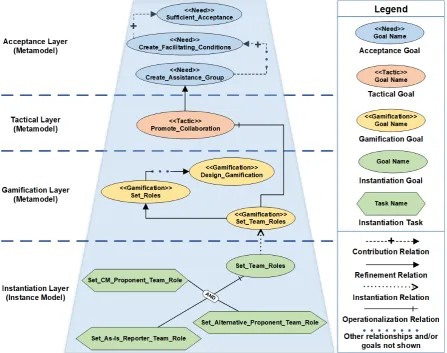
![Figure 1.1: Abstraction layers of Agon with a simple example: an extract from theDoodle-Like Meeting Scheduler Exemplar [Piras et al., 2016, 2017a]](https://thumb-us.123doks.com/thumbv2/123dok_us/509537.2050226/48.595.59.508.238.604/figure-abstraction-example-extract-thedoodle-meeting-scheduler-exemplar.webp)
![Figure 3.2: Software features of the Not Gamified ViaggiaRovereto mobile app [Kazhami-akin et al., 2015, Nurminen et al., 2014b]](https://thumb-us.123doks.com/thumbv2/123dok_us/509537.2050226/96.595.58.509.123.331/figure-software-features-gamified-viaggiarovereto-mobile-kazhami-nurminen.webp)
![Figure 3.3: Certificate of attendance with game results (left) [Kazhamiakin et al., 2015]and recommendations from Viaggia Rovereto App (right) [Kazhamiakin et al., 2015]](https://thumb-us.123doks.com/thumbv2/123dok_us/509537.2050226/97.595.96.544.124.442/figure-certificate-attendance-kazhamiakin-recommendations-viaggia-rovereto-kazhamiakin.webp)
![Figure 3.5: Distribution of saved trips per user during the experiment [Kazhamiakin et al.,2015]](https://thumb-us.123doks.com/thumbv2/123dok_us/509537.2050226/100.595.65.488.210.485/figure-distribution-saved-trips-user-experiment-kazhamiakin-et.webp)
![Figure 3.6: Percentage of Km traveled for each mode of transport [Kazhamiakin et al.,2015]](https://thumb-us.123doks.com/thumbv2/123dok_us/509537.2050226/102.595.62.501.108.324/figure-percentage-km-traveled-mode-transport-kazhamiakin-et.webp)
![Figure 4.1: Agon models at different abstraction layers, and the context model, composingthe Agon Multi-Layer Meta-Model [Piras et al., a, 2016, 2017a,b]](https://thumb-us.123doks.com/thumbv2/123dok_us/509537.2050226/121.595.101.538.120.530/figure-models-different-abstraction-layers-context-composingthe-multi.webp)
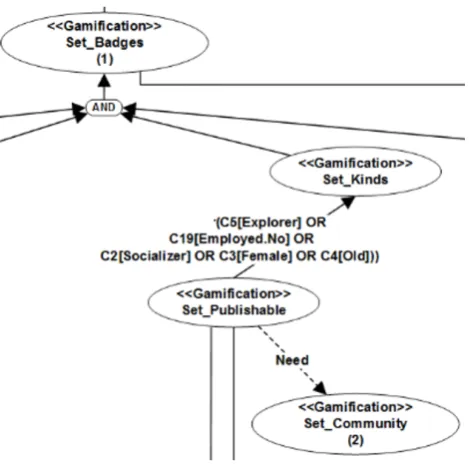
![Figure 4.2: Context dependent rules, gamification goals and tactics [Piras et al., 2017b]](https://thumb-us.123doks.com/thumbv2/123dok_us/509537.2050226/124.595.59.503.111.375/figure-context-dependent-rules-gamification-goals-tactics-piras.webp)