DOI: 10.30954/0974-1712.06.2019.11
©2019 New Delhi Publishers. All rights reserved
PLANT PROTECTION
Pathogenic Variability of
Ralstonia solanacearum
Causing
Bacterial Wilt of Brinjal in Red and Lateritic Agro-climatic
Zone of West Bengal
Karam Chand Hembrom
1*, Ranjan Nath
1, Bholanath Mondal
1*and Subrata Dutta
21Department of Plant Protection, Palli-Siksha Bhavana (Institute of Agriculture), Visva-Bharati, Sriniketan, West Bengal, India 2Department of Plant Pathology, Bidhan Chandra Krishi Viswavidyalaya, Mohanpur, Nadia, West Bengal, India
Corresponding author: [email protected], [email protected] (ORCID ID: 0000-0001-9025-276X)
Paper No. 778 Received: 06-03-2019 Revised: 12-05-2019 Accepted: 20-05-2019
ABSTRACT
Brinjal (Solanum melongena L.) is one of the most economically important solanaceous vegetables in India. The crop is suffering severely from bacterial wilt disease caused by Ralstonia solanacearum (Smith) Yabuuchi et al. that considerably limits its cultivation and production. Symptoms of the disease in brinjal appeared usually at flowering and fruiting stage of the crop growth. Drooping of the top most leaves followed by total or partial wilting was common. Infected plants showed vascular browning. Variability of the pathogen was recorded in respect to their aggressiveness and pathogenicity. Presence of more aggressive isolates in Bahadurpur (BAHRS5) and Halsidanga (HALRS6) and moderately aggressive isolates in Mukundapur (MUKRS2) and Gorabari (GORRS3) may be due to higher cropping intensity of solanaceous vegetables. Stem incision appeared superior to the stem injection method for pathogenicity test through cross inoculation studies. No host specificity was observed among the isolates of the pathogen from brinjal, tomato and Amaranthus spinosus revealed race 1 while host specificity was recorded in case of the pathogen isolated from Costus speciosus revealed race 4.
Highlights
mBacterial wilt of brinjal is a threatening disease causing havoc loss of the crop.
mSymptoms usually appeared at flowering and fruiting stages of the crop growth.
mIsolates of the pathogen showed variability in respect to aggressiveness and pathogenicity.
mThe pathogen isolated from diverse sources and climatic situations did not show any variation in respect to physico-biochemical traits.
mIsolate of the pathogen from Costus speciosus showed host specificity.
Keywords: Aggressiveness study, bacterial wilt, brinjal, cross inoculation, host specificity, pathogenicity,
Ralstoniasolanacearum, variability
Brinjal (Solanum melongena L.) is one of the important solanaceous vegetables in Red and Lateritic Agro-climatic Zone of West Bengal. Bacterial wilt caused by Ralstonia solanacearum (Smith) Yabuuchi et al. (=Pseudomonas solanacearum E.F. Smith) is the main constrain for its cultivation (Mondal et al. 2011a). It is a destructive bacterial disease distributed throughout the world, infects more than 450 plant species of different botanical families (Kelman 1953; Hayward 1991; Daughtrey
al. 2004; Mondal et al. 2011b, Mondal et al. 2012a; Mondal et al. 2016). Management of the disease is very much complicated because of extreme variability, extensive host range and soil borne in nature of the pathogen (Mondal et al. 2014).
The present investigation was conducted to study the variability among different isolates of R. solanacearum infecting brinjal in four different districts namely Purulia, Paschim Medinipur, Bankura and Birbhum of West Bengal under Red and Lateritic Agro-climatic zone.
MATERIALS AND METHODS
Collection of infected plant samplesBacterial wilt infected brinjal plants were collected from diverse sources of Red and Lateritic Agro-climatic zone of West Bengal (Fulberia and Mukundapur of Purulia, Banshpahari of Paschim Medinipur, Gorabari and Saldiha of Bankura, Bahadurpur and Halsidanga of Birbhum). The disease was confirmed in field condition through symptomatological studies and ooze test, and brought to the laboratory for isolation of the pathogen in TZC medium. Morphological and biochemical studies of seven different isolates of the pathogen from brinjal (FULRS1 – Fulberia, MUKRS2 - Mukundapur, GORRS3 – Gorabari, SALRS4 – Saldiha, BAHRS5 - Bahadurpur, HALRS6 - Halsidanga, BANRS7 - Banshpahari) were done in laboratory (Kelman, 1953, Kelman, 1954, Hayward, 1964).
Aggressiveness study
The aggressiveness study was conducted under controlled condition in the laboratory. Brinjal seeds (var. Muktakeshi, a popular variety susceptible to bacterial wilt) were sown in rectangular plastic trays in rows containing sterilized soil (Mandal 2015). The experiment was replicated thrice. Two sets of experiment were conducted. Forty-eight hours old cultures of R. solanacearum grown in TZC medium was used as inoculum at a concentration of 1.5 × 10⁸ cells/ml collected from seven different
places under Red and Lateritic Agro-climatic Zone of West Bengal. Fifteen days old brinjal seedlings were inoculated by making small incision on the roots of one side of each row (Kelman 1953). Bacterial suspension was applied over the wounded
roots and kept in controlled humid chamber at a temperature of 26±1ºC with 98 % RH. Numbers of wilted seedlings were recorded at an interval of 24 hours.
Pathogenecity through cross inoculation study
Pathogenecity test was conducted by stem injection and stem incision methods (Kelman 1953). Inoculum was prepared by putting a few pieces of stem tissue from basal part of wilted plant in distilled water. Bacteria oozed out and formed opaque suspension. The suspension containing 1.5 x 10⁸ bacterial cell/
ml was used for the experiment.
RESULTS AND DISCUSSION
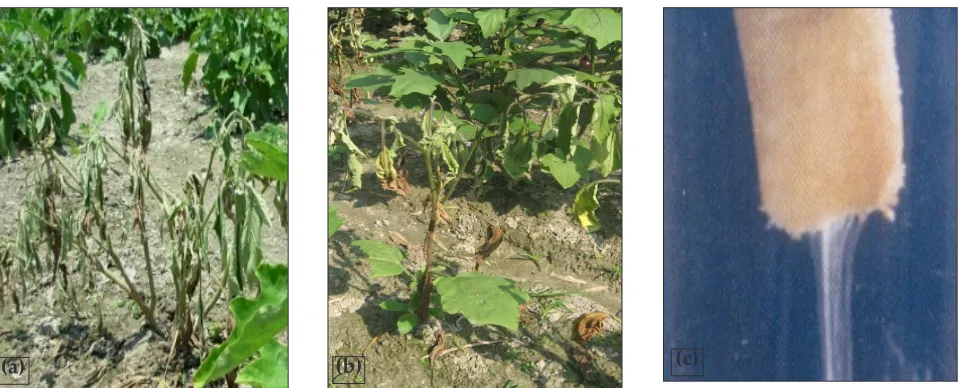
Symptoms of bacterial wilt of brinjalSymptoms of bacterial wilt of brinjal appeared in the fields at flowering and fruiting stage (Plate 1a & 1b) of the crops. Drooping of the top most leaves was recorded in early stage of the disease development that was prominent in day hours and recovered at night hours as normal plant. After 4 to 5 days the infected plant failed to recover leading to death of the infected plants without much changing of its green colour (Plate 1a & 1b). Wilting of one or two side branches were common leaving the other branches normal (Plate 1b). Infected plants showed vascular browning. The present investigation was corroborated with previous workers (Kelman 1953, Nolla 1931). Wilting of seedlings at 25-30 days after transplanting was observed may be due to infected transplants. All the wilted plants were ooze test positive (Plate 1c). The finding was corroborated with the earlier observation made by Mondal et al. (2011a) from West Bengal.
Physico-biochemical characterization of the isolates
Print ISSN : 1974-1712 Online ISSN : 2230-732X cystine and methionine, could not produce indole
from tryptophan, catalase reaction was positive (could convert hydrogen peroxide into water and oxygen). Above mentioned results confirmed that wilt causing bacterium was Ralstonia solanacearum previously known as Pseudomonas solanacearum (Hayward 1964; Palleroni 1984; Bargey’s Manual of Determinative Bacteriology, 9th Edition 2000). Isolates collected from different geographical and environmental situation did not show any type of variation in respect of physico-biochemical traits.
Aggressiveness study of the isolates
The results presented in Table 2 depicted that isolates FULRS1, SALRS4, MUKRS2, GORRS3 and
BANRS7 did not show any wilting up to 8 Days of inoculation. In case of the isolate HALRS6 wilting started at 6 DAT (8.78%), whereas in BAHRS5 wilting started at 7 DAT (15.45%). Very fast wilting was observed in BAHRS5 up to 11 DAI.More than 70% seedlings were wilted at 12 DAI in HALRS6 (80.83%) and BAHRS5 (73.89%) that indicated the rapid development of the disease. In case of
(a) (b) (c)
Plate 1: Symptoms of bacterial wilt of brinjal. (a) Wilting at flowering and fruiting stage of plant, (b) Plant showing partial wilting,
(c) Bacteria oozing out from the cut end of infected plant
Table 1: Characteristics of different isolates ofR. solanacearum
Characteristics FULRS1 MUKRS2 GORRS3 SALRS4 BAHRS5 HALRS6 BANRS7
Shape Rod and bent rod Rod and bent rod Rod and bent rod Rod and bent rod Rod and bent rod Rod and bent rod Rod and bent rod
Gram reaction –Ve –Ve –Ve –Ve –Ve –Ve –Ve
Oxidase reaction + + + + + + +
Levan formation from sucrose – – – – – – –
Gelatin lequifaction – – – – – – –
Starch hydrolysis – – – – – – –
Lipase (tween 80 hydrolysis) + + + + + + +
Growth at 40C – – – – – – –
Arginine hydrolase reaction – – – – – – –
Methyl red test – – – – – – –
Production of H2S + + + + + + +
Indole production – – – – – – –
Catalase reaction + + + + + + +
MUKRS2 and GORRS3 more than 60% seedling mortality was recorded. Though, in all other cases wilting of 60% seedlings were not observed till 12 DAI but more than 40% wilting were recorded. Isolates BAHRS5 and HALRS6 were more aggressive followed by MUKRS2 and GORRS3 than others. The seven isolates were categorized in three different groups in respect to aggressiveness. Most aggressive group (i.e. Group A) includes BAHRS5 and HALRS6,
moderate aggressive group (i.e. Group B) consisting of MUKRS2 and GORRS3 and less aggressive group (i.e. Group C) consisting of FULRS1, SALRS4, and
BANRS7.
Bacterial wilt of brinjal and other solanaceous vegetables is prevalent in West Bengal and it is the main constraint of brinjal cultivation. Presence of more aggressive isolates in Bahadurpur (BAHRS5) and Halsidanga (HALRS6) and moderately
aggressive isolates in Mukundapur (MUKRS2) and Gorabari (GORRS3) may be due to higher cropping intensity of solanaceous vegetables. Because of agro-climatic variations and disparity in cropping pattern, it is expected that R. solanacearum isolated from wilted brinjal plants may have variation in aggressiveness (Mondal 2007; Mondal et al. 2011a). Different eco-friendly strategies need to be developed to minimize the disease incidence in these areas. Though lesser aggressiveness is being observed in some cases, still much more attention is required and similar strategies needs to be followed for sustainable production and productivity of brinjal and other solanaceous vegetables.
Pathogenicity and cross inoculation studies
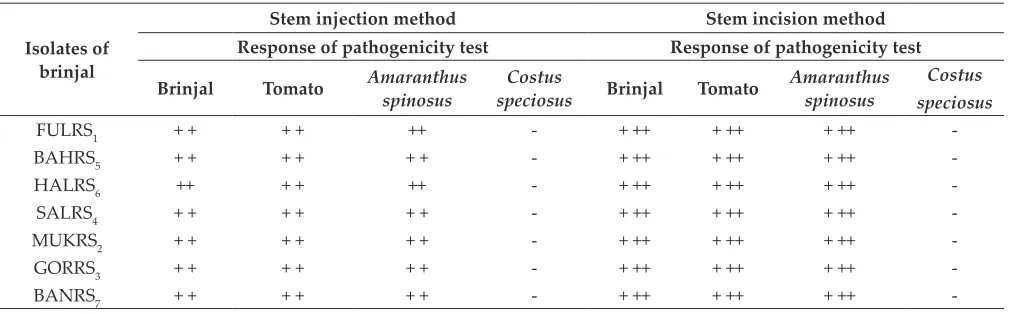
It is apparent from the result that all the isolates (FULRS1 – Fulberia, MUKRS2 - Mukundapur, GORRS3 Table 2: Aggressiveness of different isolates ofR. solanacearumon brinjal
Isolates Percentage of wilted plant as on days after treatment (DAI)
6 DAI 7 DAI 8 DAI 9 DAI 10 DAI 11 DAI 12 DAI
FULRS1 0.00 (0.40)* 0.00 (0.40) 0.00 (0.40) 12.78 (17.27) 22.20 (28.11) 33.30 (35.24) 45.46 (42.42) BAHRS5 0.00 (0.40) 15.45 (23.19) 20.56 (26.89) 38.52 (38.22) 50.18 (45.09) 73.89 (59.39) 73.89 (59.39) HALRS6 8.78 (17.26) 9.23 (17.66) 12.12 (20.37) 17.36 (20.44) 37.50 (37.74) 60.97 (51.36) 80.83 (61.55) SALRS4 0.00 (0.40) 0.00 (0.40) 0.00 (0.40) 9.52 (11.40) 14.17 (22.07) 21.56 (27.69) 42.12 (32.71) MUKRS2 0.00 (0.40) 0.00 (0.40) 0.00 (0.40) 9.52 (11.40) 25.53 (28.45) 46.03 (42.73) 65.47 (54.07) GORRS3 0.00 (0.40) 0.00 (0.40) 0.00 (0.40) 27.78 (31.68) 52.22 (46.32) 58.89 (50.16) 62.22 (52.07) BANRS7 0.00 (0.40) 0.00 (0.40) 0.00 (0.40) 5.74 (11.51) 25.14 (30.01) 29.38 (32.83) 48.83 (44.52)
SEm (±) 4.65 0.70 0.96 4.36 3.09 3.45 3.15
CD (p=0.05) 15.16 2.35 3.14 14.21 10.07 11.25 10.28
*Figures in parentheses indicate the corresponding angular transformed values, FULRS1 – Fulberia, MUKRS2 - Mukundapur, GORRS3 – Gorabari, SALRS4 – Saldiha, BAHRS5 - Bahadurpur, HALRS6 - Halsidanga, BANRS7 - Banshpahari, DAI=Days after inoculation.
Table 3: Pathogenicity of different isolates ofR. solanacearum
Isolates of brinjal
Stem injection method Stem incision method
Response of pathogenicity test Response of pathogenicity test
Brinjal Tomato Amaranthus spinosus speciosusCostus Brinjal Tomato Amaranthus spinosus Costus speciosus
FULRS1 + + + + ++ - + ++ + ++ + ++
-BAHRS5 + + + + + + - + ++ + ++ + ++
-HALRS6 ++ + + ++ - + ++ + ++ + ++
-SALRS4 + + + + + + - + ++ + ++ + ++
-MUKRS2 + + + + + + - + ++ + ++ + ++
-GORRS3 + + + + + + - + ++ + ++ + ++
-BANRS7 + + + + + + - + ++ + ++ + ++
Print ISSN : 1974-1712 Online ISSN : 2230-732X -Gorabari, SALRS4 -Saldiha , BAHRS5 - Bahadurpur,
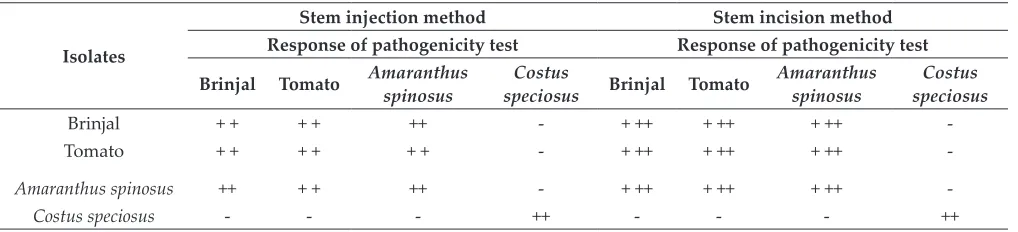
HALRS6 - Halsidanga, BANRS7 -Banshpahari) of R. solanacearum from brinjal were pathogenic on brinjal, tomato and Amaranthus spinosus (Table 3). Cross inoculation studies also revealed that the isolates of R. solanacearum from brinjal, tomato
and Amaranthus spinosus were non-host specific, whereas isolates from Costus speciosus showed host specificity, produced disease only on the same host. This indicated that the isolates were dissimilar and host specific. Extent of wilting was varied with the host species (Table 4).
The result showed in Table 3-4 indicates that the isolate infecting tomato, brinjal and Amaranthus are race 1 of the pathogen, which is ubiquitous throughout the lateritic region. Isolate infecting Costus speciosus appeared to be different. It was evident from the earlier experiment that Ralstonia solanacearum infecting ginger (Zingiber offecinale), elephant foot yam (Amorphophalus campanulata) and Costus speciosus is race 4 (Buddenhagen et al. 1962, Buddenhagen, 1986; Lazano and Sequeira 1970; Daughtrey 2003; Mondal et al. 2012a and Mondal et al. 2012c). The isolates of Ralstonia solanacearum from brinjal also showed variation in respect of virulence. Stem incision method appeared superior where very rapid wilting (+++) observed than the stem injection method for cross inoculation studies and pathogenicity test. Kelman (1953) and Klement (1963) suggested stem inoculation method for pathogenicity test. The study also corroborated with Mondal et al. (2012b).
REFERENCES
Bergey’s Manual of Determinative Bacteriology, 2000. Holt, G.J., Krieg, N.R., Sneath, P.H.A., Staley, J.T. and Williams, S.T. (Eds.). 9th edition, Lippincott Williams & Wilkins, Philadelphia, USA, pp. 787.
Buddenhagen, I.W. 1986. Bacterial wilt revisited. In: Bacterialwilt disease in Asia and the South Pacific. Proceedings of an International Workshop held at PC.ARK.D, Los Banos, Philippines, 8-10 October 1985 (Ed. by Persley, G.J.), ACIAR Proceedings, 13: 126-143.
Buddenhagen, I.W., Sequeira, L. and Kelman, A. 1962. Designation of races of Pseudomonas solanacearum. Phytopathology, 52: 726.
Butler, E.J. 1903. Potato diseases of India. Agriculture Ledger, 10: 87-124.
Cappel, E.L. 1892. A note on potato disease prevalent in Poona district and elsewhere, Bombay, Dir. Dept. land., Records and Agr. (Abs. Butler, 1903).
Chattapadhyay, S.B. and Mukherjee, N. 1968. Outbreaks and New records. Pl. Prot. Bull. FAO., 16: 52-53.
Chatterjee, S. 1996. Epidemiology and management of bacterial wilt disease in West Bengal. Ph.D. thesis submitted to Bidhan Chandra Krishi Viswavidyalaya, Mohanpur, Nadia, west Bengal, pp. 133.
Chaudhuri, S.A. and Khatua, D.C. 1982. Two weed hosts
of Pseudomonas solanacearum – a possible source of the pathogen for tomto (Croton Sparsiflorus and Physalis minima). Indian Journal of Mycology and Plant Pathology 11(2): 296.
Das, C.R. and Chattopadhyay, S.B. 1955. Bacterial wilt of egg plant. Indian Phytopalh., 8: 130-135.
Daughtrey, M. 2003. Southern bacterial wilt, caused by Ralstonia solanacearum. Summary of Presentation at Society of American Florists’ 19th Annual Conference on Insect and Disease Management on Ornamentals held March 4, 2003.
Hayward, A.C. 1964. Characteristics of Pseudomonas solanacearum. Journal of Applied Bacteriology, 27: 265-277. Hayward, A.C. 1991. Biology and epidemiology of bacterial
wilt caused by Pseudomonas solanacearum. Annual Review of Phytopathology, 29: 65-87.
Kelman, A. 1953. The bacterial wilt caused by Pseudomonas solanacearum. A literature, review and bibliography. Technical Bulletin of North Carolina’ Agricultural Experiment Station No. 99: 194.
Table 4: Pathogenicity through cross inoculation studies
Isolates
Stem injection method Stem incision method
Response of pathogenicity test Response of pathogenicity test
Brinjal Tomato Amaranthus spinosus speciosusCostus Brinjal Tomato Amaranthus spinosus speciosusCostus
Brinjal + + + + ++ - + ++ + ++ + ++
-Tomato + + + + + + - + ++ + ++ + ++
-Amaranthus spinosus ++ + + ++ - + ++ + ++ + ++
-Costus speciosus - - - ++ - - - ++
Kelman, A. 1954. The relationship of pathogenecity in Pseodomonas Solanacearum to colony appearance on a tetrazolium medium. Phytopaphology, 44: 693-695. Khatua, D.C. and Maiti, S. 1982. Vegetable diseases in West
Bengal and their control. Mukhopadhyay, S. (Ed.). In : Plant Protection in West Bengal. B.C.K.V., pp. 79-93. Klement, Z., 1963. Rapid detection of the pathogenicity of
phytopathogenic Pseudomonads. Nature 185: 299-300. Lozano, J.C. and Sequeira, L. 1970. Differentiation of races of
Pseobomonas solanacearum by a leaf infiltration technique. Phytopathology, 60: 833-838.
Mandal, S. 2015. Management of Bacterial Wilt of Brinjal (Solanum melongena L.) in Coastal Alluvial Region of Sundarbans in West Bengal. A thesis submitted to Visva-Bharati for the degree of doctor of philosophy in Agriculture (Plant Protection-Plant Pathology), pp. 202. Mondal, B., Bhattacharya, I. and Khatua, D.C. 2014. Incidence
of bacterial wilt disease in West Bengal, India. Academia Journal of Agricultural Research,2(6): 139-146.
Mondal, B., Bhattacharya, I. and Khatua, D.C. 2011b. Crop and weed host of Ralstonia solanacearum in West Bengal. Journal of Crop and Weed 7(2): 195-199.
Mondal, B., Bhattacharya, I., Sarkar, A. and Khatua, D. C., 2011a. Variation in Ralstonia solanacearum isolated from brinjal plants in West Bengal. International Journal of Bio-resource and Stress Management, 2(3): 302-306.
Mondal, B., Mandal, S., Mondal, C.K. and Khatua, D.C., 2016. Occurrence of bacterial wilt of bitter gourd in Sundarban area of West Bengal, India. European Journal of Biotechnology and Bioscience,4(8): 01-03.
Mondal, B. 2007. Characterization and management of Ralstonia solanacearum causing bacterial wilt of solanaceous vegetables with special reference to brinjal (Solanum melongena L.) (Race-1) in West Bengal. Ph. D. thesis submitted to Bidhan Chandra Krishi Viswavidyalaya, Mohanpur, Nadia, West Bengal, pp. 117 + i-xxx.
Mondal, B. 2012c. Pathogenic Menace for Brinjal Cultivation in West Bengal: Bacterial Wilt of Brinjal. LAP LAMBERT Academic Publishing Gmbh & Co. KG, Ger, pp. 144. Mondal, B., Bhattacharya, R., Ranjan, R.K. and Khatua, D.C,
2004. Bacterial wilt of horticultural plants in West Bengal and its chemical control. Green Technology, 6:70-74. Mondal, B., Mahapatra, S. and Khatua, D.C. 2012a. Records of
some new diseases of horticultural plants of West Bengal. Journal of Interacademicia,16(1): 36-43.
Mondal, B., Bhattacharya, I., Sarkar, N.C., Paul, A. and Khatua, D.C. 2012b. Standardization of inoculation technique and screening of some brinjal and tomato lines against bacterial wilt. Research on Crops,13(2): 737-742.
Mukherjce, K. and Chattopadhyay, S.B. 1955. Bacterial wilt of potato caused by Pseudomonas solanacearum var. asiatica in
West Bengal proc 42nd and Sci. Congress. Part III: 217(abs.).
Nolla, J.A.B. 1931. Studies on the bacterial wilt of the solanaceae in Porto Rico. Journal of the Department of Agriculture, Porto Rico.,15: 287-308.
Palleroni, N.J. 1984. Pseudomonas solanacearum. In: Bergey’s Manual of Systematic Bacteriology, 9 th edition, Vol. 1. (Eds. Krieg, N. R. and Holt, J. G.). Baltimore. The Williams and Wilkins Co., pp. 117-178.
Samaddar, K.R., Chakraborty, M. and Kanjilal, S. 1998. Identification of the race of Pseudomonas solanacearum causing wilt of solanaceaus vegetables in West Bengal and its survival. Journal of Mycopathological Research, 36(2): 51-58.