VOL 28 NO 2 (2019)
Editorial: Where do cross disciplinary interests in educational research merge?
Dolana Mogadime 1-3
A Commentary: Education in Canada Does Anyone Read Our Constitution?
Ron Phillips, Nipissing University 4 - 16
Professional Lives and Initial Teacher Education Experiences of Indigenous Early Childhood Educators, Childcare Workers, and Teachers in Northern Ontario
Shelley Stagg Peterson, University of Toronto, Lori Huston, and Roxanne Loon 17-32
Internalizing Cognitive Bias: An Experiential Exercise for Teaching and Learning the Anchoring Effect John C. Kleefeld, University of New Brunswick and Dionne Pohler, University of Toronto -47
Critical Literature Review
Jia Chen, University of Windsor and George Zhou, University of Windsor 48-63
Teachers as Learners in the (Literal) Field: Results from an International Service Learning Internship Daniel B. Robinson, St. Francis Xavier University, Ingrid Robinson, St. Francis Xavier University and
Andrew Foran, St. Francis Xavier University ..64-81
Include English Language Learners
Callie Mady, Nipissing University and Katy Arnett, -95
Book Review: Interest in Mathematics and Science Learning, K. Ann Renninger, Martina Nieswandt, Suzanne Hidi American Educational Research Association
1 Brock Education Journal, 28(2), 2019
Editorial:
Where do cross disciplinary interests in educational research merge?
Dolana Mogadime Editor-in-chief
Brock University
Educational research maybe cross disciplinary but it merges in the interest to investigate and answer questions of importance to educational practitioners, researchers and students alike. This Brock Education Journal issue brings together research from across Canada, all of which increase appreciation for the rigor of research for informing and improving the educational experiences of learners, professional practices and the quality of education. Furthermore, the articles challenge perceived understandings and provide directives on finding enlighten new directions through the recommendations provided. In “A Commentary: Education in Canada—Does Anyone Read Our Constitution?” Ron Phillips sheds a light on how inequality in the provision of funds for First Nations-managed schools is systemic and deliberate. He does so by posing the key problematic: “These educational structures, programs and services are common throughout provincial and territorial systems. Why were they lacking in First Nations-managed schools and communities?” Phillips’ explanation includes a rigorous conceptual analysis of two overarching causalities. Firstly, systemic inequity is rooted in the historical subjugation of Indigenous people, from a colonial legacy of discrimination. Secondly, due to misunderstandings about the Canadian Constitution, education is perceived to be neither the sole responsibility of the province nor the federal government but both. Philips analysis points to the consequences for these misunderstandings.
In “Professional Lives and Initial Teacher Education Experiences of Indigenous Early Childhood Educators, Childcare Workers, and Teachers in Northern Ontario,” Shelley Stagg Peterson, Lori Huston and Roxanne Loon make known the sojourner paths that Indigenous Early Childhood Education (ECE) community leaders undergo in their desire to become credentialed. The stories the women tell, arising out of focus group testimonials make known to the heroines’ journey they undertake. It is no small feat to claim an education and to lead their own communities, when accessing an education has personal scarifies, such as leaving one’s family (located in remote Northern communities) to attend university at a distance. One can only have a growing sense of respect for the women who through attainting an education participate in the delivery of curriculum that is relevant to their own communities. Shelley Stagg Peterson, Lori Huston and Roxanne Loon’s article dig deep into the complexity of Indigenous women’s agency in the face of both obstacles and constraints they surmount on an ongoing basis.
2 Brock Education Journal, 28(2), 2019
educational institutions regarding their responsibilities for the students sense of well-being particularly as that sense is linked to student success.
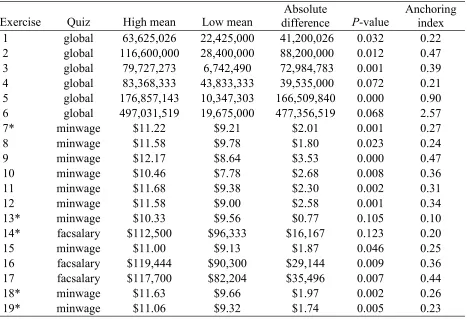
In “Internalizing Cognitive Bias: An Experiential Exercise for Teaching and Learning the Anchoring Effect,” John C. Kleefeld and Dionne Pohler share the results of their 7 year-long study involving 378 individuals and 19 classroom settings. The study focuses on supporting the ability among students to become good decision makers. With consideration of the professional importance of professional judgement among students in business, law, human resources, and public policy, the authors aim to impart deep knowledge about ‘the anchoring effect.’ A term described as, “a cognitive bias that causes decision-makers to rely too heavily on initial information when making subsequent judgments.” The contribution of the research for professional students and instructors alike, include the innovated approaches to the examination of ‘anchoring’ thought processes that “enable quick decisions but also lead to perceptual distortions, inaccurate judgments, and illogical interpretations.”
In “Teachers as Learners in the (Literal) Field: Results From an International Service Learning Internship,” Daniel J. Robinson, Ingrid Robinson and Andrew Foran report on a novel study that investigated an international service learning internship for in-service teachers. As the researchers argue there is a burgeoning body of research on pre-service teachers engaged in internships but little to none on inservice educators. As researchers making inroads in this nuanced area of inquiry they have much to offer up in terms what can be gained as well as recommendations on next steps for researchers that who may take on a similar focused study.
In “Novice Teachers’ Perspectives on the Use of Languages in French as a Second Language Classes That Include English Language Learners,” Callie Mady and Katy Arnett study focuses on three overarching questions: “1. How do novice teachers conceptualize language use in FSL classrooms with ELLs?; 2. Within novice teachers’ thinking about how to support language learners, to what extent is another language a consideration?; 3. How do novice teachers consider the ELLs’ home language as an influence on their experience with FSL?” The questions arise within the contexts of sparse studies, with one that demonstrated novice FSL teachers face challenges with the inclusion of ELLs in FSL classes. Recommendations from the study include suggestions to BEd teacher educators, that they “not only highlight the potential advantages of a plurilingual approach but also means” make known how to “put it into practice.” Additionally, they argue that the Ministry of Education has a role to play in providing direction on “how to use other languages to support FSL acquisition.” Overall, this issue challenges readers to reconceptualize perceived views on the topics investigated. As such the works offered up are a must read for researchers, practitioners and students across the disciplines in which the varied works are grounded.
Editorial Postscript: “A Fond Farwell”
3 Brock Education Journal, 28(2), 2019
authors of BEJ gain greater visibility. I am also pleased that BEJ has been relisted with the Directory of Open Access Journals (DOAJ) and newly listed in the USA based - Education Resources Information Center ERIC in 2015. The three listings signal that BEJ produces quality, peer reviewed open access publications and is committed to contributing positively to the scholarly open access community.
In March 2015, with a grant from the Brock University Advancement Fund, a new website was
developed with the assistance of David Genkin,IT Manager. The website has capabilities to feature
YouTube videos for the journal. Over several months, I worked with David Potts, IT Project Manager to launch the ‘Meet the Author’ interview series. The readers of BEJ and the wider scholarly community are invited to view digital recorded interviews in the series that features BEJ authors in conversations about their writing and research interests. The “Meet the Author” series features a personal lens thorough which to understand the innovative writing and contributions of educational researchers. The goal of engaging wider audiences is achieved within an innovative face-to-face interview format. Most recently, the Brock University Open Access Award has contributed toward the journal publications in 2018 and 2019. The funding will continue to aid the funding of the next BEJ Special Issue. With this university-wide recognition of BEJ’s role on the national and international scale, I hand BEJ to my trusted colleague, Trevor Norris. His extensive experience as journal editor, will bode BEJ well. I look forward staying connected to the journal by joining you, our loyal readers, as I delve into the treasure trove in educational research found in each issue.
Acknowledgment: BEJ is grateful for the generous funding provided through the Brock University Open Access Award, 2018.
References
Chen, J. and Zhou, G. (2019). Chinese International Students’ Sense of Belonging in North
American Postsecondary Institutions: A Critical Literature Review. Brock Education: A
Journal of Educational Research and Practice, 28 (2), pp. 48-63.
Kitchen, J. (2014). Editorial: A fond Farewell. Brock Education: A Journal of Educational
Research and Practice, 23 (2), 1-2.
Kleefeld, J. C., and Pohler, D. (2019). Internalizing Cognitive Bias: An Experiential Exercise for
Teaching and Learning the Anchoring Effect. Brock Education: A Journal of Educational
Research and Practice, 28 (2), 33-47.
Mady, C., and Arnett, K. (2019). Novice Teachers’ Perspectives on the Use of Languages in
French as a Second Language Classes That Include English Language Learners. Brock
Education: A Journal of Educational Research and Practice, 28 (2), 82-95. Peterson, S. S., Huston, L., and Loon, R. (2019). Professional Lives and Initial Teacher
Education Experiences of Indigenous Early Childhood Educators, Childcare Workers,
and Teachers in Northern Ontario. Brock Education: A Journal of Educational Research
and Practice, 28 (2), 17-32.
Phillips, R. (2019). A Commentary: Education in Canada—Does Anyone Read Our
Constitution? Brock Education: A Journal of Educational Research and Practice, 28 (2),
4-16.
Robinson, D., Robinson, I., and Foran, A. (2019). Teachers as Learners in the (Literal) Field:
Results from an International Service Learning Internship. Brock Education: A Journal of
4 Brock Education Journal, 28(2), 2019
A Commentary: Education in Canada Does Anyone Read Our
Constitution?
Ron Phillips
Nipissing University
Abstract
Education in Canada is generally considered to be within the exclusive domain of the 13 provincial and territorial governments. There are numerous statements or writings from politicians, textbook authors, federal and provincial governments, researchers, newspaper columnists, as well as education organizations that state unequivocally that education in Canada is the exclusive jurisdiction of the provinces and territories. Some statements indicate that the federal government has no constitutional role in education. Such misinformation and beliefs have had severe consequences for First Nations as Canadians absolve federal inaction in First Nations education because education is a provincial responsibility. However, education in Canada is the constitutional responsibility of both the federal and provincial/territorial
governments. This article examines bility in
education, as well as the consequences of the misinformation.
Keywords: First Nations education, education in Canada, education misinformation
Ron Phillips, PhD., and Associate Professor, Schulich School of Education, has been involved in First N
education responsibilities, as well as the lack of adequate education programs and services for First Nation youth.
5 Brock Education Journal, 28(2), 2019
about time. On October 19, 2016, Academica Group (2016) reported in its Indigenous Top Ten publication that the Canadian Broadcasting Corporation (CBC) had a briefing note prepared for Indigenous Affairs Minister Carolyn Bennett. The article s headline nada Must Build Structured K-12 Indigenous Education S acknowledged First Nations-managed schools and communities were without educational systems due to
(para. 1). Other comments in the briefing noted the absence of or the support structures available to non-Indigenous schools such as a school board, elected trustees, or an education Ministry (para. 1).
An earlier briefing note titled Departmental Two Percent Escalator. Ministerial Briefing (Aboriginal Affairs and Northern Development Canada [AANDC], 2016), marked SECRET, programs, including education. Since 1997/98, the government has restricted funding increases for First Nations to 2% annually. Federal bureaucrats were aware that this 2% increase had not kept pace with the growing
AANDC, 2016, p. 4). They recognized the difficulty of aligning
resulted e funding and that some programs such as e
insufficient on-going base funding to keep pace with costs and cost drivers, provincial/territorial expenditures and service levels .
How was this possible in 2016? Why were we discussing required educational structures, curriculum development, teacher training, assessments, as well as increasing funding for First Nations-managed schools and communities at this time? These education structures, programs, and services are common throughout provincial and territorial education systems. Why were they lacking in First Nations-managed schools and communities?
There are two answers. The first is that
issues have never been important to federal politicians and bureaucrats. The second is the mistaken belief that education is exclusively a provincial/territorial jurisdiction.
However, t were recommending the establishment of an
educational system with all of the nec federal government s
constitutional responsibility to do so. Otherwise, the provincial/territorial governments would be challenging the federal intrusion into their constitutional jurisdictions.
The federal government has had constitutional responsibilities to First Nations since Confederation in 1867.i However, for many years the federal government has chosen to ignore its constitutional responsibility in education because the establishment, development, and operation of an education system is expensive, requiring education structures, qualified personnel, and operating procedures. The federal government also allowed and encouraged Canadians and the international community to falsely believe that constitutionally education is exclusively a provincial jurisdiction.
comprehensive system of education. It has been too long. The time for change is now.
6 Brock Education Journal, 28(2), 2019
Background
On April 13, 2010, the Assistant Deputy Minister of Education and Social Development Programs at AANDC spoke to the Standing Senate Committee on Aboriginal Peoples (SSCAP, 2010). She acknowledged the absence of a comprehensive system of education for First Nations students. She admitted to the Committee
department
-secondary or
kindergarten-to-In December 2011, the SSCAP released its report on the education of First Nations students in Canada. The report, Reforming First Nations Education: From Crisis to Hope (SSCAP, 2011) was the result of meetings with federal officials, First Nations educator leaders, and provincial educators in Ottawa and across Canada. The report estimated that the federal government was responsible for the education of 120,000 First Nations students who live on First Nations in Canada. These students attend one of three different types of schools: Approximately 60% attend one of the 518 First Nations-managed schools, 40% attend a provincial school, and less than 2% attend one of the seven federal government schools.
First Nations students will not graduate from high school this year. In far too many others, countless First Nations children will never attend a school equipped with libraries, science and technology labs or athletic facilities SSCAP, 2011, p. 1).
Canada became a country when the British Parliament passed the British North America Act, 1867. In 1982, the British North America Act, 1867 was patriated and renamed Constitution Act, 1867. This act was revised and renamed Constitution Act, 1982.
Sections 91 and 92 of the Constitution Act, 1867clearly defined the separation of authority or legislative powers between the federal and provincial governments. Each level of government has exclusive authority in certain areas.
In the Distribution of Legislative Powers (Government of Canada, 2019a), the federal government was given exclusive authority under the Constitution Act, 1867, Section 91 (Powers of the Parliament). These ranged from: (5) Post Office, (12) Sea Coast and Inland Fisheries, to (24) Indians, and Lands reserved for the Indians. In total, 29 areas were assigned to the federal government.
The provincial governments were given authority under the Constitution Act, 1867, Section 92, Exclusive Powers of Provincial Legislatures (Government of Canada, 2019a). This section stated In each Province the Legislature may exclusively make Laws in relation to Matters
coming within the Classes of Subjects next hereinafter enumerated. 16
areas that ranged from Direct Taxation within the Province in order to the raising of a Revenue for Provincial Purposes, Municipal Institutions in the Province, and Generally all Matters of a merely local or private Nature in the Province.
Education is noticeably absent in the exclusive responsibilities of either the provincial or federal legislatures. Education is not found in either Section 91 or Section 92 of the Constitution Act, 1867.
7 Brock Education Journal, 28(2), 2019
Province the Legislature may exclusively make Laws in relation to Education, subject and according to the following Provisions:
(1) Nothing in any such Law shall prejudicially affect any Right or Privilege with respect to Denominational Schools which any Class of Persons have by Law in the Province at the Union;
(2) All the Powers, Privileges, and Duties at the Union by Law conferred and imposed in Catholic Subjects shall be and the same are hereby extended to the Dissentient Schools of
tholic Subjects in Quebec;
(3) Where in any Province a System of Separate or Dissentient Schools exists by Law at the Union or is thereafter established by the Legislature of the Province, an Appeal shall lie to the Governor General in Council from any Act or Decision of any Provincial Authority affecting any Right or Privilege of the Protestant or Roman Catholic Minority of the
;
(4) In case any such Provincial Law as from Time to Time seems to the Governor General in Council requisite for the due Execution of the Provisions of this Section is not made, or in case any Decision of the Governor General in Council on any Appeal under this Section is not duly executed by the proper Provincial Authority in that Behalf, then and in every such Case, and as far only as the Circumstances of each Case require, the Parliament of Canada may make remedial Laws for the due Execution of the Provisions of this Section and of any Decision of the Governor General in Council under this Section.
In summary, subsection 93(1) of the Constitution Act, 1867 involves the rights and privileges of Denomination schools, as well as people in general. It would not affect any of their rights and privileges.
Subsection 93(2) involves the rights of Separate Schools and Catholic subjects in Ontario. It would ensure that their powers and privileges would be extended to Protestant and Catholic Schools in Quebec.
Subsection 93(3) involves the powers of the Governor General. Appeals from Provincial Acts or Decisions that affect the Education Rights or Privileges of Roman Catholic or Protestant Minority are to be made to the Governor General.
Subsection 93(4) clearly demonstrates that the Parliament of Canada has constitutional
responsibilities in education as it Government of Canada, 2019a)
when there has been an Appeal to the Governor General and it has been determined that the it can be determined that provincial governments are failing to implement the decisions of the Governor General in the case of appeals.
the Constitution Act, 1867, Section 93: Province the Legislature may exclusively make Laws in relation to Education
8 Brock Education Journal, 28(2), 2019
There are at least three federal areas of jurisdiction in which the federal government has constitutional education responsibilities. The first may be found in subsection 91(7) which deals with Militia, Military, and Defence. Military members and their children would have to be educated. Officers and those who wish to become officers within the Canadian military may attend The Royal Military College of Canada (RMC) in Kingston, Ontario. The RMC is a postsecondary educational institution that al institution in Canada with degree
Royal Military College of Canada, 2019, para. 1).
uni (Royal Military College of Canada (n.d., para. 1). It was established in 1876.
Historically, the federal Department of National Defence (DND) was very reluctant to provide for the education of children of military personnel. Morin (1986), in a history of DND
,
However, on April 3, 1947, author establish schools in
establishments, camps and stations where suitable educational facilities were not available within (p. 16).
The second area of federal constitutional educational responsibilities is in penitentiaries. A federal department, Correctional Service Canada (CSC), is responsible for penitentiaries throughout Canada. CSC provides inmates with a variety of educational programs ranging from ation, Vocational, College, and SC, 2015, p. 1).
In 2015, CSC posted on its web-page a story from The Globe and Mail about Mr. Lee McNaughton, a teacher who had spent 10
in McNaughton, 2015, para. 1
programs with a school in every institution (McNaughton, 2015, para. 9). The delivery of these education programs and courses may include regular classroom instruction, as well distance
(CSC, 2015, p. 2). Federal responsibility in education may also be found in subsection 91(24) that gave the federal government exclusive authority over Indians, and Lands reserved for the Indians (i.e., First Nations). Indian or First Nations children living on federal lands or Reserves were outside uld not extend to them as they were not In and for each Province. The reserves are part of the federal
ea of constitutional authority as are penitentiaries and military bases.
When the Constitution Act, 1867 was patriated, revised, and renamed the Constitution Act, 1982, two additional parts were added: Part I The Charter of Rights and Freedoms, and Part II Rights of the Aboriginal Peoples of Canada. Subsection 35(1) of Constitution Act, 1982 Part II
states aboriginal peoples of Canada are hereby
9 Brock Education Journal, 28(2), 2019
The federal government has also enacted the Indian Act (Government of Canada, 2019b). The Indian Act has education provisions that define the educational authority and responsibilities of the federal minister of INAC. Subsection 114(2) specifies that the Minister of INAC has the
.
(115) a (a) provide
for and make regulations with respect to standards for buildings, equipment, teaching, education, inspection and discipline in connection with schools; and (b) provide for the transportation of These subsections of the Indian Act clearly indicate that the federal government has constitutional responsibilities in education. If education was exclusive to the provinces/territories, as many individuals and organizations assert, these sections of the Indian Act would be rendered unconstitutional and illegal.
In summary, the Constitution Act, 1867 and Constitution Act, 1982 assign education responsibilities to both the federal and provincial governments. Each has this responsibility within its respective areas of jurisdiction.
Misinformation on Federal Constitutional Responsibilities
The assumption that education in Canada is the exclusive constitutional responsibility of the provinces/territories may be found throughout the literature, including academic research, newspapers, government documents, and reports. Canadian and international educational organizations alike espouse similar statements.
In a speech at the Empire Club in Toronto on March 3, 1966, two ministers of education, Hon. W.C. Davis (Ontario) and P. Gerin-Lavoie (Quebec) spoke of the importance and the future of education in Canada. The title of their speeches was Education. A Priority and a Provincial Responsibility (Davis & Gerin-Lavoie, 1966).
constitutional jurisdiction in education. In the Resources section of its website, there is a page titled Teaching in Canada: Make a Difference Be in Charge (CTF, 2019). Education is listed as a provincial responsibility as
In Canada, education does not fall within the scope of federal jurisdiction it is the singular responsibility of each province or territory. Under the British North America Act of 1867, each province and territory has the power to establish its own autonomous education system and to make all decisions regarding school, teachers and curriculum pertaining to education within the specific province/territory. (CTF, 2019, para. 1)
The CTF (2019) describes First Nations schools
ara. 2). Note the absence of federal responsibilities for First Nations schools.
Another national education organization, the Canadian Education Association (CEA, 2007) secondary education. Education is exclusively within the jurisdiction of provincial ad territorial governments
p. 1) from the federal government. There was no mention of federal responsibilities.
Ten years later, the CEA continues to assert provincial exclusivity in education. On its website s FAQs page,
Canada because under our Constitution legislation and regulation, it is the separate responsibility
10 Brock Education Journal, 28(2), 2019
The Canadian School Boards Association (CSBA), in a description of the Canadian education system, ignored First Nations and federal schools and their school boards. The CSBA (2019)
believed para. 1).
The Canadian Education Centre (CEC) Network s Study Canada website provides information to international students who are interested in studying in Canada. Under a heading titled The Education System in Canada, the Study Canada site notes that Education is a
CEC, 2003, para. 2).
The Ministry of Education in Ontario perpetuates the myth that education is a provincial responsibility on its website. Under a heading titled The Ontario Government and the Education Act, the Ministry notes that
(Ontario Ministry of Education, 2019, p. 1).
The Canadian Information Centre for International Credentials (CICIC) provides education information to interested immigrants to Canada. The CICIC indicates on its website that education in Canada is a provincial responsibility. On a page titled Ministries/Departments Responsible for Education in Canada, the CICIC (2019) notes tion of 10 provinces and three territories. Under the Canadian Constitution, provincial governments have exclusive responsibility for all levels of education ara. 1).
Education textbooks and articles make similar claims of provincial exclusivity in education. The textbook Special Education in Canada (Edmunds & Edmunds, 2008), under the heading Legislation Affecting Special Education noted that
responsibility of the thirteen individual provinces and territories A second edition of the textbook includes the same statement (Edmunds & Edmunds, 2014, p. 12).
Similar thoughts may be found in other special education texts. For example, Teaching Students With Special Needs in Inclusive Settings indicates tha
Smith et al., 2009, p. 3).
Education textbooks and journals may simply ignore federal involvement and responsibilities in education. In a chapter titled The Current State of Exceptional Education in Each Province and Territory, Hutchinson (2014) provides websites on special education programs and policies for each province and territory. There was no website corresponding to federal programs and policies (i.e., INAC special education policies).
Researchers and policy analysts within Canada appear not to have read our constitution. The Canadian Centre for Policy Alternatives (CCPA, 2015) in a review of inclusive education policies, procedures, and practices throughout Canada ignored federal government special education policies
The report also noted the absence of federal guidance in inclusive education across Canada as CCPA, 2015, p. 8).
Federal special education policies are not mentioned in the international education journal Teaching Exceptional Children. Dworet and Bennett (2002) noted that
Canada unlike that in the United States is solely controlled by each of the 10 provinces and The Parliament of Canada (n.d.) also appears to have ignored or forgotten the federal n a section describing the three levels of government in Canada (e.g., federal, provincial, and municipal), it noted
10 provinces in Canada, the provincial government is responsible for areas listed in the Constitution Act, 1867, such as education, health care, some natural resources, and road
11 Brock Education Journal, 28(2), 2019
Canadian federal politicians have viewed education as a provincial responsibility. In 2010, Conservative MP Maxime Bernier used the constitution and the wishes of the Fathers of Confederation for the federal government to get out of areas of provincial jurisdiction. This included education, as Bernier
in provincial jurisdiction, and in particular in health and education, two areas where it has no constitutional legitimacy whatsoever. This is not what the Fathers of Confederation had
as cited in Leblanc, 2010, p. A12).
Newspaper columnists may also be mistaken in their views of education in Canada. Globe and Mail columnist John Ibbitson (2005) dismissed federal involvement in education by noting
that adding
in that tary field, elementary and secondary education, the (p. A4).
The misconception of education exclusivity to the provinces and territories includes federal government departments. For example, Statistics Canada s (2009) report on Education Indicators in Canada makes reference to
Indigenous and Northern Affairs Canada (INAC), the federal department responsible for providing programs and services for First Nations throughout Canada, continues the misinformation on its education responsibilities in Canada. The department appears to be reluctant to use the word constitutional in describing its responsibilities. Rather, INAC uses
, 2019a) , 2018a, 2019
(INAC, 2018b 2017).
Another federal department, Human Resources Skills Development Canada (HRSDC, 2008), of federal government responsibility in First Nations education is the word constitutional.
its constitutional responsibilities in education has enabled the Council of Ministers of Education, Canada (CMEC), an organization composed of provincial and territorial ministers of education, to assume national and international responsibilities in education. The CMEC was established in 1967 and describes The national and international aspects of the CMEC are important
education at the pan-Canadian and international levels and contributes to the exercise of the exclusive jurisdiction of provinces and territories over education , para. 2).
At a conference of Commonwealth Ministers of Education, the CMEC was very clear on which level of government had constitutional responsibilities in education. s report noted that the provinces retain constitutional authority for education in all lands, the federal government The idea that education is a provincial responsibility permeates Canadian society. No one questions such assertions. For example, in early December 2015, Ms. Anna Marie Tremonti, host of the CBC s nationally broadcasted radio program The Current, made a comment about education in Canada while discussing the struggles of teachers preparing for the influx of Syrian
children: o Teachers Struggle,
12 Brock Education Journal, 28(2), 2019
Discussion
The Constitution Act, 1867 and the Constitution Act, 1982 give the federal government of Canada authority for education within its areas. These acts allow the federal government of Canada to pass laws in education.
The federal government operates and is responsible for schools on military bases, penitentiaries, and First Nations. If education was strictly an exclusive provincial constitutional responsibility, these schools would be illegal.
L Section 93 again: In and for each Province. The provinces were given authority for education within each province. However, there is a limit to this authority only In and for each Province. There is no indication that this authority was extended to federal areas of jurisdiction or lands. It is restricted to the province. Provincial authority for education is restricted to provincial lands and areas of jurisdiction.
This restriction has been overlooked by many commentators, newspapers columnists, textbooks, politicians, and both national and international education organizations. These individuals and organizations have perpetuated the myth that education in Canada is the exclusive responsibility of the provincial and territorial governments.
How is it possible that the constitutional responsibilities in education of the federal government of Canada have been swept under the rug for so long? These responsibilities have been in existence since 1867. When our constitution was patriated in 1982, these educational responsibilities were more pronounced, obvious, and clearly stated; that is, Treaty rights. However, incorrect statements and assumptions continued.
Questions must be asked. For example, why is the federal government reluctant to use the word constitutional in its responsibilities in First Nations education?
The most obvious answer is that the matter involved Indians or First Nations. No one really cared about them. The federal government was allowed to ignore its constitutional responsibilities by emphasizing that while it funds First Nations-managed schools, the First Nation is responsible for them. There was no mention of the constitution.
The result was a non-system of federal or First Nations-managed schools across Canada. These schools continue to be without education programs, personnel, and services that provincial schools take for granted (e.g., libraries, science labs, technology, and specialists).
Another reason for the misinformation is very simple most people have not actually read the Constitution Act, 1867 or Constitution Act, 1982. If textbook writers, newspaper columnists, federal and provincial ministers, and national and international educational organizations all state that education is the exclusive responsibility of the provinces and territories in Canada, then it must be true.
However, the facts do not support such statements. The federal government of Canada has constitutional responsibilities in education. These responsibilities may be found in subsections 91(7), 91(28), and 91(24) in both the Constitution Act, 1867 and the Constitution Act, 1982.
If the federal government lacked constitutional responsibilities in education, then schools on military bases, penitentiaries, and First Nations throughout Canada would be operating under the authority, policies, and regulations of a provincial or territorial ministry of education. However, this is not the case. They are operating under the authority, policies, and regulations of a federal minister and department for example, Correctional Service Canada, Department of National Defence, and Indigenous and Northern Affairs Canada.
13 Brock Education Journal, 28(2), 2019
of Indians/First Nations. If education is perceived to be a provincial responsibility, then the issue of the past and current poor state of First Nations schools may be glossed over by the federal government by statements of funding First Nations-managed schools with no mention or concerns of constitutional responsibility. The current poor state of First Nations-managed schools can be put at the feet of the First Nations as they are responsible for their operation. Essentially, the federal government has absolved itself of any real responsibility.
However, questions must be asked. How is this possible that we are discussing needed educational structures, curriculum development, teacher training, assessments, as well as increasing funding for First Nations-managed schools and communities in 2019? These educational structures, programs, and services are common throughout provincial and territorial education systems. Why are they lacking in First Nations-managed schools and communities? issues have never been important to federal politicians and bureaucrats. The second is the mistaken belief that education is exclusively a provincial/territorial jurisdiction.
However, First Nations issues have become more prominent recently. The Truth and Reconciliation Commission of Canada (TRCC, 2015) has issued its reports on past federal governments
to attend residential schools operated by churches. First Nations students suffered many abuses in these residential schools established by the federal government of Canada. Government
TRCC, 2015, p. 1).
comprehensive system of education. It has been too long. The time for change is now. Recommendations
The federal government, as well as provincial and territorial governments, must provide Canadians and the world community with accurate information on the Constitution Act, 1867 and Constitution Act, 1982. The federal government has constitutional responsibilities in education.
This can be accomplished by:
1. Federal and provincial government documents clearly stating
constitutional responsibilities in education. Federal government department websites (e.g., INAC, National Defence, Correctional Service Canada). The Constitutional Act, 1867 and Constitution Act, 1982 must be cited.
2. The federal government acknowledging that the schools on First Nations are federal schools that are managed by the local First Nation. These federal First Nations-managed schools operate under the policies, regulations, and procedures on the federal department of Indigenous and Northern Affairs Canada.
3. The Prime Minister of Canada speaking in the House of Commons to describe the federal 4. The federal government becoming a member as well as the head of the Council of Ministers of Education, Canada (CMEC). Previous CMEC statements of education being an exclusive provincial responsibility must be corrected.
14 Brock Education Journal, 28(2), 2019
References
Aboriginal Affairs and Northern Development Canada. (2006). A proposed plan forward. Presentation to the CCOE/NIEC, November, 2006. Ottawa, ON: Author.
Aboriginal Affairs and Northern Development Canada. (2016). Departmental two percent escalator. Ministerial briefing. January 2016. Ottawa, ON: Author.
Academica Group. (2016, October 19). Canada must build structured K-12 Indigenous education systems, says ministry note. Indigenous Top Ten. Retrieved from
https://www.academica.ca/indigenoustopten/20161019
Canadian Centre for Policy Alternatives. (2015). Disability and inclusion in Canadian education: Policy, procedure, and practice. Ottawa, ON: Author.
Canadian Education Association. (2007). Public education in Canada: Facts, trends and attitudes. Toronto, ON: Author.
Canadian Education Association. (2017). FAQs. Retrieved from https://www.edcan.ca/faqs/ Canadian Information Centre for International Credentials. (2019). Ministries/departments
responsible for education in Canada. Retrieved from http://cicic.ca/1301/Ministries-Departments-responsible-for-education-in-Canada/index.canada
Canadian School Boards Association. (2019). How does the Canadian education system work? Retrieved from http://cdnsba.org/education-in-canada/all-about
Canadian Teachers Federation. (2019). Teaching in Canada: Make a difference Be the change. Retrieved from http://www.ctf-fce.ca/en/Pages/TIC/TheCanadianEducationalSystem.aspx CEC Network. (2003). The education system in Canada. Study Canada. Retrieved from
http://www.studycanada.ca/english/education_system_canada.htm
Correctional Service Canada. (2015). Forum on correctional research. FORUM on Corrections Research, 12(2). Retrieved from https://www.csc-scc.gc.ca/research/forum/e122/e122g-eng.shtml
Council of Ministers of Education, Canada. (2000). Education in a global era: Developments in Education in Canada. Plus. Responses of school and health systems in Canada to prevent HIV/AIDS. Toronto, ON: Author.
Council of Ministers of Education, Canada. (2015). education-related data sources with Aboriginal identifiers. Toronto, ON: Author. Retrieved from
https://www.cmec.ca/Publications/Lists/Publications/Attachments/361/Aboriginal-identifiers_EN.pdf
Council of Ministers of Education, Canada. (2017). About us. Retrieved from http:www.cmec.ca/11/About/index.html
Davis, W. C., & Gerin-Lavoie, P. (1966, March 3). Education. A priority and a provincial responsibility (The Empire Club of Canada Addresses, pp. 235-253). Retrieved from http://speeches.empireclub.org/60677/data?n=4
Department of National Defence. (2015). Department of National Defence (DND)school overseas: Teacher recruitment instruction, September 2013. Ottawa, ON: DND, Dependent Education Management. Retrieved from http://web.uvic.ca/~gtreloar/ED-D%20410/Lessons/Class%2012%20Support%202016/Teaching%20in%20the%20Military %202013%20ENG.pdf
Dworet, D. H., & Bennett, S. (2002). A view from the north. Teaching Exceptional Children, 34(5), 22-27.doi:10.1177%2F004005990203400504
15 Brock Education Journal, 28(2), 2019
Edmunds, A., & Edmunds, G. (2014). Special education in Canada (2nd ed.). Don Mills, ON: Oxford University Press.
Government of Canada. (2019a). Constitution Acts, 1867 to 1982. Retrieved from https://laws-lois.justice.gc.ca/eng/Const/
Government of Canada. (2019b). Indian Act (R.S.C., 1985, c. I-5). Retrieved from https://laws-lois.justice.gc.ca/eng/acts/i-5/index.html
Human Resources and Skills Development Canada. (2008). 2008 Federal Disability Report: Advancing the inclusion of people with disabilities. Retrieved from
http//www.hrsdc.gc.ca/eng/disability_issues/reports/2008/page9
Hutchinson, N. L. (2014). Inclusion of exceptional learners in Canadian schools: A practical handbook for teachers (4th ed.). Toronto, ON: Pearson.
Ibbitson, J. (2005, September 16). A lesson from Canadian education. The Globe and Mail. Retrieved from https://beta.theglobeandmail.com/news/world/a-lesson-from-canadian-education/article738862/
Indigenous and Northern Affairs Canada. (2013a). Treaty Guide to Treaty No.7 (1877). Retrieved from http://www.aadnc-aandc.gc.ca/eng/1100100028793/1100100028803 Indigenous and Northern Affairs Canada. (2013b). Treaty texts Treaties No. 1 and No. 2;
Treaties 1 and 2 Between Her Majesty the Queen and the Chippewa and Cree Indians of Manitoba and Country adjacent with adhesions. Retrieved from https://www.aadnc-aandc.gc.ca/eng/1100100028664/1100100028665
Indigenous and Northern Affairs Canada.(2013c). Treaty texts Treaty No. 10. Retrieved from http://www.aadnc-aandc.gc.ca/eng/1100100028874/1100100028906
Indigenous and Northern Affairs Canada. (2017). About Indigenous and Northern Affairs. Retrieved from https://www.aadnc-aandc.gc.ca/eng/1100100010023/1100100010027 Indigenous and Northern Affairs Canada. (2018a). Elementary and secondary education
program. Retrieved from https://www.aadnc-aandc.gc.ca/eng/1450708959037/1450709026045
Indigenous and Northern Affairs Canada. (2018b). High-cost special education program. Retrieved from https://www.aadnc-aandc.gc.ca/eng/1100100033697/1100100033698 Indigenous and Northern Affairs Canada. (2019a). Indigenous and Northern Affairs Canada:
Education. Retrieved from https://www.aadnc-aandc.gc.ca/eng/1100100033601/1100100033605
Indigenous and Northern Affairs Canada. (2019b). Kindergarten to grade 12 education. Retrieved from https://www.aadnc-aandc.gc.ca/eng/1100100033676/1100100033677 Leblanc, D. (2010, October 13). shrink federal government. The Globe and
Mail, p. A12.
McNaughton, L. (2015, February 18). After teaching at a high school, I find my inmate students respectful, polite and ready to learn. The Globe and Mail. Retrieved from
https://www.theglobeandmail.com/life/facts-and-arguments/teaching-at-a-rough-and-tumble-high-school-prepared-me-for-inmate-students/article23049470/
Morin, R. (1986). DND dependants schools, 1921-1983. Ottawa, ON: Directorate of History, Department of National Defence Headquarters. Retrieved from http://www.cmp-cpm.forces.gc.ca/dhh-dhp/his/docs/dependants_e.pdf
Ontario Ministry of Education. (2019). Retrieved
16 Brock Education Journal, 28(2), 2019
Parliament of Canada. (n.d.). Our country, our parliament: The three levels of government. Retrieved from
http://www.lop.parl.gc.ca/About/Parliament/Education/ourcountryourparliament/html_boo klet/three-levels-government-e.html
Royal Military College of Canada. (2019). In Wikipedia. Retrieved from https://en.wikipedia.org/wiki/Royal_Military_College_of_Canada
Royal Military College of Canada. (2019). Royal Military College of College. Retrieved from https://www.universitystudy.ca/canadian-universities/royal-military-college-of-canada/ Smith, T. E., Polloway, E. A., Patton, J. R., Dowdy, C. A., MacIntyre, L. J., & Francis, G. C.
(2009). Teaching students with special needs in inclusive settings (3rd ed.). Toronto, ON: Pearson.
Standing Senate Committee on Aboriginal Peoples. (2010, April 13). Proceedings of the Standing Senate Committee on Aboriginal Peoples, Issue 3 Evidence Meeting of April 13, 2010. Retrieved from http://www.parl.gc.ca/Content/SEN/Committee/403/abor/03evb-e.htm?Language=E&Parl=40&Ses=3&comm_id=1
Standing Senate Committee on Aboriginal Peoples. (2011). Reforming First Nations education: From crisis to hope. Report of the Standing Senate Committee on Aboriginal Peoples. Ottawa, ON: Senate Committee Directorate. Retrieved from
https://sencanada.ca/content/sen/committee/411/appa/rep/rep03dec11-e.pdf
Statistics Canada. (2009). Education indicators in Canada: An international perspective. Ottawa, ON: Author.
Teachers struggle to prepare for needs of Syrian children. (2015, December 1). The Current: CBC Radio. Retrieved from http://www.cbc.ca/radio/thecurrent/the-current-for-december- 01-2015-1.3344894/teachers-struggle-to-prepare-for-needs-of-syrian-refugee-children-1.3344918
Truth and Reconciliation Commission of Canada. (2015). Honouring the truth: Reconciling for the future. Summary of the final report of the Truth and Reconciliation Commission of Canada. Montreal, QC: McGill- University Press.
i In 2017, the federal government department of Indigenous and Northern Affairs Canada
(INAC) was dissolved and two new departments were created: Indigenous Services Canada (ISC) and Crown-Indigenous Relations and Northern Affairs Canada CIRNAC). First Nation education was placed in Indigenous Services Canada.
17 Brock Education Journal, 28(2), 2019
Professional Lives and Initial Teacher Education Experiences of
Indigenous Early Childhood Educators, Childcare Workers, and
Teachers in Northern Ontario
Shelley Stagg Peterson OISE/University of Toronto Lori Huston
Indigenous ECE Diploma program/Oshki-Wenjack Roxanne Loon
Supervisor at Migizi Wazason Child Care Centre
Abstract
Drawing on our analysis of focus group and narrative data, together with a review of initial educator/teacher education programs designed for northern Indigenous educators/teachers, we propose culturally appropriate programs that address the unique needs of northern Ontario Indigenous educators and teachers. The professional trajectories and initial teacher/educator education experiences of 5 Indigenous early childhood educators and teachers provide insight into the challenges of becoming credentialed. We propose that accredited programs should be designed in collaboration with northern Indigenous leaders in order to respond to the identified challenges.
Keywords: northern rural Indigenous communities, professional development, northern rural teacher education, early childhood educator
Shelley Stagg Peterson is a professor in the Department of Curriculum, Teaching and Learning where she teaches graduate courses and conducts research in literacy teaching and learning, play-based learning in early childhood contexts, and rural education.
Email: [email protected]
Lori Huston, Registered ECE, currently completing a M.Ed. ECE with UBC. Lori's background includes coordination and a part-time faculty in the Indigenous ECE post-secondary education diploma program
with Oshki-Wenjack, Lori is also a current council member of the College of ECE in Ontario. Email: [email protected]
18 Brock Education Journal, 28(2), 2019
The Truth and Reconciliation Commission s (2015) calls to action challenge all levels of government to develop culturally appropriate early childhood education programs for Indigenous
families. role in Indigenous Early Learning and Child Care
includes funding, licensing, and regulating childcare and ensuring that qualified educators staff early learning and childcare centres. In 2014, the Ontario Ministry of Education created the Child Care and Early Years Act (CCEYA) requiring that at least half of the staff in a kindergarten classroom within a licensed childcare program be qualified as Registered Early Childhood Educators (RECEs or ECEs) who are in good standing with the College of Early Childhood Educators of Ontario, a regulatory body created by the Early Childhood Educators Act in 2007. RECE or ECE accreditation requires successful completion of an approved diploma program in early childhood education (Ontario Ministry of Education, 2019).
A second mandate, which had implications for ECEs in First Nations communities, required that school boards offer full-day kindergarten for 2 years; children enter junior kindergarten at age 4 and senior kindergarten at age 5 (Ontario Ministry of Education, 2018). Included in this mandate is the expectation that a registered ECE will work alongside a licensed teacher in kindergarten classrooms.
Educator/teacher positions in Aboriginal Head Start programs, which are community-based early childhood programs for Indigenous children and their families (Ontario Aboriginal Head Start Association, 2018), and in kindergarten classrooms in remote northern Ontario First Nations communities often have been filled by community members who do not hold provincial qualifications. As a result, the provincial mandates created an immediate need for initial educator/teacher education programs for First Nations educators and teachers. In addition to addressing the provincial requirements, these programs must address calls to action of the Truth and Reconciliation Commission (2015) and ... the rich and varied cultural wealth,
knowledge, and skills of diverse learners , 2017, p. 23). Additionally,
educator/teacher education programs for northern Indigenous educators must address the challenges of accessing postsecondary education while living and working in remote communities. Researchers have shown that a culturally responsive pedagogy is needed to counter
hegemonic approaches that devalue ing, reproducing systemic
and historic inequities (e.g., see Battiste & Youngblood Henderson, 2009; Gay, 2000; Ladson-Billings, 1994).
Underpinned by theoretical tenets of culturally responsive pedagogy (Gay, 2000; Ladson-Billings, 1994), the purpose of this paper is to provide insight into the challenges and experiences of First Nations ECEs and teachers in becoming credentialed as RECEs and teachers. One of the authors of this paper, Roxanne, a First Nations early childhood supervisor in licensed childcare program, narrates the story of her professional preparation and experiences as an ECE. The other two authors are non-Indigenous postsecondary teachers whose childhood and early teaching/childcare work took place in northern rural communities in Alberta and Ontario. One author teaches in a northern Ontario ECE program designed for northern Indigenous ECEs, and the other in a southern faculty of education. She conducts research with ECEs and teachers in First Nations communities. We conducted this study to deepen our understandings of ways to support the professional learning of ECEs and teachers in northern Indigenous communities, including the childcare staff in Roxanne
19 Brock Education Journal, 28(2), 2019
rk in supporting northern Indigenous ECE
professional practice through culturally responsive practices and programs, we used these research questions to guide the research:
1. What are the background experiences leading to participating First Nations ECEs and teachers professional roles?
2. What are the biggest challenges that participants have faced in their professional preparation?
3. What are participants experiences in teacher education programs designed to address these issues?
Drawing from analysis of Roxanne narrative and of focus group responses of four other First Nations ECEs and teachers, we propose themes about the unique circumstances and the issues faced by northern First Nations educators in order to become credentialed. We also examine the programs that are in place to support First Nations educators to fulfill the requirements. We conclude with implications for culturally responsive professional preparation and ongoing professional development of Indigenous educators working in remote communities.
Background to the Research
We provide background information about First Nations education and schooling in Canada. We then outline postsecondary programs that have been created in Ontario to serve professional preparation needs of First Nations ECEs and kindergarten teachers.
Education in Northern First Nations Communities in Canada
In Canada, historical relationships between Indigenous and mainstream English societies have had a devastating impact on all aspects of social and cultural life in northern Indigenous communities. Indigenous families struggle with outcomes of Canadian government assimilationist policies and interventions that have disrupted Indigenous family life, culture, and language (Ball & Lewis, 2011). From 1880 to the latter part of the 20th century, First Nations children were forced to attend residential schools sponsored by the federal government and administered by churches (the last school closed in 1996). Separated from their families and often from siblings while residing in the schools, Indigenous children did not experience adult child nurturing or the intergenerational transmission of key cultural teachings. Additionally, the children were not permitted to speak their own language and were severely punished for doing so while in residential schools (Ball & Lewis, 2011). Hare (2011) explained that the systematic denigration of the indigenous knowledge embedded in their cultural practices, values and languages was the most destructive feature of these schools, which were then thought to be necessary as part of the civilizing agenda of governments and missionaries (p. 395). The children in those schools, who became the parents and grandparents of today s children, lost a sense of pride in their Indigenous identities and culture. They did not experience family life and the daily care, love, acceptance, and feelings of security of being in the company of family members. Schools and school personnel presented threats to their ways of being and ways of interacting with others and with the natural world. Without the support of family, language, and culture, children came to see schools as threatening places where failure was a very real possibility (Hare, 2011).
20 Brock Education Journal, 28(2), 2019
below the national average (Battiste, 2008, p. 86). Underfunding and external control of education, together with teacher shortages and rapid teacher turnover, are additional factors contributing to these educational outcomes in current times (Teach for Canada, 2019). Early childhood programming is often the focus of initiatives to change these outcomes, as high-quality Indigenous-centred ECE can help Indigenous children cope with challenging environmental conditions, while strengthening their social, emotional, and academic well-being (Conference Board of Canada, 2019, Looking Towards the Future section, para. 3). These initiatives recognize the need to revitalize Indigenous languages and knowledge, and to value traditional learning and teaching practices, involving parents and extended family (Hare, 2011).
Today, many First Nations communities schools are independently administered by a local education council. The education director is an elected band council member who holds the education portfolio (including elementary and secondary, where the schools exist) for the community. Education councils have some autonomy over the curriculum, creating locally developed curricula to teach the community s Indigenous language and culture alongside the Ontario provincial curriculum. Many of the kindergarten teachers and some teachers in higher grades are community members who step into the role because the positions are difficult to fill with certified teachers. Where teachers from southern non-Indigenous communities fill teaching positions, teacher turnover is often very high. Because of their geographic isolation, many Northern Ontario First Nations ECEs and kindergarten teachers face unique challenges in gaining the mandated credentials (Preston, Cottrell, Pelletier, & Pearce, 2011). The distances that must be covered to attend postsecondary programs, together with the costs of the program and the cost of relocating for long periods of time, are prohibitive for many Indigenous ECEs and kindergarten teachers (Greenwood, de Leeuw, & Fraser, 2007). Weather conditions can affect educators /teachers attendance in postsecondary programs, as they may not be able to fly out of their First Nations community due to winter storms. When a family crisis or social issues arise, they are faced with decisions that can result in a withdrawal from their diploma program, as the time that is needed to go to their home communities and return often exceeds the allowable time away from the program (Preston, 2008). Additionally, although many First Nations educators and teachers have years of experience, they may not have the formal academic prerequisites to be accepted into postsecondary programs.
In response to these enduring challenges, postsecondary ECE and teacher education programs have been developed, with the underlying assumption that culturally valued and useful knowledge about childhood and childcare is embedded within the community and that this knowledge needs to be afforded a central place in the development of training curricula (Ball & Simpkins, 2004, p. 482. In the following section, we describe programs in Ontario postsecondary institutions that attempt to address these challenges.
21 Brock Education Journal, 28(2), 2019
(OCAAT) to deliver a culturally sensitive ECE Diploma program for Indigenous educators. The Ontario Ministry of Education provides education and travel grants to support educators under the ECE Qualifications Upgrade program (Ontario ECE Grants Program, 2018).
The ECE Diploma program is delivered over five semesters. Students travel to the Oshki Wenjack campus in the northern city of Thunder Bay for 4 weeks out of every 15-week semester for face-to-face instruction and practicum. At the Oshki Wenjack campus, students complete practicum hours in Thunder Bay early learning settings and at their place of employment in their First Nations communities. This combination allows students to meet all requirements for practicum hours. It also recognizes the work that educators do in their communities early learning settings.
In an effort to support incoming students in dealing with financial challenges, family needs, as well as academic issues related to language and learning styles, Oshki Wenjack offers a 3-day student orientation. The campus Indigenous Elder, faculty, and staff provide workshops on life skills, budgeting, defining learning styles, and training in the online learning platforms. Each day ends with a feast.
The campus includes a large kitchen and a cultural room to provide a home-like setting. Students are encouraged to prepare all their meals on campus and use the medicines (e.g., tobacco, sage, sweet grass, and cedar) in the cultural room. The students prepare bannock almost every morning on campus and are known to bring wild meat from home in order to cook traditional foods on campus. The educators continue with their full-time employment while studying full time in the alternative delivery model of on-campus, online, and independent study. In the history of the Oshki Wenjack Indigenous ECE program, 81 educators have graduated since 2010 and continue to work in their First Nation communities across Ontario (Oshki-Pimache-O-Win The Wenjack Education Institute, 2016).
Another program is offered by Nipissing University, a mainstream postsecondary institution in a more southerly Ontario city, North Bay. Nipissing University uses an alternative delivery model in its Aboriginal Classroom Assistant Diploma Program (ACADP). Students attend face-to-face classes at the North Bay campus for two 6-week summer sessions over 2 years. They complete two 6-week practicums in their First Nations communities under the supervision of a certified teacher in the fall of each year. This program has been very popular because the summer sessions allow students to bring their children and partners along for support while away from their First Nations communities (Nipissing University, 2019a). Oshki Wenjack is entering a new partnership with Nipissing University to offer the ACADP starting the summer of 2018 with full enrollment.
In the southern Ontario city of St. Catharines, through the Tecumseh Centre for Aboriginal Research and Education, Brock University offers an alternative online Bachelor of Education degree for Indigenous students interested in qualifications to teach children aged 4 13 years. Courses are delivered using a cohort model, where students choose to take courses face-to-face or online (Brock University, 2019). Additionally, a community-based B.Ed. program run by Brock University in partnership with the Northern Nishnawbe Education Council (NNEC) spans 5 years, with students leaving their community for 3 weeks at a time to be taught in the northern town of Sioux Lookout, Ontario. Although no longer being offered, the degree program was popular with Oshki Wenjack ECE graduate students wanting to complete a teaching certificate.
22 Brock Education Journal, 28(2), 2019
Programs at all of these institutions involve Indigenous and Non-Indigenous educators and students working together to ensure that mandates of regulatory bodies, as well as community needs, are being met. The programs place a strong emphasis on Indigenous language and culture, and include Indigenous knowledge and land-based curriculum. The goal is to train local educators/teachers as culturally proficient and professionally competent in order to contribute to the health and well-being of their communities (Brock University, 2019; Oshki-Pimache-O-Win The Wenjack Education Institute, 2016).
Methods Context and Participants
This research is taking place in the ancestral Treaty 9 and Treaty 5 territories of the Nishnawbe Aski Nation and Grand Council Treaty 3 territory. In the Nishnawbe Aski Nation (NAN) territory, there are 49 First Nations communities with a total population of 45,000 (Nishnawbe Aski Nation, 2019). From west to east across the northern half of the province, these communities cover 210,000 square miles (approximately the size of France). Many communities are accessible only by plane or by winter roads for the 3 to 5 months when lakes freeze over. Other communities are accessible by road, but are hundreds of kilometers away from large urban areas. Grand Council of Treaty 3 is a political organization representing 24 First Nation communities across areas of northern Ontario and southeastern Manitoba, Canada (Grand Council Treaty #3, 2019).
We are grateful for the opportunity to learn from and with ECEs and teachers in four First Nations communities in NAN territory and with Roxanne, who lives in a First Nation community in Treaty 3 territory. Focus group participants are three Indigenous kindergarten and Grade 1 teachers who are teaching in their northern rural Indigenous communities. They were selected because they have worked with a group of speech-language pathologists who provide speech and
language services classrooms, and who work
with Shelley (a pseudonym for blind review purposes), the university researcher and author of this paper. The speech-language pathologists asked Shelley to assist them in conducting research to inform their modifications of assessments and approaches toward greater cultural responsiveness. In this respect, the focus groups were part of a reciprocal relationship (Castellano, 2004; Kirkness & Barnhardt, 1991);
would receive more culturally responsive services after their focus group contributions were used
to inform the speech- and the speech-language pathologists and
Shelley would learn ways to improve their practices. communities and
Roxanne s community are 500 1,200 kilometers from an urban area of 50,000 or more people. The population of the five communities ranges from approximately 300 people to approximately 2,600 people. Services in all five communities include a K 10, K 11, or K 8 school (administered by local Education Authorities) and an Aboriginal Head Start program. Additionally, there is a health centre, police station, general store (the post office is usually in the store), churches, a hotel, and recreation facilities, such as a baseball diamond, arena, and community hall. Communities of more than 1,000 people have other amenities, such as a bank and fast-food restaurants.
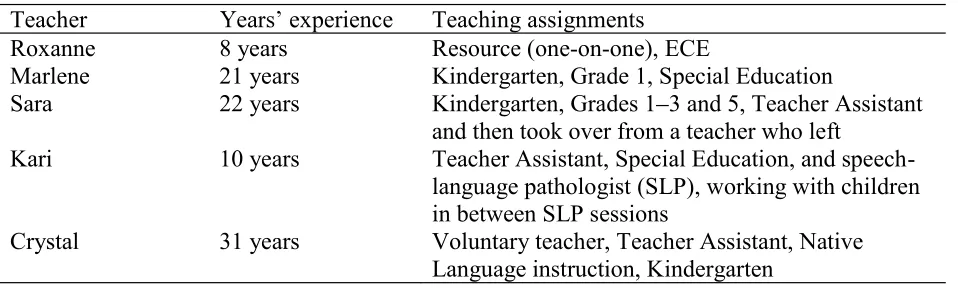
As shown in Table 1, the five participating teachers/ECEs have many years of experience and a range of postsecondary education experiences. Marlene is a graduate of both the 2-year Native
23 Brock Education Journal, 28(2), 2019
Assistant Program of Confederation College in Thunder Bay. Sara and Kari completed the Aboriginal Classroom Assistant Diploma Program over two summers at Nipissing University. Sara is planning to complement her teacher training with an Indigenous Early Childhood Education program at the Oshki Wenjack campus. She and Crystal have completed the Native Language Teachers Certification (NLTC) at Lakehead University. The program provides certification for educators to teach their native language in First Nations communities. The program is offered over 3 years during the summer months.
Table 1
Teacher experience Teaching assignments
Roxanne 8 years Resource (one-on-one), ECE
Marlene 21 years Kindergarten, Grade 1, Special Education
Sara 22 years Kindergarten, Grades 1 3 and 5, Teacher Assistant
and then took over from a teacher who left
Kari 10 years Teacher Assistant, Special Education, and
speech-language pathologist (SLP), working with children in between SLP sessions
Crystal 31 years Voluntary teacher, Teacher Assistant, Native
Language instruction, Kindergarten
Data Collection and Analysis
Our research methods honour the oral tradition of the Indigenous participants, as we invited four participants to share personal and experiential knowledge in a focus group and Roxanne to share her knowledge in a written narrative. Starting points for the focus group conversations and Roxanne
1. Tell us about your current and previous teaching/childcare experience. 2. Tell us about your teacher/educator preparation experiences.
3.
community?
We chose a focus group, rather than individual interviews, so that participants could engage in dialogue, sharing stories and experiences, and developing relationships with each other and with the researchers in concert with Indigenous research methodologies (Kovach, 2010). We are not presenting the five participants as representative of all Indigenous ECEs and teachers in remote northern Ontario First Nations communities. However, from Roxanne Lori perspectives and experience, the openness of the participants is reflective of First Nations community members
alternative models are available. This paper came out of Shelley
group questions about their professional experiences and training. After conducting the focus group and an initial reading of the transcript, Shelley invited Lori to join her in taking a closer look at the data. Lori had been working with Shelley and Indigenous ECEs on the collaborative action research project over the past 3 years. Shelley and Lori greatly valued an Indigenous