DEMOGRAPHIC RESEARCH
VOLUME 35, ARTICLE 23, PAGES 645
−
670
PUBLISHED 6 SEPTEMBER 2016
http://www.demographic-research.org/Volumes/Vol35/23/ DOI: 10.4054/DemRes.2016.35.23
Research Article
Coresidence with elderly parents and female labor
supply in China
Ke Shen
Ping Yan
Yi Zeng
This publication is part of the Special Collection on “Biodemography and Multistate Event History Analysis on Healthy Aging,” organized by Guest Editors Frans Willekens, James Carey, and Li Qiang.
©2015 Ke Shen, Ping Yan & Yi Zeng.
This open-access work is published under the terms of the Creative Commons Attribution NonCommercial License 2.0 Germany, which permits use, reproduction & distribution in any medium for non-commercial purposes, provided the original author(s) and source are given credit.
1 Introduction 646
2 Research aims 647
3 Data and variables 650
3.1 Data 650
3.2 Female labor supply and housework burden 651 3.3 Living arrangement and control variables 651
4 Model specification 654
5 Results 655
5.1 Impact of living arrangement on female labor supply 655 5.2 Why does coresidence promote female labor supply? 661
6 Conclusion 663
7 Acknowledgements 665
Coresidence with elderly parents and female labor supply in China
Ke Shen1 Ping Yan2
Yi Zeng3
Abstract
BACKGROUND
The female labor force participation rate in China has experienced a significant decline over the past two decades. Existing studies attribute this decline to the retreat of government protection of female employment and growing gender discrimination in the labor market, while overlooking other factors such as changing living arrangements. OBJECTIVE
This paper aims to explore the causal effect of coresidence or nearby residence with parents on female labor supply in China.
METHOD
Based on a paired sample of middle-aged married women and their elderly parents, we apply the instrumental variable approach to correct for the endogeneity of living arrangement.
RESULTS
We show that women coresiding with their parents are 27.9 percentage points more likely to work than those living apart, and women living with their parents in the same neighborhood are 34.9 percentage points more likely to work than those living in a different neighborhood. Also, on average, coresidence or nearby residence with parents significantly increases women’s work time by 20–26 hours per week. The positive impacts of this living arrangement are more prominent in urban areas than in rural areas. We also show that intergenerational coresidence allows women to share the burden of housework with their parents, thus leading to increased labor supply.
1 Corresponding author. School of Social Development and Public Policy, Fudan University, Shanghai, China.
E-Mail: [email protected].
2 National School of Development, Peking University, Beijing, China.
3 Center for the Study of Aging and Human Development and Geriatric Division of Medical School, Duke
CONCLUSION
Our study offers a fresh explanation for the drop in female labor force participation in China since 1990. Policies directed towards encouraging intergenerational coresidence would be effective in improving female labor supply.
1. Introduction
Three decades of virtually uninterrupted economic hyper-growth since 1980 have propelled China into the ranks of upper-middle-income countries. However, female labor force participation, as one of the major contributors to economic development, has experienced a steep decline in the post-reform period. Women’s employment was almost universal in the planned economy through the state-imposed full-employment policy (Zuo and Bian 2001). Between 1990 and 2010, female labor force participation rate at prime working ages (25–49) significantly decreased from 91% to 83%, while male labor force participation at the same ages only dropped by 2 percentage points.4
Existing literature mostly attributes the faster decline in female employment to market-oriented reforms and the massive privatization of state-owned enterprises. As the power of the state eroded, both as an employer and advocate of women’s rights, discrimination against female workers in hiring and layoffs increased (Bian 2002; Dong and Pandey 2012; Li and Li 2008; Yao and Tan 2005). However, supply-side factors, particularly changes in living arrangements which may affect women’s decision to work, have remained largely neglected.
Coresidence of aging parents with their married children has been a prevalent living arrangement in China for centuries. Since the market-oriented economic reforms and enforcement of a one-child policy in the early 1980s, a series of dramatic social and cultural changes such as rising living standards, sustained low fertility, rapid urbanization, and weakening traditional norms has largely undermined the tradition of intergenerational coresidence (Chen 2005; Chu, Xie, and Yu 2011). Single-generation households have been increasing notably and elderly persons are less likely to live in extended households.5 For example, the share of elders aged 65 and over coresiding
with children and grandchildren (three-generation households) declined from 47.4% in 1990 to 41.4% in 2000, and had further reduced to 32.8% by 2010. By contrast, the share
4 Data are calculated from 1990, 2000, and 2010 censuses.
5 Single-generation households include one-person households and one-couple households. According to
of independent-living elders rose sharply from 26.7% to 41.7% over the same period (Hu and Peng 2014).6
Given the frequent time and monetary transfers in multi-generational households, researchers have increasingly paid attention to the impact of coresidence with elderly parents on female labor supply in Japan (Ogawa and Ermisch 1996; Sasaki 2002), South Korea (Chun, Kim, and Lee 2009), the United States (Kolodinsky and Shirey 2000; Compton and Pollak 2014) and Europe (Pagani and Marenzi 2008). The few articles touching upon the subject in China have revealed that grandparents in multi-generational households undertake a tremendous amount of grandchild care, which significantly reduces a mother’s involvement in childcare (Chen, Liu, and Mair 2011; Chen, Short, and Entwisle 2000). However, little research has directly examined the outcome of coresidence with aging parents on women’s labor market.
To gain a better understanding of the recent steep decline in female labor force participation in China, our study draws on a unique paired sample of married women and their parents to cast a fresh light on the importance of living arrangement for female employment. We first identify the causal impacts of coresidence and nearby residence with elderly parents on female labor force participation and hours of work, taking into account the endogeneity of living arrangement. We then explore whether the impacts are heterogeneous in urban and rural areas, given the huge differences between urban and rural employment in flexibility and accessibility. Finally, we examine whether women in extended households do receive time transfers from parents and are less involved in domestic work – an important mechanism through which coresidence affects female labor supply.
The rest of the paper is organized as follows. Section 2 summarizes the existing literature and how our study expands upon previous work. Section 3 describes data sources and measurement. Section 4 discusses model specification and empirical strategies. The empirical results are presented in Section 5, and Section 6 concludes.
2. Literature review
Frequent reciprocal exchanges in extended households are well documented in Asia as well as in Western countries (Albertini, Kohli, and Vogel 2007; Chen, Liu, and Mair 2011; Kolodinsky and Shirey 2000). On the one hand, children take care of aging parents. On the other hand, downward time transfers are increasingly intense and pronounced. Aging parents assist their children, particularly daughters, with grandchild care and household chores, which eases the burden for employed mothers.
In recent decades there has been a growing interest in the impact of living arrangement on female labor supply. A pilot study by Ogawa and Ermisch (1996) in Japan shows that married women coresiding with parents or parents-in-law are more likely to work full time and less likely to work part time or be housewives than those in nuclear families. Nagase (1997) also finds that the presence of a grandmother in the household significantly increases the probability of employment for Japanese married women, while the presence of a grandfather does not seem to help. Negligible to substantial positive impacts of coresidence or nearby residence with grandparents on female employment are documented in a few studies in developed countries (Compton and Pollak 2014; Garcia-Moran and Kuehn 2012; Kolodinsky and Shirey 2000). A related branch of study examines the importance of time transfers from grandparents. They consistently find that grandparent support in grandchild care and household chores effectively promotes the labor supply of married women (Arpino, Pronzato, and Tavares 2014; Del Boca 2002; Dimova and Wolff 2008, 2011; Pagani and Marenzi 2008; Posadas and Vidal-Fernandez 2013; Zamarro 2011).
The above-mentioned research provides rich information on living arrangement and female labor supply. However, one caveat is the endogeneity of coresidence. One potential source of endogeneity is unobserved preferences such as family values and filial piety, relating both to living arrangement decisions and labor market outcomes. For example, women who highly value family ties are inclined to coreside with their parents, and also to spend more time in domestic work but less time in market work. As a result, unobserved preferences introduce a downward bias in the relationship between coresidence and female labor supply. Another source is reversed causality. Suppose that market alternatives to services provided by coresiding parents (e.g., childcare and housekeeping) are unavailable or very expensive. Married women who want to work are more likely to reside with their parents in order to get these services so they can share the burden of household work. In that case, the estimated impact of coresidence on female employment is biased upwards if coresidence is assumed to be exogenous (Sasaki 2002).
South Korean sample of married women, Chun, Kim, and Lee (2009) use the husband’s birth order as the instrument for coresidence, and find that the positive impact of coresidence on female labor supply shrinks and loses its significance after correcting for the endogeneity bias.
The importance of living arrangement to female labor supply has been much less explored in China. Chen, Short, and Entwisle (2000) show that coresidence or nearby residence with grandparents significantly reduces a mother’s involvement in childcare, while they do not touch on mother’s involvement in paid work. The innovative study by Maurer-Fazio et al. (2011), using 1982, 1990, and 2000 census data, reveals that coresidence with parents or parents-in-law significantly increases labor force participation of married women in China. They use the following instruments to correct for endogeneity: percentage of households which have coresident elders over age 70 in the prefecture, interaction between the woman’s age and her husband’s age, and provincial dummies. They demonstrate that these instruments have strong predictive powers for coresidence. However, woman’s age and the province that she resides in might directly affect her labor supply, in which case the validity of instruments might be challenged.7 In addition, due to limited information in census data, the model does not
control for parents’ characteristics such as health and pension availability, which may also influence women’s decision to work.
China offers an interesting economic and institutional context for further exploring this issue. First, a chronic shortage of public childcare centers and after-school programs has emerged since the market-based reforms, and the historically strong intergenerational solidarity has persisted (Chen 2005; Logan and Bian 1999). Hence, grandparents’ help in grandchild care and housekeeping is an increasingly common experience, and is ranked by women as the ‘best’, and often more desirable than paid help (Goh 2009; Short et al. 2002). Second, flexible work arrangements are generally not available in China and part-time work is less adopted as a way of balancing work and family than in other settings (Xiao and Cooke 2012). In addition, according to China’s 2008 Time Use survey, women on average spent twice as much time as men,on unpaid household work: 20.6 versus 9.5 hours per week. With the competing demand of family and work, 30.4% of unemployed women aged 35–39 at the 2008 survey dropped out of the labor market to take care of housework (Xiao and Cooke 2012). Given these cultural traditions and institutional changes, our research focuses on the impact of coresidence and nearby residence with elderly parents on female labor supply in urban and rural China.
3. Data and variables
3.1 Data
To estimate the relationship between living arrangement and female labor supply, we use the data on dyadic pairs of adult children and their elderly parents in the 2002 wave of the Chinese Longitudinal Healthy Longevity Survey (CLHLS). The CLHLS is a longitudinal survey of the elderly aged 65 and over. The survey, conducted in 1998, 2000, 2002, 2005, 2008/2009, 2011/2012, and 2014, randomly selects half of the counties in 22 out of 31 provinces, whose combined population constitutes about 85% of the total population in China (Zeng 2008).
The CLHLS 2002 wave includes a sub-sample of elderly interviewees’ adult children (each sampled elderly interviewee is paired with one of their children) in eight eastern provinces (Zeng et al. 2016).8 The sub-sample of adult children complete a
sophisticated questionnaire, the Social Survey on Family Dynamics, designed and carefully tested by a research team at Taiwan Academy Sinica in collaboration with investigators at the University of Michigan (Chu and Yu 2010). It collects detailed information on the adult child’s education, employment, marriage, living arrangement, and intergenerational transfers with (elderly) parents.
Based on this dataset, we get 1,316 dyadic pairs of adult women and their elderly parents. In our analysis we exclude 263 women who are retired, disabled, or in education, because they are not potential labor force participants. We also exclude 77 women who live with parents-in-law instead of parents, since information on their parents-in-law is not collected in the CLHLS. Only married women are selected, and 108 cases that are not currently married are excluded as they face different constraints in the reconciliation of family and work. After further dropping 12 observations with missing values on key variables, the final sample is composed of 856 daughter-parent pairs.
A major advantage of this data is that it not only contains detailed information on married women but also on their elderly parents. This allows us to consider a set of control variables such as age, pension, and health of the parents, which are important factors in women’s decision to work but are often unavailable in previous studies (Maurer-Fazio et al. 2011; Oishi and Oshio 2006; Sasaki 2002).
8 Eight Chinese eastern provinces include Liaoning, Shanghai, Jiangsu, Zhejiang, Fujian, Shandong,
Given the huge differences between urban and rural employment in terms of wages, work arrangements, and entry requirements, the sample of married women is divided into urban and rural sub-samples. 41% of the sampled women reside in urban areas and 59% in the countryside.
3.2 Female labor supply and housework burden
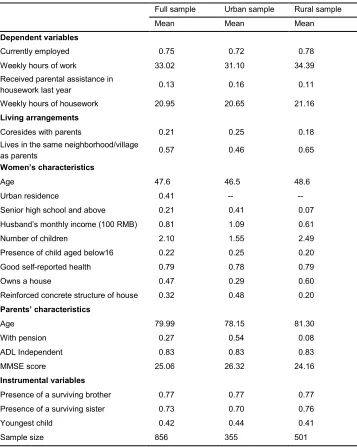
Female labor supply is measured by employment status and weekly hours of work. A woman is regarded as employed in the survey if she satisfies any of these three conditions: being engaged in paid work, working longer than 15 hours a week without pay in a self-owned enterprise, or doing farm work. Employment status is a dummy variable, and weekly hours of work is a non-negative continuous variable. Table 1 presents descriptive statistics for the variables used in the analysis both for the whole sample and separately for urban and rural sub-samples. 75% of the sampled women are currently employed, and the average length of working time of the whole sample is 33 hours per week. Rural women have a higher employment rate and work longer than their urban counterparts.
Our study also examines whether coresidence with elderly parents affects women’s housework burden and leads to a change in their labor force involvement. Two variables are selected to measure housework burden: whether the woman has received parental assistance with housework in the previous year, and hours spent on housework each week. On average the women spend 21 hours per week on housekeeping, with no evident difference between urban and rural areas.
3.3 Living arrangement and control variables
We control for three groups of covariates that may affect married women’s decision to work. First, women’s demographic characteristics are controlled for, including age, age squared, residence, and educational attainment.9 It is worth noting that the sampled
women (after excluding the retired cases) are relatively senior at an average age of 47.6 years, because they are the children of elderly respondents aged 65 and above in the CLHLS..10 Second, we control for husband’s monthly income, number of children,
presence of a young child aged below age 16, self-rated health, house ownership, and house type (whether the house has a reinforced concrete structure). These variables measure women’s financial status, home duties, accommodation, and neighborhood facilities.11 Third, we control for the characteristics of their elderly parents, including
age, pension availability, physical function (daily activity),12 and cognitive function
(MMSE score).13 These variables represent women’s caregiving burden. The lower the
burden the higher their propensity to work is expected to be.
9 We control for age and age squared because there might be a nonlinear trend between women’s age and labor
force participation. Arpino, Pronzato, and Tavares (2014) and Dimova and Wolff (2008) also control for mother’s age and age squared in the labor force participation equation.
10 The age distribution of sampled women is as follows: 39.5% of women aged 35–44, 39.5% of women aged
45–54, and 21% aged 55–65. In urban areas the legal age of women’s retirement is 50 for blue-collar workers, 55 for white-collar workers, and 60 for senior cadres/professionals. Some urban women aged 55+ still work in private enterprises, which do not have to follow the state compulsory retirement regime. In rural areas there is no forced retirement and it is common that women are still engaged in farm work at old ages. In the 2010 census, 54% of women aged 55–59 and 41% of women aged 60–64 participated in the labor force. In order to have a complete picture of female labor supply and ensure a sufficient sample size, we retain in our analyses those aged 55–65 who are not retired.
11 House type is a proxy for neighborhood facilities. If the house has a reinforced concrete structure it is often
newly built and has better neighborhood assisted living and recreational facilities.
12 Physical function is measured by the activities of daily living (ADL), which include six daily activities such
as bathing, dressing, feeding oneself, indoor transferring, going to the toilet and cleaning oneself afterwards, and continence. If an elderly person needs assistance in performing any of these six daily tasks they are considered ADL disabled; otherwise they are regarded as ADL independent.
13 In the CLHLS, Mini-Mental State Examination (MMSE) is applied to measure the respondent's cognitive
Table 1: Descriptive statistics of the married women sample
Full sample Urban sample Rural sample
Mean Mean Mean
Dependent variables
Currently employed 0.75 0.72 0.78 Weekly hours of work 33.02 31.10 34.39 Received parental assistance in
housework last year 0.13 0.16 0.11 Weekly hours of housework 20.95 20.65 21.16
Living arrangements
Coresides with parents 0.21 0.25 0.18 Lives in the same neighborhood/village
as parents 0.57 0.46 0.65
Women’s characteristics
Age 47.6 46.5 48.6
Urban residence 0.41 -- --
Senior high school and above 0.21 0.41 0.07 Husband’s monthly income (100 RMB) 0.81 1.09 0.61 Number of children 2.10 1.55 2.49 Presence of child aged below16 0.22 0.25 0.20 Good self-reported health 0.79 0.78 0.79
Owns a house 0.47 0.29 0.60
Reinforced concrete structure of house 0.32 0.48 0.20
Parents’ characteristics
Age 79.99 78.15 81.30
With pension 0.27 0.54 0.08
ADL Independent 0.83 0.83 0.83
MMSE score 25.06 26.32 24.16
Instrumental variables
Presence of a surviving brother 0.77 0.77 0.77 Presence of a surviving sister 0.73 0.70 0.76
Youngest child 0.42 0.44 0.41
4. Model specification
As mentioned in Section 2, in order to tackle the endogeneity of living arrangement we apply the instrumental variable (IV) method to identify the causal effect of living arrangement on female labor supply. A valid instrumental variable has to affect the choice of living arrangement (relevance assumption) without having a direct influence on female labor supply (exclusion restriction assumption). The exclusion restriction means that any effect of the instrument on female labor supply operates via its effect on living arrangement (Angrist, Imbens, and Rubin 1996). We select three instrumental variables. The first is whether the woman has any surviving brother and the second is whether the woman has any surviving sister. Under the patrilineal and patrilocal extended family model in China, elderly persons are expected to live with adult sons and their wives (Sun 2002; Whyte 2005; Whyte and Xu 2003), while matrilocal coresidence – parents coresiding with their married daughter – is also becoming more prevalent in China (Chu, Xie, and Yu 2011). Thus women’s possibility of coresidence with parents will be greatly reduced if they have a brother, and, to a lesser extent, if they have a sister (Zhang, Gu, and Luo 2014). At the same time, the presence of brothers and sisters does not directly affect women’s willingness to work. The third instrument is whether the woman is the youngest surviving child in her family. If the woman is the only surviving child in her family, she is also counted as the youngest child.14 Previous studies suggest
that the youngest child often leaves the parental home the latest and thus is more likely to live with or close to her aging parents (Leopold 2012). It has also been demonstrated that birth order does not affect women’s work decisions directly (Kessler 1991).
The conventional computational method to calculate IV estimates is two-stage least-squares (2SLS) estimation, expressed as follows.
𝑋 = 𝛾1𝑍1+𝛾2𝑍2+ 𝛾3𝑍3+ ∑ 𝜆𝑗𝐶𝑗+ 𝑣 (1)
𝑌 = 𝛼𝑋 + ∑ 𝛽𝑗𝐶𝑗+ 𝑢 (2)
In the first-stage equation (1), 𝑋 is the endogenous variable living arrangement,
𝑍1, 𝑍2, and 𝑍3are three instrumental variables, and 𝐶𝑗 is a series of exogenous covariates. In the first stage, an OLS regression of 𝑋 on instrumental variables and covariates is used to obtain predicted value 𝑋∗. If coefficients 𝛾
1, 𝛾2, and 𝛾3 are jointly
14 9.9% of the sampled women do not have any surviving siblings, and in the analyses they are assumed to be
significant, 𝑍1, 𝑍2, and 𝑍3 are highly correlated with 𝑋, satisfying the relevance assumption.
In the second-stage equation (2), 𝑌 is regressed on 𝑋∗ and 𝐶
𝑗 to obtain the IV estimate 𝛼, that is, the causal impact of living arrangement on female labor supply. If 𝑌
is the binary outcome of employment status, we apply the linear probability model in the second-stage estimation. If 𝑌 is hours of work, the Tobit model is employed to tackle the censoring problem.15 Hours of work is a continuous variable with nonnegative
values: We observe positive values only if the woman is employed. Otherwise the hours of work is zero; in other words, the variable is censored and there is a clustering of observations at the zero point.
We implement a series of tests to check the validity of the instruments. In addition to the significance of coefficients on the instruments, the Wald F-test of relevance is conducted. If the F-statistic of correlation among the instruments and the endogenous variable in the first-stage equation are larger than a threshold of 10, the possibility of weak instruments can be excluded (Staiger and Stock 1997). Having more instrumental variables than endogenous variables also allows us to test the exclusion restriction assumption by implementing a test of over-identification restrictions. The joint null hypothesis is that the instruments are valid and that the excluded instruments are correctly excluded from the second-stage equation.
When examining the causal effect of living arrangement on women’s housework burden we also adopt the IV approach, with the same first-stage equation (1). In the second-stage estimation the linear probability model is employed for a binary outcome (whether received parental assistance in housework) and the Tobit model is employed for a non-negative continuous outcome (weekly hours of housework).
5. Results
5.1 Impact of living arrangement on female labor supply
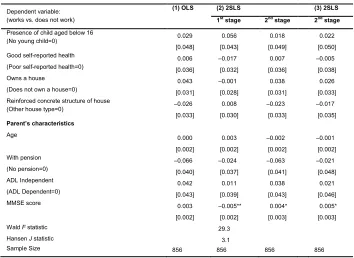
Table 2 presents the impacts of living arrangement on labor force participation among married women. Model 1 shows the OLS estimation of a linear probability model where living arrangement is assumed to be exogenous. The coefficient on coresidence with parents is positive but statistically insignificant.
Model 2 adopts the IV approach to correct for endogeneity of living arrangement. In the first-stage estimation the presence of a brother significantly lowers the probability of coresidence, and the presence of a sister also reduces the probability but to a lesser
15 If the dependent variable is censored and there is a clustering of observations at the censored point (zero
extent. A woman who is the youngest child in her family is much more likely to coreside with her parents. The coefficients of these three instruments are in line with our expectations and are highly significant. The Wald F-statistic is 29.3, larger than the threshold of 10, confirming that the instruments are not weak; otherwise, even very low correlations of the instrumental variables with the second-stage outcome may lead to biased estimates (Bound, Jaeger, and Baker 1993). In addition, the test of over-identification restriction does not reject the null hypothesis that the instruments are valid (Hansen J-Statistic= 3.1; p-value= 0.21).
The second-stage estimation shows that women coresiding with their parents are 27.9 percentage points more likely to work than those living apart from their parents. Based on these coefficients, the estimated probability of employment for an average woman who coresides with her parents is 97.5%, as compared with 69.6% for an average woman who lives apart from her parents.16 The IV estimate of the coefficient on
coresidence is much larger than the OLS estimate and is statistically significant. As mentioned in the Literature Review section, the downward bias in the OLS estimate is largely due to unobserved preferences such as traditional values and filial piety. Women who have strong traditional values including filial piety might be more inclined to coreside with their parents and be more involved in housework, but less devoted to market work. As a result, unobserved preferences introduce a downward bias in the relationship between coresidence and labor market participation.
Model 3 adopts the IV approach using an alternative measure of living arrangement. Women living in the same neighborhood/village as their parents are 34.9 percentage points more likely to work than those living in a different neighborhood, an effect even larger than that of coresidence in Model 2. The estimated probability of employment for an average woman who lives in the same neighborhood as her parents is 90.3%, in contrast to only 55.4% for an average woman living in a different neighborhood.17 In our sample, among the women who do not live with their parents
under the same roof, 46% live in the same neighborhood. A previous study suggests that Chinese parents who live close by still maintain a high level of interaction and exchange with their children (Chen 2005). Thus we observe that the difference between coresidence and non-coresidence is smaller than the difference between nearby residence and long-distance residence.
Our estimated results are comparable with the findings in other settings that also employ the IV approach. For example, coresidence significantly increases labor force participation by 19–24 percentage points among Japanese marred women (Oishi and
16 An average woman has mean values for all the independent variables except for the variable of coresidence.
We compare the difference in the probability of employment between co-resident women and non-coresident women, holding other characteristics constant, similar to the method adopted by Ogawa and Ermisch (1996).
Oshio 2006), and Italian mothers who use grandparental childcare are 32 percentage points more likely to work (Arpino, Pronzato, and Tavares 2014). Both of these studies show that the positive impact of coresidence (or grandparental support) becomes much stronger after correcting for endogeneity bias.
The coefficients of the covariates are in line with our expectations. The coefficient on age is insignificant and the coefficient of age squared is significantly negative, indicating that female labor force participation declines over age while the pace of decline accelerates at older ages. Rural women are more likely to work, largely due to easier access to agricultural jobs. Well-educated women have higher labor force participation, as expected. Women with more children face greater economic pressure and thus are motivated to work. A better parental cognitive function alleviates women’s care burden and promotes their employment.
Table 2: Impact of living arrangement on female employment
Dependent variable: (works vs. does not work)
(1) OLS (2) 2SLS (3) 2SLS
1st stage 2nd stage 2nd stage Presence of a surviving brother
(No brother=0) ‒0.248***
[0.033] Presence of a surviving sister
(No sister=0) ‒0.061*
[0.032]
Youngest child 0.057*
(Older child=0) [0.032]
Coresides with parents 0.041 0.279**
(Does not coreside=0) [0.036] [0.119]
Lives in the same neighborhood as parents
(Lives in a different neighborhood=0) [0.169] 0.349** Women’s characteristics
Age 0.033 0.017 0.032 0.027
[0.023] [0.021] [0.024] [0.025]
Age squared ‒0.000* 0.000 ‒0.000* 0.000
[0.000] [0.000] [0.000] [0.000] Urban residence ‒0.091** 0.073** ‒0.112*** ‒0.056 (Rural residence=0) [0.037] [0.034] [0.039] [0.042] Senior high school or above
(Lower than senior high school=0) 0.177*** 0.018 0.167*** 0.179*** [0.042] [0.039] [0.043] [0.044] Husband’s monthly income ‒0.017 0.003 ‒0.017 ‒0.009
[0.018] [0.017] [0.019] [0.020]
Number of children 0.022 ‒0.021 0.028* 0.032*
Table 2: (Continued)
Dependent variable: (works vs. does not work)
(1) OLS (2) 2SLS (3) 2SLS
1st stage 2nd stage 2nd stage Presence of child aged below 16
(No young child=0) 0.029 0.056 0.018 0.022
[0.048] [0.043] [0.049] [0.050] Good self-reported health 0.006 ‒0.017 0.007 ‒0.005 (Poor self-reported health=0) [0.036] [0.032] [0.036] [0.038]
Owns a house 0.043 ‒0.001 0.038 0.026
(Does not own a house=0) [0.031] [0.028] [0.031] [0.033] Reinforced concrete structure of house
(Other house type=0) ‒0.026 0.008 ‒0.023 ‒0.017 [0.033] [0.030] [0.033] [0.035] Parent’s characteristics
Age 0.000 0.003 ‒0.002 ‒0.001
[0.002] [0.002] [0.002] [0.002]
With pension ‒0.066 ‒0.024 ‒0.063 ‒0.021
(No pension=0) [0.040] [0.037] [0.041] [0.048]
ADL Independent 0.042 0.011 0.038 0.021
(ADL Dependent=0) [0.043] [0.039] [0.043] [0.046]
MMSE score 0.003 ‒0.005** 0.004* 0.005*
[0.002] [0.002] [0.003] [0.003]
Wald F statistic 29.3
Hansen J statistic 3.1
Sample Size 856 856 856 856
Note: Standard errors in square parentheses. * P<0.1, ** P<0.05, *** P<0.01. The first stage estimation results for Model 3 are similar to the results of Model 2, and thus are omitted due to space limits.
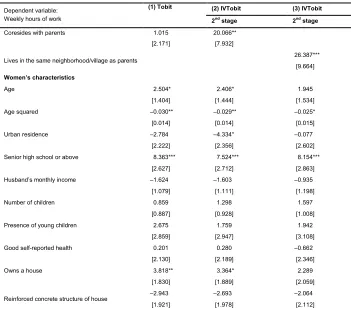
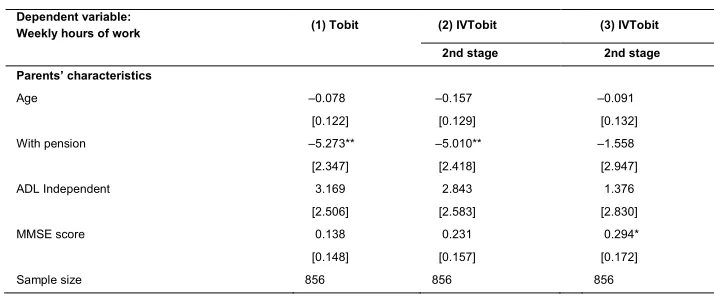
Table 3 presents the impacts of living arrangement on women’s weekly hours of work. Column 1 reports the results of a Tobit model with exogenous living arrangement. It shows that coresidence increases women’s hours of work, though the coefficient is insignificant. Model 2 and Model 3 adopt the IV approach with a Tobit model in the second-stage regression. The main finding of Model 2 is that women coresiding with their parents work 20 hours per week more than those living apart, on average. In other words, an average woman coresiding with her parents works for 47.9 hours per week, while an average woman living apart from her parents only works for 27.9 hours.18 This effect consists of two parts: First, coresidence motivates housewives to take paid employment, in other words, hours of work for this sub-group jumps from zero to
18 An average woman has mean values for all the independent variables except for the variable of coresidence,
positive; second, coresidence encourages employed women to increase hours of work. As compared with the estimate in Model 2, the positive impact of coresidence is largely underestimated in Model 1, where coresidence is assumed to be exogenous, the same finding as in Table 2. Model 3 suggests that the presence of parents in the same neighborhood/village significantly increases women’s work time by 26.4 hours per week on average, after correcting for the endogeneity bias. Based on these regression results, the estimated weekly hours of work for an average woman who lives in the same neighborhood as her parents is 44.8 hours, compared with only 18.4 hours for an average woman who lives in a different neighborhood.
Table 3: Impact of living arrangement on women’s weekly hours of work
Dependent variable: Weekly hours of work
(1) Tobit (2) IVTobit (3) IVTobit 2nd stage 2nd stage Coresides with parents 1.015 20.066**
[2.171] [7.932]
Lives in the same neighborhood/village as parents 26.387*** [9.664] Women’s characteristics
Age 2.504* 2.406* 1.945
[1.404] [1.444] [1.534]
Age squared ‒0.030** ‒0.029** ‒0.025*
[0.014] [0.014] [0.015]
Urban residence ‒2.784 ‒4.334* ‒0.077
[2.222] [2.356] [2.602] Senior high school or above 8.363*** 7.524*** 8.154***
[2.627] [2.712] [2.863] Husband’s monthly income ‒1.624 ‒1.603 ‒0.935 [1.079] [1.111] [1.198]
Number of children 0.859 1.298 1.597
[0.887] [0.928] [1.008]
Presence of young children 2.675 1.759 1.942
[2.859] [2.947] [3.108]
Good self-reported health 0.201 0.280 ‒0.662
[2.130] [2.189] [2.346]
Owns a house 3.818** 3.364* 2.289
[1.830] [1.889] [2.059]
Table 3: (Continued) Dependent variable:
Weekly hours of work (1) Tobit (2) IVTobit (3) IVTobit 2nd stage 2nd stage Parents’ characteristics
Age ‒0.078 ‒0.157 ‒0.091
[0.122] [0.129] [0.132]
With pension ‒5.273** ‒5.010** ‒1.558
[2.347] [2.418] [2.947]
ADL Independent 3.169 2.843 1.376
[2.506] [2.583] [2.830]
MMSE score 0.138 0.231 0.294*
[0.148] [0.157] [0.172]
Sample size 856 856 856
Note: Column 2–4 reports the marginal effects of explanatory variables on observed hours of work (non-negative values), instead of the impacts on latent hours of work (might be negative). Standard errors in square parentheses. * P<0.1, ** P<0.05, *** P<0.01. The first stage estimation results for Model 2 and 3 are almost the same as the results in Column 2 of Table 2; thus they are omitted to save space. Reference categories for dummy variables are the same as in Table 2 and are not listed here.
Table 4 reports the heterogeneous impacts of living arrangement by dividing the sample according to women’s residence. The IV estimates in Columns 1 and 2 show that the positive impacts of coresidence and nearby residence on female employment are much stronger in urban areas than in rural areas, and that they are statistically significant. Similarly, the impact of coresidence or proximity to parents on women’s work time is greater in urban areas than in rural areas, as shown in Columns 3 and 4. Table 4: Heterogeneous impacts of living arrangement on female labor supply
Work or not (IV) Weekly hours of work (IV Tobit)
Urban Rural Urban Rural
Coresides with parents 0.384* 0.141 22.855* 13.447
[0.208] [0.127] [13.869] [8.807]
Lives in the same
neighborhood/village as parents
0.441* 0.241 26.698* 24.842**
[0.250] [0.186] [15.803] [10.916]
Sample size 355 501 355 501
Note: Column 3 and 4 report the marginal effects of coresidence and nearby residence on observed hours of work.Standard errors in square parentheses. * P<0.1, ** P<0.05, *** P<0.01. The first-stage estimation results and coefficients of covariates in the second-stage estimation are not presented here to save space.
much harder in urban areas (Du and Dong 2009). The strain from the dual demands of market work and domestic work is more acute for urban women, and thus presence of parents in the same house or neighborhood is particularly important. Our finding supports the studies by Nagase (1997) and Ogawa and Ermisch (1996) that show that coresidence efficiently improves full-time employment (the norm in urban employment) instead of part-time employment (more usual in farm work) among Japanese women.
5.2 Why does coresidence promote female labor supply?
Our study shows that coresidence or residence near parents has substantial positive effects on both labor force participation and weekly hours of work among Chinese married women. Previous studies propose that a major reason why residential proximity to parents increases female labor supply is substantive parental assistance in housekeeping and childcare (Compton and Pollak 2014; Oishi and Oshio 2006; Sasaki 2002), while rigorous analyses are limited. In our sample, 70% of women who are not working cite the most important reason as ‘taking care of housework,’ which indicates that domestic burdens are a major obstacle to female employment.
Table 5: Impact of living arrangement on women’s housework burden Receive parental assistance in
housework Weekly hours of housework (1) IV (2) IV (3) IV Tobit (4) IV Tobit Coresides with parents 0.240*** ‒9.439***
[0.091] [3.272]
Lives in the 0.275** ‒13.440**
same neighborhood as parents [0.131] [5.191]
Women’s characteristics
Age ‒0.020 ‒0.024 0.782 0.970
[0.018] [0.019] [0.713] [0.761]
Age squared 0.000 0.000 ‒0.006 ‒0.008
[0.000] [0.000] [0.007] [0.008]
Urban residence 0.003 0.049 2.251* 0.108
[0.030] [0.033] [1.176] [1.287] Senior high school or above 0.035 0.045 ‒1.814 ‒2.180
[0.033] [0.035] [1.277] [1.339] Husband’s monthly income ‒0.015 ‒0.009 ‒0.768 ‒1.065*
[0.014] [0.015] [0.562] [0.606] Number of children ‒0.008 ‒0.006 ‒0.296 ‒0.445
[0.012] [0.013] [0.458] [0.499] Presence of young children 0.021 0.025 2.275 2.111
[0.038] [0.039] [1.473] [1.557] Good self-reported health ‒0.030 ‒0.040 0.530 0.983
[0.028] [0.029] [1.079] [1.149]
Owns a house ‒0.005 ‒0.014 1.982** 2.409**
[0.024] [0.026] [0.937] [1.025] Reinforced concrete structure of
house 0.017 0.021
‒0.660 ‒0.923 [0.025] [0.027] [0.987] [1.054] Parents’ characteristics
Age ‒0.004*** ‒0.003** ‒0.028 ‒0.061
[0.002] [0.002] [0.064] [0.066]
With pension ‒0.033 0.000 0.184 ‒1.469
[0.032] [0.037] [1.232] [1.462] ADL Independent 0.024 0.011 ‒4.518*** ‒3.744***
[0.033] [0.036] [1.328] [1.444]
MMSE score 0.002 0.002 ‒0.100 ‒0.130
[0.002] [0.002] [0.077] [0.085]
Sample size 855 855 855 855
6. Conclusion
The rapid decline in female labor force participation in China over the past two decades has received much attention, as it could impede gender equality, human capital investment, and economic growth (Anderson and Eswaran 2009; Branisa and Klasen 2013). However, most studies overlook supply-side factors such as changing living arrangements.
This study examines the causal impact of living arrangement on female labor supply in China using a paired sample of middle-aged married women and their elderly parents. As there might be unobserved preferences related both to coresidence decision and propensity to work, living arrangement should not be treated as exogenous and OLS regressions would produce biased results. We employ the instrumental variable approach to correct for potential endogeneity bias.
with parents-in-law has the same positive effect on female labor supply as coresidence with parents.
Our study offers a fresh explanation of the drop in female labor force participation in China since 1990; namely, an evident decline in intergenerational coresidence. With the traditional patriarchal ideology of ‘men outside, women inside’ in China, men are much less involved in housework than their wives. Women’s domestic burden is ever rising with a chronic shortage of public childcare facilities and increasing cost of purchasing external help since the economic reforms. The presence of parents in the household or nearby is thus especially helpful for women. However, with the rapid decline in three-generation households, women are sometimes compelled to devote more time to child rearing and housekeeping and to retreat from the labor market. Equally important, even if women manage to both maintain a full-time job and bear the domestic burden, many of them cope by cutting back on their leisure time, which can have both short- and long-term negative consequences for their health and well-being (Short et al. 2002).
This study is of particular relevance to policy in the context of contemporary China. Due to more than two decades of sustained low fertility, China’s working-age population (15–64) is projected to decline from 73% of the total population in 2014 to 59% in 2050 (United Nations Population Division 2015). The Chinese government has initiated various programs to increase the labor supply, such as gradual postponement of retirement, improved female education, and elimination of gender discrimination.19
Aside from these policies, this study suggests that policies directed towards encouraging coresidence or nearby residence would be effective in increasing female labor supply, especially in urban areas. A new law in China that came into effect in 2013 requires adult children to visit their elderly parents ‘often’; otherwise face fines or jail time.20 This law
is meant to strengthen intergenerational solidarity and protect the benefits of elders, while it would be more effective to advertise the benefits of frequent contact or nearby residence with parents for children themselves. China could learn from the experiences of Singapore. Singapore’s Housing and Development Board offers several incentive schemes for public flat applicants who live with or close to their parents. For instance, certain flats are purpose-built to house multi-generational families, and married children applying for a new flat to live with or next to their parents have improved chances of success. China should also expand good-quality public childcare facilities, introduce family-friendly employment programs, and encourage greater involvement of fathers in childcare and housework. China has already achieved tentative progress, such as
19 The Ministry of Human Resources and Social Security of China has declared that a detailed schedule of
gradual postponement of retirement will be announced in 2016.
20 The law is called The Amended Chinese Elderly’s Interests Protection Law. There is no clear definition of
introducing flexible working schedules during lactation and paid paternal leave.21 Gains
in these areas will bring relief to married women who experience heavy demands within and beyond the household, and will efficiently improve their labor force participation.
7. Acknowledgements
This study is supported by the National Science Foundation of China (71110107025, 71233001, 71490732, 71490734, 71273059 and 71273001), Shanghai Planning Project of Philosophy and Social Science (2012ESH001), Shanghai Educational Committee (14ZS005), Fudan University Zhuo Xue Talent Project, the NIA/NIH (R01AG023627) and United Nations Fund for Population Activities. We are grateful for the valuable comments of two anonymous referees and the editor, Frans Willekens, whose feedback has much improved this paper.
21 Flexible working schedule during lactation means that during the lactation months women can ask for a
References
Albertini, M., Kohli, M., and Vogel, C. (2007). Intergenerational transfers of time and money in European families: Common patterns – different regimes? Journal of European Social Policy 17(4): 319–334. doi:10.1177/0958928707081068. Anderson, S. and Eswaran, M. (2009). What determines female autonomy? Evidence
from Bangladesh. Journal of Development Economics 90(2): 179–191.
doi:10.1016/j.jdeveco.2008.10.004.
Angrist, J., Imbens, G.W., and Rubin, D. (1996). Identification of causal effects using instrumental variables. Journal of the American Statistical Association 91(434): 444–472. doi:10.1080/01621459.1996.10476902.
Arpino, B., Pronzato, C.D., and Tavares, L.P. (2014). The effect of grandparental support on mothers’ labour market participation: An instrumental variable approach. European Journal of Population 30(4): 369–390. doi:10.1007/s1068 0-014-9319-8.
Bian, Y. (2002). Chinese social stratification and social mobility. Annual Review of Sociology 28: 91–116. doi:10.1146/annurev.soc.28.110601.140823.
Bian, F., Logan, J.R., and Bian, Y. (1998). Intergenerational relations in urban China: Proximity, contact, and help to parents. Demography 35(1): 115–124. doi:10.23 07/3004031.
Bound, J., Jaeger, D.A., and Baker, R. (1993). The cure can be worse than the disease: A cautionary tale regarding instrumental variables. Cambridge: The National Bureau of Economic Research (NBER technical working paper no. 137). Branisa, B. and Klasen, S. (2013). Gender inequality in social institutions and
gendered development outcomes. World Development 45: 252–268. doi:10.101 6/j.worlddev.2012.12.003.
Chen, F. (2005). Residential patterns of parents and their married children in contemporary China: A life course approach. Population Research and Policy Review 24(2): 125–148. doi:10.1007/s11113-004-6371-9.
Chen, F., Liu, G., and Mair, C.A. (2011). Intergenerational ties in context: Grandparents caring for grandchildren in China. Social Forces 90(2): 571–594.
doi:10.1093/sf/sor012.
Chen, F., Short, S.E., and Entwisle, B. (2000). The impact of grandparental proximity on maternal childcare in China. Population Research and Policy Review 19(6): 571–590. doi:10.1023/A:1010618302144.
Chu, C.Y., Xie, Y., and Yu, R.R. (2011). Coresidence with elderly parents: A comparative study of southeast China and Taiwan. Journal of Marriage and Family 73(1): 120–135. doi:10.1111/j.1741-3737.2010.00793.x.
Chun, H., Kim, O., and Lee, I. (2009). Living arrangements and labor supply of married women[unpublished manuscript]. Seoul: Sogang University.
Compton, J. and Pollak, R.A. (2014). Family proximity, childcare, and women’s labor force attachment. Journal of Urban Economics 79: 72–90. doi:10.1016/j.jue.20 13.03.007.
Del Boca, D. (2002). The effect of child care and part time opportunities on participation and fertility decisions in Italy. Journal of Population Economics 15(3): 549–573. doi:10.1007/s001480100089.
Dimova, R. and Wolff, F.C. (2008). Grandchild care transfers by ageing immigrants in France: Intra-household allocation and labour market implications. European Journal of Population 24(3): 315–340. doi:10.1007/s10680-007-9122-x. Dimova, R. and Wolff, F.C. (2011). Do downward private transfers enhance maternal
labor supply? Evidence from around Europe. Journal of Population Economics 24(3): 911–933. doi:10.1007/s00148-010-0305-0.
Dong, X. and Pandey, M. (2012). Gender and labor retrenchment in Chinese state-owned enterprises: Investigations using firm-level panel data. China Economic Review 23(2): 385–395. doi:10.1016/j.chieco.2012.02.006.
Du, F. and Dong, X. (2009). Why do women have longer durations of unemployment than men in post-restructuring urban China? Cambridge Journal of Economics 33(2): 233–252. doi:10.1093/cje/ben034.
Folstein, M.F., Folstein, S.E., and McHugh, P.R. (1975). Mini-mental state: A practical method for grading the cognitive state of patients for the clinician. Journal of Psychiatric Research 12(3): 189–198. doi:10.1016/0022-3956(75)90026-6. Goh, E.C.L. (2009). Grandparents as childcare providers: An in-depth analysis of the
case of Xiamen, China. Journal of Aging Studies 23(1): 60–68. doi:10.1016/j.ja ging.2007.08.001.
Garcia-Moran, E. and Kuehn, Z. (2012). With strings attached: Grandparent-provided child care, fertility and female labor market outcomes. Milan: The UniCredit & Universities Foundation (Working paper series no. 37).
Kessler, D. (1991). Birth order, family size, and achievement: Family structure and wage determination. Journal of Labor Economics (9)4: 413–426. doi:10.1086/2 98275.
Kolodinsky, J. and Shirey, L. (2000). The impact of living with an elder parent on adult daughter’s labor supply and hours of work. Journal of Family and Economic Issues 21(2): 149–175. doi:10.1023/A:1009426002699.
Leopold, T. (2012). The legacy of leaving home: Long-term effects of coresidence on parent-child relationships. Journal of Marriage and Family 74(3): 399–412.
doi:10.1111/j.1741-3737.2012.00964.x.
Li, C. and Li, S. (2008). Rising gender income gap and its dynamics in China: Market competition or sex discrimination. Sociological Studies 2: 94–117 (In Chinese). Logan, J.R. and Bian, F. (1999). Family values and coresidence with married children
in urban China. Social Forces 77(4): 1253–1283. doi:10.1093/sf/77.4.1253. Maurer-Fazio, M., Connelly, R., Chen, L., and Tang, L. (2011). Childcare, eldercare,
and labor force participation of married women in urban China, 1982–2000. TheJournal of Human Resources 46(2): 261–294.doi:10.3368/jhr.46.2.261. Nagase, N. (1997). Wage differentials and labor supply of married women in Japan:
Part-time and informal sector work opportunities. Japanese Economic Review 48(1): 29–42. doi:10.1111/1468-5876.00034.
Ogawa, N. and Ermisch, J.F. (1996). Family structure, home time demands, and the employment patterns of Japanese married women. Journal of Labor Economics 14(4): 677–702. doi:10.1086/209827.
Oishi, A.S. and Oshio, T. (2006). Coresidence with parents and a wife’s decision to work in Japan. The Japanese Journal of Social Security Policy 5(1): 35–48. Pagani, L. and Marenzi, A. (2008). The labor market participation of Sandwich
Generation Italian women. Journal of Family and Economic Issues 29(3): 427– 444. doi:10.1007/s10834-008-9112-0.
Posadas, J. and Vidal-Fernandez, M. (2013). Grandparents’ childcare and female labor force participation. IZA Journal of Labor Policy 2(14). doi:10.1186/2193-9004- 2-14.
Sasaki, M. (2002). The causal effect of family structure on labor force participation among Japanese married women. The Journal of Human Resources 37(2): 429– 440. doi:10.2307/3069654.
Staiger, D. and Stock, J.H. (1997). Instrumental variables regression with weak instruments. Econometrica 65(3): 557–586. doi:10.2307/2171753.
Sun, R. (2002). Old-age support in contemporary urban China from both parents’ and children’s perspectives. Research on Aging 24(3): 337–359. doi:10.1177/01640 27502243003.
United Nations Population Division (2015). World population prospects: The 2015 revision. New York: United Nations. https://esa.un.org/unpd/wpp/publications/ files/key_findings_wpp_2015.pdf.
Whyte, M.K. (2005). Continuity and change in urban Chinese family life. The China Journal 53: 9–33. doi:10.2307/20065990.
Whyte, M.K. and Xu, Q. (2003). Support for aging parents from daughters versus sons. In: Whyte, M. (ed.). China’s revolutions and intergenerational relations. Ann Arbor: Center for Chinese Studies, University of Michigan.
Wooldridge, J.M. (2002). Econometric analysis of cross section and panel data. Cambridge: MIT Press.
Xiao, Y. and Cooke, F.L. (2012). Work–life balance in China? Social policy, employer strategy and individual coping mechanisms. Asia Pacific Journal of Human Resources 50(1): 6–22. doi:10.1111/j.1744-7941.2011.00005.x.
Yao, X. and Tan, L. (2005). Family income and labor force participation of married women in urban China. Economic Research Journal 5: 18–27 (In Chinese). Zamarro, G. (2011). Family labor participation and child care decisions: The role of
grannies. RAND working paper series WR-833. Santa Monica: RAND Corporation. doi:10.2139/ssrn.1758938.
Zeng, Y. (2008). Introduction to the Chinese Longitudinal Healthy Longevity Survey. In: Zeng, Y., Poston, D.L., Vlosky, D.A., and Gu, D. (eds.). Healthy longevity in China: Demographic, socioeconomic, and psychological dimensions. Dordrecht: Springer: 23–37.
Zeng, Y., George, L., Sereny, M., Gu, D., and Vaupel, J.W. (2016). Older parents enjoy better filial piety and care from daughters than sons in China. American Journal of Medical Research 3(1): 244–272.