VOLUME 38, ARTICLE 39, PAGES 1155
,
1188
PUBLISHED 23 MARCH 2018
http://www.demographic-research.org/Volumes/Vol38/39/ DOI: 10.4054/DemRes.2018.38.39
Research Article
Gender differences in educational adaptation of
immigrant-origin youth in the United States
Yue Qian
Claudia Buchmann
Zhe Zhang
© 2018 Yue Qian, Claudia Buchmann & Zhe Zhang.
This open-access work is published under the terms of the Creative Commons Attribution 3.0 Germany (CC BY 3.0 DE), which permits use, reproduction, and distribution in any medium, provided the original author(s) and source are given credit.
1 Introduction 1156
2 Background 1157
2.1 Theoretical perspectives on adaptation pathways of immigrants 1157
2.1.1 Immigrant optimism 1157
2.1.2 Segmented assimilation 1158
2.2 Gender differences in immigrant adaptation 1159
3 Data and methods 1162
3.1 Data 1162
3.2 Measures 1162
3.2.1 Dependent variable 1162
3.2.2 Covariates 1163
3.3 Analytic strategies 1172
4 Results 1176
4.1 Raw gender differences in patterns of educational adaptation 1166 4.2 Descriptive and multivariate results for Hispanics 1168 4.3 Descriptive and multivariate results for blacks
5 Discussion and conclusion 1176
6 Acknowledgements 1178
References 1180
Gender differences in educational adaptation of immigrant-origin
youth in the United States
Yue Qian1
Claudia Buchmann2 Zhe Zhang3
Abstract
BACKGROUND
Immigrant-origin students (i.e., first- and second-generation immigrants) comprise roughly 20% of the US school-age population. Despite growing awareness of a female-favorable gender gap in educational performance, quantitative research on immigrant educational adaptation rarely considers whether there are differences in the educational adaptation patterns between boys and girls.
METHODS
Using a nationally representative sample of 2002 high school sophomores from the Educational Longitudinal Study, we examine gender-specific patterns of generational differences in high school grades and investigate racial/ethnic variation in these patterns.
RESULTS
Among whites and Asians, girls and boys exhibit similar patterns of educational adaptation as measured by high school grade point average, but there are significant gender differences in patterns of educational adaptation among blacks and Hispanics. Second-generation Hispanic boys, but not girls, have lower grades than their coethnic native counterparts, and first-generation black boys, but not girls, earn higher grades than their native peers. Class preparedness and instrumental motivation partially explain these gender differences in educational adaptation, especially among blacks.
1 Address correspondence to: Yue Qian, Department of Sociology, University of British Columbia
(Vancouver), 6303 NW Marine Drive, Vancouver, BC, Canada, V6T 1Z1. Email:[email protected]. 2 Ohio State University, Columbus, USA. Email:[email protected].
CONCLUSIONS
The results reveal the heterogeneity in immigrant-origin youth’s educational adaptation along gender and racial/ethnic lines and illuminate which students – in terms of gender, generational status, and race/ethnicity – are most at risk of downward mobility.
1. Introduction
Immigrant-origin youth are projected to comprise one-third of all youth in the United States by 2050 (Passel 2011).4 The educational trajectories of these youth have
important implications for their life chances and the long-term economic prospects of the country. In today’s ‘hourglass’ economy, with abundant low-wage manual jobs and well-paid jobs that require a college degree but few semi-skilled industrial jobs in between, the primary route for upward mobility is through academic success in an increasingly competitive educational system (Portes and Rivas 2011).
In light of the importance of education for immigrants’ social mobility, many studies have examined the educational adaptation of immigrant-origin students by comparing educational outcomes across the first- and second-generations and native students (Glick and White 2003; Kao and Tienda 1995; Palacios, Guttmannova, and Chase-Lansdale 2008; Perreira, Harris, and Lee 2006; Rosenbaum and Rochford 2008; White and Glick 2009). In much of this research, the ideas of immigrant optimism and segmented assimilation have been central. Kao and Tienda first put forth the immigrant optimism hypothesis, positing that “native-born children of immigrant parents are best situated to perform academically due to both their mothers’ higher aspirations for children and the children’s English skills” (Kao and Tienda 1995: 16). Segmented assimilation theory offers a more multi-faceted view of the adaptation paths of immigrant-origin youth. It maintains that the contemporary second generation in America experiences divergent pathways, with some leading to upward mobility and others to downward mobility (Portes, Fernández-Kelly, and Haller 2009; Portes and Zhou 1993).
Gender is understudied in research on immigrant adaptation, and neither the immigrant optimism hypothesis nor segmented assimilation theory considers the role of gender in any detail. In fact, recent qualitative studies suggest that immigrant-origin girls and boys may have different adaptation experiences (Kasinitz et al. 2008; Lopez 2003; Suárez-Orozco, Suárez-Orozco, and Todorova 2008; see Qin 2006 and
Suárez-4 Terms used to refer to different generational groups are not consistent in the literature. For clarity, we refer
Orozco and Qin 2006 for reviews), and some scholars argue that theoretical frameworks and quantitative research need to consider the ways in which gender shapes adaptation outcomes (Donato et al. 2006; Feliciano and Rumbaut 2005). Despite clear evidence of a gender gap favoring females in educational achievement and attainment as well as in many school-related behaviors and attitudes (DiPrete and Buchmann 2013), an important question on gender and educational adaptation remains: Do immigrant-origin boys and girls experience different patterns of educational adaptation? To empirically address this question, we analyze a nationally representative sample of 2002 sophomores from the Educational Longitudinal Study and examine how generational differences in high school grades vary by gender.
As the role of race/ethnicity is central in understanding adaptation patterns of post-1965 waves of immigrants and their children, most of whom are not white (Portes and Zhou 1993; Zhou 1997), we examine gender differences in educational adaptation of immigrant-origin youth by race and ethnicity. Furthermore, our research draws from two streams of literature – one on immigrant adaptation and the other on gender gaps in education – to investigate factors that may account for gender differences in educational adaptation patterns of immigrant-origin youth. This study thus provides empirical knowledge that could help future research devise theories regarding gender and racial/ethnic variation in immigration adaptation. Because students’ high school achievement strongly influences their college attendance and graduation, as well as later occupational status (DiPrete and Buchmann 2013; Portes and Rivas 2011; Witkow and Fuligni 2011), this study also illuminates which students – in terms of gender, generational status, and race/ethnicity – are most at risk of downward mobility.
2. Background
2.1 Theoretical perspectives on adaptation pathways of immigrants
2.1.1 Immigrant optimism
Simons 1998; Suárez-Orozco and Suárez-Orozco 2001). As a result, compared with US-born parents, immigrant parents tend to see more opportunities for success and feel more optimistic about their children’s future, which then leads youth to behave in ways that promote their educational success (Feliciano and Lanuza 2016; Fuligni 2012; Raleigh and Kao 2010). Thus, the immigrant optimism hypothesis predicts that “native-born youth of immigrant parents (second generation) should outperform both their foreign- and native-born peers because they enjoy both the optimism of parents and the advantage of English skills” (Kao and Tienda 1995: 5).
While the immigrant optimism hypothesis is quite popular, empirical support for it is mixed. Evidence from the National Educational Longitudinal Study (NELS) of 1988 showed that first- and second-generation youth performed better than native students on math and reading test scores, particularly among Asians (Glick and White 2003; Kao and Tienda 1995). Likewise, using data from the National Longitudinal Study of Adolescent Health (Add Health), Bankston and Zhou (2002) found that seventh-through twelfth-graders with immigrant parents had higher self-reported grades than their native counterparts in 1995. Recent evidence, however, suggests that the immigrant optimism hypothesis may hold only for some cohorts of immigrant-origin youth. Among both the 1980 sophomore cohort of the High School and Beyond (HSB) and the 2002 sophomore cohort of Educational Longitudinal Study (ELS), second-generation students had lower math and reading test scores than their native peers (Glick and White 2003; Pong and Zeiser 2012; Rosenbaum and Rochford 2008). Additionally, according to data from the 2003 Program for International Student Assessment (PISA), native students in the United States outperformed first- and second-generation students in math, reading, science, and problem-solving (Stanat and Chistensen 2006).
2.1.2 Segmented assimilation
The theory of segmented assimilation provides a more multi-faceted view of the adaptation paths of immigrant-origin youth. Segmented assimilation theory maintains that adaptation processes are not uniform; rather, second-generation youth experience divergent pathways, with some leading to upward mobility and others to downward mobility (Portes and Zhou 1993; Zhou 1997) depending on “the barriers to adaptation encountered by second-generation youth in today’s America” (Portes, Fernández-Kelly, and Haller 2009: 1078).5 The barriers to adaptation include racism, bifurcated labor
5This is in contrast to the classical assimilation perspective that predicts a straight-line assimilation of
markets, and inner-city subcultures that expose students to alternative deviant lifestyles such as gang activity and crime (Portes, Fernández-Kelly, and Haller 2009).
Children of immigrant parents with sufficient human and social capital should experience “consonant acculturation, where parents and children jointly learn and accommodate to the language and culture of the host society” (Portes, Fernández-Kelly, and Haller 2009: 1081). As a result, some second-generation children enjoy upward mobility through their ability to achieve advanced educational credentials. Children of immigrants with lower levels of human capital but who are embedded in strong coethnic communities more likely undergo selective acculturation, where learning English and American ways occurs simultaneously with the preservation of key elements of the parental culture. Alternatively, children from working-class immigrant families who lack strong community support may experience dissonant acculturation where youth internalize the values and language of the host society but reject values associated with their parents. In tandem with the breakdown in family communication that reduces parents’ control over their children, children display low aspirations and perform poorly in school, which sets the stage for downward mobility (Portes, Fernández-Kelly, and Haller 2009).
Segmented assimilation theory emphasizes racial/ethnic variation in adaptation outcomes: The post-1965 waves of immigrants to the United States are mostly nonwhite. In light of the continuing racial discrimination in US society, many racial and ethnic minority immigrants and their children may encounter barriers to adaptation (Portes, Fernández-Kelly, and Haller 2009; Zhou 1997). Consistent with this theoretical framework, Hirschman (2001) found that while Asian immigrant youth were as likely as their US-born peers to be enrolled in high school, disadvantaged immigrant groups, particularly those of Hispanic and Caribbean origin, were less likely to be enrolled in high school than are native-born Americans. Relatedly, Potochnick and Mooney (2015) found that among first- and second-generation youth, reading and math test scores declined between 1990 and 2002 for Hispanics and blacks, but white and Asian immigrant-origin youth experienced no such declines in test scores.
2.2 Gender differences in immigrant adaptation
In recent decades in the United States, women have come to outpace men in college enrollment and completion as well as other key educational benchmarks. When examining the growing female advantage in college completion, DiPrete and Buchmann (2013) point to several key gender differences in high school as contributing factors:
Boys tend to put in less effort and be less engaged in school, and their disengagement leads to weaker academic preparation and lower grades, which in turn lower boys’ chances of getting through college. In addition, while many boys expect to earn a college degree, they exhibit low motivation in middle and high school, in part because they do not comprehend that early academic performance lays the foundation for college completion later. Furthermore, DiPrete and Buchmann (2013) argue that boys’ underperformance in school is related to society’s norms about masculinity. In light of the recent rise of girls in the educational realm, some boys may have come to regard academic achievement as a primarily female pursuit that is incompatible with masculine, status-enhancing behaviors. Some boys may seek to maintain their masculine status among peers by positioning their school achievement as a result of their innate ability as opposed to hard work and effort (Morris 2012).
Neither the immigrant optimism hypothesis nor segmented assimilation theory considers the role of gender in any detail, although Portes and Rumbaut (2001: 64) briefly discuss the importance of incorporating gender into the segmented assimilation model. Because of “the different roles that boys and girls occupy during adolescence and the different ways in which they are socialized,” adaptation outcomes such as language acculturation, aspirations, and academic achievement should differ by gender. They do not, however, assess how adaptation outcomes may differ by gender. In this paper, we attempt to address this research gap by empirically examining gender differences in educational adaptation of immigrant-origin students from different racial/ethnic groups.
Why might adaptation patterns be different for immigrant-origin girls and boys? First, gender stereotypes and norms may lead to different adaptation outcomes. Qualitative research shows that boys, including those of immigrant origin, face strong peer pressure to develop a masculine identity through downplaying education and engaging in deviant activities (Gillock and Reyes 1999; Qin 2009). Whereas excelling in school could undermine boys’ masculinity, girls strive for good grades not because of their (natural or socialized) tendencies to be docile, but because they associate educational success with empowerment. According to Morris (2012: 18), many girls now see education as a form of ‘conscientious resistance’ to gender inequality, and this may be particularly true for immigrant-origin girls. For instance, Williams, Alvarez, and Andrade Hauck (2002) find that immigrant-origin Latinas actively resist the conventional ‘domesticated Latina’ image and aspire to a professional career. Additionally, Lopez (2003) finds that immigrant-origin Dominican women develop high educational aspirations, in part due to their awareness of hardships their mothers endured because they had lacked opportunities to further their education.
Immigrant parents often control daughters’ activities outside the home more than they control sons’ activities (Kasinitz et al. 2008; Lee 2006; Qin 2009; Qin-Hilliard 2003). Such control likely reduces girls’ exposure to negative influences such as violence and drug use, particularly in inner-city communities, thus benefiting girls’ schooling (Lopez 2003; Zhou and Bankston 2001). Among second-generation Caribbean teens, boys spent much of their free time outside of the home while girls assumed more adult responsibilities at home and developed close ties to their relatives (Lopez 2003). These experiences helped girls identify education as a means of securing social independence and assisting their families (Fuligni 1998). In addition, parents’ aspirations for their children’s education may vary by gender; evidence suggests that some Hispanic and white parents express higher college aspirations for daughters than for sons (Raleigh and Kao 2010).
Assessing gendered patterns of educational adaptation can advance theoretical and empirical understandings of immigrant adaptation. Does the immigrant optimism hypothesis hold true for girls more so than for boys? Is immigrant assimilation segmented by gender? Unfortunately, these important questions have not been answered because few studies have assessed whether adaptation patterns are different for boys and girls in the United States. Most studies that have considered gender simply compare immigrant-origin boys’ and girls’ educational outcomes within each generation, and findfemale advantages in school engagement and effort, standardized test scores and grades, and educational aspirations among immigrant-origin students (Feliciano and Rumbaut 2005; Fleischmann et al. 2014; Qin-Hilliard 2003; Rumbaut 2005; Stanat and Chistensen 2006; Suárez-Orozco and Qin 2005; Suárez-Orozco, Suárez-Orozco, and Todorova 2008). While these findings parallel those for the general population (DiPrete and Buchmann 2013), they say nothing about whether there are gender differences in the educational adaptation of immigrant-origin students.6 One recent US study (Bondy,Peguero, and Johnson 2017) took a further step by examining academic self-efficacy across generational groups separately for boys and girls, and revealed that the patterns of adaptation in self-efficacy were moderated by gender and race/ethnicity. However, because this study used native whites as the reference group, it was unclear whether differences between immigrant-origin minorities and native whites were due to generational status or race/ethnicity.
In summary, to examine the educational adaptation of immigrant-origin children, researchers must compare the outcomes of interest across generational groups (Glick and White 2003; Kao and Tienda 1995; Rosenbaum and Rochford 2008) and separately
6 To illustrate the problem with this approach, consider a hypothetical scenario in which overall grade point
for boys and girls (see Vaquera and Kao 2012 for research on Spain). In the current study, we take this approach to examine how generational differences in high school grades vary by gender for different racial and ethnic groups. In doing so, we advance understanding of the intersection of gender and race/ethnicity in shaping educational adaptation of immigrant-origin students.
3. Data and methods
3.1 Data
To examine gender differences in immigrant-origin youth’s educational adaptation, we use data for a nationally representative sample of high school sophomores in 2002 from the Educational Longitudinal Study (ELS). The ELS was conducted by the National Center for Education Statistics (NCES) and collected rich details about students and their families. Given our focus on high school grades of the 2002 sophomore cohort, we limit our analysis to the First Follow-up Transcript Study of the ELS in 2004. We drop less than 0.2% of about 14,810 students7 with transcript data who had missing grades.
We further restrict the sample to about 13,790 members of the 2002 sophomore cohort from four racial/ethnic groups examined by most prior research: Non-Hispanic whites, non-Hispanic blacks, Hispanics, and Asians. We exclude Native Americans and multiracial students because of their very small sample sizes. In addition, we exclude students who only participated in the abbreviated base-year survey that did not include parents’ characteristics, because parents’ birthplace is essential information to identify students’ generational status. Taken together, our analytic sample consists of about 11,730 students from the 2002 sophomore cohort.
3.2 Measures
3.2.1 Dependent variable
The dependent variable is high school grades. Based on students’ transcript records, we use grade point average (GPA), which ranges from 0 to 4, for all academic courses including math, science, English, social studies, fine arts, and foreign languages taken in the ninth through twelfth grades. Compared with standardized test scores, grades are
7 Because high school transcripts are restricted-use data, all the sample sizes are rounded to the nearest 10 in
a stronger predictor of college completion; moreover, grades serve as a better indicator of adaptation outcomes because, unlike test scores that mainly capture students’ cognitive ability, grades are more sensitive to students’ efforts and school-related attitudes (DiPrete and Buchmann 2013).
3.2.2 Covariates
Gender is a dummy variable coded 0 for male and 1 for female, and we examine gender differences in educational adaptation patterns (if any) for each racial/ethnic group. Following prior research, we measure generational status as follows: First-generation students are foreign-born,8 second-generation students are US-born with at least one
parent born abroad, and native students are US-born to two US-born parents.
To identify the factors that may account for gender differences in educational adaptation, as detailed below, we consider parental college aspirations (according to the immigrant optimism hypothesis), exposure to school crime/violence (according to segmented assimilation theory), as well as students’ class preparedness and instrumental motivation (according to research on gender gaps in education). Immigrant parents’ higher aspirations for their children are one of the key components of the immigrant optimism hypothesis (Kao and Tienda 1995). Thus, we include a measure of parental college aspirations, indicating how far in school (the highest level) the parent wanted their sophomore to go (1 = at least a bachelor’s degree; 0 = otherwise).
Segmented assimilation theory posits that students’ exposure to violence, crime, or drug use is a key exogenous factor that poses barriers to assimilation (Portes, Fernández-Kelly, and Haller 2009). Hence, we include students’ exposure to crime and violence at school. Students were asked to report the number of incidents of eight types of crime, threat, or violence that they experienced at school during the first semester/term, including (1) “I had something stolen from me at school,” (2) “someone offered to sell me drugs at school,” (3) “someone threatened to hurt me at school,” (4) “I got into a physical fight at school,” (5) “someone hit me,” (6) “someone used strong-arm or forceful methods to get money or things from me,” (7) “someone purposely damaged or destroyed my belongings,” and (8) “someone bullied me or picked on me.” Each item was rated on a three-point scale, with 1 indicating “never,” 2 meaning “once or twice,” and 3 representing “more than twice.” By averaging scores across the eight
8 We code a few foreign-born students with two US-born parents as native students because they were
items, we create a crime/violence exposure scale that ranges from 1 to 3. Cronbach’s alpha for this scale is about 0.73, indicating good reliability of the scale (Tavakol and Dennick 2011).
Both school engagement and an understanding of the instrumental role that academic achievement plays in success in adulthood are found to be strong predictors of grades and the female advantage in high school grades (DiPrete and Buchmann 2013; Witkow and Fuligni 2011). Thus, we include a scale of preparation for class. This scale is constructed from answers to three items: how often the student goes to class without (1) pencil/pen or paper, (2) books, or (3) homework done. We also include a scale of instrumental motivation. This scale consists of three items: How often do these things apply to you? (1) “I study to get a good job,” (2) “I study to increase my job opportunities,” and (3) “I study to ensure that my future will be financially secure.” Both scales were standardized by the NCES to a mean of 0 and standard deviation of 1, and higher values represent better class preparedness or greater instrumental motivation.
When assessing whether parental aspirations, exposure to crime/violence, or students’ level of preparedness or motivation may account for gender differences in educational adaptation, we include three control variables. Studies that examine high school grades typically control for test scores as a measure of academic ability, with the notion that differences in grades across social groups largely reflect behavioral and attitudinal differences (Astone and McLanahan 1991; DiPrete and Buchmann 2013). Therefore, we control for the students’ composite test scores. The NCES created these composite test scores by taking the average of the math and reading standardized scores and then rescaling the average to a national mean of 50 and standard deviation of 10. We control for family socioeconomic status (SES) and family structure as they influence students’ educational outcomes and tend to differ across generational groups (Astone and McLanahan 1991; Glick and White 2003; Kao and Tienda 1995). Family SES is a composite variable based on five equally weighted, standardized components: father’s (or male guardian’s) education and occupation, mother’s (or female guardian’s) education and occupation, and family income.9 Family structure distinguishes intact
families (living with both biological or adoptive parents) from nonintact ones (living
9 Although results did not change if parental education was used in place of family SES, we use family SES in
with one parent and that parent’s cohabiting partner or stepparent, a single parent, or neither parent).10
3.3 Analytic strategies
The dataset is set up for complex survey design in Stata using the svyset command (Bennett and Lutz 2009). While the ELS is a longitudinal survey, this study is a cross-sectional analysis of students’ cumulative high school GPAs provided by the ELS high school transcript study. In order to generalize the results to the US population of high school sophomores in 2002, we use the cross-sectional high school transcript weight together with the appropriate sample flag (Ingels et al. 2007). We use multiple imputation in Stata to deal with missing data for the variables used in our analyses (Allison 2001).
Analyses for each racial/ethnic group are conducted separately, and we compare first- and second-generation students with their coethnic native peers to investigate adaption patterns of immigrant-origin youth.11 First, to investigate raw gender
differences in patterns of educational adaptation, we include gender, generational status, and the interaction terms between them in ordinary least-squares (OLS) models, without other covariates. Second, if we find significant gender differences in educational adaptation, we then add the other covariates to examine factors that might account for such differences. The ELS oversampled Asian and Hispanic students (Ingels et al. 2007), but because the sample sizes for some groups are small (e.g., native Asians and first-generation blacks; see Appendix Table A-1), we highlight analyses for small sample sizes and use caution in interpreting those results.
10 Originally, we disaggregated the three subgroups in the ‘nonintact families’ category, but their coefficients
were very similar. Thus, we combine them into a single category for parsimony.
11Debate continues on the definitive choice of the reference group (Alba and Nee 2003; Gordon 1964;
4. Results
4.1 Raw gender differences in patterns of educational adaptation
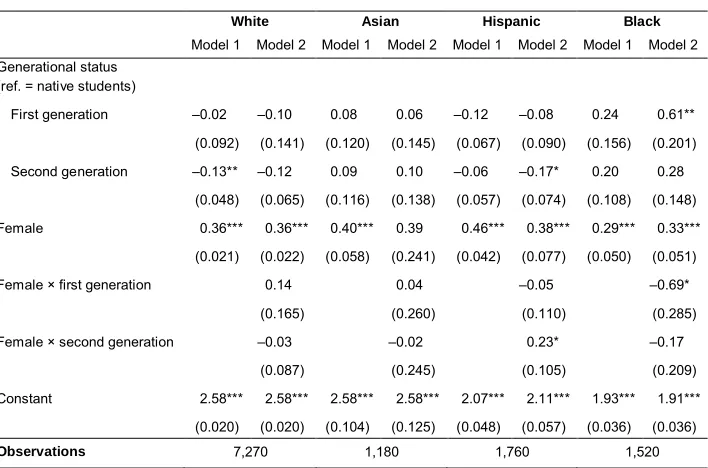
Model 1 in Table 1 includes only generational status and gender for each racial/ethnic group, as is commonly done in prior research (Greenman 2013; Kao and Tienda 1995). The gender differences in grades are much larger than generational differences in grades. Girls have higher overall high school GPAs than boys among all racial/ethnic groups, with the female-favorable GPA gap ranging from 0.29 for blacks to 0.46 for Hispanics. The coefficient for second-generation students is significant and negative only among whites ( = –0.13, p < 0.01), indicating that they have lower grades than native whites.
Model 2 of Table 1 includes generational status, gender, and their interaction. Interaction terms are significant for Hispanics and blacks, indicating gender differences in educational adaptation for these groups.12 This finding is confirmed by the
significance of the postestimation omnibus F tests of the two interaction terms for Hispanics and blacks ( = 0.018; = 0.047), but nonsignificant results for Asians and whites ( = 0.851; = 0.674).
To facilitate interpretation of the results from Table 1, Figure 1 shows mean high school GPA by generational status for each gender and racial/ethnic group. Gender differences in educational adaptation patterns are not significant among whites or Asians. In other words, GPA differences across generational groups appear to be similar for boys and girls among whites and Asians.13 Among Hispanics, the average GPA of second-generation boys is significantly lower than that of native boys (1.94 versus 2.11, a difference equal to –0.17 with ap-value less than 0.05), but there is no significant difference in the average GPAs of second-generation girls and native girls (2.55 versus 2.49). The interaction term between second generation and female reveals
12 In Table 1, due to the inclusion of the interaction terms in Model 2, the interpretation for the main effects of
gender and first/second generation differs between Models 1 and 2 (Fox 2008: 131–140). Specifically, in Model 1, the coefficients for female indicate gender differences (female minus male) in GPA, averaged across generational groups, and the coefficients for first/second generation capture differences in GPA between first-/second-generation students and native students, averaged across boys and girls. In contrast, in Model 2, the coefficients for female represent gender differences in GPA among native students only, and the coefficients for first/second generation denote differences in GPA between first-/second-generation students and native students among boys only.
13 It is important to keep in mind that with the small number of native Asians, the differences have to be very
that the gender difference in grades between second-generation and native Hispanics is statistically significant (Table 1:β = 0.23,p < 0.05). In other words, second-generation Hispanic boys exhibit a disadvantage in grades compared with their native peers, whereas this second-generation disadvantage is not evident among Hispanic girls.
Table 1: OLS regression models of high school GPA by race/ethnicity
White Asian Hispanic Black
Model 1 Model 2 Model 1 Model 2 Model 1 Model 2 Model 1 Model 2 Generational status
(ref. = native students)
First generation –0.02 –0.10 0.08 0.06 –0.12 –0.08 0.24 0.61** (0.092) (0.141) (0.120) (0.145) (0.067) (0.090) (0.156) (0.201) Second generation –0.13** –0.12 0.09 0.10 –0.06 –0.17* 0.20 0.28
(0.048) (0.065) (0.116) (0.138) (0.057) (0.074) (0.108) (0.148) Female 0.36*** 0.36*** 0.40*** 0.39 0.46*** 0.38*** 0.29*** 0.33***
(0.021) (0.022) (0.058) (0.241) (0.042) (0.077) (0.050) (0.051) Female × first generation 0.14 0.04 –0.05 –0.69*
(0.165) (0.260) (0.110) (0.285) Female × second generation –0.03 –0.02 0.23* –0.17
(0.087) (0.245) (0.105) (0.209) Constant 2.58*** 2.58*** 2.58*** 2.58*** 2.07*** 2.11*** 1.93*** 1.91***
(0.020) (0.020) (0.104) (0.125) (0.048) (0.057) (0.036) (0.036)
Observations 7,270 1,180 1,760 1,520
Note: All sample sizes have been rounded to the nearest 10 in compliance with standards regarding National Center for Education Statistics (NCES) restricted-use data files; ref. = reference group. Standard errors are in parentheses.
***p < 0.001, **p < 0.01, *p < 0.05.
Source: The transcript component of first follow-up to the Education Longitudinal Study of 2002 (ELS 2002).
Figure 1: Mean high school GPA by generational status, gender, and race/ethnicity
Note: High school GPAs are calculated based on Models 2 of Table 1.
Source: The transcript component of first follow-up to the Education Longitudinal Study of 2002 (ELS 2002).
These results based on interaction terms between female and generational status also shed light on gender gaps in grades across generational groups. They show that the female advantage in grades is comparable across generational groups for whites and Asians, whereas it is significantly larger among the second generation for Hispanics and reverses to a male advantage among the first generation for blacks. Because there is little prior research on gender gaps in educational performance by generational status (Buchmann, DiPrete, and McDaniel 2008), these results are noteworthy.
4.2 Descriptive and multivariate results for Hispanics
Because educational adaptation patterns appear to differ significantly among Hispanic and black girls and boys, we draw on the immigrant optimism and segmented assimilation perspectives as well as research on gender gaps in educational performance to explore factors that might account for these patterns. While an exhaustive examination of all potential factors is beyond the scope of this paper, the ELS data allow a cursory exploration of some key factors that may illuminate the patterns found above. We present descriptive and multivariate results first for Hispanics and then for blacks.
1.80 1.90 2.00 2.10 2.20 2.30 2.40 2.50 2.60 2.70 2.80 2.90 3.00 3.10
Male Female Male Female Male Female Male Female White Asian Hispanic Black
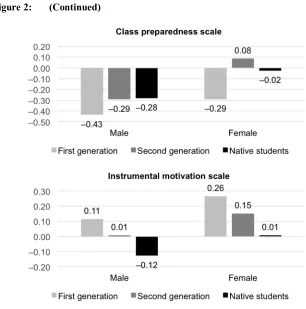
Figure 2 presents weighted means and percentages for the variables of parental college aspirations, crime/violence exposure, class preparedness, and instrumental motivation by generational status and gender for Hispanics (see Appendix Table A-2 for descriptive statistics for all covariates). Recall from Figure 1 that second-generation Hispanic boys, but not girls, lag behind coethnic native students in high school GPA. Figure 2 shows that first- and second-generation Hispanic students, regardless of gender, enjoy higher parental college aspirations, have lower levels of exposure to crime/violence at school, and report higher instrumental motivation compared to their coethnic native peers. Notably, second-generation and native Hispanic boys have very similar levels of preparedness for class, whereas second-generation girls are better prepared for class than native girls. This suggests that differences in class preparedness may be related to gender differences in educational adaptation among Hispanics.
Figure 2: (Continued)
Note: The crime/violence exposure scale ranges from 1 to 3. The class preparedness scale and the instrumental motivation scale were standardized by the NCES to a mean of 0 and standard deviation of 1.
Source: The transcript component of first follow-up to the Education Longitudinal Study of 2002 (ELS 2002).
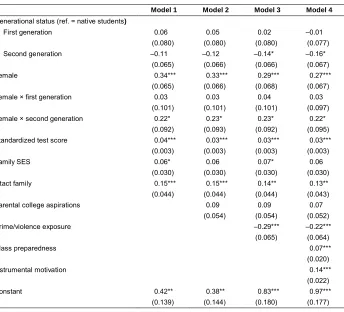
Hispanics, so it is no surprise that they do not explain gender-specific adaptation patterns. Class preparedness and instrumental motivation are added in Model 4. While both variables are positively associated with high school grades, they do not seem to play a large role in explaining the gender difference in educational adaptation among Hispanics: The interaction term between female and second generation only decreases from 0.23 (in Model 3,p < 0.05) to 0.22 (in Model 4,p < 0.05).
Table 2: OLS regression models of high school GPA, Hispanics
Model 1 Model 2 Model 3 Model 4
Generational status (ref. = native students)
First generation 0.06 0.05 0.02 –0.01 (0.080) (0.080) (0.080) (0.077) Second generation –0.11 –0.12 –0.14* –0.16*
(0.065) (0.066) (0.066) (0.067) Female 0.34*** 0.33*** 0.29*** 0.27***
(0.065) (0.066) (0.068) (0.067) Female × first generation 0.03 0.03 0.04 0.03
(0.101) (0.101) (0.101) (0.097) Female × second generation 0.22* 0.23* 0.23* 0.22*
(0.092) (0.093) (0.092) (0.095) Standardized test score 0.04*** 0.03*** 0.03*** 0.03***
(0.003) (0.003) (0.003) (0.003) Family SES 0.06* 0.06 0.07* 0.06
(0.030) (0.030) (0.030) (0.030) Intact family 0.15*** 0.15*** 0.14** 0.13** (0.044) (0.044) (0.044) (0.043) Parental college aspirations 0.09 0.09 0.07
(0.054) (0.054) (0.052) Crime/violence exposure –0.29*** –0.22***
(0.065) (0.064)
Class preparedness 0.07***
(0.020) Instrumental motivation 0.14***
(0.022) Constant 0.42** 0.38** 0.83*** 0.97***
(0.139) (0.144) (0.180) (0.177)
Note:N = 1,760 (rounded to the nearest 10 in compliance with standards regarding National Center for Education Statistics restricted-use data files); ref. = reference group. Standard errors are in parentheses.
***p < 0.001, **p < 0.01, *p < 0.05.
In sum, the results for Hispanics, especially those for Hispanic boys, provide no evidence in support of the immigrant optimism hypothesis. Instead, the generational pattern for Hispanic boys that shows a second-generation disadvantage (relative to coethnic natives) in grades aligns better with the ‘downward assimilation’ path predicted by segmented assimilation theory (Portes, Fernández-Kelly, and Haller 2009). Hispanic girls exhibit no second-generation disadvantage in grades. Strikingly, even with the addition of potential contributing factors to the model, the gender difference in educational adaptation barely changes and remains significant.
4.3 Descriptive and multivariate results for blacks
Figure 3: (Continued)
Note: The crime/violence exposure scale ranges from 1 to 3. The class preparedness scale and the instrumental motivation scale were standardized by the NCES to a mean of 0 and standard deviation of 1.
Source: The transcript component of first follow-up to the Education Longitudinal Study of 2002 (ELS 2002).
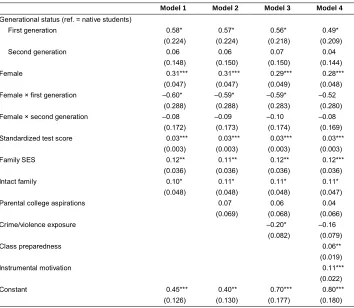
in Model 4, the interaction term for female and first generation is attenuated (from –0.59 to –0.52) and no longer significant. Class preparedness and instrumental motivation are both positively associated with high school GPA, and they thus account for much of the gender difference in educational adaptation among blacks.
Table 3: OLS regression models of high school GPA, blacks
Model 1 Model 2 Model 3 Model 4
Generational status (ref. = native students)
First generation 0.58* 0.57* 0.56* 0.49* (0.224) (0.224) (0.218) (0.209) Second generation 0.06 0.06 0.07 0.04
(0.148) (0.150) (0.150) (0.144) Female 0.31*** 0.31*** 0.29*** 0.28***
(0.047) (0.047) (0.049) (0.048) Female × first generation –0.60* –0.59* –0.59* –0.52
(0.288) (0.288) (0.283) (0.280) Female × second generation –0.08 –0.09 –0.10 –0.08
(0.172) (0.173) (0.174) (0.169) Standardized test score 0.03*** 0.03*** 0.03*** 0.03***
(0.003) (0.003) (0.003) (0.003) Family SES 0.12** 0.11** 0.12** 0.12***
(0.036) (0.036) (0.036) (0.036) Intact family 0.10* 0.11* 0.11* 0.11*
(0.048) (0.048) (0.048) (0.047) Parental college aspirations 0.07 0.06 0.04
(0.069) (0.068) (0.066) Crime/violence exposure –0.20* –0.16
(0.082) (0.079)
Class preparedness 0.06**
(0.019) Instrumental motivation 0.11***
(0.022) Constant 0.45*** 0.40** 0.70*** 0.80***
(0.126) (0.130) (0.177) (0.180)
Notes:N = 1,520 (rounded to the nearest 10 in compliance with standards regarding National Center for Education Statistics restricted-use data files); ref. = Reference group. Standard errors are in parentheses.
***p < 0.001, **p < 0.01, *p < 0.05.
Source: The transcript component of first follow-up to the Education Longitudinal Study of 2002 (ELS 2002).
Nonetheless, an educational advantage of first-generation blacks over native blacks was also found by Kao and Tienda (1995). Our results based on gender-specific analyses suggest that immigrant black boys, in particular, fare better academically than native black boys. Moreover, our findings suggest that school engagement (for which class preparedness is an indicator) and instrumental motivation, factors emphasized in research on gender gaps in educational achievement, contribute to the gendered patterns of educational adaptation for blacks.
5. Discussion and conclusion
Our empirical examination of gender differences in education adaptation for students of different racial/ethnic groups advances the literature in important ways. In contrast to most prior research, which relied on purposefully selected small samples to understand different adaptation experiences of immigrant-origin boys and girls (Suárez-Orozco, Suárez-Orozco, and Todorova 2008; Zhou and Bankston 2001), this is one of the first quantitative studies using nationally representative data to examine gendered patterns of educational adaptation in the United States. Our study challenges the assumptions of prior research that a female-favorable gap in education among immigrant-origin students constitutes evidence of better educational adaptation of immigrant-origin girls (Qin-Hilliard 2003). Figure 1 shows that regardless of generational status and race/ethnicity, girls tend to have higher grades than do boys, except among first-generation blacks. Thus, comparing gender gaps among immigrant-origin students is not informative with respect to whether and how immigrant-origin youth’s adaptation pathways differ by gender.
outcomes (DiPrete and Buchmann 2013), appear to play a role in explaining the gender differences in grades across generational groups, especially for blacks.
The primary goal of this study is to examine the heterogeneity in immigrant youth’s educational adaptation along gender and racial/ethnic lines and illuminate which students – in terms of gender, generational status, and race/ethnicity – are most at risk of downward mobility. While it reveals important differences in educational adaptation among these groups, we must leave the task of comprehensively identifying mechanisms for gender differences in educational adaptation to future research. Future research using larger samples of immigrant-origin students might consider other potentially important factors such as country of origin, family responsibilities that children assume, the socialization of boys and girls, school contexts, and teacher-student relations. Qualitative studies are also needed to unravel the sources of the patterns we find here, especially for Hispanics, as the limited factors we are able to investigate with the ELS data do not explain their gendered patterns of educational adaptation. Qualitative research could also help elucidate why first-generation black boys appear to outperform both native black boys and first-generation black girls.
Although the ELS is one of the few recent nationally representative surveys of US students with oversamples for some racial/ethnic minority groups, sample sizes for native Asian students and first-generation blacks are small, indicating the need for caution in interpreting the results. Data limitations also preclude disaggregating the data into various national origin groups (e.g., Mexicans, West Indians, Haitians, Chinese, Vietnamese, etc.).14 Nonetheless, the patterns revealed in this study can point scholars
to promising research for specific immigrant-origin populations. Moreover, future research would benefit from the use of longitudinal analyses to examine how gendered patterns of generational differences in educational outcomes change over time and further lead to divergent life trajectories in young adulthood.
These limitations notwithstanding, this study highlights the importance of incorporating gender into theoretical frameworks and empirical analyses of immigrant adaptation. By examining the intersecting role of gender, race/ethnicity, and generational status in shaping students’ educational performance in high school, it reveals that second-generation Hispanic boys are at particular risk for downward
14 Despite heterogeneity in terms of national origins within each racial/ethnic group, we believe that the
mobility. It is also intriguing that first-generation black boys appear to outperform both native black boys and first-generation black girls, suggesting that this group may be particularly worthy of study to determine factors that lead to academic success among immigrant-origin boys. The large GPA gap between first-generation and native black boys may be due, in part, to native black boys’ experiences with prejudice and racism that lead them to be less engaged and less motivated to strive for good grades in school. If black immigrants are less likely to insinuate racial prejudice to account for systemic injustices and instead willfully emphasize their national origin (Rong and Fitchett 2008), they may be more highly engaged and motivated to perform well in school. Why first-generation black boys also outperform their female counterparts, however, remains a question for future research. Overall, this study provides empirical knowledge that could help future research devise theories regarding gender and racial/ethnic variations in educational adaptation of immigrant-origin youth.
Finally, our findings are also informative for school interventions. Students’ school engagement and instrumental motivation are important in not only shaping their high school grades but also explaining gender differences in the educational adaptation of immigrant-origin youth (especially for blacks). Indeed, in response to mistreatment they received within the school system, second-generation Caribbean boys in Lopez’s (2003: 64–65) study developed “willful laziness” and expressed doubts about education as a route for upward mobility, which led to their lower academic performance. In order to reduce disparities in academic achievement, schools must find ways to minimize institutional expulsion of at-risk students, help students recognize the importance of education in today’s economy, and develop among them a clearer understanding of the value of education. Future research should continue to examine how youth from each generational status, gender, and racial/ethnic group fare in the educational system, because their education performance not only shapes their later life chances but also has profound consequences for the long-term prospects of the US economy.
6. Acknowledgements
The authors would like to dedicate this paper to the memory of Suet-ling Pong.
The authors are grateful to Bruce Daniel (Pinkerton Computer Consultants) and Jeffrey Owings (National Center for Education Statistics) for addressing their questions on the Educational Longitudinal Study of 2002 data. The authors thank Deborwah Faulk for research assistance.
References
Acevedo-Garcia, D., Bates, L.M., Osypuk, T.L., and McArdle, N. (2010). The effect of immigrant generation and duration on self-rated health among US adults 2003– 2007. Social Science and Medicine 71(6): 1161–1172.
doi:10.1016/j.socscimed.2010.05.034.
Alba, R. and Nee, V. (2003). Remaking the American mainstream: Assimilation and
contemporary immigration. Cambridge: Harvard University Press.
doi:10.4159/9780674020115.
Allison, P.D. (2001). Missing data. Thousand Oaks: Sage (Sage university papers series on quantitative applications in the social sciences, series 07–136).
Astone, N.M. and McLanahan, S.S. (1991). Family structure, parental practices, and high school completion. American Sociological Review 56(3): 309–320.
doi:10.2307/2096106.
Bankston, III, C.L. and Zhou, M. (2002). Being well vs. doing well: Self-esteem and school performance among immigrant and nonimmigrant racial and ethnic groups. International Migration Review 36(2): 389–415. doi:10.1111/j.1747-7379.2002.tb00086.x.
Bennett, P.R. and Lutz, A. (2009). How African American is the net black advantage? Differences in college attendance among immigrant blacks, native blacks, and
whites. Sociology of Education 82(1): 70–100.
doi:10.1177/003804070908200104.
Bondy, J.M., Peguero, A.A., and Johnson, B.E. (2017). The children of immigrants’ academic self-efficacy: The significance of gender, race, ethnicity, and
segmented assimilation. Education and Urban Society 49(5): 486–517.
doi:10.1177/0013124516644049.
Buchmann, C., DiPrete, T.A., and McDaniel, A. (2008). Gender inequalities in education. Annual Review of Sociology 34: 319–337.
doi:10.1146/annurev.soc.34.040507.134719.
DiPrete, T.A. and Buchmann, C. (2013).The rise of women: The growing gender gap in education and what it means for American schools. New York: Russell Sage Foundation.
Donato, K.M., Gabaccia, D., Holdaway, J., Manalansan, M., and Pessar, P.R. (2006). A glass half full? Gender in migration studies. International Migration Review
Feliciano, C. (2005). Educational selectivity in US immigration: How do immigrants
compare to those left behind?Demography 42(1): 131–152.
doi:10.1111/j.1747-7379.2006.00001.x.
Feliciano, C. and Lanuza, Y.R. (2016). The immigrant advantage in adolescent
educational expectations. International Migration Review 50(3): 758–792.
doi:10.1111/imre.12183.
Feliciano, C. and Lanuza, Y.R. (2017). An immigrant paradox? Contextual attainment
and intergenerational educational mobility.American Sociological Review 82(1):
211–241.doi:10.1177/0003122416684777.
Feliciano, C. and Rumbaut, R.G. (2005). Gendered paths: Educational and occupational
expectations and outcomes among adult children of immigrants. Ethnic and
Racial Studies 28(6): 1087–1118.doi:10.1080/01419870500224406.
Fleischmann, F., Kristen, C., Heath, A.F., Brinbaum, Y., Deboosere, P., Granato, N., Jonsson, J.O., Kilpi-Jakonen, E., Lorenz, G., Lutz, A.C., Mos, D., Mutarrak, R., Phalet, K., Rothon, C., Rudolphi, F., and van de Werfhorst, H.G. (2014). Gender inequalities in the education of the second generation in Western countries.
Sociology of Education87(3): 143–170.doi:10.1177/0038040714537836. Fox, J. (2008). Applied regression analysis and generalized linear models. Thousand
Oaks: Sage.
Fuligni, A.J. (1998). The adjustment of children from immigrant families. Current Directions in Psychological Science 7(4): 99–103. doi:10.1111/1467-8721.ep10774731.
Fuligni, A.J. (2012). The intersection of aspirations and resources in the development of children from immigrant families. In: Coll, C.G. and Marks, A.K. (eds.). The immigrant paradox in children and adolescents: Is becoming American a developmental risk? Washington, D.C.: American Psychological Association: 299–307.doi:10.1037/13094-013.
Gillock, K.L. and Reyes, O. (1999). Stress, support, and academic performance of urban, low-income, Mexican-American adolescents. Journal of Youth and Adolescence 28(2): 259–282.doi:10.1023/A:1021657516275.
Glick, J.E. and White, M.J. (2003). The academic trajectories of immigrant youths: Analysis within and across cohorts. Demography 40(4): 759–783.
Gordon, M.M. (1964). Assimilation in American life: The role of race, religion, and national origins. New York: Oxford University Press.
Greenman, E. (2013). Educational attitudes, school peer context, and the “immigrant paradox” in education. Social Science Research 42(3): 698–714.
doi:10.1016/j.ssresearch.2012.12.014.
Greenman, E. and Xie, Y. (2008). Is assimilation theory dead? The effect of assimilation on adolescent well-being.Social Science Research 37(1): 109–137.
doi:10.1016/j.ssresearch.2007.07.003.
Hamilton, E.R., Cardoso, J.B., Hummer, R.A., and Padilla, Y.C. (2011). Assimilation and emerging health disparities among new generations of US children.
Demographic Research 25(25): 783–818.doi:10.4054/DemRes.2011.25.25. Hirschman, C. (2001). The educational enrollment of immigrant youth: A test of the
segmented-assimilation hypothesis. Demography 38(3): 317–336.
doi:10.1353/dem.2001.0028.
Ingels, S.J., Pratt, D.J., Wilson, D., Burns, L.J., Currivan, D., Rogers, J.E., and Hubbard-Bednasz, S. (2007).Education Longitudinal Study of 2002: Base-year to second follow-up data file documentation (NCES 2008–347). Washington, D.C.: National Center for Education Statistics.
Jiménez, T.R. and Horowitz, A.L. (2013). When white is just alright: How immigrants redefine achievement and reconfigure the ethnoracial hierarchy. American Sociological Review 78(5): 849–871.doi:10.1177/0003122413497012.
Kao, G. and Tienda, M. (1995). Optimism and achievement: The educational performance of immigrant youth. Social Science Quarterly 76(1): 1–19.
Kasinitz, P., Mollenkopf, J.H., Waters, M.C., and Holdaway, J. (2008).Inheriting the
city: The children of immigrants come of age. New York: Russell Sage Foundation.
Lee, S.J. (2006). Additional complexities: Social class, ethnicity, generation, and gender in Asian American student experiences. Race Ethnicity and Education
9(1): 17–28.doi:10.1080/13613320500490630.
Lopez, N. (2003). Hopeful girls, troubled boys: Race and gender disparity in urban education. New York: Routledge Press.
Ogbu, J.U. and Simons, H.D. (1998). Voluntary and involuntary minorities: A cultural-ecological theory of school performance with some implications for education.
Anthropology and Education Quarterly 29(2): 155–188.
doi:10.1525/aeq.1998.29.2.155.
Palacios, N., Guttmannova, K., and Chase-Lansdale, P.L. (2008). Early reading achievement of children in immigrant families: Is there an immigrant paradox?
Developmental Psychology 44(5): 1381–1395.doi:10.1037/a0012863.
Passel, J.S. (2011). Demography of immigrant youth: Past, present, and future. Future of Children21(1): 19–41.doi:10.1353/foc.2011.0001.
Perreira, K.M., Harris, K.M., and Lee, D. (2006). Making it in America: High school completion by immigrant and native youth. Demography 43(3): 511–536.
doi:10.1353/dem.2006.0026.
Pong, S. and Zeiser, K.L. (2012). Student engagement, school climate, and academic achievement of immigrants’ children. In: Coll, C.G. and Marks, A.K. (eds.).The immigrant paradox in children and adolescents: Is becoming American a developmental risk? Washington, D.C.: American Psychological Association: 209–232.doi:10.1037/13094-009.
Portes, A., Fernández-Kelly, P., and Haller, W. (2009). The adaptation of the immigrant second generation in America: A theoretical overview and recent evidence.
Journal of Ethnic and Migration Studies 35(7): 1077–1104.
doi:10.1080/13691830903006127.
Portes, A. and Rivas, A. (2011). The adaptation of migrant children. Future of Children
21(1): 219–246.doi:10.1353/foc.2011.0004.
Portes, A. and Rumbaut, R.G. (2001). Legacies the story of the immigrant second generation. Berkeley and New York: University of California Press and Russell Sage Foundation.
Portes, A. and Zhou, M. (1993). The new second generation: Segmented assimilation and its variants. The ANNALS of the American Academy of Political and Social Science530(1): 74–96.doi:10.1177/0002716293530001006.
Potochnick, S. and Mooney, M. (2015). The decade of immigrant dispersion and growth: A cohort analysis of children of immigrants’ educational experiences 1990–2002. International Migration Review 49(4): 1001–1041.
Qin, D.B. (2006). The role of gender in immigrant children’s educational adaptation.
Current Issues in Comparative Education 9(1): 8–19.
Qin, D.B. (2009). Being ‘good’ or being ‘popular’: Gender and ethnic identity negotiations of Chinese immigrant adolescents. Journal of Adolescent Research
24(1): 37–66.doi:10.1177/0743558408326912.
Qin-Hilliard, D.B. (2003). Gendered expectations and gendered experiences: Immigrant students’ adaptation in schools. New Directions for Youth Development
2003(100): 91–109.doi:10.1002/yd.65.
Raleigh, E. and Kao, G. (2010). Do immigrant minority parents have more consistent college aspirations for their children? Social Science Quarterly 91(4): 1083– 1102.doi:10.1111/j.1540-6237.2010.00750.x.
Rong, X.L. and Fitchett, P. (2008). Socialization and identity transformation of black immigrant youth in the United States. Theory into Practice 47(1): 35–42.
doi:10.1080/00405840701764714.
Rosenbaum, E. and Rochford, J.A. (2008). Generational patterns in academic performance: The variable effects of attitudes and social capital. Social Science Research 37(1): 350–372.
Rumbaut, R.G. (2005). Turning points in the transition to adulthood: Determinants of educational attainment, incarceration, and early childbearing among children of immigrants. Ethnic and Racial Studies 28(6): 1041–1086.
doi:10.1080/01419870500224349.
Stanat, P. and Chistensen, G. (2006). Where immigrant students succeed: A comparative review of performance and engagement in PISA 2003. Paris: OECD Publishing. https://www.phil-fak.uni-duesseldorf.de/ew/bf/bf_ veranstaltungen/ss06/HS_Bildungssoziologie/9806021E.pdf.
Suárez-Orozco, C. and Qin, D.B. (2005). Immigrant boys’ experiences in US schools. In: Suárez-Orozco, M.M., Suárez-Orozco, C., and Qin, D.B. (eds.). The new immigration: An interdisciplinary reader. New York: Routledge: 345–360. Suárez-Orozco, C. and Qin, D.B. (2006). Gendered perspectives in psychology:
Immigrant origin youth. International Migration Review 40(1): 165–198.
doi:10.1111/j.1747-7379.2006.00007.x.
Suárez-Orozco, C. and Suárez-Orozco, M.M. (2001). Children of immigration.
Suárez-Orozco, C., Suárez-Orozco, M.M., and Todorova, I. (2008). Learning a new land: Immigrant students in American society. Cambridge: Harvard University Press.
Tavakol, M. and Dennick, R. (2011). Making sense of Cronbach’s alpha.International
Journal of Medical Education 2: 53–55.doi:10.5116/ijme.4dfb.8dfd.
Vaquera, E. and Kao, G. (2012). Educational achievement of immigrant adolescents in Spain: Do gender and region of origin matter? Child Development 83(5): 1560– 1576.
Warner, W.L. and Srole, L. (1945).The social systems of American ethnic groups. New
Haven: Yale University Press.doi:10.1111/j.1467-8624.2012.01791.x.
White, M.J. and Glick, J.E. (2009). Achieving anew: How new immigrants do in American schools, jobs, and neighborhoods. New York: Russell Sage Foundation.
Williams, L.S., Alvarez, S.D., and Andrade Hauck, K.S. (2002). My name is not Maria: Young Latinas seeking home in the heartland. Social Problems 49(4): 563–584.
doi:10.1525/sp.2002.49.4.563.
Witkow, M.R. and Fuligni, A.J. (2011). Ethnic and generational differences in the relations between social support and academic achievement across the high
school years. Journal of Social Issues 67(3): 531–552.
doi:10.1111/j.1540-4560.2011.01713.x.
Zhou, M. (1997). Segmented assimilation: Issues, controversies, and recent research on the new second generation. International Migration Review 31(4): 975–1008.
doi:10.2307/2547421.
Appendix
Table A-1: Sample size by generation status, gender, and race
White Asian Hispanic Black
Male Female Male Female Male Female Male Female
First generation 60 70 250 260 190 250 30 30
Second generation 200 180 280 290 360 340 60 60
Native students 3,300 3,350 50 30 290 280 620 680
Generation status missing 50 60 10 10 20 20 20 20
Total 3,610 3,660 600 590 860 900 730 790
Note: All sample sizes have been rounded to the nearest 10 in compliance with standards regarding National Center for Education Statistics (NCES) restricted-use data files. Due to rounding, details may not sum to total (e.g., for Asian males and Hispanic females).
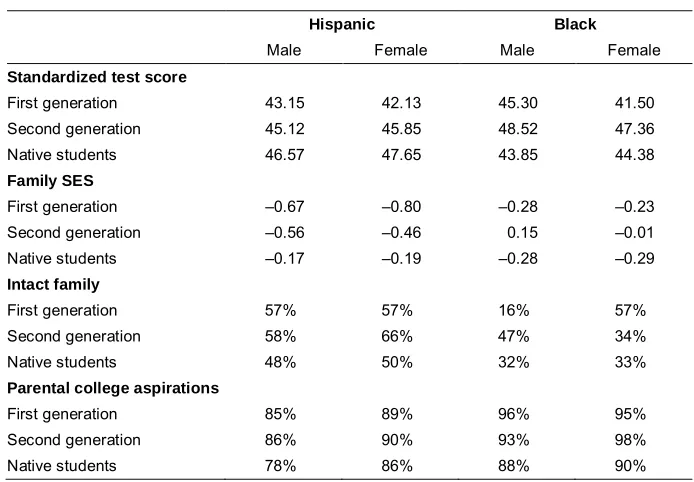
Table A-2: Means/percentages of covariates for Hispanics and blacks, by generational status and gender
Hispanic Black
Male Female Male Female
Standardized test score
First generation 43.15 42.13 45.30 41.50
Second generation 45.12 45.85 48.52 47.36
Native students 46.57 47.65 43.85 44.38
Family SES
First generation –0.67 –0.80 –0.28 –0.23
Second generation –0.56 –0.46 0.15 –0.01
Native students –0.17 –0.19 –0.28 –0.29
Intact family
First generation 57% 57% 16% 57%
Second generation 58% 66% 47% 34%
Native students 48% 50% 32% 33%
Parental college aspirations
First generation 85% 89% 96% 95%
Second generation 86% 90% 93% 98%
Table A-2: (Continued)
Hispanic Black
Male Female Male Female
Crime/violence exposure
First generation 1.28 1.15 1.20 1.14
Second generation 1.29 1.18 1.34 1.14
Native students 1.37 1.23 1.30 1.19
Class preparedness
First generation –0.43 –0.29 0.04 –0.59
Second generation –0.29 0.08 –0.23 –0.12
Native students –0.28 –0.02 –0.23 –0.01
Instrumental motivation
First generation 0.11 0.26 0.63 0.35
Second generation 0.01 0.15 0.33 0.20
Native students –0.12 0.01 0.01 0.08