
and multiple aspects of an adult evolutionary
novelty
Saenko
et al.
R E S E A R C H A R T I C L E
Open Access
Single locus affects embryonic segment polarity
and multiple aspects of an adult evolutionary
novelty
Suzanne V Saenko
1, Paul M Brakefield
1, Patrícia Beldade
1,2*Abstract
Background:The characterization of the molecular changes that underlie the origin and diversification of morphological novelties is a key challenge in evolutionary developmental biology. The evolution of such traits is thought to rely largely on co-option of a toolkit of conserved developmental genes that typically perform multiple functions. Mutations that affect both a universal developmental process and the formation of a novelty might shed light onto the genetics of traits not represented in model systems. Here we describe three pleiotropic mutations with large effects on a novel trait, butterfly eyespots, and on a conserved stage of embryogenesis, segment polarity.
Results:We show that three mutations affecting eyespot size and/or colour composition inBicyclus anynana butterflies occurred in the same locus, and that two of them are embryonic recessive lethal. Using surgical manipulations and analysis of gene expression patterns in developing wings, we demonstrate that the effects on eyespot morphology are due to changes in the epidermal response component of eyespot induction. Our analysis of morphology and of gene expression in mutant embryos shows that they have a typical segment polarity phenotype, consistent with the mutant locus encoding a negative regulator of Wingless signalling.
Conclusions:This study characterizes the segregation and developmental effects of alleles at a single locus that controls the morphology of a lineage-specific trait (butterfly eyespots) and a conserved process (embryonic segment polarity and, specifically, the regulation of Wingless signalling). Because no gene with such function was found in the orthologous, highly syntenic genomic regions of two other lepidopterans, we hypothesize that our locus is a yet undescribed, possibly lineage-specific, negative regulator of the conserved Wnt/Wg pathway. Moreover, the fact that this locus interferes with multiple aspects of eyespot morphology and maps to a genomic region containing key wing pattern loci in different other butterfly species suggests it might correspond to a
‘hotspot’locus in the diversification of this novel trait.
Background
The origin and diversification of novel morphological traits, such as angiosperm flowers, bird feathers, insect wings, or beetle horns, have always fascinated biologists and laymen alike and are currently a key theme in evo-lutionary developmental biology [1,2]. Novelties arise during the evolution of a lineage and perform new func-tions within its ecology [3]. While the ecological and evolutionary factors that promote the diversification of
such traits have been studied for some time (e.g., [4,5]), it is only more recently that the genetic and develop-mental mechanisms underlying their formation have become the focus of attention. Morphological novelties seem to arise largely through redeployment, or co-option, of conserved developmental toolkit genes (e.g., [6-9]), though recent studies suggest that taxonomically restricted genes might also be important [10].
Lepidoptera (the insect order of butterflies and moths) provide several examples of lineage-restricted traits that presumably evolved by co-option of genes or gene net-works shared across insects. Signalling pathways and enzymes involved in the development of insect wings, * Correspondence: [email protected]
1
Institute of Biology, Leiden University, Sylviusweg 72, 2333 BE Leiden, The Netherlands
Full list of author information is available at the end of the article
sensory bristles or visual pigments have been implicated in the development [11,12] and coloration [13,14] of the scales that cover lepidopteran wings, and in the forma-tion of particular pattern elements, the eyespots (reviewed in [15]). Eyespots have emerged as a promis-ing model to investigate how novel characters arise [16-18], and which genes and components of pattern induction are modified in relation to phenotypic varia-tion [19-22]. Pattern elements made of concentric rings of different colours are present on the wings of many butterflies and moths and show extreme intra- and interspecific variation in colour, size, shape and number [23,24]. Their adaptive role in predator avoidance [25-27] and mate choice [28,29] has been demonstrated in different species, and the mechanistic basis of eyespot diversity is now the focus of active research in evolu-tionary developmental biology [15,30].
Classical surgical manipulations of developing wings, such as tissue transplantation and damage, showed that eyespot centres, called foci, act as organizers of pattern formation [31,32]. In pupal wings, the focal cells presumably produce one or more diffusible mor-phogens, and the neighbouring epidermal cells respond to these signals in a concentration-dependent manner and become fated to synthesize particular pigments [23,33]. A number of conserved genes and signalling pathways with known functions in insect wing devel-opment have been implicated in the determination of eyespot foci [16,34] and colour rings [17,35]. Little, however, is known about which particular genes con-tribute to variation in eyespot morphology [19] and how these affect the signal/response components of eyespot induction.
Captive populations of the lab model Bicyclus any-nanaharbour different types of genetic variation affect-ing eyespot patterns [13], includaffect-ing spontaneous mutations of large phenotypic effect [36], some of which have been assigned to linkage groups [37]. Analysis of such mutations offers an opportunity to characterize the genetic and developmental bases of a novel trait not represented in classical model organisms (e.g., [17,18,38-41]). Of special interest are pleiotropic muta-tions that affect not only eyespots but also some other, conserved developmental processes. For example, vein-lessand Cyclops affect eyespot number and wing vein development, and Goldeneye disturbs eyespot colour composition and embryonic development [17,18]. Here, we characterize the effects of different alleles of a single locus on various aspects of eyespot morphology and on embryonic segment polarity. Our analysis suggests that this locus is a potentially novel negative regulator of the Wnt/Wg signalling pathway and a candidate ‘hotspot’ for wing pattern diversification.
Results and Discussion
Eyespot mutations are embryonic recessive lethal alleles at a single locus
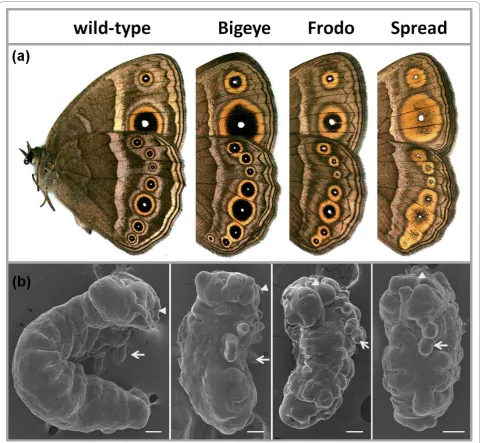
Three spontaneous mutants with disturbed eyespot size and/or colour composition have been isolated from laboratory populations ofB. anynana. Relative to‘ wild-type’(WT) butterflies, Bigeye (BE) mutants have drama-tically enlarged eyespots [21,41], Frodo (Fr) have eye-spots with a broader outer golden ring, and Spread (Spr) have very large eyespots with gold scales almost completely replacing the black scales (Figure 1a).
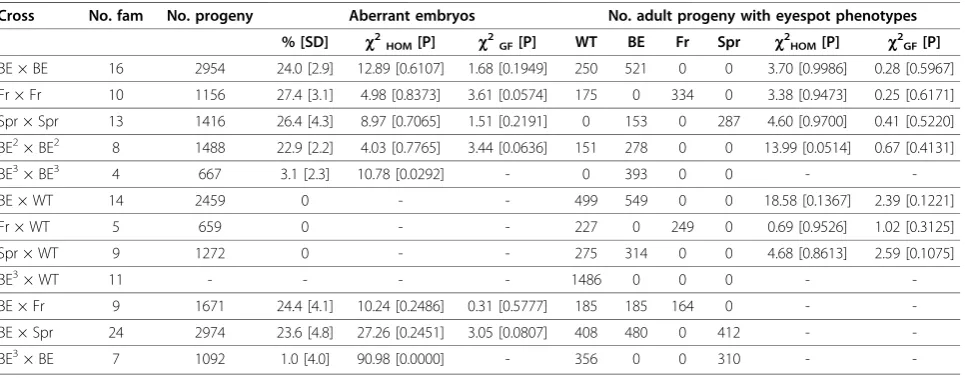
The failure to establish pure-breeding stocks of these mutants suggested embryonic lethality, similar to that described for the eyespot mutant Goldeneye [18]. We compared proportions of mutant embryos and adults in experimental crosses to those expected if BE, Fr and Spr phenotypes were caused by embryonic recessive lethal alleles with a dominant effect on eyespot pattern. In this situation, crosses between individuals of the same mutant phenotype should result in one fourth of the off-spring dying during embryogenesis, and two thirds of the adults having aberrant eyespots. On the other hand, crosses between mutant and WT butterflies should yield no embryonic lethality and one half of the adults with aberrant eyespots. The results of all crosses, including statistical analysis, are summarized in Table 1. As expected, crosses between mutant individuals of the same phenotype resulted in 1:2 segregation of WT and mutant adults (33.6 and 66.4%, respectively, in a total of 1720 adult progeny from 39 families), while crosses between each mutant and WT butterflies resulted in 1:1 segregation (47.4 and 52.6%, in 2113 adult offspring from 28 families). Consistent with BE, Fr and Spr phe-notypes being due to recessive lethal alleles, approxi-mately one fourth of the progeny of crosses between same-phenotype mutants died during embryogenesis (25.3% of 5526 progeny in 39 families), while no aber-rant embryos were found in crosses to WT butterflies.
by theGoldeneye allele (i.e., disturbed blastokinesis [18]) is different from the embryonic effects produced by the alleles underlying the BE, Fr or Spr phenotypes (see “Analysis of aberrant embryos reveals defects in segment polarity” section).
Different BE phenotypes and variation in lethality of underlying alleles
Dramatic effects on eyespot morphology in BE, Fr and Spr mutants seem to be caused by different dominant
referred to as BE2. A similar phenotype, hereafter called BE3, is found in the ‘non-Spr’progeny from Spr × Spr crosses (34.8% of 440 adults in 13 families). Single-pair crosses were set up to determine whether enlarged eye-spots in BE individuals and in the offspring of Spr × WT (BE2 individuals) and Spr × Spr crosses (BE3 indivi-duals) were caused by the same or by different alleles (Table 1).
Similarly to BE × BE, crosses between two BE2 indivi-duals yielded embryonic lethality in approximately one fourth of the progeny (22.9% of 1488 progeny in eight families) and enlarged eyespots in two thirds of the adults (64.8% of 429 adult offspring). These results are consistent with BE and BE2 phenotypes being due to the same embryonic lethal allele with a dominant effect on eyespot size. In contrast, only a small fraction of embryos from crosses between two BE3 individuals died before hatching and showed typical morphological defects (Table 1). This ratio was significantly lower than the expected 25% (c2 test of homogeneity among four families = 10.78, P < 0.05;c2 goodness-of-fit for each family = 53.05, 22.00, 29.37, 42.29, all with P < 0.05) and varied between 0 and 5.3%, perhaps due to modifier loci or incomplete penetrance. No embryonic lethality was observed in five of the seven crosses between BE3 and BE individuals. The fraction of aberrant embryos in the other two families (10.8 and 1.1%) was significantly lower than the 25% expected if the BE3 and BE pheno-types were produced by the same lethal allele (c2test for homogeneity among seven families = 90.98;c2 good-ness-of-fit in two families = 20.79 and 7.55; P < 0.01). This suggests that the mutation underlying the BE3 phe-notype is a different allele. It has a mildly deleterious
effect on embryogenesis (i.e., low incidence of embryo-nic mortality) and a recessive effect on eyespot size, since all offspring of the BE3 × WT crosses (i.e., BE3 heterozygotes) have‘wild-type’eyespots (Table 1).
On the basis of the segregation of eyespot and embryonic mutant phenotypes in the experimental crosses, we propose that the three mutations occurred in theBE/Fr/Spr(BFS) locus, and that two of them are embryonic recessive lethal. We suggest that different combinations of the wild-type (BFS+) and the three mutant alleles underlie the observed eyespot and embryonic phenotypes (Figure 2). The BE/BE2 pheno-type (each obtained in a different cross; see Table 1) is due to a single copy of the recessive lethalBFSBallele, the identical BE3 phenotype is caused by the recessive nonlethalBFSaallele, and the Spr phenotype, by a com-bination of both. The Fr phenotype is produced by a single copy of another recessive lethal allele, BFSC. In this model, allelesBFSaandBFSC each carry a mutation at a single site, while the BFSBallele carries two, one shared withBFSa. This is consistent with the fact that the Spr mutant (genotypeBFSa/BFSB) was originally iso-lated from the BE stock (see Materials and Methods), and it explains the data from all our crosses, including the more complex inheritance we described for Spr, and the different“enlarged eyespots” phenotypes we charac-terized (see previous section). Specifically (see Table 1), (1) crosses between two Spr individuals segregate for Spr and BE3 phenotypes (and not for Spr and WT, as would be the case if the Spr phenotype was due to a single, independent mutation at the BFSlocus), and (2) the Spr phenotype is lost in progeny from Spr × WT crosses (showing that it is recessive), but recovered in
Table 1 Segregation of aberrant embryos and adults in experimental crosses
Cross No. fam No. progeny Aberrant embryos No. adult progeny with eyespot phenotypes
% [SD] c2
HOM[P] c2GF[P] WT BE Fr Spr c2HOM[P] c2GF[P]
BE × BE 16 2954 24.0 [2.9] 12.89 [0.6107] 1.68 [0.1949] 250 521 0 0 3.70 [0.9986] 0.28 [0.5967]
Fr × Fr 10 1156 27.4 [3.1] 4.98 [0.8373] 3.61 [0.0574] 175 0 334 0 3.38 [0.9473] 0.25 [0.6171]
Spr × Spr 13 1416 26.4 [4.3] 8.97 [0.7065] 1.51 [0.2191] 0 153 0 287 4.60 [0.9700] 0.41 [0.5220]
BE2× BE2 8 1488 22.9 [2.2] 4.03 [0.7765] 3.44 [0.0636] 151 278 0 0 13.99 [0.0514] 0.67 [0.4131]
BE3× BE3 4 667 3.1 [2.3] 10.78 [0.0292] - 0 393 0 0 -
-BE × WT 14 2459 0 - - 499 549 0 0 18.58 [0.1367] 2.39 [0.1221]
Fr × WT 5 659 0 - - 227 0 249 0 0.69 [0.9526] 1.02 [0.3125]
Spr × WT 9 1272 0 - - 275 314 0 0 4.68 [0.8613] 2.59 [0.1075]
BE3× WT 11 - - - - 1486 0 0 0 -
-BE × Fr 9 1671 24.4 [4.1] 10.24 [0.2486] 0.31 [0.5777] 185 185 164 0 -
-BE × Spr 24 2974 23.6 [4.8] 27.26 [0.2451] 3.05 [0.0807] 408 480 0 412 -
-BE3× BE 7 1092 1.0 [4.0] 90.98 [0.0000] - 356 0 0 310 -
-The ratios of aberrant embryos and adults were tested for variation among families within each cross withc2test for homogeneity (c2HOMwith d.f. = Nfam- 1).
When ratios were not significantly different across families, the numbers of progeny were pooled and tested against the expected ratios withc2
goodness-of-fit test (c2
GFwith d.f. = 1). Otherwise, the ratios were tested against the expected values in each family separately (d.f. = 1; see“Different BE phenotypes and
progeny from BE3× BE crosses (showing that BE indivi-duals carry the relevant mutation) (see Figure 2).
Analysis of aberrant embryos reveals defects in segment polarity
Compared to WT embryos of the same age, homozy-gotes for each of the lethal alleles displayed severe and similar abnormalities. They were much shorter and thicker than WT embryos (Figure 1b). The typical 3 thoracic and 10 abdominal segments were all present, as was clear from the number of thoracic and abdominal appendages, but the segments were compressed and their borders poorly defined. Dorsal closure was not completed in approximately 30% of the embryos. The thoracic legs and the mouthparts (arrows and arrow-heads in Figure 1b) were short; some embryos were missing one leg while one of the remaining legs was branched. We observed variation in timing of death among mutants. Typically, embryos from Spr × Spr crosses died before the stage when bristles appear (~70% of developmental time, DT [42]), and looked more compacted, while embryos from crosses between BE or Fr butterflies were fully sclerotized and had mela-nized head capsules, and died at approximately 90% DT. The severe shortening of segments and poorly defined segment boundaries observed in all mutant embryos
suggest that the mutations affect the structure of each segment, rather than their establishment, possibly by interfering with the normal function of segment polarity genes.
Analysis of expression patterns of key segment polar-ity genes engrailed(en) andwingless(wg) revealed sub-stantial differences between WT and mutant embryos. In early embryos (Figure 3a), en was expressed in the posterior compartment of each segment, as is typical for insects [43]. No aberrations in morphology oren expres-sion were detected in 85 embryos dissected at 12-13% DT, revealing no differences among mutant and WT embryos. At 15% DT, the differences became obvious with the En protein detected not only in the posterior compartment, as in WT, but also in the anterior cells of each segment in mutant embryos (Figure 3b). Defects in segmentation became even more apparent at 25% DT, when mutant embryos appeared shorter due to com-pacted segments, and the En stripes were almost twice as broad as those of WT (Figure 3c). At 40% DT, mutant embryos looked almost spherical, with En clearly visible in a posterior and an anterior stripe within each segment, thoracic appendages, and abdominal prolegs (Figure 3d). Differences in wgexpression were also very clear at 25-40% DT. In WT,wg mRNA was detected in each segment in stripes positioned just anterior to the Figure 2Model for the embryonic and eyespot effects of theBE/Fr/Sprlocus. For each mutant phenotype, possible genotypes are shown with lines representing the locus, dots corresponding to different sites therein, mutations indicated with stars (the order and the distance between sites is arbitrary), and labels +,a,BandCrepresenting the wild-type and three mutant alleles. Mutations at these three sites, isolated or in combination, define different alleles which can explain all our data. A single copy of theBFSaallele has no obvious effect on eyespot morphology (the WT phenotype), but two copies produce enlarged eyespots which have‘normal’colour composition (the BE3phenotype; phenotypically indistinguishable from BE/BE2). Mutations at sites 1 and 2 together make up theBFSBallele; it has a dominant effect on eyespot size (the BE/BE2phenotype), and, in combination with theBFSaallele, affects colour composition (the Spr phenotype). This explains the recessive colour composition aspect of Spr inheritance and the presence of BE3individuals (BFSahomozygotes) in crosses between two Spr individuals (Table 1), and is consistent with Spr having been isolated from the BE stock (see Materials and Methods). A mutation at a third site in this locus (corresponding to theBFSCallele) affects eyespot ring boundaries (the Fr phenotype). The allelesBFSBandBFSCare embryonic recessive lethal
En domain, while in mutant embryos two stripes of wg
were observed in each segment, with the additional stripe positioned posterior to the expanded En domain (Figure 3e).
These results show that the lethal alleles at theBFS
locus do not affect the specification of segment number or the establishment of en andwg expression domains in embryonic segments, but rather disturb their correct maintenance and generate a typical segment polarity phenotype, i.e., the‘replacement’of the anterior part of each segment by a mirror image duplication of the pos-terior part [44]. In Drosophila melanogaster, identical embryonic defects are caused by loss-of-function muta-tions, or experimental knockdown, of one of the nega-tive regulators of Wg signalling; zeste-white 3 [45],
naked cuticle[46],axin[47],APC2[48], or Bili[49].
Epidermal response properties are affected in the Spr mutant
The formation of eyespots in developing pupal wings involves the production and diffusion of a morphogen from the cells at the center (stage called‘focal signal-ling’) and the response of the surrounding epidermal cells [31,32]. Different levels of the signal induce
expression of different regulatory genes, e.g., Distall-less
(Dll) and spalt (sal) in the inner disc, and en in the outer ring [17], which then directly or indirectly control biosynthesis of different pigments. Changes in the focal signal (e.g., morphogen concentration, stability or diffu-sion coefficient) have been shown to explain most of the variation in eyespot size between artificial selection lines [50], while the sensitivity levels of the epidermal cells to that signal determine eyespot colour composition [20,51] and, to a lesser extent, eyespot size [21,50]. Genetic correlations between eyespot size and colour composition are typically low [50-52], suggesting that different sets of genes determine these two aspects of eyespot morphology, and their underlying components of pattern induction.
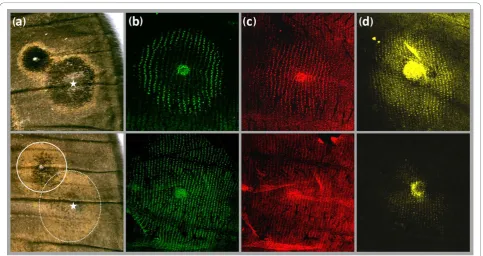
Damage applied to the developing wing in early pupa typically induces the formation of ectopic patterns [53], and can be used to probe variation in epidermal response sensitivities (see [20]). Damage-induced ectopic eyespots were produced in more than 60% of cauterized WT and Spr pupae (32 of 50 for WT, and 56 of 70 for Spr), and typically resembled the native eyespots on the same wing surface (Figure 4a). Damage-induced eye-spots consisted of a black inner disc and an outer
Figure 4Ectopic eyespots and expression of eyespot patterning genes. Eyespots of WT (top) and Spr individuals (bottom) differ in colour scheme in adults, and in gene expression patterns in developing pupal wings. (a) Anterior distal part of dorsal adult forewings showing native and damage-induced eyespots formed around wound sites (stars). The colour composition of the ectopic eyespots resembles that of the native eyespots and reveals differences in the response properties of wing epidermal tissue between WT and Spr butterflies (solid and dashed rings outline the Spr native and the ectopic eyespots, respectively). These differences are reflected in the expression patterns ofen(b),Dll(c) andsal
golden ring in WT, but were almost entirely made up of gold scales in Spr. These results show that the ability of the entire wing epidermis to respond to eyespot-indu-cing signals, such as damage, is altered in Spr mutants. We also show that the expression patterns of ‘response’ eyespot ring genes were altered in Spr wings: enwas detected in almost all cells of the eyespot field (Figure 4b), while the numbers of scale-building cells expressing
Dll andsalwere strongly reduced (Figures 4c and 4d). Taken together, our results are consistent with an effect of the target gene downstream of the eyespot-inducing focal signalling, but upstream of the response patterning genes.
The Wnt/Wg signalling pathway and butterfly eyespot formation
Our study of embryonic defects and ofen/wgexpression in the targetB. anynanamutants suggests that the BFS
locus is a negative regulator of the Wnt/Wg signalling pathway. Analysis of eyespot formation in Spr wings further suggests that the product of this gene acts upstream of eyespot ring patterning transcription factors during the ‘response to focal signal’stage. The Wg mor-phogen, implicated in the evolution of wing pigmenta-tion spots in Drosophila [54], has been proposed as a candidate focal signal in butterflies [35]. It is produced by eyespot centres in early pupal wings of B. anynana
[35], and is known to upregulate en and Dllin insect embryos and imaginal wing discs, respectively [45,55]. In butterfly wings, Wg could act as the inducer of the circularDlland en domains corresponding to eyespot rings in adults [17]. Mutations in a negative regulator of the Wnt/Wg pathway, as could be theBFS gene, would affect the response of epidermal cells to this signal, alteringen andDllexpression and therefore the distri-bution of black and gold scales. Molecular identification and functional characterization of theBFSlocus, includ-ing the analysis of expression of key components of Wg signalling in both normal and altered eyespot develop-ment, will be necessary to assess its role in the regula-tion of this signalling pathway.
In a previous study, we mapped the BFS locus to approximately a 1.3 Mb interval onB. anynana chromo-some 17, which has a high level of synteny with its ortholog inBombyx mori[37], the model lepidopteran with the fully sequenced and annotated genome. Cur-iously, the orthologous chromosome in the butterfly
Heliconius melpomenecarries colour pattern loci impli-cated in intra- and interspecific divergence [56]. Inspec-tion of gene content in the genomic regions ofB. mori
(nscaf2829 [57]) andH. melpomene[56], orthologous to theBFS interval, revealed that they do not contain any of the candidate genes generated via the comparison of embryonic phenotype to Drosophilamutants (namely,
Axin,zeste-white 3, APC2, naked cuticle, and Bili), or any other gene with a known role in the regulation of Wg signalling. The high levels of synteny between these lepidopterans [37] suggest that the implicated interval in
B. anynana, even though its exact genetic content is still unknown, probably also does not contain any of the described negative regulators of the Wnt/Wg pathway. This pathway is crucial for embryonic development and numerous other processes, and is remarkably conserved and extensively studied (reviewed in [58-60]). Neverthe-less, sophisticated new genetic and genomic approaches continue to identify new Wnt/Wg regulators [61,62], some of which are taxon-restricted (e.g., WTX [63]). The BFSlocus could be another, yet unknown, negative regulator of this pathway, potentially specific to this lepidopteran lineage.
Conclusions
Analysis of mutant alleles of large effect is a powerful approach for exploring the developmental basis of novel traits, and especially valuable for studies in nonmodel organisms with limited genetic resources. This work describes three pleiotropic mutations in a single locus, presumably a negative regulator of Wg signalling. The product of this gene is involved in the formation of eye-spots, a butterfly-specific novelty, and a relatively con-served process of embryonic development [64-66]. Different alleles at this locus produce similar effects on embryonic segment polarity, but disturb different aspects of eyespot morphology. This locus maps to a genomic interval whose orthologous regions in two other, syntenic leidopterans do not contain any anno-tated genes with a known role in the regulation of the Wnt/Wg pathway. This suggests that the B. anynana BFSlocus might be a yet undescribed negative regulator of Wg signalling.
Studies of lab mutants represent a valuable approach for understanding the developmental genetics of mor-phological traits, and can provide candidate genes for intra- and interspecific variation in natural populations [67,68]. Although it is unlikely that recessive lethal alleles at the BFS locus will contribute to naturally occurring variation in eyespot morphology, other alleles (e.g., the recessive mildly deleterious BFSaallele) might. A striking feature of this locus is the diversity of effects the different alleles have on eyespot phenotype (i.e., on size and colour composition), either independently or together. Some of these resemble eyespot phenotypes obtained in artificial selection lines of B. anynana
[20,69], and even those found in other species of the
eyespot locus is located in a genomic region [37] ortho-logous to that containing colour pattern loci in multiple other species and thought to be‘hotspots’for the evolu-tionary diversification of wing patterns [70].
Future work will shed light onto the exact nature and evolutionary significance of this interesting locus. Fine mapping can reveal whether it encodes a con-served or a derived regulator of Wg signalling and to what extent it is related to colour pattern loci in other butterflies. Analysis of its contribution to intra- and interspecific variation in eyespot morphology can address its role in the evolutionary diversification of butterfly wing patterns.
Methods
Butterfly stocks and crosses
All butterfly stocks were at reared 27°C as in [36]. The BE and Fr stocks were each set up from a single indivi-dual isolated from different laboratory populations in 1994 and 2007, respectively. The Spr stock was founded from a single individual isolated from the BE stock in 2003. All mutant stocks have been maintained with selection in favour of the mutant phenotype and, when necessary to avoid inbreeding depression, were out-crossed to the laboratory outbred WT stock.
whether the mutations behave as embryonic recessive lethal alleles, butterflies from each mutant stock were crossed to individuals of the same phenotype and to WT stock butterflies. Crosses between butterflies of dif-ferent mutant phenotypes were performed to determine whether the mutant alleles occur in the same locus (complementation tests). Eggs were collected from indi-vidual mating pairs, hatched larvae were reared through to adulthood, and the eclosed butterflies were frozen and scored for eyespot phenotype. Unhatched eggs were counted, dechorionated in 50% bleach solution for 1 min, rinsed with water, and fixed in 4% formaldehyde solution in 1 × phosphate-buffered saline (PBS). Embryos were dissected under a light microscope. Unfertilized eggs, identified as those lacking large blasto-derm cells, were excluded from the analysis.
Statistical analysis c2
tests were used to compare observed proportions of mutant embryos and adults to those expected if the alleles underlying the BE, Fr and Spr phenotypes were embryonic recessive lethal with dominant effect on eye-spot pattern. First, we tested whether the ratios varied among families using the c2 test of homogeneity. If ratios were not significantly different, the numbers of progeny were pooled over all families belonging to the same cross type and mutant phenotype; these overall frequencies were then tested against the expected ratios using thec2 goodness-of-fit test. If the c2homogeneity test revealed significant variation among families, the frequencies of aberrant embryos and mutant adults were tested against the expected values separately in each of the families (the case for only BE3).
Embryo morphology and gene expression analysis Eggs were collected at different times after laying, dechorionated in 50% bleach solution for 1 min, rinsed with water, fixed in 10% formaldehyde in PBS/50 mM EGTA for 30 min, dehydrated in methanol in four steps and stored at -20°C until use. For scanning electron microscopy studies, 10-20 fixed embryos of each mutant phenotype were rehydrated in PBS in four steps and mounted on specimen holders, air-dried, coated with gold and viewed in a JEOL JSM 6400 scanning electron microscope.
For the analysis of gene expression patterns, 50-100 embryos were examined for each mutant line per opmental stage, defined according to the system devel-oped for M. sexta[42]. Fixed embryos were rehydrated in PBS, blocked in PBT (5 mg/ml bovine serum albumin in PBS) for 2 hr, incubated with primary antibody over-night at 4°C (anti-Engrailed 4F11 [43]), washed 10 times in PBS with 0.1% Triton X-100 and incubated for 2 hr at 4°C in a 1:200 dilution of the secondary antibody
(Alexa Fluor 488; Molecular Probes). After 10 washes in PBS, embryos were incubated in 100% glycerol for 1 hr and mounted on glass slides. Images were collected on a Bio-Rad MRC 1024 ES laser scanning confocal microscope.
A 315-bp fragment of B. anynana wingless gene (AY218276) was amplified from embryonic cDNA with primers 5’-GTCATGATGCCCAATACCG and 5’ -GCAGTTGCATCGTTCCACTA and cloned into pCRII-TOPO dual-promoter vector using the TOPO TA cloning kit (Invitrogen). Plasmids were isolated with QIAprep Spin Miniprep Kit (Qiagen) and used as tem-plate for PCR reactions with vector primers M13F and M13R. The amplified products were cleaned with Wizard SV Gel and PCR Clean-Up System (Promega) and used for SP6 or T7 transcription. Sense and anti-sense digoxygenin-labeled riboprobes were synthesized using SP6 and T7 RNA polymerases and DIG RNA labeling mix (Roche Applied Science). The probes were run on an agarose gel and measured with NanoDrop spectrophotometer (Thermo Scientific) to verify their quality and concentration. In situ hybridization with sense and antisense probes was performed at 55°C for 48 hr following the protocol described previously [36]. The probes were detected with NBT/BCIP (Roche Applied Science). Stained embryos were mounted on slides and photographed with a Leica DC 200 digital camera attached to a Leica MZ 125 microscope.
Induction of ectopic eyespots
Dorsal surface of left pupal forewings was damaged at 12-18 h (± 30 min) after pupation, when ectopic eye-spots are produced most often [53]. Wings were pierced with a finely sharpened tungsten needle (cat. no. 501317; World Precision Instruments) at a site next to the small anterior eyespot, approximately halfway between the wing margin and the normal location of the eyespots. Operated pupae were returned to 27°C; adults were frozen soon after emergence, and their wings were photographed with a Leica DC 200 digital camera attached to a Leica MZ 125 microscope.
Immunohistochemistry of pupal wings
Pupal wings of WT and Spr individuals were stained at 16-18 h after pupation according to the protocol described previously [17] with antibodies against Engrailed (4F11 [43], 1:50 dilution), Distal-less ([71], 1:200 dilution) and Spalt ([72], 1:500 dilution). Alexa Fluor 488 and Texas Red (Molecular Probes) were used as secondary antibodies in 1:200 dilutions.
Acknowledgements
during the early stages of this work; Maurijn van der Zee for discussions and critical comments on earlier versions of the manuscript; Gerda Lamers for help with the confocal microscopy; Dirk Gassmann for scanning electron microscope images; Oskar Brattström for the image ofBicyclus taenias; and two anonymous reviewers for useful suggestions. This work was supported by grants to Patrícia Beldade from the Dutch Science Foundation NWO (VIDI 864.08.010) and the Portuguese Foundation for Science and Technology FCT (PTDC/BIA-BDE/65295/2006).
Author details
1Institute of Biology, Leiden University, Sylviusweg 72, 2333 BE Leiden, The Netherlands.2Instituto Gulbenkian de Ciência, Rua da Quinta Grande 6, P-2780-156 Oeiras, Portugal.
Authors’contributions
SVS and PB conceived the project, designed all experiments, and wrote the manuscript. SVS performed the experiments, and collected and analyzed all data. PB participated in data analysis and interpretation. PMB found the mutants and contributed to discussions on project design and data interpretation. All authors read and approved the final manuscript.
Received: 30 June 2010 Accepted: 26 August 2010 Published: 26 August 2010
References
1. Müller GB:Evo-devo: extending the evolutionary synthesis.Nat Rev Genet
2007,8:943-949.
2. Wagner GP, Lynch VJ:Evolutionary novelties.Curr Biol2009,20:R48-R52. 3. Pigliucci M:What, if anything, is an evolutionary novelty?Phil Sci2008,
75:887-898.
4. Stebbins GL:Adaptive radiation of reproductive characters in
angiosperms I: pollination mechanisms.Ann Rev Ecol Syst1970,1:307-326. 5. Kingsolver JG, Koehl MAR:Selective factors in the evolution of insect
wings.Annu Rev Entomol1994,39:425-451.
6. Baxter CE, Costa MM, Coen ES:Diversification and co-option of RAD-like genes in the evolution of floral asymmetry.Plant J2007,52:105-113. 7. Prum RO:Evolution of the morphological innovations of feathers.J Exp
Zool B Mol Dev Evol2005,304:570-579.
8. Bowsher JH, Nijhout HF:Partial co-option of the appendage patterning pathway in the development of abdominal appendages in the sepsid fly
Themira biloba.Dev Genes Evol2009,219:577-587.
9. Tomoyasu Y, Arakane Y, Kramer KJ, Denell RE:Repeated co-options of exoskeleton formation during wing-to-elytron evolution in beetles.Curr Biol2009,19:2057-2065.
10. Khalturin K, Hemmrich G, Fraune S, Augustin R, Bosch TC:More than just orphans: are taxonomically-restricted genes important in evolution? Trends Genet2009,25:404-413.
11. Galant R, Skeath JB, Paddock S, Lewis DL, Carroll SB:Expression pattern of a butterflyachaete-scutehomolog reveals the homology of butterfly wing scales and insect sensory bristles.Curr Biol1998,8:807-813. 12. Reed RD:Evidence for Notch-mediated lateral inhibition in organizing
butterfly wing scales.Dev Genes Evol2004,214:43-46.
13. Beldade P, Brakefield PM, Long AD:Generating phenotypic variation: prospects from“evo-devo”research onBicyclus anynanawing patterns. Evol Dev2005,7:101-107.
14. Reed RD, McMillan WO, Nagy LM:Gene expression underlying adaptive variation inHeliconiuswing patterns: non-modular regulation of overlappingcinnabarandvermilionprepatterns.Proc Biol Sci2008,
275:37-45.
15. Beldade P, Saenko SV:Evolutionary and developmental genetics of butterfly wing patterns: focus onBicyclus anynanaeyespots.InMolecular Biology and Genetics of the Lepidoptera (Contemporary Topics in Entomology).
Edited by: Goldsmith MR, Marec F. Boca Raton, FL: CRC Press; 2009:89-104. 16. Keys DN, Lewis DL, Selegue JE, Pearson BJ, Goodrich LV, Johnson RL,
Gates J, Scott MP, Carroll SB:Recruitment of a hedgehog regulatory circuit in butterfly eyespot evolution.Science1999,283:532-534. 17. Brunetti CR, Selegue JE, Monteiro A, French V, Brakefield PM, Carroll SB:The
generation and diversification of butterfly eyespot color patterns.Curr Biol2001,11:1578-1585.
18. Saenko SV, French V, Brakefield PM, Beldade P:Conserved developmental processes and the formation of evolutionary novelties: examples from butterfly wings.Philos Trans R Soc Lond B Biol Sci2008,363:1549-1555. 19. Beldade P, Brakefield PM, Long AD:Contribution ofDistal-lessto
quantitative variation in butterfly eyespots.Nature2002,415:315-318. 20. Allen CE, Beldade P, Zwaan BJ, Brakefield PM:Differences in the selection
response of serially repeated color pattern characters: standing variation, development, and evolution.BMC Evol Biol2008,8:94. 21. Beldade P, French V, Brakefield PM:Developmental and genetic
mechanisms for evolutionary diversification of serial repeats: eyespot size inBicyclus anynanabutterflies.J Exp Zool B Mol Dev Evol2008,
310:191-201.
22. Monteiro A:Alternative models for the evolution of eyespots and of serial homology on lepidopteran wings.Bioessays2008,30:358-366. 23. Nijhout HF:The development and evolution of butterfly wing patterns.
Washington, DC: Smithsonian Institution Press 1991.
24. Kodandaramaiah U:Eyespot evolution: phylogenetic insights from
Junoniaand related butterfly genera (Nymphalidae: Junoniini).Evol Dev
2009,11:489-497.
25. Lyytinen A, Brakefield PM, Lindström L, Mappes J:Does predation maintain eyespot plasticity inBicyclus anynana?Proc Biol Sci2004,271:279-283. 26. Vallin A, Jakobsson S, Lind J, Wiklund C:Prey survival by predator
intimidation: an experimental study of peacock butterfly defence against blue tits.Proc Biol Sci2005,272:1203-1207.
27. Olofsson M, Vallin A, Jakobsson S, Wiklund C:Marginal eyespots on butterfly wings deflect bird attacks under low light intensities with UV wavelengths.PLoS One2010,5:e10798.
28. Robertson KA, Monteiro A:FemaleBicyclus anynanabutterflies choose males on the basis of their dorsal UV-reflective eyespot pupils.Proc R Soc B2005,272:1541-1546.
29. Costanzo K, Monteiro A:The use of chemical and visual cues in female choice in the butterflyBicyclus anynana.Proc R Soc B2007,274:845-851. 30. Monteiro A, Prudic KL:Multiple approaches to study color pattern
evolution in butterflies.Trends Evol Biol2010,2:e2.
31. Nijhout HF:Pattern formation on Lepidopteran wings: determination of an eyespot.Dev Biol1980,80:267-274.
32. French V, Brakefield PM:Eyespot development on butterfly wings: the focal signal.Dev Biol1995,168:112-123.
33. Monteiro A, French V, Smit G, Brakefield PM, Metz JA:Butterfly eyespot patterns: evidence for specification by a morphogen diffusion gradient. Acta Biotheor2001,49:77-88.
34. Reed RD, Serfas MS:Butterfly wing pattern evolution is associated with changes in a Notch/Distal-less temporal pattern formation process.Curr Biol2004,14:1159-1166.
35. Monteiro A, Glaser G, Stockslager S, Glansdorp N, Ramos D:Comparative insights into questions of lepidopteran wing pattern homology.BMC Dev Biol2006,6:52-65.
36. Brakefield PM, Beldade P, Zwaan BJ:The African butterflyBicyclus anynana: a model for evolutionary genetics and evolutionary
developmental biology.InEmerging model organisms: a laboratory manual.
Edited by: Behringer RR, Johnson AD, Krumlauf RE. Cold Spring Harbor, NY: Cold Spring Harbor Laboratory Press; 2009:1.
37. Beldade P, Saenko SV, Pul N, Long AD:A gene-based linkage map for
Bicyclus anynanabutterflies allows for a comprehensive analysis of synteny with the lepidopteran reference genome.PLoS Genet2009,5: e1000366.
38. Monteiro A, Chen B, Scott LS, Vedder L, Prijs JH, Belicha-Villanueva A, Brakefield PM:The combined effect of two mutations that alter serially homologous color pattern elements on the fore and hindwings of a butterfly.BMC Genet2007,8:22.
39. Koch PB, Lorenz U, Brakefield PM, ffrench-Constant RH:Butterfly wing pattern mutants: developmental heterochrony and co-ordinately regulated phenotypes.Dev Genes Evol2000,210:536-544.
40. Monteiro A, Prijs J, Bax M, Hakkaart T, Brakefield PM:Mutants highlight the modular control of butterfly eyespot patterns.Evol Dev2003,5:180-187. 41. Brakefield PM, Gates J, Keys D, Kesbeke F, Wijngaarden PJ, Monteiro A,
42. Broadie KS, Bate M, Tublitz NJ:Quantitative staging of embryonic development of the tobacco hawk mothManduca sexta.Roux’s Arch Dev Biol1991,199:327-334.
43. Patel NH, Martin-Blanco E, Coleman KG, Poole SJ, Ellis MC, Kornberg TB, Goodman CS:Expression of Engrailed protein in arthropods, annelids, and chordates.Cell1989,58:955-968.
44. Ingham PW:Segment polarity genes and cell patterning within the
Drosophilabody segment.Curr Opin Genet Dev1991,1:261-267. 45. Siegfried E, Chou TB, Perrimon N:wingless signalling acts through
zeste-white 3, theDrosophilahomolog of glycogen synthase kinase-3, to regulateengrailedand establish cell fate.Cell1992,71:1167-1179. 46. Zeng W, Wharton KA Jr, Mack JA, Wang K, Gadbaw M, Suyama K, Klein PS,
Scott MP:naked cuticleencodes an inducible antagonist of Wnt signalling.Nature2000,403:789-795.
47. Hamada F, Tomoyasu Y, Takatsu Y, Nakamura M, Nagai S, Suzuki A, Fujita F, Shibuya H, Toyoshima K, Ueno N, Akiyama T:Negative regulation of Wingless signalling by D-Axin, aDrosophilahomolog of Axin.Science
1999,283:1739-1742.
48. McCartney BM, Dierick HA, Kirkpatrick C, Moline MM, Baas A, Peifer M, Bejsovec A:DrosophilaAPC2 is a cytoskeletally-associated protein that regulates wingless signalling in the embryonic epidermis.J Cell Biol1999,
146:1303-1318.
49. Kategaya LS, Changkakoty B, Biechele T, Conrad WH, Kaykas A, DasGupta R, Moon RT:Bili inhibits Wnt/beta-catenin signalling by regulating the recruitment of axin to LRP6.PLoS One2009,4:e6129.
50. Monteiro A, Brakefield PM, French V:The evolutionary genetics and developmental basis of wing pattern variation in the butterflyBicyclus anynana.Evolution1994,48:1147-1157.
51. Monteiro A, Brakefield PM, French V:Butterfly eyespots: the genetics and development of the color rings.Evolution1997,51:1207-1216.
52. Beldade P, Brakefield PM:Concerted evolution and developmental integration in modular butterfly wing patterns.Evol Dev2003,5:169-179. 53. Brakefield PM, French V:Eyespot development on butterfly wings: the
epidermal response to damage.Dev Biol1995,168:98-111.
54. Werner T, Koshikawa S, Williams TM, Carroll SB:Generation of a novel wing colour pattern by the Wingless morphogen.Nature2010,464:1143-1148. 55. Neumann CJ, Cohen SM:Long-range action of Wingless organizes the
dorsal-ventral axis of theDrosophilawing.Development1997,
124:871-880.
56. Ferguson L, Lee SF, Chamberlain N, Nadeau N, Joron M, Baxter S, Wilkinson P, Papanicolaou A, Kumar S, Kee TJ, Clark R, Davidson C, Glithero R, Beasley H, Vogel H, Ffrench-Constant R, Jiggins C:
Characterization of a hotspot for mimicry: assembly of a butterfly wing transcriptome to genomic sequence at the HmYb/Sb locus.Mol Ecol
2010,19(Suppl 1):240-254.
57. The Silkworm Genome Database.[http://silkworm.genomics.org.cn/]. 58. Logan CY, Nusse RA:The Wnt signalling pathway in development and
disease.Annu Rev Cell Dev Biol2004,20:781-810.
59. van Amerongen R, Nusse R:Towards an integrated view of Wnt signalling in development.Development2009,136:3205-3214.
60. MacDonald BT, Tamai K, He X:Wnt/beta-catenin signalling: components, mechanisms, and diseases.Dev Cell2009,17:9-26.
61. DasGupta R, Kaykas A, Moon RT, Perrimon N:Functional genomic analysis of the Wnt-wingless signalling pathway.Science2005,308:826-833. 62. Quijano JC, Stinchfield MJ, Zerlanko B, Gibbens YY, Takaesu NT,
Hyman-Walsh C, Wotton D, Newfeld SJ:The Sno oncogene antagonizes Wingless signalling during wing development in Drosophila.PLoS One2010,5: e11619.
63. Major MB, Camp ND, Berndt JD, Yi X, Goldenberg SJ, Hubbert C, Biechele TL, Gingras AC, Zheng N, Maccoss MJ, Angers S, Moon RT:Wilms tumor suppressor WTX negatively regulates WNT/beta-catenin signalling.Science2007,316:1043-1046.
64. Peel AD:The evolution of developmental gene networks: lessons from comparative studies on holometabolous insects.Philos Trans R Soc Lond B Biol Sci2008,363:1539-1547.
65. Damen WG:Evolutionary conservation and divergence of the segmentation process in arthropods.Dev Dyn2007,236:1379-1391. 66. Peel AD, Chipman AD, Akam M:Arthropod segmentation: beyond the
Drosophilaparadigm.Nat Rev Genet2005,6:905-916.
67. Haag ES, True JR:From mutants to mechanisms? Assessing the candidate gene paradigm in evolutionary biology.Evolution2001,55:1077-1084.
68. Hoekstra HE:Genetics, development and evolution of adaptive pigmentation in vertebrates.Heredity2006,97:222-234.
69. Beldade P, Koops K, Brakefield PM:Developmental constraints versus flexibility in morphological evolution.Nature2002,416:844-847. 70. Papa R, Martin A, Reed RD:Genomic hotspots of adaptation in butterfly
wing pattern evolution.Curr Opin Genet Dev2008,18:559-564. 71. Panganiban G, Sebring A, Nagy L, Carroll S:The development of
crustacean limbs and the evolution of arthropods.Science1995,
270:1363-1366.
72. De Celis JF, Barrio R, Kafatos FC:Regulation of thespalt/spalt-relatedgene complex and its function during sensory organ development in the
Drosophilathorax.Development1999,126:2653-2662.
doi:10.1186/1741-7007-8-111
Cite this article as:Saenkoet al.:Single locus affects embryonic
segment polarity and multiple aspects of an adult evolutionary novelty. BMC Biology20108:111.
Submit your next manuscript to BioMed Central and take full advantage of:
• Convenient online submission
• Thorough peer review
• No space constraints or color figure charges
• Immediate publication on acceptance
• Inclusion in PubMed, CAS, Scopus and Google Scholar • Research which is freely available for redistribution


![Figure 5 Variation in eyespot size and colour composition inlarge eyespots [69] resembles that of BE individuals](https://thumb-us.123doks.com/thumbv2/123dok_us/8915781.1838975/10.595.58.544.87.510/figure-variation-eyespot-composition-inlarge-eyespots-resembles-individuals.webp)
