R E S E A R C H
Open Access
Effectiveness of an edutainment video
teaching standard precautions
–
a
randomized controlled evaluation study
Aline Wolfensberger
*†, Alexia Anagnostopoulos
†, Lauren Clack, Marie-Theres Meier, Stefan P. Kuster and
Hugo Sax
Abstract
Background:Standard precautions are essential to prevent pathogen transmission and nosocomial infections. We
assessed learning effect (primary outcome) and satisfaction (secondary outcome) of watching a 5-min humorous “edutainment (=education and entertainment) video”on Standard Precautions compared to reading a written standard operating procedure (SOP) or receiving no intervention.
Methods:This randomized controlled trial was executed at the University Hospital Zurich, Switzerland, a tertiary care centre with a state-of-the-art infection prevention programme. Healthcare providers (HCPs) of different medical departments were 1:1:1 randomized to watching the edutainment video (video group), reading the SOP (SOP group), or no study-specific intervention (no-intervention group). Online questionnaires included a knowledge assessment about Standard Precautions at time point (TP) 1 immediately after intervention, TP2 after 1 month, and TP3 after 3 months. Information about HCPs’satisfaction with the learning method was collected. Variables were assessed within and between groups using the appropriate non-parametric tests. Predictors for knowledge of Standard Precautions were assessed by uni- and multivariable linear regression.
Results:Overall, 363 predominantly female (78.2%) HCPs were included. At TP 1 and TP3, the video group scored
better on the knowledge assessment against both the SOP and the no-intervention group (TP1p< .001 and 0.001, TP3p= 0.036 and 0.048). In the multivariable analysis, being member of the video group was an independent predictor for better knowledge scores. The video was rated higher than the SOP regarding satisfaction with learning experience, and video group participants more frequently indicated they would recommend their learning method to colleagues.
Conclusions:Watching an edutainment video proved to be more effective to improve knowledge about Standard
Precautions compared to reading an SOP or no intervention. Satisfaction with the learning method was superior in the video group, suggesting higher potential for future uptake.
Keywords:Standard precautions, Universal precautions, E-learning, Online learning, Education, Edutainment, Infection prevention and control (IPC)
© The Author(s). 2019Open AccessThis article is distributed under the terms of the Creative Commons Attribution 4.0 International License (http://creativecommons.org/licenses/by/4.0/), which permits unrestricted use, distribution, and reproduction in any medium, provided you give appropriate credit to the original author(s) and the source, provide a link to the Creative Commons license, and indicate if changes were made. The Creative Commons Public Domain Dedication waiver (http://creativecommons.org/publicdomain/zero/1.0/) applies to the data made available in this article, unless otherwise stated. * Correspondence:[email protected]
†Aline Wolfensberger and Alexia Anagnostopoulos contributed equally to
this work.
Background
Standard precautions are designed to ensure safety for healthcare providers (HCPs), patients and visitors [1]. They are essential to prevent transmission of pathogens that may be involved in hospital acquired infections. Ac-cording to the Centers for Disease Control and Preven-tion (CDC), the following topics are listed as Standard Precautions elements: hand hygiene, personal protective equipment, respiratory hygiene/cough etiquette, patient placement, cleaning and disinfection of patient care equipment and instruments/devices, handling of textiles and laundry, safe injection practices, and handling of needles and other sharps [1].
Knowledge about Standard Precautions among HCPs is oftentimes limited [2–4], and the level of knowledge can vary substantially among institutions. It was found to be lower in long-term care and psychiatric institutions compared to acute care hospitals [3]. Also, knowledge and familiarity with Standard Precautions differs be-tween HCPs, with nurses being more familiar with Standard Precautions than medical doctors [3]. There-fore, education and teaching of Standard Precautions across all healthcare institutions and all professions is crucial when infection prevention and control (IPC) practices are aimed to be successfully implemented.
In recent years, online learning (e-learning) and inter-net were used as an important resource for education, and became a progressively growing part of HCP educa-tion. E-learning – defined as educational intervention mediated electronically via the Internet [5] – has been shown to be associated with remarkably positive effects on learning performance compared to no intervention and with a similar learning effectiveness compared to traditional methods [6, 7]. An important advantage of e-learning is its flexibility [8]; it is easily accessible, avail-able around the clock, and can be accessed and
per-formed independently and repetitively – an important
aspect considering the tendency of knowledge to fade over time. E-learning is cost-efficient; once established, it is a time- and resource-saving approach compared to traditional learning techniques [9]. E-learning techniques have been increasingly applied in the past and have shown positive results regarding the promotion of IPC topics in general [10–12], for hand hygiene [13, 14], and for prevention of hospital acquired infections [15,16].
The IPC team of the University Hospital Zurich, Switzerland, created an educational video clip to im-prove HCP knowledge about Standard Precautions with the help of a professional film-making staff. As it is well known that emotions help learners to focus and facilitate uptake of information into long-term memory [17], we chose humor as the central emotional feature in this project. Positive emotions and the power of laughter can enhance the learning experience, and humor improves
student performance by attracting and sustaining atten-tion, reducing anxiety, enhancing participaatten-tion, and
in-creasing motivation [18]. As safety in aviation and
healthcare are often compared [19], we decided to pro-duce a mash-up between an flight safety video and in-fection prevention instructions. The final product was a
5 min “edutainment” video, combining education and
entertainment.
Kirkpatrick proposed a “four-level model”for evaluat-ing trainevaluat-ing programs [20]:‘Reactions’(level 1), assessing participant satisfaction; ‘Learning’ (level 2), assessing knowledge or skills of participants; ‘Behaviors’ (level 3), measuring performance in actual practice; and ‘Results’ (level 4), assessing the impact of education on the sys-tem, such as changes in patients’ health. Before launch-ing the video, we conducted a randomized controlled trial to evaluate the educational impact (level 1) and user satisfaction (level 2) of our edutainment video compared to education by reading a standard operating procedure (SOP) about Standard Precautions or no intervention.
Methods
Study setting and participants
The study was conducted at the University Hospital Zur-ich, ZurZur-ich, Switzerland, a 950-bed tertiary-care teaching hospital covering all medical specialties except pediatrics and orthopedics. The University Hospital Zurich has 7200 employees, and around 67% thereof are working in patient care. We invited all hospital ward managers, heads of operating room personnel and therapists, as well as heads of several medical departments, to partici-pate in the study with their entire team of HCPs, both registered and in training. We enrolled the teams based on the order of their replies and considering all profes-sions to be represented. Ethical approval for this quality assessment and improvement project with anonymous data collection was not necessary according to the Swiss law on research on humans.
Study design
answering all questions in the questionnaire were invited to participate at the following TP.
At TP1, participants were asked for demographic in-formation, a subjective self-assessment of their familiar-ity with Standard Precautions, the Universfamiliar-ity Hospital Zurich infection prevention and control concept (a col-lection IPC-relevant SOP on the intranet), and the SOP
document “Standard precautions –the basics”.
Accord-ing to their randomization group, the participants were then asked to either watch the video, read the SOP, or neither of both. They were then asked to evaluate their satisfaction with the video/SOP, and to answer 32 know-ledge assessment questions (Eight “scenarios” with four questions, each to be answered as correct or incorrect;
Table 2). The questionnaire contained four questions
whose content was not explicitly mentioned neither in the video nor the SOP. The content of another two questions was only covered by the SOP but not the video.
At TP2 and TP3, the participants were asked again for a subjective self-assessment of their familiarity with Standard Precautions, the University Hospital Zurich in-fection prevention control concept, and their exposure to either video or SOP since the last TP. Also, they had to re-evaluate their satisfaction with the video/SOP, and were asked the same eight knowledge assessment ques-tions again. See Additional file 1 and 2 for an English translation of the questionnaires.
Interventions
The teaching intervention in our study was to either
watch the 5-min video “Welcome on board” or to read
the SOP “Standard precautions –the basics”. For
com-parability reasons, time for reading the SOP was advised not to be longer than 5 min. Both the video and the SOP equally cover the six fundamental topics of Standard Precautions: hand hygiene, use of personal protective equipment (PPE), professional appearance, respiratory hygiene, aseptic technique, environmental cleaning, and device disposal and reprocessing.
The“Welcome on board”video
“Welcome on board –Infection prevention at the
Uni-versity Hospital Zurich”is a 5-min video about Standard
Precautions [https://www.youtube.com/watch?v=
uHzwbdBoZVg]. The screenplay was written in collabor-ation of the IPC team and a film director. The video was filmed with a professional film team including a director, a director of photography, a gaffer, a sound engineer, a costume designer, a make-up artist, two professional ac-tors and 15 extras. Hospital-known infection prevention team members took part in the video. Humor was em-phasized as central feature of this “edutainment” video. The scenes were set inside an airplane with passengers
appearing as patients. The plot was a “mash-up”
be-tween an in-flight safety video and infection prevention instructions. The audience witnesses a cabin crew/infec-tion prevencrew/infec-tion team member giving instruccrew/infec-tions to a novice cabin crew member/healthcare provider.
Standard operating procedure“Standard precautions– the Basics”
“Standard precautions – the Basics” is a three page,
600-word SOP, which was designed for high usability in iterative rounds of design and user testing. In the “Top--Section”, the main messages of the document are sum-marized. Then, the six topics are elaborated serially, in short and well-structured sections. For clarity and com-prehensibility reasons, the word count of every section is reduced to the minimum. Where considered beneficial, the text is illustrated with iconic visualizations. The SOP has been accessible and promoted among all HCP on the University Hospital Zurich intranet website since June 2016 as part of all infection prevention and control SOPs (Additional file3).
Endpoints
The primary endpoint was the performance of the video group answering the eight multiple response knowledge assessment questions immediately after the intervention
at TP1, compared to the SOP group and the
no-intervention group. Secondary endpoints were the comparison of the performance of the video group to the other two groups one (TP2) and 3 months (TP3) after the intervention to test the long-term effect of the video, the assessment of the HCP’s satisfaction with the video and the SOP, and evaluation of independent pre-dictors of ‘good knowledge’about Standard Precautions.
Statistical analysis
All employees responding to our invitation were in-cluded in this study. Variables were assessed within and between the assigned groups at and between the differ-ent TPs using non-parametric tests (Fisher’s exact test, Wilcoxon rank-sum test, Wilcoxon signed-rank test, Kruskal-Wallis test - where appropriate - with Dunn’s multiple pairwise comparison with Holm correction, or Friedman test). Predictive factors for higher scores on the knowledge assessment were analyzed using uni- and multivariable linear regression analysis. As an evaluation of the teaching methods, answers regarding satisfaction were measured using a six-point Likert-type scale and
compared by using Student’s t-test with Welch
approximation.
excluding participants who were re-exposed to the video between TPs.
Statistical analysis was performed using Stata 15.1 SE (StataCorp, College Station, TX, USA).
Results
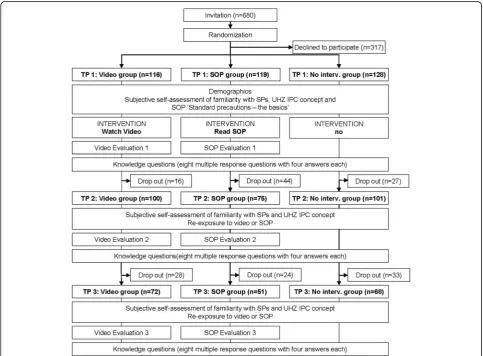
Of 680 invited HCP, 363 (53.4%) participated in the study at TP1. Thereof, 276 (76.0%) and 191 (52.6%) completed the questionnaires at TP2 and TP3,
respect-ively. The dropout rate from TP1→TP2 and TP1→
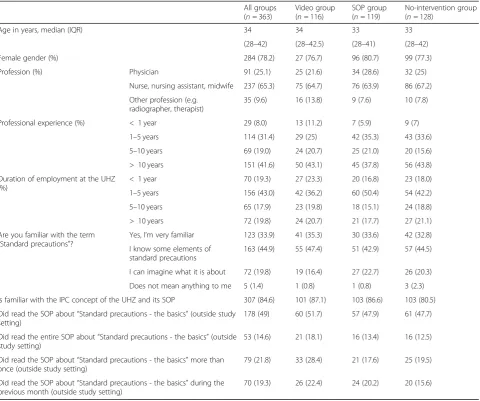
TP3 was 13.8 and 37.9% for the video group, 37.0 and 57.1% for the SOP group, and 21.1 and 46.9% for the no-intervention group, respectively. The study flowchart and the number of participants at each time point are il-lustrated in Fig. 1. Demographic data, self-assessment regarding familiarity with Standard Precautions, the University Hospital Zurich hygiene concept and the
SOP “Standard precautions – the basics” are shown
in Table 1.
The participants were predominantly female (78.2%) with a median age of 34 years. The majority were nurses
(65.3%), had a work experience of at least 5 years (60.6%), and considered themselves familiar with at least
‘some elements’ of Standard Precautions (78.8%).
Through the randomization process, all 3 study groups were balanced on these demographic and professional characteristics.
Effect of educational intervention on knowledge scores
Figure2shows the mean number and percentage of
cor-rect answers to the 8 × 4 knowledge questions for all study groups and time points. At all three TP, the video group scored best. At TP1, the video group, with a mean of 27.34 correct answers (85.4%), scored significantly better than the SOP group (26.03 correct answers (81.3%)), and the no-intervention group (25.48 correct answers (79.6%)) (p= .001). In the pairwise comparison,
the SOP group also scored better than the
no-intervention group (p = .006). At TP2, there was no
difference between the three groups (p = .364). At 3
months follow-up (TP3), the video group again scored better (mean of 27.63 correct answers (86.3%)) than the
Table 1Participant characteristics
All groups (n= 363)
Video group (n= 116)
SOP group (n= 119)
No-intervention group (n= 128)
Age in years, median (IQR) 34 34 33 33
(28–42) (28–42.5) (28–41) (28–42)
Female gender (%) 284 (78.2) 27 (76.7) 96 (80.7) 99 (77.3)
Profession (%) Physician 91 (25.1) 25 (21.6) 34 (28.6) 32 (25)
Nurse, nursing assistant, midwife 237 (65.3) 75 (64.7) 76 (63.9) 86 (67.2)
Other profession (e.g. radiographer, therapist)
35 (9.6) 16 (13.8) 9 (7.6) 10 (7.8)
Professional experience (%) < 1 year 29 (8.0) 13 (11.2) 7 (5.9) 9 (7)
1–5 years 114 (31.4) 29 (25) 42 (35.3) 43 (33.6)
5–10 years 69 (19.0) 24 (20.7) 25 (21.0) 20 (15.6)
> 10 years 151 (41.6) 50 (43.1) 45 (37.8) 56 (43.8)
Duration of employment at the UHZ (%)
< 1 year 70 (19.3) 27 (23.3) 20 (16.8) 23 (18.0)
1–5 years 156 (43.0) 42 (36.2) 60 (50.4) 54 (42.2)
5–10 years 65 (17.9) 23 (19.8) 18 (15.1) 24 (18.8)
> 10 years 72 (19.8) 24 (20.7) 21 (17.7) 27 (21.1)
Are you familiar with the term "Standard precautions"?
Yes, I’m very familiar 123 (33.9) 41 (35.3) 30 (33.6) 42 (32.8)
I know some elements of standard precautions
163 (44.9) 55 (47.4) 51 (42.9) 57 (44.5)
I can imagine what it is about 72 (19.8) 19 (16.4) 27 (22.7) 26 (20.3)
Does not mean anything to me 5 (1.4) 1 (0.8) 1 (0.8) 3 (2.3)
Is familiar with the IPC concept of the UHZ and its SOP 307 (84.6) 101 (87.1) 103 (86.6) 103 (80.5)
Did read the SOP about“Standard precautions - the basics”(outside study setting)
178 (49) 60 (51.7) 57 (47.9) 61 (47.7)
Did read the entire SOP about“Standard precautions - the basics”(outside study setting)
53 (14.6) 21 (18.1) 16 (13.4) 16 (12.5)
Did read the SOP about“Standard precautions - the basics”more than once (outside study setting)
79 (21.8) 33 (28.4) 21 (17.6) 25 (19.5)
Did read the SOP about“Standard precautions - the basics”during the previous month (outside study setting)
70 (19.3) 26 (22.4) 24 (20.2) 20 (15.6)
Abbreviations: IQRInterquartile range,SOPStandard Operating Procedure,UHZUniversity Hospital Zurich
SOP (mean of 26.55 correct answers (83.0%)) and the no-intervention group (mean of 26.47 correct answers (82.7%)) (p= .045).
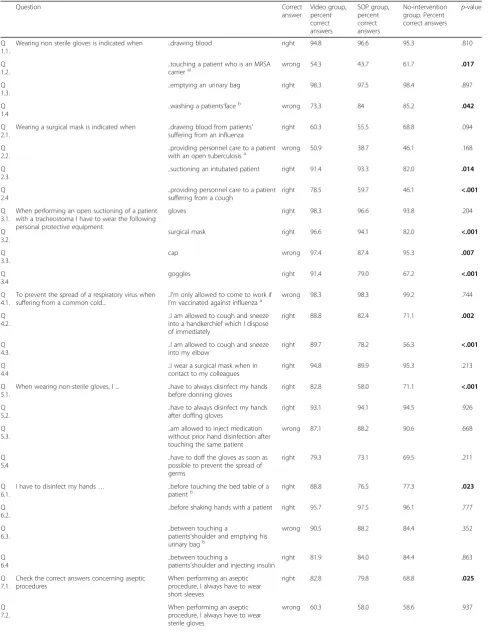
Table 2shows the results of the 8 × 4-item knowledge assessment questionnaire in detail, the number of cor-rect answers, and the percentages of corcor-rect answers at TP1 per study group. Participants of the video group
scored better than the SOP group and/or
no-intervention group in questions concerning respira-tory hygiene, PPE, and professional appearance (i.e. questions Q 2.4, Q 3.2–3.4, Q 4.2–4.3, Q 5.1, Q 6.1, Q 8.1, Q 8.3).
Results remained categorically equal when analyzing only drop-out participants, participants completing all three surveys, and excluding participants who were re-exposed to video (data not shown).
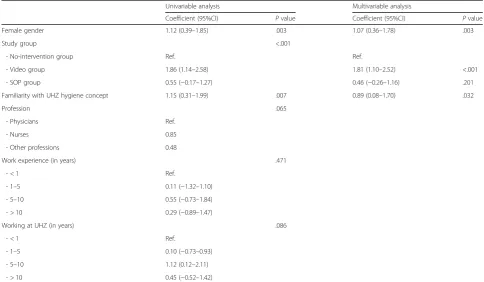
By using uni- and multivariable linear regression models, we found independent associations of higher knowledge scores at TP1 for female sex (p= .003), mem-bers of the video group (p< .001), and those participants who described themselves as being familiar with the University Hospital Zurich infection prevention and control concept (p = .032). Univariate and multivariate estimates are shown in Table3.
Satisfaction with teaching material
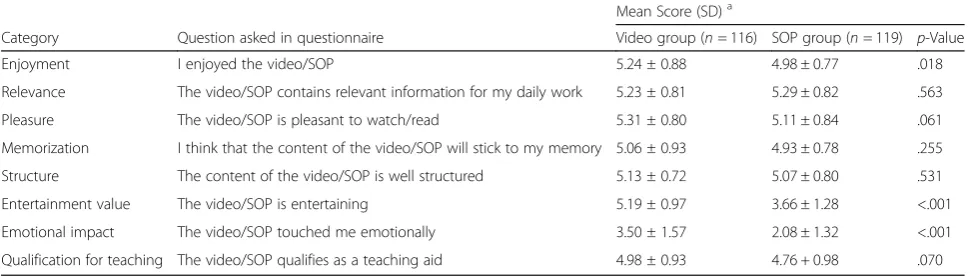
Table 4 shows the eight evaluation questions for the
video and SOP groups at TP1. Both interventions were similarly rated regarding importance and structure of contents, and both were considered suitable teaching methods. The video was rated higher regarding enjoy-ment (i.e. ‘I enjoyed the video/SOP’), regarding enter-tainment value (i.e. video/SOP considered entertaining), and emotional impact. At TP2, more participants de-clared being ready to recommend the video than the SOP to colleagues (mean 3.02 ± 1.63 vs 2.57 ± 1.35,
p = .049) (Additional file 4). Video group members
thought they recalled more content information than the SOP-group and more often talked about the video than the other two groups’participants. This association, however, was not statistically significant (Additional files4
and 5). Compliance and engagement with Standard
Pre-cautions assessed by self-evaluation, were equally stimu-lated by both interventions.
Discussion
This randomized controlled study found that watching
the edutainment video “Welcome on board”, combining
educational and entertaining elements, resulted in higher knowledge scores in Standard Precautions than reading the SOP or no intervention, immediately after the inter-ventions and at 3 months follow-up. Participants of the video group reported a higher satisfaction and recom-mended their teaching aid (i.e. edutainment video) more
often to colleagues than participants from the SOP group.
Many of the elements of Standard Precautions seem to be well known to HCPs in our hospital, as the no-intervention group already scored high. Still, after
watching the video “Welcome on board”, video group
participants scored a mean of two points higher than participants of the no-intervention group. This differ-ence reached statistical significance, and is, in our opin-ion, clinically relevant. Knowing all elements of Standard Precautions is essential for patient and HCP safety -every single item may make a difference during routine hospital work. The video group scored also higher than the group reading the SOP, demonstrating the superior effectiveness of watching the video compared to having purposefully read the SOP.
E-learning techniques teaching IPC topics have shown positive results. Other than our study, all of these studies feature interactivity [10–14, 16, 21], multimodal ap-proaches including videos [10, 11, 13, 14, 16, 21], text [10, 14, 16, 21], pictures [10, 13, 16], or a variety of knowledge tests, games or quizzes [10–14, 21]. The use-fulness of a ‘video only’ intervention was tested in pa-tient education and showed improvement in retention of information [22], and increased short-term knowledge [23]. Also, video interventions were shown to be effect-ive in modifying health behavior of patients [24]. Many edutainment videos on hand hygiene are available–and Lim et al. have considered them educationally useful by a non-validated scoring system [25]. To our knowledge, this study is the first to assess the learning effect of and satisfaction with a standalone edutainment video on IPC Standard Precautions.
The higher scoring of the video group was mainly driven by higher scores in 10 of the 32 knowledge ques-tions. These questions dealt with topics prominently ad-dressed in the video - almost exclusively through humor -, such as wearing PPE when suctioning a patient, com-pliance with cough etiquette, and professional appear-ance. Banas et al. stated in a review about humor in education, that appropriate humor attracts and sustains attention and produces a relaxed and productive learn-ing environment [26]. Our findings are also in line with the results of Kaplan et al., who found that humor leads to a better retention of teaching material [27].
Table 2Knowledge assessment with 32-item questionnaire at time point 1 (immediately after intervention) Question Correct answer Video group, percent correct answers SOP group, percent correct answers No-intervention group. Percent correct answers p-value Q 1.1.
Wearing non sterile gloves is indicated when ..drawing blood right 94.8 96.6 95.3 .810
Q 1.2.
..touching a patient who is an MRSA
carriera) wrong 54.3 43.7 61.7 .017
Q 1.3.
..emptying an urinary bag right 98.3 97.5 98.4 .897
Q 1.4
..washing a patients‘faceb
wrong 73.3 84 85.2 .042
Q 2.1.
Wearing a surgical mask is indicated when ..drawing blood from patients’ suffering from an influenza
right 60.3 55.5 68.8 .094
Q 2.2.
..providing personnel care to a patient
with an open tuberculosisa wrong 50.9 38.7 46.1 .168
Q 2.3.
..suctioning an intubated patient right 91.4 93.3 82.0 .014
Q 2.4
..providing personnel care to a patient suffering from a cough
right 78.5 59.7 46.1 <.001
Q 3.1.
When performing an open suctioning of a patient with a tracheostoma I have to wear the following personal protective equipment:
gloves right 98.3 96.6 93.8 .204
Q 3.2.
surgical mask right 96.6 94.1 82.0 <.001
Q 3.3.
cap wrong 97.4 87.4 95.3 .007
Q 3.4
goggles right 91.4 79.0 67.2 <.001
Q 4.1.
To prevent the spread of a respiratory virus when suffering from a common cold...
..I’m only allowed to come to work if I’m vaccinated against influenzaa
wrong 98.3 98.3 99.2 .744
Q 4.2.
..I am allowed to cough and sneeze into a handkerchief which I dispose of immediately
right 88.8 82.4 71.1 .002
Q 4.3.
..I am allowed to cough and sneeze into my elbow
right 89.7 78.2 56.3 <.001
Q 4.4
..I wear a surgical mask when in contact to my colleagues
right 94.8 89.9 95.3 .213
Q 5.1.
When wearing non-sterile gloves, I ... ..have to always disinfect my hands before donning gloves
right 82.8 58.0 71.1 <.001
Q 5.2.
..have to always disinfect my hands after doffing gloves
right 93.1 94.1 94.5 .926
Q 5.3.
..am allowed to inject medication without prior hand disinfection after touching the same patient
wrong 87.1 88.2 90.6 .668
Q 5.4
..have to doff the gloves as soon as possible to prevent the spread of germs
right 79.3 73.1 69.5 .211
Q 6.1.
I have to disinfect my hands… ..before touching the bed table of a patientb
right 88.8 76.5 77.3 .023
Q 6.2.
..before shaking hands with a patient right 95.7 97.5 96.1 .777
Q 6.3.
..between touching a
patients‘shoulder and emptying his urinary bagb
wrong 90.5 88.2 84.4 .352
Q 6.4
..between touching a
patients‘shoulder and injecting insulin
right 81.9 84.0 84.4 .863
Q 7.1.
Check the correct answers concerning aseptic procedures
When performing an aseptic procedure, I always have to wear short sleeves
right 82.8 79.8 68.8 .025
Q 7.2.
When performing an aseptic procedure, I always have to wear sterile gloves
all participants declared being stimulated to use Stand-ard Precautions by participating in our study (data not shown). The video group scored highest both 1 and 3 months after the intervention. Subjectively, the video participants tended to rate the video to better ‘sink into
long-term memory’than the SOP group participants and
felt to remember more of the video elements after 1 month compared to the SOP elements. This suggests
that the edutainment video might have a more favorable long-term effect than reading the SOP.
Educational videos are only useful if watched. Hy-pothesizing that higher satisfaction leads to higher utilization, we also assessed the participants’satisfaction with the teaching material. Interestingly, both, the video and the SOP intervention, were rated positively. Still, the video was rated higher in terms of entertaining effect Table 2Knowledge assessment with 32-item questionnaire at time point 1 (immediately after intervention)(Continued)
Question Correct
answer
Video group, percent correct answers
SOP group, percent correct answers
No-intervention group. Percent correct answers
p-value
Q 7.3.
Aseptic procedures prevent the contamination of clean surfaces and material
right 76.7 83.2 89.1 .037
Q 7.4
If I talk during aseptic procedures I need to wear a mask
right 75.0 73.1 66.4 .298
Q 8.1.
When in direct patient contact, I’m NOT allowed to wear…
..wedding ring right 98.3 89.1 78.1 <.001
Q 8.2.
..pearl earrings wrong 88.8 90.8 85.9 .504
Q 8.3.
..nail polish right 99.1 96.6 93.0 .038
Q 8.4
..watch right 97.4 98.3 96.9 .842
Caption: 32-item questionnaire with the percentage of correct answers by study group at time point 1
Abbreviations: MRSAMethicillin resistantStaphylococcus aureus,SOPStandard Operating Procedure,QQuestion
a
Topics not or only rudimentary thematized in video and SOP.b
Topics not or only rudimentary covered in the video but covered in the SOP
Table 3Predictive factors for higher knowledge scores at time point 1
Univariable analysis Multivariable analysis
Coefficient (95%CI) Pvalue Coefficient (95%CI) Pvalue
Female gender 1.12 (0.39–1.85) .003 1.07 (0.36–1.78) .003
Study group <.001
- No-intervention group Ref. Ref.
- Video group 1.86 (1.14–2.58) 1.81 (1.10–2.52) <.001
- SOP group 0.55 (−0.17–1.27) 0.46 (−0.26–1.16) .201
Familiarity with UHZ hygiene concept 1.15 (0.31–1.99) .007 0.89 (0.08–1.70) .032
Profession .065
- Physicians Ref.
- Nurses 0.85
- Other professions 0.48
Work experience (in years) .471
- < 1 Ref.
- 1–5 0.11 (−1.32–1.10)
- 5–10 0.55 (−0.73–1.84)
- > 10 0.29 (−0.89–1.47)
Working at UHZ (in years) .086
- < 1 Ref.
- 1–5 0.10 (−0.73–0.93)
- 5–10 1.12 (0.12–2.11)
- > 10 0.45 (−0.52–1.42)
and appealing emotions, and was generally considered to be the better teaching aid compared to the SOP. More members of the video group talked to a colleague about the video or even recommended other HCPs to watch the video than SOP group members reading the SOP. Also, the fact that the video-group had the lowest drop-out rate can be interpreted as a sign of relatedness and sustained attention to the topic. Still, if those who watched the video actually shared it with others, e.g. via social media, leading to a‘viral’spread among peers, has to be assessed in future studies.
Our study has limitations. First, participant blinding is not feasible in educational studies and recall bias may be unavoidable in this setting. Second, the know-ledge assessment questionnaire contained four ques-tions whose topics were not or only rudimentarily addressed neither in the video nor the SOP and two questions whose content was only addressed in the SOP and not the video. We included these questions with the argument that both the video and the SOP not only explicitly but also implicitly teach IPC topics. Still, we carefully minded to not include ques-tions only covered in the video to not bias the results in favor of the video group. Third, drop-out rate was considerable, especially in the SOP group. Still, sensi-tivity analysis showed equal results when analyzing only drop-out participants or participants completing all three surveys, respectively. Last, and most import-antly, better knowledge of Standard Precautions alone does not necessarily lead to higher adherence to Standard Precautions [28].
Conclusion
We demonstrated that an edutainment video on Stand-ard Precautions is not only entertaining but also educa-tional by finding highest knowledge scores in the video group. Transporting the content in a humorous way seemed to lead to especially high scoring. The video was preferred over the SOP regarding emotional and
entertainment values, and was more often recommended to colleagues. This study addressed the first two levels of Kirkpatrick’s “four-level model” for evaluating training and education programs,‘learning effectiveness’and ‘re-actions of participants’; further research is needed to evaluate the effect of edutainment videos on ‘behavior’
and‘impact on patients’or HCWs’health’.
Additional files
Additional file 1:Study questionnaire time point 1 (immediately after intervention). (DOCX 24 kb)
Additional file 2:Study questionnaire time point 2 (1 month after intervention) and 3 (3 months after intervention). (DOCX 22 kb)
Additional file 3:Standardmassnahmen Übersicht. (DOCX 137 kb)
Additional file 4:Participants satisfaction with their assigned teaching method at time point 2. (DOCX 18 kb)
Additional file 5:Participants satisfaction with their assigned teaching method at time point 3. (DOCX 18 kb)
Abbreviations
CDC:Centers for Disease Control and Prevention; CI: Confidence interval; HCP: Healthcare provider; IPC: Infection prevention and control; PPE: Personal protective equipment; SOP: Standard operating procedure; TP: Time point
Acknowledgements
The authors would like to thank the video director Adrian Aeschbacher, his video crew, the extras and the whole IPC-team of the University Hospital Zurich for their great work in filming the video“Welcome on Board– Infec-tion PrevenInfec-tion at the University Hospital Zurich”. We thank the participating HCP of the University Hospital Zurich, and Jan Breckwoldt, MD, for helping us design the questionnaire.
Funding
The video was co-funded by the Education Program of the Medical Director’s Office at the University Hospital Zurich. AW and AA are supported by the academic career program“Filling the Gap”of the Medical Faculty of the Uni-versity of Zurich.
Availability of data and materials
The datasets used and/or analyzed during the current study are available from the corresponding author on reasonable request.
Authors’contributions
AW, LC, MTM and HS produced the edutainment movie. AW, LC, and HS designed the study. AW acquired the data, and AA performed the statistical
Table 4Participants satisfaction with their assigned teaching method at time point 1
Mean Score (SD)a
Category Question asked in questionnaire Video group (n= 116) SOP group (n= 119) p-Value
Enjoyment I enjoyed the video/SOP 5.24 ± 0.88 4.98 ± 0.77 .018
Relevance The video/SOP contains relevant information for my daily work 5.23 ± 0.81 5.29 ± 0.82 .563
Pleasure The video/SOP is pleasant to watch/read 5.31 ± 0.80 5.11 ± 0.84 .061
Memorization I think that the content of the video/SOP will stick to my memory 5.06 ± 0.93 4.93 ± 0.78 .255
Structure The content of the video/SOP is well structured 5.13 ± 0.72 5.07 ± 0.80 .531
Entertainment value The video/SOP is entertaining 5.19 ± 0.97 3.66 ± 1.28 <.001
Emotional impact The video/SOP touched me emotionally 3.50 ± 1.57 2.08 ± 1.32 <.001
Qualification for teaching The video/SOP qualifies as a teaching aid 4.98 ± 0.93 4.76 + 0.98 .070
Abbreviations: SOPstandard operating procedure,SDstandard deviation
a
analysis. AW, AA, SPK, HS and LC analyzed and interpreted the data. AW and AA drafted the manuscript, and HS, LC, MTM, and SPK provided critical review of the manuscript for important intellectual content. All authors agree with the content and conclusions of this manuscript.
Ethics approval and consent to participate Not applicable.
Consent for publication Not applicable.
Competing interests
The authors declare that they have no competing interests.
Publisher’s Note
Springer Nature remains neutral with regard to jurisdictional claims in published maps and institutional affiliations.
Received: 25 February 2019 Accepted: 29 April 2019
References
1. CDC - Center for disease prevention and control: Standard precautions for all patients; https://www.cdc.gov/infectioncontrol/basics/standard-precautions.html, last Accessed 14 Aug 2018.
2. Acharya AS, Khandekar J, Sharma A, Tilak HR, Kataria A. Awareness and practices of standard precautions for infection control among nurses in a tertiary care hospital. Nurs J India. 2013;104(6):275–9.
3. Atif ML, Brenet A, Hageaux S, Fave MH, Cochet C, Baticle E, et al. Awareness of standard precautions for 4439 healthcare professionals in 34 institutions in France. Med Mal Infect. 2013;43(1):10–6.
4. Sax H, Perneger T, Hugonnet S, Herrault P, Chraiti MN, Pittet D. Knowledge of standard and isolation precautions in a large teaching hospital. Infect Control Hosp Epidemiol. 2005;26(3):298–304.
5. Vaona A, Banzi R, Kwag KH, Rigon G, Cereda D, Pecoraro V, et al. E-learning for health professionals. Cochrane Database Syst Rev. 2018;1:CD011736. 6. Cook DA, Levinson AJ, Garside S, Dupras DM, Erwin PJ, Montori VM.
Internet-based learning in the health professions - a meta-analysis. Jama. 2008;300(10):1181–96.
7. Sinclair PM, Kable A, Levett-Jones T, Booth D. The effectiveness of internet-based e-learning on clinician behaviour and patient outcomes: a systematic review. Int J Nurs Stud. 2016;57:70–81.
8. Labeau SO. Is there a place for e-learning in infection prevention? Aust Crit Care. 2013;26(4):167–72.
9. Maloney S, Nicklen P, Rivers G, Foo J, Ooi YY, Reeves S, et al. A cost-effectiveness analysis of blended versus face-to-face delivery of evidence-based medicine to medical students. J Med Internet Res. 2015;17(7):e182. 10. Atack L, Luke R. Impact of an online course on infection control and
prevention competencies. J Adv Nurs. 2008;63(2):175–80.
11. Bryce E, Yassi A, Maultsaid D, Gamage B, Landstrom M, LoChang J, et al. E-learning of infection control: it's contagious. Can J Infect Control. 2008;23(4): 228 30, 32 passim.
12. O'Neill E, Stevens NT, Clarke E, Cox P, O'Malley B, Humphreys H. Use of e-learning to enhance medical students' understanding and knowledge of healthcare-associated infection prevention and control. J Hosp Infect. 2011;79(4):368–70. 13. Laustsen S, Bibby BM, Kristensen B, Moller JK, Thulstrup AM. E-learning may
improve adherence to alcohol-based hand rubbing: a cohort study. Am J Infect Control. 2009;37(7):565–8.
14. Kobewka D, Backman C, Hendry P, Hamstra SJ, Suh KN, Code C, et al. The feasibility of e-learning as a quality improvement tool. J Eval Clin Pract. 2014;20(5):606–10.
15. Reime MH, Harris A, Aksnes J, Mikkelsen J. The most successful method in teaching nursing students infection control - E-learning or lecture? Nurse Educ Today. 2008;28(7):798–806.
16. Zingg W, Cartier V, Inan C, Touveneau S, Theriault M, Gayet-Ageron A, et al. Hospital-wide multidisciplinary, multimodal intervention Programme to reduce central venous catheter-associated bloodstream infection. PLoS One. 2014;9(4):e93898.
17. McConnell MM, Eva KW. The role of emotion in the learning and transfer of clinical skills and knowledge. Acad Med. 2012;87(10):1316–22.
18. Savage BM, Lujan HL, Thipparthi RR, DiCarlo SE. Humor, laughter, learning, and health! A brief review. Adv Physiol Educ. 2017;41(3):341–7.
19. Kapur N, Parand A, Soukup T, Reader T, Sevdalis N. Aviation and healthcare: a comparative review with implications for patient safety. JRSM Open. 2016; 7(1):2054270415616548.
20. Kirkpatrick D. Revisiting Kirkpatrick’s four-level model. Train Dev. 1996;50(1):54–9. 21. Hassan ZM. Improving knowledge and compliance with infection control
standard precautions among undergraduate nursing students in Jordan. Am J Infect Control. 2018;46(3):297–302.
22. Kinnane N, Thompson L. Evaluation of the addition of video-based education for patients receiving standard pre-chemotherapy education. Eur J Cancer Care (Engl). 2008;17(4):328–39.
23. Conceicao C, Pedro J, Martins MV. Effectiveness of a video intervention on fertility knowledge among university students: a randomised pre-test/post-test study. Eur J Contracept Reprod Health Care. 2017;22(2):107–13. 24. Tuong W, Larsen ER, Armstrong AW. Videos to influence: a systematic
review of effectiveness of video-based education in modifying health behaviors. J Behav Med. 2014;37(2):218–33.
25. Lim K, Kilpatrick C, Storr J, Seale H. Exploring the use of entertainment-education YouTube videos focused on infection prevention and control. Am J Infect Control. 2018;46(11):1218–23.
26. Banas JADN, Rodriguez D, Liu S-J. A review of humor in educational settings: four decades of research. Commun Educ. 2011;60:115–44.https:// doi.org/10.1080/036345232010496867.
27. Kaplan RM, Pascoe GC. Humorous lectures and humorous examples: some effects upon comprehension and retention. J Educ Psychol. 1977;69(1):61–5. 28. Pittet D. The Lowbury lecture: behaviour in infection control. J Hosp Infect.