CONCEPT BOOKLETS: EXAMINING THE PERFORMANCE EFFECTS OF JOURNALING OF MATHEMATICS COURSE CONCEPTS
Todd Stephen Fogdall
A thesis
submitted in partial fulfillment of the requirements for the degree of Master of Science in Mathematics Education
Boise State University
ii
BOISE STATE UNIVERSITY GRADUATE COLLEGE
DEFENSE COMMITTEE AND FINAL READING APPROVALS
of the thesis submitted by
Todd Stephen Fogdall
Thesis Title: Concept Booklets: Examining the Performance Effects of Journaling of Mathematics Course Concepts
Date of Final Oral Examination: 12 June 2009
The following individuals read and discussed the thesis submitted by student Todd Stephen Fogdall, and they evaluated her presentation and response to questions during the final oral examination. They found that the student passed the final oral examination. Sharon Walen, Ph.D. Chair, Supervisory Committee
Alan Hausrath, Ph.D. Member, Supervisory Committee Kathleen Rohrig, Ph.D. Member, Supervisory Committee
iii
For my family and friends,
iv
ACKNOWLEDGEMENTS
v ABSTRACT
Journaling is an effective tool for writing about mathematics, but research is mixed about the extent to its effectiveness in writing to learn mathematics. This study examined the performance effects of concept booklets on curriculum assessments. Concept booklets are a hybrid style of journal-writing that include responses to journal prompts, diagramming, and traditional note-taking. Prompts were designed to sometimes investigate new concepts and, at other times, to reflect on components of previously learned concepts.
The study, of an experimental design, was carried out at the high school level in honors-level mathematics classes with the independent variable being exposure to the booklets. A unit examination consisting of two parts, the first being traditional curriculum assessment items and the second being composed of nontraditional open-ended problems, was given to both groups. Exam results were analyzed to determine any statistically significant difference between the groups’ performances. Separate analyses of test results were done for sophomores and juniors. Additionally, six examination items were
analyzed based on whether an accurate diagram was drawn for the problem. This analysis was performed for the control group, the treatment group, and for the pool of all students in the study.
vi
vii
TABLE OF CONTENTS
ACKNOWLEDGEMENTS ... iv
ABSTRACT ... v
CHAPTER 1: INTRODUCTION ... 1
Definitions of Key Terms ... 6
CHAPTER 2: LITERATURE REVIEW ... 8
Writing-To-Learn in the Mathematics Classroom ... 8
Journaling and Writing-To-Learn Mathematics ... 10
How Writing Affects Learning ... 13
Assessing Responses to Journal Prompts ... 15
CHAPTER 3: RESEARCH DESIGN ... 17
Design Overview ... 17
Sampling Procedure ... 18
Procedure and Instruments ... 19
Limitations ... 20
CHAPTER 4: RESULTS ... 22
Outcomes of Concept Booklets Influencing Exam Performance ... 22
Necessary Changes to Initial Study Design ... 23
Sophomore Exam Results ... 26
Junior Exam Results ... 27
viii
CHAPTER 5: CONCLUSIONS ... 45
Potential Differences in Grade-Level ... 45
Potential Differences in Self-Perception of Mathematical Ability ... 46
Coding of Examinations ... 47
How Concept Booklets Influenced Diagramming ... 50
Other Suggested Further Research and Final Comments ... 52
REFERENCES ... 54
APPENDIX A ... 56
Journal Prompts APPENDIX B ... 59
Assessment Instruments APPENDIX C ... 68
CHAPTER 1: INTRODUCTION
The National Council of Teachers of Mathematics (NCTM) recommends in their curriculum-guiding document, Principles and Standards for School Mathematics (2000), that students be able to communicate clearly about mathematics and recognize the connections between mathematical concepts. More precisely, they say that students at all grade levels should be able to “organize and consolidate their mathematical thinking through communication” (p. 348), and “understand how mathematical ideas interconnect and build on one another to produce a coherent whole” (p. 354). Unfortunately, every school year starts with an inordinate amount of time devoted to teaching my students, regardless of where they are in the course sequence, how to properly write solutions to problems encountered in class. Moreover, students do not recognize the connections between concepts. An excellent example of this is the large number of students in Algebra 2 who have never connected the fact that two points are needed to write the equation of a line to the postulate in geometry that states that a unique line can be drawn between any two distinct points. These experiences, which are reinforced constantly by similar stories from my colleagues, lead me to conclude that these standards are not being met.
to cover new concepts. To make matters worse, the current education landscape of high-stakes standardized testing is creating an environment where teachers are opting to cut out important concepts simply because they are absent from topic lists, even when they are important concepts necessary for the development of the whole curriculum. By the end of the semester or school year, students have been exposed to a disjointed set of topics to be studied individually rather than the coherent curriculum they should receive (Rich, 2003). The next year begins with yet another review and re-teaching period, and the harmful cycle continues. Teachers have little control over this testing reality, so it becomes essential that they prevent further disjointing of the curriculum and help students to see mathematics as the coherent whole that NCTM promotes.
One practice that further disjoints the mathematics curriculum is a study and organizational habit that many of my students use. They often write any notes and diagrams from lectures or class activities at the top of the same pieces of paper that they later use to complete practice exercises. Many of these students report that they were advised to do this by previous teachers, usually with the goal of reducing the number of items to organize in their binders. Wherever they developed this habit, it has the
unfortunate side effect of creating a disjointed set of notes that only serve to muddy an already disjointed curriculum. Worse yet, many students in my classes are in the habit of immediately discarding returned assignments, leaving themselves with no record of the course’s main topic sequence to reference when studying for assessments.
easily be used as a way to encourage students to take notes in a separate location rather than writing them with their solutions to practice exercises. I immediately presented this method to my students and, for the rest of the year, they were required to write all of their notes and diagrams in these booklets.
I was pleasantly surprised by two consequences of this informal classroom experiment. The first consequence was that students enjoyed making the booklets, partly because there is no stapling or gluing of any kind to make them; instead, they are
inventively made through several selective cuts and folds. Furthermore, they also liked how easy they were to write on, since they laid flat on writing surfaces, allowing them to use drawing tools like rulers, compasses, and protractors, which are tricky to use with a spiral notebook or loose-leaf binder. The second consequence was that many students reported that studying had become easier and more efficient, mainly because they finally had a better method for organizing and later reviewing the concepts they learned in class.
reflective prompts were designed to help students think about the ways that concepts were interrelated or about common misconceptions that had arisen over time. By including these prompts, students were now explicitly forming links from previous concepts to new concepts.
In addition to the journal prompts, I began to have the students incorporate in the booklets their responses to the daily problems that I had always used as anticipatory sets. These problems had always been selected based on ties to the current curriculum. Prior to using these booklets, students had written their solutions to these problems on assignment pages, but as expected, they would lose the problems much like they had previously lost the notes they had written on their assignments. Consequently, it was often impossible for students to locate their work when I tried to bring attention to the connections presented in these problems. Requiring that these problems be written in the booklets made them immediately retrievable as well as a subject for subsequent journal prompts. Finally, the daily problems were being used as the legitimate source of learning material for which they had initially been designed.
The inclusion of the journal prompts and daily problems into the booklets turned what was initially just an organizational tool into a writing tool. I began to observe students making more thorough and complete connections between concepts and exhibiting a better anticipation of where concepts were leading. One particular instance of this was when a student in one of my geometry classes quickly recognized that the reason that we were developing the Laws of Sines and Cosines was because we wanted to be able to finally solve missing values in triangles that were not necessarily right
which journaling in concept booklets affects student performance on traditional curriculum assessments, as well as more nontraditional open-ended assessments.
The effects that writing to learn mathematics have on learning are mixed but generally positive. The practice of reflective journaling has been shown to have a positive effect on students’ abilities to understand new concepts and procedures, communicate mathematically (Jurdak & Rihad, 1998), and solve novel problems (Countryman, 1992). However, journaling alone has not necessarily had positive results on student
performance on specific curricular assessments of the curriculum, probably because the nature of skill-specific mathematics instruction and open-ended problem-solving are vastly different (Jurdak & Rihab, 1998; Klein, 1999). Inspired by these conclusions, the objective of this study is to formally determine through experimentation whether a journaling process that is more closely aligned with specific course learning objectives, specifically the one involving the booklets described here, will have a positive effect on curriculum assessments, both of a traditional nature as well as open-ended problem- solving tasks.
Definitions of Key Terms
Concept booklet – A small, hand-made book, roughly five and a half inches wide by eight and a half inches tall, constructed from blank pieces of standard printer paper (see Appendix C). While the booklet serves as a location for taking notes, drawing diagrams, and writing solutions to daily problems, each also contains two other important features: responses to investigative journal prompts designed to motivate a lesson and responses to reflective journal prompts designed to bring attention to connections between past
made for each instructional unit, partly to provide a sense of closure to major concepts but also to provide the teacher time to examine individual booklets without depriving students of their entire record of course concepts.
Writing-to-learn mathematics – A style of writing “to help students understand, retain, analyze, and organize mathematical concepts” (Flores & Brittain, 2003, p. 112).
Conceptual understanding – Comprehension of overarching mathematical ideas. One instance of this is knowing that real roots to a quadratic polynomial found by using the quadratic formula correspond to the points where the graph of the polynomial intersects the x-axis of the coordinate plane. While the high-stakes testing that is prevalent in public education today is mainly focused on procedural skills, it is important to note that
“(c)onceptual understanding is an important component of proficiency” (NCTM, 2000, p. 20).
CHAPTER 2: LITERATURE REVIEW Writing-To-Learn in the Mathematics Classroom
With the exception of occasional written proofs, writing has not historically been a major component of traditional mathematics classrooms. Various types of writing in mathematics have grown in prominence over the latter half of the last century, becoming even more strongly encouraged with the introduction of the National Council of Teachers of Mathematics’ standards documents, first in 1989 and followed by the 2000 revision,
Principles and Standards for School Mathematics. This shift in emphasis was primarily due to an identified need for our students to have more experiences that develop their abilities to communicate effectively about mathematics. In theory, students who communicate proficiently about mathematics are better equipped to develop the deeper conceptual understanding that is considered to be widely missing from our students’ educations (Morgan, 1998).
According to Morgan (1998), while NCTM and similar organizations in the United Kingdom and New Zealand have urged an increase in the use of writing in mathematics classrooms, the extent to which it is currently being used is unclear. The writing that has been reported and examined, however, appears to be superficial compared to the types of writing discussed in the recommendation documents. Most often, the mathematics-classroom writing in which students engage consists of
writing occurring in mathematics classrooms do not consist of simply copying or
transcribing information but still do little to support learning. “To fulfill school or district writing requirements, many mathematics teachers report that they annually assign writing biographical reports to their students” (Bosse & Faulconer, 2008, p. 8). These types of biographical reports of mathematicians, while perhaps valuable, do little to provide students with opportunities to think critically about mathematical concepts. Much of the lack of creative writing opportunities can be attributed to students’ lack of familiarity with the language and symbols of mathematics. Most students are never formally taught to communicate about mathematics, only the way to perform mathematical computations and manipulations. Unfortunately, these types of writing do not achieve the goals set forth to accomplish a higher level of mathematical communication (Morgan, 1998). The type of writing intended to meet these goals, which has come to be known as writing-to-learn mathematics, is the focus of this study.
The writing utilized in the concept booklets falls under the writing-to-learn umbrella. Writing-to-learn discards the idea that mathematical knowledge is a set of facts and procedures to be recalled by the student, but rather a more dynamic body of
formal writing, where students write up formal solutions to often open-ended mathematical problems (Countryman, 1992; Morgan, 1998).
Journaling and Writing-to-Learn Mathematics
Borasi and Rose (1989) suggest a substantial list of potential benefits of journal writing, including individual benefits to the student, individual benefits to the teacher, and collective benefits to the student-teacher relationship. Specific individual benefits to the student that are cited include a positive effect on their emotional response to learning mathematics due to the opportunities to communicate their feelings about the course, as well as a better understanding of how the subject relates to other areas of study and their own reality, whether that reality pertains to future academic classes that they have to take, or perhaps to a potential career field that they have been exploring. More specific to this particular study, Borasi and Rose cite that students obtain an improved understanding of mathematical content through inquiry and reflection and improved problem-solving skills from the process of examining their experiences doing mathematics.
Morgan (1998) goes to great lengths to point out the controversial aspects of the kind of mathematical investigation used in journal prompts, specifically that investigative work can be divergent in nature, but also points out that they are important activities because they provide students the opportunity to engage in the kind of work that
professional mathematicians do on a regular basis. The fact that this kind of work can be divergent, i.e. that different students can come to different conclusions, is not necessarily a drawback. It is just more important that journal prompts are carefully crafted to focus student learning toward a common objective. Additionally, through the process of sharing responses to journal prompts, students can see that alternative solution paths are
sometimes equally as strong and frequently mathematically equivalent methods of completing a task (Countryman, 1992; Morgan, 1998).
develops conceptual understanding in students (Ben-Hur, 2006). In addition to these benefits, reflection is also noted to benefit students by allowing them to examine their emotional relationship to the subject and how it may affect performance on assessments (Flores & Brittain, 2003).
How Writing Affects Learning
Writing-to-learn mathematics exhibits four characteristics of successful learning; it forces the writer to integrate the hand, eye, and brain to express reality, it provides immediate feedback and reinforcement, it encourages semantic connections, and it “is self-rhythmed because it connects past, present and future through analysis and synthesis” (Morgan, 1998, p. 25). In this way, Morgan argues, writing has a positive effect on learning; however, the extent to which it affects learning and the specific ways in which it affects learning have not been adequately addressed, with most of the
supporting literature lacking concrete evidence (Borasi & Rose, 1989; Morgan, 1998). Still, the reliable underlying premise here is that writing-to-learn mathematics, such as the type of writing found in the concept booklets, “forces construction of understanding, because we cannot write coherently about something we do not understand” (Talman, 1992, p. 107).
cognitive process. The other is that this process involves reflective thinking that is greatly facilitated through mediated learning” (p. 11). The mediated learning mentioned here simply means that the teacher provides numerous opportunities for the student to make individual connections on their own, but that these connections are made through experiences designed to guide students to specific outcomes and conclusions. When relating this to journaling, this means that journal prompts must be designed to help students reach a certain conclusion, rather than more open-ended prompts that are prone to elicit less specific responses not necessarily focused on the topic at hand.
In general, writing-to-learn mathematics through journaling has been shown to have positive effects on students’ conceptual and procedural understandings and mathematical communications (Jurdak & Rihad, 1998). Oddly, though, the effects of journal writing on objective, curriculum assessments have been shown to be small to nonexistent (Jurdak & Rihad, 1998; Klein, 1999). The results of Klein’s (1999) meta-analysis of the literature pertaining to journal writing found that while there are definite effects on learning, they are not always toward objective test performance. A variety of factors are cited for this phenomenon. For instance, the writer’s prior language often prevents new learning, sometimes even perpetuating common incomplete conceptions. An example given in the review is of the phrase “warm sweater,” which illustrates many students confusion of the scientific principles of heat-generation versus insulation.
Additionally, when teachers ask students to engage in open-ended journal writing without prompts, usually called free writing (Countryman, 1992), the result is often the
prompts designed to elicit responses about specific ideas and components of major concepts, students frequently showed gains in conceptual understanding as a result of the process (Klein, 1999). This is consistent with Ben-Hur’s (2006) outline of conceptually-based learning previously mentioned. Without teacher mediation, the learning is too open-ended to provide students with a focused path to the intended outcome. This notion, which is the chief motivation for this study, stimulates the question of whether the
concept booklets can lead to improved performance on not only curriculum-based assessments, but also on more open-ended styles of assessments. The booklets should promote learning of curriculum concepts because they consist of journal prompts aimed at essential course concepts, rather than the traditional journaling approach involving open-ended journal prompts or no prompts at all.
Assessing Responses to Journal Prompts
suspend judgment in the journal and to feel free to ask questions, to experiment, to make statements about what they did and did not understand” (Countryman, 1992, p. 27). This is not to say that they should be free of requirements. It just means that it is inappropriate to assign a formal grade to a journal or journal entry based on criteria other than the volume and frequency of their writing (Borasi & Rose, 1989).
Students received feedback about the content in their booklets from me, whether through conversations with them or written responses from me after having read their entries. Consistent with the recommendations about assessment, however, the journal writing that was done in the concept booklets was graded only for participation, with a completion grade assigned for their booklet at the end of the unit. All of the journaling occurred before the main lesson began each day, so it was usually very brief, only amounting to between three and five minutes on average. Students would participate not only through formulating their responses to each prompt, but also by sharing their responses with classmates. This sharing would sometimes take place in randomly assigned small groups, while at other times it was with the whole class. I would usually call on specific groups or individuals to present their responses to the rest of the class, based on the responses that I was seeing as they were writing. I felt that it was very important to try to get varied responses to each prompt, not only to show that there were many possible interpretations, but also to allow students to see the benefits of other points of view. In addition, I would sometimes paraphrase flawed responses, without identifying the student, so as to avoid any embarrassment, with the goal of pointing out that,
CHAPTER 3: RESEARCH DESIGN Design Overview
This study examined the effects of the use of concept booklets on students’ academic performance on both objective curriculum-based assessments and
nontraditional open-ended problem-solving tasks. The study was of an experimental design, with the independent variable or treatment being exposure to the concept booklets and dependent variable being performance on both types of assessments. The treatment group consisted of students in four sections of pre-calculus classes that I taught at a large suburban high school in Southwestern Idaho, which I will refer to as Lincoln High. Excluding a small number of freshmen and seniors who did not participate in the study, there were 84 students in the treatment group. The control group consisted of 41students, excluding freshmen and seniors, in two sections of pre-calculus classes taught by a colleague of mine, to whom I will refer as Ms. R, at another high school in the same school district, which I will call Washington High. Groups were examined for any differences in the dependent variable based on the null hypothesis, that any differences between the groups’ performance could not be explained by receiving the treatment. The hypothesis, tested using two-tailed t-Tests, was designed to answer the research question, whether exposure to the concept booklets would have any effect on student performance on traditional and open-ended curriculum assessments.
information about the possible ways in which the concept booklets influenced whether or not a student provided a correct solution to a problem. Coding included some algebraic and arithmetic issues such as whether a student’s mistake was due to a computational error or an incorrectly applied formula. Out of this coding, I decided to focus on whether or not a student provided an accurate diagram of the problem. At that time, six
examination questions were selected for analysis, based on whether a diagram was
typically used to help in the discovery of a correct solution. The rationale for this analysis and the exercises that were examined for this purpose are described in detail in the next chapter.
Sampling Procedure
The sampling procedure used in this study was one of convenience. Prior to the year of the completion of the study, the author and Ms. R both taught pre-calculus classes at Lincoln High. The year of the study was the first year of existence for Washington High School. Students at Washington mostly came from the older high school, Lincoln. Because of this, both student bodies were strikingly similar in demographic composition and educational background. Moreover, almost all of the students entering the
Procedure and Instruments
At the beginning of the school year, I instructed students on the use of the concept booklets and began to use them as a regular component of their course assignments at Lincoln High. Concept booklets have been used by all of my students, including students in Geometry, Algebra 2, Pre-Calculus, and Introduction to Calculus, for the previous two years, so they were already existing components of each course. It is important to once again note that assessment of the concept booklets was only for volume and frequency of journal responses so as not to inhibit the journaling processes, both to investigative prompts, to introduce new concepts, and to reflective prompts, designed to motivate students to process previously learned topics on a much deeper level and identify important but often overlooked elements of those topics.
were not included in this study. The instructional unit was taught over the same number of days, using the same sets of practice exercises, as well as the same quizzes and tests for assessments of the course curriculum (see Appendix B). Both instructors had access to all assessment items prior to the beginning of the study. The treatment group
responded to a number of journal prompts, both reflective and investigative, designed to deepen their understanding of daily concepts (see Appendix A).
Upon conclusion of the curriculum unit, test results were analyzed through the use of two-tailed t-Tests, with rejection of the null hypotheses occurring with statistical significance below the p = .05 level. All data analysis was performed with the Analysis Toolpak component of Microsoft Excel, Version XP.
Limitations
While the two high schools were predominantly formed from one high school, there were still a limited number of students that previously attended a third high school that has traditionally had students from a lower socioeconomic background. As a result, there were likely subtle differences between groups because of this factor.
Washington High School operated its opening year on a hybrid schedule that taught some classes on 60-minute periods every day and others over a 90-minute period every other day. However, all mathematics classes were taught in class periods that were the same length as those at Lincoln High. The hybrid nature of the teaching schedule caused a large number of student-scheduling conflicts and resulted in a large number of students from the third high school being placed in the wrong mathematics level at
semester. It is logical to assume that some of these students’ struggles were due, at least in part, to a different type or level of preparation in mathematics. As a result, the presence of students from the third high school in this study may support the belief that the study is limited due to this factor.
Another potential limitation of this study is the fact that the students that enroll in pre-calculus classes are generally considered “advanced” mathematics students and usually participate in their school’s honors program. This may indicate that the groups studied here are not representative of the general student population. Consequently, the argument can be made that the generalizability of the study is in question.
CHAPTER 4: RESULTS
Outcomes of Concept Booklets Influencing Exam Performance
Too often in classrooms I have seen instances where common teaching practices have undermined student understanding of curriculum concepts and, subsequently, the conceptual understanding that was deemed so important in Chapter 2. Certainly one of the most prevalent and arguably damaging practices is the presentation of formulas or algorithms without any opportunity for students to connect the underlying concepts to prior knowledge. Consequently, students learn skills without the ability to apply them in novel mathematical situations. This is especially true in the vector unit that was the focus of this study. Students often have great difficulty with certain vector concepts, such as vector projections and force diagrams. As a pre-calculus teacher who is bombarded by student requests to make the curriculum more accessible and perhaps “easier” to digest, I am often tempted to overlook the geometric relationships underlying these concepts and teach students to simply apply formulas without any context. Naturally, this provides little long-term benefit to students.
problems they encountered. I will further discuss aspects of students’ solution processes in Chapters 4 and 5.
Necessary Changes to Initial Study Design
Originally, the study was intended to conclude on Thursday and Friday,
February 5 and 6, but the unit assessments had to be given three school days later than originally planned due to Lincoln High School’s participation in the 2009 Special Olympics. Many students participated in the games as volunteers at the opening
ceremonies and assisted at several of the events. Lincoln’s regular schedule was changed to compensate for this participation, resulting in one of the pre-calculus classes not actually meeting on one of the scheduled test days. Students at Washington High School took the exam on the originally scheduled dates. Although students took the exam on different dates, both groups of students received the same number of instructional days; students at Lincoln High began the next instructional unit rather than reviewed the content examined for this study for a longer time. As a result, this change of dates
provided little to no advantage for students in the treatment group. One might even argue that time spent on a different instructional unit prior to being examined may be a
disadvantage to the treatment group.
reliability was 100% between the two coders, confirming accuracy and consistency in the development of the categories and the evaluation of the student responses on the exam, the instrument.
Recall that upon examining the students’ scores on the ISAT and the examination itself, it had become apparent that, for analysis purposes, it was necessary to stratify participants. I separated both the control and treatment groups into subgroups of sophomores and juniors, predominantly due to the fact that the ISAT is a grade level exam and cannot be used to make comparisons between students at different grade levels.
In addition to the formation of subgroups, it became apparent that the sample size of the control group was going to be limited significantly. Recall that scheduling issues at Washington High, which was using a hybrid schedule, necessitated a large number of schedule changes at the semester break immediately before this unit began. The decision was made to use a matched pair design for both the sophomore and junior subgroups; this matching was made based on students’ base-line data, ISAT scores. This was a relatively easy task for the juniors, since the ISAT scores for the juniors aligned nicely.
In addition to analysis of overall test results, analyses of individual parts of the test were also performed. The first part of the test consisted of very straight-forward items, such as exercise 7 (see Appendix B), which simply asks students to find the
measure of the angle between two given vectors. There is a formula for this, and from my experience, students can memorize and apply the formula without really knowing what they are doing. On the other hand, the second part of the test was filled with much more open-ended items, such as exercise 5 (see Appendix B), which asks students to determine the possible locations that a boat traveling across a flowing river can reach the opposite side. The solution involves creatively assigning vectors to represent the situation and successfully applying the vector concepts and operations introduced in the instructional unit. The aim of implementing concept booklets in the first place was to help students improve their abilities to approach the types of problems that were encountered in the second part of the examination, so it was logical to analyze these two parts separately. Consequently, I performed statistical analyses on students’ scores on the entire test as well as Parts I and II, which I will call Part I: Closed and Part II: Open for descriptive purposes.
Finally, the results of six questions were analyzed based on diagrams, one of the classification codes which emerged during the analysis of the exam. Some of the coding tracked computational and algebraic errors, but, as was mentioned previously, the main purpose was to analyze the performance of students who drew accurate diagrams of the problems presented on the exam against the performance of those students who did not. This analysis attempted to look at whether exposure to the concept booklets affected whether or not a student would provide a diagram, more importantly an accurate diagram, of the problem and a subsequent correct solution. Six questions, where the ability to diagram seemed beneficial to determining the solution, were identified and analyzed within the treatment and control groups, as well as for the pooled group. It is important to remember that these analyses were intended as a microcosmic evaluation of the
connection between concept booklets and the use of diagrams and provided motivation for further examination of the benefits of concept booklets.
Sophomore Exam Results
student from Washington High School, and a high test score in one group tended to correspond to a high test score in the other group.
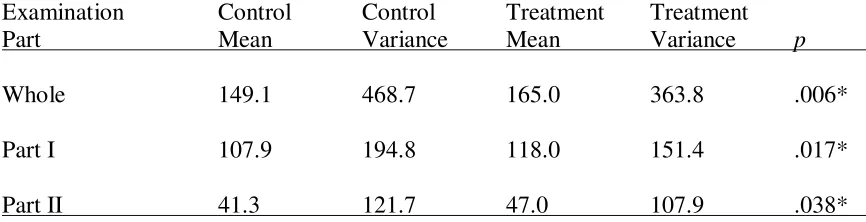
Individual analyses of the whole exam and each of the two parts, shown in Table 1 revealed significantly better performance by the treatment group, with P-values of .006 for the whole examination and .017 and .038 for Part I: Closed and Part II: Open, respectively. These values indicate that, for the entire exam and both parts, we can reject the null hypothesis, that any differences between the groups could not be explained by receiving the treatment, with significance occurring at the p = .05 level. As a result, we can conclude that the implementation of concept booklets in these classrooms resulted in an improvement in students’ performance on assessments. This appears to be the case, not only for traditional, straight-forward items designed to test procedural processes, but also for the types of open-ended items designed to test a student’s ability to design and implement flexible solutions to more abstract problems.
Table 1.
Sophomore Performance on Whole Examination and Parts I and II.
Examination Control Control Treatment Treatment
Part Mean Variance Mean Variance p
Whole 149.1 468.7 165.0 363.8 .006*
Part I 107.9 194.8 118.0 151.4 .017*
Part II 41.3 121.7 47.0 107.9 .038*
*p < .05
Junior Exam Results
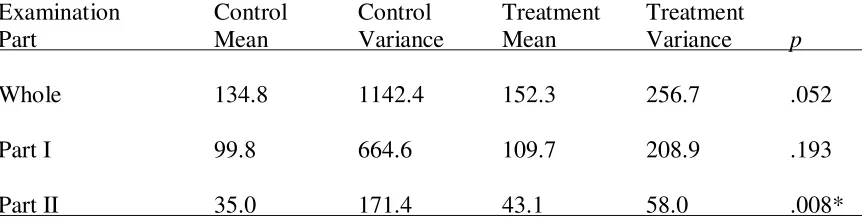
group did indeed have higher mean scores, their improved performance on the whole examination and Part I was not statistically significant. Performance on Part II of the examination, however, was significantly better at the .05 level, with a P-value of .008. My experience is that juniors enrolled in Lincoln High’s Pre-Calculus are more akin to members of the general student population, as opposed to sophomores, who tend to be more naturally gifted mathematics students. The reason that juniors seem to have reached this level of mathematics is more often due to effort and to well-developed work ethics rather than intuitive understandings of mathematics. This may indicate one possible explanation for the reason that statistically significant results were found for the whole exam and both sub-parts for the sophomores, while results for the juniors were only significant on Part II: Open. This is purely speculation, however, and would require further investigation into these high-school level differences to answer with any sense of finality.
Table 2.
Junior Performance on Whole Examination and Parts I and II.
Examination Control Control Treatment Treatment
Part Mean Variance Mean Variance p
Whole 134.8 1142.4 152.3 256.7 .052
Part I 99.8 664.6 109.7 208.9 .193
Part II 35.0 171.4 43.1 58.0 .008*
*p < .05.
Concept Booklets and Diagram Analysis
each part of the examination, were analyzed based on whether the student provided an accurate diagram for the problem or not. The three items from Part I: Closed were exercises 2, 9, and 10 (see Appendix B). The student samples that follow illustrate some of what was seen in the analysis.
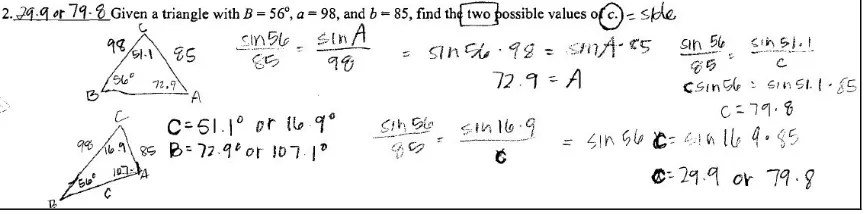
Exercise 2 tested students’ understanding of the ambiguous case of the Law of Sines. The given triangle measurements can result in two unique triangles. Generally, it is to the student’s advantage to sketch the triangle in order to better understand the
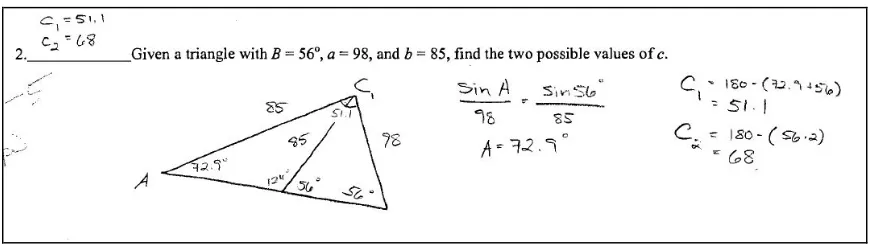
differences between triangles. Two examples of student responses to this question are shown in Figures 1 and 2.
Figure 1. Accurate supporting sketches of the two correct solutions to the problem presented in exercise 2 of Part I.
Figure 1, which shows a solution by a junior from the treatment group, is an example of an accurate sketch of the scenario and a subsequent correct algebraic solution to the problem. Note that this student drew the two triangles with relatively accurate scale to represent the two different solutions to the problem. To contrast this, Figure 2, which was also done by a junior from the treatment group, although this student was not included in the junior strata, shows an inaccurate rendering of the scenario and a
This incomplete conception is evident in the sketch of the problem and led to an incorrect algebraic solution.
Figure 2. An inaccurate sketch of the problem presented in exercise 2 of Part I.
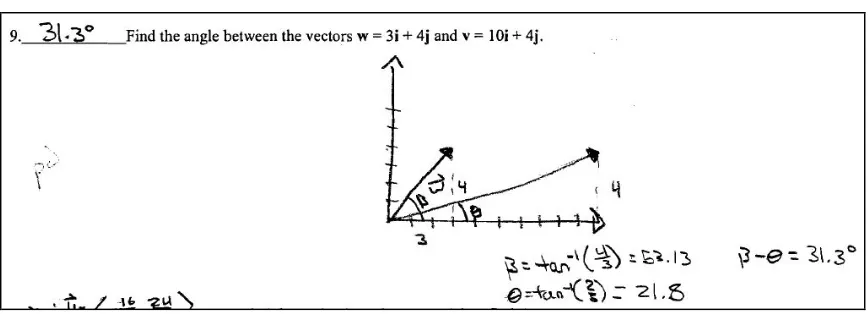
Exercise 9 involved finding the measure of the angle between two given vectors. While this can be a formula-driven skill, students usually benefit from sketching the vectors first to get a rough estimate of the size of the angle. Figure 3, done by a
sophomore from the treatment group, shows the power of the ability to sketch accurately. This student elected not to use the traditional formula; instead, simple trigonometric ratios were used to find angle measures and subtract to find the angle between the vectors. This indicates a strong, yet flexible approach to problem solving supported by the ability to sketch a situation accurately.
Figure 3. A novel approach to finding the angle measure in exercise 9.
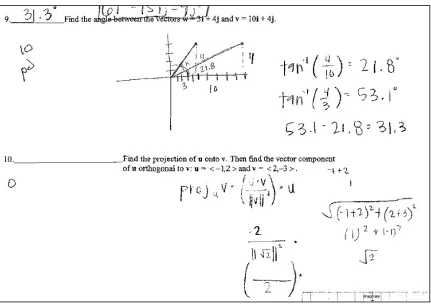
Figure 4. A miscalculation made without a sketch to indicate a smaller angle.
Figure 5 shows how one student can have great success with a sketch on one exercise and struggle on the very next problem. This student, who is a sophomore from the control group, did a wonderful job diagramming the vectors in exercise 9. Note that the solution in this case was the exact same novel solution shown in Figure 3, which does not rely on the typically-used formula. In contrast, the same student’s response on
having a formula does not necessarily translate into an understanding of the mathematical relationships involved.
Figure 5. The same student uses a diagram effectively on exercise 9 and is unable to find the correct solution on the very next exercise without a diagram.
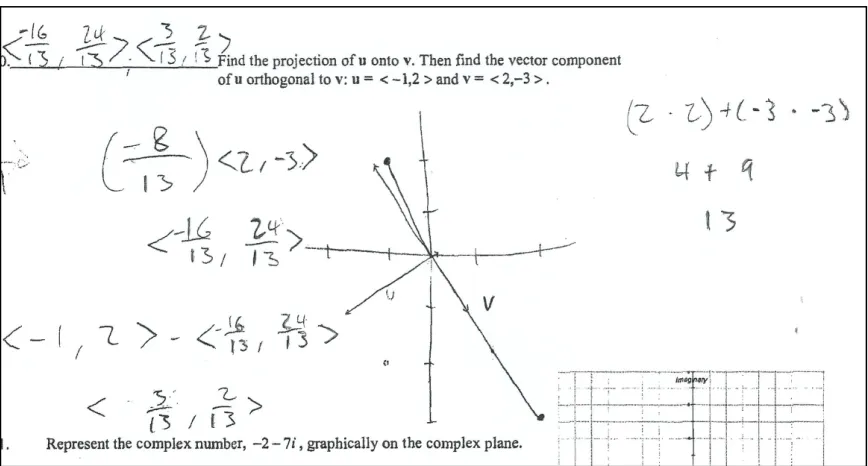
Exercise 10 involved students’ ability to find the projection of one vector onto another, as well as a component of the vector that is orthogonal to the projection. In my and my colleagues’ teaching experience, this is a skill that is notoriously difficult for students to master, but the ability to estimate the projection and orthogonal component from a sketch of the vectors seems to generally give students an advantage over those who lack this skill. This ability is evident in Figure 6. Note that the student, a junior from the treatment group, initially drew vector u incorrectly in the direction of the third
the projection and orthogonal components are shown with arrows. The orthogonal component is barely visible to the right of the origin since its magnitude is so small.
Figure 6. A sketch of the projection of vector u onto vector v and the orthogonal component of u aids the correct calculations of each vector.
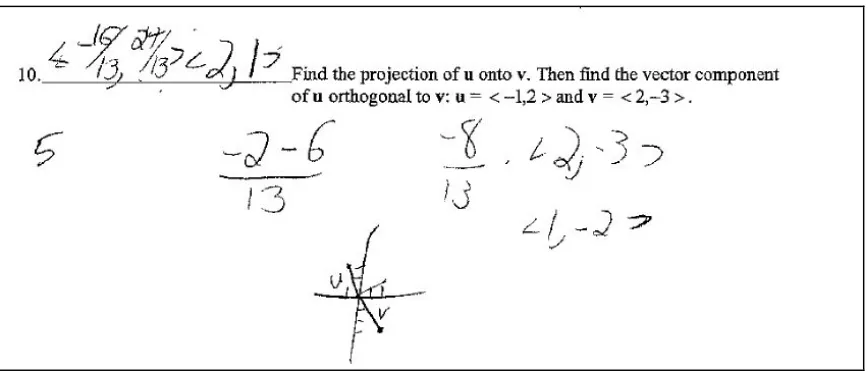
In Figure 7, the student has calculated the projection correctly but mistakenly calculated the orthogonal component. It is reasonable to suggest that an accurate sketch of the vector would have helped this student, a junior from the treatment group, to recognize the implausibility of the answer.
Figure 7. Without a sketch, the correct projection is found, but the orthogonal component is found incorrectly.
Figure 8. An incorrectly drawn sketch does little to help a student approximate the correct solution to exercise 10.
While the problem can be solved formulaically, sketching a map of the situation helps to find an easy path to the solution, as evidenced by the sample shown in Figure 9.
Figure 9. A junior from the treatment group correctly solves exercise 3 from Part II.
Figure 10. The sketch is beneficial by showing that both vectors are moving to the right.
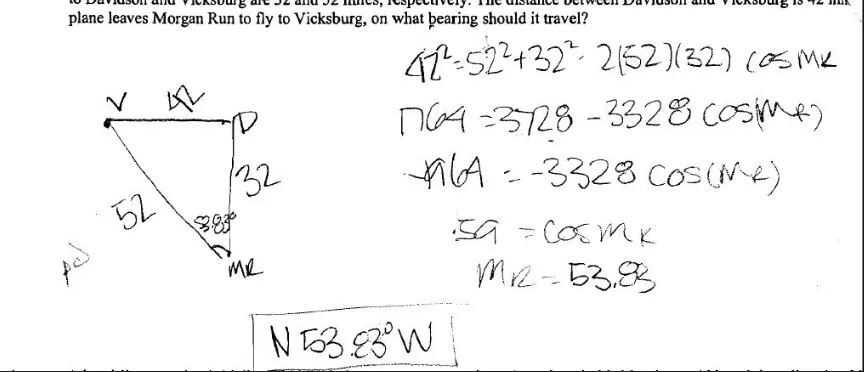
For comparison to what is seen in Figure 10, note the improperly drawn vectors shown in Figure 11, which was done by a sophomore from the control group. The origin of this students’ mistake is unclear, but the picture was directly responsible for the incorrect response, since the wind was drawn as having a northwesterly direction.
Figure 11. A response to exercise 4 that signifies an incomplete understanding of how to orient vectors.
This is an excellent case of a student who has well-developed procedural understanding, evidenced by their correct application of the Law of Cosines, but at the same time, a lack of conceptual understanding that prohibited a successful completion of the task. This is a clear instance of where concept booklets would allow me to communicate with students and attempt to remediate these types of incomplete conceptual understandings.
Finally, exercise 5 involves a boat crossing a flowing river in a fixed time. There are two potential landing sites, one upstream, and the other downstream, and again, the ability to sketch the scenario correctly is highly beneficial. Incidentally, this is the exercise that was reported most by students at both Lincoln and Washington as the hardest problem on the examination. The overall average score on this exercise was .984 out of 10 points, so it appears that students accurately gauged their performance on this problem.
Figure 12. A response to exercise 5 that displays a lack of recognition that the boat cannot cross the river perpendicular to the banks.
easy to see how the study would be confused by the fact that the question asked them to find two points, one upstream and the other downstream, where the boat could land.
Most responses to this question were similar to the one in Figure 12, written by a junior from the treatment group, but there were some promising solutions, especially the one shown in Figure 13. The first interesting component of this solution, from a different junior in the treatment group, is the right triangle in the middle of the figure where the student was using the Pythagorean Theorem to solve for time. (This is a much more abstract application of the Pythagorean Theorem than is usually used.) Next, the solution to the triangle was used to find the angle at which the boat would have to travel. This angle was then used to break the boat’s velocity vector into components. These components were then used to find how far upstream and downstream the boat would travel. It is difficult to imagine that this exercise could be solved in this manner without sketching an accurate representation of the figure. Developing this kind of sketching ability is, for this reason, one of the objectives of implementing the concept booklets.
Six analyses were performed for each of the six items. The first three analyses were comparisons of subgroups of the sophomore control group, sophomore treatment group, and pooled group of sophomores. The second three analyses for each examination item were comparisons of the junior control group, treatment group, and pooled group of juniors. It is important to note that all of the previous t-Tests that were performed on the matched pair groups for overall examination performance assumed matched pairs. While these tests are examinations of the same groups of students, they are of subgroups of each group. As a result, they are not matched within each group, so an f-Test for variance was performed for all analyses of each of the six exam items. The null hypothesis of each Test was that there was no difference in the variances of the group. If the results of the f-Test returned a value less than .05, the null hypothesis was rejected, and the t-f-Test that was performed assumed unequal variances. Otherwise, all t-Tests that were performed assumed equal variances.
Table 3.
Sophomore Diagram Analysis for Part I Examination Items
Exercise 2 Exercise 9 Exercise 10
DNP count 2 12 21
DNP Mean 10.0 9.9 5.8
Control
DP count 20 10 1
DP Mean 8.4 9.9 9.0
p - .899 -
DNP count 0 16 16
DNP Mean - 9.6 7.6
Treatment
DP count 22 6 6
DP Mean 9.3 9.0 8.3
p - .075 .510
DNP count 2 28 37
DNP Mean 10.0 9.8 6.6
Pooled
DP count 42 16 7
DP Mean 8.9 9.6 8.4
p .000 .583 .162
Note. “DNP” denotes subgroups of students who did not provide an accurate diagram. “DP” denotes subgroups of students who did provide an accurate diagram. Also, all questions were out of ten points.
not. This may indicate that either the diagram is not essential after all or that students understand this concept so well that the only individuals who drew the sketch were the ones that struggled with basic understanding of the problem. In general, the data in Table 3 suggests that, for the sophomores, diagramming was not necessarily beneficial to their performance on Part I of the examination.
Table 4.
Junior Diagram Analysis for Part I Examination Items
Exercise 2 Exercise 9 Exercise 10
DNP count 1 11 15
DNP Mean 10.0 6.6 5.2
Control
DP count 18 8 4
DP Mean 6.3 9.8 5.0
p - .046* .931
DNP count 1 15 14
DNP Mean 5.0 9.3 7.0
Treatment
DP count 18 4 5
DP Mean 7.6 10.0 6.8
p - - .905
DNP count 2 26 29
DNP Mean 7.5 8.2 6.1
Pooled
DP count 36 12 9
DP Mean 7.0 9.8 6.0
p .822 .022* .961
* p < .05
Table 5.
Sophomore Diagram Analysis for Part II Examination Items
Exercise 3 Exercise 4 Exercise 5
DNP count 5 9 17
DNP Mean 6.0 2.8 0.0
Control
DP count 17 13 5
DP Mean 8.2 6.2 0.0
p .206 .102 -
DNP count 6 13 2
DNP Mean 6.8 5.7 2.5
Treatment
DP count 16 9 20
DP Mean 9.7 7.6 1.3
p .000* .296 .553
DNP count 11 22 19
DNP Mean 6.5 4.5 0.3
Pooled
DP count 33 22 25
DP Mean 8.9 6.7 1.0
p .063 .096 .200
* p < .05
interpretation of how this may be tied to exposure to concept booklets is offered in Chapter 5.
Table 6.
Junior Diagram Analysis for Part II Examination Items
Exercise 3 Exercise 4 Exercise 5
DNP count 8 11 10
DNP Mean 5.6 .8 .0
Control
DP count 11 8 9
DP Mean 9.0 9.1 .6
p .059 .000* .347
DNP count 4 8 9
DNP Mean 8.8 2.5 .0
Treatment
DP count 15 11 10
DP Mean 9.1 6.5 3.3
p .813 .038* .007*
DNP count 12 19 19
DNP Mean 6.8 1.5 .0
Pooled
DP count 26 19 19
DP Mean 9.0 7.6 2.0
p .058 .000* .006*
CHAPTER 5: CONCLUSIONS Potential Differences in Grade-Level
Certainly the most striking part of this study is how differently the sophomores and juniors performed in this study. The sophomore subgroup performed significantly better on the whole examination as well as the sub-components, Part I: Closed and Part II: Open. At the same time, the juniors only reached a level of significance on Part II: Open. Moreover, the diagram analysis suggested that the ability to generate an accurate diagram is more of a factor for juniors than sophomores. As mentioned previously, this may be an indication of the different types of students who wind up taking an honors mathematics class. It has been my experience over the past eleven years that it is often the sophomores in the room who rely heavily on intuition, while the juniors are more reliant on procedures and algorithms. As a result, sophomores may have benefited from the process of journaling in the concept booklets not only on the
traditional closed questions from the first part of the test, but also on the open-ended questions in the second part of the exam. I hypothesize that this may be because, from my experience, they work more on intuition. In any case, adding a visualization component to their mathematical intuition helped them on both styles of questions.
don’t want to know why I’m doing it; just tell me how to do it.” As a result, working with concept booklets did not seem to provide an advantage on the closed questions from Part I. This might be because juniors will practice a skill repeatedly until they are confident that they have mastered it, as opposed to trying to generate a sketch to interpret a problem. On the other hand, when the questions were more abstract and required the ability to look more flexibly at a not memorized situation, juniors began to benefit from the journaling.
Another potential motivation for investigating grade-level differences in this study may be to help explain some of the characteristics of the general student
population. As was mentioned previously, my experience with juniors in pre-calculus classes is that they tend to exhibit qualities similar to general mathematics students who are not taking accelerated mathematics classes. I attribute this to their being closer to the average grade-level at which most students take a pre-calculus class. Accordingly, their response may be more indicative of how the general school population might respond to the concept booklets. Whatever the case, this is an area that deserves further examination, not only into how different grade-levels respond to this type of journaling, but also the extent to which it makes a difference in populations of honors students, mainstream students, and students who consistently struggle with mathematics.
Potential Differences in Self-Perception of Mathematical Ability
level of significance. If not for this high variance, the separation between groups would certainly be enough to reach this level of significance. Of note, however, were potential causes for this. When evaluating and coding the examinations, it became immediately clear that many of the juniors either knew what they were doing, or they simply did not. To explain this, I return to the idea of older grade-level students in pre-calculus using lower level cognitive skills, such as rote memorization, to prepare for examinations. In other words, they are less likely to attempt to experiment until they find a workable solution. Generally, students in my classes who approach the curriculum in this manner will not attempt a problem that they do not immediately know how to do. One of the juniors who participated in this study is an excellent example of this difference. She spent an inordinate amount of time preparing for every examination she faced during the year. Despite all of the preparation, though, if she encountered a situation that wasn’t exactly like the ones she had practiced, she would give up. I spent a great deal of effort trying to help her develop her abilities to interpret more abstract problems, but in the end she would always return to rote practice. More intuitive students, who seem to be more frequently encountered at the sophomore level, will play persistently with several ideas, hoping to find a path that leads to a working solution. This may explain the wider range of scores for the sophomores and suggest the importance of fostering confidence in our students; otherwise, they risk the possibility of giving up before they begin.
Coding of Examinations
objects, primarily those who had never taken a physics course, which is probably somewhere around 95% of my student population. Simple relationships like Newton’s Third Law, the classic relationship between active and reactive forces, had simply never been considered by these pre-calculus students. This naturally makes understanding force diagrams trickier, a phenomenon I have seen through working with students who have been educated using a curriculum that emphasized physics before the other sciences. This may suggest the importance of the prerequisite courses for calculus. So much of pre-calculus course-content depends on physical examples, students with a science
background usually had an advantage. It was my experience that the students in the treatment group, who were usually better able to successfully diagram a relationship in their booklets, generally had better responses to the prompts. As a result, I decided that, if the examination was going to be thoroughly analyzed, these responses would have to be coded in order to better track some of the trends that were seen in the concept booklets.
Figures 14 and 15 illustrate the kinds of differences that were visible in the responses to the journal prompts. Figure 14 is an example of a student, a junior, who is computationally very strong but usually hesitates to answer concept-rich questions. This student’s response seems to focus less on the question about the vectors and more about the part pertaining to preventing arm and shoulder fatigue. This response demonstrates a reluctance to discuss the concept in a technical manner, which may simply be a
Figure 14. A response from a student with little physics experience.
much more technical precision, as can be seen in the vector components shown in both sketches.
How Concept Booklets Influenced Diagramming
In Chapter 4, I indicated some reasons for coding the examination items, primarily to investigate how concept booklets influenced whether or not a student provided an accurate sketch of the problem. The practice of diagramming the problem seemed most beneficial for the juniors on the second part of the examination, so my comments will pertain mainly to Table 6 in Chapter 4.
Table 7.
Ratio of Junior Students Who Provided an Accurate Diagram to Those Who Did Not on Open-Ended Questions From Part II
Exercise 3 Exercise 4 Exercise 5
Control 11/8* 8/11* 9/10
Treatment 15/4 11/8* 10/9*
* Students from this group who provided an accurate diagram performed significantly better at the p = .05 level on this exercise.
This ratio may be higher in the treatment group because of the number of journal prompts that required students to sketch a diagram to answer the question. This was true for five of the ten journal prompts used during the unit, those on January 20, 27, and 30, as well as February 2 and 3 (see Appendix A). In each of these cases, a sketch was used by the vast majority of students in the treatment group. The prompt for January 20 required students to diagram a triangle, but the four other prompts involved vectors. In every one of these instances, the main focus in class while discussing their responses to the journal prompt was on whether or not students could accurately sketch the problem or scenario presented in the prompt. The concept booklets provided me with an opportunity to reinforce and encourage the use of drawings as an organizational tool for solving problems. Recall that students also received written journal feedback as well as participating in solution-discussions.
part of their solution process. While qualitative analysis might suggest a relationship, statistically significant analysis pertaining to concept booklets and the likelihood of sketching an accurate diagram cannot be determined from this study. However, this is definitely worthy of further investigation. Qualitative or quantitative analysis could answer the questions of not only how the concept booklets affected whether or not a student provided an accurate diagram of the problem, but also why this seems to be more of a factor for juniors than sophomores.
Other Suggested Further Research and Final Comments
The statistical results of this study, which aimed to determine if concept booklets would have a positive effect on closed and open-ended curriculum assessments, signify significantly better examination results on the entire examination as well as Part I: Closed and Part II: Open for sophomores. While the juniors did not perform significantly better on the entire examination or Part I, their performance was significantly better on Part II. Concept booklets and the accompanying discussions are an instructional strategy that may improve mathematics performance on assessments of not only traditional skill-oriented problems, but also on open-ended problem-solving tasks. From a practical standpoint, concept booklets are easy to implement in class and add little to the workload for teachers in terms of assessing responses.
between freshmen and sophomores in Algebra 2, or between sixth and seventh graders in Pre-Algebra.
It would also be beneficial to see this study implemented in other mathematics classes that are not generally considered to be honors classes. This study involved
students who are typically college-bound and take their academic studies seriously. What would the study yield if it was implemented in a class aimed at the general student population, or even in a skills class for students who historically have struggled with mathematics?
Finally, what kinds of results would be seen if concept booklets were
REFERENCES
Ben-Hur, M. (2006). Concept-rich mathematics instruction: Building a strong foundation for reasoning and problem solving. Alexandria, VA: Association for Supervision and Curriculum Development.
Borasi, R. & Rose, B.J. (1989). Journal writing and mathematics instruction.
Educational Studies in Mathematics, 20(4), 347-365.
Bosse, M.J. & Faulconer, J. (2008). Learning and assessing mathematics through reading and writing. School Science and Mathematics, 108(1), 8-19.
Countryman, J. (1992). Writing to learn mathematics. Portsmouth, NH: Heinemann. Flores, A. & Brittain, C. (2003). Writing to reflect in a mathematics methods course.
Teaching Children Mathematics, 10(2), 112-118.
Jurdak, M & Rihad, A.Z. (1998). The effect of journal writing on achievement in and attitudes toward mathematics. School Science and Mathematics, 98(8), 412-419. Klein, P.D. (1999). Reopening inquiry into cognitive processes in writing-to-learn.
Educational Psychology Review, 11(3), 203-270.
Mason, R.T. & McFeetors, P.J. (2002). Interactive writing in mathematics class: Getting started. Mathematics Teacher, 95(7), 532-536.
National Council of Teachers of Mathematics. (2000). Principles and standards for school mathematics. Reston, VA: The National Council of Teachers of Mathematics, Inc.
Rich, W. (2003, Spring). Historical high-stakes policies relating to unintended consequences of high-stakes testing. Educational Measurement: Issues and Practice, 22(1), 33-35.
Talman, L.A. (1992). Weekly journal entries – An effective tool for teaching
Date Lesson Topic Journal Prompt (Investigate = I, Reflective = R) Mon.,
Jan. 19
N/A No School – Martin Luther King, Jr. Day
Tue., Jan. 20
Law of Sines, including the ambiguous case (SSA)
I – Consider the figure below. Explain why the area of the triangle cannot be found with the traditional formula, A = 0.5bh, using any of the given measurements. Describe a method that could be used to find the area of this triangle based on the traditional formula.
Wed., Jan. 21
Law of Cosines, Heron’s Formula
R - Under what circumstances of given information can the Law of Sines be used to solve a triangle? Under what circumstances can it not be used to solve a triangle.
Thur., Jan. 22
Vectors in the Plane I – Each of the following is a type of vector quantity: 30 miles to the north; 45 mph straight up; a force of 15 Newtons 20o above the horizontal. Each of the following is not a vector quantity, but rather a scalar quantity: 35 inches; 17 mph; an acceleration of 30 ft. per second per second.
Use the examples and counterexamples to define “vector quantity.” Then describe other quantities that require description with a vector quantity.
Fri., Jan. 23
Vectors in the Plane R – The mathematics of vectors is notoriously difficult. Describe some strategies that would be helpful when working with vector quantities.
Mon., Jan. 26
Vector Unit Quiz None
Tue., Jan. 27
Vectors and Dot Products R – In everyday conversation, the terms velocity and speed are often used a synonyms. In mathematics and science, however, these terms are considered to be different. Velocity is a magnitude and direction, whereas speed is a single-dimension quantity that can be represented by nonnegative real numbers. Consider an object that has a velocity v and a speed s. Discuss how these two quantities are related to each other.
Which of the following statements is correct mathematically? Explain your reasoning.
1. While driving to work, I did not exceed a velocity of 55 miles per hour.
Wed., Jan. 28
Vectors and Dot Products R – Consider two forces of equal magnitude acting on a point.
1. If the magnitude of the resultant is the sum of the magnitudes of the two forces, make a conjecture about the angle between the forces.
2. If the resultant of the forces is 0, make a conjecture about the angle between the forces.
3. Can the magnitude of the resultant be greater than the sum of the magnitudes of the two forces? Explain.
Thur., Jan 29
Trigonometric Form of a Complex Number
I – Explain why finding powers of complex, imaginary
numbers, such as
(
− +2 3i)
7is a considerably more demanding task than finding powers of real numbers, such as 7( 2.3)− .
Fri., Jan. 30
Trigonometric Form of a Complex Number
R – What can be said about the vectors u and v if the following are true? Be sure to explain your answers.
1. The projection of u onto v equals u.
2. The projection of u onto v equals 0.
Mon., Feb. 2
Review for Vector Unit Exam R – Suppose you are mowing lawns for a summer job. Use the concept of the projection of one vector onto another to describe why having a longer handle on your lawnmower is better for preventing fatigue.
Tue., Feb. 3
Review for Vector Unit Exam R – Consider the vectors, <-3, 5>, < 5, 2>, and <-1, 3>. Find the resultant vector in three different orders. What do your results say about the associativity of vector addition? Wed.,
Feb. 4
Review for Vector Unit Exam None
Thur., Feb. 5
Vector Unit Exam, Part I None
Fri., Feb. 6
Honors Pre-Calculus – Vector Quiz – Spring 2009 Name
Be sure to show all work to receive credit for each solution! Do not leave any questions unanswered.
1. Given a triangle with A=39°, B=106°, and c = 78, find a.
2. Find the area of a triangle withA=71°, b = 10, and c = 19.
3. Find the height of a giant helium balloon used in a Thanksgiving Day parade given that two guy wires are attached as shown in the figure below.
4. Given a triangle with a = 78, b = 15, and c = 91, find A, B, and C.
6. A group of scientists wants to measure the length of a crater cause by a meteorite crashing into the earth. From a point, O, they measure the distance to each end of the crater and the angle between these two sides. What is the approximate length l of the crater? Round your answer to one decimal place.
l
7. A vector has an initial point (3, 7) and a terminal point (3, -2). Find its component form.
8. A vector has an initial point (2, 5) and terminal point (-1, 9). Find its magnitude and direction.
9. Given u = 3i – 2jand w = 9i + 5j, find v = 2 1
u + 4w.
Honors Pre-Calculus Vector Exam, Part I – Spring 2009 Name
Be sure to show all of your thought process and write your solution, with units where necessary, in the space provided.
2
v v v⋅ =
v u v u⋅ = θ cos v v v u u
v ⋅
⋅ = 2 proj
(
cosθ isinθ)
r bi a
z= + = + , where r= a2+b2 and
a b = θ tan
(
)
(
)
[
1 2 1 2]
2 1 2
1z =rr cosθ +θ +isinθ +θ
z
[
(
1 2)
(
1 2)
]
2 1 2
1 = cosθ −θ +isinθ −θ
r r z z
(
)
[
r θ i θ]
r(
nθ i nθ)
zn = cos + sin n = n cos + sin
+ + + n k i n k r
n θ π θ 2π
sin 2
cos , where
1 ,..., 2 , 1 , 0 − = n k
1. Given a triangle with A = 102o, B = 23o, and c = 576.1, find a.
2. Given a triangle with B = 56o, a = 98, and b = 85, find the two possible values of c.
3. Find the area of the triangle with A = 37o, B = 78o, and c = 250.
5. Given the triangle at right, find B.
6. A vector v has magnitude 27 and direction θ=216°. Find its component form.
7. Given v = 3i + 2j and w = 6i + j, find the angle between v and w.
8. Given v = 3i - 9j and w = 2i + j, find v • w.
9. Find the angle between the vectors w = 3i + 4j and v = 10i + 4j.
11. Represent the complex number, −2−7i, graphically on the complex plane.
12. Multiply:
[
16(
cos33°+isin33°)
]
[
8(
cos17°+isin17°)
]
13. Evaluate:
(
3−i)
7Bonus: Use the Law of Cosines to find the two possible values for the missing side length in the triangle below.