D E B A T E
Open Access
Control of neglected tropical diseases needs a
long-term commitment
Yaobi Zhang
1*, Chad MacArthur
2, Likezo Mubila
3, Shawn Baker
1Abstract
Background:Neglected tropical diseases are widespread, particularly in sub-Saharan Africa, affecting over 2 billion individuals. Control of these diseases has gathered pace in recent years, with increased levels of funding from a number of governmental or non-governmental donors. Focus has currently been on five major‘tool-ready’ neglected tropical diseases (lymphatic filariasis, onchocerciasis, schistosomiasis, soil-transmitted helminthiasis and trachoma), using a package of integrated drug delivery according to the World Health Organization guidelines for preventive chemotherapy.
Discussion:Success in controlling these neglected tropical diseases has been achieved in a number of countries in recent history. Experience from these successes suggests that long-term sustainable control of these diseases requires: (1) a long-term commitment from a wider range of donors and from governments of endemic countries; (2) close partnerships of donors, World Health Organization, pharmaceutical industries, governments of endemic countries, communities, and non-governmental developmental organisations; (3) concerted action from more donor countries to provide the necessary funds, and from the endemic countries to work together to prevent cross-border disease transmission; (4) comprehensive control measures for certain diseases; and (5) strengthened primary healthcare systems as platforms for the national control programmes and capacity building through implementation of the programmes.
Conclusions:The current level of funding for the control of neglected tropical diseases has never been seen before, but it is still not enough to scale up to the 2 billion people in all endemic countries. While more donors are sought, the stakeholders must work in a coordinated and harmonised way to identify the priority areas and the best delivery approaches to use the current funds to the maximum effect. Case management and other necessary control measures should be supported through the current major funding streams in order to achieve the objectives of the control of these diseases. For a long-term and sustainable effort, control of neglected tropical diseases should also be integrated into national primary healthcare systems.
Background
A group of chronic and debilitating conditions, caused by parasitic, bacterial, and viral infections, is defined as the neglected tropical diseases (NTDs) [1,2]. These NTDs are the most prevalent diseases in the poorest populations in the world, putting an estimated 2.7 billion people at risk [3]. They cause blindness (for example, onchocerciasis and trachoma) [4-7], disfigurement (for example, lym-phatic filariasis, leishmaniasis, leprosy, and Buruli ulcer) [8-12], and are often life threatening at a later stage of the disease (for example, African trypanosomiasis,
Chagas disease, dengue fever, and schistosomiasis) [13-17]. They are also related to various clinical compli-cations, such as anaemia and other forms of malnutrition (for example, hookworm infections, schistosomiasis, ascariasis, and trichuriasis) [18-23]. In terms of disability-adjusted life years (DALYs), NTDs as a whole are among the top 10 leading causes of years of healthy life lost to long-term disability and premature death worldwide [1,3]. Sub-Saharan Africa bears the biggest burden of many of these NTDs, and the numbers of people afflicted by each of several of these diseases are simply striking [24], representing up to over 90% of the world’s burden for some of these diseases. Moreover, these NTDs geo-graphically overlap [1], and a significant proportion of * Correspondence: [email protected]
1Helen Keller International, Regional Office for Africa, Dakar, Senegal Full list of author information is available at the end of the article
the poorest populations often harbours more than one of these NTDs [2,25,26]. These NTDs have severe socioeco-nomic consequences as they cause long-term illness, dis-figurement, social stigma and marginalisation, and decreased productivity [27,28]. Therefore, successful con-trol of NTDs will have a wide range of health and socioe-conomic benefits to the poorest populations. The control of NTDs has now gained momentum in recent years with growing interest from the international community and funding from governmental or non-governmental donors, however more donors are needed to provide the funds to bridge the funding gap; the existing donors need to rethink their funding policy to include other necessary control measures for certain diseases in order to achieve the objectives, and the endemic countries need to com-mit themselves to the NTD control effort. This paper reviews experiences in the success of controlling these NTDs from recent history, and highlights the important aspects in the control of these NTDs in order to achieve a long-term sustainable effect.
Discussion
Current situation in controlling the five major NTDs
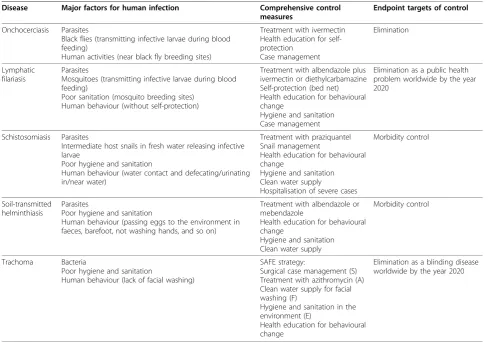
Control of the NTDs currently focuses on five major ‘tool-ready’NTDs, lymphatic filariasis, onchocerciasis, schistosomiasis, soil-transmitted helminthiasis (hook-worm infections, ascariasis, and trichuriasis) and tra-choma in an integrated control programme [29]. This is because the drugs needed for these five NTDs are robust, safe, low cost and available by donation from pharmaceu-tical companies or by purchasing at relatively low costs. The current control strategy is mass drug administration (MDA) using the available drugs in a coordinated approach according to World Health Organization (WHO) guidelines on preventive chemotherapy [30]. This drug-based intervention delivers available drugs either alone or in combination to prevent morbidity caused by these NTDs, or in some cases to eliminate the diseases. To date, with the funds committed to deliver the available tools to the poorest people in need from external donors, a number of countries, for example, Bangladesh, Burkina Faso, Cameroon, Democratic Republic of Congo, Burundi, Ghana, Haiti, Mali, Nepal, Niger, Rwanda, Sierra Leone, Southern Sudan, Tanzania, Togo, and Uganda, have been able to implement inte-grated national NTD control programmes. Although the current strategy emphasises integrated control by preven-tive chemotherapy, control of each of these five major NTDs has its own endpoint targets and its own compre-hensive measures to achieve these targets (Table 1).
Onchocerciasis
Onchocerciasis, or river blindness, is the second highest infectious cause of blindness in the world, and is now
mainly distributed in 19 African countries, some foci in Yemen and parts of the Americas. There are 37 million people with onchocerciasis and 99% of the cases are in Africa, with more than 102 million people at risk of the disease in Africa alone [31]. The control strategy is through mass administration of ivermectin (Mectizan) donated by Merck & Co., Inc. through its Mectizan Donation Program http://www.mectizan.org.
In the Americas, the Onchocerciasis Elimination Pro-gram for the Americas (OEPA) was launched in 1992 to act as a technical and coordinating body for a multina-tional, multiagency coalition that facilitated the estab-lishment of programmes for the semiannual mass administration of ivermectin in the six countries with onchocerciasis [32]. Significant progress has already been made in all six countries, with no new cases of onchocercal blindness being reported in the region, and it is anticipated that onchocerciasis could be eliminated from most of the remaining foci in the Americas by 2012 [32].
In Africa, the most successful control programme has been the Onchocerciais Control Program (OCP) which virtually eliminated river blindness from 11 countries first by vector control through spraying insecticides and subsequently through delivery of ivermectin [33]. In 1995, onchocerciasis control was expanded to include areas outside the original OCP zone with a second pro-gramme, the African Program of Onchocerciasis Control (APOC). It adopted a strategy of community-directed treatment with ivermectin (CDTI) annually [34], deliver-ing over 50 million treatments per year for onchocercia-sis in 19 participating countries [31]. Through this strategy, the prevalence of onchocerciasis in these coun-tries has been reduced from a precontrol level of 46.5% in 1995 to 28.5% in 2008 [31]. In some countries, for example, Senegal and Mali, longitudinal studies in three foci showed that after 15-17 years of annual or biannual CDTI, prevalence of onchocerciasis was reduced to < 1% [35]. This has ignited a hope of eliminating oncho-cerciasis from Africa.
Lymphatic filariasis
combination of diethylcarbamazine (DEC) tablets and DEC-fortified salt accompanied by intensive surveillance to monitor the prevalence of infection. Building on the successful experience and taking advantage of the avail-able drug albendazole (donated by GlaxoSmithKline for areas coendemic with onchocerciasis), the Global Pro-gram to Eliminate Lymphatic Filariasis (GPELF) was established in 1997 to eliminate the disease as a public health problem worldwide by the year 2020. The strat-egy used is annual MDA with albendazole and DEC or albendazole and ivermectin to over 80% of the entire population at the risk of infection. Since 2000, GPELF has delivered MDA to around 700 million people worldwide, averting 32 million DALYs and an estimated 6.6 million newborns being prevented from the disease [8,42]. Data collected from the sentinel sites in several countries showed that the prevalence of microfilaraemia had been reduced by 60% to 100% after 5-6 rounds of MDA [42], and that Egypt, after 5 rounds of MDA at high coverage, is likely to join the list of countries that has successfully eliminated LF [43]. Despite the progress
made, 20 out of 71 endemic countries that require MDA are still yet to start the control programme.
Schistosomiasis
Schistosomiasis, or bilharzia, caused by the schistosome trematode, is one of the most debilitating helminthic diseases among rural populations. There are three major species that cause tremendous human morbidity, Schis-tosoma haematobium andSchistosoma mansoni predo-minantly in Africa, andSchistosoma japonicum in the Far East. Schistosomiasis can cause a wide range of symptoms and consequences depending on the species, the worm burden and the length of time infected [44]. Globally there are over 200 million people infected with the disease with many more at the risk of being infected, and the majority are in sub-Saharan Africa [45].
In China, the national control programme for schisto-somiasis has restricted the disease to very limited areas with relatively low prevalence via decades of compre-hensive control effort [46,47]. In Brazil and Egypt, simi-lar successes in schistosomiasis control have also been Table 1 Risk factors, comprehensive control measures and endpoint control targets for each of five major neglected tropical diseases (NTDs)
Disease Major factors for human infection Comprehensive control measures
Endpoint targets of control
Onchocerciasis Parasites
Black flies (transmitting infective larvae during blood feeding)
Human activities (near black fly breeding sites)
Treatment with ivermectin Health education for self-protection
Case management
Elimination
Lymphatic filariasis
Parasites
Mosquitoes (transmitting infective larvae during blood feeding)
Poor sanitation (mosquito breeding sites) Human behaviour (without self-protection)
Treatment with albendazole plus ivermectin or diethylcarbamazine Self-protection (bed net) Health education for behavioural change
Hygiene and sanitation Case management
Elimination as a public health problem worldwide by the year 2020
Schistosomiasis Parasites
Intermediate host snails in fresh water releasing infective larvae
Poor hygiene and sanitation
Human behaviour (water contact and defecating/urinating in/near water)
Treatment with praziquantel Snail management
Health education for behavioural change
Hygiene and sanitation Clean water supply
Hospitalisation of severe cases
Morbidity control
Soil-transmitted helminthiasis
Parasites
Poor hygiene and sanitation
Human behaviour (passing eggs to the environment in faeces, barefoot, not washing hands, and so on)
Treatment with albendazole or mebendazole
Health education for behavioural change
Hygiene and sanitation Clean water supply
Morbidity control
Trachoma Bacteria
Poor hygiene and sanitation
Human behaviour (lack of facial washing)
SAFE strategy:
Surgical case management (S) Treatment with azithromycin (A) Clean water supply for facial washing (F)
Hygiene and sanitation in the environment (E)
Health education for behavioural change
achieved through MDA campaigns [48,49]. The current control strategy recommended by the WHO is to con-trol morbidity due to schistosomiasis by MDA with pra-ziquantel, targeting mainly school-age children and adults at high risk of infection. Preschool children and infants are also being considered for inclusion in the target population [50]. Unlike for other major NTDs there has been limited drug donation and so praziquan-tel has had to be purchased, although it is now available at low cost. In 2002, the Schistosomiasis Control Initia-tive was established with support from the Bill & Melinda Gates Foundation, and has since delivered over 40 million treatments in sub-Saharan Africa using prazi-quantel [51]. The treatment made a significant impact on infection [52,53] and morbidity [54,55] in the tar-geted populations. Currently there are 13 countries in sub-Saharan Africa that are implementing integrated NTD control programmes in which schistosomiasis con-trol is an important component, however the majority of endemic countries are still yet to start such integrated control programmes.
Soil-transmitted helminthiasis
Soil-transmitted helminthiasis (STH) is caused by a group of parasitic nematode worms (most importantly, hookworms, Ascaris lumbricoides and Trichuris tri-chiura) through ingestion of parasite eggs or contact with skin-penetrating larvae that are present in the con-taminated environment. These diseases are by far the most common NTDs in the developing world [3], affecting school-age children in particular and causing anaemia and other forms of malnutrition [18-22,56]. The control strategy is morbidity control through MDA using albendazole or mebendazole. Generally, control of STH is integrated into other programmes such as nutri-tion or school health as a deworming component, and is often part of schistosomiasis control programmes or as a collateral benefit from LF control programmes, as the same drug is used. Addition of mebendazole to vita-min A supplementation expanded the treatment to chil-dren of 12-59 months with a high coverage [57]. Children Without Worms (CWW) was established as a partnership between Johnson & Johnson and the Task Force for Global Health to leverage the donation of mebendazole from Johnson & Johnson to advocate for comprehensive and sustainable control of STH with a focus exclusively on school-age children http://www. childrenwithoutworms.org. Despite these efforts, less than 20% of the at-risk school-age population receive deworming treatment worldwide [58]; this is far short of the World Health Assembly’s target to regularly treat 75% of school-age children at risk of morbidity due to somiasis and STH infections by 2010 [59]. As for schisto-somiasis control, only a few countries are currently
implementing or about to implement national integrated NTD control programmes that include STH control.
Trachoma
Trachoma, a recurrent eye infection caused by the bac-teria, Chlamydia trachomatis, is the leading infectious (and thus preventable) cause of blindness worldwide. Repeated infection of the conjunctiva lining the under-neath of the eyelid leads to scarring and the eventual turning-in of the eyelid, causing the eyelashes to rub against the eye itself. This painful condition, called tri-chiasis, eventually abraded the cornea and results in irreversible blindness.
Trachoma is endemic in 57 countries, particularly in sub-Saharan Africa, the Middle East and Asia, with the highest prevalence rates reported in sub-Saharan Africa [60]. The disease affects the poorest populations in the world. It is estimated that there are currently over 40 million people with the infectious form of the disease, and 8.2 million people that have trichiasis and are thus at risk of blindness. It is further estimated that over 7 million people have been blinded by trachoma [60].
The WHO, through the Global Alliance for the Elimi-nation of Blinding Trachoma (GET2020), endorses the SAFE strategy (for‘Surgery for trichiasis, Antibiotics to treat infections, Facial cleaning and Environmental improvement to reduce transmission’) [61,62] to elimi-nate this disease as a cause of blindness by the year 2020 [63]. In 1998, the International Trachoma Initiative (ITI), now part of the Task Force for Global Health, was established by the Edna McConnell Clark Foundation and Pfizer, Inc. [64], and has been working with govern-mental and non-governgovern-mental partners to support the implementation of the SAFE strategy in 18 endemic countries through the donation of the drug Zithromax (azithromycin) by Pfizer as the ‘A’ component of the SAFE strategy. As a result of this donation programme and the implementation of the other components of the SAFE strategy, in 2006 Morocco announced the elimina-tion of trachoma as a public health problem. Several countries such as Ghana, Iran, Oman, Mexico and Saudi Arabia have since followed suit.
Trachoma control is currently included in the inte-grated control of NTDs but primarily for antibiotic dis-tribution (the ‘A’ component). Funds to support the other components in the SAFE strategy, particularly sur-gery for trichiasis, have to be sourced elsewhere.
Recommendations for a sustainable success in the control of NTDs
Long-term commitment
earmarked $100 million for the United States Agency for International Development to target the aforemen-tioned ‘tool-ready’ NTDs. In 2008, President Bush launched the NTD Initiative with $350 million over 5 years to provide treatment to over 300 million people in developing countries. In 2009, President Obama announced a new global health initiative with $63 billion over 6 years to address a range of global health pro-blems including NTDs. The US Government has since steadily increased funding in NTD control over the last few years, from $15 million per year during 2006-2008, to $25 million in 2009, and to $65 million for 2010. The UK government also announced a commitment of £50 million over 5 years towards NTD control and elimina-tion. In 2009, a $34 million grant was also provided by the Bill & Melinda Gates Foundation to establish regio-nal strategies and funding mechanisms and leverage new investments to control or eliminate NTDs by 2020. Indeed, with the funding provided, many countries have now been able to implement their integrated NTD con-trol programmes.
However, caution must be taken to avoid being over-optimistic and sending the wrong messages to donors for achieving the stated goals over a short period of time. Overoptimism can artificially raise donor expecta-tions, which may not be met during the funding period. Experience shows that a successful control programme needs a long-term effort. It has been decades since schistosomiasis control programmes started in China in the 1950 s with a comprehensive control strategy [47] and in Brazil in the mid 1970 s with (mainly) che-motherapy [48], yet effort in control is still required and ongoing. There have been resurgences (or re-emergences) of schistosomiasis in previously controlled areas [47,65]. With onchocerciasis, it took 15-17 years of biannual MDA plus vector control to reduce the pre-valence to a very low level as in Senegal and Mali [35]. It is therefore important that donors are aware that the overall objectives in controlling or eliminating NTDs may not be achieved after one or two rounds of a 5-year funding cycle using the current strategy, and that long-term commitment and investment are needed.
A long-term commitment is also required from the endemic countries. Current integrated control pro-grammes are almost exclusively funded by external sources. It is recognised that the governments of ende-mic countries have to balance resource allocation for NTD control against a high burden of more dramatic diseases, and as such they rarely allocate budgets for implementation activities of NTD control programmes. However, in-kind contributions have been made as well as the commitment to integrate NTD activities into health systems. For long-term sustainable control, the endemic countries need to progressively take on the
responsibility of such control programmes. This will also ensure that the residual levels of NTDs will be manageable within the health system when they cease to be of public health significance following intensive large-scale, relatively expensive, and community based interventions. It is also important for the beneficiary communities to realise that a long-term commitment is needed from them.
Partnerships
Successful control of NTDs needs a strong partnership involving all stakeholders across the various sectors. The successes of OCP, APOC, GPELF and GET2020 are all stories of partnerships of donors, the World Health Organization, pharmaceutical industries, governments of endemic countries, communities, and non-governmental developmental organisations (NGDOs). Commitment from the pharmaceutical industries to continue to donate the necessary drugs is also vital. Currently, Mec-tizan for onchocerciasis treatment will be donated by Merck for as long as is needed and with as much as is needed [66]. Albendazole for LF will be donated by GlaxoSmithKline for as long as necessary to eliminate LF to meet the current target of elimination by 2020 [67]. Pfizer donates Zithromax for trachoma treatment that is necessary to achieve the goal of the elimination of blinding trachoma by 2020. Johnson&Johnson also donates mebendazole for STH treatment. However, the funds provided by donors to deliver these drugs to the populations in need are still not enough [68]. Therefore, in order to better use the limited resources, all the sta-keholders within a country including donors and NGDOs, coordinated by governments of endemic coun-tries, need to work together to identify those priority areas most in need and to plan and implement the con-trol activities in a coordinated and harmonised way to avoid repetition and overlapping in both funding and effort. In this partnership, NGDOs have a very impor-tant role in assisting countries to raise funds and plan and implement the programmes, as has been demon-strated in onchocerciasis control [69].
Concerted action
Successful control of these diseases and the alleviation of the suffering of millions of people from long-term ill-ness, disfigurement, social stigma and marginalisation, and decreased productivity require concerted action.
their commitments to provide additional funds for the cause of NTD control so that efforts can be scaled up to reach all those people in need [70].
Concerted action is also needed from the endemic countries. Many of the NTDs spread across borders. Cross-border transmission of the NTDs is common because of the movement of populations. Expanding control efforts into bordering countries will be critical, as successful NTD control programmes in one country may be undermined by cross-border traffic from neigh-bouring countries where there are no NTD control pro-grammes [68]. The neighbouring countries can also work together to exchange experience in planning, implementation, training and advocacy [51,71].
Comprehensive control measures
The current strategy for integrated control of NTDs is preventive chemotherapy using the available drugs [30] for one group of NTDs that share MDA as a common strategy. Therefore, the current major funding for the integrated NTD control programmes focuses almost exclusively on integrated MDA, ignoring a number of other components that are critical to the control, miti-gation and in some cases the elimination of these dis-eases. For a long-term and sustainable impact, other measures (for example, clean water supply, hygiene and sanitation, behavioural changes, and vector manage-ment) must be addressed. The importance of socioeco-nomic development in NTD control needs to be recognised and appropriate collaboration sought when implementing NTD interventions. While these other measures will need concerted action from all relevant sectors and may not be fully addressed within an indivi-dual programme, for the purpose of morbidity control, extreme cases (for example, trichiasis, hydrocele, and elephantiasis) must be cared for and be included in the current funding. The control programme per secan actually benefit from such inclusion of case management as it has been shown that including lymphoedema man-agement in the control programme can increase the community compliance with MDA [72]. In the case of trachoma control, the objective is global elimination of trachoma as a blinding disease by year 2020 using the SAFE strategy. In the current major funding, only the ‘A’component is supported, that is, MDA with Zithro-max, while the ‘S’, ‘F’ and ‘E’ components are over-looked. Without addressing the‘F’and‘E’components, the disease is guaranteed to return in the long term. There are currently 8.2 million people worldwide with trichiasis, the stage of trachoma that leads to irreversible blindness [60]. If funding for surgery for these cases (the ‘S’component) is not provided in the major funding, the main objective of GET2020 will never be achieved. There is a similar case for LF elimination for which dis-ability management and prevention is of equal
importance in the programme in order to attain the elimination goal. Another disease for which other com-plementary measures should be included is schistoso-miasis. MDA with praziquantel alone showed excellent results in reducing prevalence and intensity of infection in the integrated control programmes [52,53,73], but it also showed difficulties in reducing infection in heavy endemic areas with close proximity to major water bodies [52], as the once a year treatment does not pre-vent reinfection. Even in areas where prevalence is reduced to very low levels by consecutive MDA, there is still a risk of recrudescence of the disease as shown in China [47,65]. The helminth control programme on Zanzibar Island is another good example of why com-prehensive control measures are needed [74,75]. There-fore, for long-term sustainable control, there should be other measures including clean water supply, hygiene and sanitation such as latrine building and use, health education for behavioural change, and snail manage-ment if possible.
Implementation through the primary healthcare system and capacity building
In most developing countries, particularly in the poorest areas, there is a lack of fully functional infrastructure in the health service system. If strengthened, this system can be comprehensive, flexible in adjusting to changing disease patterns, permanent, and embedded in commu-nity life [76]. As an integrated NTD control programme is implemented in a country, it is important to avoid creating a separate parallel health service system relative to the existing one, and to avoid undermining the already under-resourced healthcare systems [77]. In areas with poor infrastructure and poor resources, a programme-oriented approach has been effective to achieve maximum effect in a short period of time in onchocerciasis control using community-directed inter-ventions in APOC. However, for a long-term benefit and sustainable control programme on NTDs, it is vital to integrate NTD control into the existing primary healthcare system as routine health service operations where possible and thus to strengthen the infrastructure of the primary health system through such control pro-grammes [76,78,79]. This is exemplified by the success-ful integration of NTD drug delivery through the national Child Health Days in Uganda [80,81]. Experi-ence from the national integrated NTD control pro-gramme in Sierra Leone showed that implementing the programme involving the existing health service system actually helped rebuild and strengthen the system (M Hodges, personal communication).
programme, one of the most important issues is the in-country capacity to implement such integrated control programmes. Under the current funding structure, an international organisation or an NGDO (or a consor-tium) is required to provide technical assistance and support in financial management to the national pro-gramme. It is vital that the government and the commu-nities, rather than NGDOs, take the lead in planning and implementation of the programme. With the assis-tance from NGDOs, the programme can start from a limited scale to gain experience and build capacity through training and implementation, and then expand progressively.
Conclusions
Control of the NTDs has gained momentum in the last few years. The burden of these diseases on over 2 billion people in the poorest areas and the importance of con-trolling these NTDs for a wide range of benefits are recognised by the international community [70]. While impressive progress has been made in investment and control of the diseases, a long-term commitment from existing donors must be emphasised and funding from more governmental and non-governmental donors must be mobilised in order to ensure that the billions of peo-ple afflicted by the NTDs benefit from such a large-scale international effort. With increased funding in the control of NTDs, the NTD control community must remain objective and maintain focus on maximum achievement with currently available resources. The cur-rent level of funding for NTD control has never been seen before, but it is still not enough to scale up to all people in all endemic countries, and the duration of assured funding is not known. The stakeholders must work in a coordinated and harmonised way to identify the priority areas and the best delivery approach to use the current funds to maximum effect. Case management and other necessary measures should be supported in the current funding stream in order to achieve the objectives of these disease controls. For a long-term and sustainable effort, control of NTDs should also be inte-grated into the primary healthcare system and strengthen the needed supporting structures where required.
Acknowledgements
Helen Keller International’s programmes on the control of neglected tropical diseases in Africa received financial supports from the United States Agency for International Development through RTI International, the European Union, the Conrad N Hilton Foundation, the Lions Clubs International Foundation, the African Program for Onchocerciasis Control, the Mectizan Donation Program, the Nippon Foundation, the Government of Taiwan, the Government of South Korea through Heart to Heart Foundation, the World Food Program, and other private donors. Views expressed in this paper are solely those of the authors and not necessarily of the World Health Organization or the donor agencies.
Author details
1Helen Keller International, Regional Office for Africa, Dakar, Senegal.2Helen Keller International, Headquarters, New York, the USA.3World Health Organization, Regional Office for Africa, Harare, Zimbabwe.
Authors’contributions
YZ drafted the manuscript, and all authors contributed to and revised the manuscript.
Competing interests
The authors declare that they have no competing interests.
Received: 28 July 2010 Accepted: 29 October 2010 Published: 29 October 2010
References
1. Molyneux DH, Hotez PJ, Fenwick A:“Rapid-impact interventions”: how a policy of integrated control for Africa’s neglected tropical diseases could benefit the poor.PLoS Med2005,2:e336.
2. Hotez PJ, Molyneux DH, Fenwick A, Ottesen E, Ehrlich Sachs S, Sachs JD: Incorporating a rapid-impact package for neglected tropical diseases with programs for HIV/AIDS, tuberculosis, and malaria.PLoS Med2006,3: e102.
3. Hotez PJ, Molyneux DH, Fenwick A, Kumaresan J, Sachs SE, Sachs JD, Savioli L:Control of neglected tropical diseases.N Engl J Med2007, 357:1018-1027.
4. Mathew AA, Turner A, Taylor HR:Strategies to control trachoma.Drugs
2009,69:953-970.
5. Wright HR, Turner A, Taylor HR:Trachoma.Lancet2008,371:1945-1954. 6. Stingl P:Onchocerciasis: developments in diagnosis, treatment and
control.Int J Dermatol2009,48:393-396.
7. Berger IB, Nnadozie J:Onchocerciasis and other eye problems in developing countries: a challenge for optometrists.J Am Optom Assoc
1993,64:699-702.
8. Ottesen EA, Hooper PJ, Bradley M, Biswas G:The global programme to eliminate lymphatic filariasis: health impact after 8 years.PLoS Negl Trop Dis2008,2:e317.
9. Hepburn NC:Cutaneous leishmaniasis: an overview.J Postgrad Med2003, 49:50-54.
10. Barrett R:Self-mortification and the stigma of leprosy in northern India.
Med Anthropol Q2005,19:216-230.
11. Hartzell JD, Zapor M, Peng S, Straight T:Leprosy: a case series and review.
South Med J2004,97:1252-1256.
12. Pszolla N, Sarkar MR, Strecker W, Kern P, Kinzl L, Meyers WM, Portaels F: Buruli ulcer: a systemic disease.Clin Infect Dis2003,37:e78-82. 13. Fevre EM, Wissmann BV, Welburn SC, Lutumba P:The burden of human
african trypanosomiasis.PLoS Negl Trop Dis2008,2:e333.
14. Kennedy PG:The continuing problem of human African trypanosomiasis (sleeping sickness).Ann Neurol2008,64:116-126.
15. Sanchez-Sancho F, Campillo NE, Paez JA:Chagas disease: progress and new perspectives.Curr Med Chem2010,17:423-52.
16. Ong A, Sandar M, Chen MI, Sin LY:Fatal dengue hemorrhagic fever in adults during a dengue epidemic in Singapore.Int J Infect Dis2007, 11:263-267.
17. Kheir MM, Eltoum IA, Saad AM, Ali MM, Baraka OZ, Homeida MM:Mortality due toSchistosomiasis mansoni: a field study in Sudan.Am J Trop Med Hyg1999,60:307-310.
18. Hotez PJ, Molyneux DH:Tropical anemia: one of Africa’s great killers and a rationale for linking malaria and neglected tropical disease control to achieve a common goal.PLoS Negl Trop Dis2008,2:e270.
19. Brooker S, Hotez PJ, Bundy DA:Hookworm-related anaemia among pregnant women: a systematic review.PLoS Negl Trop Dis2008,2:e291. 20. Stephenson LS:Helminth parasites, a major factor in malnutrition.World
Health Forum1994,15:169-172.
21. Stephenson LS, Latham MC, Ottesen EA:Malnutrition and parasitic helminth infections.Parasitology2000,121(Suppl):S23-38.
22. Bates I, McKew S, Sarkinfada F:Anaemia: a useful indicator of neglected disease burden and control.PLoS Med2007,4:e231.
24. Hotez PJ, Kamath A:Neglected tropical diseases in sub-saharan Africa: review of their prevalence, distribution, and disease burden.PLoS Negl Trop Dis2009,3:e412.
25. Raso G, Luginbuhl A, Adjoua CA, Tian-Bi NT, Silue KD, Matthys B, Vounatsou P, Wang Y, Dumas ME, Holmes E, Singer BH, Tanner M, N’goran EK, Utzinger J:Multiple parasite infections and their relationship to self-reported morbidity in a community of rural Cote d’Ivoire.Int J Epidemiol2004,33:1092-1102.
26. McKenzie FE:Polyparasitism.Int J Epidemiol2005,34:221-222, author reply 222-223.
27. Conteh L, Engels T, Molyneux DH:Socioeconomic aspects of neglected tropical diseases.Lancet2010,375:239-247.
28. Ehrenberg JP, Ault SK:Neglected diseases of neglected populations: thinking to reshape the determinants of health in Latin America and the Caribbean.BMC Public Health2005,5:119.
29. Brady MA, Hooper PJ, Ottesen EA:Projected benefits from integrating NTD programs in sub-Saharan Africa.Trends Parasitol2006,22:285-291. 30. World Health Organization:Preventive Chemotherapy in Human Helminthiasis
Geneva, Switzerland: World Health Organization; 2006.
31. African Programme for Onchocerciasis Control:Report of the sixth meeting of national task forces, October 2009.Wkly Epidemiol Rec2010, 85:23-28.
32. Sauerbrey M:The Onchocerciasis Elimination Program for the Americas (OEPA).Ann Trop Med Parasitol2008,102(Suppl 1):25-29.
33. Hougard JM, Poudiougo P, Zerbo G, Meyer R, Guillet P, Agoua H, Seketeli A, Akpoboua A, Sowah S, Samba EM,et al:Control of onchocerciasis vectors in West Africa: description of the logistics adapted for a large-scale public health program [in French].Sante1994,4:389-398.
34. Amazigo U:The African Programme for Onchocerciasis Control (APOC).
Ann Trop Med Parasitol2008,102(Suppl 1):19-22.
35. Diawara L, Traore MO, Badji A, Bissan Y, Doumbia K, Goita SF, Konate L, Mounkoro K, Sarr MD, Seck AF, Toé L, Tourée S, Remme JH:Feasibility of onchocerciasis elimination with ivermectin treatment in endemic foci in Africa: first evidence from studies in Mali and Senegal.PLoS Negl Trop Dis
2009,3:e497.
36. Ottesen EA, Duke BO, Karam M, Behbehani K:Strategies and tools for the control/elimination of lymphatic filariasis.Bull World Health Organ1997, 75:491-503.
37. Ottesen EA:Lymphatic filariasis: treatment, control and elimination.Adv Parasitol2006,61:395-441.
38. Sun DJ:Global significance of the elimination of lymphatic filariasis in China [in Chinese].Zhongguo Ji Sheng Chong Xue Yu Ji Sheng Chong Bing Za Zhi2005,23(5 Suppl):329-331.
39. World Health Organization:Global programme to eliminate lymphatic filariasis.Wkly Epidemiol Rec2008,83:333-341.
40. Cheun HI, Lee JS, Cho SH, Kong Y, Kim TS:Elimination of lymphatic filariasis in the Republic of Korea: an epidemiological survey of formerly endemic areas, 2002-2006.Trop Med Int Health2009,14:445-449. 41. Cheun HI, Kong Y, Cho SH, Lee JS, Chai JY, Lee JK, Kim TS:Successful
control of lymphatic filariasis in the Republic of Korea.Korean J Parasitol
2009,47:323-335.
42. World Health Organization:Global programme to eliminate lymphatic filariasis.Wkly Epidemiol Rec2009,84:437-444.
43. Ramzy RM, El Setouhy M, Helmy H, Ahmed ES, Abd Elaziz KM, Farid HA, Shannon WD, Weil GJ:Effect of yearly mass drug administration with diethylcarbamazine and albendazole on bancroftian filariasis in Egypt: a comprehensive assessment.Lancet2006,367:992-999.
44. Fenwick A, Zhang Y:Schistosomiasis.InInfectious Diseases..3 edition. Edited by: Cohen J, Opal SM, Powderly WG. Amsterdam, The Netherlands: Elsevier; 2010.
45. Steinmann P, Keiser J, Bos R, Tanner M, Utzinger J:Schistosomiasis and water resources development: systematic review, meta-analysis, and estimates of people at risk.Lancet Infect Dis2006,6:411-425. 46. Xianyi C, Liying W, Jiming C, Xiaonong Z, Jiang Z, Jiagang G, Xiaohua W,
Engels D, Minggang C:Schistosomiasis control in China: the impact of a 10-year World Bank Loan Project (1992-2001).Bull World Health Organ
2005,83:43-48.
47. Wang L, Utzinger J, Zhou XN:Schistosomiasis control: experiences and lessons from China.Lancet2008,372:1793-1795.
48. Katz N:Schistosomiasis control in Brazil.Mem Inst Oswaldo Cruz1998, 93(Suppl 1):33-35.
49. Webbe G, el Hak S:Progress in the control of schistosomiasis in Egypt 1985-1988.Trans R Soc Trop Med Hyg1990,84:394-400.
50. Stothard JR, Gabrielli AF:Schistosomiasis in African infants and preschool children: to treat or not to treat?Trends Parasitol2007,23:83-86. 51. Fenwick A, Webster JP, Bosque-Oliva E, Blair L, Fleming FM, Zhang Y,
Garba A, Stothard JR, Gabrielli AF, Clements AC, Kabatereine NB, Toure S, Dembele R, Nyandindi U, Mwansa J, Koukounari A:The Schistosomiasis Control Initiative (SCI): rationale, development and implementation from 2002-2008.Parasitology2009,136:1719-1730.
52. Zhang Y, Koukounari A, Kabatereine N, Fleming F, Kazibwe F, Tukahebwa E, Stothard JR, Webster JP, Fenwick A:Parasitological impact of 2-year preventive chemotherapy on schistosomiasis and soil-transmitted helminthiasis in Uganda.BMC Med2007,5:27.
53. Toure S, Zhang Y, Bosque-Oliva E, Ky C, Ouedraogo A, Koukounari A, Gabrielli AF, Bertrand S, Webster JP, Fenwick A:Two-year impact of single praziquantel treatment on infection in the national control programme on schistosomiasis in Burkina Faso.Bull World Health Organ2008, 86:780-787, A.
54. Kabatereine NB, Brooker S, Koukounari A, Kazibwe F, Tukahebwa EM, Fleming FM, Zhang Y, Webster JP, Stothard JR, Fenwick A:Impact of a national helminth control programme on infection and morbidity in Ugandan schoolchildren.Bull World Health Organ2007,85:91-99. 55. Koukounari A, Gabrielli AF, Toure S, Bosque-Oliva E, Zhang Y, Sellin B,
Donnelly CA, Fenwick A, Webster JP:Schistosoma haematobiuminfection and morbidity before and after large-scale administration of praziquantel in Burkina Faso.J Infect Dis2007,196:659-669. 56. King CH, Dickman K, Tisch DJ:Reassessment of the cost of chronic
helmintic infection: a meta-analysis of disability-related outcomes in endemic schistosomiasis.Lancet2005,365:1561-1569.
57. World Health Organization:How to Add Deworming to Vitamin A Distribution
Geneva, Switzerland: World Health Organization; 2004.
58. CWW:A closer look at soil-transmitted helminth (STH) infections.[http:// www.childrenwithoutworms.org/].
59. WHO:Deworming for health and development.[http://whqlibdoc.who.int/ hq/2005/who_cds_cpe_pvc_2005.14.pdf].
60. Burton MJ, Mabey DC:The global burden of trachoma: a review.PLoS Negl Trop Dis2009,3:e460.
61. West SK:Blinding trachoma: prevention with the safe strategy.Am J Trop Med Hyg2003,69(5 Suppl):18-23.
62. Chami Y, Hammou J, Mahjour J:Lessons from the moroccan national trachoma control programme.Community Eye Health2004,17:59. 63. Mariotti SP, Pararajasegaram R, Resnikoff S:Trachoma: looking forward to
Global Elimination of Trachoma by 2020 (GET 2020).Am J Trop Med Hyg
2003,69(5 Suppl):33-35.
64. Kumaresan JA, Mecaskey JW:The global elimination of blinding trachoma: progress and promise.Am J Trop Med Hyg2003,69(5 Suppl):24-28.
65. Liang S, Yang C, Zhong B, Qiu D:Re-emerging schistosomiasis in hilly and mountainous areas of Sichuan, China.Bull World Health Organ2006, 84:139-144.
66. Merck:Merck MECTIZAN Donation Program.[http://www.merck.com/ corporate-responsibility/access/access-developing-emerging/mectizan-donation-riverblindness/approach.html].
67. GlaxoSmithKline:Our commitment on LF.[http://www.gsk.com/filariasis/ commitment.htm].
68. Fenwick A, Zhang Y, Stoever K:Control of the neglected tropical diseases in sub-Saharan Africa: the unmet needs.International Health2009,1:61-70. 69. Haddad D:The NGDO co-ordination group for onchocerciasis control.
Ann Trop Med Parasitol2008,102(Suppl 1):35-38.
70. Molyneux DH:Neglected tropical diseases - beyond the tipping point?
Lancet2010,375:3-4.
71. Garba A, Toure S, Dembele R, Bosque-Oliva E, Fenwick A:Implementation of national schistosomiasis control programmes in West Africa.Trends Parasitol2006,22:322-326.
72. Cantey PT, Rout J, Rao G, Williamson J, Fox LM:Increasing compliance with mass drug administration programs for lymphatic filariasis in India through education and lymphedema management programs.PLoS Negl Trop Dis2010,4:e728.
after a single dose of praziquantel in Nigerian schoolchildren.PLoS Negl Trop Dis2008,2:e241.
74. Knopp S, Mohammed KA, Rollinson D, Stothard JR, Khamis IS, Utzinger J, Marti H:Changing patterns of soil-transmitted helminthiases in Zanzibar in the context of national helminth control programs.Am J Trop Med Hyg2009,81:1071-1078.
75. Stothard JR, French MD, Khamis IS, Basanez MG, Rollinson D:The epidemiology and control of urinary schistosomiasis and soil-transmitted helminthiasis in schoolchildren on Unguja Island, Zanzibar.Trans R Soc Trop Med Hyg2009,103:1031-1044.
76. Gyapong JO, Gyapong M, Yellu N, Anakwah K, Amofah G, Bockarie M, Adjei S:Integration of control of neglected tropical diseases into health-care systems: challenges and opportunities.Lancet2010,375:160-165. 77. McCoy D, Chopra M, Loewenson R, Aitken JM, Ngulube T, Muula A, Ray S,
Kureyi T, Ijumba P, Rowson M:Expanding access to antiretroviral therapy in sub-saharan Africa: avoiding the pitfalls and dangers, capitalizing on the opportunities.Am J Public Health2005,95:18-22.
78. Victora CG, Hanson K, Bryce J, Vaughan JP:Achieving universal coverage with health interventions.Lancet2004,364:1541-1548.
79. Hopkins AD:Challenges for the integration of mass drug administrations against multiple‘neglected tropical diseases’.Ann Trop Med Parasitol
2009,103(Suppl 1):S23-31.
80. Kabatereine NB, Fleming FM, Nyandindi U, Mwanza JC, Blair L:The control of schistosomiasis and soil-transmitted helminths in East Africa.Trends Parasitol2006,22:332-339.
81. Kolaczinski JH, Kabatereine NB, Onapa AW, Ndyomugyenyi R, Kakembo AS, Brooker S:Neglected tropical diseases in Uganda: the prospect and challenge of integrated control.Trends Parasitol2007,23:485-493.
Pre-publication history
The pre-publication history for this paper can be accessed here: http://www.biomedcentral.com/1741-7015/8/67/prepub
doi:10.1186/1741-7015-8-67
Cite this article as:Zhanget al.:Control of neglected tropical diseases
needs a long-term commitment.BMC Medicine20108:67.
Submit your next manuscript to BioMed Central and take full advantage of:
• Convenient online submission
• Thorough peer review
• No space constraints or color figure charges
• Immediate publication on acceptance
• Inclusion in PubMed, CAS, Scopus and Google Scholar
• Research which is freely available for redistribution