ARD Prasad & Devika P. Madalli (Eds.): ICSD-2007, pp. 568-57, 2007 Swapan Deoghuria1 and Satyabrata Roy2
1 Computer Centre
Indian Association for the Cultivation of Science Jadavpur, Kolkata – 700032, India
2 Library
Indian Association for the Cultivation of Science Jadavpur, Kolkata – 700032, India
Abstract. The Internet has changed how we conduct and share research, primarily by increasing the global reach of scholarly communication. Today the world of information is divided between two views on costs and business. One group believes that content should be freely accessible for the development of further knowledge. The other group believes that content should be maintained by market value for quality products and incentives to the intellectual content.
Open Access (OA) has come from the growing interest of researchers in experimenting with innovative mechanisms to disseminate their research findings. However OA is still far behind what it should be in the country like India. At least the scientific community is still in a dilemma to embrace OA. This is what we find in our survey of researcher's attitude towards OA. There are many reasons ranging from lack of awareness, myths about OA and biasness towards traditional publishing model for prestige & recognition.
We approached scientists of different research institutes and universities around Kolkata with different age groups in different ways. Interesting results have come out which clearly identified the major hurdles to adopt OA by scientific community in India.
Keywords: Open Access, Scholarly Publications, Journal Publisher, Citation and Impact Factor, Research Impact, Open Access Initiative, Institutional Repositories and Usability Study.
1 Introduction
discussion about the economics of funding an OA scholarly communication system. Already substantial progress has been made in favour of OA. Many scientists actively take part in this social movement to make their work accessible to their colleagues and to the general public at large in the rapidly changing publishing environment by self-archiving it. One motivation for authors to make their articles openly accessible is to gain research impact (Brody, 2004). Lawrence's landmark study (Lawrence, 2001) and also a growing number of studies (Eysenbach, 2006, Garfield, 1998, Hajjem, 2005, Harnad, 2005, MacCallum, 2006) have confirmed, that an OA article is more likely to be used and cited (Davis, 2007 in press). The more the article is used, cited and applied it is better for the research (Eysenbach, 2006) as well as for researcher's career (Garfield, 1998). While universities, libraries, and funding agencies all have their own reasons to advance OA, only authors can make it happen (Suber, 2006). The reason is that authors decide whether to submit their work to OA journals (DOAJ, 2006), whether to deposit it in OA repositories, and whether to transfer copyright. Institutions and funding agencies (NIH, US) are in a position to influence author decisions, to adopt policies encouraging or requiring authors to provide OA to their work.
Many journal publishers are also changing their policies in regards to copyright and self-archiving by the scientists. Over 90% of journals have already given their green light to authors/institutions for self-archiving (Sherpa RoMEO 2006).
There are legitimate reasons why government-funded research should be available to those who pay for it. Increasingly, authors are being asked to make their works openly accessible by research funding agencies, such as the U.S. National Institutes of Health (NIH), and the Wellcome Trust, as well as by their universities.
2 Methodology
towards OA. The lecture created much enthusiasm among the scientists and many of them readily agreed to participate in the survey by filling up the questionnaire. In our random study we approached scientists with different age groups ranging from senior research scholars who have little experience with research publications to renowned scientists in their fields with large number of publications. We tried to cover scientists from both sexes and also working in different subject areas (both experiment and theory) to get a clear opinion of scientists about OA.
3 Limitations
Due to the lack of time and manpower we could not approach scientists of all the research institutes in Kolkata. Only three prominent research institutes like Saha Institute of Nuclear Physics (SINP), S N Bose National Centre for Basic Sciences (SNBNCBS) and Indian Association for the Cultivation of Science (IACS) were covered. So this survey is limited to proper Kolkata. We did not consider Universities and other research institutes from Kolkata due to time constraint. In this study we consider only three science subjects like physics (P), chemistry (C) and biology (B). Thus the current study is limited to research organizations from Kolkata in the area of physics, chemistry and biology. The study can be considered as a pilot survey. We hope in near future we may be able to cover more scientists affiliated to other institutes working in varied subjects at detailed way
.
4 Data Analysis, Interpretation and Findings
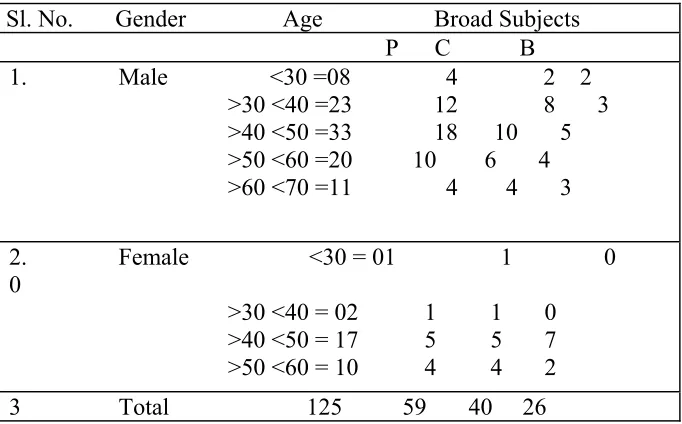
A total number of 300 questionnaires were administered of which 125 filled-in questionnaires were returned back by the scientists up to 1st November
Sl. No. Gender
Age
Broad Subjects
P C
B
1.
Male
<30 =08
4
2 2
>30 <40 =23
12
8 3
>40 <50 =33
18 10 5
>50 <60 =20 10 6 4
>60 <70 =11
4 4 3
2.
Female <30 = 01
1
0
0
>30 <40 = 02 1 1 0
>40 <50 = 17 5 5 7
>50 <60 = 10 4 4 2
3
Total
125 59 40 26
Table 1 Gender and subject wise distribution of respondents
From the analysis of Table 1, it is clear that out of 125 respondents 95 (76%) are male respondents and 30 (24%) are female respondents. Next, survey shows that 98 (~80%) scientists used OA only to access literature and remaining 27 (~20%) used OA both for publish and access. Out of 125 respondents 36 scientists (29%) expressed their willingness to publish in OA outlets for their next 10 publications and very few (only 7) expressed their desire to publish in OA outlets within the next 6 months.
70% (87 respondents) scientists agree that OA is a good idea and 18% (23 scientists) wrote that it is an idea they like and 11% (14 scientists) said that it is interesting to them and the remaining 1% i.e.1 scientist feel that it is problematic.
We get an idea from the survey about what scientists expect from OA. 15% scientists have found OA outlets useful to publish their work. 7% scientists think that using OA outlets enable them to publish their work more quickly. Very few think (4 scientists) that OA outlets will increase their productivity as an author. Nobody thinks that OA outlets will increase chances of getting promotion and incentive for them. Many scientists (64%) think that OA outlets may increase citations of their paper.
26 scientists (21%) believe that the interactions with OA publication systems are clear and understandable to them.
23 scientists (18%) think that it is easy for them to become skillful at publishing their work.
28 scientists (22%) said that it is easy for them to publish their work in OA outlets.
8 scientists (6%) (especially young) wrote that to publish their work is beyond their control, but they said they would think about OA outlets when they will get a chance
40 scientists (32%) expressed their views that publishing their papers in OA outlets is entirely dependent on themselves.
Scientists expressed their views on OA characteristics that are essential according to them. 70 (56%) scientists think that OA enables researchers in developing countries to access literature more easily. 56 (45%) scientists think that OA outlets help them to improve access to scientific knowledge. All agree that turnaround time will be shorter for their publication in OA outlets. 82 scientists (66%) believe that they have large potential readership if they publish their papers in OA outlets. Many (80%) scientists think that their papers will be readily available if they publish in OA outlets because it is free and without access restrictions. But nobody believes that publishing in OA outlets may increase to get more research funds.
On the issue of social aspects of OA characteristics, four scientists among 125 mentioned that other scientists influence them to publish their works in OA outlets. Only two scientists expressed that renowned scientist in his/her field told them to publish their works in OA outlets. Six scientists mentioned that their institution is favourable to them for publishing in OA outlets. About 70% scientists (88 scientists) comment that their funding agency did not support them on publishing in OA outlets. Many (65%) scientists said that leading researchers in their discipline do not publish in OA outlets, so they also do not consider it at present. Only few (about 5%) who are working in the field of Theoretical High Energy Physics and Biology are aware that their close colleagues publish in OA outlets and leading researchers in other discipline also publish in OA outlets.
Through questionnaire when scientists were approached to know availability of necessary facilities for publishing in OA outlets, about 45% scientists gave positive response and these scientists remarked that they have the knowledge in this regard. But around the same percentage believes that OA is not compatible with traditional publishing methods. Remaining 10% said that they need a specific person (or group) for assistance like Computer people, Library people with difficulties when using OA outlets to publish their works. Survey shows that about 20% scientists strongly agree for publishing their papers in OA.
About 35% scientists expressed their views that they will publish in OA outlets within the next 6 months and 50% scientists of the respondents would not like to publish within the next 6 months. The remaining (15%) scientists are not sure whether they will publish in OA outlets within the next 6 months or not.
Scientists those who are ready to publish in OA outlets gave their response regarding barriers to adopt OA. The issues are independent:
• 15% scientists see that they have to pay author fee
• 25% scientists remarked that they are still not familiar enough with OA publishing
• 60% scientists believe that OA outlets does not count for performance evaluation
• 38% scientists thinks that OA outlets have no or insufficient impact factor
• 20% scientists remark that long-term availability of OA publications is not guaranteed.
Regarding past 12 months publishing activity majority of scientists (76%) remarked that they published in the traditional print journals. Occasionally some scientists (2%) published in online journals (Not OA) and self website. But nobody published in OA journals or OA repositories. 40% of the respondents have published their papers in the Proceedings/conference transcripts. About 10% scientists regularly publish their articles in the Reviews and the remaining occasionally publishes in monographs.
Regarding target groups for their published works scientists gave their preference in the following manner:
• Researchers of their own discipline
• Research funding agencies
• Interested public
• The industry
Next we asked scientists how important are the following properties of scientific publications for them when choosing where to publish. They gave following feedback:
• 42% scientists said that it is very important for rapid dissemination of new findings
• 35% remarked that wide dissemination of scientific findings is very important
• In regard to reach broad readership 45% think that it is important for them
• 30% scientists think that it is very important for reaching a specific readership
• 32% scientists choose their journal by seeing the high profile editorial board
• 45% scientists remarked that impact factor of the journal is very important to them
• 78% scientists see the reputation of the journal; and
• 45% scientists gave opinion that guaranteed long-term availability of articles is very important.
When we asked scientists for comparing OA and traditional outlets, they expressed their views in the following way:
• OA is better for rapid dissemination of new findings according to almost 50% scientists
• OA is better for wide dissemination of new findings according to about 40% scientists
• About 30% scientists wrote that OA is better for reaching a broad readership
• 50% scientists view that OA and traditional publications almost equal for the dissemination of scientific findings to experts
• Almost all scientists said that they have no idea which journal have high profile editorial board
• Everybody agreed that the traditional publications have better impact factor than OA
• Almost all scientists agreed that the traditional publications have more reputation than OA
• For the long-term availability of articles scientists are almost equally divided between OA and traditional publishing model
Task Author (%)
Reader (%)
Publisher (%)
Library (%)
Editor (%)
Search Engine (%) To identify a new
content in the market
10 60 10 5 5 10
Selection:
extraction of high quality content
5 35 5 5 50
Aggregation 40 25 30 5
Transformation: formatting and indexing
5 70 15 10
Reproduction: printing or online
10 80 10
Preservation: long term archiving
20 80
Distribution: physical or online forwarding
5 35 40 20
Presentation: making available (online,
marketing)
5 70 20 5
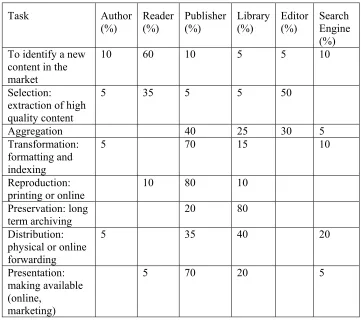
Table 2 Ranking of generic publishing tasks
Overall survey shows that despite the growing success of the OA movement, most of the scientists (at least in Kolkata) continue to feel that traditional publishing model is better. They are still influenced by the prestige of a traditional journal with high impact factor because of recruitment, promotion and award as all these come through publishing in traditional journals.
Scientists continue to feel that OA is not popular to them for the following reasons:
• The lack of awareness program from institute, funding agencies and from the government
• No recognition or incentive from institute or from the government for publication in OA outlets
• The lack of infrastructural facilities to self-archive publications in Institutional Repositories
• There is no single national organization with a clear policy and responsibility for supporting it.
If the above barriers are removed, then OA may be widely used by our scientific community as evident in our survey results.
5 Conclusions
Enamored of the 'glory' that comes along with publishing a paper in a 'prestigious' journal, scientists surrender copyright to their research, often funded by taxpayers' money, to commercial publishers who charge exorbitant subscription prices for their journals. There are visionary researchers who want OA desperately influencing governments in many countries to introduce strict legislation rules and other actions favoring OA. Many believe that the big publishers are not an enough lobby to stop OA when developing countries like India climb on the OA bandwagon. Slowly but surely, the environment is changing in an OA direction. The ranks of pro-open-access researchers are growing who will make independent self-interest-based decisions to play along. We are experiencing more and more public statements advocating OA. OA is far from the default today for scholarly communication. But OA proponents are working hard worldwide to build OA infrastructure. We may not reach in that utopian country with entire OA landscape but we may hope more and more people have unfettered access to much more scholarly information if country like India mandates OA for publicly-funded research nationwide. From our survey we strongly feel that mandate from government institutes and funding agencies is must to adopt OA by the scientific community in India. Also policy makers and institutions should encourage OA proponents by giving due recognition and full support. Institutes can initiate Institutional Repositories and encourage scientists to deposit their research articles (preprints or post-prints) in the repository. Three major publishers – the BMJ Publishing group, Cambridge University Press, and Wiley all introduced new open access options for authors publishing in their journals.
References
[1] Brody, T. & Harnad, S. (2004) Comparing the impact of open access (OA) vs. non-OA articles in the same journals D-Lib Magazine 10(6). [2] Cockerill M. & Tracz V. (2006). Open Access and the future of the scientific research article. The Journal of Neuroscience, October 4, 26(40), 10079-10081.
articles? Scientometrics.
http://arxiv.org/pdf/cs.DL/0603056
[4] Directory of Open Access Journals (2006). http://www.doaj.org [5] Eysenbach G. (2006) Citation advantage of open access articles.
PLoS Biol. 4(5) p. e157.
[6] Garfield, E. (1998). The use of journal impact factors and citation analysis in the evaluation of science. 41st Annual Meeting of the Council of Biology Editors, Salt Lake City, UT, May 4, 1998
[7] Ginsparg, J. (2006). As we may read. The Journal of Neuroscience, September 20, 26(38), 9606-9608.
[8] Hajjem, C., Harnad, S. & Gingras, Y. (2005). Ten-Year cross-disciplinary comparison of the growth of open access and how it increases research citation impact IEEE Data Engineering Bulletin
28(4) pp. 39-47.
[9] Harnad, S. (2005) OA impact advantage = EA + (AA) + (QB) + QA + (CA) + UA Open Access Archivangelism September 17, 2005 [10] Johnson, R.K. (2006). Will research sharing keep pace with the
Internet? The Journal of Neuroscience, September 13, 26(37), 9349-9351.
[11] Lawrence, S. (2001). Online or Invisible? Nature 411 (6837): 521. [12] MacCallum, C.J. & Parthasarathy H. (2006) Open access increases
citation rate. PLoS Biol 4(5): e176. Editorial about the Eysenbach study
[13] Open Access & Science Publishing (2006). International study on the acceptance and use of open access publishing. http://openaccess-study.com/en_project.html
[14] Shadbolt, N., Brody, T., Carr, L. and Harnad, S. (2006) The open research web: a preview of the optimal and the inevitable (in Jacobs, N., ed. Open Access: Key Strategic, Technical and Economic Aspects, chapter 21. Chandos)
[15] Sherpa RoMEO (2006). Publisher copyright policies & self- archiving. http://www.sherpa.ac.uk/romeo.php
[16] Suber, P (2006) The primacy of authors in achieving open access.
Nature 05 November
http://www.nature.com/nature/focus/accessdebate/24.html
[17] Willinsky, J. (2006). Why open access to research and scholarship?