A New Security Architecture for SIP Based P2P
Computer Networks
Huang Yongfeng, Professor, Tsinghua University, [email protected] Shanyu Tang, Dr & Senior Lecturer, London Metropolitan University,
Yau Jim Yip, Professor & Dean, University of Huddersfield, [email protected]
Abstract
performance study has verified the proposed distributed node authentication algorithm for SIP based P2P computer networks.
Introduction
Peer-to-Peer (P2P) is one of the important topics in the research of next generation networks. P2P brings significant changes to the Internet. P2P applications have gained increasing popularity over recent years, particularly for those using Session Initialisation Protocol (SIP). It is regarded as the core control protocol for the next generation network, and is evolving from its original C/S (Client/Server) mode to P2P mode (Rosenberg & Schulzrinne & Camarillo & Johnston & Peterson & Sparks & Handley & Schooler, 2002).
With the expansion of SIP based applications, the C/S mode appears to have drawbacks that are hard to overcome. To address these problems, the SIPPING working group of IETF has conducted a series of research on P2P distributed mode for SIP computer networks. Since 2005 the group has proposed several protocols; the latest two are “An Architecture for Peer-to-Peer Session Initiation Protocol” (IETF SIPPING, 2005) and “A P2P Approach to SIP Registration and Resource Location” (IETF SIPPING, 2005).
The latest two protocols proposed by the SIPPING group have two different P2P SIP architectures. The first protocol suggests a distributed SIP server to be deployed, i.e. the information about participants is distributed to every server in P2P mode. These servers communicate with each other using Distributed Hash Table (DHT) algorithms and all participants share and query resources in the same mode. The second draft takes advantage of a P2P structure, leading to the elimination of the SIP server with all the SIP nodes being associated in some way. The differences between the two P2P SIP architectures are that the former still retains some characteristics of C/S mode, but has a manageable advantage. The latter is a pure P2P structure as each node in the structure maintains its neighbour’s information and the scalability and management of the structure needs to be explored further. Although both protocols suggested their own P2P SIP architectures and application algorithms, the security problems of the architectures are still remained unsolved.
network. However, there are more security issues to be considered in the P2P distributed environment, not only existing security threats to the centralized C/S network, but also encountering new ones in the P2P networks where nodes join and leave dynamically. Due to the lack of a centralized management, the P2P networks need extra safety approaches to ensure itself to run smoothly (Milojicic & et al, 2002).
The security of the P2P SIP network involves many aspects. They are routing security, saving and accessing security, malicious destroy, intentional deception, user and peer authentication, encryption and decryption, application security and personal privacy. The major security problem of the P2P SIP network is peer trustworthy authentication when nodes join the network.
This work focuses on peer trustworthy authentication (namely node authentication). A peer authentication solution based on a one-way accumulator is suggested in this paper for P2P SIP computer networks. The authentication method is adapted to P2P mode, and can be used to ensure the authenticity of the identity of the SIP node that is added to the P2P SIP network, preventing forged ones from being added to the network. A cryptographic primitive called one-way accumulator is also presented. The corresponding node authentication algorithms are established based on the accumulator and a node authentication protocol according to the specific characteristics of the P2P SIP application. Finally, the performance of the proposed node authentication protocol is verified in our P2P SIP experiment platform.
Due to the essential differences between P2P mode and C/S mode, the authentication technologies suited to C/S mode cannot be directly applied to P2P computer networks (Nowell & Balakrishnan & Karger, 2002). Hence new authentication methods capable of adapting to the P2P networks are sought.
There is no explicit difference between peer authentication and user authentication for SIP networks in C/S mode. Both adopt the HTTPS DEGEST authentication method (Rosenberg & et al, 2002). In contrast, for SIP networks in P2P mode user authentication is different from node authentication. User authentication performs at the application layer, verifying the participating user’s identity in a special SIP application and ultimately confirming whether the user has right to access the resource. Node authentication is used to ensure the reliability and security of nodes and to testify the authenticity and validity of the participants. In terms of the objects being encrypted, the two authentication methods have some similarity. For example, both run in the same way that one part (or multiple parts) validates the identity of the other part (or other multiple parts). As existing methods can be directly adopted to solve the security problems associated with the user authentication for P2P SIP networks, this study is mainly focused on node authentication for the networks.
shortcomings of this centralized authentication method include complex management, un-scalability, and single node’s failure.
Node authentication based on the encryption technology has more virtues than the legal node identification technology mentioned above (Xiong & Liu, 2004). The digital signature using encryption is the major method of implementing node authentication. The basic idea is to validate the node’s identity through its digital certificate issued by the authorized organization. This can be achieved on the Internet. The node participating safe communication applies a digital certificate from the authorized organization, e.g. Certificate Authority (CA), which is responsible for issuing digital certificates. The credibility of the node can then be ensured by the authorized organization. In the communication process, the node provides its own certificate when its identity needs to be validated making its peer to know its identity.
The node authentication using digital certificates has derived from the centralized CA technology. It is convenient to inosculate with the existing information security technology. It can be used for small- or medium-scale P2P networks. However it is not appropriate for large-scale P2P computer networks (Camenish & Lysyanskaya, 2002). On the one hand, there should not be a central controlling node in the P2P networks. On the other hand, the centralized CA does not conform to the distributing character of the P2P networks.
Xiong & Liu, 2004). With the technology all nodes collaborate on issuing the user’s certificate with their own shares of the CA private key. The users applying for certificates receive only the fragments of the digital certificates issued by these nodes, and the whole certificates can then be obtained through computing (the computing is performed by the node itself or with the help of the third party). The distributed CA technology not only needs the correlative infrastructure of key management (e.g. key distributing and key deleting) but also involves the management of certificates such as certificate withdrawing, certificate renewing etc.
A new node authentication method is proposed based on a one-way accumulator for P2P SIP networks, leveraging the distributed nature of P2P to allow for distributed resource discovery and rendezvous in a SIP network, and eliminating (or at least reducing) the need for centralized servers.
Proposed Node Authentication Based on a One-way Accumulator
The main objective of this study is to propose a new mechanism for node authentication using a cryptographic primitive called one-way accumulator. This section is to detail how to construct the one-way accumulator and the basic ideas of the node authentication.
According to the correlative theory of cryptology, the one-way Hash function that meets the half-exchange law has the following characteristics (Bnaloh & Dde Mare, 1994):
o The one-way characteristic of the Hash function signifies that it is easy to compute in a certain way but it is very difficult to compute in other ways.
o Half-exchange law means, on condition seeds being given, the result of the accumulator keeps invariable when it is computed in different orders.
On the basis of the two characteristics, a one-way accumulator is suggested in this study to validate whether an appointed value belongs to the corresponding set of nodes, and a special authentication scheme is designed to meet the requirements of node authentication for P2P SIP computer networks. The basic principle is summarized below.
Firstly, each node in P2P SIP networks is assigned a number i and a uniquely
correlated private key yi. All nodes should submit their own values of (i, yi) to an
appointed authentication node, i.e. a bootstrap node in the P2P SIP networks.
Secondly, having received all nodes’ values of (i, yi), the appointed node, i.e. the
bootstrap node, takes use of the one-way accumulator to calculate the total accumulative value z for all the nodes and the corresponding partial accumulative
values of (i, zi) for each node. The appointed node then sends the partial accumulative
Thirdly, the node j is used to validate the identity of its peer, e.g. the node i that
intends to establish a connection with it. After the peer node i submitting its own
value of (yi, zi) to the node j, the node j then calculates the Hash value z’ = h(yi, zi) and
determines whether z’ equals the total accumulative value z. If z’ is equal to z, the
node i passes validation; otherwise, the node i fails authentication.
The characteristics of the one-way accumulator determine the security and credibility of node authentication, so constructing the one-way accumulator is the core step in the design of the authentication protocol. The one-way accumulator should not only ensure the simplicity of validation computing, but also guarantee there is no contradiction between the final results.
The unique identity of the node in P2P SIP networks described by the value (i, yi) is
the warrant of the node’s routing communication. So the most important aspect of the node authentication algorithm is to ensure the uniqueness of the legal node’s identity. This can be achieved by using the private key distribution method, which is discussed in details in another paper.
One-way Accumulator Based Node Authentication Algorithm
Constructing a one-way accumulator is the major task of designing the node authentication algorithm for P2P SIP networks. Equation (1) is proposed as a one-way accumulator based on an exponent. It has been proved to be the one-way function that has the characteristics of accumulators (Michael & Goodrich & Tamaassia & Hasic, 2002; Mukherjee, 2006).
y Y i n
n x
z n x
z y mod y1.y2...yi mod , i , 1,2,... (1)
where n is an integer.
To establish the node authentication algorithm based on equation (1), the following procedures are performed:
Step 1: a random integer generator RANDOM() generates an integer m;
Step 2: the function PRIME(m) capable of selecting a prime number is used to choose
a big enough prime number n from the set of [1 ,…, m] as follows:
) 1 ( * ) 1 ( ) ( , *
p q and n p q
n (2)
where (n) is the Euler number, p and q are prime numbers, and p != q.
Step 3: the accumulative value z is calculated by using equation (3).
y Y i n
x nn x
z
y
i y Y
i y
y
y1. 2... mod , , 1,2,... mod
Step 4: the partial accumulative value of the node j is calculated by using equation (4).
In fact, each node can compute its partial accumulative value zj after receiving the
accumulative value z.
n z n x j i m i Y y n x z n y y Y y i y y y j j y j i mod mod , ,... 2 , 1 , , mod ) ( mod } { ... . 1 2 1 (4)
Step 5: equation (5) is used for node authentication. If p equals 1, the node j is legal
and passes authentication; otherwise, node authentication fails.
z z mod n ?1:0
p yj
j
(5)
To reduce the expense of calculating the accumulative value z, equation (6) is then
suggested to compute the accumulative value z when a new node j is added to the P2P
SIP network.
n z
z yj
j mod
(6)
P2P SIP computer networks are dynamical and self-organized networks in which nodes can join and leave randomly. When a node is added or deleted, the boot node must update the corresponding information about all the nodes in the networks, such as re-calculating the accumulative value z and the partial accumulative values zi for
each node. So the node authentication protocol based on the one-way accumulator suggested above should include four stages, protocol initiation, node adding, node deleting and node authentication. The details are discussed in the next section.
Based on the one-way accumulator constructed by the method presented above, a node authentication protocol is then suggested in this section for P2P SIP computer networks.
Architecture of P2P SIP Computer Networks
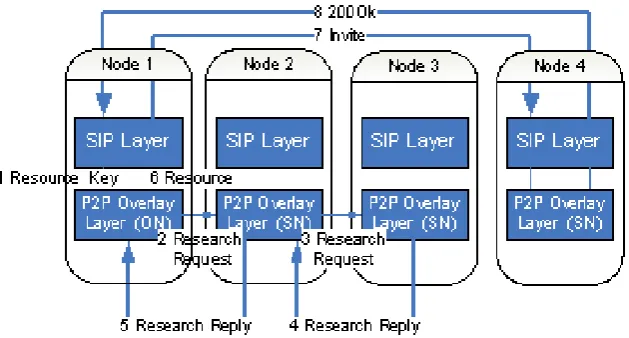
According to a draft, “A P2P Approach to SIP Registration and Resource Location” suggested by SIPPING (IETF SIPPING, 2005), a hierarchical P2P SIP architecture is proposed here, as shown in Figure 1.
Fig. 1: The architecture of a P2P SIP network
Tables (DHTs) that support efficient search mechanisms when resource names are precisely known. The proposed hierarchical architecture for P2P SIP computer networks has a number of advantages, including:
o It would reduce significantly the average number of hops in a lookup, particularly when nodes are heterogeneous.
o It would cut down the lookup latency when the peers in the same group are topologically close and cooperative caching is used within the group.
o It facilitates the large-scale deployment of the P2P lookup.
The key feature of the P2P SIP architecture (Fig. 1) compared with SIP in C/S mode is that it has no dedicated server or proxy (IETF SIPPING, 2005). The nodes participating in the overlay not only act as traditional SIP User Agents (UA), allowing their users to place and receive calls, but also play the roles of registrars and proxies in SIP networks when being viewed collectively with other peers. These roles include resource location, maintaining information, and call routing.
The semantics of standard SIP messaging is preserved to a great extent as possible in order to implement the node authentication protocol on P2P SIP networks. All the messages that maintain DHTs and are required to query information are implemented using SIP messaging. The SIP REGISTER messaging is extended here to look up resources. It includes maintaining DHTs, such as the messages that are joined or left the overlay network, and information transferred between nodes. So the extended REGISTER messaging has two functions, one is to accomplish node registration and validate newly joined nodes (see Figure 2 for the REGISTER message format in this situation); another function is to implement the resource registration before the session is invited, and the REGISTER messaging has no contact information, but resource IDs.
A new header parameter, Key, is introduced in the node REGISTER messaging as shown in Figure 2. It is used to inform the peer about its authentication number yi
Fig. 3: The signalling process of a P2P SIP network
Consequently, the REGISTER messaging has various functions at different states for P2P SIP networks, and the whole signalling process of the P2P SIP networks is shown in Figure 3. The first REGISTER message is used to accomplish node registration; similarly, the second and the third are also used for node registration. But the seventh and ninth REGISTER messages are used to perform user registration. Having completed user registration, a node sends an INVITE message, e.g. the 15th message, to initiate a session with its peer. Among these messages, the node registration message, REGISTER, has the information of node authentication.
Assign a modulus n
Compute two big primes q & p, n = p*q
Calculatesz, z= x0y1mod n
Compute the Euler number (n) = (p-1)(q-1)
Assign a seed x0, gcd(x0, (n)) = 1
Assign a node IDy1, y1Єz (private) Assign a modulus n
Compute two big primes q & p, n = p*q
Calculatesz, z= x0y1mod n
Compute the Euler number (n) = (p-1)(q-1)
Assign a seed x0, gcd(x0, (n)) = 1
Assign a node IDy1, y1Єz (private)
Details of the Node Authentication Protocol
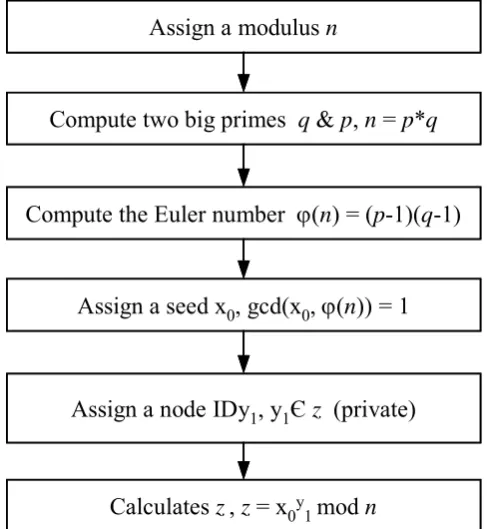
The node authentication protocol based on the proposed one-way accumulator in the preceding section can be divided into four stages, initialization stage, node adding stage, node deleting stage and node authentication stage.
Initialization stage
The initiation process of the protocol is shown in Figure 4. At this stage, some parameters such as (n), p, q and y1 are introduced, in order to accomplish the
parameter initialization of the authentication protocol.
Node adding stage
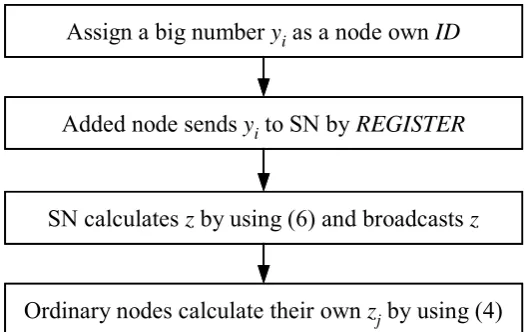
Figure 5 shows the process of the node adding stage. Provided that there are not many nodes in the P2 SIP computer network, for example, the total node number is less than 100, all nodes in the network are regards as one group. The bootstrap node in the network is responsible for calculating the total accumulative value z. Other nodes in
the P2P SIP network then calculate their own partial accumulative values (zi) after
Assign a big number yias a node own ID
Added node sends yito SN by REGISTER
SN calculates zby using (6) and broadcasts z
Ordinary nodes calculate their own zjby using (4) Assign a big number yias a node own ID
Added node sends yito SN by REGISTER
SN calculates zby using (6) and broadcasts z
Ordinary nodes calculate their own zjby using (4)
Fig. 5: The process of the node adding stage
Whereas, if there are more than 100 nodes in the P2P SIP network, the nodes in the network are divided into groups in order to improve the efficiency of node authentication. As a result, a super node (SN) is chosen for each group. The firstly added node of a group is acted as a temporary SN; with more nodes added to the group, the super node of the group is then selected according to the SN selection algorithm (Liu & Huang & Li, 2008). The computation of the accumulative value is accomplished by the super node, and ordinary nodes in the group calculate their own partial accumulative values after receiving the accumulative value broadcasted by the SN.
Node deleting stage
nodes in the network should be divided into multi-groups in order to decrease the load on the super node. This issue is discussed in detail in the following section. Otherwise, the bootstrap node or the SN will delete the ID of the new node from the node list, and update the z and zj values by using equations (3) and (4). The bootstrap node or
the SN is responsible for computing the new accumulative value and broadcasting it to ordinary nodes, which compute their own partial accumulative values once a node has been removed.
Node authentication stage
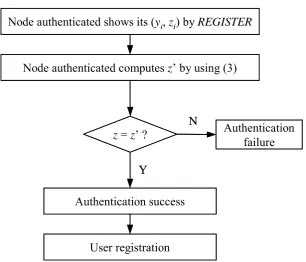
The process of node authentication is shown in Figure 6. If a node intends to establish a connection with its peer according to the best peer selection algorithm, it must pass the authentication by its peer first. Only if the authentication is successful, the node can then establish a connection with its peer by using the node REGISTER messaging as shown in Figure 2. Otherwise, the link cannot be established.
Node authenticated shows its (yi, zi) by REGISTER
Node authenticated computes z’ by using (3)
Authentication success
User registration
z= z’ ? Authentication failure N
Y
Node authenticated shows its (yi, zi) by REGISTER
Node authenticated computes z’ by using (3)
Authentication success
User registration
z= z’ ? Authentication failure N
Y
Fig. 6: The process of the node authentication stage
Evaluation of the Proposed Node Authentication Protocol
As the bootstrap node or the super node computes the accumulative value for all the nodes in P2P SIP networks, the performance of the node authentication protocol is dependent upon two factors. One is the hardware configuration of the bootstrap or the super node. The other is the complexity of the authentication protocol. It also depends largely on the complexity of the one-way accumulator on which the authentication protocol is based.
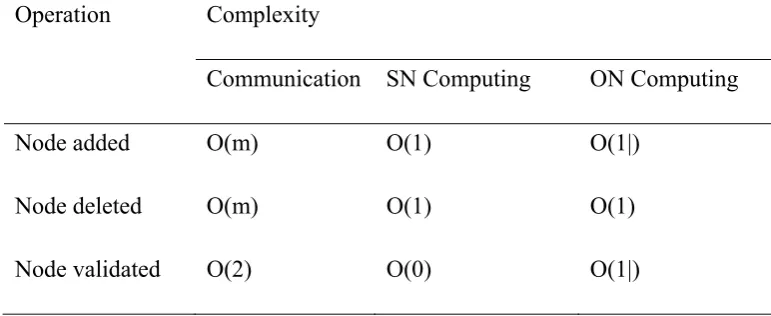
needs to exchange two messages for a node to be validated. The complexity of computation indicates the time of an exponent operation, e.g. O(1) denoting two executions of the exponent operation.
Table 1: Complexity of the node authentication protocol
Operation Complexity
Communication SN Computing ON Computing
Node added O(m) O(1) O(1|)
Node deleted O(m) O(1) O(1)
Node validated O(2) O(0) O(1|)
Fig. 7: A streaming media playing software on a P2P SIP network
To assess the performance of the node authentication protocol, some groups are organized in a way that they had different numbers of nodes ranging from 10 to 100 nodes. These nodes are configured with Intel duo core CPU, 1GB memory and windows XP. All applications support IPv6.
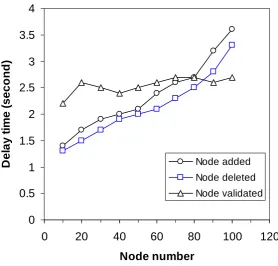
The results in Table 1 and Figure 8 show that the authentication algorithm is a validating symmetry, which means the computing and communication overhead of each node in the SIP P2P network are almost equal. Symmetry requires that node authentication is totally distributed and no node should bear more responsibility than others. The symmetry characteristic meets the distribution requirement of P2P networks. The delay times of validating a node demonstrate the authentication algorithm has an excellent symmetry. The delay times of adding a node and deleting a node have some slight varieties when the node number increases, which is due to the increasing overhead of communication while the overhead of computation is steady.
0 0.5 1 1.5 2 2.5 3 3.5 4
0 20 40 60 80 100 120
Node number D e lay t im e ( seco nd ) Node added Node deleted Node validated
Fig. 8: The delay time of the authentication algorithm
leave the network freely. So the node authentication algorithm needs to ensure the stability of the authentication overhead when the node number of the network varies frequently. The authentication overhead includes both the communication delay and the computing delay. As shown in Figure 8, the delay times of validating a node are almost constant despite the node number changes. In addition, the delay times of adding a node and deleting a node increase slightly when the node number increases from 10 to 100.
Conclusions
By analysing the differences between P2P (Peer-to-Peer) computing mode and traditional C/S (Client/Server) mode for SIP computer networks, the significance of node authentication in P2P over SIP computer networks has been emphasized by this study.
A mechanism for node authentication using a cryptographic primitive called one-way accumulator is proposed and presented in this paper to solve the node authentication for P2P SIP computer networks.
The further work of research is to design a better one-way accumulator, simplifying the procedures of node authentication for P2P SIP computer networks.
Acknowledgment
This work was supported in part by a grant from the National High Technology Research and Development Program of China (863 Program, No.2006AA01Z444), National Foundation Theory Research of China (973 Program, No.2007CB310806), and National Natural Science Foundation of China (No.60703053, No.60773140).
References
Bnaloh, J., & Dde Mare, M. (1994). One-way Accumulators: A decentralized alternative to digital signatures. In Advances in Cryptology Eutocrypt’93, Proceedings of the Workshop on the Theory and Applications of Cryptographic Techniques, LNCS
765. Springer-Verlag, Berlin.
Camenish, J., & Lysyanskaya, A. (2002). Dynamic accumulators and application to efficient revocation of anonymous credentials. In Crypto’02.
peer-to-peer overlays. In Proceedings of the Conference on Computer Communications (IEEE Infocom).
IETF SIPPING (March 17, 2005,). Architecture for Peer-to-Peer Session Initiation Protocol. Internet P2P SIP Draft [Online]. Available: http//www.P2PSIP.org.
IETF SIPPING (June 15, 2005). A P2P Approach to SIP Registration and Resource Location. Internet P2P SIP Draft [Online]. Available: http//www.P2PSIP.org.
Lennox, J., & Schulzrinne, H. (2003). A protocol for reliable decentralized conferencing. In ACMNOSSDAV 2003.
Liu, H., Huang, Y.F., & Li, X. (2008). Research on Grouping strategy of SIP-based Streaming media P2P Live Broadcast Network. Journal of Electronics and Information. Accepted for publication.
Maricn, N., & Piftzmann, B. (1997). Collision-Free Accumulators and Fail-Stop Signature Schemes Without Trees. In Eurocrypt’97.
Michael, T., Goodrich, R., Tamaassia, & Hasic, J. (2002). An efficient dynamic and distributed cryptographic accumulator. Lecture Notes In Computer Science. In Proc. 5th International Conference on Information Security. Springer-Verlag, Berlin.
Department, HP Labs Research Library, Tech. Rep. HPL-2002-57 20020315. Avail-able: http://www.hpl.hp.com /techreports/ 2002/HPL-2002-57.html.
Mukherjee, D. (2006, November 27). Format-independent authentication of arbitrary scalable bit-streams using one-way accumulators. Hewlett Packard Laboratories, Palo Alto, CA, USA [Online]. Available: http://www.hpl.hp.com/techreports/2006/HPL-2006-173.pdf.
Nowell, D.L., Balakrishnan, H., & Karger, D. (2002). Analysis of the evolution of peer-to-peer systems. In ACM Conf. on Principles of Distributed Computing (PODC),
Monterey, CA, USA.
Rosenberg, J., Schulzrinne, H., Camarillo G., Johnston, A. R., Peterson, J., Sparks, R., Handley, M., & Schooler, E. (2002). SIP: Session Initiation Protocol, RFC 3261. Internet Engineering Task Force, June.
Singh, K., & Schulzrinne, H. (2004). Failover and Load Sharing in SIP Telephony. Computer Science Department, Columbia University, New York, USA, Tech. Rep. CUCS-011-04.