The Need for an Informational Systems Approach to
Security
José María Díaz Nafría
Department of Psychology, Sociology and Philosophy; Universidad de León, 24071 León, Spain. E-mail: [email protected]
Abstract: Different senses of security and its related assumptions, methodologies and contexts are analyzed by first reviewing the liberalistic notions of security and trust, unveiling, on the one hand, the contradictions exhibited between discourse and practice; on the other hand, the historical strategy of concentration of power behind the liberalistic doctrines. The weaknesses, limits and implications of the liberalistic notions and methods on security and trust are inquired, and subsequently a genuine horizon of security as sustainable and general procurement of positive freedom is advocated. The CyberSyn project successfully implemented in Chile, but tragically and prematurely ending under the hard power in the 9/11 of 1973, serves as model of the posed system approach to security. However, the system model is actualized and completed with elements of the general theory of information in virtue of: the increased complexity of societal systems, its ultimate global dimension, its biospherical closure, the increase of information assets and processes, and some epistemological boundaries. These reasons also set the need of keeping –beside the system approach– a critical and ethical stance.
Keywords: security, trust, systems theory, information theory, General Theory of Information, political economy, political philosophy, liberalism, political history, surveillance, control theory, critical theory, information society
Acknowledgement: The author wishes to express his profound gratitude to Peter Fleissner, Rafael Capurro, Mercedes Osorio, and Anthony Hoffmann for their kind and careful reviewing of the manuscript, their valuable comments, suggested improvements, and the stimulating discussion on ethical, political and economic topics. The author is also in debt to Rainer Zimmermann for his invitation to the Munich University of Applied Sciences which offered a fertile soil for the germination of the ideas developed herewith.
Before undertaking our inquiry into security, let us recall the famous fear that arose in the XVIII century concerning the stability of the solar system. Regarding some of Newton’s ideas on the dynamics of planetary bodies including his belief on a periodic divine intervention (Newton 1729), and the surprising success of his mechanics in the prediction of so many terrestrial and celestial phenomena, the fear about the possible collapse of the solar system started to propagate, nourishing the secular apocalyptic picture. With the perspective of the possibility of non preservation of the earth, it was hard to feel secure in everyday life, so the question about the stability of the Solar System became a scientific problem of societal relevance. Fortunately, this question was tackled by one of the most outstanding thinkers of the time, Laplace, who succeeded in proving the so desired stability of the system in spite of the multiple body interaction problem, which could not be handled by Newton’s method (Laplace 1990, Whitrow 2001). Solving this problem, Laplace developed an excellent mathematical tool, used till our days in the analysis of the stability of a system. Later on Poincaré (1905-1910) probed the inaccuracy of Laplace’s approach, but the approximation was, in any case, reasonable enough to bring quietness into everyday life (Poincaré 2003).
world –therefore their lives – did not exist. System preservation is something objective – if we are able to grant an outer observation –, but the feeling about the confidence or certainty in the stability of environmental conditions is subjective. Concerning this second acceptance, Maslow (1943) considered in the second level of his well-known hierarchy of needs security as the second level, right above the most elementary physiological needs as breathing, eating, etc. Thus, both continuity (preservation) and certainty (foresight) are the main notes of the common uses of security.
Being these notes so fundamental to any life, it is clear that no fear can arise against knowing about the security of the solar system. However, there are good reasons for some subjects to be suspicious of measures when they correspond to the certainty about the continuity of the problems, which are hindering the own subject´s security. This can happen because the stable state entails some unfairness or because we are talking about some heteronomous security.
In our inquiry into security we will deal with these questions, adopting a critical stance towards the uses of security and trust in liberalism, and adopting an information-systems approach aware of the hyper-complexity of social systems, as well as some fundamental epistemic boundaries.
1.
Security and Trust in Historical Perspective: Between Liberalistic Groundings and
Discourses
In the last decade, an increasing stress on security concerns has spread at different levels of social life. But contradictorily, it has been coincident with a major recession of social security systems, and the consolidation of the Information Society, idealized as a transparent and borderless global community. Despite the policy and discourse changes after September 11th, these contradictory moments could also be ascribed to the inherent contradiction of the liberalistic discourse versus its interventionism and protectionism at critical stages. Perhaps to veil this contradiction or just to make it more pleasant to certain audiences, the liberal discourse seems to prefer “trust” at the stakeholder level, while “security” is rather used at the level of policy making. We might indeed see trust and security as two faces of a same coin, which is reversed depending on the audience and depending on the severity of the concerned problems. Furthermore, we can ask whether this current emphasis on security – stressed from September 11th and relatively absent in the previous decade (Mattelart 2003, chapter 6) – cannot be considered as a phase of a pendulum present in the history of liberalism along the centuries, in which the role of public institutions as guaranties of security and order is differently weighted depending on the feeling of dangers (Rivero 1998).
1.1. Historical Notes on the Liberalistic Use of Security and Trust
A key to understanding the forces moving this pendulum is provided by the 19th-century German economist Friedrich List:
“It is a very common clever device that when anyone has attained the summit of greatness, he kicks away the ladder by which he has climbed up, to deprive others of the means of climbing up after him […]
Any nation which by means of protective duties and restrictions on navigation has raised her manufacturing power and her navigation to such a degree of development that no other nation can sustain free competition with her, can do nothing wiser than to throw away these ladders of her greatness, to preach to other nations the benefits of free trade” (List, 1885, pp. 295-296)
1.1.1. Liberalistic Pureness and Digressions
Robert Walpole – Britain's first prime minister – and the repeal of the Corn Law in 1846.1 This abolition (often interpreted as the definitive victory of liberal economic doctrine) caused the “great famine” that struck Ireland from 1846 to 1849 maintained by the “political courage”2 of the liberalistic doctrinaires that imposed the principle of no intervention and brought about the death of 1,5 million people (Warde 2007). However, this non-interventionist courage was circumvented during this liberalist phase, for instance, in the case of the opium wars in which – by means of the “unequal treaties” of Nanking (1842) and Tianjin (1858) – the weak Qing’s China made significant trade and territorial concessions, including the mandatory legalization of the opium trade which led to addiction to millions of Chinese people (Stiglitz 2002, Golub 2006, Roux 2004). These measures also had the consequence of deindustrializing China, sinking its manufactures (particularly the iron and steel production) until the XX century, though they were globally dominant until the XIX century.
Moreover, if we regard the mixtures of reasons and lies used to justify the intervention starting the Second Opium War, and the subsequent looting of the Summer Palace by the Anglo-French troops, we can find despite obvious differences also relevant similarities with the 2003 Iraq war: (1) the use of false arguments aimed at legally disguising the intervention, which were publicly falsified (Cobden 1857); (2) it came to complete the previous opium/Iraq war, making stable the related concessions; (3) it brought about a de facto colonialism de facto though with a limited achievement of political and social control – except to foreign trade concerns; (4) it hindered the wealth and long term development of the country on a long-term basis; (5) the losses of historical and artistic assets had a symbolic value of defeat (Hugo 1985); (6) a number of separatist, ethnic and religious rebellions – favored by the weakened inner government – brought about high human and economical costs (Gernet 1996; Ramonet 2004; Lafourcade 2007).
Nevertheless, whereas the British interventionism did not represent a significant change in its foreign and domestic policy, the second Iraq war exemplified the clear superseding of the soft power paradigm promoted in the 1990s by a hard power imposed since September 11th (Mattelart 2003, chapter 6): if the commotion of the 9/11 facilitated the deployment of the hard power for the benefit of the civil society, the Iraq war represented the turning away from the faction ofcivil society that globally opposed the war (PewGlobal 2003). But besides the relative decline of this hard power after the mired military supremacy in Iraq and Afghanistan and the 2008 stock market crash – imposing a moderation, at least at the discourse, in the military projects –, what is the essential difference between these hard and soft power? Does the latter comply with liberalism, while the former enters in contradiction with this doctrine?
1.1.2. Soft vs. Hard Power: Between Lyric and Obsession
Every one in the world knows that the soft overcomes the hard, and the weak the strong, but no one is able to carry it out in practice. (Lao-Tse, 1995, §78.1)
It is true that, on the one hand, the soft power – coined and advocated by Joseph Nye (2004) – was aligned with the “Global Information Dominance” as a goal pursued by several non-coercive actions of the United States to procure an advantageous position in the realm of free, commercial- and strategic- information3; while, on the other hand, the hard power has been aligned with the attempt at domination based upon a blend of force, economic and financial mechanisms focused on enemies, production and consumption (Mattelart 2003). In consequence, the soft power harmonizes – in the sense of not involving coercion and the appearance of enabling free-willing – with the projects of the global information society and its related democratic ideals of an
1 In the case of the United States, it is not until the time after the Second Word War when it converts to the free trade –
though not as much as Great Britain in the middle of the XIX Century (Chang 2003).
2 including Prime Minister Robert Peel’s “moral greatness” highlighted by Queen Victoria (cited by Warde 2007, p. 19). 3 Among these actions, it is worth mentioning: the usage of the Echelon network for economical espionage; the creation
mediated, borderless and self-regulated world, whereas the hard power better harmonizes with the disciplinary and panopticon archetype.4
But it is no less true that the purpose of gaining advantage and achieving domination remains in both cases, and that the usage of coercion was compatible in principle and practice with the soft power: In principle, because the preference of co-option to coercion – as it has been stated (Nye 2004) – is utilitarian, and therefore subject to the results; in practice, because during the time in which the soft power was allegedly preferred by US foreign policy, significant military actions also took place: Iraq 1993, Somalia 1993, Haiti 1994-1995, Bosnia 1995, Iraq 1998, Sudan 1998, Afghanistan 1998, Serbia 1999, East Timor 1999-2001, etc.5 Furthermore, though there are obvious differences in the degrees of coercion exhibited during the decades of 1990 and 2000, the surveillance initiatives involved in the “Global Information Dominance” in the 1990s was a de facto deployment of the panopticon assisted by the new digital technologies (see note 3; Bentham 1995, pp. 29-95).
In order to understand better the relation between these two kinds of power – apparently antagonistic –, it is enlightening the comparison stated by Michel Foucault between Bentham’s Panopticon and Rousseau’s topics of transparency:
“Bentham was the complement to Rousseau. What in fact was the Rousseauist dream that motivated many of the revolutionaries? It was the dream of a transparent society, visible and legible in each of its parts, the dream of there no longer existing any zones of darkness [...] It was the dream that each individual, whatever portion he occupied, might be able to see the whole society " (Foucault 1980: 152).
Following this comparison, a familiar resemblance can be found: on the one hand, among the expectancies of those who participated in the astonishing communication endeavors in the time of the French revolution (in the 1780s and early 1790s) and the techno-utopias of Piotr Kropotkin (1842-1921), Marshall MacLuhan (1911-1980), Alvin Toffler (1928-) and Nicholas Negroponte (1943-) – to name but a few – (Vázquez 1997, Mattelart 2003); on the other hand, among all those who – being aware of the “zones of darkness” – considered the necessity of shedding new lights into those zones to ensure the advance of the new order, like Bentham. This was the case – with different tendencies– of Edmund Burke (1729-1797), Benjamin Constant (1767-1830) or François Guizot (1787-1874) (Abellán 1998, Rivero 1998). The complementarity of both poles is rooted in the avoidance of harm – or in other words security. To this respect, Bentham:
“effects the project of a universal visibility which exists to serve a rigorous, meticulous power. Thus Bentham’s obsession, the technical idea of the exercise of an ‘all-seeing’ power, is grafted on to the great Rousseauist theme which is in some sense the lyrical note of the Revolution… When the Revolution poses the question of a new justice, what does it envisage as its principle? Opinion. The new aspect of the problem of justice, for the Revolution, was not so much to punish wrongdoers as to prevent even the possibility of wrongdoing, by immersing people in a field of total visibility where the opinion, observation and discourse of others would restrain them from harmful acts” (Foucault 1980, p.153)
In Gabriel Tarde (1843-1904) we find a blend of both positions: the clarity is shed to the public (molding its opinion, thus becoming “public opinion”), whereas such clarity cannot get into the crowds, in which the crime can be organized (Tarde 1986). Thus, Tarde’s approach provides a
4 It is pertinent to mention here those actions that – though continuing the path of those listed before in note 3– represent
a change in the degree of intervention: the electronic surveillance measures to citizens under the US Patriot Act; the creation of the Homeland Security Department in 2002 or the Total Information Awareness project launched in the same year and aimed at collecting about 40 pages of information of every person on the planet (Mattelart 2003, Ramonet 2003).
5 Considering the military expenses it is worth mentioning that although the summit reached in Reagan’s administration
criterion to distinguish where to direct the soft and the hard power;6 and also provides guidance for social control:
“All the improvements of social organization… have the consequence of enabling that one meditated, coherent, individual project arrives purer, lesser polluted, deeper, and through the safer and shorter means into the minds of all the associated” (Tarde 1986, p. 149)
According to the XIXth century utopia of journalism, opinion (for instance, Tarde’s opinion) “is fair by nature, it disseminates by itself, and it is a sort of democratic surveillance” (Foucault 1980). The naivety of the soft power can be regarded as linked to this utopia, but the reality and eventual complexity of the “co-option” advocated by Nye (2004) is free of the ideal of justice, it is aware of the costs of dissemination, and it serves to the dominant.7 On the other hand, if we explore the historical use of the soft power in US policy between the Second World War and the neo-liberalist reaction in the 1980s, we find it as a complement of military actions – Korea, Guatemala, Vietnam, Dominican Republic (Chomsky 1994) – and economical measures – Breton Woods Institutions, General Agreement on Tariffs and Trade, Organisation for Economic Co-operation and Development, World Economic Forum (Pironet 2007, Díaz-Salazar 2002).
This historical combination of soft and hard measures actually counteracted the raise of a multipolar world coming out the decolonization of Africa and Asia, which claims organized around the multilateral bodies within the United Nations, the Bandung Conference in 1955, the Tricontinental Conference in 1966, and the Non-Aligned Movement (founded in 1961). This intergovernmental organization condemned the economic measures employed to warranty the economic dominancy, and subsequently promoted in 1974 a New International Economic Order (NIEO) to facilitate global fairness. In the realm of the soft power, the Non-Aligned Movement denounced that under the US advocacy of the “Free Flow of Information” doctrine in several international institutions there was an actual promotion of the US telecommunication and cultural industry by the US administration serving to the prevalence of North American culture and communication. Therefore, in parallel to the NIEO also a New World Information and Communication Order (NWICO) was promoted from 1974.
In 1977, the UNESCO convened the MacBride Commission to state the basis of such claimed order. However, the condemns from these stages concerning the imbalance in the communication and cultural domains were received by the US as a partisan defense to the Third World by UNESCO. The extreme reaction was the withdrawal of the US from the UNESCO in 1984 – followed by Great Britain and Singapore in the year after – (Miguel de Bustos 1994). Again, it can be easily interpreted – using List’s metaphor – as kicking away the ladder by which they have been climbing up: In this same year a strong liberalization of the communication and cultural industry started in the US and disseminated worldwide (Schiller 2003).
1.1.3. A New Criterion to Distinguish Historical Stances on Security
By looking back on this historical development of the soft power, we intended to show that only at the level of discourse can it be aligned with enlightenment ideals of transparency, clearness and fairness. Therefore a new distinction has to be introduced in order to understand the specificity of the aforementioned sociopolitical positions.
But before posing this new distinction, it is still worth pointing out that the soft power was interpreted by some cyber-utopians as an opportunity for the fulfillment of their ideals, and, furthermore, the soft power was presented as a horizon of superseding the hard one in a global
6 As pointed out by Latour (2005) and Kullenberg and Palmås (2008) Tarde’s sociology and particularly his laws of
imitation constitute a clear antecedent of the surveillance techniques focused on societies and groups rather than on individuals. These techniques are referred as “panspectric” – centered in patterns and social behaviors – in contrast to the concept of “panopticon”. Although this kind of surveillance allegedly represents a means to make it compatible with personal privacy, either alone or specially as a combination of both kinds of surveillance, it could increase the danger of social sorting, whose societal consequences might be dramatic as it has been discussed by David Lyon (2002, Zureik et al. 2010).
society – similar to how publicity would work in Tarde’s vision when the crowds and criminal organizations would disappear (Nye 2004, Tarde 1986). As previously pointed out, the utilitarian grounding of soft power implies a complementarity with the hard power based in effectiveness, and the awareness that the clarity cannot reach everywhere.8 From this point of view, the complementarity between these kind of powers is similar to the one highlighted by Foucault between Rousseau and Bentham.
Thus Rousseau’s side is in a sense aligned with the soft power, publicity, transparency, trust and the “control society” depicted by Gilles Deleuze (1990), whereas Bentham’s side is aligned with the hard power, coercion, surveillance, distrust and the “disciplinary society”. Both sides are concerned with security with respect to the eventual harms in the development of the liberties. Whether one pole or the other dominates explains the pendular movement referred to at the beginning of section 1.
Regarding the liberalistic groundings, though the former side is preferred at the level of discourse – it corresponds to its lyric –, the general claim for security is at the very foundations of the liberal state as conceived by its early thinkers. For instance, according to Locke: “the enjoyment of the property [in the state of nature] is very unsafe, very unsecure” (Locke 1690: §123), and to avoid this harm, the political society “was first instituted” to the procurement of “safety and security” (§94). In Bentham, it is security that is the all-important condition of human happiness, and it has to be warranted by government as its very first goal (Bentham 1891).
Since security is conceived as the basic pre-condition for the liberal state (i.e. it settles the frame in which freedom can develop, when moving within this frame) the liberal discourse disregards “security” in favor of “trust” and “trustworthiness”. The frame imposes an inside and an outside. However, when the frame is in question, the security concerns jump to the forefront.9
“Who is at either side of the security frame?” is the open question of exclusion. “What harms are going to be avoided?” questions the reach of security procurement, and its role in the attainment of social fairness. The non-definition of what harms should be avoided and who should be included within the frame of trust, i.e. what is the extent of the security attainment, explains the broad spectrum of liberalist positions from Burke or Constant to Bentham or Stuart Mill; from Hayek to Keynes (Mellón 1998): on the one hand, the security of the property for a leading minority; on the other hand, a regard closer to the Marlow’s aforementioned vision of security and the achievement of fairness.
This observation brings a new criterion for reconsidering the previous bipolar distinction (and complementarity) established between Rousseau and Bentham as aligned with the soft vs. hard power complementarity. Considering Rousseau’s concerns for security and justice (for instance, “the first rules of justice: for to secure every man his own, every man must have something” (Rousseau 2007: 71)): justice, security and equality belong to a same plane, therefore aligning his position with the soft power is unmerited, since the basis for the latter is domination. And it is also unmerited aligning Bentham’s position with the hard power since the latter disharmonizes with Bentham’s well known criteria of “the greatest happiness of the greatest number” as the “measure of the right and wrong” (Bentham 1891, p. 93) and the fundamental duties he ascribes to government (besides security): subsistence, increase of wealth, and equality (Abellan 1998, p. 23).
If the distinction between the soft and the hard power reflects a shift concerning authoritarianism – from free-willing to coercion –, equality serves now as the criterion to distinguish between the
8 To this respect it is remarkable that a claim to rebuild a US soft power in 2008 was based upon the evidence of the
worldwide adverse opinion dramatically growing during the years of hard power prevalence (PewGlobal 2008). Moreover, though during the years in which the soft power has been partially restored, the US expenses devoted to the hard power have not turned back (Johnson 2010).
9 The relation among trust, security and the frame erected by government is exposed by Locke: “those, who like one
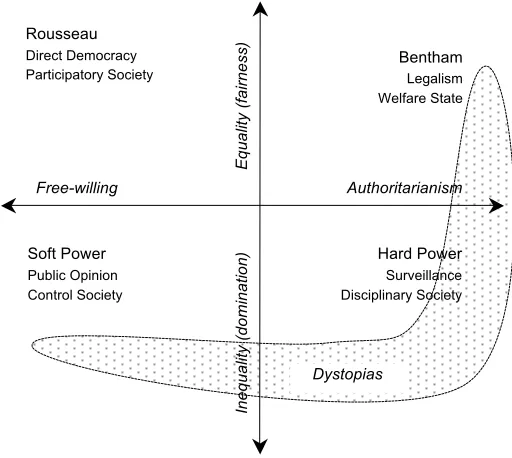
position of either the soft or hard power with respect to those held by either Rousseau or Bentham –from inequality to fairness. Fig. 1 schematically deploys these distinctions.
Most utopias – and particularly the techno-utopias a la Kropotkin (MacLuhan, Etzioni, Toffler, Barlow, etc (Mattelart 2003)) – are located at the periphery of Rousseau’s quadrant of fig.1, whereas the dystopias like those proposed by Orwell (1949), Huxley (1932) or Bradbury (1953) locate at the periphery of the other quadrants. Considering the aforementioned liberalist positions, we move downwards when passing from Bentham, Mill or Keynes’ to those of the so-called conservative liberalism.
Figure 1: Representation of the political positions discussed in the liberalistic visions of security
The equality issues – as touched by Rousseau’s former quotation – give rise to pure economic questions, specifically those related to redistribution, in which dominancy mechanism and the aspiration of equality are directly concerned. As Marx posed (for instance, in the Grundrisse, his Critique of Political Economy or the Capital) it is the development of the productive forces within the frame of the existing productive relations – reflected and legitimized in the property relations – that leads to the contradictions between the productive-forces and relations (Marx 1859). This process – especially under the capitalist economy in which the productive forces are impelled towards a “free, unobstructed, progressive and universal development” (Marx 1973, p. 540) – brings about a repetitive obsolescence of the productive relations and the subsequent necessity to re-express the productive relations in the existing political frame (Elster 1983, pp. 209-236).
This inherent contradiction is in particular reflected in the capitalist democracies where the productive forces evolve within capitalist economy, while the productive relations and the corresponding property legitimacy evolve in the liberal democracy. As argued by Bowles (2007), this opposition of forces (corresponding to a logical contradiction between pure democracy and capitalism, namely equality versus inequality, or participation versus dominancy) requires a recurrent agreement obtained under pressure which terms are updated in a constant struggle.
1.1.4. Globalization and Information Society
Until the decade of 1970s the equilibrium between democracy and dominancy was chiefly actualized in the liberal democracies, where the general rights o factual participation and production were respectively waived by means of the extension of salary and suffrage (Bowles
Rousseau
Direct Democracy Participatory Society
Hard Power
Surveillance Disciplinary Society
Soft Power
Public Opinion Control Society
Authoritarianism Free-willing
Eq
u
a
lit
y
(f
a
ir
n
e
ss
)
In
e
q
u
a
lity
(
d
o
m
in
a
tio
n
)
Bentham
Legalism Welfare State
2007). However, especially after the 1990s the relative equilibrium of the decades before 1980 was undermined (weakening the democracy pole) due to several factors:
• The deflation of the labour productive force because of the introduction of automatic
technologies – as Wiener, among many others, tried to prevent (Noble 1993, Al Hadithi & Díaz 2010a)-;
• The introduction of the Information Technologies linked to completely new productive relations,
which can easily evolve at the global scale with independence of the national boundaries – though they still need the States in order to legitimate and secure the corresponding productive relations.10
• Advocacy of capitalist interests by unobstructed international institutions after the dissolution of
the opposition led by the Soviet Union – e.g. OECD, International Monetary Fund, World Bank, World Trade Organization (Stiglitz 2002);
• The global liberalization of labour as a part of the liberalization of the world economy
significantly assisted by: the information technologies, the automation of the productive processes and the growing power of transnational corporations.
Whereas in the previous situation the re-expression of the productive relations was chiefly negotiated within the liberal democracies, at the current stage of development of the productive forces, the Global Institutions represent a new means –besides the productive forces itself- to press the terms of the agreement with the sovereign states, which still legitimate the productive relations.
It is here worth pointing out here that the previously referred-to protection of the Information and Communication Technologies between World War II and the 1980s erected a significant oligopoly concentrating not only economic power but also political power, since the related media industry has the possibility to drive significantly the public opinion – as it was condemned by the Non-Aligned Movement. This fact offers a different conception of the ladder that was thrown away in the liberalization of the Information and Communication Technologies to which we previously referred: it was not only a sovereign state which climbed up through the ladder; instead an international stage was erected driven by transnational corporations through which the role of the sovereign states and the liberal democracies could be undermined.11
Thus, the pressure, previously exerted by productive forces within the frame of the sovereign states in order to actualize the productive relations, found a second mechanism to improve its efficiency at the pole of the capitalist interests: the pressure could now be driven through international institutions forcing the actualization of the national legislations, using mechanism as, for example: the structural adjustments by international financial institutions, the Agreements within the World Trade Organization, the restrictions imposed on the States via regional institutions such as the European Central Bank, the North American Free Trade Agreement, etc.
Within this context, the recent affair of WikiLeaks is interesting as it reveals security concerns with respect to digital technologies and social networks. The open debate has centered on the security challenges presented by digital social media, and even some measures have been taken to avoid eventual harms – though no relevant security incident derived from the published
10 As argued by Peter Fleissner (2009), the commodification of goods previously belonging to the sphere of culture by
means of the Information Technologies requires updating the concepts of the Marxist economic theory allowing us to grasp such process and how the productive relations actualize. A proper understanding would even open the possibility to commodify those goods that left on the hands of markets could have dramatic consequences. At this eventual de-commodification path, Dan Schiller (2009) stresses the double face of the new modes of dominancy created by the digital capitalism: bringing about inequality but also new possibilities of reconstruction and resistance.
11 To this respect, Herbert Schiller argued that the changes in the international geopolitical arena – occurred at the end of
information is known. As Christensen (2010) argues, this debate usually presupposes what he considers as 3 myths – that can be ascribed to the aforementioned current of the techno-utopians: 1) social media represents an emerging power; 2) the sovereign state is undermined by the forces of the digital age; 3) the obsolescence of the traditional public opinion media. However, as the author shows, it was not only the publication by social media, but especially through conventional media (particularly The Guardian, The New York Times, Der Spiegel) that gave rise to the actual impacts of the published information – thus (1) and (3) are ill-founded. On the other hand, it was not a political rootless social media that allegedly threatened the National Security, on the contrary it was the Swedish, Belgian and Icelandic legislation, which support the legitimacy of WikiLeaks – thus also (2) was ill-founded.
What this case actually shows is on the one hand, the effective power of the conventional public opinion; on the other hand, the importance of sovereign states as the Institutions in which the social and productive relations are legitimized, and furthermore, a small but possible subverting of the control effected by the dominant stakeholders. If it were a risk for the relations of dominancy, it might represent a security issue of the liberal state – according to its groundings.
1.2. Methodological Approaches and the Liberalistic Model of Trust
The shift between the security and the trustworthiness, mentioned at the beginning of section 1, also reflects a methodological change between a systems- and an individualistic approach respectively, being the latter more consistent with liberalistic doctrines, and therefore exhibiting a higher coherency at the liberal discourse level. On the other hand, the systems approach on security is given by the fact that security is considered at the level of the social-, political-, economical- or technological systems (particularly, information and communication systems when referring to security in the information society).
The dominant account of trustworthiness –as it can be found for instance in the RISEPTIS report (2009), aimed at steering the European administrative and industrial policy in trust and security concerns, is usually reduced to an individualistic model in which only three parts enter the scene: A trusts in B to do X. It is easy to find here a commercial continuity: if A trusts in B, then A will pay to B the costs of doing X. The awareness model is based on the reliability of doing X. Having 100% effectiveness is not needed, since trust tends to be bipolar; just a relative high reliability is required. Therefore, the achievement of trustworthiness can stress in the good achievements of doing X and forgetting about the rest. The road is open to a fully commodification of doing X, and even of achieving trustworthiness, which might be envisaged as a supplement given to X; namely, some kind of brand needed to success in the market.
This is not the only way to consider trust, but this is how it is nowadays predominantly addressed (Luhman 1979, McKnight and Chervany 1996, RISEPTIS 2009). In any case, one of the basic aspects of trust, as stated by Luhmann, regards the reduction of complexity, namely if we trust on another agent we can forget whatsoever is involved in “doing X”. Pitifully among all what is being forgotten in this account of trustworthiness, we can find today: the many divides within our societies, between countries, cultures, genders (Ruedin and Hanimann 2007, Capurro and Díaz 2010); electronic-waste, and non-regenerability of resources (Feilhauer and Zehle 2009), etc.
Especially depending on the position taken in the plane represented in fig. 1, the account of security (and trust as its counterpart) concerns a different realm of what harms are being excluded. Subsequently, the included trust relations are correspondingly different. For instance, if fairness is pursued, then social relations, which cannot be reduced to the previous model of individualistic interplay, come to the forefront.
However, if we delve into the social issues appraised in the effort towards a trustful information society, we mostly find awareness just on the information divide12. But the concern of this cleft is
12 This was, for instance, the only specific social issue (i.e. excluding for instance privacy concerns) included in the
restricted to two main aspects: (1) how to connect everyone – accessibility –, and (2) how to enlighten people about information means – literacy – (Mastromatteo 2010); while the questions of: (1’) whether information and communication systems are really accounting for social needs, and (2’) to what extend they are doing it, are not seriously tackled. These last questions – undoubtedly of higher importance since they are a prerequisite for the former ones – are aligned with the stance taken in social security systems in which a systems approach is taken, but are relatively alien to an individualistic / liberal approach for which the “invisible hand” solves such kind of questions (Smith 1759).
Beyond what is concerned in the security and trust endeavors, if we analyze who is involved and how these issues are faced, we observe again the absence of the social sphere13 and the circumvention of complexity (Díaz 2010a). On the one hand, the endeavor is primarily treated as an industrial and administrative issue with relevant private consequences. On the other hand, two main approaches are pursued: (i) a projective top-down approach – trustworthiness by design – and (ii) a bottom-up approach, reduced to the observation of how users trust on service procurement and all its related elements. However, it is the simultaneous combination of the downwards and upwards causation (respectively stressed in each of the above approaches) which characterizes the systems approach, and it is the complexity of social systems and its interplay with information technologies which – to our belief – claims for a systems approach on security and trust, or their counterparts: exclusion, fear, mistrust… namely, the manifestation of social rifts.
Therefore, we will focus the problem considering a systems approach, and analyzing security rather than trust, though bringing social needs to the forefront. From this analysis we will try to understand the roots of the distressing senses of security – as they are felt in the street – and the possibility to build a more constructive sense of security as a fundamental element of a sustainable information society.
2.
Senses of Security
2.1. Common Sense of Security
As we have previously discussed, the sense of security – even on liberalistic grounds – has been significantly different among authors, historical periods, and sociopolitical contexts depending on the interests at stake. As with any other word its senses are the result of a combination of forces corresponding to settled uses and living interests. Thus, since the etymological sense provides, at least, a starting point, this sense is somehow present in the current usages, as it is the case of “security”. The Latin adjective “securus” (–a, -um) – from which security comes from – blends “se” (without, free from) and “cura” (care), i.e. “free from” care (Harper 2001). Therefore, this primitive sense points to the state in which there is nothing to care about, and consequently normal life can go on.14
The common use is very close related to this etymological sense, especially in the passive value of being protected against harm, since in the case of being in such a state we do not have any care about harms. However, the term also adopted the active value of those measures providing the state of security (as it is particularly reflected in the verb “secure”).
Since special care is taken when the threatened value is cherished, security focuses on those values, and particularly if the survival of an object, relationship or subject were threatened. It is nonetheless important to stress the difference to plain survival, since it represents just a minimum
León, Spain, February 2010. And curiously, this issue was tacked by a Brazilian contribution (see: TrustIS 2010, Díaz 2010a).
13 Though RISEPTIS recommendation 2 scarcely mentions “social-economic actors” (RISEPTIS 2009, p.7).
14 Especially the passive use of security is very close to the primitive sense of “safety”, which came to English through
in the security procurement, corresponding to the necessary conditions to exist; whereas normal life – in which we can “feel free of care”, safe – usually develops in a social frame of broader possibilities, in which different goals can be pursued. Therefore, security “involves the general ability to pursue cherished political and social ambitions” (Williams 2008, p. 6).
2.2. Different Senses of Security
By analyzing the elements of the given broad and common concept of security, we can delve into the different understandings of security. Analyzing the previous definitions we can easily distinguish the following values of security:
• Subjective: which is twofold: (i) who cares or not about something; or who estimates something
as valuable enough to take special measures for its preservation (the subject can be individual or collective); (ii) the appreciation that the estimated values or objects of security are threatened or not. The first concerns individual or collective values and objectives, the second is fundamentally cognitive.
• Objective: which is also and correspondingly twofold: (i) what is being estimated/protected; (ii)
the fact that the survival of whatever is estimated is stable or not. The first concerns something that is, the second its future being.
• Relative: which is a direct consequence of having subjective and objective values, and therefore
the corresponding relationship is also double faced: (i) referred to the estimation; (ii) referred to the perception of its stability.
• Passive: being protected against harm.
• Active: measures taken to ensure the preservation of whatever is estimated.
• Gradual: the alleviation of threats can have different degrees, from complete avoidance of harm
to a moderate alleviation. In any case, security (as we mentioned in the case of trust) tends to be bipolar: somebody cares or not about a threat. Because of practical reasons, this allows designing and achieving security even when the objective avoidance of harm is not absolute.
By changing the different subjects, objects and the prevalence of either passive or active values and also its degree, we can obtain a complete catalogue of the different uses of security (for instance, an individual regarding its properties; a state regarding political stability or military threats; a community regarding its subsistence; the global society regarding the preservation of the biosphere; sane or obsessive security, etc). However, it is worth – for the sake of simplicity – distinguishing major trends and contexts.
To this end, it is useful recalling the plane used to differentiate the political positions in the liberalistic practice and discourse (fig. 1). It is clear that if we move in the direction of increasing equality the subject of security (in the first sense) changes from a dominant group to the involved community, and correspondingly also the objects will change, for instance, from property to subsistence and general well-being. Also in the case of a horizontal displacement from authoritarianism to free-willing, the subjects of security (now in the second sense) change: from a specialized minority – social subsystem – who evaluates the threats and decides measures to the involved community who assets and decides; and the objects will also change correspondingly, for instance, from means enabling social control and governance to means for driving public opinion or the attainment of effective freedom and participation.
We can even attain a simpler distinction if we focus on a general shift towards the ideal of a fair and participatory society (at the left upper corner of fig.1) from any other position of the represented plane. It is possible to distinguish two major trends of security in case of distancing or approaching to this goal security as attainment of power, or general and effective freedom, respectively.15
15 Similarly, Paul Williams (2008) distinguishes two main security philosophies depending on whether they are based
To this antagonist partition corresponds also an antagonist division of procedures: concentration or distribution of security means. In the case of power procurement, the process of estrangement/alienation of the subject with respect to the object being protected opens the process of commodification of such objects, which is also extended to the means being taken to protect the assets (i.e. the assets and its corresponding security can enter into the market). However, in the case of achievement of freedom, namely emancipation, it is the relation among actors that plays the major role in the achieving of security and it is also mainly relational assets that are being cherished. Though goods are needed for the attainment of factual freedom, it is the cooperative and redistributive links that we really ought to attain and preserve, and these are ultimately not commodifiable.
In this emancipative type of security, it is relevant to make another significant distinction in reference to the character of the intended freedom, which can be either negative or positive. Negative, if it concerns the absence of a threat hindering the enjoyment of freedom, for instance, “the threat of (involuntary) pain, fear, hunger, and poverty” which is, of course, “an essential element in the struggle for emancipation" (Jones 1999, p. 126), but it is not enough to enable the space of open possibilities which characterize positive freedom. It is the achievement of this space of possibilities and the ability to select them that provides a real emancipation, namely a factual provision of freedom.
2.3. The Contexts of “Security”
According to the previous analysis of the general concept of security, the subject (in the sense of: who estimates, who assets and who adopts special measures) constitutes the very context where the other elements of security take place.16 From this point of view we can delve into the complexity of security distinguishing five major contexts that correspond to different security agents:
(s) states, in which both (s1) national security and (s2) social security systems are organized for the attainment of security in clearly different senses;17
(i) individuals, in which security can be understood as either (i1) protection of properties and privacy – which corresponds to a negative freedom as argued before – or (i2) provision of basic needs or positive freedoms. They are often envisaged as rights – the former corresponds to a classical liberalistic right; the latter enters into the frame of human rights. (o) organizations characterized by the pursuit of certain goals and hierarchical organizations
driven to its fulfillment (e.g. industrial or commercial companies, non-governmental organizations, research institutions, etc). Similarly, here security can be regarded as the (o1) protection of the conditions enabling the pursuit of private goals – as it is supposed in the classical liberalistic groundings, in which those conditions are mainly regarded as properties; or (o2) provision of the needs enabling the pursuit of goals of general interest.18
For instance, for Ken Booth (1991, p. 319) “security and emancipation are two sides of the same coin. Emancipation, not power or order, produces true security.” (see also Jones 1999, Bilgin 2008).
16 Although the 5 major sectors highlighted by Barry Buzan (1983): military, political, economic, societal and
environmental, are seen from an optic in which states seem to be the predominant subjects of security, it is possible to find significant differences among the real subjects of security if we delve into each of these sectors. Even if the corresponding holders were the same, the political or the societal subjects are not equal, since the roles and involved relations are different. In the case of the environmental sector, the subject is broadened in a temporal dimension, since biosphere maintenance corresponds to the interest of future generations.
17 In this context it is worth distinguishing the different weight of (s1) or (s2) in the US and Europe respectively. Whereas
(s1) has been dominant in the US – specially after 9/11 –, (s2) has been preferred in Europe until the terrorist attacks of Madrid, 2004, and London, 2005, and afterwards changed into the preference of (s1) (s. Mattelart 2003).
18 Though there are certain similarities between (s2) and (o1), the former is considered from the point of view of the
(c) complex societal systems characterized by the pursuit of a multiplicity of goals and heterarchical organizations (as it is the case of our complex societies constituted by several cultural-, religious-, national-, state-, regional-, international-… systems; or in a smaller scale our current universities integrated by groups, departments, institutes, faculties, libraries, etc). Again, it is here possible to distinguish security as the procurement of the conditions enabling (c1) the pursuit of goals exclusively belonging to specific subsystems, or (c2) the pursuit of goals shared or fitted to the global functioning of the complex system.
(e) ecosystems, which can be understood as a generalization of the economic realms in which the resources are employed for the fulfillment of the cherished values. Though they are often envisaged in local, regional or planetary horizons, since Vernadsky coined the term of biosphere in 1926, there has been a growing awareness – especially in the last decades – that its ultimate horizon is in any case planetary, since it is the whole biosphere which works as a self-organized system (Tello 1998). Nonetheless, in a broad sense it is again possible to distinguish between: (e1) the security of access to those resources enabling the pursuit of determined goals by the optimization of such resources19; (e2) the administration of resources with respect to general needs as to warrant its future and general fulfillment.
It is easy to see that the line dividing the contexts of type (x1) and (x2) – where x stands for any within the set {s, i, o, c, e} – corresponds to the difference established above between security as attainment of power, or security as attainment of effective freedom (see section 2.2).
But concerning the difference among these contexts, it is important to highlight that whereas (s), (i) and (o) has represented the classical security agents, (c) and (e) correspond to contexts especially relevant in our contemporary global society. Until the 1970s, the equilibrium among (s), (i) and (o) has been achieved – despite the prevalence of accumulation of power – by means of constant economic growth (considered by Rostow (1960) as an unlimited mechanism). This growth brought about two relevant consequences: on the one hand, it directly corresponded to the broadening of its eco-systemic basis, which limits started to be evident from the 1970s;20 on the other hand, it impelled the increase of international migratory flows and land migrants to the cities which turned the relatively homogenous societies at the beginning of the 20th century into complex societal systems characterized by a plurality of agents, goals, beliefs, etc.21
These two facts radically change the actual horizon of the achievement of security towards the contexts denoted by (c) and (e). However, the agency of the first kind of contexts is still essential, since it is within the states and their international interplay where the attained historical and fragile security, the contingent equilibria, as well as the achieved emancipations are substantiated. Nevertheless, after centuries of growth under geographical colonization and below the bio-spherical limits, there is growing evidence that the pursuit of securities of type 1 are intrinsically unstable, and the authentic horizon of security is within the boundaries of (e2) and shall be attained in (c2).
2.4. The Liberalistic Vision of Security
From the point of view of classical liberalist doctrines, the realm of security is chiefly restricted to (s1), (i1), (o1) and (e1). It corresponds to what we have named (section 1.1.3) the settling of the liberal frame, or Locke’s “frame of government” (see note 9) – trust is bounded by this frame, which individualistic groundings are particularly preserved by (i1). However, (o2) and (c1) can also be
19 It corresponds to settling the frame in which modern economics is developed as criticized by Polanyi in terms of
‘formal economy’ (1957). The relation between (s1) and (e1) has often been underlined in relation to historical wars as the aforementioned opium wars, the Iraq wars – as we did above – but also in many other military conflicts, e.g. Afghanistan or Colombia (Klare 2002).
20 As stated by the Club of Rome (Meadows et al 1972) and several scientific analysis, e.g. the works of Commoner,
Boulding, Georgescu-Roegen, or Daly appearing during the 1960s and 1970s
21 The migratory population duplicated between 1965 and 1990, the rate of urban citizens has grown constantly,
foreseen, though restrictedly, for some liberalist authors as the procurement of essential assets of general interest – from the point of view of the state – that cannot be achieved otherwise.22
As we can see in Smith’s grounding of liberalism, whatsoever strive towards security in any of the above contexts in their secondary senses (i.e. s2, i2, o2, c2 and e2, and particularly in (c2) and (e2), are explicitly excluded:
“The sovereign is completely discharged from a duty, in the attempting to perform which he must always be exposed to innumerable delusions, and for the proper performance of which, no human wisdom or knowledge could ever be sufficient; the duty of superintending the industry of private people, and of directing it towards the employments most suitable to the interests of the society” (Smith, 1776, p.407).
The honesty of this exclusion lays on the limits of the methodological individualism – referred above (section 1.2): by means of the practically unlimited combination of free intentions and the involvement of innumerous factors in its deployment, we are unable to grasp and predict the particular dynamics of the set of interactions.
However, from this liberalistic grounding, there has been growing awareness – especially since 9/11 – of the possible conflicts arisen between (i1) and either (s1) or (o1), since the deployment of the security of these can threaten the sacred principle of inviolability of privacy. This is clearly the problem of both heteronomous security and the limitation of state interventionism, which has had a long historical presence since the appearance of the conservative liberalism in the 18th century (Mellón 1998).
In the foundations of liberalism, the avoidance of the privacy violation – though fundamental – is not a categorical value, but limited by the possibility that privacy was used to conspire against others, or the whole. Hence violations of privacy are commonly acceptance if general security is threatened or another private security is unfairly exposed. However, in the other extreme, if a national or private security system stresses its measures to proactively grant its own interests, regardless the privacy of others, the conflict is settled and violation of privacy might exceed acceptable limits. In this case, trust cannot be maintained and the liberalistic frame is threatened, therefore an equilibrium is needed for required procurement of trust.
Furthermore, when this privacy violation belongs to completely alien interests, for instance, the surveillance by another state or commercial company intending to grant dominance against one’s interests, the rejection is categorical whenever this conflict of interests is grasped (Chomsky 2003). Therefore the concealing of these practices within the liberal states is one of their essential elements – as it is the case of the Echelon and Franchelon Networks or Israel’s 8200 Unit for strategic surveillance (Mattelart 2003, Hager 2010).
Although there has been an increased in recent decades concerning these excesses, particularly in the individual-, private-, or minority surveillance after 9/11 (Norris & Armstrong 1999, Lyon 2002, Wood and Ball 2006, Webb 2007, Zureik et al 2010), it is symptomatic of the accepted liberalistic equilibrium between surveillance and privacy that often the distrust on the surveillance technologies does not arise from a rejection of the violation of privacy, or the unfairness of the related dominancy, but from the utilitarian verification of a negative balance regarding the expected results. This has been for instance the case of the stressed practice of video-surveillance and other remote monitoring practices during the last 15 years (especially in the US and EU, though
22 That is, the private initiative cannot provide them. E.g. education, administration of justice or defense in Smith (1776,
§3), or many other areas in Bentham’s or Mill’s radical liberalism.
asymmetrically distributed among countries), which negative balance in the private, economical and criminological spheres (abuses, expenses and increase of crime) has been stated in several impact assessment in UK and other EU countries (Ditton 1999, Gill 2005, Leblanc 2008, Smith 2004).23 Also often utilitarian reasons assist the critics of the commercial surveillance on the Internet – in spite of the growing evidence that privacy is violated and new relations of domination appear, for instance in the labour sphere (Le Crosnier 2008, Story 2007, Fuchs 2009a).
In sum, the liberalistic attainment of security is based upon the equilibrium of (s1) – (i1) – (o1) – (e1), and the restricted and variable addition of (s2) – (o2) for governance assurance (namely, a minimum of trust) and (c1) for the achievement of dominance. However since this security procurement is antagonistic to the one pursued by other states, alliances, regions, ecosystems…
the conflict is unavoidable under this frame, thus global security requires another stage. One of the posed solutions – during the past two decades especially until 2008 – was unipolar dominance, namely hegemony, though the security achievements concerning peace, trust, political and economical stability were significantly poor, whereas the growth of the clefs between countries, social groups, rich and poor (Atkinson 2009, Milanovic 2007, Gresh et al 2004, 2009) as well as dissonances in the environmental and societal sustainability reached unprecedented scores (Bovet et al 2008).
2.5. Beyond a Liberalistic Account of Security in the Information Society
In the previous analysis of security and the critique of the liberalistic uses, we have set a normative stage allowing to distinguish between good and bad uses of security, and to foster good security. We posed some limits to what we called a genuine security in section 2.3, arguing that (e2) puts the boundaries within which security can be achieved, and that (c2) constitutes the context to achieve it; and furthermore, rejecting security of type 1 due to its aporetic character.
If we consider information systems (articulated by Information and Communication Technologies, and taken as essential elements of the Information society) it is worth pointing out that – despite the promises of supporting of a fair, democratic, participatory, and non-polluting society – the age of deployment of these technologies has been coincident with: (i) an increasing weight in the economical, social and political organization; (ii) an increase of consumption goods and productivity (Gresh et al 2009) (iii) an intensification of inequality and poverty, the decrease in the political participation and the increase of pollution and energetic consumption (Atkinson 2009, Feilhauer and Zehle 2009). Though this situation is, of course, the result of a vast combination of factors, it is a clear symptom of the failure of technological determinism, and the necessity of a more fair economy (beyond the reduction of the digital divide) for harvesting general economic and social benefits from new technologies.24
As argued above, since information systems are subsystems of the information society – a clear case of complex societal system –, the security related to the achievement of goals just determined by the information subsystem is not enough. Instead, a sustainability concerning the information society attainable within (e2) and (c2) is the reasonable horizon of security as an effective warranty of trust as it has been posed by several authors (Hofkirchner 2007, Fuchs 2009b, Kukuda-Arr 2001, Wolff 2002, Logan 2010). For the search of an equilibrium in the context of (c2) related to the information society covering ethical, economical, social, political and environmental concerns, the field of information ecology has been developed since Capurro’s proposal at the beginning of the 1990s (Capurro 1990, 2009, Floridi 1999, Hofkirchner 2007, Logan 2010).25 But in addition to this field, the attainment of (c2) needs also jumping over the boundaries set by the liberalistic horizon – namely a critical theoretical approach aimed at pursuing the fulfillment of the promises of the
23 Despite this relative distrust and the evidences of the assessments, there has been a practical maintenance of the
surveillance policies driven by the states condemned by the mentioned authors.
24 as acknowledged by the inquiries of international agencies as UN, OECD, World Bank, etc (s. Milanovic 2007) 25 The need for an interdisciplinary approach to security concerns has also been stressed by the recommendations –
enlightenment (Fuchs 2010). Informational assets have to be evaluated in relation to any other societal process within the complex international societal system, closed by the Earth biosphere.
Furthermore, we must find a feasible methodological path, not only to pose the goals of security or to analyze security measures but to achieve security in the sense of: enabling the pursuit of goals shared or fitted to the global functioning of the complex system (c2) and the administration of resources with respect to general needs as to warranty its future and general fulfillment (e2). The challenge corresponds to the extent and complexity of the relations constituting the whole system, whose understanding was prima facie rejected by liberalist methodology.
3.
An Informational Systems Approach
3.1. A Paradigmatical Systems Approach to Security: Cybersyn Project
Before deploying our approach to security, in the sense that we clarified in the previous section as positive or genuine security, namely the attainment and support of global, sustainable and general positive freedom, it will be useful to recall a historical case in which the methodological paths to security followed an antagonistic counterpart to the liberalistic approach – at least the dominant one during the last decades. We refer to the case of the implemented cybernetic control of the nationalized economic companies by Allende’s government of Popular Unity in Chile during the years of 1972 and 1973. Such economic control proved its strengths against the “soft” power organizing the massive transport strike but it brutally collapsed under the bombs of the hard power in the other black 9/11 of 1973 (Church 1975, Atina 2008, Rivière 2010).
The project CyberSyn was initiated in 1971 by the invitation by the National Company Corfo to the British cybernetician Stanford Beer by the National Company Corfo, who enthusiastically accepted. The objective of the project – directed by Fernando Flores, Beer and Raúl Espejo – was the implementation – at the national level – of the scientific approaches of organization and management to cope in real time with the economic crisis by means of a coordination of actions under the monitoring of the information from all the related national companies. To dissipate any Orwellian interpretation, it is worth highlighting Allende’s insistent claim to ensure that the system behaves in a “decentralising, worker-participative, and antibureaucratic manner” (Medina 2008).
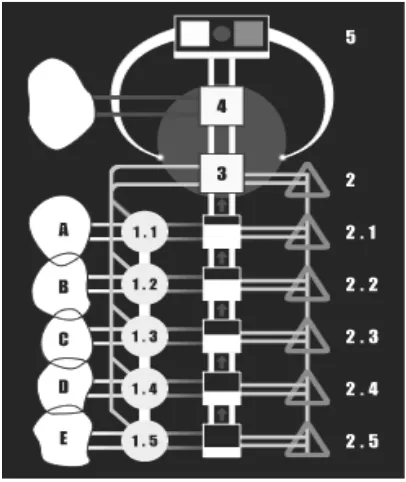
Figure 2: Schema of CyberSyn’s Viable System Model. The clouds on the left represent environments (A-E organizational, global at the top); 1: primary activities; 2: information channels; 3: current internal management; 4: environmental and future monitoring; 5: political decisions of the
organization aimed at balancing global necessities (OR-AM 2006).
The VSM allegedly structures the organization of any viable system, i.e. any organized system that combines the survival demands in a changing environment. It consists of 3 different states that incubate the management and dynamics of the processes at: (a) the environment of the organism; (b) the operations area, (c) the metasystem. As illustrated, the system is integrated by the following subsystems: activity, information, internal management, environmental monitoring and global management; and there are 5 control and information levels.
Although the systems could not be fully implemented, in October 1972, the CyberSyn team faced the truck strike – supported by the CIA and the US 40 Committee (Church 1975). CyberSyn endeavored organizing the 200 loyal truckers (against 40.000 in strike) to warrant the most essential transports. The survival to this crisis made the project respectful. Furthermore, Flores was appointed as Economic Minister. Pitifully, as said above and before the project could be fully developed, the bombs and guns of the hard power finished the experiment in the 9/11 of 1973, and Flores spent three years in the concentration camps of Pinochet’s Chile (Rivière 2010).
The probe that, from the viewpoint of security as freedom procurement – as we previously posed –, the CyberSyn project was a clear example of it, is based upon the following facts: (i) the political, social and economical stability was dramatically threatened during the period of development of the project, (ii) it enabled the circumvention of extreme harms, and (iii) it was posed as a provision of freedom (Medina 2008).
3.2. A Methodological Shift