Journal of Applied Linguistics and Language Research Volume 5, Issue 1, 2018, pp. 106-120
Available online at www.jallr.com ISSN: 2376-760X
* Correspondence: Marzieh Bahrami Birgani, Email: marziebahramiiii gmail.com © 2018 Journal of Applied Linguistics and Language Research
Exploring the Effectiveness of Blended Learning in Improving
Reading Comprehension among Iranian EFL Students
Shiela Kheirzadeh
Assistant Professor, ACECR Institute of Higher Education, Isfahan, Iran
Marzieh Bahrami Birgani *
M.A student, ACECR Institute of Higher Education, Isfahan, Iran
Abstract
Using blended learning, a combination of online digital media and traditional face to face methods, as an educational program has increased widely in educational settings over the past decade. The present study attempted to reveal the effectiveness of blended learning platform in improving reading comprehension performance of Iranian EFL students. The participants of this study were 60 EFL students at Islamic Azad University, Masjed Soleiman Branch. They were selected based on convenience sampling and their age ranged between 19 and 25. They were from both genders. These participants were divided into an experimental and a control group. Each group consisted of 30 EFL students. The first step in the current study was to administrate pretests of reading and the second step was to administrate the treatments. During the 10 ninety minute sessions of the study, the experimental group received reading passages of the Select Readings book. They were also required to use the website nicenet.com at home. For the control group, the passages were taught based on traditional classroom teaching methods, and materials, instructions, and feedback were presented in classroom according to the Select Readings book. The third step in this research was the administration of the post-test. In order to test the hypotheses of this study, independent samples t-tests was used to find the statistically significant difference, if any, in the study. The findings showed that blended learning had a positive effect on reading comprehension ability which is the main finding of the resent research.
Keywords: blended learning, reading comprehension, EFL learners
INTRODUCTION
preparations for the development of BL. In practice, BL offers the possibility to benefit from the supportive classroom direct interaction and the flexibility of online learning (Hopper, 2003).
While there are several studies (e.g., Soltani Tehrani & Tabatabaei, 2012; Behjat, Yamini., & Sadegh Bagheri, 2012) on investigating the effect of blending learning on different language skills of foreign language learning, to the best of the researcher’s knowledge, no comprehensive study has been done to explore the effectiveness of Blended learning for Iranian EFL learners. Computers and the Internet have a high position in language classes, but the positive role of teachers in traditional classrooms cannot be denied (Wright, 2000). And this is the basis of blended learning: integrating face-to-face classroom teaching with online activities so that learners can take the benefits of both e-learning and face-to-face instruction.
On the other hand reading skill may be important in Iran where English is taught as a foreign language and Iranian students need this skill to continue their academic education. This significant skill can be improved by aping effective instructions such as blending learning. For that reason, the present study tried to reveal the effectiveness of blended learning platform in improving reading comprehension performance of Iranian EFL students.
Blended learning is a new platform that can significantly decrease the cost of education and increase efficiency of Education. Higher education institutions such as the University of Wisconsin in Milwaukee (Vaughn, 2007)), the University of Central Florida (Dziuban et al., 2004; Vaughn, 2007) and the University of Southern Indiana (Reasons, Valadares, & Slavkin, 2004), have been exploring, developing, and offering since 1990s. Considering the growing access to Internet over the past ten years in Iran, it seems that Blended learning can be employed in teaching EFL. Blending learning platform is a useful instruction which helps learners to improve language skills, especially the reading comprehension.
Thus, the purpose of the present study was to investigate the effectiveness of Blended learning in reading comprehension programs in EFL education. This study attempted to answer the following questions:
1. Does blended learning have a statistically significant effect on improving reading comprehension of Iranian EFL students?
2. Is there any significant difference between traditional and blended EFL reading comprehension teaching methods regarding learners’ reading comprehension ability? REVIEW OF THE RELATED LITERATURE
In this part, attempts are made to review the previous studies and related theories on the two concepts of blended learning and reading comprehension. First, blended learning is taken into account and then reading comprehension is discussed.
The North American Council for Online Learning (NACOL, 2008) describes blended learning. Blended learning is the natural growth of e-learning to a comprehensive program of numerous multi-media and using it in a perfect method in order to solve problems. Blended learning, as stated above, combines both e-learning and face-to-face learning. Blended learning setting which is viewed as a kind of distance education mixes the benefits of distance education with the real features of traditional education, such as face-to-face interaction. Contrary to classical learning environment which makes limitations on place and time, e-learning offers an atmosphere where the students can study irrespective of time and place limitations. The elements such as students’ single differences, personal features and learning methods have noteworthy influences on the learning environment. For example, the students who have trouble in creating communication in the classroom environment believe that communicating in the electronic environment is easier. It is apparent that the weaknesses and strengths of online environment and the weaknesses and strengths of face-to-face education incorporate in blended learning (Finn & Bucceri, 2004).
Huang, Zhou and Wang (2006) consider that blended learning has three features. The first is flexibility of giving learning resources. The second is maintenance of learning variety. As students are different in terms of learning styles, learning proficiency, in addition to learning ability, blended learning can revive the rescue by making it probable for customized learning and self-regulated learning to occur. The third is improvement of e-learning experience. From the faculty’s view, blended learning can allow them to increase their current teaching practices. As said by Al Fiky (2011), blended learning reshapes the educational model with these features:
1. Transferring form talks to student centered learning.
2. Increasing teacher-student, student-student, student-content, student-outside resources communication.
3. Integrated assessment practices for educators and learners.
4. Widen the spaces and chances accessible for learning. (Bath and Bourke, 2010). 5. Maintaining course management actions (e.g., communication, assessment
submission, marking and feedback).
6. Upkeep the establishment of information and resources to learners.
Graham (2004) suggested that blended learning can happen at various levels, such as the student activity level, course level, program level, and institutional level. Learners at various levels of their university studies require an educator to keep their learning activities, but in all levels the instructors have to draw back and highlight student’s self-regulation in learning soon. Al Fiky (2011) categorized it in line with its nature, quality and the degree of blend to four categories:
2. Integrated level: It is combination among numerous components of the electronic learning founded on the internet. Each element cares other elements and assessment is one of these integrated components to measure the pupils' capacity to do the allocated learning jobs.
3. Collaborative level: It is on bases of combination between the instructor (as a guide) and the co-operative learning groups in the traditional classroom or the collaborative learning groups on the internet.
4. Expansive level: The combination between traditional classroom learning and offline electronic learning resources (email, electronic documents and books, programs)
Moreover the usage of technology has long been presented to supplement traditional writing classes (Goldberg, Russell, & Cook, 2003). For instance, Chang et al. (2008) offered an online collocation aid for EFL writers in Taiwan, targeting at perceiving and improving learners’ mis-collocations conceivable to L1 interference. Related precise collocation as feedback messages was recommended in relation to the translation equivalents between learner’s L1 and L2. The system employed natural language processing (NLP) methods to divide sentences so as to remove V-N collocations in assumed texts, and to develop a list of candidate English verbs that united the same Chinese translations through checking electronic bilingual dictionaries. After linking nouns with these derived candidate verbs as V-N pairs, the system assumed a reference body to eliminate the incorrect V-N pairs and choose the suitable collocations. The outcomes displayed that the system could successfully identify the mis-collocations and offer the student with suitable collocations that the student planned to write but abused and that this online assistant enabled EFL learner-writers’ collocation use.
Shang (2007) studied the general influence of using email on the development of writing performance in features of syntactic complexity, grammatical accuracy and lexical density and examined the association between the number of email exchanges and writing performance. Data gathered from 40 non-traditional EFL students enrolled in an intermediate reading class at a university in Taiwan revealed that learners made developments on syntactic complexity and grammatical accuracy, that exchanging email messages with their peers as a minimum four times may have a bigger complete development on their writing performance, and that the email approach was a positive strategy that aided improve students’ foreign language learning and approaches towards English. Therefore the investigator proposed designing an effective email task to improve foreign language writing development and attitudes.
classroom and CALL in the computer lab or student home through CALL programs, learning management systems (LMS), and the web, occasionally together with computer-mediated communication instruments. Several works made use of CALL technology features to set limits for trainings so learners would complete them in a suitable way (Scida & Saury, 2006). Numerous researches presented that the students developed their proficiency in a language skill (usually speaking and reading) since they can practice it both in the CALL mode and face-to-face mode (Bañados, 2006).
Other studies discovered that pupils required more support from the teacher as well as a more comprehensive program of assignments and deadlines (Chenoweth et al., 2006). A number of learners in several studies perceived that lessons and exercises were not associated or that the distribution of learning content was not similar and therefore released out of the blended learning class (Adair-Hauck et al., 1999). Nineteen Asian learners studying at an American university contributed in Grgurović’s (2011) study on the technology-enhanced blended-learning model in an ESL class wherein the use of online CALL materials provided over a commercially available LMS. The outcomes showed that the model effectively integrated modes and distributed learning content and that online speaking and pronunciation activities added value to instruction. Likewise the study displayed that the educator’s attendance and help given to students throughout labs permitted for more individualized instruction than the educator could offer in the classroom. Moreover, the educator participant assumed that working on online materials in the lab aided less attentive students control their learning better than in the classroom. There exist several other investigations concentrating on blended learning as well. Al-Masry (2012) investigated the effectiveness of using electronic blended learning in teaching a unit in English course at the cognitive levels (recognition, comprehension, and application) by second year secondary female students in Makkah. The quasi-experimental method was used. The population of study was all (156) female students in the second secondary school in Makkah. The sample was (56) students, divided into two groups: an experimental group of (31) students, and a control of (25) students. An achievement test organized by the investigator was used to collect data. The outcomes determined there were statistically significant differences at (0.05) level between the average test scores of the group of students who educated by the electronic blended learning, and the control group of students who well-educated by the traditional method in post-application of the achievement test at the "recognition", "comprehension" and "application" level all for the experimental group.
Reading comprehension
It was long ago deemed that reading comprehension was simply a mixture of decoding and oral comprehension abilities (Hoover & Gough, 1990). That is, if audiences could decode the words on a page, they could monitor what was being read to them orally and comprehend what they were reading (Duke & Pearson, 2002). Just since audiences can decode words does not mean that they have comprehended what they have read. In fact, as readers develop into more complicated passages, their capability to decode gets less and less a sign of their capability to understand. Hammerberg (2004) expressed: “… the development of meaning is an interactive mechanism, more so than merely decoding the vocabularies, saying them aloud in your head, and assuming comprehension ‘happens’ when the words are heard” (p. 650).
Investigation on reading understanding and the cognitively-based comprehension techniques used by proficient readers made by Snow (2002) has shown that audiences who comprehend:
are active users of passage
relate passages to their experiences and prior data determine expectations or aims for their reading
pay attention to the components and structures of literature monitor their comprehensions
ask questions of the passage as they read preview or skim texts before reading pay attention to vocabulary
are able to produce and negotiate meaning
construct meaning as they read through passages
read selectively, selecting passages that serve their aims and aims
Reading is taken into account as a process of making meaning in interaction with passages according to a cognitive or psycholinguistic attitude (Goodman, 1996). However, a concentration on personal readers and the cognitive techniques they use can hide the effect and role that immediate and socio-cultural settings play in the act of reading. To comprehend the effects these settings play in the act of reading needs a shift from a psycholinguistic viewpoint to a socio-psycholinguistic view (Gee, 1996). The passage expresses written language, plan and visual elements to be taken into account and interpreted, the audience makes meanings according to their knowledge of language, passage and the universe, the writer makes the written passage, acting as rhetor producing goals and purpose to the act of writing (Kress, 2010), the publisher plans the layout and typographic components of the passage itself, and the immediate and socio-cultural setting provides the socio-cultural and pragmatic facets of why one is reading and how the passage is to be understood.
experiences. They draw upon these experiences as each reading is, “placed in conversation with and in production of other passages” (Smagorinsky, 2001, p. 141). A revision of the idea of passage would help develop our interpretation of reading comprehension with regard to the effect of the reader. Drawing on modernist literary theory (Serafini, 2003), the passage has been perceived as a conduit, a neutral container for the conveying of messages and science from writer to audience (Bogdan & Straw, 1990). From this view, a passage is shaped by a writer to be shaped by an audience. In explaining reading techniques, Keene and Zimmerman (1997) offered the passage is able to consist of comprehension. This passage as conduit metaphor is clarified by the methods in which passages are explained in writings on reading strategy teachings. For instance, Keene and Zimmerman (1997) expressed one of the reading techniques readers require to learn is the capability to set the most significant ideas and concepts in a passage. Later, Snow (2002) expressed that reading is the simultaneous structure and extraction of meaning from a passage. If meaning is to be interpreted, then it must reside within the passage a priori so readers can be able to efficiently extract it.
Viewing the statements used in explaining reading comprehension, and how these statements make the idea of passage, is essential to comprehending the different theoretical views being built on in reading skill. There is no idea that simply relies on a passage until an audience with the requisite knowledge and abilities makes the meaning with the signs on a page from a post-structuralist or socio-cultural view (McCormick, 1995). The two-facet focus of the structure and extraction metaphor offered by Snow (2002) may function as a balancing mechanism in a field of varying political allegiances, but it could also be made as a form of theoretical schizophrenia attempting to accommodate incommensurate views on meaning and reading.
In an investigation, Durkin (1978) mentioned that classroom teachers hardly explicitly instructed reading comprehension strategies. Unfortunately, her investigation also showed that classroom educators spent a great amount of time testing comprehension by asking questions at the end of each reading part. This focus on assessment pushed the teaching and confirmation of comprehension techniques implemented by accomplished readers during the act of reading to the format of the reading curriculum (Pressley, 1999). What was once taken teaching in reading comprehension was subjected as measurement of literal attribute and occurrence contained in a text.
abbility for using in supporting reading comprehension. Educators and learners do, but, must be taught so as to use WebQuests more successfully.
Johnson (2013) studied the influence of technology on reading comprehension among twenty-three Indigenous adolescents (mean age 16.4 years,) existing in isolated regions of Western Australia who contributed in specific planned interviews which asked age of first use and current frequency of use of television, computers, the internet, video games and mobile phones. A cloze omission process was also independently managed to evaluate reading comprehension. Though age of first use of devices showed substantial variability, there were no significant relationships to reading comprehension. Nevertheless, as frequency of present mobile phone use increased, reading comprehension inclined to upturn and as frequency of current computer use increased, reading comprehension has a tendency to to reduce. Mobile phones, normally used to text message, can enable reading achievement among youths categorized by limited literacy skills in Standard English.
Han (2010) in an argumentative work examines the multimedia-aided reading comprehension. Initially he focuses on the benefits of multimedia-aided English reading instruction by comparison to the traditional instruction. And then the paper discusses the difficulties of the multimedia-aided English reading instruction in China to encourage the application of multimedia helps to English reading instruction. He lastly determines that the utilization of multimedia and Internet in the reading instruction offers instruments and rich backgrounds for foreign language learners and is becoming broader and more competent. Such an instruction improvement is a decent way to perform quality-oriented education which focuses on students’ increasing in an all-round way and stated that students are matters of learning. As difficulties still are in the present multimedia–aided English reading instructions, the work of how to use computers to help language instruction is well worth studying.
As seen in the previously-done research works on the two concepts of blended learning and reading comprehension, few works have been done on the effect of blended learning on reading comprehension among Iranian EFL learners. Thus, this study aimed to fill this gap by investigating this area.
METHOD
Participants
The participants of this study were 60 college students majoring in EFL at Islamic Azad University, Masjed Soleiman branch, Iran. They were selected based on convenience sampling and their age ranged between 19 and 25. They were from both genders. These participants were divided into an experimental and a control group. Each group consisted of 30 EFL students.
Materials and Instruments
Select Readings
The course book Select Readings for EFL university students written by Lee and Gunderson (2002), intermediate level, was selected as the main material of this research. In this regard, nine reading comprehension passages extracted from the text book were selected.
Reading ComprehensionTest
In order to measure both the homogeneity of the learners and their progress, a reading comprehension test was devised. The test included 30 items from their course books. This test was given as Pretest to the participants. In order to understand the students' ability in reading comprehension performance after the treatments, a post-test of reading comprehension was prepared and administrated. This test included the same content but different items.
Data Collection Procedure
To conduct the present study, the following steps were taken:
The first step in the current study was to administrate pretests of reading. In order to measure the learners' performance in reading ability before the treatments, this test was given to the students. The EFL students whose score was above the mean were selected to ensure the homogeneity of the participants. Therefore, the data received from students who performed poorly on the test were not included in the research data.
The second step in this study was to administer the treatments. During the 10 ninety minute sessions of the study, the experimental group received reading passages of the Select Readings book. They were also required to use the website nicenet.com at home. This website functions as a virtual class. On this website, the teacher made a virtual class and by giving the students the password, they could join that class. In this virtual class, three nights a week, the teacher put a passage and the participants had to practice that passage through different tasks such as: discussion, solving problems, filling in the blanks, comprehension questions, story finishing, etc. The teacher corrected the participants’ mistakes and they could use teacher’s comments and feedback online. This process continued to the end of the term and all participants of the experimental group used this website three nights a week.
Data Analysis
The data were fed into SPSS software for statistical analysis, In order to test the hypotheses of this study, independent samples t-tests was used to find the statistically significant difference, if any, in the study.
RESULTS
The results of different statistical tests are presented here. Firstly, the results of normality test are reported and it was revealed that the data were normal. Then, the results of paired samples t-test and independent samples t-tests are presented.
Data Normality Test
First of all to check the normality of the data, K-S test and Shapiro Wilk test were carried out. Table 1 presents the results obtained from these two tests according to SPSS analysis. As it is clear from Table 4.1, the data were normal as the p values (.06 & .20) and (.09 & .54) are greater than .05. As the data were normal, parametric statistical procedure, t-test, was used to compare the performance of the two groups.
Table 1. Tests of Normality
Group Kolmogorov-Smirnova Shapiro
Statistic df Sig. Statistic df Sig.
Reading Experimental Control .175 .147 29 29 .20.06 * .920 .960 29 29 .09 .54
Paired Samples t-test, Research Question One
Table 2 presents the descriptive statistics of learners’ performance in pre-test and post-test of experimental group. As it is clear from this table, the mean score of the learners in the pre-test which was out of 60, before any treatment in experimental group is 43.2 and after the treatment, their mean score in the post-test is 52.3 To see whether the difference between the mean scores of the experimental group participants in pre-test and post-test is statistically significant or not, a paired samples t-test was run.
Table 2. Descriptive Statistics of Pre-test and Post-test form Experimental Group
Group N Mean Std. Deviation Std. Error Mean
Exp. Group Post-test Pre-test 30 30 43.2 52.3 .451 .654 1.008 .81
post-test was better than the pre-test which shows that blended learning had a positive and significant effect on learners’ reading comprehension.
Table 3. Paired Samples T-test for Pre-test and Post-test of Experimental Group
Levene's Test for Equality of
Variances
t-test for Equality of Means
F Sig. t df Sig. (2-tailed)
Mean Differen
ce
Std. Error Differenc
e
95% Confidence Interval of the
Difference
Lower Upper
Equal variances
assumed .579 .451 .656 59 .03 .850 1.295 -1.772 3.47
Equal variances not
assumed .656 59 .03 .850 1.295 -1.776 3.47
Independent Samples T-test, Research Question Two
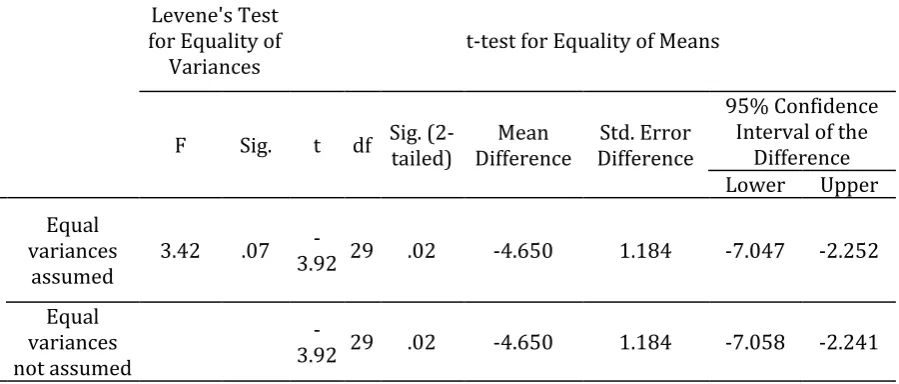
Table 4 presents the descriptive statistics of learners’ performance in the post-tests of experimental and control groups. As it can be seen in this table, the mean score of the learners after they received treatment in control group is 44.8 and in experimental group it is 52.3. To see whether the difference between the mean scores of the two groups is statistically significant and meaningful, an independent samples t-test was conducted on the scores of learners in their post-test.
Table 4. Descriptive Statistics of Post-tests of Experimental and Control Groups
Group N Mean Std. Deviation Std. Error Mean
post_tests Experimental Control 30 30 44.8 52.3 2.964 4.390 .662 .981
Table 5. Independent Samples T-test for Post-tests of Experimental and Control Groups
Levene's Test for Equality of
Variances
t-test for Equality of Means
F Sig. t df Sig. (2-tailed) Difference Mean Difference Std. Error
95% Confidence Interval of the
Difference
Lower Upper
Equal variances
assumed 3.42 .07
-3.92 29 .02 -4.650 1.184 -7.047 -2.252
Equal variances not assumed
-3.92 29 .02 -4.650 1.184 -7.058 -2.241
DISCUSSION
In this part, it is attempted to discuss whether the present study is in line with the related theories and studies or not. Thus, it is tried to compare and contrast the previous studies done in this field with the results of the present study to see whether they are opposing or supporting the present study.
According to the results obtained from data analysis, it was revealed blended learning had a positive and significant effect on reading comprehension among Iranian EFL students. This finding emphasizes the significance and importance of blended learning in language achievement. It was found in the previous studies too. For example, Behjat, Yamini and Bagheri (2012) did a research on the effect on blended learning on reading comprehension. In Behjat et al. (2012), a reading comprehension test was administered as the pretest. Then, the participants were put in control and experimental groups. For the treatment, the experimental group received the instruction in the classroom and had assignments through virtual environments whereas the control group had the instruction and assignments in conventional mode. A post-test of reading comprehension was administered, and the participants' performances in both tests were compared. The results indicated blending traditional classroom instruction with technology can help learners outperform in their reading comprehension. As the present study revealed the same results, these two studies are in line with each other.
comprehension. The present study came into the same conclusion. As a result, it can be said that Alshumaimeri and Almasri (2012) supported the present study.
The next study to be discussed is the one done by Al-Masry (2012). He investigated the effectiveness of using electronic blended learning in teaching a unit in English course at the cognitive levels (recognition, comprehension, and application) by second year secondary female students in Makkah. The quasi-experimental method was used. The population of study was all 156 female students in the second secondary school in Makkah. The outcomes determined there were statistically significant differences at 0.05 level between the average test scores of the group of students who educated by using the electronic blended learning, and the control group of students who well-educated by using the traditional method in post-application of the achievement test at the "recognition", "comprehension" and "application" level all for the experimental group. Al-Masry (2012) supports the present study since both studies prove that blended learning has a positive and significant effect on language learning with the former revealing that blended learning has a positive effect on cognitive levels of learning English and the latter proving the positive effect of blended learning on reading comprehension.
CONCLUSION
All in all, the present study comes into conclusion that blended is an effective approach toward teaching reading comprehension ability. The pedagogical value of blended learning is placed in the concept that its findings can be implemented for the growth of individual learning designs for learners with different learning requirements. Besides, having in mind that the aim of blended learning is to equip the learner to use websites or any other virtual devices or devices to learn better, this research inspires the material developers to make changes in their materials, developing some especial websites in addition to their books to influence the quality of pedagogy as well as improving the learners' capability to be innovative in their performance on learning.
REFERENCES
Adair-Hauck, B., Willingham-McLain, L., & Youngs, B. E. (1999). Evaluating the integration of technology and second language learning. CALICO Journal, 17(2), 296-306. Al Fiky, A. I. (2011). Blended Learning: Educational Design, Multi-media, Creative Thinking.
Amman (Jordan): Dar Athaqafa for publishing and distribution.
Alshumaimeri, Y., & Almasri (2012). The effects of using webquests on reading comprehension performance of Saudi EFL students. The Turkish Online Journal of Educational Technology, 11(4), 295-306.
Al-Masry, N. M. S. (2012). The Effectiveness of Using Blended Learning in Teaching A unit in English language in Second Secondary Class in Mecca. Unpublished Master Degree, Faculty of Education, Mecca, Om El-Qua University.
Bañados, E. (2006). A blended-learning pedagogical model for teaching and learning EFL successfully through an online interactive multimedia environment. CALICO Journal, 23(5), 533-550.
Bogdan, D., & Straw, S. B. (1990). Beyond communication: Reading comprehension and
criticism. Portsmouth, NH: Boynton/Cook.
Duke, N., & Pearson, P. D. (2002). Effective practices for developing reading comprehension. In A. Farstrup & S. J. Samuels (Eds.), What research has to say about reading instruction (pp. 205-242). Newark, DE: International Reading Association. Durkin, D. (1978). What classroom observations reveal about reading comprehension
instruction. Reading Research Quarterly, 14(4), 481-553.
Faust, M. (1994). Alone but not alone: Situating readers in school contexts. In B. Corcoran, M. Hayhoe & G. M. Pradl (Eds.), Knowledge in the making: Challenging the text in the
classroom (pp. 25-33). Portsmouth, NH: Boynton-Cook.
Gee, J. P. (1996). Social linguistics and literacies: Ideology in discourses. London: Taylor & Francis.
Goodman, K. (1996). On Reading: A common-sense look at the nature of language and the
science of reading. Portsmouth, NH: Heinemann.
Grgurović, M. (2011). Blended learning in an ESL class: a case study. CALICO Journal, 29(1), 100-117.
Hammerberg, D. (2004). Comprehension instruction for socioculturally diverse classrooms: A review of what we know. The Reading Teacher, 57(2), 648-658. Hoover, W. A., & Gough, P. B. (1990). The simple view of reading. Reading and writing: An
interdisciplinary journal, 2(5), 127-160.
Hopper, K. (2003). Reasons to go hybrid. Distance Education Report, 7(24), 7-36.
Huang, R. H., Zhou, Y. L., & Wang, Y. (2006). Blended Learning: Theory into Practice. Beijing: Higher Education Press.
Kress, G. (2010). Multimodality: A social semiotic approach to contemporary
communication. London: Routledge.
NACOL. (2008). Fast facts about online learning (Issue report,1-6). Vienna: North American Council for Online Learning.
Rosenblatt, L. (1978). The reader, the text, the poem: The transactional theory of the literary work. Carbondale, IL: Southern Illinois University Press.
Reasons, S. G., Valadares, K., & Slavkin, M. (2004). Hybrid courses—hidden dangers? Distance Education Report, 8(7), 3–7.
Scida, E. E., & Saury, E. R. (2006). Hybrid courses and their impact on student and classroom performance: A case study at the University of Virginia. CALICO Journal, 23(4), 517-531.
Serafini, F. (2003). Informing our practice: Modernist, transactional, and critical perspectives on children’s literature and reading instruction. Reading Online, 6(6), 143-159.
Shang, H-F. (2007). An exploratory study of e-mail application on FL writing performance. Computer Assisted Language Learning, 20(1), 79-96.
Smagorinsky, P. (2001). If meaning is constructed, what is it made from? Toward a cultural theory of reading. Review of Educational Research, 71(1), 133-169.
Snow, C. (2002). Reading for understanding: Toward and R & D program in reading
comprehension. Santa Monica, CA: RAND.
Soltani Tehrani, N., & Tabatabaei, O. (2012). The impact of blended online learning on Iranian EFL learners' vocabulary achievement. ELT voices- India, 2(5) 73-88.
Thorne, K. (2003). Blended learning: how to integrate online & traditional learning. Kogan Page Publishers.