Available online at www.jallr.ir ISSN: 2376-760X
Correspondence: Ahmad Reza Beigi Rizi, Email: [email protected] © 2015 Journal of Applied Linguistics and Language Research
A Close Look at Sixty Years of Corrective Feedback
Ahmad Reza Beigi Rizi
PhD Candidate in TEFL, University of Isfahan, Isfahan, Iran
Saeed Ketabi
Associate Professor, University of Isfahan, Isfahan, Iran
Abstract
Debates about the value of applying corrective feedback in language teaching and learning has been prominent in the recent years by respecting the past, understanding the current values, proofs and directions and finding new perspectives to change the future of corrective feedback (CF). The purpose of this article is to examine how CF found its way through the history of its development from 1950s to the new millennium and to present a review of CF in English language teaching. A close look at the history of CF helps teachers and researchers become familiar with different views about the CF and change their methodological perspectives on CF and try to apply the research findings to language pedagogy. The article concludes with some general suggestions about standard ways of receiving feedback by students, the development of CF through complex systems, and the development of CF for specific purposes.
Keywords: corrective feedback, 1950s, 1960s, 1970s, 1980s to new millennium
INTRODUCTION
The current familiar term “Corrective feedback” has been variously named in the history of the fields of second language teaching and learning, linguistics and psychology and unfortunately “to a large extent, researchers in these three approaches have been isolated from one another, each ignorant of the others’ stands on the issues” (Schachter, 1991, p.89).
Table 1. Various terms for CF
Field Term
Pedagogical field of second language
teaching/learning Corrective feedback
The various terms for CF in their respective fields have been mainly used for descriptive
or explanatory purposes. In this respect Schachter (1991) presents a summary of
commonly used fields which apply corrective feedback terms for their descriptive or
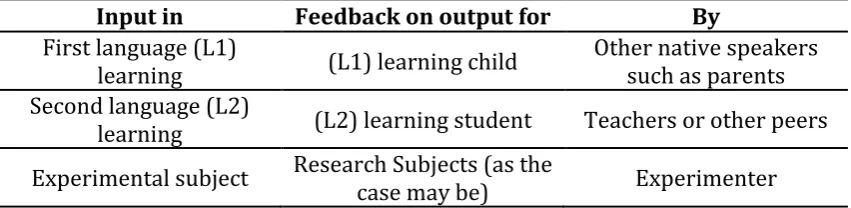
explanatory purposes in Table 2. According to these fields CF is provided for the second
language (L2) learners, first language (L1) learning child, or the experimental subjects (as the case may be).
Table 2. Commonly used fields which apply corrective feedback terms
Input in Feedback on output for By
First language (L1)
learning (L1) learning child Other native speakers such as parents Second language (L2)
learning (L2) learning student Teachers or other peers Experimental subject Research Subjects (as the case may be) Experimenter
The non-interactive input in the form of texts that learners listen to or read or the input from different interactions help learners to produce output and to receive feedback on their attempts at production, in particular feedback that points out and corrects their errors i.e., CF (Ellis, 2008). During oral or written interaction, participants may negotiate for meaning due to a lack of understanding. As part of this negotiation,
learners receive feedback on their language production, potentially helping to draw
attention to linguistic problems and leading them to notice gaps between features of their inter-language and the target language.
By providing learners with information regarding their linguistic and communicative accomplishments or failures, this interactional feedback creates a favorable environment for L2 development and a tendency for researchers to study different aspects of CF.
We limit our attention herein to the type of CF provided to the second language learning student, but we sometimes needed to focus on negative data or negative evidence in linguistic field of language acquisition or negative feedback in the psychological field of concept learning when we felt they are integrated with each other or when they could help us create new perspectives.
1950S
A slight historical glance back at the study of SLA in the 1950s & 1960s quickly reveals that for a long time there had been no principled approach to language teaching based on error, for a long time CF meant nothing more than simple corrections of the learner’s speech production, but in the late 1950’s and 1960’s this started to change because increased political, educational and occupational opportunities for communication among countries created a demand for oral proficiency in foreign languages. In 1950s alone we saw the emergence of contribution to the avoidance of this sin, “the error” and overcoming its influence (Lennon, 1991).
Some of the earliest error correction research of 1950s and 1960s was in linguistics such as the Contrastive Analysis hypothesis and some in psychology such as the Behaviorism. At that time error was considered to result from differences between the native and the target language and teaching aimed to prevent errors occurring and grammatical accuracy was stressed and, thus, errors were avoided at all costs. Since then there have been a number of different understandings about the causes of errors and how best to deal with them in teaching (Dabaghi, 2010).
A typical research example is Uriel Weinreich’s (1953) publication “Languages in Contact” which was primarily interested in how different languages influence each other when they come in contact. This phenomenon which later was called “language
interference” came from the influence that usually the stronger language has on the
weaker one. Weinreich’s great contribution was to posit a psychological or
psycholinguistic explanation for language interference. This view put language teachers in a quandary of hope and mystery: how was one to apply this revolutionary view of language in practice? Weinreich also suggested that any speaker of two languages (the
stronger language and the weaker one) will tend to identify sounds, words, structures
and meanings in one language (probably the stronger language) with corresponding elements in the other language (perhaps the weaker language), that is to say, speakers of two or more languages are engaged in a systematic process of making “interlingual identifications” (Weinreich 1953, p.7 & Lennon 1991, p. 2).
The sudden popularity of contrastive analysis school of linguistics put language teachers in another dilemma of courage and puzzle: how was it possible to identify the areas of difficulty a particular foreign language would present for native speakers of another language? Robert Lado one of the pioneers of contrastive analysis tried to answer the question in his book “Linguistics Across Cultures (1957)”, by systematically comparing the two languages and cultures.
In the pedagogical field of second language teaching and learning, helping the students get the correct answer (CF) was considered absolutely essential. If the students made errors or did not know the answer, the teacher supplied them with the correct answer (Larsen-Freeman 2000, p. 19).
no literature that offers a rationale or justification for it or that attempts to relate it to issues in linguistics, psychology, or educational theory. If we did not have access to the literature that offers such a rationale or justification, perhaps it was our fault after all. The widely embraced behaviorist view grew into favor in the 1950s. The most controversial claims came from the field of psychology.
When applied to second or foreign language learning, the behaviorist view assumed that language learning was advanced when the learners made repeated and active responses to the stimuli. These responses were then reinforced when repeated time after time to shape and form habits that consisted of automated responses elicited by a given stimulus. Therefore the implications for language teaching were that language learning would take place through exact imitation and repetition of the same structures over and over. Furthermore, this new theory amassed evidence that that teachers needed to focus their teaching on structures which were believed to be difficult. By considering this implication, it can be inferred that error correction or CF provided by language teachers could serve as the stimuli to which language learners would actively respond in order to promote effective language learning or acquisition (Corpuz, 2011, p. 8).
The behaviorist view of error correction was destined to grow into disfavor at the end of 1950s. Challenges came from the big splash that Chomsky (1959) and latter his MIT colleagues made.
According to Chomsky, language learners create novel structures that they have never learned or received before, rather than simply reproducing sentences or utterances to suit particular situations. Learners are able to create new sentences by internalizing rules, rather than a string of words. Chomsky also states that the process of language learning is not only complex but also abstract. Some of the structural aspects of language could not possibly be learned by students on the basis of language stimuli to which learners are exposed. This criticism led to the decline of the behaviorist theory for error correction, and linguists started viewing the nature of learning within a naturalistic and communicative perspective. Furthermore, it can be inferred from Chomsky’s criticism that providing error correction may have a minimal effect on student’s language development because structural aspects of a target language are learned through internalizing the rules of the language, rather than repeated responses to stimuli (Corpuz, 2011, p. 9).
The Audiolingual Method (ALM), based on behaviorism and structuralism, was very popular in L2 classrooms. Error correction was seen as helping learners to form good habits by giving correct responses instead of making structural mistakes. Behaviorists viewed errors as inevitable, but strove to avoid and overcome them by providing speedy examples of correct responses (Leaph, 2011).
The CF in 1950s according to Frisby (1957) was mainly considered to have three processes in learning a language “receiving the knowledge from the teacher or the educational materials, fixing it in the memory by repetition, and using it in actual practice until it becomes a personal skill” (Marquis 2005, p.2).
1960S
Frequently cited studies of errors and CF in 1960s are Brooks (1964), Skinner (1957, 1968), Ferguson (1965), Mackey (1965), Corder (1967) and Selinker (1969). The 1960s is a significant decade for the development of CF because of “the emergence of second language acquisition (SLA) as a significant field of enquiry within applied linguistics” Waters (2007, p.5).
the research literature of the 1960s, I supposed that if we couldn’t find any experimental data to prove Brooks claims it must be my fault.
Little by little the 1960s made CF more complex and valuable as researchers started coming up with new theoretical bases for CF first the errors should have been considered “venial sins” and not “actual sins” anymore and gradually as valuable assets and not sins anymore as they were considered to in 1950s and in the beginning of the 1960s, so by the mid-1960s, some L1 acquisition researchers such as Mackey (1965) and Corder (1967) tried to demonstrate that “children’s linguistic errors were ‘systematic’, they highlighted two issues the first one was that children did things that they had not been taught to do before and the second was that they all succeeded in learning the language of their caregivers” (Nicholas et al., 2002)
Another issue that shaped the 1960s was Chomsky’s (1965) that raised serious questions by stating that children constructed a grammar by using input together with innate linguistic knowledge to formulate hypotheses about possible grammatical rules, test them out on further input, holding, revising or abandoning them as necessary Schachter (1991).
A special version of CF in first language acquisition entitled “expansions” was first observed and developed probably by Brown and Bellugi (1964) with which the caregivers rephrased the child’s incomplete telegraphic utterance in a complete sentence as an adult’s response to the child’s attempt. Later on, in response to this idea Cazden (1965) found that “modeling” led to more developmental progress than “expansions” of the children’s utterances (Farrar, 1990, p. 613, Nicholas et al. 2002, p. 723).
The next issue that demonstrated the gradual and dynamic nature of CF and also led to the rejection of the views of the previous decade was Corder (1967), according to which “supplying the correct form is not a suitable form of CF because it prevents the language learners from testing alternative hypotheses” (p. 168). He also proposed that pushing language learners in their output, rather than helping them with correct forms, could benefit their interlanguage development. He also focused on pushing language learners in their output, adapting teachers/researchers to learners’ needs, studying the errors to see if the student's second language has developed and if teachers' training methods and techniques have been effectiveness. In addition to those mentioned, Corder highly contributed to the development of CF that was underway.
(1960), but later studies dealing with CF concluded that teachers were interrupting their students too often to provide explicit corrections and lengthy explanations. To resolve the second issue Corder (1967) pointed out that providing feedback in an explicit way may be ineffective. To answer the third issue Corder (1967) distinguished “error” which is a result of lack of knowledge and “mistake” which is a performance phenomenon. They must have been very proud of themselves because researchers of the new millennium still have controversies on the ideas they tackled in 1960s.
The controversy over the topic of error correction, however, still remained unresolved in the 1960s. For years and years, error correction had been a matter of hot altercation and strife among language practitioners and researchers. Attitudes towards error correction ranges from the utter abolition of errors before 1960s to strong disapproval of error correction as being noxious and unjustified in the late 1970s and to a more serious view of the need and value of error correction in the 1970s and 1980s (Salteh & Sadeghi, 2012).
1970S
Frequently cited studies of errors in 1970s are Selinker (1972), Corder (1976), Hendrickson 1978, Chomsky 1974 and Chomsky, 1979. A historical glance back at literature of language teaching in the 1970s quickly reveals that second language acquisition (SLA) was established as a significant field of enquiry within applied linguistics Waters (2007) and the CF of the 1970s seems to be controlled at the beginning with contrastive analysis and error analysis and later on with applied linguistics and SLA researchers. In the late 1960s and early 1970s, several researches such as Nemser (1971); Selinker (1972); Adjemian (1976); Corder (1976) pointed out that the language of second language learners is systematic and that language learner errors are not random mistakes but evidence of rule-governed behavior.
In the beginning of 1970s the CF was still under influence from Contrastive Analysis and Error analysis to transformational-generative grammar in linguistics and from behavioristic view of language acquisition to a more cognitive view of language acquisition in psychology and from audiolingualism and its mechanistic approach to a more humanistic approach of language teaching (Hendrickson, 1978).
Analysis which was criticized by the supporters of error analysis focused on differences between L1 and L2 and it ignored various factors which might affect the second language learner's performance such as his learning and communication strategies, training procedures, overgeneralization, … and does not predict many problems which are apparent in learner's actual performance …” (Khansir, 2012, p. 1028).
As an alternative to contrastive analysis, error analysis which had emerged in the 1960s by Stephen Pit Corder and his colleagues Rustipa (2011) tried to help teachers find the difficult areas that the students faced. It was also supposed to help teachers to focus on comparing language learners’ and the errors made in the target language to allow for prediction of the difficulties involved in acquiring a second language (Hughes & Lascaratou, 1982). To support such comparisons Richards (1971), who was under influence of error analysis, classified errors observed in the acquisition of English as a second language as a result of overgeneralization, ignorance of rule restriction, incomplete application of rules and false concepts hypothesized. Dulay and Burt (1972) also gave their own categorization of student errors as goofs, developmental goofs, ambiguous goofs, unique goofs. Corder (1975) mentioned that there are three types of errors such as errors caused by the learner’s over-generalizing of rules, errors caused by teaching techniques Schuniann and Stenson (1975) and Svartvik (1973) and errors caused by first language interference.
The decline of error analysis soon started by many criticisms from Brown and Hanlon (1970) and Chastain (1971) to Levine (1975), Chaudron (1977) and Schachter et al. (1977). Schachter et al. (1977) for example argued that “the analysis of errors in isolation … excludes the other corpus from consideration, the classification of errors that are identified is not usually proper, statements of error-frequently are quite misleading, the identification of points of difficulty in target language is usually not very correct, the ascription of causes to systematic errors may not be right, and the biased nature of sampling procedures supplies another point of criticism of EA … data collection and selection of informants is biased and …drawn statistically significant findings from such samples may be a questionable practice” (Khansir 2012, p. 1030). The voice of language teachers could also be heard from the beginning of the 1970s, a typical example is Chastain (1971) who began to stress the use of language for communication and instead of asking their students to produce error-free sentences in the foreign language, started motivating their students to simply speak. Teachers were encouraged to create an atmosphere in which the students felt comfortable to talk, an atmosphere in which students were not constantly being corrected or urged to produce completely flawless sentences Chastain (1971). These views began to have their influence on methodological suggestions for the classroom and they continued to have force.
is a main immediate measurement of the effectiveness of CF because he believed that uptake with repair provides evidence that learners have noticed teachers’ corrections and are able to deploy them while no uptake indicates learners’ failure in noticing the corrective intention of the feedback” (Quoted in Ding 2012, p.90). He also believed that “first and foremost, teachers’ intention to correct learners’ ill-formed utterances should
be signaled somehow: for example, by repeating learner errors with heightened
intonation or paralinguistic cues (i.e., hand signals, a funny face, and raised eyebrows). Chaudron (1977) on the basis of his analyses of students’ performance in the classroom found that teachers’ corrections that worked best were those that clearly indicated to the student the locus of the error” (Kim 2014, p. 11).
At the end of 1970s Hendrickson (1978) helped to change the direction of the research by framing the five unanswered questions about CF such as (Should learners’ errors be corrected? When should learners’ errors be corrected? Which errors should be corrected? How should errors be corrected? Who should do the correcting?), and many researchers devoted their effort into this direction.
One of the souvenirs of the 1970s is that second language researchers did not agree about the terms, categories and types of the errors. All in all, the CF of the 1970s was mostly descriptive in nature. This decade complicated the debate that had started before and the complexity proceeded into the 1980s in which the certainties of the 1970s have disappeared. This debate seeded new views not only in first language and second language acquisition but also in experimental research and was mainly approached by linguists, psychologists and researchers in SLA.
1980S TO PRESENT
Since the beginning of 1980s there had been a plethora of qualitative, quantitative, statistical, interpretative, experimental and non-experimental researches related to the highly controversial issues of CF.
language acquisition such as “learners’ noticing of CF (CF as a trigger for learners’ noticing of gaps, learners’ noticing and the extent of explicitness of CF and direct measure of learners’ noticing of CF), the mismatches between teachers’ intentions and learners’ interpretation (Learners’ internal systems and fine-tuning CF) and the roles of different type of implicit CF: self-generated repairs vs. recasts (Types of L2 Acquisition and Learners’ Immediate Incorporation of Feedback)” (Kim 2014, pp.6-18). In the recent decades we had also been concerned with many hot issues of CF in the computer assisted language learning such as Razagifard and Rahimpour (2010), Faghih and Hosseini (2012) and Hosseini and Hosseini (2014). It is clearly impossible cope with all topics and issues of the aforementioned field in one single study.
There also appears to be a growing consensus among the majority of researchers concerning the significance of the role played by CF in the process of SLA both in oral and written discourse Tatawy (2002).
DISCUSSIONS AND CONCLUSION
Since 1950s we had been dealing with complexity and constant change in the researches related to CF. As Farhady (2011) wrote in his book "following any theory would give different definitions for the variable under investigation. … He also believes
the measurability of [a] variable will change because of the way it is defined" (P. 77).
The definitions offered for "error" and "corrective feedback" in a particular research project may not be the most agreed upon or acceptable definitions. However, within the context of the research, the readers will understand what they stand for.
Considering Farhady (2011), it can be inferred that if theories vary then the definitions and the measurability of CF and errors will vary too. Probably that is why “corrective feedback” and “error” have had so many definitions so far. From 1950s to the end of 1970s we can hardly observe general agreement or concord among researchers about CF in different fields but the growing consensus since 1980s will be definitely more meaningful, intense, international and for specific purposes in the future decades. One suggestion to get to such CF ideal is to culturally and educationally prepare, motivate and teach our capable language learners to search and ask for standard ways to receive CF for as many mistakes or errors they face as soon as possible in their language learning process from reliable sources and people with standard tools, techniques and discourses in different cultures.
teaching and another way is to downplay the constant change that we experience by turning the living, dynamic world of language teaching in to named objects and thinking about them as fixed entities, as lesson planning, teaching, motivating, giving and receiving feedback, testing or learning. According to Freeman & Cameron (2008) “the power of the field of complex systems comes not only from its application to many different disciplines, but also from the fact that it can be applied to many different levels” (p. 1). CF can also be generally applied to many sciences of human and specifically to SLA field of study. “The agents or elements in a complex system change and adapt in response to feedback … the complex systems have no distinct permanent boundaries; they are not a ‘thing’ themselves. They exist only through the fluxes that feed them, and they disappear or become moribund in the absence of such fluxes” (Freeman & Cameron, 2008, p. 2). CF which seems to be a complex system comes in to being due to certain conditions, and it is sustained by them. When these conditions change, such as when mistakes or errors appear in L1, L2 orally or written, CF types are changed, sustained or through the learners’ improvements it is eventually decreased. Of course the overall CF process or system remains and if the conditions that cause the CF prevail, then a new type of CF might be spawned further. However, the particular perturbation caused by the original conditions disappears in the absence of the fluxes that fed the CF. So it is suggested that CF be scrutinized through the complex systems theories.
The next suggestion is that it is time to change the teachers’ point of view from CF as a general term toward CF for specific purposes. If we can develop language for specific purposes we can also plan, design and implement CF for specific purposes in first language acquisition, second language acquisition, computer assisted language learning and experimental research environments.
CF has reached an exciting stage in its development. As CF researchers increase our connection with other branches of science such as linguistics, psychology, pedagogy, language testing etc. we continue to push the field forward, uncovering new insights and helping both researchers and practitioners reach a better understanding of the dynamic, socially situated, and cognitive processes of acquiring a second language through CF. REFERENCES
Arthur, B., Wemer, R., Culver, M., Lee, Y. J., & Thomas, D. (1980). The register of impersonal discourse to foreigners: Verbal adjustments to a foreign accent. In D.
Larsen-Freeman (Ed.), Discourse analysis in second language research (pp. 111124).
Rowley, MA: Newbury House.
Austin, J. (1962). How to do things with words. Oxford. Oxford University Press.
Baker, C.L. (1979). Syntactic theory and the projection problem. Linguistic Inquiry 10,533-81.
Brock, C., Crookes, G., Day, R. R., & Long, M. H. (1986). The differential effects of corrective
feedback in native speaker/non-native speaker conversation. In R. R. Day (Ed.),
“Talking to learn”: Conversation in second language acquisition (pp. 327-351). Cambridge, MS: Newbury House.
Brooks, N. (1960). Language and language learning. Theory and practice. New York: Harcourt, Brace and World.
Brooks, N. (1964). Language and language learning. Theory and practice (2nd edn.). New York: Harcourt Brace.
Brown, R. & Hanlon, C. (1970). Derivational Complexity and Order of Acquisition in Child
Speech. In R. Hayes (Ed.), Cognition and the Development of Language (pp. 11-53).
New York: John Wiley.
Brown, R. & U. Bellugi (1964). Three processes in the child’s acquisition of syntax.
Harvard Educational Review 34: 133-151.
Burt, M. (1975). Error analysis in the adult EFL classroom. TESOL Quarterly, 9, 53-63. Burt, M. K., Kiparsky, C. (1972). The goocon: a repair manual for English. Rowley,
Massachusetts: Newbury House.
Cazden, C. (1965). Environmental assistance to the child’s acquisition of grammar. Unpublished doctoral dissertation, Harvard University, Cambridge, MA.
Chastain, K. (1971). The development of modern language skills: theory to practice. Philadelphia. Center for Curriculum Development, Inc.
Chaudron, C. (1977). A descriptive model of discourse in the corrective treatment of
learners’ errors. Language Learning, 27, 29-46.
Chaudron, C. (1986). Teachers’ priorities in correcting learners’ errors in French
immersion classes. In R. R. Day (Ed.), “Talking to learn”. Conversation in second
language acquisition (pp. 64-84). Cambridge, MS: Newbury House.
Chaudron, C. (1988). Second language classrooms. Research on teaching and learning.
Cambridge, UK: Cambridge University Press.
Chomsky, N (1979). Morphophonemics of modern Hebrew. New York: Garland Publishing Co. (136 Madison Ave. NYC 10016).
Chomsky, N. (1959). Reviews: Verbal behavior by B. F. Skinner. Language 35 (1): 26–58. JSTOR 411334"
Chomsky, N. (1965). Aspects of the theory of syntax. Cambridge, MA: MIT Press.
Chomsky, N. (1974). Topics in the Theory of Generative Grammar in The Philosophy Of
Language. J.R. Searle (ed.). Oxford Readings in Philosophy. Oxford University Press.
Oxford.
Chun, A., Day, R. R., Chenoweth, A., & Luppescu, S. (1982). Errors, interaction, and correction: A study of native-nonnative conversation. TESOL Quarterly, 16, 537-547.
Corder, Pit S. (1967). The significance of learner's errors. International Rview of Applied
Linguistics 5, 161-170
Corder, S. P. (1975). Error Analysis, Interlanguage and Second Language Acquisition.
Language Teaching, 8, pp 201-218.
Corpuz, V. (2011). Error Correction in Second Language Writing: Teachers’ Beliefs,
Practices and Students’ Preferences. Queensland University of Technology Faculty
Dabaghi, A. (2010). Corrective Feedback in Second Language Acquisition, Theory,
Research and Practice. Lambert Academic Publishing.
Day, R., Chenoweth, A., Chun, A., & Luppescu, S. (1984). Corrective feedback in native nonnative discourse. Language Learning, 34, 19-45.
Ding T. (2012). The comparative effectiveness of recasts and prompts in second language classrooms. Journal of Cambridge Studies. Retrieved from http://journal.acs-cam.org.uk/data/archive/2012/201202-article6.pdf
Dulay, H. C. & M. K. Burt. (1972) Goofing: an indicator of children’s second language learning strategies. Language Learning 22.235-252.
Ellis, R. (2008). The Study of Second Language Acquisition. New York: Oxford university press.
Ellis, R. Jiang, C. (2009). Corrective Feedback and Teacher Development. L2 Journal, UC Consortium for Language. Learning & Teaching, UC Davis. Available on line at: http://www.escholarship.org/uc/item/2504d6w3
Faghih E., Hosseini S. B. (2012). Asynchronous Computer-Mediated Corrective Feedback and the Correct Use of Definite/Indefinite Articles. International Journal of
Instructional Technology and Distance Learning. Vol. 9. No. 1. Retrieved from
http://www.itdl.org/Journal/Jan_12/Jan_12.pdf
Fanselow, J. (1977). The treatment of error in oral work. Foreign Language Annals, 10, 583-593.
Farhady H. (2011). Research Methods in Applied Linguistics 1 & 2. Tehran, PNU
University, ISBN: 978-964-387-637-1
Farrar, M. (1990). Discourse and the acquisition of grammatical morphemes. Journal of
Child Language 17.3, 607–624.
Ferguson, C.A. (1965). General introduction to contrastive structural series. Chicago and London: The University of Chicago Press.
Freeman D. L. & Cameron L. (2008). Complex Systems and Applied Linguistics. Oxford: Oxford University Press.
Frisby A.W. (1957). Teaching English as a Foreign Language: Notes and Comments. Overseas, London: Longman
George, H. Victor. (1972). Common errors in language learning. Rowley, Massachusetts: Newbury House Publishers.
Hendrickson, J. (1978). Error correction in foreign language teaching: recent theory, research, and practice. Modern Language Journal 62, 387- 398.
Hosseini S. B. & Hosseini S. S. (2014). The impact of email-based corrective feedback on Iranian EFL learners’ correct use of past tenses. International Journal of
Instructional Technology and Distance Learning. Vol. 11. No. 3. Retrieved from
http://www.itdl.org/Journal/Mar_14/Mar14.pdf
Karmiloff-Smith, A., & Inhelder, B. (1977). If you want to get ahead get a theory. In Johnson-Laird, P.N. and Wason, P.C., editors, Thinking: readings in cognitive
science. Cambridge: Cambridge University Press.
Kasper, G. (1986). Repair in foreign language teaching. In Kasper, G., editor, Learning, teaching and communication in the foreign language classroom. Arhus: Arkona. Khansir, A. A. (2012). Error Analysis and Second Language Acquisition. Theory and
Kim J. H (2014). Issues of Corrective Feedback in Second Language Acquisition. Teachers College, Columbia University. Teachers College, Columbia University Working Papers in TESOL & Applied Linguistics, Vol. 4, No. 2.
Krashen, S. D. (1982). Principles and practice in second language acquisition. New York: Lado, R. (1957). Linguistics across cultures. Applied linguistics for language teachers.
University of Michigan Press: Ann Arbor
Larsen-Freeman, D. (2000). Techniques and Principles in Language Teaching. Oxford University Press.
Leaph, K. (2011). Using Oral and Written Feedback to Improve Student Writing: An
Investigation from Cambodian University Students’ Perspectives. Royal University of
Phnom Penh Institute of Foreign Languages Department of English.
Lennon, Paul. (1991). Error: some problems of definition and identification. Applied Linguistics 12 (2), 180-195.
Levine, M. (1975). A cognitive theory of learning: research in hypothesis testing. Hillsdale, NJ: Lawrence Erlbaum.
Lightbown, P. M., & Spada, N. (1990). Focus-on-form and corrective feedback in Communicative Language Teaching: Effects on second language acquisition.
Studies in Second Language Acquisition, 12, 429-448.
Lyster R. Ranta L. (2013). Corrective Feedback and Learner Uptake Negotiation of Form in Communicative Classrooms. Studies in Second Language Acquisition , 2013, 35 , 167– 184. doi:10.1017/S027226311200071X
Mackey , W. F. (1965) . Language Teaching Analysis. London: Longman.
Marquis, R. C. (2005). Language teaching methodologies in computer-assisted language
learning: A prospective review. Simon Fraser University. Retrieved from
http://cqfd.teluq.uquebec.ca/distances/v7n1_d.html
Nemser, W. (1971). Approximative Systems of Foreign Language Learners. IRAL. 9,115-123.
Nicholas H., Lightbown P., Spada N. (2002). Recasts as Feedback to Language Learners.
Language Learning. 51(4):719 - 758. DOI: 10.1111/0023-8333.00172
Nystrom, N. (1983). Teacher-student interaction in bilingual classrooms: Four
approaches to error feedback.
Oller, J. & Ziahosseiny, S. (1970). The contrastive analysis hypothesis and spelling errors. Language Learning. 20. 183-189.
Pitman, G. (1963). Teaching structural English. Brisbane: Jacaranda Press.
Razagifard P. & Rahimpour M (2010). The Effect of Computer-mediated Corrective Feedback on the Development of Second Language Learners’ Grammar.
International Journal of Instructional Technology and Distance Learning (IJITDL).
Rustipa K. (2011). Contrastive Analysis, Error Analysis, Interlanguage and the Implication to Language Teaching. Stikubank University (Unisbank) Semarang.
Ragam Jurnal Pengembangan Humaniora Vol. 11 No. 1, April 2011.
Saeideh, A. & Amirzadeh, S. (2011). Exploring the Teachers’ Use of Spoken Corrective Feedback in Teaching Iranian EFL Learners at Different Levels of Proficiency. Available online at www.sciencedirect.com, Procedia - Social and Behavioral
Salteh M. A., Sadeghi K, (2012). Teachers’ Corrective Feedback in L2 Writing Revisited: Concerns Against and Suggestions for its Employment. World Applied Sciences
Journal 17 (3), 375-383.
Schachter J, (1991). Corrective feedback in historical perspective. Second Language
Research, The online version of this article can be found at:
http://slr.sagepub.com/content/7/2/89
Schmidt, R., & Frota, S. (1986). Developing basic conversation ability in a second
language: A case study of an adult learner of Portuguese. In R. R. Day (Ed.), “Talking
to learn”: Conversation in second language acquisition (pp. 237-326). Cambridge, MS: Newbury House.
Schuniann, J., & Stenson, N. (Eds.). (1975). New frontiers in second language learning. Rowley, MA: Newbury House.
Seliger H. & Long M. (1983). Classroom-oriented research in second language acquisition. Rowley, MA: Newbury House.
Selinker, L. (1969). lnterlanguage, IRAL, 3, 114.132. Selinker, L. (1972). Interlanguage. IRAL, 10, 209-231.
Skinner, B. F. (1957). Verbal behavior. Acton, Massachusetts: Copley Svartvik, J. Errata (1973). Papers in error analysis. Lund, Sweden: Gleerup.
Tarone, Elaine and George Yule. (1989). Focus on the Language Learner. Oxford: Oxford U. P.
Tatawy M. E. (2002). Corrective Feedback in Second Language Acquisition. Teachers
College, Columbia University. Vol 2. No. 2
Wardhaugh, R. (1970). The Contrastive Analysis Hypothesis. TESOL Quarterly.4. 120-130.
Waters, Alan (2007). Forty Years of Language Teaching: the Nineteen-Nineties.
Language Teaching, 40 (1). pp. 12-13.
Weinreich, U. (1953). Languages in Contact: Findings and Problems. New York: Linguistic Circle of New York.
Wiener, N. (1948). Cybernetics and control and communication in the animal and the
machine. Boston: MIT Press.