Journal of Applied Linguistics and Language Research Volume 2, Issue 6, 2015, pp. 119-127
Available online at www.jallr.ir ISSN: 2376-760X
* Correspondence: Saloomeh Niknejad, Email: [email protected] © 2015 Journal of Applied Linguistics and Language Research
Enhancing EFL Learners’ Reading Comprehension Ability
through Multimedia-Based Visualization
Saloomeh Niknejad *
Department of Foreign Languages, Zanjan Branch, Islamic Azad University, Zanjan, Iran
Behzad Rahbar
Department of Foreign Languages, Zanjan Branch, Islamic Azad University, Zanjan, Iran
Abstract
The present study was conducted to measure the impact of multimedia-based visualization on Iranian EFL learners’ reading comprehension. The current study is based on the researcher's motivation to find empirical evidences in intermediate English language learners. To do so, the reading comprehension texts was provided through two methods; first, static visualization in which students received reading texts with static pictures; second, dynamic visualization in which the reading texts were provided with animated pictures. The results of independent sample t-test showed that dynamic visualization was more effective than static one in enhancing EFL learners' reading comprehension.
Keywords: visualization, dynamic, static, multimedia, reading comprehension
INTRODUCTION
A new era is considered as a platform for applying and incorporating Computer Assisted Language Learning (CALL) into foreign language learning and instructional context. Levy (1997) succinctly defines computer-assisted language learning as “the search for and study of applications of the computer in language teaching and learning (p. 1).” Nowadays, nobody can ignore the fundamental role of information and communication technology in the learning and teaching context. Harris, Sutton and Johnson (2001) state that unlike traditional teaching approaches, which were generally teacher-directed and confined exclusively to paper-based textbook, the non-traditional approaches come to exist in order to enhance the quality of teaching and learning in the classroom.
With the entry of computers into education in the past decade, language education has gone through significant changes. Khamkien (2012) believes that, “because of the availability of computer and education technologies in today’s world, computers have entered and have strongly influenced our life in every domain of communication” (p. 55). He further adds that the increasing use of computer in today’s world is due to faster and easier communication, which takes place between learners or speakers of language. With the arrival of computers in the instructional contexts, the new era is considered as a platform for applying CALL, that is, “the search for and study of applications of the computer in language teaching and learning” (Levy, 1997, p. 1). Recent advances in technology make it possible for teachers and learners to see more interactive uses of CALL. Furthermore, it makes an increase in the integration of various media into the computer system (Pusack & Otto, 1990). Instructional materials using texts, graphics, animation, pictures, videos, and sound to present information is called multimedia. Multimedia developed and integrated using computer have provided virtual surge of computer based multimedia instructional applications (Lawrence, 1996). Brett (1995) advocates Lawrence’s terms and states, “increase in the speed, storage capacity and memory size of computers, together with developments in the sophistication of software, now enable computers to deliver video, sound, text and graphics” (p. 77), paving the way not only for the process of teaching but also for its further usage in most language classrooms.
Chastain (1988) utters that "reading is a basic and complementary skill in language learning. Second language students need to learn to read for communication and to read greater and greater quantities of authentic materials" (p. 216). He further adds that reading for meaning or reconstructing the writer meaning is at the crux of the reading process. Actually, understanding or comprehending a text is the primary purpose of reading.
Along the lines of Anderson and Pearson (1984), to assist the processing and understanding of new unfamiliar information, a previous acquired schema should be stored in the long-term memory. Consequently, under this condition first language reading comprehension takes place. Hong (2007) states that “there are many factors influencing reading comprehension such as reader’s characteristics, nature of reading materials, and reading tasks, etc.” (p. 15) since individual differences, particularly learning styles which play a decisive role in L2 learning (Ehrman, Leaver, & Oxford, 2003), careful consideration should be given to issue of learners’ differences. As Hoffler and Leutner (2011) state, “In recent years, the role of individual differences on learning with visual representations has been more and more focused on” (p. 209). Learning styles of students is one area of higher education, which has been given growing attention. Some studies have revealed that academic performance of university students is associated with their learning styles (Aripin, Mahmood, Rohaizad, Yeop, & Anuar, 2008).
Of the relevance to the aim of the present study is the question of enhancing the quality of reading multimedia-based texts through visualization. Thus, to find out whether the use of a multimedia-based system helps the students to better learn language and its components, the present study seeks to explain the learning of a language in relation to visualizations and compare the effect of using these approaches against the traditional approaches. In addition, this study seeks to identify the relationship between learners' learning style and multimedia-based reading comprehension.
In recent years, English has been given a high status in Iran. According to Tabatabaei and Banitalebi (2011), “in today’s schools, reading in an L2 is a very challenging task” (p. 59). Hong (2005, p. 15) states that “from the cognitive view, reading is a conversation between reader and author, and thus the widely accepted models of fluent reading are an interactive one in which a variety of processes interact with text features.”
The present study sought to investigate the effect of visualization on reading comprehension of Iranian EFL learners. It is assumed that paying heed to nature and types of visualization as well as investigating the effect of them on EFL learners’ reading comprehension becomes prerequisite for language learning. Thus, the following research question was posed:
METHOD
Participants
A sample of 60 Iranian intermediate-level students (females and males) participated in this experiment. These participants were selected from a larger sample of 74 students from a Iran Language Institute (ILI) located in the city of Zanjan by Oxford Placement Test. Participants’ age range was between 20 and 25. Their native language was Persian and Azari. Then, the participants were randomly divided into two groups. The first group received multimedia-based texts with static visualizations, the second group was given multimedia-based texts with dynamic visualizations.
At the time of the study, all of the participants have been learning English at least for seven semesters in English language learning institute; therefore, it was assumed that these students were familiar with reading tasks. In addition, all of them were placed in the intermediate levels by the Oxford Placement Test.
Instruments
To collect data, this study made use of the following instruments: a) Oxford Placement Test (OPT) consisting of 70 items, including 10 multiple-choice and true-false reading, 10 writing, and 50 multiple-choice language use items. According to the Oxford Placement Test (Solutions) (2007), the intermediate learners are those who attain 31 and above (out of 50) on grammar and vocabulary section, and 8 and above (out of 10) on reading; b) a computer software, produced by a computer technician, which could play reading texts with static and animated pictures. This software packages, used on all versions of windows, was prepared by C# (C sharp). This software program is able to show a same text with two formats: the first format is multimedia-based texts with dynamic visualization (animation); the second format is multimedia-based texts with static visualization. The instructional module, used in the study, consisted of the two different reading texts that were provided for two groups of the study. Based on reading texts, reading comprehension questions were prepared. True/false questions and multiple-choice questions comprised the reading comprehension questions used for data collection; c) a reading comprehension test was developed and utilized to appraise the participants’ reading comprehension ability. It was used before and after the treatment sessions functioning as pretest and posttest. This instrument consisted of 10 true/false and 20 multiple-choice items about the main points of the texts.
Procedures
The psychometric characteristics (i.e., reliability and validity) of reading comprehension test were scrutinized. The validity of the reading comprehension was examined through the development and use of a detailed item specification as the blueprint and the judgment of 5 experts in the field of Applied Linguistics to ensure that the test was carefully and accurately planned to include reading comprehension abilities. The internal consistency or reliability of the reading comprehension test was also estimated through conducting Cronbach’s alpha. The results showed that the reading comprehension test was satisfactorily reliable (r = .81). Therefore, the reading comprehension test showed a very good internal consistency and was reliable.
Based on the performance of the participants on OPT, 60 intermediates were selected. In this case, the participants whose scores fell within the range of intermediate cut-off scores (determined by OPT) were held in the study, and those who did not were excluded from the study. Regarding this, 14 learners were excluded from the main analysis.
The participants of each group had to choose the static/animation options. The static group received reading texts with static pictures and the animation reading texts with animated pictures.
Reading of each reading text, all groups took the reading comprehension test including true/false items and multiple-choice items. Taking place in a computer lab, firstly, the participants completed the consent form, which was one part of the software. Regarding the organization of the software, in the bottom was a navigation bar that helped students to go back or move forward within the instructional module. Reading materials were placed on the left side of the software screen and visual materials, either static or animated, were displayed on the right side of the screen. At the end of the study, post-test was administered in order to assess learners' reading comprehension ability. RESULTS
Descriptive statistics such as mean and standard deviation of the pre-test scores are shown for both control and experimental group subjects in Table 1.
Table 1. Descriptive statistics of the groups’ pretest scores
Groups N Mean Std. Deviation Std. Error Mean
Pretest Static 30 15.30 1.76 .32
Animation 30 14.93 1.99 .36
The mean score of static group members (M = 15.30) was not very much different from the mean score of those in the animation group (M = 14.93). However, the value of p
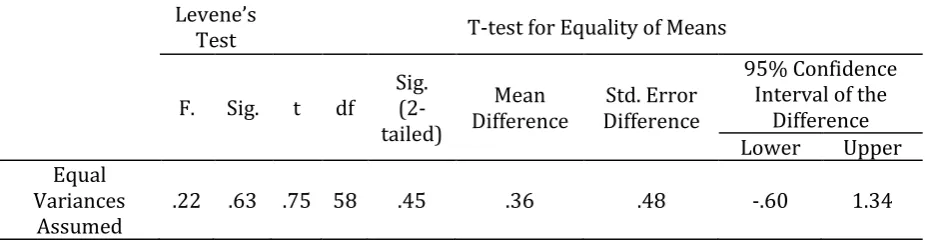
Table 2. Results of the independent samples t-test for comparing the groups’ pretests
Levene’s
Test T-test for Equality of Means
F. Sig. t df Sig. (2-tailed)
Mean Difference
Std. Error Difference
95% Confidence Interval of the
Difference
Lower Upper
Equal Variances
Assumed .22 .63 .75 58 .45 .36 .48 -.60 1.34
According to Table 2, there was not a statistically significant difference in vocabulary pretest scores for the subjects in static (M = 15.30, SD = 1.76) and animation groups (M
= 14.93, SD = 1.99), t (58) = .75, p = .45 (two-tailed). This is so because the p value was greater than the specified level of significance (i.e. .05). If the p value were less than the level of significance, the conclusion would be that the two groups were significantly different in terms of their pretest vocabulary scores.
Once it was concluded that the two groups were similar in terms of their reading comprehension ability at the outset of the study, any potential significant difference in their posttest could be attributed to the treatment, i.e. using visualization. The comparison of posttest scores of the control and experimental groups are presented in Tables 3 and 4 below.
Table 3. Descriptive statistics for comparing control and experimental groups’ posttests
Groups N Mean Std. Deviation Std. Error Mean
Posttest Animation 30 43.93 Static 30 35.23 1.99 3.66 .36 .66
The mean score of static group members (M = 35.23) was less than the mean score of the learners in the animation group (M = 43.93). Nonetheless, to determine whether this difference between the mean scores was statistically meaningful or not, one had to check the value of p under the Sig. (2-tailed) column in Table 4.
Table 4. Independent samples t-test for comparing static and animation groups’ posttest
Levene’s
Test T-test for Equality of Means
F. Sig. t df
Sig. (2-tail ed)
Mean Differen
ce
Std. Error Differ
ence
95% Confidence Interval of the
Difference
Lower Upper
Equal Variances
Assumed 19.23 .00 -6.16 58 .00 -4.70 .76 -6.22 -3.17
comprehension. In addition, animation group outperformed the static group on the posttest. Therefore, the research question of the study was verified.
DISCUSSION AND CONCLUSION
The present study was designed to explore the impact of visualization on Iranian EFL learners’ reading comprehension based on the researcher's motivation to find empirical evidences in Iranian English language learners. The reading instruction was provided through two methods; first, through the static visualization, second, dynamic visualization. The results of independent sample t-test showed that dynamic visualization was more effective in enhancing EFL learners' reading comprehension. The results of the present study support those of Hegarty (2004) who found that creating documents that allow students to browse the information in any order was more useful than being constrained by the linear ordering of information in printed books.
The findings of this study confirm those of Tversky, Morrison and Betrancourt (2002) who reviewed several studies to scrutinize the role of animation in learning. , looking into how visualization could facilitate learning. Their review focused on uses of animation to teach complex systems, mechanical, biological, physical, operational, and computational. They found that if only animation was used in the process of learning it could not facilitate learning. Actually, they concluded that most of the successes of animation seemed to be due to the advantages in extra information conveyed or additional procedures, rather than the animation of the information per se.
This study approves the results of Mayer and Moreno (2002) who examined the role of animation visualization in multimedia learning including multimedia instructional messages and micro world games. They presented a cognitive theory of multimedia learning and summarized a program of research, yielding seven principles for the use of animation in multimedia instruction. They confirmed that animation would lead to improve human learning especially when the goal was to promote deep understanding. The results of this study proved that reading comprehension while using visualization would lead to better comprehension among EFL learners. Visualization increased the motivation of learners to improve their reading comprehension as they experienced different ways to learn reading. In addition to the fact that visualization was innovative for the participants of the study, it could provide opportunities for them to be more successful in their reading comprehension. They were involved in the process of learning by interactive visuals and activities, so it helps them promote reading comprehension. It was, also, found that by the use of visualization module as the one investigated in this study, EFL learners more opportunities to communicate in EFL classes.
the selection and the implementation of the appropriate kind of visualization materials can have a considerable effect on reading comprehension and consequently it would help save teachers' time and energy.
In this study, the type of strategies and communication style of participants were not investigated. Another research can use an attitude questionnaire to understand the types of strategies and communication style that learners used in the visualization classroom.
REFERENCES
Anderson, R. C., & Pearson, P. D. (1984). A schema-theoretic view of basic processes in reading comprehension. In D. Pearson (Ed.), Handbook of reading research (pp. 255-291). New York: Longman.
Anglin, G., Vaez, H., & Cunningham, K. (2004). Visual representations and learning: The role of static and animated graphics. In D. H. Jonassen (Ed.), Handbook of research on educational communications and technology (pp. 865-916). Mahwah, NJ: Lawrence Erlbaum.
Aripin, R. Mahmood, Z. Rohaizad, R. Yeop U. & Anuar. M. (2008). Students’ Learning Styles and Academic Performance. 22nd Annual SAS Malaysia Forum, Kuala Lumpur.
Brett, P. (1995). Multimedia for listening comprehension: The design of a multimedia-based resource for developing listening skills. System, 23(1), 77-85.
Chastain, K. (1988). Developing second language skills: theory and practice (3rd Brace
Jovanovich. ed.). San Diego CA: Harcourt.
Chun-Y. & Hsiu, L. (2011). Metacognitive skills development: a web-based approach in higher education. The Turkish Online Journal of Educational Technology, 10 (2), 140-150. Ehrman, M., Leaver, B. L., & Oxford, R. (2003). A brief overview of individual differences in second language learning. System, 31, 313-330.
Feaver, W. (1977). When we were young: Two centuries’ of children’s book illustration. London: Thames & Hudson.
Hegarty, M. (2004). Dynamic visualizations and learning: Getting to difficult questions.
Learning and Instruction, 14, 343–351.
Hong, C. Z. (2007). The effect of learning strategies on reading comprehension. Sino-US English Teaching, 4(4), 15-18.
Hoffler, T. N., & Leutner, D. (2011). The role of spatial ability in learning from instructional animations-evidence for an ability-as-compensator hypothesis. Computers in Human Behavior, 27, 209-216.
Javanbakht, Z. O. (2014). Attitudes of Iranian teachers and students towards internship.
Journal of Applied Linguistics and Language Research, 1(1), 87-99.
Khamkhien, A. (2012). Computer-assisted language learning and English language teaching: Overview. Mediterranean Journal of Social Sciences, 3(1), 55-64.
Lawrence, J. N. (1996). Multimedia information and learning. Jl. of Educational Multimedia and Hypermedia, 5(2), 129-150.
Levy, M. (1997). CALL: Context and conceptualization. Oxford: Oxford University Press. Mayer, R. E., & Moreno, R. (2002). Aids to computer-based multimedia learning.
Learning and Instruction, 12,107-119.
Narayanan, N. H., & Hegarty, M. (2000). Communicating dynamic behaviors: Are interactive multimedia presentations better than static mixed-mode presentations?. In
Theory and application of diagrams (pp. 178-193). Springer Berlin Heidelberg.
Pusack, J. P., & Otto, S. K. (1990). Priority Instruction: Applying instructional technologies. Foreign Language Annals, 23(5), 409-417.
Slythe, R. M. (1970). The art of illustration 1750-1900. London: The Library Association. Tabatabaei, O., & Banitalebi, A. (2011). Feedback strategies in foreign language reading classes. Asian Culture and History, 3(2) 59-70.
Tversky, B., Morrison, J. B., & Betrancourt, M. (2002). Animation: can it facilitate?