Optimal Auctions with Simultaneous and
Costly Participation
Gorkem Celik and Okan Yilankaya
This Version: April 2009
Abstract
We study the optimal auction problem with participation costs in the symmetric independent private values setting, where bidders know their valuations when they make independent participation decisions. After characterizing the optimal auction in terms of participation cuto¤s, we provide an example where it is asymmetric. We then investigate when the optimal auction will be symmetric/asymmetric and the nature of possible asymmetries. We also show that, under some conditions, the seller obtains her maximal pro…t in an (asymmetric) equilibrium of an anonymous second price auction. In general, the seller can also use non-anonymous auctions that resemble the ones that are actually observed in practice.
JEL Classi…cation Numbers: C72, D44, D82
Keywords: Optimal auctions, participation cost, endogenous entry, asymmetry, bidding preferences
1
Introduction
In many auction environments bidders incur participation costs even when they know their valuations for the object being sold or how much they will bid: Bidders are sometimes required to purchase bid documents, to pre-qualify or register for the auction, or to be present at the auction site, all of which may be costly. In procurement and sales of public assets, a “bid” is often more than a dollar amount; it must also include a detailed plan with the requisite documentation. Procurement auctions usually require the posting of bid bonds by all bidders before the auction and a performance bond by the winner immediately after. There may be …xed costs associated with securing bid bonds and making arrangements in advance for performance bonds, or for …nancing in general in other environments.
In this paper, we study the optimal (pro…t-maximizing) auction problem with costly participation in the standard symmetric independent private val-ues setting.1;2 After the seller, who owns an indivisible object, announces her selling mechanism, bidders independently decide whether to participate in it or not.3 Bidders know their valuations when they make their decisions. We model costly participation in a simple and stylized manner: Any bidder who chooses to participate incurs a real resource cost that is independent of both the seller’s mechanism and her planned action in it.
We show that the search for the optimal auction need not involve consid-ering stochastic bidder participation decisions. Each bidder will participate in the optimal auction i¤ her valuation is greater than a cuto¤ value. Given an arbitrary pro…le of these (bidder-speci…c) participation cuto¤s, the optimal allocation rule is a familiar one: The bidder with the highest valuationamong participants shall receive the object. The seller’s problem is therefore reduced to …nding the optimal participation cuto¤s.
We give an example where the optimal auction is asymmetric in our sym-metric environment, i.e., bidders have di¤erent cuto¤s.4 We then provide a
1Bidder asymmetries do not present any conceptual di¢ culties. We assume that bidders
are ex-ante symmetric to keep the notation simple, since we will later focus on properties of optimal auctions in a symmetric environment.
2Our results are also applicable to the e¢ cient auction problem, as we will elaborate
later.
3Our use of the term “auction” therefore is more restrictive than in Myerson (1981):
We only allow mechanisms where bidders’ participation decisions depend solely on their own valuations. This constraint may be binding, unlike in the standard setup, due to the existence of participation costs.
4Since the environment is symmetric, ex-ante randomization by the seller among
pre-su¢ cient condition for this to happen in general. As an immediate corollary, this result identi…es valuation distribution functions for which the optimal auction is asymmetric independent of the magnitude of the participation cost
c and the number of bidders n. Note that in asymmetric auctions the ob-ject is not necessarily assigned to the highest valuation bidder (who may be a nonparticipant). The optimal auction does not have this type of allocative ine¢ ciency when there are no participation costs.5 We then characterize distri-bution functions for which the optimal auction is symmetric independent of c
andn. We also provide some results about the nature of possible asymmetries that simplify the task of …nding the optimal cuto¤s.
We analyze the case of uniformly distributed valuations in detail, where it is possible to give a complete characterization of optimal auctions by using our previous results. In particular, depending on the support of the distribution, the optimal auction will be either symmetric or it will have only two distinct cuto¤s where the smaller one is used by only one of the bidders. An interesting feature of the optimal auction is that whenever it is asymmetric the seller will exclusively deal with a single bidder, i.e., “sole-source,” if the participation cost is high enough.
The implementation of asymmetric optimal auctions is the …nal issue we address. We show that, under some conditions, the seller will obtain her maximal pro…t in an (asymmetric) equilibrium of a second price auction that is anonymous, i.e., with rules that do not discriminate among bidders. In general, the seller can use …rst or second price auctions where some bidders are preferentially treated.6
In our model the cost incurred by participating bidders is independent of the auction chosen by the seller. Yet, in many cases, this cost is endogenous; it is the seller who requires pre-quali…cation, a detailed plan with documents, or bid and performance bonds. However, there are good reasons for these types of requirements that are outside of our standard models, like making sure that
randomization symmetry in a trivial sense. In this paper we study the auction that ends up being used, which the seller might have chosen through such a randomization.
5We are referring to the “regular” case of increasing virtual valuation functions with
symmetric bidders. However, there is a di¤erence also with the asymmetric bidders case: In our setup, the optimal auction doesnot necessarily assign the object to the bidder with the highest virtual valuation either.
6Examples include government-run auctions where domestic/in-state/small businesses
the winner can and will do as she promises, and securing, or at least improving, the integrity of the auction process.7 The participation cost in our setup can be thought as the smallest amount necessary for running any auction as in our textbook models, where doing so is preferable to the alternatives.8
We assume that, after the seller chooses her mechanism, bidders make their participation decisions independently, and thus study a constrained problem. The class of mechanisms allowed by this assumption, which includes standard auctions and their variations, is large enough and has received considerable interest both in academia and in practice. However, it leaves out sequential participation mechanisms where a bidder’s participation decision can be con-ditioned on participation decisions and the revealed valuations of the bidders who are contacted earlier by the mechanism.9 Note that even when such mech-anisms are available, auctions with simultaneous participation may be favored because of transparency bene…ts, or due to the high cost of time delay, among other factors.10
There are a few papers that use our setup where bidders know their valu-ations when they make simultaneous costly participation decisions.11 Samuel-son (1985) shows that both ex-ante total surplus and the seller’s revenue may decline with the number of bidders n in symmetric equilibria of …rst price
7The last one may be critically important when an agent must run the auction for the
principal, which is the case for government procurement or sales of public assets. This issue is also relevant when comparing auctions to private negotiations.
8Note that the seller would like the participation cost to be as small as possible in our
setup.
9Ehrman and Peters (1994) provide the following formalization: They assume that the
seller contacts the bidders in a pre-determined (by nature) sequence unobservable to bidders. Each time the seller meets an additional bidder, she sends acostlessbinary signal revealing only whether she is willing to negotiate with this bidder or not. After receiving this signal, the bidder updates her belief on the valuations of the bidders who are already contacted by the seller and then decides whether to incur the participation cost.
10For example, the general rule for government procurement in the US, as well as in many
other countries, is “full and open competition,” see the Federal Acquisition Regulation.
11There is another strand of literature where costly entry, or information acquisition,
auctions with reserve prices, which are chosen optimally (given the respective criterion) for …xedn.12
Stegeman (1996) studies ex-ante e¢ cient auctions (maximizing social sur-plus). He shows that the e¢ cient auction is characterized by participation cuto¤s and provides an example where it is asymmetric. He also shows that the second price auction always has an e¢ cient equilibrium, whereas the …rst price auction has one i¤ the symmetric equilibrium of the second price auction is e¢ cient. Our paper di¤ers from Stegeman’s (1996) in that we consider opti-mal auctions, which necessitates an independent proof for the characterization result in term of cuto¤s.13 More importantly, we investigate the conditions under which the optimal auction will be symmetric, the nature of possible asymmetries, and the implementation question.
At this juncture, we would like to point out that our results about the properties of optimal cuto¤s are pertinent in the e¢ cient auction problem as well. In particular, corresponding results for e¢ cient auctions can be obtained via a simple substitution in our results, which we will identify after the formal analysis. Therefore, our paper also provides a contribution in terms of e¢ cient auctions, complementing Stegeman’s (1996).
Campbell (1998) gives a su¢ cient condition for existence of asymmetric equilibria in second price auctions when there are two bidders. He shows that, under some conditions, the bidders bene…t from coordinating on the most asymmetric of these equilibria via a correlating device with publicly observable signals, and that preplay communication will help even more.
Finally, we bene…ted signi…cantly from the methods used by a related paper by Tan and Yilankaya (2006) who study equilibria of second price auctions and provide su¢ cient conditions for uniqueness and multiplicity.
The rest of the paper is organized as follows: We study optimal auctions in Section 2 and how to implement them in Section 3. All the proofs, except that of Lemma 1, are in the Appendix.
12His …nding also applies to any symmetric and increasing equilibrium of any anonymous
auction where the highest bidder receives the object. Menezes and Monteiro (2000) and Lu (2009) show that the auctions considered by Samuelson (1985) are optimal if the seller is restricted to consider symmetric equilibria of anonymous auctions. Lu (2009) concludes from this observation that the seller’s maximized revenue within this class of equilibria may decline inn, pointing to the possibility that the unrestricted optimal auction is asymmetric.
13Transfers from bidders to the seller, which is of paramount importance for the optimal
2
Optimal Auctions
2.1
The Environment
We consider a symmetric independent private values environment. There is a risk-neutral seller who wants to sell an indivisible object for which her val-uation is zero. There are n 2 risk-neutral potential buyers, or “bidders.” Let vi denote the valuation of bidder i 2 N = f1; :::; ng. Bidders’valuations
are independently distributed according to the cumulative distribution func-tion F( )with continuously di¤erentiable and positive densityf( )on[vl; vh],
where 0 vl < vh < 1. Bidders know their own valuations. All of this is
common knowledge. We assume throughout that the virtual valuation func-tion, i.e., J(v) =v 1fF(v()v); is increasing.14 The seller’s problem is to choose an auction mechanism (to which we assume she can commit) that maximizes her expected pro…t in one of its Bayesian-Nash equilibria.15
We depart from this standard optimal auction problem in two ways. The …rst is “costly participation.” Any bidder who chooses to participate in the seller’s auction incurs a commonly known real resource cost of c 2 (0; vh).
Note that this cost is independent of both the particular auction chosen by the seller and the bidder’s (planned) behavior in it. We also assume that nonparticipating bidders neither receive the object nor make any payments.16 The second di¤erence is that we consider a restricted class of mechanisms in that bidders make independent participation decisions. At the time of these decisions, bidders already possess their private information, i.e., they know their own valuations.
A few remarks are in order. We rule out agent-to-agent communication with our independent participation assumption.17 We do not allow, for exam-ple, the seller to communicate with only one of the bidders, and let her freely learn the valuations of other bidders. Note that the lack of communication among agents is a su¢ cient condition for our assumption that bidders behave
14Myerson (1981) shows how to dispense with this standard regularity assumption. 15In what follows we investigate the properties of the mechanism that is communicated
to the bidders which the seller may have chosen through an ex-ante randomization, see Footnote 4.
16Stegeman (1996) calls this the “no passive reassignment rule.”Note that it may be seen
as a consequence of the costly participation issue we are addressing: Voluntarily receiving the object (a premise we maintain throughout) negates the idea of nonparticipation.
17See McAfee and McMillan (1988) for a detailed and very useful discussion of these issues.
noncooperatively in the seller’s auction, which is a standard premise in the optimal auction literature.18
The independent participation assumption doesnot preclude dynamic auc-tions, such as English or Dutch formats, where participating bidders observe the set of participants (or, more generally, some noisy signal about it), as long as the (costly) participation decisions are made before the (costless) bidding process starts. Note, however, that the seller does not gain anything by con-sidering dynamic auctions of this kind. That would only introduce additional (incentive) constraints to the problem in which bidders simultaneously make participation and “bidding”decisions.19 Moreover, it turns out that the seller does not lose anything either if bidders were to observe the set of participants and update their beliefs about them: As we will discuss in Section 3, a sec-ond price auction is optimal in our (unconstrained) problem, and since its equilibrium is in dominant strategies, what the bidders know about the set of participants is immaterial.
2.2
Optimal Auction up to Participation Cuto¤s
In this section we will show that the seller can restrict attention to those with deterministic participation decisions when searching for optimal auctions.20 In particular, each bidder will participate in the optimal auction i¤ her valua-tion is greater than her participavalua-tion cuto¤. Once we …x these bidder-speci…c cuto¤s the seller’s problem becomes identical to that in the standard envi-ronment, i.e., c = 0, except the requirement that nonparticipating types do not receive the object. Therefore, the solution is similar as well: The bidder with the highest valuation among participants will receive the object (Lemma 1). After this characterization of the optimal allocation rule given arbitrary participation cuto¤s, we investigate the optimal cuto¤s and present our main results in Section 2.3.
Consider any (Bayesian-Nash) equilibrium of any auction that the seller may choose. Since bidder i is risk-neutral, she cares only about her expected probability of winning the object, denoted by Qi, and her expected payment,
18The seller obviously does not want the bidders to collude, everything else being constant,
but she would save in terms of participation costsif bidders were able to communicate freely among themselves.
19Therefore, without any loss of generality (in terms of …nding the optimal auction), the
setup we consider can be represented as follows: The bidders simultaneously choose messages
from fNog [[vl; vh], whereNo (denoting nonparticipation) is free and all other messages
costc. The seller’s mechanism consists ofassignment andtransfer rules that map message pro…les. Bidders who sendNoreceive the object with probability zero.
denoted by Pi. Notice two di¤erences from the standard setup: Qi
incor-porates i’s probability of participating in the auction, denoted by i; and Pi
incorporates the expected participation cost that i incurs. The equilibrium expected payo¤ of type-vi bidderi (vi for short) can thus be written as
i(vi) =Qi(vi)vi Pi(vi). (1)
It must be the case that vi does not want to imitate the equilibrium behavior
of any v0
i, which consists of v0i’s participation decision i(vi0) as well as her
actions in the auction when she participates. Using standard arguments, this implies that
i(vi) = i(vl) + Z vi
vl
Qi(y)dy, (2)
and that Qi( ) is weakly increasing.21;22
However, in our setup, where bidders have full control of the participation decisions that they make, we also need to make sure thatvi does not have an
incentive to choose any participation probability, not only i(v0i). This will
indeed be the case for the optimal auction for which all participation decisions can be taken to be deterministic, without any loss of generality.
The seller’s expected pro…t (also revenue, since her valuation is zero) is
s= X
i2N
f
Z vh
vl
[J(vi)Qi(vi) i(vi)c]f(vi)dvi i(vl)g, (3)
where the term in braces is bidderi’s expected payment to the seller, calculated by using (1), (2), and the fact that the participation cost is incurred by bidders, but not received by the seller.
In the optimal auction, the lowest type of each bidder will obtain zero equilibrium expected payo¤, i.e., i(vl) = 0; 8i 2 N. Moreover, for each i,
since Qi( ) is weakly increasing, there exists a cuto¤ evi 2 [vl; vh] such that
Qi(vi) = 0 for vi < evi and Qi(vi) > 0 for vi > evi. It follows from (2) that i(vi) = 0 for vi evi and i(vi) > 0 for vi > evi. This in turn implies that
21Note that
i( )is also weakly increasing, and it is increasing wheneverQi( )>0.
22Suppose that the seller’s auction is dynamic (e.g., English or Dutch formats) in the sense
bidders’ participation decisions will be deterministic for almost all types for the optimal auction. To see this, …rst note that i(vi) = 0 for all but a
mea-sure zero set of vi < evi: We have Qi(vi) = i(vi) = 0 for vi < evi. If a
positive measure set of these types were participating in an auction, then the seller can simply save the participation costs that must be incurred to induce their participation without a¤ecting others’incentives.23;24 Secondly, we have
i(vi) = 1 for all vi > evi, which follows from these types’ optimal
participa-tion decisions: Since their overall payo¤ is strictly positive, their payo¤ from participation must be strictly positive as well (notice that payo¤ from nonpar-ticipation is zero). Combining these two steps, we conclude that bidder i will participate in the optimal auction with probability one (respectively, zero) if her valuation is greater (respectively, less) than evi 2 [vl; vh].25 Incorporating
these deterministic participation decisions and i(vl) = 0;8i2N into (3), we
have
s = X
i2N Z vh
vl
J(vi)Qi(vi)f(vi)dvi c X
i2N
[1 F(evi)], (4)
with Qi(vi) = 0 for vi < evi. Let qi(v1; :::; vn) be i’s equilibrium probability of
winning the object when the valuations are (v1; :::; vn). Since
Qi(vi) = Z 1
0
:::
Z 1
0
qi(v1; :::; vn) Q j6=i j2N
f(vj)dvj, (5)
23Suppose we modify the auction so that types of bidderiwho participate but have zero
probability of receiving the object are not participating in the new one. There is no change
in Qi( ). Moreover, we can construct an allocation rule for the new auction that does not
change any Qj( ), j 6= i either, even when bidder i’s participation made a di¤erence to
other bidders. For instance, consider an auction where bidder 2 never receives the object, bidder 1 receives the object if and only if bidder 2 participates, and all types of bidder 2 participate with probability >0. We modify this auction by excluding all types of bidder 2 and assigning the object to bidder 1 with probability : Incentives for bidder 1 do not change and the seller saves on the cost she must incur to induce bidder 2’s participation in the old auction.
24In what follows we will let
i(vi) = 0 for all vi <vei. Clearly, this is without loss of
generality in terms of expected payo¤s of the bidders and the seller.
25Note that if it is not pro…table forv
i to imitate anyvi0(inclusive of i(vi0)2 f0;1g), then
it will not be pro…table forvi to use a nondegenerate participation probability (and then
imitate the action ofv0
i in the auction), since this will yield an expected payo¤ which is just
a convex combination of whatvi would receive if she were to imitatev0iand the payo¤ from
we can rewrite the seller’s expected pro…t as
s = Z vh
vl
:::
Z vh
vl
[X
i2N
J(vi)qi(v1; :::; vn)] n Q i=1
f(vi)dvi c X
i2N
[1 F(evi)]. (6)
It is useful to think the seller’s problem in two steps. We …rst …nd equilib-rium winning probabilities that maximize the seller’s expected pro…t for …xed cuto¤s.26 We then turn our attention to optimal cuto¤s in Section 2.3.
For the …rst step, consider arbitrary cuto¤s where virtual valuations are nonnegative.27 The following notation will be useful throughout the paper. Let v0 2 [vl; vh] be the smallest valuation for which the virtual valuation is
nonnegative. That is, if J(vl)<0; then v0 2 (vl; vh) is given by J(v0) = 0; if
J(vl) 0; then v0 =vl. (Note that J( ) is increasing and J(vh) = vh >0.)
Given the cuto¤s, the seller’s problem is to maximize (6) with respect to qi( )’s subject to the constraints that these are probabilities, they indeed
imply the given cuto¤s, nonparticipating bidders neither obtain the object nor a¤ect any participating bidder’s probability of obtaining the object, and the induced expected winning probabilities are weakly increasing. That is, given evi’s, qi(v1; :::; vn) (and the resulting Qi(vi)’s) must satisfy the following
constraints for all i2N, (v1; :::; vn)2[vl; vh]n, and vi; vi0 2[vl; vh]:
qi(v1; :::; vn) 0 and P
i2Nqi(v1; :::; vn) 1.
qi(v1; :::; vn) = 0 for vi <evi and qi(v1; :::; vj; :::vn) =qi(v1; :::; vj0; :::vn) for
allj 2N and vj; v0j <evj.
Qi(vi)>0for vi >evi.28
Qi(vi) Qi(vi0) for vi > v0i.
Notice that the seller’s problem is identical to that of the standard optimal auction setup (c= 0), except that participation cuto¤s of the bidders must be respected.29 Maximizing (6) pointwise results in the object being assigned with
26Notice that equilibrium winning probabilities and cuto¤s are related: q
i( )determines
Qi( )(see (5)), which in turn determinesevi. Therefore, our search for qi( )’s for …xedevi’s
is constrained to be among those that would imply theseevi’s.
27Notice that this is indeed the case for optimal cuto¤s: The seller is better o¤ not selling
to negative virtual types.
28We also needQ
i(vi) = 0forvi<vei, but this is implied by the second constraint.
positive probability only to bidders who have the highest virtual valuations, and hence valuations,among participants.30
We have characterized the optimal auction up to the level of participation cuto¤s, which we summarize next.
Lemma 1 In the optimal auction there exists a cuto¤ point for each bidder such that she participates in the auction if and only if her valuation is greater than her cuto¤, i.e., 8i 9evi v0 such that i(vi) = 0 (hence Qi(vi) = i(vi) =
0) for vi <evi and i(vi) = 1 for vi > evi. For each (v1; :::; vn) the equilibrium
winning probabilities satisfy:
i) If vj < evj 8j 2 N, then qi(v1; :::; vn) = 0 8i 2 N. If 9j s.t. vj > evj,
then Pi2Nqi(v1; :::; vn) = 1.
ii) qi(v1; :::; vn)>0)vi vj 8j 2N s.t. vj evj.
Remark 1 (Revenue Equivalence) Consider two auctions, say AandB, that, in equilibrium, assign the object to the highest-valuation participant and have the same participation cuto¤ for each bidder, i.e., eviA = veiB 8i 2 N (with the associated cuto¤ rule in participation we discussed above), where expected payo¤s of the marginal types are equal as well, i.e., i(eviA) = i(eviB) 8i 2 N.
The expected payo¤ of every type of every bidder, and hence that of the seller, is the same in both auctions.
2.3
Optimal Participation Cuto¤s
We now turn our attention to optimal cuto¤s. For this purpose, we …rst express the seller’s expected pro…t in terms of solely bidders’ participation cuto¤s, utilizing what we know about optimal auctions (Lemma 1). We show with an example that the optimal auction may be asymmetric, i.e., not all bidders have identical cuto¤s in our symmetric environment. We then identify a su¢ cient condition for the optimal auction to be asymmetric given the number of bidders
n, the participation costc, and the distribution function of the valuationsF( )
(Proposition 1). As a corollary, this result gives a condition on F ( ) under which the optimal auction will be asymmetric for allcandn. We next provide a characterization result for the symmetry of the optimal auction for all c
and n (Proposition 2). Finally, we present some results about the nature of possible asymmetries that will also simplify the task of …nding optimal cuto¤s (Proposition 3). Taken together, these results enable us to completely
30If bidders are ex-ante asymmetric, the object will still be assigned to the bidder with
characterize optimal auctions in some cases, e.g., when bidders’valuations are uniformly distributed.
We start with indexing the set of bidders with respect to their participation cuto¤s so that
v0 ev1 ev2 ::: evn vh. (7)
We adopt the convention that evn+1 = vh. Recall that in the optimal auction
the object is assigned to the bidder who has the highest valuation among participants (we can ignore ties). Consider an arbitrary bidderiwith valuation
v who is a participant, i.e., with v > evi. For her to receive the object in the
optimal auction, all otherparticipating bidders must have valuations less than
v. This means that bidders whose cuto¤s are lower than v need to have valuations lower thanv. Bidders with cuto¤s higher thanv on the other hand, need to have valuations lower than their respective cuto¤s, not v. Therefore, bidderi’s probability of receiving the object in the optimal auction is given by
Qi(v) =F(v)j 1 nQ+1
k=j+1
F(evk) if evj v evj+1 (8)
for v >evi, with Qi(v) = 0 forv <evi. Notice that, for any pair of bidders, the
probability of winning functions di¤er at only those valuations for which only one of them is a participant: For anyi and j with evi >evj, Qi(v) =Qj(v) for
v >evi or v <evj, and Qj(v)> Qi(v) = 0 for v 2(evj;evi).
Using these probability of winning functions and (4), the expected pro…t of the seller can be expressed solely as a function of the cuto¤s (suppressing the dependence on exogenous variables):
s(ev1; :::;evn) = X
i2N
i
Z evi+1
e
vi
J(v)[F(v)i 1
nQ+1
k=i+1
F(evk)]f(v)dv c X
i2N
(1 F(evi)).
(9) The seller’s problem is thus reduced to choosing a cuto¤ for each bidder to maximize s(ev1; :::evn), which is continuous, subject to the ranking constraint of
the cuto¤s, i.e., (7), de…ning a nonempty and compact constraint set. There-fore, a solution exists.
Let evi denote the optimal evi. Note that the maximized expected revenue
of the seller increases as c decreases, since the seller can choose the same cuto¤s and claim the participation cost savings as direct revenue.31 Similarly, an exogenous increase in n weakly increases the seller’s maximized expected
31Note that at least one of the bidders will participate in the optimal auction with positive
revenue, since the seller has the option to restrain newcomers’participation in the auction (by setting their cuto¤s as vh).32
If there are no participation costs, the optimal auction is symmetric: The object is assigned to the bidder with the highest valuation as long as her virtual valuation is positive, i.e., evi =v0 8i2N (Myerson, 1981).
In our setup where participation is costly the seller’s pro…t maximization problemalwaysadmits a symmetric critical point, i.e., the …rst order necessary conditions for this problem are satis…ed atvei =vs 8i2N, where
J(vs)F(vs)n 1 =c. (10)
This condition has a straightforward interpretation. Suppose all the bidders have cuto¤vs. Increasing the cuto¤ of one of the bidders slightly will decrease
the gross pro…t of the seller by J(vs)F(vs)n 1 (losing J(vs), the virtual val-uation, when all the others’valuations are less than vs, i.e., with probability
F(vs)n 1), while saving herc, the marginal cost of inducing participation.33 The symmetric cuto¤ is uniquely determined, and we have v0 < vs <
vh. The existence or the uniqueness of this symmetric critical point does not
depend on the data of the problem, namely F( ), c, and n, but, naturally, its magnitude does.
If the seller is restricted to use a symmetric auction, it is easy to show that
e
vi =vs 8i 2 N, is indeed the solution to her pro…t maximization problem.34
For this reason, we callvs the optimal symmetric cuto¤.
We want to remark at this point the connection between the optimal and ef-…cient (maximizing ex-ante social surplus) auction problems. Stegeman (1996) shows that the e¢ cient auction in this setup is characterized by participation cuto¤s (with the associated allocation rule) as well. Given this observation, the e¢ cient auction problem also reduces to the problem we are studying, once we replace J(v) (virtual valuations, or “marginal revenue”) by v (valuations, or “marginal social surplus”) in (9), and hence in (10). Therefore, with only this substitution, our results about optimal auctions are directly applicable to e¢ cient auctions.35
32As we will show in Section 2.4, sometimes there will be “sole-sourcing” in the optimal
auction, and increasingnwill have no impact on the seller’s revenue.
33These are normalized (by dividing by the density) marginal gross pro…t and the marginal
cost. The marginal pro…t is given by J(vs)F(vs)n 1f(vs) +cf(vs):
34This does not mean that the seller cannot do better in an asymmetric equilibrium of an
anonymous auction. See Section 3.
35Naturally, v
0 becomes irrelevant in this case, and so should be replaced by vl in the
Returning to our problem, we …rst show that the optimal auction may be asymmetric:
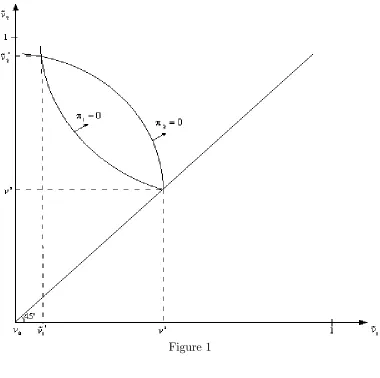
Example 1 There are two bidders whose valuations are distributed according to F(v) =v4 on [0;1]; and the participation cost is 0:4.
It turns out that, for this example, the optimal auction is asymmetric. The optimal cuto¤s are ev1 :816 and ve2 :92; yielding a pro…t of :2525 for the seller. If we impose symmetry, however, the seller’s pro…t decreases to :25155
(with the optimal symmetric cuto¤vs :868). Notice the allocative ine¢
-ciency of the optimal auction that we mentioned before. When the valuations of both bidders are between ev1 and ve2, the …rst bidder will obtain the object even when her valuation is less than that of the second bidder.
We use Figure 1 not only to explain why the optimal auction is asymmetric for this example, but also to provide some pictorial intuition for Proposition 1 below and its proof. Let i denote the marginal pro…t of the seller with
respect to bidder i’s cuto¤, i.e., i = @ s(@veev1;ev2)
i , i = 1;2. First order necessary
conditions for optimality are satis…ed, i.e., 1 = 2 = 0, at two points: (vs; vs) and (ev1;ev2). However, (vs; vs) is not even a local maximizer. At any point to the right (respectively, left) of the 1 = 0 curve, the seller can increase her pro…t by decreasing (respectively, increasing) the …rst bidder’s cuto¤ while keeping the second bidder’s cuto¤ constant.36 Similar arguments apply for the second bidder’s cuto¤ above and below the 2 = 0 curve. Therefore, starting from the optimal symmetric cuto¤s(vs; vs), decreasingev
1while simultaneously increasing ve2 by an appropriate amount, i.e., moving inside the lens-shaped area, will increase the seller’s pro…t.37
From this discussion, it is clear that the existence of such a lens-shaped area emanating from(vs; vs)in the admissible side of the constraint boundary (where ev2 ev1) is a su¢ cient condition for the suboptimality of symmetric cuto¤s, which gives us our next result.
Proposition 1 (ASYMMETRY) If FJ((vv)) is decreasing at the optimal sym-metric cuto¤ vs, then the optimal auction is asymmetric. Moreover, for every
k 2 f1;2; :::; n 1g, there is an auction where k bidders use one cuto¤ (evi =
a < vs for i= 1; :::; k) and the remaining bidders use another one (ev
i =b > vs
fori=k+1; :::; n) that gives the seller higher pro…t than the optimal symmetric auction (evi =vs 8i2N).
We prove Proposition 1 (in the Appendix) by showing that, starting from the optimal symmetric cuto¤s, the seller can increase her pro…ts by decreasing an arbitrary group of bidders’cuto¤s and increasing the cuto¤s of the comple-mentary set of bidders, as long as FJ((vv)) is decreasing. In other words, if FJ((vv)) is decreasing at vs, then a lens-shaped improvement area, like that of Figure 1,
will exist for any partition of bidders into two groups.
In order to gain some understanding of why asymmetry may be bene…cial to the seller, consider the optimal symmetric cuto¤s in the two-bidders case. Suppose we decrease the …rst bidder’s cuto¤ slightly and increase the second bidder’s cuto¤ so that the total expected participation cost incurred remains the same. This has an obvious negative e¤ect: The object is sometimes sold to a low (virtual) valuation bidder 1 instead of a high valuation bidder 2
36Note that we have
11<0, using the standard notation for second derivatives.
37The optimal cuto¤s are indeed given by(ev
1;ev2), where the second order su¢ cient
(when she is not participating). However, there is also a positive e¤ect: Total probability of selling the object increases.38 Our su¢ cient condition ensures that this positive e¤ect outweighs the negative one.
It seems that these intuitive arguments should also work when c= 0, but we know that the optimal auction is symmetric in this case. What is special about positive c? When c = 0 the virtual valuation is zero at the optimal symmetric cuto¤.39 Therefore, decreasing a bidder’s cuto¤ results in selling the object to her even when her virtual valuation is negative, reducing the seller’s revenue, see (6). In contrast, the virtual valuation for the bidder with the lower cuto¤ is still positive when c >0.
An asymmetric auction does not always assign the object to the bidder with the highest valuation, causing allocative ine¢ ciency. If there are no participation costs, the optimal auction will have this type of ine¢ ciency only when bidders are heterogenous. However, even in that case the object is always assigned to the bidder with the highest virtual valuation, unlike the solution in our setup.40
When there are more than two bidders, Proposition 1 goes further than identifying a su¢ cient condition for the suboptimality of symmetric cuto¤s. It shows that, whenever this condition is satis…ed, even an arbitrary classi…cation of the bidders into only two groups and implementation of a di¤erent cuto¤ for each group would improve over the optimal symmetric outcome. We …nd this observation relevant for analyzing the performance of auctions where one group of bidders receives preferential treatment from the seller. For example, domes-tic …rms are sometimes given a price preference in government procurement (see McAfee and McMillan, 1989), and minority and women owned businesses received bidding credits and guaranteed …nancing in some FCC auctions (see Ayres and Cramton, 1996). We will come back to the preferential treatment issue when we discuss implementing asymmetric auctions in Section 3.
Our su¢ cient condition for the asymmetry of the optimal auction depends on both the magnitude of the participation cost and the number of bidders through the optimal symmetric cuto¤vs. For certain distribution functions
(for example, uniform with vh < 2vl) this su¢ cient condition will always be
38Letev
1 < vs<ev2, where2F(vs) =F(ve1) +F(ve2). The probability of making a sale is
1 F(vs)2when the cuto¤s are symmetric, and1 F(ve
1)F(ev2)when they are asymmetric.
The latter is larger than the former, sinceF(vs)2 F(ev
1)F(ev2) =F(vs)2 F(ev1)(2F(vs)
F(ve1)) = (F(vs) F(ev1))2>0. 39This is the case unlessv
0=vl(withJ(vl)>0) making it impossible to even create the
type of asymmetry we are considering.
satis…ed, i.e., the optimal auction will be asymmetric regardless of the partic-ipation cost level and the number of bidders.41
Corollary 1 If FJ((vv)) is decreasing on(vl; vh), then the optimal auction is
asym-metric (independent of c and n).
The optimal auction is symmetric when c = 0, with the cuto¤ v0. The corollary identi…es cases where even an in…nitesimally small c causes the op-timal auction to be asymmetric. However, the asymmetry will also be small: As c approaches to 0, bidders’ optimal cuto¤s all approach to v0. In other words, even though there is no “continuity” in the symmetry property of the optimal auction atc= 0, there is continuity in terms of outcomes, and hence the seller’s pro…t.
We next turn our attention to conditions under which the optimal auction is symmetric.
Proposition 2 (SYMMETRY) The optimal auction is symmetric for all
c (and n), i.e., evi = vs 8i 2 N, if and only if FJ((vv)) is weakly increasing on
(v0; vh).
The necessity part of the result is a consequence of Proposition 1. If FJ((vv)) is not weakly increasing at some v0 in (v
0; vh), then, for any given number of
bidders, we can …nd a participation cost level for which the optimal symmet-ric cuto¤vs equals to v0, so that the su¢ cient condition of Proposition 1 is
satis…ed, i.e., the optimal auction is asymmetric.42
The main interest in Proposition 2 stems from the su¢ ciency part. If the distribution of valuations is such that FJ((vv)) is weakly increasing on the relevant range, then the optimal auction is symmetric and hence completely characterized: Each bidder has the same participation cuto¤ vs, as de…ned
in (10). For this result, obviously, it is not enough to consider only local improvements around vs. In order to gain some understanding for the result
and the condition, consider the two bidders case with asymmetric cuto¤s, i.e.,
e
v1 < ev2. Suppose the seller increases ev1 and decreases ev2 slightly in such a way that total participation cost incurred stays the same. As a result of these changes in the cuto¤s, the seller’s pro…t from bidder 1 (net of the participation
41Since v
0 < vs < vh, we need FJ((vv)) to be decreasing only on (v0; vh) for this result.
However, whenv0> vl, FJ((vv)) cannot be decreasing on (v0; vh)(since FJ((vv0)0) = 0and
J(vh)
F(vh)= vh), so this case is irrelevant.
42We can see from the de…nition of vs in (10) that vs is a continuous and increasing
function ofc(for any givenn), wherevs!v
cost) decreases by J(ev1)F(ev2) +
Rev2
e
v1 J(v)f(v)dv, where the …rst term arises from increasingev1 slightly and the second term is the result of types in(ev1;ev2) receiving the object with a lower probability due to a decrease in ve2. This loss is bounded above by J(ev1)F(ve2) +J(ve2)[F(ev2) F(ev1)]. On the other hand, the pro…t from bidder 2 (again, net of the participation cost) increases by J(ev2)F(ev2) due to the decrease in ev2. Therefore, the seller’s pro…t will increase if J(ev2)F(ev1) J(ev1)F(ev2) 0, or FJ((veev2)
2)
J(ev1)
F(ev1).
Remark 2 For distribution functions that satisfy the monotone hazard rate condition (1fF(v()v) is decreasing), if F(vv) is increasing, then so is JF((vv)). Therefore, if vl = 0, F(v) is concave and satis…es the monotone hazard rate condition,
then the optimal auction will be symmetric.
We next present two results about the nature of (possible) asymmetries in the optimal auction. First, we show that, when the su¢ cient condition for the asymmetry of the optimal auction in Corollary 1 is satis…ed, only one bidder will have the lowest cuto¤. Second, we identify a class of distribution functions for which the optimal auction is either symmetric or uses only two cuto¤s. Notice that both of these results are independent of the number of bidders and the magnitude of the participation cost, and they simplify the task of …nding the optimal auction considerably whenever they apply.
Proposition 3 i) If JF((vv)) is decreasing on (vl; vh), then in the optimal auction
only one bidder has the lowest cuto¤, i.e., evi >ev1 for all i2 f2; :::; ng. ii) If J0(v)F(v)
f(v) is weakly increasing on (v0; vh), then the optimal auction
has at most two distinct cuto¤s.
The proof of part (i) parallels that of Proposition 1: If FJ((vv)) is decreasing and two or more bidders are using the lowest cuto¤, the seller can increase her pro…t by splitting these bidders into two arbitrary groups and setting a di¤erent cuto¤ for each group. In a similar fashion, we can …nd conditions for optimality of separating or bunching di¤erent bidders who are using cuto¤s other than the lowest one. There is one additional complication: Changing the lowest cuto¤ a¤ects the seller’s rent extraction only from bidders using that cuto¤, since it does not alter the expected probability of winning for the other bidders. However, changing a higher cuto¤ also a¤ects the seller’s revenue from bidders using lower cuto¤s than the modi…ed one. Therefore, conditions regarding bunching bidders at higher cuto¤s are di¤erent from conditions for bunching them at the lowest cuto¤: Having J0(v)F(v)
2.4
Uniform Distributions
In this section, using our previous results, we characterize optimal auctions when bidders’valuations are uniformly distributed and provide some compar-ative statics results.
We have n 2 bidders whose valuations are uniformly distributed on
[vl; vh], where 0 vl < vh, i.e., F(v) = vv vl
h vl. The participation cost is
c2 (0; vh). The virtual valuation function is given by J(v) = 2v vh, which
is increasing. If 2vl vh 0, then v0 = vl; otherwise v0 = v2h. When c = 0, the object is assigned to the highest valuation bidder in the optimal auction as long as her valuation is higher thanv0.
We …rst observe that J0(v)F(v)
f(v) = 2 (v vl) is increasing. Therefore, at most two distinct cuto¤s will be used in the optimal auction (Proposition 3ii). We next note that FJ((vv)) = (2v vh)(vh vl)
v vl is either weakly increasing (ifvh 2vl)
or decreasing (ifvh <2vl) on the entire support[vl; vh]. So, if vh 2vl, then it
follows from Proposition 2 that the optimal auction is symmetric. The optimal cuto¤s are given by ev1 =:::=evn =vs, where
J(vs)F(vs)n 1 = (2vs vh)(
vs vl
vh vl
)n 1 =c.
If vh < 2vl, then the optimal auction is asymmetric (Corollary 1) with
exactly two cuto¤s. Moreover, only one bidder will have the lower cuto¤ (Proposition 3i). Using these, solving the seller’s problem becomes a straight-forward exercise. We provide the solution here for completeness. Let ev1 = a
and ev2 =:::=evn=b > a.
Ifc minfvh vl; (2vl vh)
n
(vh vl)n 1g, thena =vl and b =vl+c
1
n(vh vl) n 1
n .
Ifvh vl < c <2vl vh, then a=vl and b=vh.
If (2vl vh)n
(vh vl)n 1 < c < 3vh 4vl, then a satis…es (2a vh)(
a+vl vh
vh vl )
n 1 = c and b=a+ 2vl vh.
Ifc maxf2vl vh;3vh 4vlg, then a= vh2+c and b=vh.43
Note that the optimal cuto¤s are weakly increasing in n. If vh 2vl,
then the optimal auction is symmetric, and as n increases the seller chooses to restrict participation symmetrically, i.e., vs is increasing in n with vs
!vh
43Note that when v
h < 2vl we have, vh vl < (2vl vh)
n
(vh vl)n 1 , vh vl < 2vl vh ,
(2vl vh)n
as n ! 1. If vh < 2vl, both a and b are weakly increasing in n, and b !vh
as n! 1.
The optimal cuto¤s are also weakly increasing in c. All cuto¤s approach
v0 as c!0 and vh asc!vh.
Dealing exclusively with one bidder, or “sole-sourcing,”is a commonly ob-served phenomenon in government procurement. In our setting, sole source contracting emerges as an optimal response to high participation costs in cer-tain cases: Whenever the optimal auction is asymmetric, the seller deals with one of the bidders exclusively when the participation cost is high enough. Ob-serve that this threshold cost level, and hence whether sole-sourcing is optimal or not, is independent of the number of bidders.
3
Implementing the Optimal Auction
Our objective in this section is to show that using common auction formats, augmented with “familiar” instruments or variations, can be optimal for the seller.44 This task is trivial if the optimal auction is symmetric, i.e., each bidder has the same cuto¤ vs, de…ned in (10). The standard auctions, e.g., …rst
and second price auctions (FPA and SPA, respectively), with appropriately chosen reserve price and/or entry fee will be optimal. To see this, let rdenote the reserve price and ce e¤ective participation cost, i.e., ce is the sum of the
participation cost c and the entry fee (which could be negative, implying an entry subsidy). Supposer and ce satisfy the following equation:
(vs r)F(vs)n 1 =ce. (11)
Both FPA and SPA, withr and ce satisfying (11), are optimal, since each has
a symmetric equilibrium where all bidders use the participation cuto¤vs (at which their expected payo¤s are zero) and their bids are increasing in their valuations, implying that the highest-valuation participant receives the object. Our results concerning second price auctions are valid also for English auctions as long as bidders make the (costly) participation decision prior to the start of bid calling, which is assumed to be costless: Participating bidders will bid their valuations in all (undominated) equilibria regardless of what they observe about the set of participants.
44We will not be concerned with “strong implementation”in what follows. So, we call an
The seller can accomplish her goal in a simple way that also works when the optimal auction is asymmetric. Consider a SPA where each bidder has an individualized reserve price given by her optimal cuto¤ (only bids exceeding her reserve price are allowable), and an entry subsidy ofcis provided to any bidder who submits an allowable bid, i.e., the e¤ective participation cost is zero. There is an equilibriumin dominant strategies where bidders participate (and bid their valuations) i¤ their valuations are greater than their respective reserve prices. This gives the seller her maximal pro…t, since the object is assigned to the highest-valuation participant and bidders use the optimal cuto¤s where their expected payo¤s are zero.
We nevertheless believe that further investigation of implementing asym-metric optimal cuto¤s is a worthwhile endeavor for two reasons. First, the above auction is not anonymous, i.e., the bidders are not treated identically by its rules. Second, even when non-anonymous auctions are used in prac-tice (we provide a few examples below), bidder-speci…c reserve prices have never been employed, to the best of our knowledge. In what follows, we will …rst show that under some conditions the seller can obtain her maximal pro…t by using an anonymous auction. We will then discuss some non-anonymous auctions that resemble the ones that are actually observed in practice.
3.1
Anonymous Second Price Auctions
There may be multiple equilibria (in undominated strategies) in SPAs with costly participation even in the symmetric independent private values envi-ronment we are considering.45 In any equilibrium in undominated strategies, bidders employ cuto¤ rules in participation and bid their valuations whenever they submit a bid. There is always a symmetric equilibrium where the cuto¤s used are all identical, but there may be asymmetric equilibria as well. There-fore, it may be possible for the seller to achieve her optimal pro…t level in an asymmetric equilibrium of an anonymous SPA. To demonstrate this point, we return to Example 1, where there are two bidders, F(v) = v4 on [0;1], and
c = 0:4. The optimal auction is asymmetric, with ev1 :816 and ev2 :92. Now, consider a SPA with reserve price r :598 and e¤ective participation cost ce :156 (there is an entry subsidy). There is an equilibrium where one
of the bidders participate i¤ her valuation is greater than :816, the other use
:92as her cuto¤, and both bid their valuations whenever they participate.46 In
45See Campbell (1998) and Tan and Yilankaya (2006) for conditions under which this
would happen.
this equilibrium, the highest-valuation participant receives the object. In ad-dition, the expected payo¤s of bidders are zero at their respective cuto¤s, since these are determined by indi¤erence (to participation) conditions. Therefore, the seller obtains her optimal pro…t.
This example can be generalized as follows:
Proposition 4 Suppose that the optimal auction has two cuto¤s, and that the monotone hazard rate condition is satis…ed (1fF(v()v) is decreasing). An anonymous second price auction (with appropriately chosen reserve price and e¤ective participation cost) has an equilibrium in undominated strategies that is optimal for the seller.
Two cuto¤ requirement is obviously an important restriction.47 However, we know that under some conditions the optimal auction will indeed have at most two distinct cuto¤s (Proposition 3ii provides a su¢ cient condition). Moreover, whenever our su¢ cient condition for the asymmetry of the optimal auction is satis…ed, the seller needs to implement only two distinct cuto¤s to improve over the optimal symmetric cuto¤vs(Proposition 1), which can again
be accomplished by using an anonymous SPA.48
We use the optimality of the cuto¤s and the monotone hazard rate condi-tion to make sure that the reserve price is nonnegative. If we do not impose this restriction (a negative reserve price implies that a bidder gets a subsidy if she is the only participant), then no assumptions are needed: Virtually all arbitrary pairs of cuto¤s are equilibrium cuto¤s for some anonymous second price auction.49
3.2
Di¤erential E¤ective Participation Costs
Not all bidders incur the same participation cost in all auctions, and sometimes this happens by the design of the seller. One obvious way of doing this is by charging bidders di¤erent entry fees. There are also indirect ways. The seller may provide guaranteed …nancing for some bidders, thus saving them the …xed costs associated with credit arrangements. This was done, for example, in the FCC spectrum auctions; see, e.g., Ayres and Cramton (1996). Also, the rules
47For example, when there are three bidders, F(v) = v4 on [0;1], and c = 0:327, the
optimal auction has three distinct cuto¤s and cannot be implemented using an anonymous SPA with anyrandce pair.
48The proof of this result is contained in our proof of Proposition 4 in the Appendix. 49The only exception is if the lower cuto¤ is v
l and two or more bidders are supposed
of the auction may be such that some bidders face higher participation costs. For example, participation costs of foreign …rms are sometimes increased in government procurement by imposing residency requirements, giving a very tight deadline for submission of bids, etc.; see, e.g., McAfee and McMillan (1989).
If the seller can induce di¤erential e¤ective participation costs, then a SPA or FPA will be optimal for the seller. We demonstrate these for the two-bidders case for expositional simplicity. Let ev1 be the cuto¤ of bidder 1 and ev2 > ev1
that of bidder 2 in the optimal auction. Consider the SPA withr=ev1,ce1 = 0, and ce
2 =
Rev2
e
v1 F(v)dv, where c e
i is the e¤ective participation cost of bidderi. It
is a dominant strategy for the …rst bidder to participate and bid her valuation i¤ her valuation is greater than ev1. Given this, the second bidder’s expected payo¤ (forv2 >ev1) if she participates and bids her valuation is
(v2 ev1)F(ev1) +
Z v2
e
v1
(v2 v)dF(v) ce2 =
Z v2
e
v1
F(v)dv ce2.
Note that ce2 is chosen in such a way that bidder 2 participates (and bids her valuation) i¤ her valuation is greater thanev2. Therefore, the seller obtains her maximal pro…t.50
The seller can also achieve her goal by using the FPA with r =ev1, ce1 = 0, and ce
2 =
Rev2
e
v1 F(ev2)dv, since there is an equilibrium of this auction where i uses evi as her cuto¤ (at which her expected payo¤ is zero) and both bidders use the same strictly increasing bid function for types greater thanev2, so that the highest-valuation participant receives the object.51 To calculate the bid functions, and to see where these e¤ective participation costs are coming from, suppose such an equilibrium exists.52 Let Qi ( ) be i’s probability of winning function in this equilibrium (and hence in the optimal auction). From the
50For arbitrary n, the same method would yield the SPA with r =
e
v1 and cei =
iP1
j=1
nQ+1
k=j+1
k6=i
F(evk)
e
vjR+1
e
vj
F(v)jdv,8i2N.
51The equilibrium bid functions for arbitrarynare given by (14) as well, so the FPA with
r=ev1 andce i =
Revi e
v1 Q1(v)dv=
iP1
j=1
nQ+1
k=j+1
F(evk)
e
vjR+1
e
vj
F(v)j 1dv,8i2N;will be optimal. 52The bid functions we …nd below indeed constitute an equilibrium. The proof is identical
incentive compatibility conditions, we have, for v evi,
i(v) = Qi(v)v Pi(v) = Z v
e
vi
Qi(y)dy, (12)
where
Pi(v) = cei +bi(v)Qi(v) (13)
isi’s equilibrium expected payment andbi( )isi’s equilibrium bid. Combining
(12) and (13),
bi(v) =v Rv
e
vi Qi(y)dy+cei
Qi(v) . (14)
Notice thatb0
i(v)>0. Considerv >ev2. We haveQ1(v) = Q2(v) =F(v), since both participate and the highest-valuation participant wins, and so b1(v) =
b2(v)if ce1 = 0 and ce2 =
Rev2
e
v1 Q1(y)dy =
Rev2
e
v1 F(ev2)dv.
3.3
Bidding Preferences
In some government auctions certain groups of bidders are given explicit bid-ding preferences. For example, the Buy American Act of the US (and compa-rable provisions in other countries) gives bidding preferences to domestic …rms over foreign …rms in government procurement. Similarly, small businesses or in-state bidders are favored in some government auctions.
We now show that, in our setup, a FPA with bidding preferences could be optimal for the seller. To see this, …rst note that in the optimal auction, bidder i’s expected payment is given by, see (12) for example,
Pi(v) = Qi(v)v
Z v
e
vi
Qi(y)dy,
whereQi ( )isi’s probability of winning function (given by (8) and the optimal cuto¤s). Now consider the FPA withr=ev1 and e¤ective bid functions, for all
i2N,
i(b) = 8 > > < > > :
e
vi c
Qi(vi) ev1 b <vei
b Rb
e
v
i Qi(v)dv+c
Qi(b) evi b vh
b (Rvh
e
vi Qi(v)dv+c) vh < b
,
so that bidder i receives the object if her bid b is the highest bid (as long as it is higher than the reserve price ev1), but pays only her e¤ective bid i(b)
bidder i participates i¤ her valuation is higher than evi and all participating bidders bid their valuations, giving the seller her maximal pro…t. To see that this is indeed an equilibrium, suppose that all bidders butiare following their equilibrium strategies. Biddingevi is better than bidding anything lower, since the winning probability is higher (strictly, unless i= 1) and the e¤ective bid, i.e., the payment conditional on winning, is the same. Similarly, bidding vh
is better than bidding anything higher, since the winning probability is con-stant and the e¤ective bid is lower. Finally, note that i’s e¤ective bidding function is constructed so that if she bidsv0 2[evi; vh], then her expected
prob-ability of winning is Qi(v0) and her expected payment is P
i (v0), i.e., we have i(v0)Qi(v0) +c= Pi (v0). Since the optimal auction is incentive compatible
and individually rational, it is a best-response forito participate (and bid her valuation) i¤ her valuation is higher thanevi.
4
Appendix
Proof of Proposition 1. Fix an integer k such that 1 k < n. Suppose that the seller considers only two cuto¤ auctions, where the cuto¤ of the …rst
k bidders is a and the others’ is b a. The expected pro…t of the seller in terms of a and b is
R(a; b) =
Z b
a
J(v)F(b)n kdF(v)k+
Z vh
b
J(v)dF(v)n
kc(1 F(a)) (n k)c(1 F(b)).
Raa; Rbb < 0 at vs, using the standard notation for second derivatives. At
a=b=vs, using the fact thatR
a=Rb = 0,
Raa
Rab
= J
0(vs)F(vs) + (k 1)J(vs)f(vs)
(n k)J(vs)f(vs) >0,
Rab
Rbb
= kJ(v
s)f(vs)
J0(vs)F(vs) + (n k 1)J(vs)f(vs) >0.
Therefore, if FJ((vv)) is strictly decreasing at vs; then
0< Raa Rab
< Rab Rbb
, (15)
1; vs+ 2)> R(vs; vs).53
Proof of Proposition 2. The necessity part is straightforward and discussed in the text. For su¢ ciency, suppose to the contrary that FJ((vv)) is weakly increasing on (v0; vh), but the optimal auction is asymmetric, so that
at least two distinct cuto¤s are chosen. Consider two smallest cuto¤s: a v0 is used for bidders 1; :::; m, andb > a is used for bidders m+ 1; :::; m0, where 1 m < m0 n. From the …rst order condition fora,
c J(a)F(a)m 1F(b)m0 m
nQ+1
k=m0+1
F(vek) 0, (16)
which is satis…ed with equality whenevera > vl.
From the …rst order condition with respect to b,
c J(b)F(b)m0 1
nQ+1
k=m0+1
F(evk) +F(b)m0 m 1
nQ+1
k=m0+1 F(evk)
Z b
a
J(v)dF(v)m 0,
which is satis…ed with equality wheneverb < vh. Combining these, we have
J(a)F(a)m 1F(b) J(b)F(b)m
Z b
a
J(v)dF(v)m
> J(b)F(b)m J(b)(F(b)m F(a)m) = J(b)F(a)m,
or,
J(a) F(a) >
J(b) F(b),
which is a contradiction.
Proof of Proposition 3. i) Suppose by contradiction that ev1 is the cuto¤ of the …rstm >1bidders in the optimal auction. Let k be an arbitrary positive integer smaller thanm. Consider the class of auctions, where the …rst
k cuto¤s are equal to a, the followingm k cuto¤s are equal tob, and cuto¤s
m+ 1ton are given as evm+1 toevn, such thata < b <evm+1. We can write the
53At (vs; vs) we are on the boundary of the feasible set (b a constraint), so showing
that the Hessian is not negative de…nite at (vs; vs) would not have been su¢ cient. The
expected pro…t from such an auction as a function of a and b:
R(a; b) = k
Z b
a
J(v)[F(v)k 1F(b)m k
nQ+1
j=m+1
F(vej)]f(v)dv
+m
Z evm+1
b
J(v)[F(v)m 1
nQ+1
j=m+1
F(vej)]f(v)dv kc(1 F(a)) (m k)c(1 F(b))
+
n X
i=m+1
i
Z evi+1
e
vi
J(v)[F(v)i 1
nQ+1
j=i+1
F(evj)]f(v)dv
c
n X
i=m+1
(1 F(evi)).
The optimal auction must also be optimal within this class. Therefore,R(a; b)
is maximized ata=b =ev1. First, note that, since FJ((vv)) is decreasing on[vl; vh],
the optimal auction is asymmetric (Corollary 1), i.e., ev1 < vh. Note also that e
v1 > vl, since when a=b =vl, the …rst order condition for a is violated, i.e.,
Ra(vl; vl) =kf(vl)[c J(vl)F(vl)m 1 nQ+1
j=m+1
F(evj)]>0,
since F(vl) = 0 and f(vl) > 0. Hence, a = b = ev1 could satisfy the …rst order necessary conditions only at an interior point. Following the proof of Proposition 1, note that, ata =b =ev1, we have
Raa
Rab
= J 0(v
1)F(v1) + (k 1)J(v1)f(v1)
(m k)J(v1)f(v1) >0,
Rab
Rbb
= kJ(v1)f(v1)
J0(v
1)F(v1) + (m k 1)J(v1)f(v1)
>0.
Therefore, if J0(ev1)F(ev1) < J(ev1)f(ve1), i.e., FJ((vv)) is decreasing at ev1, then
Raa
Rab <
Rab
Rbb at a = b = ev1, implying that a = b = ev1 cannot be optimal, a
contradiction.
ii) The proof is by contradiction. Suppose to the contrary that at least three cuto¤s are used in the optimal auction, and consider three smallest of these cuto¤s, vl a1 < a2 < a3 vh, where the number of bidders using
with respect to the cuto¤s ofn1 bidders who usea1 v0 (using (9)), we have
c J(a1)F (a1)
n1 1
F(a2)n2F(a3)n3
nQ+1
j=n1+n2+n3+1
F(evj) 0, (17)
with equality if a1 > vl.
From the …rst order condition with respect to the cuto¤s of bidders using
a2,
c [J(a2)F(a2)n1 n1
Z a2
a1
J(v)F(v)n1 1f(v)dv]
F(a2)n2 1F(a3)n3
nQ+1
j=n1+n2+n3+1
F(evj) = 0,
or, after integration by parts,
c= [J(a1)F (a1)
n1
+
Z a2
a1
J0(v)F(v)n1dv]F(a
2)n2 1F(a3)n3
nQ+1
j=n1+n2+n3+1
F(evj). (18) Finally, from the …rst order condition with respect to a3 bidders,
c [J(a3)F(a3)n1+n2 n1
Z a2
a1
J(v)F(v)n1 1F(a
2)n2f(v)dv
(n1+n2)
Z a3
a2
J(v)F(v)n1+n2 1f(v)dv]F(a 3)n3 1
nQ+1
j=n1+n2+n3+1
F(evj) 0,
or, after integration by parts,
c [J(a1)F (a1)
n1
F(a2)n2 +
Z a2
a1
J0(v)F(v)n1F(a
2)n2dv+
Z a3
a2
J0(v)F(v)n1+n2dv]F(a 3)n3 1
nQ+1
j=n1+n2+n3+1
F(evj). (19)
From (17) and (18),
J(a1)F(a1)n1 1[F(a2) F (a1)]
Z a2
a1
J0(v)F(v)n1dv.
0 or the above inequality holds as an equality. In either case,
J(a1)F (a1)
n1
= F(a1) F(a2) F (a1)
Z a2
a1
J0(v)F(v)n1dv.
Adding Ra2
a1 J
0(v)F(v)n1dv to both sides,
J(a1)F (a1)
n1
+
Z a2
a1
J0(v)F(v)n1dv= F(a2)
F(a2) F(a1)
Z a2
a1
J0(v)F(v)n1dv.
(20) Similarly, from (18) and (19), we have
J(a1)F (a1)n1 +
Z a2
a1
J0(v)F(v)n1dv
Ra3
a2 J
0(v)F(v)n1+n2dv
F(a2)n2 1[F(a3) F(a2)]
> F(a2)
Ra3
a2 J
0(v)F(v)n1dv
F(a3) F(a2) ,
where the strict inequality follows from the fact thatF(v)is larger thanF(a2) on[a2; a3]. Together with equality (20), this last inequality yields
Ra2
a1 J
0(v)F(v)n1dv
F(a2) F (a1)
>
Ra3
a2 J
0(v)F(v)n1dv
F(a3) F(a2) ,
or,
'(x2) '(x1)
x2 x1
> '(x3) '(x2) x3 x2
, (21)
where xi =F(evi) and '(x) =
RF 1(x)
0 J0(v)F(v)
n1dv. Now notice that,
'0(x) = J
0(F 1(x))F(F 1(x))n1
f(F 1(x)) >0,
and '00(x) 0 (since J0(v)Ff((vv)) is weakly increasing), which contradicts (21).