Journal of Education and Training Studies Vol. 4, No. 1; January 2016 ISSN 2324-805X E-ISSN 2324-8068 Published by Redfame Publishing URL: http://jets.redfame.com
150
Interrelationship between Attachment Styles and Facebook Addiction
Yuksel ErogluCorrespondence: Yuksel Eroglu, School of Education, Bayburt University, Bayburt, 69000, Turkey
Received: September 10, 2015 Accepted: September 28, 2015 Online Published: October 13, 2015 doi:10.11114/jets.v4i1.1081 URL: http://dx.doi.org/10.11114/jets.v4i1.1081
Abstract
Social networking sites have started to become one of the most frequently used online communication types in the world. It is reported that one of the commonly used social networking sites is Facebook. Since Facebook use is new yet, it can be stated that researches on the Facebook addiction are at the beginning level. For this reason, determining factors leading to the Facebook addiction has gained importance. In this context, in this study, relationships between attachment styles and the Facebook addiction were examined. The participants of the study were 322 university students [145(45%)
male, 177(55%) female, Mage=20.61 years, SD=1.82]. In the study, the Personal Information Form, the Relationship
Scales Questionnaire and the Facebook Addiction Scale were administered. The relationships between attachment styles and the Facebook addiction were calculated via using the Pearson correlation analysis. The Pearson correlation analysis results indicated that the Facebook addiction was negatively related with the secure and dismissing attachment style and positively related with the preoccupied attachment style. No relationship was found between the fearful attachment style and the Facebook addiction. If the attachment styles predicted the Facebook addiction was examined via using the stepwise regression analysis. The research findings indicated that the secure and dismissing attachment style negatively predicted and the preoccupied attachment style positively predicted the Facebook addiction. However, it was determined that the fearful attachment style did not predict Facebook addiction. The research findings were discussed under the light of related literature.
Keywords: attachment styles, facebook addiction, stepwise regression analysis 1. Introduction
1.1 Facebook Addiction
Social networking sites have become an indispensible part of the lives of many people. Social networking sites provide individuals with the opportunity to create profiles which are completely or partly open to public, add individuals with whom they want to establish communication in their lists of friends and establish communication with people whom they have added to their lists of friends in various ways (Boyd & Ellison, 2007). Besides this, individuals can share their personal information, emotions, thoughts, photos and videos through social networking sites. Moreover, social networking sites provide individuals with many environments where they can entertain (Joinson, 2008).
Researchers report that one of the social networking sites commonly used throughout the world is Facebook. It was explained that the number of active Facebook users was 1.48 billion per month in the second quarter of 2015 (Facebook, 2015). Like other social networking sites, Facebook, too, provides many opportunities at the point of creating profiles, sharing personal information and establishing close relationships. In Facebook, individuals can establish communication with other individuals through status update, poking, sharing something on their walls and sending personal messages (Papacharissi & Mendelsohn, 2011). Besides this, by using Facebook, individuals can set up groups or form activities, participate in formed groups and activities and tag their friends' photos (Foregger, 2008). Briefly, Facebook provides individuals with the opportunity to establish communication with their families and friends, helps them become aware of what is going on in the world and offers the possibility of expressing their own statuses (Facebook, 2015).
Journal of Education and Training Studies Vol. 4, No. 1; January 2016
151
social relationships (Hong, Huang, Lin & Chiu, 2014; Kim, Sohn, & Choi, 2011; Kuss, Griffiths & Binder, 2013). In this direction, it can be stated that as individuals' need to maintain their online friendships increases, the possibility of becoming a Facebook addict increases (Hong et al., 2014). In conclusion, it is observed that the use of Facebook, achieving the fulfilment of various needs, may reach addiction level (Andreassen, Torsheim, Brunborg & Pallasen, 2012; Kuss & Griffiths, 2011).
Facebook addiction is defined as having difficulty in controlling and limiting the time spent in Facebook (Lee, Cheung & Thadani, 2012). Moreover, Andreassen et al. (2012) list the symptoms of the Facebook addiction as mood modification, salience, tolerance development, withdrawal, conflict and relapse. Mood modification involves using social networking sites to create useful changes in an emotional. Salience involves one's giving all his/her attention to the use of social networking sites at cognitive, emotional and behavioral levels. Tolerance development covers extremely increasing the amount of using social networking sites. Withdrawal points to experiencing unpleasant physical and emotional symptoms when one cannot access social networking sites or is restricted to enter social networking sites. Conflict denotes living problems in home and work life, social relationships and other activities due to the use of social networking sites. Relapse points to one's not giving up using social networking sites although s/he tries to give up (Andreassen et al., 2012).
Kuss and Grififths (2011) stated that the Facebook addiction leads to psychological and social problems in an individual's life. Moreover, Facebook causes individuals to live problems in their school and work life. In the qualitative study carried out by Karaiskos, Tzavellas, Balta and Paparrigopoulos (2010), it was mentioned about a woman losing her job because of using Facebook for at least 5 hours a day. Sagioglou and Greitemeyer (2014) reported that Facebook affected individuals' emotional situations negatively. According to Sagioglou and Greitemeyer (2014), the reason for this is their not appreciating the value of time and thinking that they are busy with useless things in Facebook (Sagioglou and Greitemeyer, 2014). Kross et al. (2013) stated that the Facebook addiction decreases individuals' feelings of living the moment and their life satisfaction. Moreover, Bevan, Gomez and Sparks (2014) indicated that the Facebook addiction decrease individuals' life satisfaction. Besides this, there are also studies reporting that the Facebook addiction is associated with depression (Hong et al., 2014). The Facebook addiction's affecting all dimensions of individuals' lives seriously have directed researchers to investigate predictors of the Facebook addiction. In the literature, as the predictors of the Facebook addiction are emphasized personality, narcissism, low self-esteem, shyness, introvertedness and loneliness (Cao & Su, 2007; Hughes, Rowe, Batey, & Lee, 2012; Lavin, Yuen, Weinman & Kozak, 2004).
1.2 Attachment Styles
The concept of attachment points out the natural tendency toward creating closeness and emotional attachment with important figures (Bowlby, 1977). It is stated that attachment relationships are based on basic figures formed in infancy and show themselves in adult life by going beyond childhood as well. Individuals create cognitive representations about themselves and others by encoding their early experiences which they live with basic attachment figures. Individuals' cognitive representations about themselves and others are called internally working models (Bartholomew & Horowitz, 1991; Bowlby, 1980). Attachment schemes created in childhood affect individuals' perceptions, emotions and expectations in interpersonal relationships (Shaver & Hazan, 1993) and are called adult attachment styles (Bartholomew and Horowitz, 1991). The model developed by Bartholomew and Horowitz (1991) in relation to adults' attachment styles includes four dimensions (secure, dismissing, fearful and preoccupied). This four-dimensional model is composed of the combination of individuals' negative and positive points of view about themselves and others (Bartholomew & Horowitz, 1991).
It is stated that adult attachment is based on two basic dimensions, namely anxious and avoidance (Fraley, Waller, & Brennan, 2000; Mikulincer & Shaver, 2007). An individual's having both dimensions at low level indicates secure attachment. Securely attached individuals have positive internally working models about both themselves and others. These individuals feel secure in their close relationships, cope with stress actively and believe that other individuals will support them when they need (Mikulincer & Florian, 1995). The anxious dimension includes extreme fear of rejection and the salient dimension includes using the strategies (hyperactiviting strategies) to achieve getting closer to others. The anxious dimension is characterized by negative view of self and oversensitivity to rejection and the salient is characterized by extremely focusing on others' reactions. The avoidance dimension is based on the rejection of the need for closeness and the salient covers suppressing behaviors related to getting closer to others (deactiviting strategies). In the avoidance dimension, having a negative view of other individuals, inhibiting the need for establishing relationships and emphasizing autonomy are mentioned (Mikulince & Shaver, 2007).
Journal of Education and Training Studies Vol. 4, No. 1; January 2016
152
styles are discussed as an important regulator of an individual's behaviors (Mikulincer & Shaver, 2007). For this reason, in studies made, it is eye-catching that many psychological constructs such as depression (Lee & Koo, 2015), anxiety (Mikulincer & Shaver, 2007), autism (Gallitto & Leth-Steensen, 2015), eating disorders (Pepping, O’Donnovan, Zimmer-Gembeck, & Hanisch, 2015), problematic internet use (Debernardi, 2012; Odacı & Çıkrıkçı, 2014), antisocial behaviors (Oshri, Sutton, Clay-Warner, & Miller, 2015) and burnout (Leiter, Day, & Price, 2015) are discused as a function of individual differences in the attachment styles. In this context, Hart, Nailling, Bizer and Collins (2015) state that the attachment styles can be discussed as one of the individual factors accounting for individuals' cognitive, emotional and motivations based on their behaviors in social networking sites.
1.3 Purpose of the Study
Social compensation hypothesis (McKenna, Green, & Gleason, 2002) puts forward that individuals having difficulty in establishing social relationships in real life tend towards online communication in order to meet these needs of theirs. Online communication provides individuals with many opportunities at the points of hiding identity, introducing themselves in any way they like and ignoring reactions of people with whom they establish communication. For this reason, it can be put forward that individuals having difficulty in establishing close social relationships may tend towards Facebook in order to meet these needs of theirs and this may result in addiction. In this context, in this study, it was hypothesized based on the social compensation theory that the Facebook addiction was negatively related with the secure attachment style and positively related with the dismissing, preoccupied and fearful attachment style (McKenna et al., 2002).
2. Method
2.1 Research Model
In this study, the relationships between the attachment styles and the Facebook addiction were examined based on the descriptive relational model. The data was collected from univesity students via using the measurement tools based on self-report. In the study, the cross-sectional model providing information about the current statuses of the participants was used.
2.2 Participants
In the study participated a total of 322 students, 145 male (45%) and 177 female (55%), taking education at the Education, Engineering, Economics and Administrative Sciences and Sciences and Arts faculties of Uludag University. 88 of the participants were the 1st year (27%), 69 were the 2nd year (21%), 74 were the 3rd year (23%) and 91 were the 4th year (29%) students. The mean age of the participants aged between 18-33 years old was found as 20.61±1.82. Only the participants having a Facebook account was included in the study. The average weekly internet use of the participant individuals was found as 172.31±4.42 hours.
2.3 Data Collection Tools
In the study, as data collection tools were used the Personal Information Form, the Relationship Scales Questionnaire and Bergen Facebook Addiction Scale.
2.3.1 Personal Information Form
In this form, there are questions about gender, age, class, average weekly internet use duration and having a Facebook account or not.
2.3.2 Bergen Facebook Addiction Scale (BFAS; Andreassen et al., 2012)
BFAS includes 18 items and individuals state the extent to which they agree to the items by using a Likert type grading varying from 1 (Very rarely to) to 5 (5: Very often). High scores obtained from BFAS indicate high Facebook addiction. The scale is composed of the sub-dimensions of salience, mood modification, tolerance, withdrawal, conflict and relapse. The reliability of the original form of the scale was found as .83. Its adaptation into Turkish was made by Akın, Demirci, Akın, Ocakcı, Akdeniz and Akbaş (2013). The findings obtained from the adaptation study (Akın et al., 2013) indicate that BFAS is a valid and reliable measurement tool which can be used in a Turkish sample with the purpose of measuring the Facebook addiction. The internal consistency reliability coefficient of the Turkish version of the BFA was determined as .93 (Akın et al., 2013).
2.3.3 Relationship Scales Questionnaire (Griffin & Bartholomew, 1994)
Journal of Education and Training Studies Vol. 4, No. 1; January 2016
153
7-point Likert type grading (1=does not define me in any way, 7=exactly defines me). According to the Relationship Scales Questionnaire, a participant is evaluated as having an attachment style if they get a high score from that attachment style. In the validity and reliability study which Sümer and Güngör (1999) carried out in a Turkish sample, they determined that the scale, similarly to its original form, was composed of four sub-dimensions, namely secure, dismissing, preoccupied and fearful attachment styles. Sümer and Güngör (1999) examined the reliability of the scale by using both the Cronbach's alpha internal consistency coefficient and the test-retest reliability. In their study, Sümer and Güngör (1999) determined that the test-retest reliability coefficients of the scale varied between .54 and .78 and the internal consistency coefficients varied between .27 and .61. In other studies made in Turkey (Arslan, Arslan, & Arı, 2012; Deniz, 2006; Gündüz, 2013; Ilhan, 2012; Odacı and Çıkrıkçı, 2014; Şimşek, 2011), too, it was observed that the internal consistency coefficients of the sub-scales were at low level. Griffin and Bartholomew (1994) stated that this resulted from the sub-scales' including the model belonging both to self and others together. Griffin and Bartholomew (1994) indicated that although the internal coefficients of the sub-scales were low, their construct validities were at sufficient level.
2.4 Data Collection
The data was collected in the 2014-2015 academic year. Before participating in the study, the participants were informed about the purpose of the study and the participation in the study was based on voluntariness. Moreover, they were told that they could leave the study whenever they wanted. The measurement tools were administered to the participants in the classroom environment. In the selection of the participants, the convenience sampling method was used. The convenience sampling method includes selection of participants providing the researcher with convenience in terms of time and accessibility.
2.5 Data Analysis
In the examination of the relationships between the attachment styles and the Facebook addiction, the Pearson correlation coefficient and the stepwise regression analysis were used. Before employing the stepwise regression analysis, the hypotheses were checked. In the multiple regression analysis, the total scores obtained by the participants from the BFAS were used as the dependent variable and those obtained from the sub-dimensions of the Relationship Scales Questionnaire (secure, preoccupied, fearful and dismissing) were used as the independent variable.
3. Results
3.1 Descriptive Statistics and Zero-order Correlations
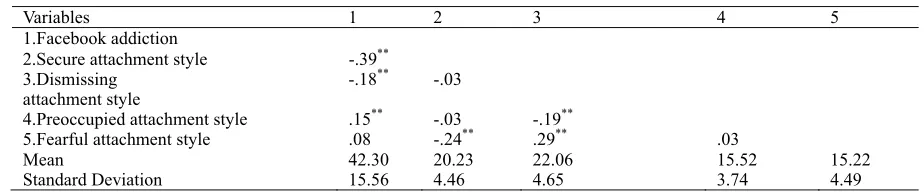
The descriptive statistics belonging to the variables used in the study and the Pearson correlation coefficients between the variables were shown in Table 1.
Table 1. Descriptive statistictis and zero-order correlations between attachment styles and Facebook addiction
Variables 1 2 3 4 5
1.Facebook addiction
2.Secure attachment style -.39**
3.Dismissing
attachment style -.18
** -.03
4.Preoccupied attachment style .15** -.03 -.19**
5.Fearful attachment style .08 -.24** .29** .03
Mean 42.30 20.23 22.06 15.52 15.22
Standard Deviation 15.56 4.46 4.65 3.74 4.49
**p<.01
When Table 1 is examined, it is observed that the participants' Facebook addictions were at average level (M=42.30, 15.56). According to Table 1, the Facebook addiction is negatively related with the secure attachment style (r(322)=-.39,
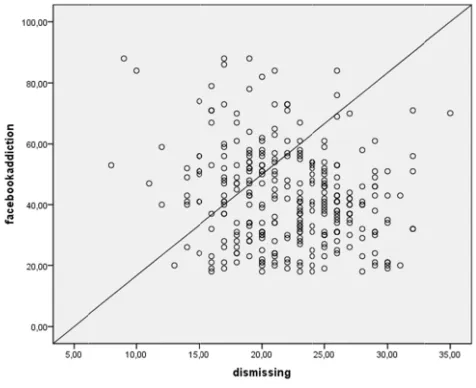
95% C. I. [-.48, -.29] and the dismissing attachment style (r(322)=-.18, % C. I. [-.28, -.07] and positively related with the
preoccupied attachment style (r(322)=.15, % C.I. [.04, .25].
Journal of Edu
Figure
Figure 2
Figure 3.
ucation and Tra
e 1. Scatter dia
. Scatter diagra
Scatter diagra
aining Studies
gram of Pearso
am of Pearson
am of Pearson
on correlation
n correlation be
correlation bet
154 between secur
etween dismiss
tween preoccu
re attachment
sing attachmen
upied attachme
Vol. 4
style and Face
nt style and Fa
ent style and Fa
4, No. 1; Janu
ebook addiction
acebook addict
acebook addic
ary 2016
n
tion
Journal of Edu
Figure
3.2 Multiple R
Before emplo or not was ex variables take were found as fearful attachm style. Moreov multiple regre the variance in that there was styles were th Table 2. Stepw
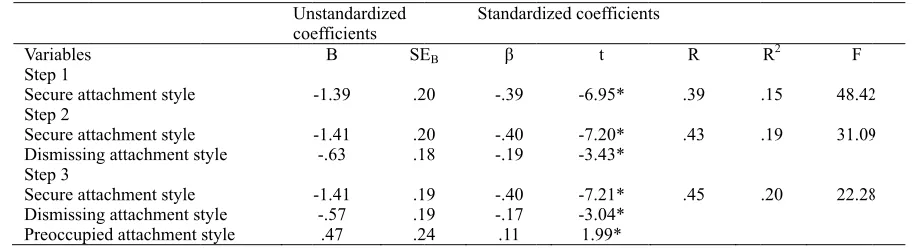
Variables Step 1 Secure at Step 2 Secure at Dismissin Step 3 Secure at Dismissin Preoccup *p<.05 According to Facebook add analysis, the accounted for stage of the Adjusted R2=
variance belo accounted for as .25. Based have a modera the regression standardized c that the indep (β=-.40, t=-7.
ucation and Tra
e 4. Scatter diag
Regression Ana
ying the multi xamined by u en into the mul s .20 (p>.05) f ment style, .11 ver, it was obse ession analysis nflation factor s not a collinea e predictive an wise regression
s
ttachment style ttachment style ng attachment s ttachment style ng attachment s pied attachment Table 2, firstly diction, R2=.15
dismissing at r 4% of the Fa regression equ =.19, ΔR=.01, onging to the r 20% of the F
on this coeffic ate effect on th n equation at
coefficients ind pendent variab
21, p<.05) an
aining Studies
gram of Pearso
alysis
iple regression using the Kolm
ltiple regressio for the Facebo 1 (p>.05) for th erved that the s s varied betwe (VIF). That al arity problem.
nd the Faceboo n analysis for F Un coe
tyle
tyle style
y the secure a 5, Adjusted R2
ttachment styl acebook addict uation, the pr
F(3, 268)=22 Facebook add Facebook add cient, it can be he Facebook a the beginning dicating the re ble having the nd this was fo
on correlation
n analysis, the mogorov-Smir on analysis dis ook addiction, he preoccupied skewness and een -1 and 1. I ll the VIF valu The results be ok addiction w Facebook addi nstandardized efficients B SE -1.39 .2 -1.41 .2 -.63 .1 -1.41 .1 -.57 .1 .47 .2 ttachment styl
2=.15, F (1, 26
le was added tion, R2=.19, A
reoccupied att 2.28. The pre diction. The s diction. The C e stated that th addiction (Coh g, it was obser elative order o
strongest effe llowed in ord
155
between fearfu
hypotheses w rnov test. The
stributed norm .15 (p>.05) fo d attachment s
kurtosis coeffi If there was a ues were small elonging to the was the predicte
iction
Standard
EB β
20 -.39 20 -.40 8 -.19 9 -.40 9 -.17 24 .11
le entered the 68)=48.42, p<. d to the regre Adjusted R2=.
tachment style occupied attac secure, dismis Cohen’s f2 coef
he secure, preo hen, 1988). Alt
rved that it di f importance o ect on the Fac der by the dism
ful attachment
were checked. Kolmogorov-mally. The resu or the secure a style and .10 (p ficients belongi multicollinear ler than 10 (Ta multiple regre ed variable we
dized coefficient t -6.95* -7.20* -3.43* -7.21* -3.04* 1.99* regression equ .05. In the sec ession analysis
.18, ΔR2=.04,
e took place i chment style sing and preo fficient related occupied and d
though the fea id not predict of the variable cebook addicti missing (β=-.1
Vol. 4
style and Face
If the variable -Smirnov test ults of the Kolm
attachment sty p>.05) for the ing to all the v rity problem w abachnick and
ession analysis ere given in Tab
ts R .39 .43
.45
uation and acc ond stage of t s. The dismis F(2, 268)=31. in the regress made a contr occupied attac d to this accou dismissing atta
arful attachmen the Facebook es were examin ion was the se 17, t=-3.04, p<
4, No. 1; Janu
ebook addictio
es distributed n indicated tha mogorov-Smir yle, .08 (p>.05 dismissing att variables taken was examined b
Fidell, 2001) i s where the att ble 2.
R2 F
.15 48.42 .19 31.09
.20 22.28
counted for 15 the multiple re ssing attachme .09, p<.05 . In sion equation,
ribution of 1% chment styles
unting rate wa achment styles
nt style was ta k addiction. W
ned, it was det ecure attachm <.05) and preo
ary 2016
n
normally at all the
rnov test ) for the tachment n into the by using indicated tachment 2 9 8
% of the egression ent style n the last R2=.20,
Journal of Education and Training Studies Vol. 4, No. 1; January 2016
156
(β=.11, t=1.99, p<.05) attachment styles. According to the standardized coefficients, the strongest predictor of the Facebook addiction was the secure attachment style.
4. Discussion
In this study, the relationships between the attachment styles and the Facebook addiction were examined. The research results indicated that the Facebook addiction was negatively predicted by the secure and dismissing attachment styles and positively predicted by the preoccupied attachment style. Moreover, it was determined that the strongest predictor of the Facebook addiction was the secure attachment style and this was followed in order by the dismissing and the preoccupied attachment styles.
In this study, it was observed that the strongest predictor of the Facebook addiction was the secure attachment style. According to the research findings, as the participants' secure attachment style scores increase, their Facebook addiction scores decrease. Individuals with secure attachment style have positive perceptions about themselves and others. These individuals perceive themselves as those who are worth loving and honest. Moreover, they trust themselves and behave assertively in social environments. Besides this, when individuals with the secure attachment style experience a problem, they believe that they will get sufficient support from other individuals (Huntsinger & Luecken, 2004; Hazan & Shaver, 1987). Park, Crocker and Mickelson (2004) stated that individuals with the secure attachment style can establish supportive social relationships in real life thanks to these characteristics of theirs. Starting from here, it can be stated that the ability to establish satisfying social relationships in real life will protect individuals with the secure attachment style against the Facebook addiction. The finding obtained in the study carried out by Satıcı, Sarıcalı, Satıcı and Eraslan-Çapan (2014) that the social sufficiency predicted the Facebook addiction negatively supports this interpretation.
In this study, that the dismissing attachment style predicted the Facebook addiction in a negative way can be evaluated as an interesting finding. This finding contradicts the studies reporting that the individuals with the dismissing attachment style are at risk in terms of problematic internet use (Debernardi, 2012; Lin, Ko, & Wu, 2011; Odacı & Çıkrıkçı, 2014). According to the mentioned researchers, that individuals with the dismissing attachment style live approaching anxiety leads to social incapability in them and this results in problematic internet use. Individuals with the dismissing attachment style self-regard excessively, attach very much importance to self-efficacy and prefer to withdraw from other individuals affectively (Shaver & Hazan, 1993). For this reason, it can be stated that individuals with the dismissing attachment style tend to withdraw from environments where they think that their self-efficacies are threatened. In the recent period, some researchers (Chou & Edge, 2012; Gulati, 2011) have emphasized the fact that Facebook trigger social comparison and create a competition-based online culture. In conclusion, it can be stated that individuals with the dismissing attachment style may withdraw from Facebook when they think that their self-efficacies are damaged because of social comparisons.
In this study, it was found that the preoccupied attachment style predicted the Facebook addiction in a positive way. In other words, as the participants' preoccupied attachment style scores increase, their Facebook addiction increase. Individuals with the preoccupied attachment style feel themselves worthless. However, individuals with the preoccupied attachment style have positive opinions about other individuals. For this reason, individuals with the preoccupied attachment style are in need of receiving positive feedback from other individuals in order to feel themselves worthy (Brennan & Bosson, 1998). Facebook's including many applications including receiving positive feedback and manage other individuals' impressions (for example, the alternatives of “like” and “comment”) may put individuals with the preoccupied attachment style at risk in terms of Facebook addiction. Moreover, another reason why individuals with the preoccupied attachment style are at risk in terms of Facebook addiction might be Facebook’s including features facilitating the establishment of social relationships (for example, possibility of an individual's introducing him/herself differently in order to get the approval of party) (Hart et al., 2015).
Journal of Education and Training Studies Vol. 4, No. 1; January 2016
157
In conclusion, the findings obtained from this study did not verify the social compensation hypothesis. The social compensation hypothesis put forwards that when individuals do not feel themselves secure in their social relationships in real life, they may spend too much time on using social networking sites to compensate this and this may result in addiction (Hong et al., 2014). For social networking sites provide individuals with many opportunities facilitating the establishment of close relationship (hiding identity, etc.). However, the findings obtained from this study indicated that individuals with the dismissing and fearful attachments styles preferring to withdraw from other individuals in real life were not at risk in terms of Facebook addiction. The finding that using Facebook for social compensation led to increase in the feeling of loneliness within the course of time (Teppers, Luyckx, Klimstra, & Goosens, 2014) makes the findings obtained from this study more understandable. Moreover, in the mentioned study, it was also determined that using Facebook with the aim of making new friends increased the satisfaction derived from peer relationships. In this context, it can be stated that carrying out new studies examining the relationships between the attachment styles and the Facebook addiction by considering the factors leading to use of Facebook (for example, receiving positive feedback, self-presentation, entertainment, etc.) will make it possible to obtain healthier results.
This study has various limitations. Firstly, this study includes university students. This restricts the generalizability of the findings. Secondly, since the cross-sectional design was used in the study, findings related to causality could not be obtained. For this reason, it can be stated that longitudinal studies are needed. Finally, in this study, the measurement tools based on self-report were used. For this reason, carrying out new studies based on different techniques (for example, interview, etc.) will make contribution to the detailed evaluation of Facebook.
Despite all these limitations, this study makes a serious contribution to the field. Focusing on the attachment styles, this study put forward important findings in the explanation of individuals' using Facebook in an uncontrolled way. Within the scope of this study, various suggestions can be made. Firstly, if the relationships between the attachment styles and the Facebook addiction are examined via new studies considering such variables as time spent in Facebook, reasons for using Facebook, attitudes toward Facebook, loneliness, personality, etc., more comprehensive findings can be obtained. Secondly, in this study, the attachment styles were examined by using the Relationship Scales Questionnaire. In this context, carrying out new studies measuring the attachment styles via using different measurement tools (e.g., Attachment to Parents and Friends Inventory, Experiences in Close Relationships Inventory) will make it possible to obtain new findings related to these relationships. Lastly, it can be stated that preparing intervention programs by psychological counseling services will be useful in terms of preventing Facebook addiction in university students. It can be stated that these intervention programs should especially include elements increasing individuals' problem solving skills and supporting their interpersonal relationships (Akbaba, 2012).
5. Conclusion
To the author’s knowledge, the current study is among the first to investigate the relationships between attachment styles and Facebook addiction. Furthermore, the results of this study hold important implications for researchers interested in identifying university students most at risk for Facebook and other social networking sites addiction. University students who use Facebook to compensate for their shortcomings in low self-worth and poor social skills are more likely to be Facebook addiction. The social compensation hypothesis postulates that these university students more adaptive ways of coping with difficulties in real life by using Facebook in order to establish social relationships and receive positive feedback. Although Facebook is utilized to compensate weakness in real life (McKenna et al., 2002), this study indicated that Facebook usage is only useful in terms of compensating shortcomings in real life, if people have preoccupied attachment style.
References
Akbaba, S. (2012). Psikolojik sağlığı koruyucu rehberlik. Ankara: Pegem Akademi.
Akın, A., Demirci, İ., Akın, Ü., Ocakçı, H., Akdeniz, C., & Akbaş, Z. Ş. (2013). Turkish version of the Facebook addiction scale. In 13th European congress of psychology, June, 9-12, Stockholm, Sweeden.
Andreassen, C. S., Torsheim, T., Brunborg, G. S., & Pallesen, S. (2012). Development of a Facebook Addiction Scale.
Psychological Reports, 110(2), 501-517. http://dx. doi.org/ 10.2466/02.09.18.PR0.110.2.501-517
Arslan, E., Arslan, E., & Arı, R. (2012). An investigation of interpersonal problem solving approaches with respect to attachment styles .Educational Sciences: Theory & Practice, 12(1), 7-23.
Bartholomew, K., & Horowitz, L. M. (1991). Attachment styles among young adults: A test of a four-category model.
Journal of Personality and Social Psychology, 61, 226-244. http://dx.doi.org/10.1037/0022-3514.61.2.226
Journal of Education and Training Studies Vol. 4, No. 1; January 2016
158
Bowlby, J. (1977). The making and breaking of affectional bonds: Aetiology and psychopathology in the light of attachment theory. British Journal of Psychiatry, 130, 201-210. http://dx. doi.org/ 10.1192/bjp.130.3.201
Bowlby, J. (1980). Attachment and loss, Vol. II. Seperation: Anxiety and anger. New York: Basic Books.
Boyd, D. M., & Ellison, N. B. (2007). Social network sites: Definition, history, and scholarship. Journal of Computer-Mediated Communication, 13(1), 210-230. http://dx. doi.org/ 10.1111/j.1083-6101.2007.00393.x
Brennan, K. A., & Bosson, J. K. (1998). Attachment-style differences in attitudes toward and reactions to feedback from romantic partners: An exploration of the relational bases self-esteem. Personality and Social Psychology Bulletin, 24, 699-714. http://dx. doi.org/10.1177/0146167298247003
Cao, F., & Su, L. (2007). Internet addiction among Chinese adolescents: Prevalence and psychological features. Child Care and Health and Development, 33(3), 275-281.
Chou, H. T. C., & Edge, N. (2012). “They are happier than having better lives than I am.”: The impact of using Facebook on perceptions of others’ lives. Cyberpsychology, Behavior, and Social Networking, 15(2), 117-121. http://dx. doi.org/10.1089/cyber.2011.0324
Cohen, J. (1988). Statistical power analysis for the behavioral sciences (2nd ed.). Hillsdale, NJ: Lawrance Earlbaum Associates.
Debernardi, N. R. (2012). Problematic internet use: Exploring the roles of attachment and social competency. Ph.D. dissertation, University of Missouri-Kansas City, Kansas City, Missouri.
Deniz, M. E. (2006). Ergenlerde bağlanma stilleri ile çocukluk istismarları ve suçluluk-utanç arasındaki ilişki. Eurasian Journal of Educational Research, 22, 89-99.
Facebook (2015). Company info. Palo Alto, CA: Facebook. Retrieved from http://newsroom.fb.com/company-info/ Foregger, S. (2008). Uses and gratifications of Facebook.com. Ph.D. dissertation, Michigan State University, Michigan. Fraley, R. C., Waller, N. G., & Brennan, K. A. (2000). An item-response theory analysis of self-report measures of adult
attachment. Journal of Personality and Social Psychology, 78, 350-365. http://dx.doi.org/ 10.10370022-3514.78.2.350
Gallitto, E., & Leth-Steensen, C. (2015). Autistic traits and adult attachment styles. Personality and Individual Differences, 79, 63-67. http://dx. doi.org/10.1016/j.paid.2015.01.032
Griffin, D. W., & Bartholomew, K. (1994). The metaphysics of measurement: The case of adult attachment. In K. Bartholomew & D. Perlman (Eds.), Advances in personal relationships. 5, Attachment process in adulthood (pp.17-52). London: Kingsley.
Gulati, D. (2011). Re: Facebook is making us miserable [Web log message]. Retrieved from http://blogs.hbr.org/cs/2011/12/facebook_is_making_ us_miserabl.html
Gündüz, B. (2013). The contributions of attachment styles, irrational beliefs and psychological symptoms to the prediction of cognitive flexibility. Educational Sciences: Theory & Practice, 13(4), 2071-2085. http://dx. doi.org/ 10.12738/estp.2013.4.1702
Hart, J., Nailling, E., Bizer, G. Y., & Collins, C. K. (2015). Attachment theory as a framework for explaining engagement with Facebook. Personality and Individual Differences, 77, 33-40. http://dx. doi.org/10.1016/j.paid.2014.12.016
Hazan, C., & Shaver, P. R. (1987). Romantic love conceptualized as an attachment process. Journal of Personality and Social Psychology, 52, 511-524.
Hong, F. Y., Huang, D. H., Lin, H. Y., & Chiu, S. L. (2014). Analysis of the psychological traits, Facebook usage, and Facebook addiction model of Taiwanese university students. Telematics and Informatics, 31, 597-606. http://dx. doi.org/10.1016/j.tele.2014.01.001
Hughes, D. J., Rowe, M., Batey, M., & Lee, A. (2012). A tale of two sites: Twitter vs. Facebook and the personality predictors of social media usage. Computers in Human Behavior, 28(2), 561-569. http://dx. doi.org/10.1016/j.chb.2011.11.001
Huntsinger, E. T., & Luecken, L. J. (2004). Attachment relationships and health behavior: The mediational role of self-esteem. Psychology and Health, 19(4), 515-526. http://dx. doi.org/ 10.1080/0887044042000196728
Journal of Education and Training Studies Vol. 4, No. 1; January 2016
159
Joinson, N. A. (2008). Looking at’, ‘Looking up’ or ‘Keeping up with’ People? Motives and uses of Facebook. CHI 2008 Proceedings (pp. 1027–1036).
Karaiskos, D., Tzavellas, E., Balta, G., & Paparrigopoulos, T. (2010). Social network addiction: a new clinical disorder?
European Psychiatry, 25(1), 855. http://dx. doi.org/10.1016/S0924-9338(10)70846-4
Kim, J., & Haridakis, P. M. (2009). The role of Internet user characteristics and motives in explaining three dimensions of Internet addiction. Journal of Computer-Mediated Communication, 14(4), 988–1015. http://dx.doi.org/ 10.1111/j.1083-6101.2009.01478.x.s
Kim, Y., Sohn, D., & Choi, S. M. (2011). Cultural difference in motivations for using social network sites: A comparative study of Amerikan and Korean college students. Computers in Human Behavior, 27, 365-372. http://dx. doi.org/10.1016/j.chb.2010.08.015
Kross, E., Verduyn, P., Demiralp, E., Park, J., Lee, D. S., Lin, N., Shablack, H., Jonides, J., & Ybarra, O. (2013). Facebook use predicts declines in subjective well-being in young adults. PLoS ONE, 8(8), e69841. http://dx. doi.org/ 10.1371/journal.pone.0069841
Kuss, D. J., Griffiths, M. D., & Binder, J. F. (2013). Internet addiction in students: Prevalence and risk factors.
Computers in Human Behavior, 29(3), 959-966. http://dx. doi.org/10.1016/j.chb.2012.12.024
Kuss, D., & Griffiths, M. (2011). Online social networking and addiction-A review of the psychological literature. International Journal of Environmental Research and Public Health, 8, 3528-3552.
Lavin, M. J., Yuen, C. N., Weinman, M., & Kozak, K. (2004). Internet dependence in the collegiate population: the role of shyness. CyberPsychology & Behavior, 7(4), 379-383. http://dx. doi.org/10.1089/cpb.2004.7.379
Lee, J. S., & Koo, H. J. (2015). The relationship between adult attachment and depression in Korean mothers during the first 2 years postpartum: A moderated mediation model of self-esteem and maternal efficacy. Personality and Individual Differences, 79, 50-56. http://dx. doi.org/10.1016/j.paid.2015.01.021
Lee, Z. W. Y., Cheung, C. M. K., & Thadani, D. R. (2012). An investigation into the problematic use of Facebook. In
45th Hawaii international conference on system sciences.
Leiter, M. P., Day, A., & Price, L. (2015). Attachment styles at work: Measurement, collegial relationships, and burnout.
Burnout Research, 2, 25-35. http://dx. doi.org/10.1016/j.burn.2015.02.003
Lin, M. P., Ko, H. C., & Wu, J. Y. (2011). Prevalence and psychosocial risk factors associated with internet addiction in a nationally representative sample of college students in Taiwan. Cyberpsychology, behavior, and social networking, 14(12), 741-746. http://dx. doi.org/ 10.1089/cyber.2010.0574
McKenna, K. Y. A., Green, A. S., & Gleason, M. E. J. (2002). Relationship formation on the internet: what’s the big attraction? Journal of Social Issues, 58, 9-31. http://dx.doi.org/10.1111/1540-4560.00246.
Mikulincer, M., & Florian, V. (1995). Appraisal of and coping with a real-life stressful situation: The contribution of attachment styles. Personality and Social Psychology Bulletin, 21, 406–414. http://dx. doi.org/ 10.1177/0146167295214011
Mikulincer, M., & Shaver, P. R. (2007). Attachment in adulthood: Structure, dynamics, and change. New York, NY: Guilford Press.
Odacı, H., & Çıkrıkçı, Ö. (2014). Problematic internet use in terms of gender, attachment styles and subjective well-being in university students. Computers in Human Behavior, 32, 61-66. http://dx. doi.org/10.1016/j.chb.2013.11.019
Oldmeadow, J. A., Quinn, S., & Kowert, R. (2013). Attachment style, social skills, and Facebook use amongst adults.
Computers in Human Behavior, 29(3), 1142-1149. http://dx. doi.org/10.1016/j.chb.2012.10.006
Oshri, A., Sutton, T. E., Clay-Warner, J., & Miller, J. D. (2015). Child maltreatment types and risk behaviors: Associations with attachment style and emotion regulation dimensions. Personality and Individual Differences, 73, 127-133.
Papacharissi, Z., & Mendelsohn, A. (2011). Toward a new(er) sociability: Uses, gratifications and social capital on Facebook. In S. Papathanassopoulos (Ed.), Communication and society. Media perspectives for the 21st century. Concepts, topics and issues (pp. 212–230). New York: Routledge.
Park, L. E., Crocker, J., & Mickelson, K. D. (2004). Attachment styles and contingencies of self-worth. Personality and Social Pscyhology Bulletin, 30, 1243-1254. http://dx. doi.org/ 10.1177/0146167204264000.
Journal of Edu
and eatin http://dx. Sagioglou, C. mood and Satıcı, B., Sar
predictor Satıcı, S. A.,
185-190. Shaver, P. R.,
Advances
Sheldon, P. (2
Media Ps
Şimşek, Ö. F. moderato Sümer, N., & cross-cul Tabachnick, B Teppers, E., L longitudi Valkenburg, P
friends. D
This work is l
ucation and Tra
ng pathology: . doi.org/10.10 ., & Greiteme d why people rıcalı, M., Satıc rs of Facebook
& Uysal, R. http://dx. doi.
& Hazan, C. (
s in personal r
2008). The rel
sychology, 20,
(2011). Struct or. Social Indic
& Güngör, D. ltural comparis B. G., & Fidell Luycx, K., Kli inal inquiry int P. M., & Peter Developmenta
icensed under
aining Studies
The mediatin 016/j.paid.2014 eyer, T. (2014) still use it. Com
cı, S. A., & Er k addiction. Stu
(2015). Well .org/10.1016/j. (1993). Adult
relationships (p lationship betw
67-75. http://d tural relations
cator Research
(1999). Psych son. Turkish Jo
, L. S. (2001). imstra, T. A., to directionalit r, J. (2007). Pr
l Psychology,
a Creative Co
ng role of mi 4.10.040 ). Facebook’s
mputers in Hu
raslan-Çapan, B
udia Psycholog
l-being and pr .chb.2015.03.0 romantic attac pp. 29-70). Lo ween unwillin dx. doi.org/10. of personal an
h, 110(1), 219-hometric evalu
ournal of Psyc Using multiva
& Goossens, L ty of effect. Jo
readolescents’ 43, 267-277. h
ommons Attrib
160 indfulness. Pe
emotional con
uman Behavior,
B. (2014). Soc
gica, 56(4), 30 roblematic Fac 005 chment: Theor ondon: Jessica ngness-to-comm .1027/1864-11 nd collective se -236. DOI 10.0 uation of adult
chology, 14(43)
ariate statistics
L. (2014). Lon
ournal of Adole
’ and adolesce http://dx.doi.or
ution 3.0 Licen
ersonality and
nsequences: W
r, 35, 359-363. cial competenc 01-308.
cebook use. C
ry and evidenc Kingsley. municate and
05.20.2.67 elf-esteem to s 007/s11205-01 t attachment m
), 71-109.
s. Boston: Ally neliness and F
escence, 37, 69 ents’ online co
rg/10.1037/001
nse.
Vol. 4
d Individual D
Why Facebook
ce and psychol
Computers in
ce. In D. Perlm
students’ Fac
subjective well 1-99-27-1 measures on T
yn and Bacon. Facebook moti 91-699. ommunication
12-1649.43.2.2
4, No. 1; Janu
Differences, 75
k causes a dec
logical vulnera
Human Beha
man & W. Jone
ebook use. Jo
l-being: Attach
Turkish sample
ives in adolesc
and their clos 267
ary 2016
5, 24-29.
crease in
ability as
vior, 49,
es (Eds.),
ournal of
hment as
es and a
cence: A