ISSN: 2231-5373 http://www.ijmttjournal.org Page 276
Heronian Mean Labeling In
The Context of
Duplication Of Graph Elements
S.S.SandhyaDepartment of Mathematics, Sree Ayyappa College for Women, Chunkankadai-629 003,Tamilnadu,India
.
E.Ebin Raja Merly
Department of Mathematics, Nesamony Memorial Christian College, Marthandam-629 165,Tamilnadu,India
G.D.Jemi
Department of Mathematics, Narayanaguru College of Engineering, Manjalumoodu-629 151,Tamilnadu,India
.
ABSTRACT
Here we look into some graphs on Heronian Mean Labeling of graphs. In this paper we investigate Heronian mean labeling for various graphs resulted from the duplication of graph elements.
Key words:
Graph, Heronian mean graph, Duplication. 1. INTRODUCTION:
The concept of graph labeling was introduced by Rosa in 1967.A graph labeling is an assignment of integers to the vertices or edges or both subject to certain conditions.If the domain of the mapping is the set of vertices (or edges),then the labeling is called a vertex labeling (or an edge labeling).Here we consider simple,finite,undirected and connected graph G = (V,E). For all standard terminology and notation we follow Chartrand and Lesniak [1].
DEFINITION:1.1
A graph G=(V,E) with p vertices and q edges is said to be a Heronian Mean Graph if it is possible to label the vertices xϵV with distinct labels f(x) from 1,2,3,. . . ,q+1 in such a way that each edge e=uv is labeled
with f(e=uv)= 𝑓 𝑢 + 𝑓 𝑢 𝑓(𝑣) +𝑓(𝑣)3 (OR) 𝑓 𝑢 + 𝑓 𝑢 𝑓(𝑣) +𝑓(𝑣) 3 then the edge labels are distinct. In this case f
is called a Heronian Mean Labeling of G. DEFINITION:1.2
Two vertices of a graph which are adjacent are said to be neighbours. The set of all neighbours of a vertex v is called the neighbourhood set denoted as N(v).
DEFINITION:1.3
Duplication of a vertex vk of graph G produces a new graph G', by adding a vertex v'k with N(vk) = N(v'k).
In other words a vertex v'k is said to be duplication of vk if all the vertices which are adjacent to vk are now adjacent to v'k also.
DEFINITION:1.4
Duplication of an edge e = uv of graph G produces a new graph G' by adding an edge e' = u'v' such that N(u') = N(u) Ս {v'} – {v} and N(v')= N(v) Ս {u'} – {u}
DEFINITION:1.5
Duplication of a vertex vk by a new edge e' = u'v' in a graph G produces a new graph G' such that N(v') = {vk,u'} and N(u') = {vk,v'}.
DEFINITION:1.6
Duplication of an edgee = uv by a vertex v' is a graph G produces a new graph G' such that N(v') = {u,v}.
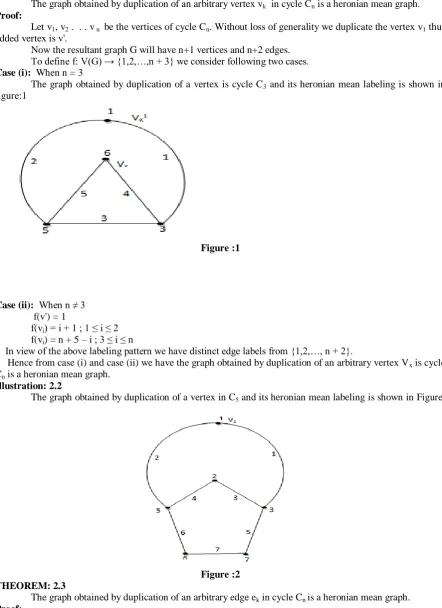
ISSN: 2231-5373 http://www.ijmttjournal.org Page 277 figure:1
Figure :1
Case (ii): When n ≠ 3 f(v') = 1
f(vi) = i + 1 ; 1 ≤ i ≤ 2 f(vi) = n + 5 – i ; 3 ≤ i ≤ n
In view of the above labeling pattern we have distinct edge labels from {1,2,…, n + 2}.
Hence from case (i) and case (ii) we have the graph obtained by duplication of an arbitrary vertex Vx is cycle Cn is a heronian mean graph.
Illustration: 2.2
The graph obtained by duplication of a vertex in C5 and its heronian mean labeling is shown in Figure: 2
Figure :2 THEOREM: 2.3
The graph obtained by duplication of an arbitrary edge ek in cycle Cn is a heronian mean graph. Proof:
Let e1,e2 ,…e n be the edges of cycle Cn. Without loss of generality we duplicate the edge e1 thus added vertices are v'1 and v'2..Now the resultant graph G will have n + 2 vertices and n + 3 edges.
To define f : V(G) → {1,2,…,n+4} we consider following two cases.
Case (i): When n = 3
ISSN: 2231-5373 http://www.ijmttjournal.org Page 278 Figure :3
Case (ii): When n ≠ 3 f(v'1) = 1 ; f(v'2) = 3 f(vi) =2 i ; 1 ≤ i ≤ 2 f(vi) = n + 6 – i ; 3 ≤ i ≤ n
In view of the above defined labeling pattern we have distinct edge labels.
Hence the graph obtained by duplication of an arbitrary edge ek in cycle Cn is a Heronian mean graph. Illustration: 2.4
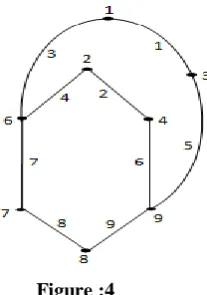
The graph obtained by duplication of an edge in C6 and its heronian mean labeling is shown in Figure: 4
Figure :4
THEOREM: 2.5
The graph obtained by duplication of an arbitrary vertex by a new edge in cycle Cn is a heronian mean graph.
Proof:
Let v1,v2 ,…v n be the vertices and e1,e2 ,…e n be the edges of cycle Cn. Without loss of generality we duplicate the vertex vn by an edge en+1 with endvertices as v'1 and v'2. The resultant graph G will have n + 2 vertices and n + 3 edges.
We define f : V(G) → {1,2,…,n+4} as follows f(v'i) = i ; 1 ≤ i ≤ 2
f(v1) = 3
f(vi) = i + 3 ; 2 ≤ i ≤ n
In view of the above defined labeling pattern we have distinct edge labels from {1,2, …, n+3}.
Hence the graph obtained by duplication of an arbitrary vertex by a new edge in cycle Cn is heronian mean graph.
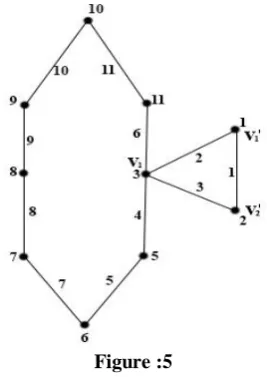
Illustration:2.6
ISSN: 2231-5373 http://www.ijmttjournal.org Page 279 Figure :5
THEOREM: 2.7
The graph obtained by duplication of an arbitrary edge by a new vertex in cycle Cn is a heronian mean graph.
Proof:
Let v1,v2 ,…v n be the vertices and e1,e2 ,…e n be the edges of cycle Cn. Without loss of generality we duplicate the edge vnv1 by a vertex v'. The resultant graph G will have n + 1 vertices and n + 2 edges.
To define f : V(G) → {1,2,…,n+3} we consider following two cases. Case (i): When n = 3
The graph and harmonic mean labeling is shown in figure.6
Figure:6 Case (ii): When n ≠ 3
f(v') = 1
f(v1) = 2 , f(V2) = 4 f(vi) = i + 3 ; 3 ≤ i ≤ n
In view of the above labeling pattern we have distinct edge labels from {1,2, …, n+2}.
Hence from case(i) and case (ii) we have the graph obtained by duplication of an arbitrary edge by a new vertex in cycle Cn is heronian mean graph.
Illustration:-2.8
ISSN: 2231-5373 http://www.ijmttjournal.org Page 280 Figure :7
Conclusion:
Here we discuss Heronian Mean Labeling in the Context of duplication of graph elements. The results are demonstrated by means of sufficient illustrations which provide better understanding.
References:
[1]. Chartrand g.Lesniak L.Graphs and Digraphs,4thed.CRC Press;2004.
[2]. Gallian J A, A Dynamic Survey of Graph labeling, The Electronic journal of Combinatorics(2013). [3]. Harary F (1988),Graph Theory, Narosa Publishing House Reading, New Delhi.
[4]. Somasundaram S and Ponraj R, “Mean Labelling of Graphs”,National Academy of Science Letters vol.26,p.210-213.
[5]. Somasundaram S, Ponraj R and Sandhya S S, “Harmonic Mean Labeling” of Graphs communicated to Journal of Combinatorial Mathematics and Combinatorial Computing.
[6]. Sandhya S. S, Ebin Raja Merly E. and Jemi G. D , “Some Results On Super Heronian Mean Labeling of Graphs” communicated to International Journal of Contemporary Mathematical Science. Vol 11,2016,no.10,485-495.
[7]. Sandhya S. S, Ebin Raja Merly E. and Jemi G. D , “Some More Results On Super Heronian Mean Labeling of Graphs” communicated to International Journal of Mathematics Research. Vol.8 no.3 (2016) pp.199-206.