The Thirty-Third AAAI Conference on Artificial Intelligence (AAAI-19)
Memory-Augmented Temporal Dynamic Learning for Action Recognition
Yuan Yuan, Dong Wang, Qi Wang
School of Computer Science and Center for OPTical IMagery Analysis and Learning (OPTIMAL), Northwestern Polytechnical University, Xi’an 710072, China,
{y.yuan1.ieee, nwpuwangdong, crabwq}@gmail.com
Abstract
Human actions captured in video sequences contain two cru-cial factors for action recognition, i.e., visual appearance and motion dynamics. To model these two aspects, Convo-lutional and Recurrent Neural Networks (CNNs and RNNs) are adopted in most existing successful methods for recog-nizing actions. However, CNN based methods are limited in modeling long-term motion dynamics. RNNs are able to learn temporal motion dynamics but lack effective ways to tackle unsteady dynamics in long-duration motion. In this work, we propose a memory-augmented temporal dynamic learning network, which learns to write the most evident information into an external memory module and ignore irrelevant ones. In particular, we present a differential memory controller to make a discrete decision on whether the external memory module should be updated with current feature. The discrete memory controller takes in the memory history, context em-bedding and current feature as inputs and controls informa-tion flow into the external memory module. Addiinforma-tionally, we train this discrete memory controller using straight-through estimator. We evaluate this end-to-end system on benchmark datasets (UCF101 and HMDB51) of human action recogni-tion. The experimental results show consistent improvements on both datasets over prior works and our baselines.
Introduction
In recent years, video based human action recognition has received increasing attention from the research commu-nity (Wang et al. 2011; Simonyan and Zisserman 2014; Tran et al. 2015; Carreira and Zisserman 2017), owing to its great potential value in many real-world applications like surveillance (Lin et al. 2008), abnormal activity detection (Boiman and Irani 2007) and so forth. Unlike recognition in static images, a distinctive aspect of the action recognition in videos is the motion dynamics, which is a crucial factor in addition to visual appearance. The performance of action recognition system depends, to a large extent, on whether the dynamics can be effectively represented and utilized. A key goal of this work is to enhance the model’s capacity for learning and capturing the motion dynamics in videos.
Encouraged by the success of Convolutional Neural Net-work (CNNs) on computer vision tasks such as image
clas-Copyright c2019, Association for the Advancement of Artificial Intelligence (www.aaai.org). All rights reserved.
sification, many researchers have adopted similar meth-ods for video understanding and human action recogni-tion (Simonyan and Zisserman 2014; Feichtenhofer, Pinz, and Zisserman 2016; Zha et al. 2015; Sun et al. 2015) and achieved remarkable performance on public benchmark datasets. Deep CNNs have been shown to have an extraor-dinary capacity for learning discriminative representation from raw visual data. The most successful action recogni-tion algorithm, two-stream convents, utilizes two indepen-dent CNNs to extract pre-frame features from RGB and optical flow images, followed by simple or strategic pool-ing across the temporal domain. However, traditional two-stream convnets learn the action representation frame by frame and lack the capacity to model long-range dynam-ics across the temporal domain. Recurrent Neural Networks (RNNs) is a straightforward choice to exploit the sequential structure in videos. Long Short-Term Memory (LSTM) and its variants have been explored to incorporate frame-level features in several works (Xingjian et al. 2015; Li et al. 2018; Ma et al. 2017). These models tend to work well for actions with short duration and little movement. However, these ap-proaches would incur low accuracy when applied to long-range and complex motions, as verified by our experiments. These challenges motivate us to design an effective and effi-cient module to (1) capture salient motion dynamics in long-range temporal structure and (2) compose complex motion information across time for distinguishing actions.
dis-crete decision on whether write the current frame-level ture into memory module. After processed every frame fea-tures, the final action representation for recognizing actions is obtained by applying average pooling to features in the memory module. At the same time, the straight-through es-timator is utilized to make the discrete memory controller trainable in end-to-end manner. We evaluate our model on two benchmark datasets, and outperform our baseline and state-of-the-art performance.
The main contribution of this paper is summarized as fol-lows:
• We design a memory-augmented temporal dynamic learn-ing network for action recognition. An external memory module is attached to CNNs to store salient and informa-tive motion dynamics in videos, and greatly enhances ca-pacity to encode long-term and complex motion dynamics in long-range temporal structure.
• We propose a discrete memory controller, that takes in the memory history, context embedding and current fea-ture as inputs, to control the writing process of the ex-ternal memory module. This allows efficiently leveraging information from different temporal scale and improves the representation power, as demonstrated by our experi-ments.
• We extensively evaluate our algorithm on large-scale datasets UCF101 and HMDB51. Our method performs favorably against state-of-the-art action recognition meth-ods and our baseline.
Related Work
Motivated by the impressive performance of CNNs on image classification (Krizhevsky, Sutskever, and Hinton 2012), se-mantic segmentation (Long, Shelhamer, and Darrell 2015) and other computer vision work (Wang et al. 2018), sev-eral recent works have utilized CNN-based architectures for video based human action recognition. Karpathy et al. (Karpathy et al. 2014) directly apply CNNs to extract frame-level features and exploit multiple simple temporal pooling methods, including early fusion, late fusion, and slow fusion. But these approaches only yield a modest improvement over single frame baseline, indicating that motion dynamic infor-mation is hard to model by directly pooling spatial features from CNNs.
In view of this, Tran et al. (Tran et al. 2015) propose Convolutional 3D (C3D) and construct a deep C3D neu-ral network with 3D convolution filters and 3D pooling layers, which operate on short video clips over space and time simultaneously. Noticing that 3D kernels only cover a short range of the sequence when filtering video clips, Simonyan et al. (Simonyan and Zisserman 2014) incorpo-rate motion information by training a temporal stream of CNN on optical frames in addition to spatial stream with RGB frame input. By simple fusing probability scores from these two-stream CNNs, the accuracy of action recognition is significantly boosted. Moreover, several attempts have been made to learn subtle spatio-temporal relationships be-tween appearance and motion in order to improve recog-nition accuracy. Feichtenhofer et al. (Feichtenhofer, Pinz,
and Zisserman 2016) study a number of ways of integrating two-stream CNNs spatially and temporally. They propose s spatiotemporal fusion method by generalizing residual net-works. Wang et al. (Feichtenhofer, Pinz, and Wildes 2017) introduce the spatiotemporal compact bilinear operator to efficiently fuse spatial and temporal features hierarchically. However, the only several consecutive optical flow frames are fed into temporal stream CNN, so that it cannot capture longer-term motion patterns associated with certain human actions.
To enable the model to learn long-term motion dynamic, Ng et al. (Yue-Hei Ng et al. 2015) take advantage of LSTM to fuse features across a longer temporal range. However, the vanilla LSTM model is not satisfactory for learning the spatial correlations and motion dynamics between the frames. (Xingjian et al. 2015) extends LSTM to ConvLSTM, which replace linear multiplicative operation with spatial 2D convolution, so that it can learn the spatial patterns along the temporal domain. Furthermore, Shikhar et al. (Sharma, Kiros, and Salakhutdinov 2015) implant soft attention mod-ule in LSTM to learn which parts in the frames are fatal for the task at hand and assign higher importance to them. Spring from the soft-Attention LSTM, VideoLSTM (Li et al. 2018) hardwire convolutions and introduce motion-based attention to guides better the attention towards the relevant spatio-temporal locations. However, this complex architec-ture does not bring significant performance improvement. Recently, Sun et al. (Sun et al. 2017) propose Lattice-LSTM (L2TSM), which extends traditional LSTM by learning in-dependent hidden state transition of memory cells for indi-vidual spatial locations. But it does not address the complex backgrounds similar scenes problem in different categories very well. Additionally, Ma et al. (Ma et al. 2017) study two different ways, i.e., Temporal Segment LSTM and Tempo-ral Inception, to extract spatio-tempoTempo-ral information by sys-tematically explored possible network architectures. Wang et al. (Wang et al. 2016) propose a segmental network, which splits a long sequence into several segments followed by sparse sampling, and achieve state-of-the-art performances.
integrate informative local features and an multimodal key-less attention model is proposed to fuse visual and acoustic features for action recognition in (Long et al. 2018a)
Approach
The primary goal of this paper is to enhance the model’s ca-pacity for learning long-term and complex motion for action recognition in videos, by capturing salient and informative motion dynamics across the long-range temporal structure. A structured and growing external memory has been demon-strated is capable of learning long-term sequential pattern in (Joulin and Mikolov 2015). Inspired by this idea, we pro-pose to continuously read and write external memory mod-ule over time to obtain stable and discriminative represen-tations of the human action captured by the video, which is verified by working with different CNN models.
Overview
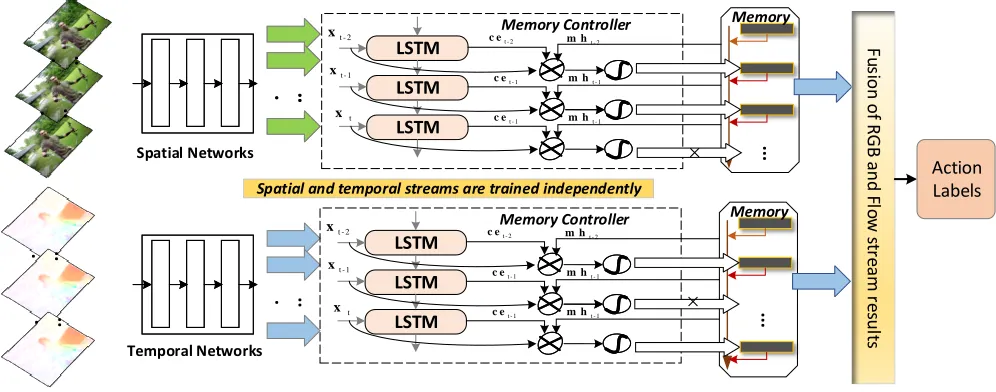
We design a end-to-end dynamic memory network that writes task-relevant features into a growing external mem-ory module according to a discrete memmem-ory controller. Fig-ure 1 shows the overall architectFig-ure of our design. Specif-ically, given a whole video in the form of sparse sampled frame sequence with lengthT, suppose at each timetwith
t = 1, . . . , T, the network first produces convolution fea-tures xt with ddimension for individual frames via
arbi-trary convolutional network. As shown in many CNN-based method (Wang et al. 2016; Simonyan and Zisserman 2014), after training, these convolutional features can capture sig-nificant appearance evidences for action recognition. Sub-sequently, convolutional features x1,...,t−1 are fed into a LSTM to obtain context embedding cet for each time t.
Meanwhile, the memory historymhtis calculated by
cur-rent external memory module Mt. At the end, the
mem-ory controller takes context embeddingcet, memory history
mht and convolutional featurext as inputs and outputs a
discrete decisionst∈ {0,1}on whether write convolutional
feature xt into external memory module Mt. The
combi-nation of context embedding and memory history enables the model to capture informative motion dynamics in long-range temporal structure.
The whole input sequence is processed in a sequential manner. The memory historymht+1 is obtained after ex-ternal memory moduleMthave been updated at timet, and
the features in external memory moduleMT are averaged to
get final representation for action recognition. In what fol-lows, we will explain the read and write process of external memory over time with details, as well as how the discrete decisions are made by the memory controller.
Updating Memory Module over Time
Different from previous works that either mixes memory with computation in the recurrent network or mimics the one-dimensional memory with elaborate access mechanism in the Turing machine/von Neumann architecture, we pro-pose a growing memory module to process arbitrarily long sequences theoretically. This is intuitive because frame se-quences that capture same human action may have different
length with different sample rate. But more importantly, a growing memory module is suitable for model long-term and complex motion in videos. To be specific, our mem-ory module is represented by a list M, with the length of it equals to the number of memory items and memory item isD dimension feature vectorm. Memory module can be updated after processing each frame, thus we useM0tto
rep-resent memory before updating for the current frame so far and Mt denotes memory module after processing current
frame, that is,M0tandMt−1are the same.
Memory Read and Write. When processing the first frame, the external memory module is empty so that mem-ory histmem-orymh1is a zero feature vector. Suppose memory moduleMt, t > 1 is not empty with lengthNt > 0, and
thenmhtis average of all memory items in memory
mod-ule,
mht= Nt
X
i=1
mi, (1)
which is a simple but effective memory read mechanism. Meanwhile, context embeddingcet is calculated by a
cus-tom LSTM, which will be elaborated in next section. Next, the context embeddingcet, memory historymhtand
con-volutional featurextare fed into the memory controller to
obtain discrete decisionst∈ {0,1}, and the memory
mod-ule is updated as follows,
Mt=
ϕ(M0t, Wwxt) st= 1
M0t st= 0
, (2)
whereWw∈RD×dis a matrix that transform convolutional
featurextinto memory itemmNt+1, and the write function ϕ(·)is implemented as list append operation. Obviously, the external memory module is updated only whenst= 1and
remain the same whenst= 0. With large-scale datasets, the
model can learn to write relevant information into mem-ory module and neglect noise from scratch, which is crucial to model complex motion dynamics in long-range temporal structure. Except memory history and convolutional feature, context embedding is another factor to determine the mem-ory write decision, and we will introduce it in the next sec-tion.
Context Embedding. Due to LSTM’s limited ability to address the non-stationary issue of long-term motion dy-namics (Sun et al. 2017), we build a segmental recurrent cell on top of LSTM unit, which alleviates the non-stationary issue by split a long sequence into several short segments. At its core, there is a one-dimensional vectorvt ∈ {0,1}
which indicates whether continue updating the LSTM’s state at current timestep or reinitializes them to zeros. Because long-term motion dynamics usually shows segmental char-acteristics, in practice, we just replace this indicator vector with the memory discrete decisionst, i.e.,vt = st, which
reduces the computation and makes sense to some extent. Specifically, indicator vectorvtdecide whether to transfer
the hidden state and memory cell content to the next timestep or to reinitialize them,
ˆ
LSTM
..
.
..
.
..
.
..
.
..
. ..
.
..
.
LSTM
LSTM
Fu
sion
of
R
GB
a
n
d F
lo
w
st
re
am
re
su
lts
Action Labels Memory
Memory Controller
Spatial Networks
Temporal Networks
t - 2
x
...
t - 1
x
t
x
t - 2
c e m ht - 2
t - 1
c e m ht - 1
t - 1
c e m ht - 1
Spatial and temporal streams are trained independently
LSTM
LSTM
LSTM
Memory Memory Controller
t - 2
x
...
t - 1
x
t
x
t - 2
c e m ht - 2
t - 1
c e m ht - 1
t - 1
c e m ht - 1
Figure 1: The overview of Memory-Augmented Temporal Dynamic Learning Network for action recognition. First, a set of video sequences are passing through CNN to extract convolutional features. Then, an LSTM unit is used to obtain context embedding by processing these features sequentially. Meanwhile, the memory items are recalled to constructed memory history. At each timestep, the memory controller takes these as inputs and outputs the discrete memory write decisions. Finally, the memory items in the memory module are pooled to recognizing action in the video. The final classification results are the average of spatial and temporal stream results.
ht=st×hˆt, (4)
ct=st׈ct. (5)
The resulting state and memory are employed to compute gates values at the next time step. The LSTM breaks the connection with the previous hidden statesht−1,ct−1and reinitializes them to zeros ifst= 0, and the hidden state of
timesteptis passed tot+ 1whenst= 1. We usehˆtas the
context embeddingcetat timet.
Discrete Memory Controller
In previous works on memory networks, the memory con-troller is constructed by a feed-forward network or LSTM, which interacts with the external memory module using a number of read and write instructions. We employ the simi-lar idea but the controller only outputs the write instruction that acts to place informative features into memory mod-ule, because the read process is performed at each timestep. Specifically, for each time step, the memory controller takes the convolutional featurext, memory historymhtand
con-text embeddingcetas inputs, and outputs the discrete
mem-ory write decisionst∈ {0,1}. Formally, the write decision
stis computed as a linear combination of these three inputs,
followed by a functionτ which is the composition of sig-moid function and a hard threshold function:
qt=vTs·ReLU(Wsfxt+Wsccet+Wsmmht+bs), (6)
at=σ(qt), (7)
st=τ(at), (8)
τ(x) =
1, if x > thr
0, otherwise , (9)
wherevTs is learnable row vector andWsf,Wsc,Wsmand
bs are learned weights and biases. Firstly, sigmoid
func-tionσis applied on the outputs from linear combination to normalizeat ∈ (0,1), which represents the importance of
current frame for recognizing action in the video. Then, we adopt a simple threshold-based selection mechanism to de-cide whether write current convolutional featurextinto
ex-ternal memory module, wherethris a hyper-parameter and set to 0.5 in our experiments.
Straight-Through Estimator.The discrete decisions in-volved in transferring the binary variablest with the hard
threshold functionτmake it impossible to use standard gra-dient back-propagation to learn the parameters of the mem-ory controller. To solve this issue, straight-through estimator proposed by (Bengio, L´eonard, and Courville 2013) is em-ployed to obtain to gradients of the memory controller. The idea is that a differentiable approximation function is used to substitute hard threshold function. In our case, we approxi-mate the hard threshold function with the identity function, which has shown its effectiveness when considering a sin-gle layer of neurons. After replacing hard threshold function with identity function, the chain rule betweenstandqtis
∂st
∂qt
= ∂st
∂at
·∂at
∂qt
= 1· ∂at
∂qt
=σ(qt)(1−σ(qt)),
(10)
LSTM LSTM
1
x1 x
LSTM
2
x2
x xx33
...
LSTM
t-2
xt-2 x
LSTM LSTM External Memory Module
t-1
xt-1
x xxtt
Memory Controller
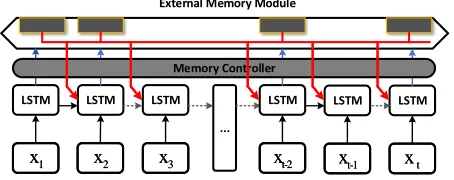
Figure 2: Illustration of the data flow in our proposed model. ‘LSTM’ boxes represent the linear operations in Eq. 3, the black solid line between ‘LSTM’ boxes represents the hid-den states update operation and gray dashed line means reinitialize hidden state to zero, as shown in Eq. 4, Eq. 5. Additionally, blue line cross memory controller box means that corresponding features are written into memory module and the red line represents the read processing of external memory module.
Learning Architecture
As illustrated in Figure 1, the two-stream framework is adopted to improve the accuracy of prediction, where the op-tical flow is utilized as an additional modality to compensate the RGB inputs. The optical flow inputs are complementary to our proposed model, because optical flow only captures small motion between consecutive frames and our model aims to learn long-term motion patterns in long-range tem-poral structure. Note that video sequences, each composed of several frames sampled from a video, are fed into con-volutional network to extract high-level feature representa-tions. Therefore, our approach can be extendible for almost all CNN architectures, including BN-Inception, ResNets, and VGGnet. In practice, we initialize our convolutional net-work with models that are well pre-trained on ImageNet be-fore we fine-tune them on the relatively small video datasets. Computation Graph Analysis.From data flow perspec-tive, our approach enables the model to reroute the forward path adaptively, which provides an effective and efficient way to exploit the temporal correlations in long-range mo-tion dynamics. As shown in Figure 2, suppose the convo-lutional featurextis written into external memory module, i.e.,st=1, and it will be connected with subsequent frames through memory read processing such asx1andx2in Fig-ure 2. Meanwhile, the inherent connection in LSTM unit is broken using Eq. 4 and Eq. 5 when st = 0, e.g. dashed line betweenx2 andx3 in the figure. Compared to tradi-tional LSTM, all information from foregoing frames that are transformed into memory items are utilized to compute the gate value st rather than only last frame, which im-proves capacity for modeling long-term and complex mo-tion dynamics. For example, the informamo-tion ofx1andx2 is passed to framet−1 andt through “red” data path in Figure 2. Moreover, all parameters in the memory controller are learned from video datasets and the data flow of forward pass varies in different video sequences by using sample-dependent variablest.
Experiments
To evaluate the proposed network architecture, we conduct action recognition experiments on two benchmark datasets, with in-depth comparisons with baseline and other architec-tures to verify our design principles. We also provide visu-alization of the learned memory controller as a critic part of the model’s interpretability.
Experimental Settings
Dataset.Experiments are mainly conducted on two action recognition benchmark datasets: UCF101 (Soomro, Zamir, and Shah 2012) and HMDB51 (Kuehne et al. 2011). The UCF101 dataset is composed of 13,320 videos categorized into 101 actions, ranging from daily life activities to unusual sports. The videos are collected from Internet with various camera motions and illuminations. HMDB51 dataset con-tains 6766 videos divided into 51 action classes. Complex backgrounds and similar scenes in different categories make this dataset more challenging than others. For both of them, we follow the provided evaluation protocol and adopt stan-dard training/test splits and report the mean classification ac-curacy over these splits.
Implementation Details. We choose VGG16 and ResNet101 as our CNN feature extractor for the RGB and optical flow images. We use stochastic gradient descent al-gorithm to train our model from scratch. The mini-batch size is set to 64 and the momentum is set to 0.9. We use small learning rate in our experiments. For spatial-stream networks, the learning rate is initialized as 0.001 and de-crease by 101 every 6,000 iterations. The training procedure stops after 18,000 iterations. For the temporal stream, we initialize the learning rate as 0.005, which reduces to its 101 after 48,000 and 72,000 iterations. The maximum iteration is set as 80,000. We use gradient clipping of 20 to avoid exploding gradient at the early stage. For data augmenta-tion, we use the techniques of location jittering, horizontal flipping, corner cropping, and scale jittering, as described in (Wang et al. 2016). All the experiments are run on the Py-Torch toolbox (Paszke et al. 2017).
Baseline Two-stream ConvNets. There are two types of two-stream baseline. One is the convNet-baseline re-ported in (Li et al. 2018) and another one is TSN-baseline proposed in (Wang et al. 2016). We distinguish these two baseline-based method by w/o “+TSN”, i.e., Ours(VGG)/Ours(VGG+TSN) and Ours(ResNet+TSN).
Table 1: Performance evaluation on videos of split 1 of UCF-101 with complex movements.
Action Category ConvLSTM Ours(VGG) Human-Object Interaction 76.0 83.3 Human-Human Interaction 89.1 91.5 Body Motion Only 88.1 89.3
Pizza Tossing 21.1 54.6
Mixing Batter 55.6 75.6
Playing Dhol 81.6 95.9
Salsa Spins 86.0 93.1
Fall Floor Drink
Turn Eat
1)
3)
2)
4)
Figure 3: Memory controller decision results of the proposed method on HMDB51 dataset. Note that the memory controller can correctly select the most evident frames and ignore irrelevant frames. Specifically, the blue bar stands for the memory controller decisionst=0, and the green bar stands for the memory controller decisionst =1, i.e., corresponding convolutional features are written into external memory module.
Effect on videos with complex movements
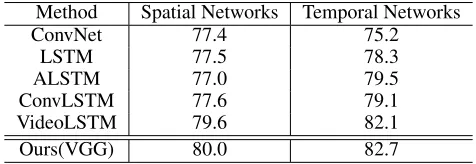
In this subsection, We focus on the effectiveness of our model processing videos with complex motion dynamics. The 101 action categories of UCF101 dataset have been di-vided into five coarse types: human-object interaction, body-motion only, human-human interaction, playing musical in-struments, and sports. We summarize the classification ac-curacy on these coarse categories and report it in Table 1. The upper part of the table shows the performance on the coarse category. The ConvLSTM that aims to model spatio-temporal pattern in complex motion dynamics are utilized for comparison, and our model outperforms on all coarse categories, particularly by 7.3% on human-object interac-tion, by 2.4% on human-human interaction and 1.2% on body motion only. The impressive improvements on human interacting actions verify our model’s superiority in han-dling complex motion dynamics over ConvLSTM. Mean-while, our method shows similar results with ConvLSTM on body motion only actions since the movements are sim-ple in this category. Furthermore, results from several typi-cal classes are shown in lower part of the table. Our model gains 33.5% and 20.0% improvements on pizza tossing and mixing batter category respectively, where the movements between the person and object are complex and fast. In the ice dancing category, we see only 0.2% improvement since the appearance information is very discriminative and recog-nition accuracy is comparable using one-single frame.
Table 2: Detailed results on videos of split 1 of UCF-101 using VGG16.
Method Spatial Networks Temporal Networks
ConvNet 77.4 75.2
LSTM 77.5 78.3
ALSTM 77.0 79.5
ConvLSTM 77.6 79.1
VideoLSTM 79.6 82.1
Ours(VGG) 80.0 82.7
Memory Controller Visualization
We present several video sequences to visually verify the effect of the discrete memory controller, which is the key
component that rules the memory content for action recog-nition. Figure 3 shows the memory write decisions and cor-responding RGB frame on split 1 of HMDB51 datasets. We can clearly see that the memory controller learns to write the most evident information into external memory module and ignore irrelevant frames.
In Figure 3, we show four video sequences sampled from fall floor, drink, eat, and turn categories. These actions have strong segmental characteristics, for example, drink can be divided into three stages: grab the glass, drink and put down the glass. And the learned memory controller can select the most discriminative stage to recognize actions. For instance, in sequence 1), there is a close-up of the person’s head in the beginning which is irrelevant to the fall floor activity, so the memory controller decides to ignore these close-up frames and store the relevant frames once they appear. What is more, in sequence 2) and 3), drink and turn activities are composed of several stages and the activities are usu-ally confusing before real actions occur. For example, the person may put down the glass instead of drink it after ob-served three frames in sequence 2). Therefore, the learned memory controller tends to write the most evident frames into the external memory module even though losing some relevant information. At the same time, the learned mem-ory controller is robust to background and object variation. The changes of person and background make the sequence 4) more challenging, and our controller can autonomically find the leading person and ignore others.
Comparison with other temporal models
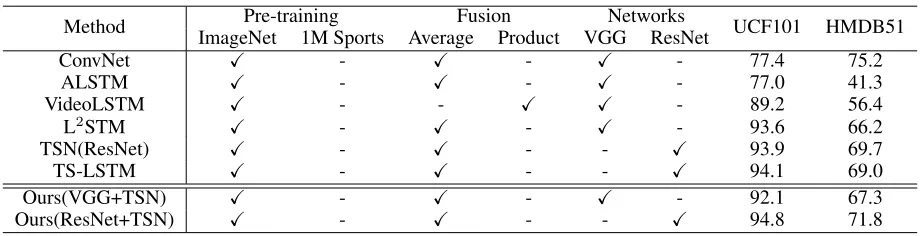
im-Table 3: State-of-the-art comparison with LSTM-like architectures.
Method Pre-training Fusion Networks UCF101 HMDB51
ImageNet 1M Sports Average Product VGG ResNet
ConvNet X - X - X - 77.4 75.2
ALSTM X - X - X - 77.0 41.3
VideoLSTM X - - X X - 89.2 56.4
L2STM X - X - X - 93.6 66.2
TSN(ResNet) X - X - - X 93.9 69.7
TS-LSTM X - X - - X 94.1 69.0
Ours(VGG+TSN) X - X - X - 92.1 67.3
Ours(ResNet+TSN) X - X - - X 94.8 71.8
proves the performance by 2.6 and 7.5 points respectively. Furthermore, our model also outperforms other LSTM vari-ants that are designed to action recognition.
In Table 3, we list all state-of-the-art methods which learn motion patterns with LSTM for action recognition tasks. In order to present the completely and clearly, we elaborate on some factors, such as pre-training type, fusion strategy, and network architectures. To be specific, we compare the pro-posed method with ALSTM (Sharma, Kiros, and Salakhut-dinov 2015), VideoLSTM (Li et al. 2018), L2STM (Sun et al. 2017) and TS-LSTM (Ma et al. 2017). The recent state-of-the-art method L2STM and TS-LSTM also aim at modeling long-term motion dynamics in the videos, and our method outperforms L2STM in terms of average accuracy 67.3% vs 66.2% on HMDB51 dataset and obtains compara-ble performance on UCF101 dataset. The reason behind this is the videos from UCF101 are trimmed carefully, which makes our method less useful, and a cross-modal training strategy is utilized to boost final performance. Compared with UCF101 dataset, videos from HMDB51 dataset usually contains some action-irrelevant shot, as shown in Figure 3, which makes HMDB51 dataset more challenging. And our proposed model tackles these video better by storing use-ful information and ignore noisy feature representations, so our approach makes a consistent improvement on HMDB51 dataset when compared with other methods.
Comparison with the state-of-the-art
In addition to the various temporal models comparison in Table 3, we compare our method with other state-of-the-art algorithms and the results are reported in Table 4. We eval-uate our method following the testing scheme described in the standard two-stream method (Simonyan and Zisserman 2014), where final classification results are obtained by aver-age of the spatial and temporal stream results. Specifically, we compare our method with traditional approaches such as improved trajectories (iDTs) (Wang et al. 2011) and deep learning algorithms such as two-stream networks (Simonyan and Zisserman 2014), factorized spatio-temporal convolu-tional networks (FSTCN) (Sun et al. 2015), 3D
convolu-tional networks (C3D) (Tran et al. 2015), spatio-temporal fusion CNNs (Feichtenhofer, Pinz, and Zisserman 2016), at-tention cluster (Att-C) (Long et al. 2018b) and TSN (Wang et al. 2016), which model long-term temporal structure by
segmental architecture with sparse sampling.
As shown in Table 4, our best implementation based on ResNet improves the average accuracy by 0.7% on UCF101 and 2.5% on HMDB51, which is reported in TS-LSTM us-ing the same ResNet architecture. For testifyus-ing that our method is generally effective, we additionally evaluate our model with VGG-16 network as the previous two-stream CNNs architectures (Simonyan and Zisserman 2014). Both based on VGG-16, our method (92.1%) is still compara-ble to the spatio-temporal fusion CNNs (92.5%) (Feichten-hofer, Pinz, and Zisserman 2016) on UCF101 datasets and outperforms it by 1.9% on HMDB51 dataset. Meanwhile, our method achieves the best results 94.8% and 71.8% on UCF101 and HMDB51 dataset respectively. This result demonstrates that our approaches can be widely applied to many fancy CNN models.
Table 4: Performance comparison with the state-of-the-art.
Model Method UCF101 HMDB51
Traditional
iDT + FV 85.9 57.2
iDT + HSV 87.9 61.1
VideoDarwin - 63.7
MPR - 65.5
Deep
Two Stream 88.0 59.4
FSTCN 88.1 59.1
VideoLSTM 89.2 56.4
Very Deep
C3D 85.2
-Fusion 92.5 65.4
L2STM 93.6 66.2
TS-LSTM 94.1 69.0
TSN(BN-Inception) 94.0 68.5 TSN(ResNet) 93.9 69.7
Att-C 94.6 69.2
Ours Ours(VGG16+TSN) 92.1 67.3 Ours(ResNet+TSN) 94.8 71.8
Conclusion
Fur-thermore, through memory items in the external memory module, the model can route the forward path adaptively us-ing the discrete memory controller. As the core of the net-work, the memory controller employs hard threshold func-tion to output discrete memory write decision and approx-imates its gradients using straight-through estimator, which enables the network can be trained end-to-end from scratch. As shown in visualization results, the learned memory con-troller can write the most evident information into exter-nal memory module and ignore irrelevant frames automat-ically. Moreover, to verify the generalization ability of the proposed model, we evaluate our model with different CNN architecture. Experiments conducted on both UCF101 and HMDB51 datasets validate our proposal and analysis.
Acknowledgments
This work was supported by the National Key R&D Program of China under Grant 2017YFB1002202, National Natural Science Foundation of China under Grant U1864204 and 61773316, Natural Science Foundation of Shaanxi Province under Grant 2018KJXX-024, Projects of Special Zone for National Defense Science and Technology Innovation, Fdamental Research Funds for the Central Universities un-der Grant 3102017AX010, and Open Research Fund of Key Laboratory of Spectral Imaging Technology, Chinese Academy of Sciences.
References
Bengio, Y.; L´eonard, N.; and Courville, A. 2013. Estimat-ing or propagatEstimat-ing gradients through stochastic neurons for conditional computation. arXiv preprint arXiv:1308.3432. Boiman, O., and Irani, M. 2007. Detecting irregularities in images and in video. International journal of computer vision74(1):17–31.
Carreira, J., and Zisserman, A. 2017. Quo vadis, action recognition? a new model and the kinetics dataset. InIEEE Conference on Computer Vision and Pattern Recognition, 4724–4733.
Feichtenhofer, C.; Pinz, A.; and Wildes, R. P. 2017. Spa-tiotemporal multiplier networks for video action recogni-tion. InIEEE Conference on Computer Vision and Pattern Recognition, 2097–2106.
Feichtenhofer, C.; Pinz, A.; and Zisserman, A. 2016. Convo-lutional two-stream network fusion for video action recog-nition. InIEEE Conference on Computer Vision and Pattern Recognition, 1933–1941.
Gao, J.; Ge, R.; Chen, K.; and Nevatia, R. 2018. Motion-appearance co-memory networks for video question answer-ing.arXiv preprint arXiv:1803.10906.
Graves, A.; Wayne, G.; and Danihelka, I. 2014. Neural turing machines.arXiv preprint arXiv:1410.5401.
Joulin, A., and Mikolov, T. 2015. Inferring algorithmic pat-terns with stack-augmented recurrent nets. InAdvances in Neural Information Processing Systems, 190–198.
Karpathy, A.; Toderici, G.; Shetty, S.; Leung, T.; Suk-thankar, R.; and Fei-Fei, L. 2014. Large-scale video
classi-fication with convolutional neural networks. InIEEE Con-ference on Computer Vision and Pattern Recognition, 1725– 1732.
Krizhevsky, A.; Sutskever, I.; and Hinton, G. E. 2012. Imagenet classification with deep convolutional neural net-works. InAdvances in Neural Information Processing Sys-tems, 1097–1105.
Kuehne, H.; Jhuang, H.; Garrote, E.; Poggio, T.; and Serre, T. 2011. Hmdb: a large video database for human motion recognition. InIEEE International Conference on Computer Vision, 2556–2563.
Li, Z.; Gavrilyuk, K.; Gavves, E.; Jain, M.; and Snoek, C. G. 2018. Videolstm convolves, attends and flows for action recognition. Computer Vision and Image Understanding
166:41–50.
Lin, W.; Sun, M.-T.; Poovandran, R.; and Zhang, Z. 2008. Human activity recognition for video surveillance. In Inter-national Symposium on Circuits and Systems, 2737–2740. Long, X.; Gan, C.; de Melo, G.; Liu, X.; Li, Y.; Li, F.; and Wen, S. 2018a. Multimodal keyless attention fusion for video classification. InAAAI Conference on Artificial Intel-ligence.
Long, X.; Gan, C.; de Melo, G.; Wu, J.; Liu, X.; and Wen, S. 2018b. Attention clusters: Purely attention based local fea-ture integration for video classification. InIEEE Conference on Computer Vision and Pattern Recognition, 7834–7843. Long, J.; Shelhamer, E.; and Darrell, T. 2015. Fully convo-lutional networks for semantic segmentation. InIEEE Con-ference on Computer Vision and Pattern Recognition, 3431– 3440.
Ma, C.-Y.; Chen, M.-H.; Kira, Z.; and AlRegib, G. 2017. Ts-lstm and temporal-inception: Exploiting spatiotempo-ral dynamics for activity recognition. arXiv preprint arXiv:1703.10667.
Paszke, A.; Gross, S.; Chintala, S.; Chanan, G.; Yang, E.; DeVito, Z.; Lin, Z.; Desmaison, A.; Antiga, L.; and Lerer, A. 2017. Automatic differentiation in pytorch. InAdvances in Neural Information Processing Systems Workshop. Sharma, S.; Kiros, R.; and Salakhutdinov, R. 2015. Ac-tion recogniAc-tion using visual attenAc-tion. arXiv preprint arXiv:1511.04119.
Simonyan, K., and Zisserman, A. 2014. Two-stream con-volutional networks for action recognition in videos. In Ad-vances in Neural Information Processing Systems, 568–576. Soomro, K.; Zamir, A. R.; and Shah, M. 2012. Ucf101: A dataset of 101 human actions classes from videos in the wild. arXiv preprint arXiv:1212.0402.
Sukhbaatar, S.; Weston, J.; Fergus, R.; et al. 2015. End-to-end memory networks. InAdvances in Neural Information Processing Systems, 2440–2448.
Sun, L.; Jia, K.; Yeung, D.-Y.; and Shi, B. E. 2015. Human action recognition using factorized spatio-temporal convolu-tional networks. InIEEE International Conference on Com-puter Vision, 4597–4605.
Savarese, S. 2017. Lattice long short-term memory for hu-man action recognition. InIEEE International Conference on Computer Vision, 2166–2175.
Tran, D.; Bourdev, L.; Fergus, R.; Torresani, L.; and Paluri, M. 2015. Learning spatiotemporal features with 3d con-volutional networks. InIEEE International Conference on Computer Vision, 4489–4497.
Vu, T.-H.; Choi, W.; Schulter, S.; and Chandraker, M. 2018. Memory warps for learning long-term online video repre-sentations.arXiv preprint arXiv:1803.10861.
Wang, H.; Kl¨aser, A.; Schmid, C.; and Liu, C.-L. 2011. Ac-tion recogniAc-tion by dense trajectories. InIEEE Conference on Computer Vision and Pattern Recognition, 3169–3176. Wang, L.; Xiong, Y.; Wang, Z.; Qiao, Y.; Lin, D.; Tang, X.; and Van Gool, L. 2016. Temporal segment networks: To-wards good practices for deep action recognition. In Euro-pean Conference on Computer Vision, 20–36.
Wang, Q.; Yuan, Z.; Du, Q.; and Li, X. 2018. Getnet: A gen-eral end-to-end 2-d cnn framework for hyperspectral image change detection. IEEE Transactions on Geoscience and Remote Sensing.
Xingjian, S.; Chen, Z.; Wang, H.; Yeung, D.-Y.; Wong, W.-K.; and Woo, W.-c. 2015. Convolutional lstm network: A machine learning approach for precipitation nowcasting. In
Advances in Neural Information Processing Systems, 802– 810.
Yang, T., and Chan, A. B. 2018. Learning dynamic memory networks for object tracking. arXiv preprint arXiv:1803.07268.
Yue-Hei Ng, J.; Hausknecht, M.; Vijayanarasimhan, S.; Vinyals, O.; Monga, R.; and Toderici, G. 2015. Beyond short snippets: Deep networks for video classification. In
IEEE Conference on Computer Vision and Pattern Recogni-tion, 4694–4702.