iNNvestigate Neural Networks!
Maximilian Alber [email protected]
Technische Universit¨at Berlin, Machine Learning Group 10623 Berlin, Germany
Sebastian Lapuschkin [email protected]
Fraunhofer Heinrich Hertz Institute, Video Coding and Analytics 10587 Berlin, Germany
Philipp Seegerer [email protected]
Miriam H¨agele [email protected]
Kristof T. Sch¨utt [email protected]
Gr´egoire Montavon [email protected]
Technische Universit¨at Berlin, Machine Learning Group 10623 Berlin, Germany
Wojciech Samek [email protected]
Fraunhofer Heinrich Hertz Institute, Video Coding and Analytics 10587 Berlin, Germany
Klaus-Robert M¨uller [email protected]
Technische Universit¨at Berlin, Machine Learning Group 10623 Berlin, Germany
Korea University, Department of Brain and Cognitive Engineering Seoul 02841, Korea
Max Planck Institute for Informatics 66123 Saarbr¨ucken, Germany
Sven D¨ahne [email protected]
Pieter-Jan Kindermans [email protected]
Technische Universit¨at Berlin, Machine Learning Group 10623 Berlin, Germany
Editor:Alexandre Gramfort
Abstract
In recent years, deep neural networks have revolutionized many application domains of machine learning and are key components of many critical decision or predictive processes. Therefore, it is crucial that domain specialists can understand and analyze actions and pre-dictions, even of the most complex neural network architectures. Despite these arguments neural networks are often treated as black boxes. In the attempt to alleviate this short-coming many analysis methods were proposed, yet the lack of reference implementations often makes a systematic comparison between the methods a major effort. The presented
library iNNvestigate addresses this by providing a common interface and
out-of-the-box implementation for many analysis methods, including the reference implementation for PatternNet and PatternAttribution as well as for LRP-methods. To demonstrate the
versatility of iNNvestigate, we provide an analysis of image classifications for variety of
state-of-the-art neural network architectures.
c
Keywords: Artificial neural networks, deep learning, analyzing classifiers, explaining classifiers, computer vision
1. Introduction
In recent years deep neural networks have revolutionized many domains, e.g., image recog-nition, speech recogrecog-nition, speech synthesis, and knowledge discovery (Krizhevsky et al., 2012; LeCun et al., 2012; Schmidhuber, 2015; LeCun et al., 2015; Van Den Oord et al., 2016). Due to their ability to naturally learn from structured data and exhibit superior performance, they are increasingly used in practical applications and critical decision pro-cesses, such as novel knowledge discovery techniques, autonomous driving or medical image analysis. To fully leverage their potential it is essential that users cancomprehend and ana-lyze these processes. E.g., in neural architecture (Zoph et al., 2018) or chemical compound searches (Montavon et al., 2013; Sch¨utt et al., 2017) it would be extremely useful to know which properties help a neural network to choose appropriate candidates. Furthermore for some applications understanding the decision process might be a legal requirement.
Despite these arguments neural networks are often treated as black boxes, because their complex internal workings and the basis for their predictions are not fully understood. In the attempt to alleviate this shortcoming several methods were proposed, e.g., Saliency Map (Baehrens et al., 2010; Simonyan et al., 2013), SmoothGrad (Smilkov et al., 2017), In-tegratedGradients (Sundararajan et al., 2017), Deconvnet (Zeiler and Fergus, 2014), Guid-edBackprop (Springenberg et al., 2015), PatternNet and PatternAttribution (Kindermans et al., 2018), LRP (Bach et al., 2015; Lapuschkin et al., 2016a,b, 2019; Montavon et al., 2018), and DeepTaylor (Montavon et al., 2017). Theoretically it is not clear which method solves the stated problems best, therefore an empirical comparison is required (Samek et al., 2017; Kindermans et al., 2017). In order to evaluate these methods, we present iNNvesti-gate which provides a common interface to a variety of analysis methods.
In particular, iNNvestigate contributes:
• A common interface for a growing number of analysis methods that is applicable to a broad class of neural networks. With this instantiating a method is as uncomplicated as passing a trained neural network to it and allows for easy qualitative comparisons of methods. For quantitative evaluations of (image) classification task we further provide an implementation of the method “perturbation analysis” (Samek et al., 2017).
• Support of all methods listed above—this includes the first reference implementation for PatternNet and PatternAttribution and an extended implementation for LRP— and an open source repository for further contributions.
• A clean and modular implementation, casting each analysis in terms of layer-wise forward and backward computations. This limits code redundancy, takes advantage of automatic differentiation, and eases future integration of new methods.
Terminology: The different methods pose different assumption to tasks and are designed for different objectives, yet they are related to “explaining” or “interpreting” neural net-works, see Montavon et al. (2018). We actively refrain from using this terminology in order to prevent misunderstandings between the design choices of the algorithms and the implicit assumption these terms bring along. Therefore we will solely use the neutral termanalyzing
and leave any interpretation to the user.
2. Library
Interface: The main feature is a common interface to several analysis methods. The workflow is as simple as passing a Keras neural network model to instantiate an analyzer object for a desired algorithm. Then, if needed, the analyzer will be fitted to the data and eventually be used to analyze the model’s predictions. The corresponding Python code is:
1 import i n n v e s t i g a t e
2 model = c r e a t e a k e r a s m o d e l ( )
3 a n a l y z e r = i n n v e s t i g a t e . c r e a t e a n a l y z e r ( ‘ ‘ a n a l y z e r n a m e ’ ’ , model ) 4 a n a l y z e r . f i t ( X t r a i n ) # i f n e e d e d
5 a n a l y s i s = a n a l y z e r . a n a l y z e ( X t e s t )
Implemented methods: At publication time the following algorithms are supported: Gra-dient Saliency Map, SmoothGrad, IntegratedGraGra-dients, Deconvnet, GuidedBackprop, Pat-ternNet and PatternAttribution, DeepTaylor, and LRP including LRP-Z, -Epsilon, -AlphaBeta. In contrast, current related work is limited to gradient- and perturbation-based methods (Kotikalapudi and contributors, 2017; Ancona et al., 2018) or focuses on a single algorithm (E.g., Lundberg and Lee, 2017; Ribeiro et al., 2016). For an overview see Alber (2019). We intend to extend this selection and invite the community to contribute implementations as new methods emerge.
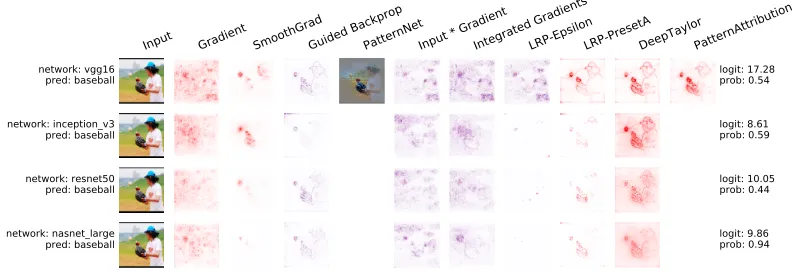
Documentation: The library’s documentation contains several introductory scripts and ex-ample applications. We demonstrate how the analyses can be applied to the following state-of-the-art models: VGG16 (Simonyan and Zisserman, 2014), InceptionV3 (Szegedy et al., 2016), ResNet50 (He et al., 2016), InceptionResNetV2 (Szegedy et al., 2017), DenseNet (Huang et al., 2017), NASNet (Zoph et al., 2018). Figure 1 shows the result for a subset.
network: vgg16 pred: baseball
Input Gradient SmoothGradGuided BackpropPatternNetInput * GradientIntegrated GradientsLRP-EpsilonLRP-PresetADeepTaylorPatternAttribution
logit: 17.28 prob: 0.54
network: inception_v3
pred: baseball logit: 8.61prob: 0.59
network: resnet50
pred: baseball logit: 10.05prob: 0.44
network: nasnet_large
pred: baseball logit: 9.86prob: 0.94
2.1. Details
Modular implementation: All of the methods have in common that they perform a back-propagation from the model outputs to the inputs. The core of iNNvestigate is a set of base classes and functions that is designed to allow for rapid and easy development of such algorithms. The developer only needs to implement specific changes to the base algorithm and the library will take care of the complex and error-prone handling of the propagation along the graph structure. Further details can be found in the repositories documentation. Another advantage of the modular design is that one can extend any analyzer with a given set of wrappers. One application of this is the smoothing of the analysis results by adding Gaussian noise to the copies of the input and averaging the outcome. E.g., SmoothGrad is realized in this way by combining a smoothing wrapper with a gradient analyzer.
Training: PatternNet and PatternAttribution (Kindermans et al., 2018) are two novel approaches that condition their analysis on the data distribution. This is done by identifying the signal and noise direction for each neuron of a neural network. Our software scales favorably, e.g., one can train required patterns for the methods on large data sets like Imagenet (Deng et al., 2009) in less than an hour using one GPU. We present the first reference implementation of these methods.
Quantitative evaluation: Often analysis methods for neural networks are compared by qualitative (visual) inspection of the result. This is can lead to subjective evaluations and one approach to create a more objective and quantitative comparison of analysis algorithms is the method “perturbation analysis” (Samek et al., 2017, also known as “PixelFlipping”). The intuition behind this method is that perturbing regions which are recognized as im-portant for the classification task by the analyzing method, will impact the classification most. This allows to assess which analysis method best identifies regions that matter for a specific task and neural network. iNNvestigate contains an implementation of this method.
Installation & license: iNNvestigate is published as open-source software under the BSD-2-license and can be downloaded from: https://github.com/albermax/innvestigate. It is built as a Python 2 or 3 application on top of the popular and established Keras (Chollet et al., 2015) framework. This allows to use the library on various platforms and devices like CPUs and GPUs. At the time of publication only the TensorFlow (Abadi et al., 2016) Keras-backend is supported. The library can be simply installed as Python package.
3. Conclusion
Acknowledgments
References
Mart´ın Abadi, Paul Barham, Jianmin Chen, Zhifeng Chen, Andy Davis, Jeffrey Dean, Matthieu Devin, Sanjay Ghemawat, Geoffrey Irving, Michael Isard, et al. Tensorflow: a system for large-scale machine learning. Proceedings of the 11th USENIX Symposium on Operating Systems Design and Implementation, 16:265–283, 2016.
Maximilian Alber. Software and application patterns for explanation methods. In Inter-pretable AI: Interpreting, Explaining and Visualizing Deep Learning. Springer, 2019.
Marco Ancona, Enea Ceolini, Cengiz ¨Oztireli, and Markus Gross. Towards better under-standing of gradient-based attribution methods for deep neural networks. InInternational Conference on Learning Representations, 2018.
Sebastian Bach, Alexander Binder, Gr´egoire Montavon, Frederick Klauschen, Klaus-Robert M¨uller, and Wojciech Samek. On pixel-wise explanations for non-linear classifier decisions by layer-wise relevance propagation. PLOS ONE, 10(7):1–46, 2015.
David Baehrens, Timon Schroeter, Stefan Harmeling, Motoaki Kawanabe, Katja Hansen, and Klaus-Robert M¨uller. How to explain individual classification decisions. Journal of Machine Learning Research, 11:1803–1831, 2010.
Fran¸cois Chollet et al. Keras. https://github.com/fchollet/keras, 2015.
Jia Deng, Wei Dong, Richard Socher, Li-Jia Li, Kai Li, and Li Fei-Fei. Imagenet: A large-scale hierarchical image database. In 2009 IEEE Conference on Computer Vision and Pattern Recognition, pages 248–255, 2009.
Kaiming He, Xiangyu Zhang, Shaoqing Ren, and Jian Sun. Deep residual learning for image recognition. In 2016 IEEE Conference on Computer Vision and Pattern Recognition, pages 770–778, 2016.
Gao Huang, Zhuang Liu, Laurens van der Maaten, and Kilian Q. Weinberger. Densely connected convolutional networks. In 2017 IEEE Conference on Computer Vision and Pattern Recognition, pages 2261–2269, 2017.
Pieter-Jan Kindermans, Sara Hooker, Julius Adebayo, Maximilian Alber, Kristof T Sch¨utt, Sven D¨ahne, Dumitru Erhan, and Been Kim. The (un)reliability of saliency methods.
Neural Information Processing Systems 2017 - Interpreting, Explaining and Visualizing Deep Learning - Now what? workshop, 2017.
Pieter-Jan Kindermans, Kristof T Sch¨utt, Maximilian Alber, Klaus-Robert M¨uller, Dumitru Erhan, Been Kim, and Sven D¨ahne. Learning how to explain neural networks: PatternNet and PatternAttribution. InInternational Conference on Learning Representations, 2018.
Raghavendra Kotikalapudi and contributors. keras-vis. https://github.com/raghakot/ keras-vis, 2017.
Sebastian Lapuschkin, Alexander Binder, Gr´egoire Montavon, Klaus-Robert M¨uller, and Wojciech Samek. Analyzing classifiers: Fisher vectors and deep neural networks. In 2016 IEEE Conference on Computer Vision and Pattern Recognition, pages 2912–2920, 2016a.
Sebastian Lapuschkin, Alexander Binder, Gr´egoire Montavon, Klaus-Robert M¨uller, and Wojciech Samek. The layer-wise relevance propagation toolbox for artificial neural net-works. Journal of Machine Learning Research, 17:3938–3942, 2016b.
Sebastian Lapuschkin, Stephan W¨aldchen, Alexander Binder, Gr´egoire Montavon, Wojciech Samek, and Klaus-Robert M¨uller. Unmasking clever hans predictors and assessing what machines really learn. Nature communcations, 10:ID: 1096, 2019.
Yann A LeCun, L´eon Bottou, Genevieve B Orr, and Klaus-Robert M¨uller. Efficient back-prop. InNeural networks: Tricks of the trade, pages 9–48. 2012.
Yann A LeCun, Yoshua Bengio, and Geoffrey E Hinton. Deep learning. Nature, 521(7553): 436–444, 2015.
Scott M Lundberg and Su-In Lee. A unified approach to interpreting model predictions. In
Advances in Neural Information Processing Systems 30, pages 4765–4774, 2017.
Gr´egoire Montavon, Matthias Rupp, Vivekanand Gobre, Alvaro Vazquez-Mayagoitia, Katja Hansen, Alexandre Tkatchenko, Klaus-Robert M¨uller, and Anatole Von Lilienfeld. Ma-chine learning of molecular electronic properties in chemical compound space. New Jour-nal of Physics, 15(9):ID: 095003, 2013.
Gr´egoire Montavon, Sebastian Bach, Alexander Binder, Wojciech Samek, and Klaus-Robert M¨uller. Explaining nonlinear classification decisions with deep taylor decomposition.
Pattern Recognition, 65:211–222, 2017.
Gr´egoire Montavon, Wojciech Samek, and Klaus-Robert M¨uller. Methods for interpreting and understanding deep neural networks. Digital Signal Processing, 73:1–15, 2018.
Marco T´ulio Ribeiro, Sameer Singh, and Carlos Guestrin. ”why should i trust you?”: Explaining the predictions of any classifier. In Proceedings of the 22th ACM SIGKDD International Conference on Knowledge Discovery and Data Mining, pages 1135–1144, 2016.
Wojciech Samek, Alexander Binder, Gr´egoire Montavon, Sebastian Lapuschkin, and Klaus-Robert M¨uller. Evaluating the visualization of what a deep neural network has learned.
IEEE Transactions on Neural Networks and Learning Systems, 28(11):2660–2673, 2017.
J¨urgen Schmidhuber. Deep learning in neural networks: An overview. Neural networks, 61: 85–117, 2015.
Karen Simonyan and Andrew Zisserman. Very deep convolutional networks for large-scale image recognition. arXiv preprint arXiv:1409.1556, 2014.
Karen Simonyan, Andrea Vedaldi, and Andrew Zisserman. Deep inside convolutional networks: Visualising image classification models and saliency maps. arXiv preprint arXiv:1312.6034, 2013.
Daniel Smilkov, Nikhil Thorat, Been Kim, Fernanda Vi´egas, and Martin Wattenberg. Smoothgrad: Removing noise by adding noise. International Conference on Machine Learning 2017 - Workshop on Visualization for Deep Learning, 2017.
Jost T Springenberg, Alexey Dosovitskiy, Thomas Brox, and Martin Riedmiller. Striv-ing for simplicity: The all convolutional net. In International Conference on Learning Representations - Workshop track, 2015.
Mukund Sundararajan, Ankur Taly, and Qiqi Yan. Axiomatic attribution for deep networks. In Proceedings of the 34th International Conference on Machine Learning, pages 3319– 3328, 2017.
Christian Szegedy, Vincent Vanhoucke, Sergey Ioffe, Jon Shlens, and Zbigniew Wojna. Rethinking the inception architecture for computer vision. In 2016 IEEE Conference on Computer Vision and Pattern Recognition, pages 2818–2826, 2016.
Christian Szegedy, Sergey Ioffe, Vincent Vanhoucke, and Alexander A Alemi. Inception-v4, inception-resnet and the impact of residual connections on learning. InProceedings of the 31st AAAI Conference on Artificial Intelligence (AAAI), pages 4278–4284, 2017.
A¨aron Van Den Oord, Sander Dieleman, Heiga Zen, Karen Simonyan, Oriol Vinyals, Alex Graves, Nal Kalchbrenner, Andrew Senior, and Koray Kavukcuoglu. Wavenet: A gener-ative model for raw audio. arXiv preprint arXiv:1609.03499, 2016.
Matthew D Zeiler and Rob Fergus. Visualizing and understanding convolutional networks. In Proceedings of the 2014 European Conference on Computer Vision, pages 818–833, 2014.