The Thirty-Third AAAI Conference on Artificial Intelligence (AAAI-19)
Temporal Deformable Convolutional
Encoder-Decoder Networks for Video Captioning
∗Jingwen Chen,
1Yingwei Pan,
2Yehao Li,
1Ting Yao,
2Hongyang Chao,
1,3Tao Mei
21Sun Yat-sen University, Guangzhou, China 2JD AI Research, Beijing, China
3The Key Laboratory of Machine Intelligence and Advanced Computing (Sun Yat-sen University),
Ministry of Education, Guangzhou, China
{chenjingwen.sysu, panyw.ustc, yehaoli.sysu, tingyao.ustc}@gmail.com, [email protected], [email protected]
Abstract
It is well believed that video captioning is a fundamental but challenging task in both computer vision and artificial intelligence fields. The prevalent approach is to map an in-put video to a variable-length outin-put sentence in a sequence to sequence manner via Recurrent Neural Network (RNN). Nevertheless, the training of RNN still suffers to some de-gree from vanishing/exploding gradient problem, making the optimization difficult. Moreover, the inherently recurrent de-pendency in RNN prevents parallelization within a sequence during training and therefore limits the computations. In this paper, we present a novel design — Temporal Deformable Convolutional Encoder-Decoder Networks (dubbed as TD-ConvED) that fully employ convolutions in both encoder and decoder networks for video captioning. Technically, we ex-ploit convolutional block structures that compute interme-diate states of a fixed number of inputs and stack several blocks to capture long-term relationships. The structure in en-coder is further equipped with temporal deformable convolu-tion to enable free-form deformaconvolu-tion of temporal sampling. Our model also capitalizes on temporal attention mechanism for sentence generation. Extensive experiments are conducted on both MSVD and MSR-VTT video captioning datasets, and superior results are reported when comparing to con-ventional RNN-based encoder-decoder techniques. More re-markably, TDConvED increases CIDEr-D performance from 58.8% to 67.2% on MSVD.
Introduction
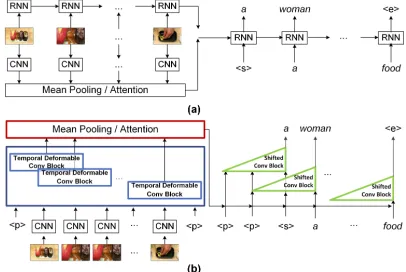
The recent advances in deep neural networks have convinc-ingly demonstrated high capability in learning vision mod-els particularly for recognition. The achievements make a further step towards the ultimate goal of video understand-ing, which is to automatically describe video content with a complete and natural sentence or referred to as video cap-tioning problem. The typical solutions (Pan et al. 2016; Venugopalan et al. 2015a; 2015b; Yao et al. 2015; Yu et al. 2016) of video captioning are inspired by machine transla-tion and equivalent to translating a video to a text. As illus-trated in Figure 1 (a), the basic idea is to perform sequence to sequence learning, where a Convolutional Neural Network (CNN) or Recurrent Neural Network is usually exploited to
∗
This work was performed at JD AI Research.
Copyright c2019, Association for the Advancement of Artificial Intelligence (www.aaai.org). All rights reserved.
Figure 1: An illustration of (a) CNN or RNN plus RNN ar-chitecture and (b) our Temporal Deformable Convolutional Encoder-Decoder Networks, for video captioning.
encode a video and a decoder of RNN is utilized to generate the sentence, one word at each time step till the end. Regard-less of different versions of CNN or RNN plus RNN video captioning framework, a common practice is the use of se-quential RNN, which may result in two limitations. First, RNN powered by Long Short-Term Memory (LSTM) alle-viates the issue of vanishing or exploding gradients to some extent, nevertheless the problem still exists. Moreover, the utilization of RNN on a long path between the start and end of a sequence will easily forget the long-range information. Second, the training process of RNN is inherently sequen-tial due to the recurrent relation in time and thus prevents parallel computations in a sequence.
com-putations over all the input elements could be fully paral-lelized during training.
By consolidating the idea of leveraging convolutions in sequence-to-sequence learning for video captioning, we present a novel Temporal Deformable Convolutional Encoder-Decoder Networks (TDConvED) architecture, as conceptually shown in Figure 1 (b). Given a video, a stan-dard CNN is utilized to extract visual features of sampled frames or clips. Then, the features of frames/clips are fed into convolutional block to produce intermediate states of each frame/clip with contexts. The context size is enlarged by stacking several convolutional blocks. Please also note that we endow the convolutional block in encoder with more power of devising temporal deformable convolutions by cap-turing dynamics in temporal extents of actions or scenes. Once all sampled frames/clips are encoded, the video-level representations are computed by mean pooling over all the intermediate states. Similarly, we employ feed-forward con-volutional blocks that operate on the concatenation of video-level representations and the embeddings of past words to generate subsequent word, till the end token is predicted. In addition, sentence generation is further enhanced by ad-ditionally incorporating temporally attended video features. Since there are no recurrent connections and all ground-truth words are available at any time step, our TDConvED model could be trained in parallel.
Our main contribution is the proposal of the use of con-volutions for sequence-to-sequence learning and eventually boosting video captioning. This also leads to the elegant view of how to design feed-forward convolutional structure in an encoder-decoder video captioning framework, and how to support parallelization over every element within a se-quence, which are problems not yet fully understood.
Related Work
Video Captioning.The dominant direction in modern video captioning is sequence learning approaches (Pan et al. 2016; 2017; Chen et al. 2017; Venugopalan et al. 2015a; 2015b; Yao et al. 2015; Yu et al. 2016; Li et al. 2018) which utilize RNN-based architecture to generate novel sentences with flexible syntactical structures. For instance, Venugopalanet al.present a LSTM-based model to generate video descrip-tions with the mean pooled representation over all frames in (Venugopalan et al. 2015b). The framework is then ex-tended by inputting both frames and optical flow images into an encoder-decoder LSTM in (Venugopalan et al. 2015a). Compared to mean pooling, Yaoet al.propose to utilize the temporal attention mechanism to exploit temporal structure for video captioning (Yao et al. 2015). Later in (Zhao, Li, and Lu 2018), Zhaoet al.design an object-aware tube fea-ture for video captioning to enable attention on salient ob-jects. Most recently, Haoet al.develop several deep fusion strategies to effectively integrate both visual and audio cues into sentence generation in (Hao, Zhang, and Guan 2018).
Sequence Learning with CNN. The most typical paradigm in sequence learning is RNN-based encoder-decoder structure which mainly capitalizes on RNN to model the probability of decoding an output given the pre-vious outputs and all the inputs. Although the remarkable
results have been observed on a number of sequential tasks (e.g., image/video captioning, machine translation), the in-herent recursive characteristic inevitably limits the paral-lelization abilities and even raises vanishing/exploding gra-dient problems in the training stage. To tackle these barriers, there is an emerging trend of leveraging Convolutional Neu-ral Network (CNN) for sequence learning in language mod-eling for NLP tasks (Meng et al. 2015; Bradbury et al. 2016; Kalchbrenner et al. 2016; Gehring et al. 2017). A convolu-tional encoder with a gated architecture has been designed in (Meng et al. 2015), which could pinpoint the parts of a source sentence that are relevant to the target word for machine translation. Recently, the first fully convolutional model for sequence learning is proposed in (Gehring et al. 2017) to design both encoder and decoder in the form of convolutions with CNN, which even outperforms strong re-current models on machine translation task.
Summary.In short, our approach in this paper belongs to sequence learning method for video captioning. Unlike most of the aforementioned sequence learning models which mainly focus on generating sentence by solely depending on RNN-based decoder, our work contributes by exploiting a fully convolutional sequence learning architecture that relies on CNN-based encoder and decoder for video captioning. Moreover, we additionally explore the temporal deformable convolutions and temporal attention mechanism to extend and utilize temporal dynamics across frames/clips, and even-tually enhance the quality of generated sentence.
Temporal Deformable
Convolutional Encoder-Decoder Networks
Our Temporal Deformable Convolutional Encoder-Decoder Networks (TDConvED) architecture is devised to generate video descriptions by fully capitalizing on convolutional en-coder and deen-coder. Specifically, a convolutional enen-coder is firstly leveraged to encode each frame/clip with the con-textual information among multiple sampled frames/clips via temporal deformable convolution. The idea behind tem-poral deformable convolution is to augment the temtem-poral samplings with additional offsets learnt from the inherent temporal dynamics of scenes/actions within frame/clip se-quence. Next, conditioned on the video-level representation induced by the temporal deformable convolutional encoder (e.g., performing mean pooling over all encoded features of frames/clips), we employ a convolutional decoder to pre-dict each output word by additionally exploiting the con-textual relations across the previous output words. Further-more, a temporal attention mechanism tailored to temporal deformable convolutional encoder-decoder structure is de-signed to further boost video captioning. An overview of TDConvED is shown in Figure 2.Problem Formulation
Suppose a videoV withNv sampled frames/clips (uniform
sampling) to be described by a textual sentence S, where S = (w1, w2, . . . , wNs) is the word sequence consisting
of Ns words. Let v = (v1, v2, . . . , vNv) denote the
Figure 2: The overall architecture of our TDConvED that fully employs convolutions in both encoder and decoder networks for video captioning. A standard CNN is firstly utilized to extract visual features of sampled frames/clips. Then, the features of frames/clips are fed into a temporal deformable convolutional encoder with stacked temporal deformable convolutional blocks to produce intermediate states of each frame/clip with contexts. The video-level representations are computed by mean pooling over all the intermediate states. After that, a convolutional decoder with stacked shifted convolutional blocks operates on the concatenation of video-level representations and the embeddings of past words to generate the next word. In addition, a temporal attention mechanism tailored to such convolutional encoder-decoder structure is incorporated to boost video captioning.
wherevi ∈ RDv represents theDv-dimensional feature of
i-th frame/clip extracted by 2D/3D CNN.
Inspired by the recent successes of sequence to sequence solutions leveraged in image/video captioning (Venugopalan et al. 2015a; Yao et al. 2017a; 2017b; 2018), we aim to for-mulate our video captioning model in an encoder-decoder scheme. Instead of relying on RNN to compute intermedi-ate encoder/decoder stintermedi-ates, we novelly utilize a fully con-volutional encoder-decoder architecture for sequence to se-quence modeling in video captioning. Formally, a tempo-ral deformable convolutional encoder is utilized to encode the input frame/clip sequencev = (v1, v2, . . . , vNv)into a
set of context vectorsz= (z1, z2, . . . , zNv), which are
en-dowed with the contextual information among frames/clips sampled in a free-form temporal deformation along the in-put sequence. Next, we perform mean pooling over all the context vectorszto achieve the video-level representation, which is further injected into the convolutional decoder to generate target output sentenceSby capturing the long-term contextual relations among input video and previous output words. Thus, the video sentence generation problem we ex-ploit is formulated by minimizing the following energy loss:
E(v, S) =−log Pr (S|v), (1)
which is the negativelogprobability of the correct textual sentence given the temporal sequence of input video. By applying chain rule to model the joint probability over the sequential words, thelogprobability of the sentence is mea-sured by the sum of thelog probabilities over each word, which can be written as
log Pr (S|v) =
Ns
X
t=1
log Pr (wt|v, w0, . . . , wt−1). (2)
In contrast to the conventional RNN-based encoder-decoder architecture that models the above parametric distribution
Pr (wt|v, w0, . . . , wt−1)with RNN, we employ convolu-tions to calculate it in a simple feed-forward manner at de-coding stage. Since no recurrent dependency exists in the convolutional decoder and all grough-truth words are avail-able at training, the joint probabilityPr (S|v)can be calcu-lated in parallel for all words. Derived from the idea of at-tention mechanism in sequence to sequence modeling (Yao et al. 2015), we also capitalize on temporal attention mech-anism to focus on the frames/clips that are highly relevant to the output word for enriching the video-level representa-tion. Such representation will be additionally injected into convolutional decoder to enhance video captioning.
Temporal Deformable Convolutional Encoder
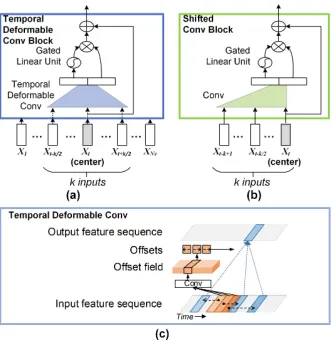
An encoder is a module that takes the source sequence (i.e., frame/clip sequence of video) as input and produces inter-mediate states to encode the semantic content. Here we de-vise a temporal deformable convolutional block in the en-coder of our TDConvED which applies temporal deformable convolution over the input sequence to capture the context across frames/clips sampled in a free-form temporal defor-mation, as depicted in Figure 3 (a). Such design of poral deformable convolution improves conventional tem-poral convolution by capturing temtem-poral dynamics on the natural basis of actions/scenes within the video. Meanwhile, the feed-forward convolutional structure in encoder enables the parallelization within the input sequence and allows fast computation. Furthermore, to exploit long-term dependency among input sequence at encoding stage, multiple temporal deformable convolutional blocks are stacked in encoder to integrate the contextual information from a larger number of temporal samplings in the input sequence.
Formally, consider the l-th temporal deformable convo-lutional block in encoder with the corresponding output se-quence denoted aspl= (pl1, pl2, . . . , plNv), wherep
l i∈R
Figure 3: An illustration of (a) the temporal deformable conv block in encoder, (b) the shifted conv block in decoder, and (c) the temporal deformable convolution.
is the output of the temporal deformable convolution cen-tered on the i-th frame/clip. Given the output sequence pl−1= (pl−1
1 , p
l−1 2 , . . . , p
l−1
Nv)of the(l−1)-th block, each
output intermediate statepl
iis achieved by feeding the
subse-quence ofpl−1into a temporal deformable convolution (ker-nel size:k) plus a non-linearity unit. Note that the tempo-ral deformable convolution operates in a two-stage way, i.e., first measuring temporal offsets via an one-dimensional con-volution for sampling frames/clips and then aggregating the features of sampled frames/clips, as depicted in Figure 3 (c). More specifically, letX = (pli−+1r
1, p
l−1
i+r2, . . . , p
l−1
i+rk)denote
the subsequence ofpl−1, wherer
n is then-th element of
RandR ={−k/2, . . . ,0, . . . , k/2}. The one-dimensional convolution in thel-th temporal deformable convolutional block can be parameterized as the transformation matrix Wfl ∈Rk×kDr and the biasbl
f ∈R
k, which takes the
con-catenation ofkelements inXas input and produces a set of offsets∆ri={∆ri
n}kn=1∈Rk: ∆ri=Wfl[p
l−1
i+r1, p
l−1
i+r2, . . . , p
l−1
i+rk] +b l
f, (3)
where then-th element∆rin in∆ri denotes the measured
temporal offset for then-th sample in the subsequenceX. Next, we achieve the output of temporal deformable con-volution by augmenting samples with temporal offsets via another one-dimensional convolution:
oli=Wdl[pli−+1r
1+∆ri1
, pli−+1r
2+∆ri2
, . . . , pli−+1r
k+∆rik
] +bld, (4)
whereWl d ∈R
2Dr×kDr is the transformation matrix in the
one-dimensional convolution andbld∈R2Dris the bias. As
the temporal offset∆ri
n is typically fractional,p l−1
i+rn+∆rin
in Eq.(4) can be calculated via temporal linear interpolation:
pli−+1r
n+∆rin=
X
s
B(s, i+rn+ ∆rin)p l−1
s , (5)
wherei+rn+ ∆rindenotes an arbitrary position,s
enumer-ates all integral positions in the input sequencepl−1, and B(a, b) =max(0,1− |a−b|).
In addition, we adopt a gated linear unit (GLU) (Dauphin et al. 2017) as the non-linearity unit to ease gradient propa-gation. Thus given the output of temporal deformable con-volutionol
i ∈ R2Dr which has twice the dimension of the
input element, a GLU is applied overol
i= [A, B]through a
simple gating mechanism:
g(oli) =A⊗σ(B), (6)
whereA, B ∈RDr and⊗is the point-wise multiplication.
σ(B) represents a gate unit that controls which elements of A are more relevant to the current context. Moreover, the residual connections (He et al. 2016) from input of the temporal deformable convolution block to the output of the block are added to enable deeper networks. Hence, the final output of thel-th temporal deformable convolutional block is measured as
pli=g(oli) +pli−1. (7)
To ensure the match between the length of output se-quence of temporal deformable convolutional block and the input length, both the left and right sides of the input are padded withk/2zero vectors. By stacking several temporal deformable convolutional blocks over the input frame/clip sequence, we obtain the final sequence of context vectors z= (z1, z2, . . . , zNv), wherezi ∈R
Dr represents the
con-textually encoded feature of thei-th frame/clip.
Convolutional Decoder
The most typical way to implement the decoder for sequence learning is to adopt sequential RNN to produce the out-put sequence conditioned on the representations of the in-put sequence induced by the encoder. However, the inher-ent dependency in RNN inevitably limits the paralleliza-tion abilities of RNN-based decoder and even raises van-ishing/exploding gradient problems for training. To allevi-ate the challenges in decoder of sequence learning, we de-vise a fully convolutional decoder by stacking several shifted convolutional blocks to capture long-term context across the encoded context vectors of input video and output words. Here, the center position of the convolution in shifted convo-lutional block is shifted with respect to the center of normal convolutions, as shown in Figure 3 (b).
In particular, given the encoded sequence of context vec-torsz= (z1, z2, . . . , zNv)for input video, we first perform
mean pooling over all context vectors and achieve the
video-level representation˜z = 1
Nv Nv
P
i=1
zi. Since no memory cells
or autoregressive path exists in the convolutional decoder, the video-level representationz˜is transformed with a linear mappingWiand concatenated with the embeddings of the
input word at each time step, which will be set as the input of the first shifted convolutional block of the decoder. The transformation for addition of word embeddings and posi-tion embeddings is denoted asWe. Consider thel-th shifted
convolutional block in decoder with the corresponding out-put sequenceql = (ql
0, ql1, . . . , qNls), whereq l
t ∈ RDf
ofql−1 is fed into an one-dimensional convolution (kernel size:k) plus a GLU and residual connections, resulting in the output intermediate stateql
tat time stept. Different from the
basic convolution, the corresponding subsequence of ql−1 isXq = (qlt−−1k+1, q
l−1
t−k+2, . . . , q
l−1
t )since no future
infor-mation is available to decoder at decoding stage. Hence, the operation in each shifted convolutional block is given by
qlt=g(Wlq[qtl−−1k+1, qtl−−1k+2, . . . , qtl−1] +bql) +qlt−1, (8)
whereWlq ∈ R2Df×kDf andbq l ∈ R
2Df denote the
trans-formation matrix and bias of the convolutional kernel in the l-th shifted convolutional block, respectively. Note that for each shifted convolutional block, only the left side of the in-put sequence is padded withk−1zero vectors for matching the length between input and output sequence. Accordingly, by leveraging the convolutional decoder with stacked shifted convolutional blocks, we obtain the final output sequence h= (h1, h2, . . . , hNs)and each elementht∈R
Df denotes
the output intermediate state at time stept.
Temporal Attention Mechanism
In many cases, the output word at decoding stage only re-lates to some frames/clips of the input video. As a result, utilizing one encoder to compress the whole video into a global feature (e.g., the aforementioned mean pooled video-level representation˜z) would collapse the natural temporal structure within video and bring in the noises from irrele-vant frames/clips, resulting in sub-optimal results. To dy-namically pinpoint the frames/clips that are highly relevant to the output word and further incorporate the contributions of different frames/clips into producing video-level repre-sentation for predicting target word, a temporal attention mechanism is employed over the encoded sequence of con-text vectors z = (z1, z2, . . . , zNv)to boost video
caption-ing. Specifically, at each time step t, the attention mecha-nism first generates a normalized attention distribution over all the encoded context vectorszdepending on the current output intermediate statehtof the convolutional decoder as
ati=Wa[tanh (Wzzi+Whht+ba)], λt=sof tmax at, (9)
whereat
i is thei-th element of at, Wa ∈ R1×Da,W z ∈ RDa×Dr andW
h ∈ RDa×Df are transformation matrices.
λt∈
RNv denotes the normalized attention distribution and
itsi-th elementλtiis the attention probability of context vec-torzi of the i-th frame/clip. Based on the attention
distri-bution, we calculate the attended video-level featureˆzt by
aggregating all the context vectors weighted by attention:
ˆ zt=
Nv
X
i=1
λtizi. (10)
The attended video-level feature ˆzt is further transformed
with a linear mapping and combined with the output in-termediate statehtof convolutional decoder, which is
em-ployed to predict the next word through a softmax layer.
Inference
Similar to RNN based model, the inference of TDConvED is performed sequentially by generating one word at each time step. At the beginning of inference, the start sign word < s > and the encoded sequence z = (z1, z2, . . . , zNv)
of input video are jointly fed into the convolutional decoder to predict the output word distribution. The word with the maximum probability is popped out as the input word to the convolutional decoder at the next time step. This pro-cess continues until the end sign word< e >is emitted or the pre-defined maximum sentence length is reached.
Experiments
We evaluate and compare our TDConvED with conventional RNN-based techniques by conducting video captioning task on two benchmarks, i.e., Microsoft Research Video Descrip-tion Corpus (MSVD) (Chen and Dolan 2011) and Microsoft Research Video to Text (MSR-VTT) (Xu et al. 2016).
Datasets and Experimental Settings
MSVD.The MSVD dataset is the most popular video cap-tioning benchmark and contains 1970 short videos clips from YouTube. Following the standard settings in previous works (Pan et al. 2016; Yao et al. 2015), we take 1200 videos for training, 100 for validation and 670 for testing.
MSR-VTT.MSR-VTT is a recently released large-scale benchmark for video captioning and consists of 10,000 web video clips from 20 well-defined categories. Following the official split, we utilize 6513, 497, and 2990 video clips for training, validation and testing, respectively.
Features and Parameter Settings.We uniformly sample 25 frames/clips for each video and each word in the sentence is represented as “one-hot” vector (binary index vector in a vocabulary). For visual representations, we take the out-put of 4,096-way fc7 layer from VGG or 2,048-way pool5 from ResNet (He et al. 2016) pre-trained on ImageNet (Rus-sakovsky et al. 2015), and 4,096-way fc6 layer from C3D (Tran et al. 2015) pre-trained on Sports-1M (Karpathy et al. 2014) as frame/clip representations. In training phase, we add a start token< s >to indicate the starting of sentence, an end token< e >to denote the end of each sentence, and a padding token < p > to keep the length of all textual sequences the same. For sentence generation in inference stage, we adopt the beam search and set the beam size as 5. The kernel sizekof convolutions in encoder and decoder is set as 3. The convolutional encoder/decoder in our TD-ConvED consists of 2 stacked temporal deformable/shifted convolutional blocks. Both the dimensions of intermediate states in encoder and decoder, i.e., Dr and Df, are set as
512. The dimension of the hidden layer for measuring at-tention distribution Da is set as 512. The whole model is
trained by Adam (Kingma and Ba 2015) optimizer. We set the initial learning rate as10−3 and the mini-batch size as 64. The maximum training iteration is set as 30 epoches.
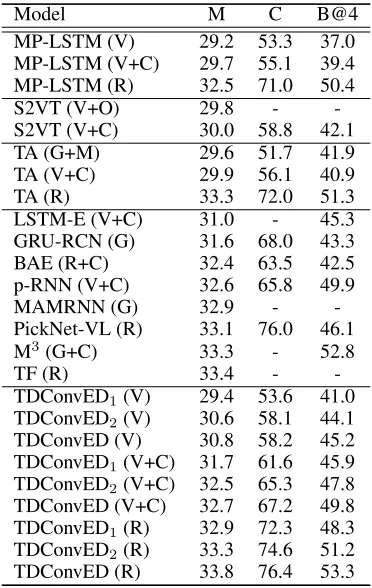
Table 1: Performances of TDConvED and other RNN-based approaches on MSVD, where B@4, M and C are short for BLEU@4, METEOR and CIDEr-D. All values are reported as percentage (%). The short name in the brackets indicates the features, where G, V, C, O, R and M denotes GoogleNet, VGGNet, C3D, Optical flow, ResNet and motion feature learnt by 3D CNN on hand-crafted descriptors, respectively.
Model M C B@4
MP-LSTM (V) 29.2 53.3 37.0 MP-LSTM (V+C) 29.7 55.1 39.4 MP-LSTM (R) 32.5 71.0 50.4
S2VT (V+O) 29.8 -
-S2VT (V+C) 30.0 58.8 42.1 TA (G+M) 29.6 51.7 41.9 TA (V+C) 29.9 56.1 40.9
TA (R) 33.3 72.0 51.3
LSTM-E (V+C) 31.0 - 45.3 GRU-RCN (G) 31.6 68.0 43.3 BAE (R+C) 32.4 63.5 42.5 p-RNN (V+C) 32.6 65.8 49.9
MAMRNN (G) 32.9 -
-PickNet-VL (R) 33.1 76.0 46.1
M3(G+C) 33.3 - 52.8
TF (R) 33.4 -
-TDConvED1(V) 29.4 53.6 41.0 TDConvED2(V) 30.6 58.1 44.1 TDConvED (V) 30.8 58.2 45.2 TDConvED1(V+C) 31.7 61.6 45.9 TDConvED2(V+C) 32.5 65.3 47.8 TDConvED (V+C) 32.7 67.2 49.8 TDConvED1(R) 32.9 72.3 48.3 TDConvED2(R) 33.3 74.6 51.2 TDConvED (R) 33.8 76.4 53.3
2015). All the metrics are computed using the API1released by Microsoft COCO Evaluation Server (Chen et al. 2015).
Compared Approaches.To empirically verify the merit of TDConvED, we compared our method with several con-ventional LSTM based models, including a CNN Encoder plus a LSTM Decoder model (MP-LSTM) (Venugopalan et al. 2015b), LSTM based Encoder-Decoder model (S2VT) (Venugopalan et al. 2015a) and Temporal Attention based LSTM network (TA) (Yao et al. 2015). We also compared TDConvED with state-of-the-art methods:GRU-RCN (Bal-las et al. 2015), LSTM-E (Pan et al. 2016),p-RNN (Yu et al. 2016), MM (only visual input) (Ramanishka et al. 2016),MA-LSTM(Xu et al. 2017),BAE(Baraldi, Grana, and Cucchiara 2017),hLSTMat(Song et al. 2017), MAM-RNN(Li, Zhao, and Lu 2017),TF(Zhao, Li, and Lu 2018),
M3 (Wang et al. 2018), PickNet-VL (Chen et al. 2018) andMCNN+MCF(Wu and Han 2018). In addition to TD-ConvED, two different versions, named as TDConvED1and TDConvED2, are also taken into comparisons. The former extends the basic CNN plus RNN model (MP-LSTM) by simply replacing the RNN-based decoder with our designed
1
https://github.com/tylin/coco-caption
Table 2: Performance of TDConvED and other RNN-based approaches on MSR-VTT, where B@4, M and C are short for BLEU@4, METEOR and CIDEr-D scores. All values are reported as percentage (%). The short name in the brack-ets indicates the frame/clip features, where G, C, R and A denotes GoogleNet, C3D, ResNet and Audio feature.
Model M C B@4
MP-LSTM (R) 25.4 35.8 34.1 MP-LSTM (G+C+A) 25.6 38.1 35.7
S2VT (R) 25.8 36.7 34.4
S2VT (G+C+A) 26.0 39.1 36.0
TA (R) 24.9 34.5 33.2
TA (G+C+A) 25.1 36.7 34.8 LSTM-E (R) 25.7 36.1 34.5 LSTM-E (G+C+A) 25.8 38.5 36.1
hLSTMat (R) 26.3 - 38.3
MA-LSTM (G+C+A) 26.5 41.0 36.5
M3(V+C) 26.6 - 38.1
MM (R+C) 27.0 41.8 38.3
MCNN+MCF (R) 27.2 42.1 38.1 PickNet-VL (R) 27.2 42.1 38.9 TDConvED1(R) 26.8 40.7 37.1 TDConvED2(R) 27.2 41.9 39.0 TDConvED (R) 27.5 42.8 39.5
convolutional decoder, and the latter is more similar to TD-ConvED that only excludes temporal attention mechanism.
Experimental Results and Analysis
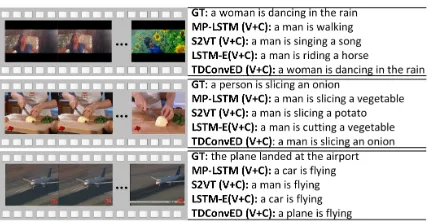
ac-Figure 4: Sentence generation results on MSVD dataset. The videos are represented by sampled frames and the output sentences are generated by 1) GT: ground truth sentences, 2) MP-LSTM, 3) S2VT, 4) LSTM-E and 5) our TDConvED.
count. There is a performance gap between TDConvED and TA. Though both runs involve the utilization of temporal at-tention, they are fundamentally different in the way that TA explores the attention distribution over original frame/clip features depending on the hidden state of RNN-based de-coder, and TDConvED is by measuring attention distri-bution over the contextually encoded frame/clip features conditioned on the intermediate state of convolutional de-coder. This again verifies the effectiveness of convolutional encoder-decoder architecture. In addition, compared to other state-of-the-art techniques (e.g., BAE, p-RNN, PickNet-VL, M3, and TF), our TDConvED achieves better results in terms of all the three evaluation metrics. The results basically indi-cate that exploring convolutions in both encoder and decoder networks is a promising direction for video captioning.
The performance comparisons on MSR-VTT are sum-marized in Table 2. Our TDConvED consistently outper-forms other baselines. Similar to the observations on MSVD, TDConvED1 exhibits better performance than the basic CNN plus RNN model, MP-LSTM, by replacing RNN with convolutions in decoder. Moreover, TDConvED2which ad-ditionally utilizing temporal deformable convolutional en-coder to encode input frame/clip sequence performs bet-ter than TDConvED1, and larger degree of improvement is attained when employing temporal attention mechanism in convolutional encoder-decoder structure by TDConvED.
Qualitative Analysis. Figure 4 shows a few sentence examples generated by different methods and human-annotated ground truth. It is easy to see that all of these au-tomatic methods can generate somewhat relevant sentences, while TDConvED can predict more relevant keywords by exploiting long-range contextual relations via temporal de-formable convolutional encoder-decoder structure and tem-poral attention mechanism. Compared to “walking” in the sentence generated by MP-LSTM, “dancing” in TDConvED is more precise to describe the first video. Similarly, the ob-ject “onion” presents the second video more exactly.
Effect of the Number of Convolutional Blocks.In order to investigate the effect of the number of stacked convolu-tional blocks in our TDConvED, two addiconvolu-tional experiments are conducted by varying the number of stacked convolu-tional blocks in encoder and decoder, respectively. As the
Table 3: The effect of the number of stacked conv blocks (i.e.,#blocks) in (a) decoder and (b) encoder on MSVD.
(a) Decoder in TDConvED1 #blocks M C
1 31.6 57.9 2 31.7 61.6 3 31.4 59.8
(b) Encoder in TDConvED2 #blocks M C
1 32.2 64.3 2 32.5 65.3 3 32.3 62.8
Table 4: Comparison of training time between TDConvED and MP-LSTM on MSVD (Nvidia K40 GPU).
Model #param training time B@4 M MP-LSTM (V) 11.15 M 2370 s/epoch 37.0 29.2 TDConvED (V) 16.79 M 1070 s/epoch 45.2 30.8
encoder in TDConvED1 is to perform mean pooling over the features of frames/clips and irrespective of convolutions, we first examine the impact of the convolutional block num-ber in decoder of TDConvED1. Table 3(a) reports the com-parison when the number ranges from 1 to 3. The best per-formances are achieved when the number of stacked convo-lutional blocks is 2. Next, by fixing the number of convolu-tional blocks in decoder as 2, Table 3(b) summarizes the per-formances of TDConvED2 (V+C) when the convolutional block number in encoder varies from 1 to 3. The results show that the setting with 2 stacked temporal deformable convo-lutional blocks in encoder outperforms others.
Comparisons on Training Time. Table 4 details the training time of our TDConvED and MP-LSTM. TD-ConvED is benefited from parallelization for training and the results clearly demonstrate the advantage of TDConvED at training speed, which is about 2.2×faster than MP-LSTM.
Conclusions
Acknowledgments
This work is partially supported by NSF of China under Grant 61672548, U1611461, 61173081, and the Guangzhou Science and Technology Program, China, under Grant 201510010165.
References
Ballas, N.; Yao, L.; Pal, C.; and Courville, A. C. 2015. Delving deeper into convolutional networks for learning video representa-tions.arXiv preprint arXiv:1511.06432.
Banerjee, S., and Lavie, A. 2005. METEOR: an automatic met-ric for MT evaluation with improved correlation with human judg-ments. InACL.
Baraldi, L.; Grana, C.; and Cucchiara, R. 2017. Hierarchical boundary-aware neural encoder for video captioning. InCVPR. Bradbury, J.; Merity, S.; Xiong, C.; and Socher, R. 2016. Quasi-recurrent neural networks.arXiv preprint arXiv:1611.01576.
Chen, D., and Dolan, W. B. 2011. Collecting highly parallel data for paraphrase evaluation. InACL.
Chen, X.; Fang, H.; Lin, T.; Vedantam, R.; Gupta, S.; Doll´ar, P.; and Zitnick, C. L. 2015. Microsoft COCO captions: Data collection and evaluation server.arXiv preprint arXiv:1504.00325.
Chen, S.; Chen, J.; Jin, Q.; and Hauptmann, A. 2017. Video cap-tioning with guidance of multimodal latent topics. InACM MM. Chen, Y.; Wang, S.; Zhang, W.; and Huang, Q. 2018. Less is more: Picking informative frames for video captioning. CoRR
abs/1803.01457.
Dauphin, Y. N.; Fan, A.; Auli, M.; and Grangier, D. 2017. Lan-guage modeling with gated convolutional networks. InICML.
Gehring, J.; Auli, M.; Grangier, D.; Yarats, D.; and Dauphin, Y. N. 2017. Convolutional sequence to sequence learning. InICML. Hao, W.; Zhang, Z.; and Guan, H. 2018. Integrating both visual and audio cues for enhanced video caption. InAAAI.
He, K.; Zhang, X.; Ren, S.; and Sun, J. 2016. Deep residual learn-ing for image recognition. InCVPR.
Kalchbrenner, N.; Espeholt, L.; Simonyan, K.; van den Oord, A.; Graves, A.; and Kavukcuoglu, K. 2016. Neural machine translation in linear time.arXiv preprint arXiv:1610.10099.
Karpathy, A.; Toderici, G.; Shetty, S.; Leung, T.; Sukthankar, R.; and Li, F. 2014. Large-scale video classification with convolutional neural networks. InCVPR.
Kingma, D., and Ba, J. 2015. Adam: A method for stochastic optimization. InICLR.
Li, Y.; Yao, T.; Pan, Y.; Chao, H.; and Mei, T. 2018. Jointly local-izing and describing events for dense video captioning. InCVPR. Li, X.; Zhao, B.; and Lu, X. 2017. MAM-RNN: multi-level atten-tion model based RNN for video capatten-tioning. InIJCAI.
Meng, F.; Lu, Z.; Wang, M.; Li, H.; Jiang, W.; and Liu, Q. 2015. Encoding source language with convolutional neural network for machine translation. InACL.
Pan, Y.; Mei, T.; Yao, T.; Li, H.; and Rui, Y. 2016. Jointly modeling embedding and translation to bridge video and language. InCVPR.
Pan, Y.; Yao, T.; Li, H.; and Mei, T. 2017. Video captioning with transferred semantic attributes. InCVPR.
Papineni, K.; Roukos, S.; Ward, T.; and Zhu, W. 2002. Bleu: a method for automatic evaluation of machine translation. InACL.
Ramanishka, V.; Das, A.; Park, D. H.; Venugopalan, S.; Hendricks, L. A.; Rohrbach, M.; and Saenko, K. 2016. Multimodal video description. InACM MM.
Russakovsky, O.; Deng, J.; Su, H.; Krause, J.; Satheesh, S.; Ma, S.; Huang, Z.; Karpathy, A.; Khosla, A.; Bernstein, M. S.; Berg, A. C.; and Li, F. 2015. Imagenet large scale visual recognition challenge.
IJCV.
Song, J.; Gao, L.; Guo, Z.; Liu, W.; Zhang, D.; and Shen, H.-T. 2017. Hierarchical LSTM with adjusted temporal attention for video captioning. InIJCAI.
Tran, D.; Bourdev, L. D.; Fergus, R.; Torresani, L.; and Paluri, M. 2015. Learning spatiotemporal features with 3d convolutional net-works. InICCV.
Vedantam, R.; Zitnick, C. L.; and Parikh, D. 2015. Cider: Consensus-based image description evaluation. InCVPR. Venugopalan, S.; Rohrbach, M.; Donahue, J.; Mooney, R. J.; Dar-rell, T.; and Saenko, K. 2015a. Sequence to sequence - video to text. InICCV.
Venugopalan, S.; Xu, H.; Donahue, J.; Rohrbach, M.; Mooney, R. J.; and Saenko, K. 2015b. Translating videos to natural lan-guage using deep recurrent neural networks. InNAACL.
Wang, J.; Wang, W.; Huang, Y.; Wang, L.; and Tan, T. 2018. M3: Multimodal memory modelling for video captioning. InCVPR. Wu, A., and Han, Y. 2018. Multi-modal circulant fusion for video-to-language and backward. InIJCAI.
Xu, J.; Mei, T.; Yao, T.; and Rui, Y. 2016. MSR-VTT: A large video description dataset for bridging video and language. InCVPR. Xu, J.; Yao, T.; Zhang, Y.; and Mei, T. 2017. Learning multimodal attention LSTM networks for video captioning. InACM MM. Yao, L.; Torabi, A.; Cho, K.; Ballas, N.; Pal, C. J.; Larochelle, H.; and Courville, A. C. 2015. Describing videos by exploiting tem-poral structure. InICCV.
Yao, T.; Pan, Y.; Li, Y.; and Mei, T. 2017a. Incorporating copy-ing mechanism in image captioncopy-ing for learncopy-ing novel objects. In
CVPR.
Yao, T.; Pan, Y.; Li, Y.; Qiu, Z.; and Mei, T. 2017b. Boosting image captioning with attributes. InICCV.
Yao, T.; Pan, Y.; Li, Y.; and Mei, T. 2018. Exploring visual rela-tionship for image captioning. InECCV.
Yu, H.; Wang, J.; Huang, Z.; Yang, Y.; and Xu, W. 2016. Video paragraph captioning using hierarchical recurrent neural networks. InCVPR.