Marquette University
e-Publications@Marquette
Master's Theses (2009 -) Dissertations, Theses, and Professional Projects
Asymmetric Transfer of Task Dependent
Perceptual Learning in Visual Motion Processing
Sampada Charudatta WakdeMarquette University
Recommended Citation
Wakde, Sampada Charudatta, "Asymmetric Transfer of Task Dependent Perceptual Learning in Visual Motion Processing" (2011).
Master's Theses (2009 -).Paper 111.
!
ASYMMETRIC TRANSFER OF TASK DEPENDENT PERCEPTUAL LEARNING IN VISUAL MOTION PROCESSING
by
Sampada Wakde, B.S.
A Thesis submitted to the Faculty of the Graduate School, Marquette University,
in Partial Fulfillment of the Requirements for the Degree of Master of Science
Milwaukee, Wisconsin August 2011
!
ABSTRACT
ASYMMETRIC TRANSFER OF TASK DEPENDENT PERCEPTUAL LEARNING IN VISUAL MOTION
PROCESSING Sampada Wakde, B.S. Marquette University, 2011
The effects of perceptual learning (PL) on the sensory representation are not fully understood, especially for higher-level visual mechanisms more directly relevant to behavior. The objective of this research is to elucidate the
mechanisms that mediate task dependent learning by determining where and how task dependent learning occurs in the later stages of visual motion processing.
Eighteen subjects were trained to perform a dual-2TAFC visual
discrimination task in which they were required to simultaneously detect changes in the direction of moving dots (task-1) and the proportion of red dots (task-2) shown in two stimulus apertures presented in either the left or right visual field. Subjects trained on the direction discrimination task for one of two types of motion, global radial motions (expansion and contraction) presented across stimulus apertures (global task), or an equivalent (local) motion stimulus formed by rotating the direction of motion in one aperture by 180o. In task-1 subjects
were required to indicate whether the directions of motion in the second stimulus interval were rotated clockwise or counter-clockwise relative to the first stimulus interval. In task-2, designed to control for the spatial allocation of attention, subjects were required to indicate which stimulus interval contained a larger proportion of red dots across stimulus apertures.
Sixteen of the eighteen subjects showed significant improvement on the trained tasks across sessions (p<0.05). In subjects trained with radial motions, performance improvements transferred to the radial motions presented in the untrained visual field, and the equivalent local motion stimuli and untrained circular motions presented in the trained visual field. For subjects trained with local motion stimuli, learning was restricted to the trained local motion directions and their global motion equivalents presented in the trained visual field. These results suggest that perceptual learning of global and local motions is not symmetric, differentially impacting processing across multiple stages of visual processing whose activities are correlated. This pattern of learning is not fully coherent with a reverse hierarchy theory or bottom-up model of learning,
suggesting instead a mechanism whereby learning occurs at the stage of visual processing that is most discriminative for the given task.
! "!
ACKNOWLEDGEMENTS!
Sampada Wakde, B.S.
As I write this acknowledgement, I remember all the ups and downs that happened to me since I came to Milwaukee. I started as a graduate student during fall’06 in Biomedical Engineering program. Over these years, I’ve been fortunate to be surrounded by my colleagues, friends and family, whom I want to acknowledge here. More then anything I owe a lot to my adviser Dr. Scott
Beardsley for the patience he had in me and the encouragement and support he gave me throughout my graduate life. Throughout the project with him, we collected data over many human subjects at the cost of a few friends who really hated the experiments. I thank all the subjects who participated in our
‘uncomfortable but not painful’ experiments.
I thank all of my colleagues in the INSL lab Jain, Megan, David, and Prajakta. I am grateful to my committee members Dr.Scheidt and Dr.Libenthal along with my adviser Dr.Beardsley to be on my committee. My Husband, Mayank, has been really supportive and encouraging throughout the process of my thesis. My dearest friend Mukta always stood besides me even in my hard times, which I won’t forget for lifetime. I take this opportunity to specially thank my dear friends Tushar, Priyanka S., Chintan, Vaibhav, and Promita who were always there for me.
Finally, I want to thank my parents, father-in-law and my younger sister for the mental support, and advice and financial support to be able to complete my
! ""! thesis. I would like to dedicate this thesis to my father Mr.Charudatta M. Wakde, who has been a role model and an immense source of inspiration throughout my academic career. And also my mother-in-law, Mrs. Mrunalini Sudhakar Rege without whom this accomplishment was impossible.
! """!
Table of Contents
ACKNOWLEDGEMENTS i
LIST OF FIGURES v
LIST OF TABLES ix
CHAPTERS1
INTRODUCTION & SPECIFIC AIMS
1
2
BACKGROUND AND SIGNIFICANCE
4
2.1 P
ERCEPTUALL
EARNING4
2.2 V
ISUALM
OTIONP
ROCESSING7
2.3 S
IGNIFICANCE12
3
EXPERIMENTAL APPARATUS AND METHODS
13
3.1 E
XPERIMENTALA
PPARATUS13
3.1.1
Human Subjects
13
3.1.2
Stimuli
13
3.1.3
Experimental Setup
15
3.1.4
Eye Tracker Calibration
20
3.1.5
Visual Motion Tasks (Global vs. Local Motion)
22
3.2 E
XPERIMENTALP
ARADIGM23
3.2.1
Speed discrimination training paradigm
26
3.2.2
Threshold Tracking Paradigm
27
4
RESULTS
30
! "#!
5.1 R
EVERSEH
IERARCHYT
HEORY44
5.2 B
OTTOM-U
P THEORY OF PERCEPTUAL LEARNING47
5.3 S
ENSITIVITY-S
PECIFICITYT
HEORY(SST)
49
5.4 A
LTERNATIVE THEORIES OFP
ERCEPTUALL
EARNING52
6
CONCLUSION
54
7
FUTURE DIRECTIONS
55
8
BIBLIOGRAPHY
56
9
APPENDIX
65
9.1 APPENDIX A1
65
9.2 APPENDIX A2
66
9.3 APPENDIX A3
67
9.4 APPENDIX A4
68
9.5 APPENDIX A5
69
9.6 APPENDIX A6
70
! #!
List of Figures
FIGURE 2-1. VISUAL PROCESSING PATHWAYS. (TOP) THE VISUAL PROCESSING
HIERARCHY IS SHOWN DIAGRAMMATICALLY. (BOTTOM) ANATOMICAL PROJECTIONS BETWEEN VISUAL AREAS INCLUDING THOSE ASSOCIATED WITH VISUAL MOTION PROCESSING - ROCEPRIMARY VISUAL CORTEX), V2 (PRESTRIATE CORTEX), MT
(MIDDLE TEMPORAL), MST (MIDDLE SUPERIOR TEMPORAL), VIP (VENTRAL INTRAPARIETAL), AREA 7A (THIS AREA IS INVOLVED IN VISUO-MOTOR
COORDINATION)……….8
FIGURE 2-2. SCHEMATIC DIAGRAM ILLUSTRATING THE FUNCTIONAL HIERARCHY OF VISUAL MOTION PROCESSING BETWEEN THE MIDDLE TEMPORAL (MT) AND MEDIAL SUPERIOR TEMPORAL (MST) AREAS. THE VISUAL MOTION PROPERTIES OF
MT/MST NEURONS ARE PORTRAYED IN SEPARATE LAYERS TOGETHER WITH THEIR RELATIVE RECEPTIVE FIELD SIZES. THE ARROWS BETWEEN LAYERS SHOW THE PRIMARY DIRECTION OF INFORMATION FLOW. MT NEURONS ARE TUNED TO DIRECTIONS OF MOTION WHILE NEURONS IN MST PREFERENTIALLY RESPOND TO MORE COMPLEX PATTERNS OF MOTION SUCH AS EXPANSION AND CONTRACTION.
THE DOTTED CIRCLES IN THE VISUAL FIELD INDICATE THE RELATIVE SIZES OF THE RECEPTIVE FIELDS BETWEEN NEURONS IN MT AND MST. ... 11
FIGURE 3-1. SCHEMATIC DIAGRAM OF THE MOTION MECHANISMS ASSOCIATED WITH THE GLOBAL AND LOCAL MOTION TASKS. A GLOBAL MOTION TASK WAS USED TO
ENGAGE COMPLEX MOTION MECHANISMS AND QUANTIFY SUBJECTS’ ABILITY TO DISCRIMINATE CHANGES IN THE DIRECTION OF RADIAL MOTION ACROSS STIMULUS APERTURES. A LOCAL MOTION TASK, WHEREIN THE DIRECTION OF MOTION IN ONE APERTURE WAS ROTATED 180O TO REMOVE THE GLOBAL MOTION PERCEPT, WAS USED TO PREFERENTIALLY ENGAGE LOCAL MOTION MECHANISMS TO QUANTIFY THE SUBJECTS’ ABILITY TO DISCRIMINATE CHANGES IN THE DIRECTION OF LOCAL PLANAR
MOTION………..16
FIGURE 3-2. EXPERIMENTAL SETUP. FIXATION ON THE SCREEN WAS PRESENTED EITHER ON THE LEFT OR RIGHT SIDE OF SCREEN TO MAXIMIZE THE VISUAL DISPLAY OF THE STIMULUS AND RESTRICT THE STIMULUS TO A SINGLE VISUAL FIELD. THE HEAD AND CHIN REST WAS USED TO WAS USED TO HOLD THE SUBJECTS HEAD IN A PLACE WHILE THE EXPERIMENT WAS CONDUCTED AND THE EYE TRACKER GOGGLES WERE ON AT THE SAME TIME TO TRACK THE PUPIL MOVEMENTS OF THE EYE... 17
FIGURE 3-3. SCHEMATIC ILLUSTRATION OF THE STIMULUS PRESENTATION SEQUENCE.
TWO 500 MS STIMULI WERE PRESENTED (S1 AND S2), WITH A 500 MS INTER -STIMULUS INTERVAL. THE DOTTED LINES ARE SHOWN FOR REFERENCE AND WERE NOT PRESENT DURING TESTING. THE GREY SQUARE AT THE INTERSECTION OF THE ILLUSORY LINES IS THE FIXATION POINT AND THE ROTATED ARROWS IN STIMULUS S2 SHOW THE DIRECTION OF DOT MOTION ROTATED BY AN ANGLE !P... 18
! #"! FIGURE 3-4. ARRINGTON BINOCULAR EYE TRACKER CAMERA AND EYE IMAGE ON RIGHT
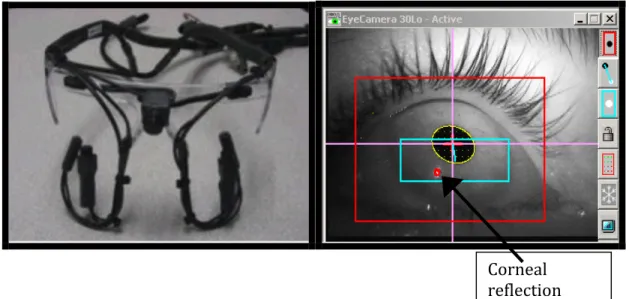
WITH CORNEAL REFLECTION (GLINT). ARRINGTON BINOCULAR EYE TRACKER CAMERA (LEFT) THE TWO SMALL PROTRUSIONS NEAR THE EYES ARE THE IR-ILLUMINATORS AND CAMERAS. THE SMALL CUBE ON THE FOREHEAD BAND OF THE GOGGLES IS THE HEAD CAMERA. THE GOGGLES ALSO HAVE A TIGHTENING STRAP AT THE BACK, WHICH HELPS SUPPORT THE GOGGLES ON THE SUBJECT’S FOREHEAD.
THE EYE IMAGE WITH A CORNEAL REFLECTION (GLINT) FROM ONE EYE OBTAINED BY THE IR-ILLUMINATOR AND CAMERA USED TO PERFORM THE PUPIL-GLINT
LOCALIZATION IS SHOWN ON THE RIGHT... 20
FIGURE 3-5. THE EYE SPACE WINDOW WITH THE ADVANCED CALIBRATION SETTINGS.
EYE TRACKER CALIBRATION. CALIBRATION POINTS WERE PRESENTED AT 16 POINTS SPANNING THE DISPLAY. IN THE DEFAULT CONFIGURATION (USED HERE) THE AUTO CALIBRATION SEQUENCE PRESENTED THE CALIBRATION POINTS IN RANDOM ORDER,
EACH FOR ~5 SEC……….21
FIGURE 3-6. EXPERIMENTAL PARADIGM FOR THE GLOBAL MOTION TASK (EXP.1) AND
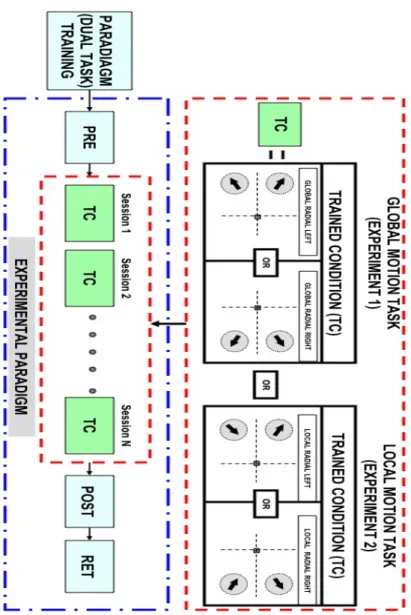
LOCAL MOTION TASK (EXP. 2). DURING THE PRE, POST AND RET SESSIONS ALL EIGHT COMBINATIONS OF MOTION TASK (GLOBAL VS. LOCAL), VISUAL FIELD (LEFT OR RIGHT) AND MOTION DIRECTION (RADIAL VS. CIRCULAR) WERE TESTED. THE TC
(TRAINED CONDITION) BLOCKS IN RED DASHED FRAME DENOTE DIFFERENT TASKS SELECTED IN TRAINING SESSIONS WHERE ‘N’ WAS BASED ON SUBJECTS LEARNING THRESHOLDS. SUBJECT WAS TRAINED ON DUAL TASK PARADIGM (SPEED TASK WITH DOT DISCRIMINATION AS SEEN IN SPEED DISCRIMINATION TRAINING PARADIGM) BEFORE THE MAIN EXPERIMENT TO TRAIN THE SUBJECTS ON PERFORMING THE DUAL
TASK……….24
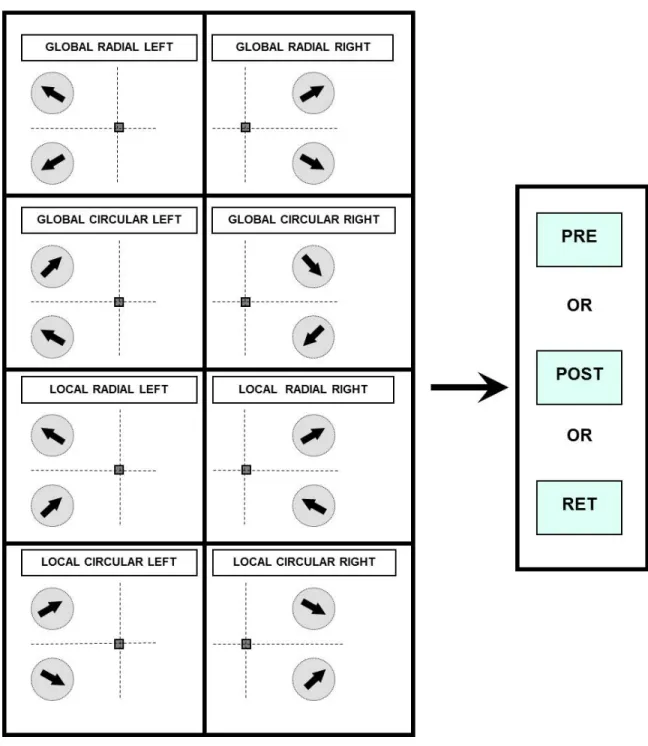
FIGURE 3-7. EXPERIMENTAL CONDITIONS TESTED BEFORE AND AFTER TRAINING. EIGHT EXPERIMENTAL CONDITIONS WERE CONSISTED BEFORE AND AFTER TRAINING CORRESPONDING TO ALL COMBINATIONS OF MOTION TASK (GLOBAL VS. LOCAL), VISUAL FIELD (LEFT OR RIGHT) AND MOTION DIRECTION (RADIAL VS. CIRCULAR).
THRESHOLDS ARE COLLECTED ON THESE CONDITIONS BEFORE TRAINING (PRE), AFTER TRAINING (POST) AND RETENTION (RET) IN THE EXPERIMENTAL PARADIGM
(FIGURE 3-6)………..25
FIGURE 3-8. THE THRESHOLD TRAINING PARADIGM SESSION (~11/2 HOURS IN ONE DAY) IS DIAGRAMMATICALLY REPRESENTED USING THE FLOW CHART. DURING ONE SESSION OF THRESHOLD PARADIGM TRAINING THE SUBJECTS HAS TO PERFORM A STAIRCASE PARADIGM ON THE TASK TO BE TRAINED AND WE GET THE
PERFORMANCE MEASURE IN TERMS OF THRESHOLD (T) AND STANDARD DEVIATION
("). THESE TERMS T AND " ARE USED TO FORM THREE LEVELS FOR ONE RUN IN CONSTANT STIMULUS PARADIGM. AS THE PERCENTAGE CORRECT PERFORMANCE OF THE SUBJECT FOR RUN1 # 80%, THEN THE LEVELS ARE REDUCED BY " FOR RUN2 AND SO ON. EVERY SESSION HAS NINE RUNS IN TOTAL AND 3 RUNS TOGETHER COMPRISE OF A BLOCK. HENCE EVERY SESSION HAS 3 BLOCKS AND THESE BLOCKS FURTHER FROM ALL THE TRAINING SESSIONS ARE COMPILED
! #""!
TOGETHER TO PLOT THE THRESHOLD CURVE FOR EVERY SUBJECT USING THE
WEIBULL PSYCHOMETRIC FIT………29
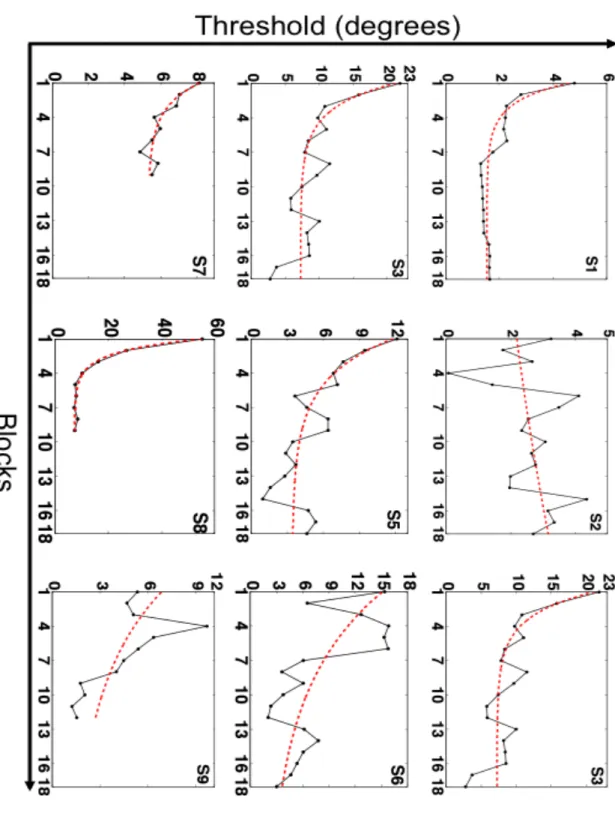
FIGURE 4-1. DIRECTION DISCRIMINATION THRESHOLDS AS A FUNCTION OF TRAINING BLOCK FOR SUBJECTS TRAINED ON THE GLOBAL MOTION TASK. DISCRIMINATION THRESHOLDS (79% CORRECT) ARE SHOW FOR SUBJECTS S1-S9 AS A FUNCTION OF TRAINING BLOCK. A NONLINEAR LEAST-SQUARE EXPONENTIAL FIT WAS APPLIED TO EACH SUBJECTS’ PERFORMANCE (RED DASHED LINE) TO CHARACTERIZE THE TIME COURSE OF LEARNING. THE BEST-FIT PARAMETERS FOR EACH SUBJECT ARE
SHOWN IN TABLE 4-1……….31
FIGURE 4-2. PERCENT CORRECT PERFORMANCE ON THE (TASK2) DOT DISCRIMINATION TASK AS A FUNCTION OF TRAINING BLOCK FOR SUBJECTS TRAINED ON THE (A)
GLOBAL MOTION AND (B) LOCAL MOTION TASKS. PERFORMANCE IS REPORTED WITHIN EACH GROUP AS THE MEAN ACROSS SUBJECT’S ± 1 SE... 36
FIGURE 4-3. GROUP AVERAGED DIRECTION DISCRIMINATION THRESHOLDS ACROSS EXPERIMENTAL CONDITIONS. (A) PRE- AND POST-TRAINING PERFORMANCE AND (C) POST-TRAINING AND LEARNING RETENTION (ONE WEEK AFTER TRAINING) FOR SUBJECTS TRAINED ON THE GLOBAL MOTION TASK. (B) PRE- AND POST-TRAINING PERFORMANCE AND (D) POST-TRAINING AND LEARNING RETENTION (ONE WEEK AFTER TRAINING) FOR SUBJECTS TRAINED ON THE LOCAL MOTION TASK.
PERFORMANCE IS REPORTED AS THE MEAN ±SE. THE SINGLE ASTERISK DENOTES CONDITIONS THAT WERE SIGNIFICANTLY DIFFERENT (P<0.05). ... 38
FIGURE 4-4. DIAGRAMMATIC COMPARISON OF STATISTICALLY SIGNIFICANT TRAINING -INDUCED CHANGES IN DIRECTION DISCRIMINATION THRESHOLDS ACROSS
EXPERIMENTAL CONDITIONS. VISUAL FIELDS WERE CLASSIFIED AS TRAINED AND UNTRAINED, BASED ON THE CONDITIONS THE SUBJECTS WERE TRAINED ON. COLOR
REPRESENTATION:BLUE DENOTES THE TRAINED TASK AND CONDITION. ORANGE INDICATES SIGNIFICANT IMPROVEMENT IN POST (VERSUS PRE-) TRAINING
THRESHOLDS (P<0.05). WHITE INDICATES NO SIGNIFICANT CHANGE IN THRESHOLDS BEFORE AND AFTER TRAINING. CONDITION ANNOTATIONS:THE TASK CONDITION ANNOTATIONS CORRESPOND TO THE TASK AND MOTION TYPE PRESENTED DURING TRAINING (GR: GLOBAL-RADIAL, GC: GLOBAL-CIRCULAR, LR: LOCAL–RADIAL,
LC: LOCAL-CIRCULAR)……….41
FIGURE 5-1. COMPARISON OF EXPERIMENTAL RESULTS WITH PREDICTIONS FROM A TASK-SPECIFIC ATTENTION DRIVEN INTERPRETATION OF REVERSE HIERARCHY
THEORY (RHT). THE COLOR REPRESENTATION AND DESIGNATION OF
EXPERIMENTAL CONDITIONS FOLLOWS THE CONVENTION DETAILED IN FIGURE
4-4……….45 FIGURE 5-2. COMPARISON OF EXPERIMENTAL RESULTS WITH PREDICTIONS FROM A
TASK-DIFFICULTY DRIVEN INTERPRETATION OF REVERSE HIERARCHY THEORY
(RHT). THE COLOR REPRESENTATION AND DESIGNATION OF EXPERIMENTAL
! #"""! FIGURE 5-3. COMPARISON OF EXPERIMENTAL RESULTS WITH PREDICTIONS FROM A
BOTTOM-UP THEORY OF PERCEPTUAL LEARNING. THE COLOR REPRESENTATION AND DESIGNATION OF EXPERIMENTAL CONDITIONS FOLLOWS THE CONVENTION
DETAILED IN FIGURE 4-4………49
FIGURE 5-4. COMPARISON OF EXPERIMENTAL RESULTS WITH PREDICTIONS FROM A SENSITIVITY-SPECIFICITY THEORY OF PERCEPTUAL LEARNING. THE COLOR
REPRESENTATION AND DESIGNATION OF EXPERIMENTAL CONDITIONS FOLLOWS THE CONVENTION DETAILED IN FIGURE 4-4... 51
FIGURE 5-5. COMPARISON OF EXPERIMENTAL RESULTS WITH PREDICTIONS FROM A COMBINATION OF SENSITIVITY-SPECIFICITY THEORY AND BOTTOM-UP THEORY OF PERCEPTUAL LEARNING. THE COLOR REPRESENTATION AND DESIGNATION OF EXPERIMENTAL CONDITIONS FOLLOWS THE CONVENTION DETAILED IN FIGURE
! "$!
List of Tables
TABLE 4-1. PARAMETERS FOR BEST FIT EXPONENTIAL TO SUBJECTS’ DISCRIMINATION THRESHOLD WITH TRAINING ON THE GLOBAL MOTION TASK. LEAST SQUARES ESTIMATES OF SUBJECTS’ PRE-TRAINING THRESHOLD (FPRE), B= 1/TIME CONSTANT (T), AND POST-TRAINING THRESHOLDS (FPOST) ARE SHOWN TOGETHER WITH THEIR 95% CONFIDENCE INTERVAL (IN BRACKETS) FOR EACH SUBJECT. THE NEGATIVE TIME CONSTANT OBTAINED FOR S2 INDICATES THE SUBJECT WAS A NONLEARNER
(HIGHLIGHTED IN GRAY). ... 33
TABLE 4-2. PARAMETERS FOR BEST FIT EXPONENTIAL TO SUBJECTS’ DISCRIMINATION THRESHOLD WITH TRAINING ON THE LOCAL MOTION TASK. LEAST SQUARES ESTIMATES OF SUBJECTS’ PRE-TRAINING THRESHOLD (FPRE), B= 1/TIME CONSTANT (T), AND POST-TRAINING THRESHOLDS (FPOST) ARE SHOWN TOGETHER WITH THEIR 95% CONFIDENCE INTERVAL (IN BRACKETS) FOR EACH SUBJECT. THE NEGATIVE TIME CONSTANT OBTAINED WITH S11 INDICATES THE SUBJECT WAS A NONLEARNER
(HIGHLIGHTED IN GRAY). ... 34
TABLE 4-3. GROUP ANALYSES OF PRE- VERSUS POST-TRAINING DIRECTION
DISCRIMINATION THRESHOLDS ACROSS EXPERIMENTAL CONDITIONS AS SHOWN IN TABLE ON LEFT FOR SUBJECTS TRAINED WITH (A) GLOBAL RADIAL MOTIONS AND (B)
LOCAL RADIAL MOTIONS. DIFFERENCE IN PRE VERSUS POST-TRAINING THRESHOLDS WERE EVALUATED ACROSS SUBJECTS USING PAIRED T-TESTS WITH SEVEN DEGREES OF FREEDOM. TEST CONDITIONS HIGHLIGHTED IN GREY SHOWED STATISTICALLY SIGNIFICANT DECREASES IN DISCRIMINATION THRESHOLDS FOLLOWING TRAINING.40
! %!
1 INTRODUCTION & SPECIFIC AIMS
Previous research has shown that perceptual abilities in adults can be developed through practice or experience (Ahissar and Hochstein, 1997; Dosher and Lu, Z.L.1998; Vidyasagar and Stuart, 1993; Gilbert et. al; 2001; Snowden and Milne, 1996; Bex and Mehta, 1998; Pleger, 2003). The ability to improve ones capability or skills with practice to detect changes in the features that define a sensory stimulus is referred to as perceptual learning (Gilbert et. al; 2001). This property, assumed to reflect plasticity at different levels of sensory processing, has been shown to occur across a wide range of sensory attributes (Dosher and Lu, Z.L., 1998; Ahissar, M. and Hochstein, S., 1997). In the visual system, hyper-acuity (Paggio et al., 1994; Kapadia et al., 1994; Fahle and Morgan, 1996), orientation discrimination (Shiu and Pashler, 1992; Vogels, R., 2010), direction discrimination (Ball and Sekuler, 1982, 1987), and object segregation using textural cues (Karni and Sagi, 1991, 1993) can all be improved with practice. There are two types of perceptual learning, task dependent (or task relevant) and task independent (or task irrelevant). In task dependent learning subject attends to the stimulus features, while in task independent learning subject does not attend to the stimulus features.
Though perceptual learning for complex visual motion processing has been widely reported (Gilbert et. al; 2001), it still remains uncertain how the underlying mechanisms determine where in the sensory system learning is suppose to occur. At which stage of information processing does perceptual
! &! learning occur? Is there a hierarchy to the perceptual learning mechanism? The extrastraite visual cortex areas suitable for analysis of perceptual learning hierarchy in visual motion are MT (middle temporal) and MST (middle superior temporal).
Reverse Hierarchy Theory (RHT) suggests that task-dependent learning is a top-down guided process, which starts at later stages of sensory visual
processing, and when these are not sufficient, progresses backwards to initial stages of processing, which have a better signal-to-noise ratio (Ahissar, M. and Hochstein, S. 1997a, 1997b, 1999, 2004). In task dependent learning, attention is focused on the stimulus to be learnt. Alternatively learning can occur from the bottom-up when the stimulus feature falls outside the focus of attention. Watanabe and colleagues have referred to this form of plasticity as task
irrelevant learning (Watanabe et. al., 2002; Seitz and Watanabe 2005). A recent study by Nishina, Kawato and Watanabe suggests that in the visual motion system learning of motion patterns associated with self-motion is based on changes in local rather than global motion processing (Nishina, S., Kawato, M., and Watanabe, T. 2009).
This research seeks to further characterize the mechanisms that mediate task-dependent learning by identifying the specific stages of visual processing at which task dependent learning occurs. We propose two coupled experimental studies designed to identify the visual motion mechanisms modulated during training by contrasting psychophysical performance in tasks designed to
! '! are tuned to the planar motions) direction mechanisms from the global motion (expansion, contraction, radial and circular etc., in this particular motion the neurons are tuned to complex motions) pattern percept.
SPECIFIC AIM 1: Identify the stage(s) within the visual motion processing hierarchy at which task dependent learning for global and local motions occur. We compare psychophysical performance in two visual motion tasks designed to determine the stage of visual processing at which learning occurs - at the level of motion direction mechanisms that operate within an aperture versus complex motion mechanisms that operate across apertures. The disparity in the degree of motion direction and complex motion mechanisms extending into the ipsilateral hemi-field, in combination with the increase in spatial scale observed across successive stages of visual motion processing is used to identify where in the visual processing hierarchy learning occurs.
SPECIFIC AIM 2: To characterize the mechanisms that mediate task dependent perceptual learning across multiple stages of visual processing. The patterns of task-specific improvement in visual motion discrimination between visual hemi-fields and across task conditions will be tested against two prominent theories of perceptual learning (Ahissar, M. and Hochstein, S. 1997a, 1997b, 1999, 2004; Nishina, S.; Kawato, M. and Watanabe, T., 2009), to identify the mechanisms that mediate task-specific improvements in visual motion
! (!
2 BACKGROUND AND SIGNIFICANCE
2.1 Perceptual Learning
Enhancement in perceptual skills and behavior with practice or experience to sensory stimuli is referred to as perceptual learning. The enhancement of performance with exposure and/or training is fundamental to our ability to adapt to changes in the environment and the ease with which our perception adapts to task-relevant changes in the environment illustrates that learning is a
fundamental part of the normal perception.
Perceptual learning displays an important relationship with the practiced stimulus as the transfer of learning has been shown to involve functional and structural changes to the sensory cortex (Recanzone et. al, 1993; Fahle, Edelman and Paggio, 1994; Gilbert et. al., 2001; Schwartz et. al., 2002; Pleger et. al, 2003; Vogels, 2009). Training-based improvements in discrimination for visual features, such as direction discrimination (Ball and Sekuler, 1982, 1987, orientation (Shiu and Pashler, 1992; Vogels, R., 2010) and spatial frequency are typically task-specific and have been shown to be spatially limited to a certain area in the visual field, suggesting plasticity within visual (or more generally sensory) processing areas of the brain - a hallmark of perceptual learning.
The dynamics of learning can be difficult to evaluate since the measured parameter, performance, can be affected by a variety of factors. Learning, attention, training, and memory can improve performance while cortical
! )! impairment, lack of attention and fatigue, can adversely affect performance
(Schnupp and Kacelnik, 2002; Dawson and Reid, 1997).
Physiological studies have shown training related improvements in the responses of individual neurons (Recanzone et al. 1992, 1993; Ghose, 2002; Yang and Maunsell, 2004). Functional imaging studies suggest similar task-dependent changes in the representation of sensory information in the human brain (Schwartz et al., 2002; Pleger et. al, 2003; Logothetis, 2002; Logothetis et. al, 2002) across a wide variety of areas and sensory stimuli including the cortical representation and training induced changes in activity in somatosensory cortex in response to tactile coactivation of skin (Pleger et al., 2003).
In a series of studies Ahissar and Hochstein (Ahissar, M. and Hochstein, S. 1997a, 1997b, 1999, 2004) showed that that task-dependent learning in a visual pop-out task is a top-down guided process; beginning first at later stages of visual processing, and when these do not suffice, progressing backwards through the processing hierarchy to earlier stages of processing, which have a better signal-to-noise ratio. Based on these results they proposed a learning mechanism wherein easy task conditions are learned at later stages of sensory processing, where receptive fields generalize across position and orientation. As task difficulty increases, perceptual learning systematically shifts toward earlier stages of processing where receptive fields are more specific to both retinal position and orientation (Ahissar, M. and Hochstein, S. 2004).
! *! Attention in particular has been shown to play an important role in
perceptual learning (Goldstone, 1998; Karni and Sagi, 1993). Learning effects are typically limited to the attended, task-relevant, features and are typically absent or very limited for task-irrelevant and unattended features. In such cases, attention provides a selection mechanism, restricting learning to those pieces of information considered to be of importance. Watanabe and colleagues have shown that ‘task irrelevant’ learning can occur in the absence of focused attention to the learned feature (Watanabe et. al, 2002; Seitz and Watanabe, 2005). However, task-irrelevant learning was only found for stimulus attributes (e.g., motion direction) that were correlated temporally with the task (Seitz and Watanabe, 2005). Hence the study by (Watanabe et. al, 2002) also shows improved sensitivity to local motion directions and also showed that task
irrelevant motion was processed at lower levels in visual system, showing bottom –up mechanisms are active during task-irrelevant learning.
A study by Watanabe and collogues indicates that perceptual (task dependent) learning of global pattern motion occurs on the basis of local motion processing (Nishina, S., Kawato, M., and Watanabe, T. 2009). The study
suggests that perceptual learning of motion at least according to their
experimental settings is highly likely to be based on changes related to local motion rather than global motion, although the task was to detect global motion.
! +!
2.2 Visual Motion Processing
The visual motion system is a fundamental part of our actions and perception of the environment and perceptual learning has been demonstrated across a variety of visual motion attributes (Ball, K., & Sekuler, R. 1982, 1987; Seitz, A. and Watanabe T. 2003; Sundareshwaran and Vaina, 1995; Wakde and Beardsley, 2009; Liu and Weinshall, 2000). Coupled with the hierarchical
organization of the visual motion system (Van Essen and Maunsell, 1983; Van Essen and Gallant, 1994), perceptual learning of visual motion processing provides a well-characterized model system within which to determine where learning occurs. Thus, this research focuses on perceptual learning in the visual motion system as a convenient sensory sub-system within which to more fully characterize the mechanisms that mediate task-dependent leaning.
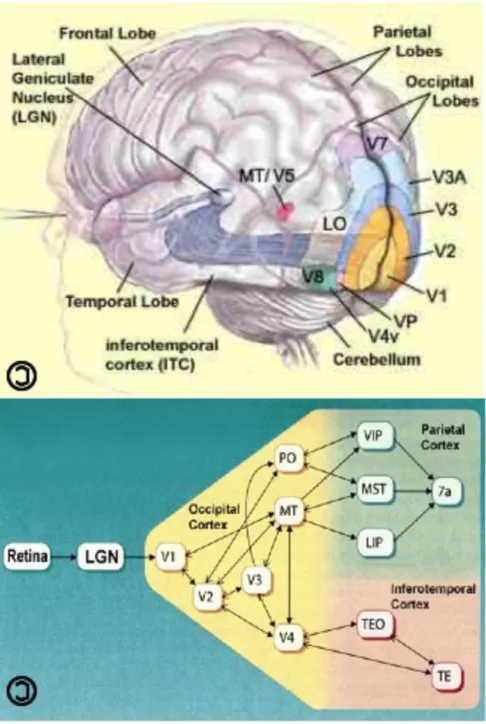
The anatomical and physiological pathways that mediate visual motion processing have been characterized in considerable detail (Maunsell and Van Essen, 1983; Deyoe and Van Essen, 1988; Andersen, R.A. 1997; Felleman and Van Essen, 1991), and are shown in Figure 2-1.The visual scene is encoded on the retina and subsequently transmitted to primary visual cortex (V1) via the optic nerve and lateral geniculate nucleus (LGN).
! ,!
! !
!
Figure 2-1. Visual processing pathways. (Top) The visual processing hierarchy is shown diagrammatically. (Bottom) Anatomical projections between visual areas including those associated with visual motion processing - V1 (primary visual cortex), V2 (prestriate cortex), MT (middle temporal), MST (middle superior temporal), VIP (ventral intraparietal), area 7a (this area is involved in visuo-motor coordination).
! -! Cells in V1 encode a wide range of basic visual attributes including,
luminance, contrast, disparity, and spatiotemporal frequency, which are
combined at successive stages of visual processing (including V2, V3, etc.) to represent the complex visual features that together characterize the visual scene. The analysis of visual stimuli that begins in V1 and V2 continues through two major visual processing streams. One, the ventral pathway, extends to the temporal lobe and is associated with the representation of objects. The second, the dorsal pathway, extends to the parietal lobe and is associated with the processing of motion and spatial location.
The ability to perceive motion and moving objects is a critical visual sub-modality that relies on changes in luminance, color, texture, and disparity over time to identify and segment motion within the visual field. Each region in visual cortex is characterized by neurons whose receptive fields increase across successive stages of processing and whose encoded visual motion attributes become increasingly complex.
Motion information in V1 is represented by spatiotemporal frequencies over small regions of the visual field (~1o). Neurons in middle temporal cortex
(MT), provide the earliest representation of motion direction which is combined across subsequent parietal areas including the medial superior temporal area (MST), ventral intraparietal area (VIP), and superior temporal polysensory area (STP) to represent more complex forms of motion of progressively larger regions of the visual field (Maunsell and Van Essen, 1983; Deyoe and Van Essen, 1988; Andersen, 1997), (Figure 2-1). Functionally, these regions are largely in
! %.! agreement between monkey neurophysiology and human fMRI studies
(Vanduffel et. al., 2001).
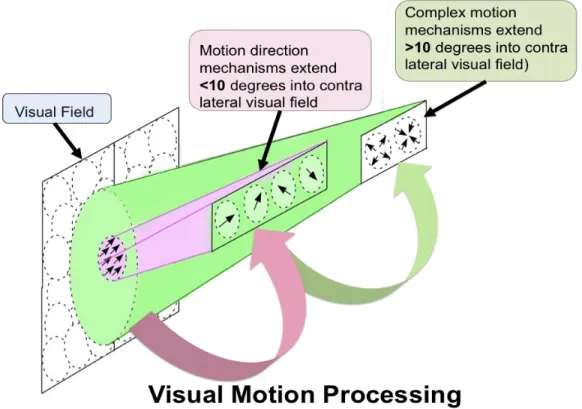
Visual motion processing between areas MT and MST has a hierarchical structure such that neurons in MT are selective to the speed and direction of translation (local) motion, while neurons in MST are selective to more complex patterns of motion, including radial, circular and spiral (global) motion (Saito et. al., 1986; Meese and Harris, 2001). Neurons in MST, exhibit preferred responses to radial, rotational and translational motions formed by spatially integrating local motions across the visual field to obtain a global motion percept (Clifford et. al., 1999; Morrone et. al., 1995; Beardsley and Vaina, 2005; Burr et. al., 1998; Snowden and Milne et. al., 1996;Meese et. al., 2001).
! %%!
!
Figure 2-2. Schematic diagram illustrating the functional hierarchy of visual motion processing between the middle temporal (MT) and medial superior temporal (MST) areas. The visual motion properties of MT/MST neurons are portrayed in separate layers together with their relative receptive field sizes. The arrows between layers show the primary direction of information flow. MT neurons are tuned to directions of motion while neurons in MST preferentially respond to more complex patterns of motion such as expansion and contraction. The dotted circles in the visual field indicate the relative sizes of the receptive fields between neurons in MT and MST.
In MT, neurons are tuned for motion direction, have receptive fields that span (~10o) and are confined largely to the contra-lateral visual field; extending
less than 10o into the ipsilateral visual field. Neurons in MST have larger
receptive fields (~61o) that extend more than 10o into the ipsilateral visual field
(Duffy and Wurtz, 1991a; Duffy and Wurtz, 1991b). Consistent with the known anatomy (Maunsell and Essen, 1983; Ungerleider and Desimone, 1986), MST motion selectivity assumes input from a range of MT cells (Bex et. al., 1998)
! %&! (Figure 2-2). Tanaka and Saito proposed that motion pattern tuning in MST
neurons results from the combined inputs of MT cells whose directional tuning and receptive fields coincide with the directions of motion that form the MST neurons preferred motion (Tanaka and Saito, 1989).!
2.3 Significance
This study seeks to characterize the mechanisms that mediate perceptual learning by determining how learning progresses through particular stages of sensory processing. In the near term, the techniques developed here are expected to provide insights into the mechanisms that mediate task-dependent learning. Over the long term, improved understanding of how learning occurs and the extent to which the sensory representation is modulated by training could impact neurorehabilitation facilitating development of more effective rehabilitation strategies in patients suffering from stroke or neurodegenerative diseases in areas such as virtual reality (Marians et. al., 2006) and robot aided sensorimotor rehabilitation (Volpe et. al. 2001). Understanding how the brain dynamically adapts to changes in the environment (including the percept of self) could impact the design of adaptive closed-loop prosthetic systems, e.g., neuroprosthetics, visual neuroprosthetics (Piedade, 2005), and cochlear implants (Rouger et. al, 2007), by providing insight into the physiological adaptive processes that operate with (or against) man-made adaptive controllers.
! %'!
3 EXPERIMENTAL APPARATUS AND METHODS
3.1 Experimental Apparatus
3.1.1 Human Subjects
A total of 18 subjects (7 females and 11 Males; age range: 23.83 years with SEM of / 2.81) with normal or corrected to normal vision participated in the experiment. Prior to participation in the study written informed consent was obtained from all subjects in accordance with Institutional Review Board at Marquette University. During their participation in the study, the pattern of subjects’ sleeping habits, recorded via questionnaire, was taken into
consideration when setting up training and test sessions to maximize attention to the tasks. Throughout the study, subjects were trained and tested at the same time of day to control for diurnal (active during daytime) effects on attention (Babkoff, H. and Zukerman, G. et al.; 2005). The quality and amount of sleep was evaluated using a short self-assessment questionnaire (Pittsburg sleep quality index (PSQI)) prior to each test/training session.
3.1.2 Stimuli
Visual stimuli were generated in Matlab© 2007b, using Psychtoolbox v.3 for stimulus presentation and Bravitoolbox v.2008.9.25 for experimental design, and presented on a calibrated NEC Accusync 120 CRT display with a resolution of 1024 x 768 pixels. During testing subjects fixated on a grey square with a pen
! %(! width of 4 minutes of visual angle and luminance of 59.98 Cd/m2. The stimulus
was presented on a grey background with luminance of 20.12 Cd/m2, as shown
in Figure 3-2. The fixation square defined the center of the stimulus with respect to the subjects’ visual field, such that stimuli were presented either in the left or right visual field.
Stimuli consisted of random dot kinematograms (RDK’s) presented in two circular apertures, 8o in diameter, located in either the left or right visual field. The
stimulus apertures, which were illusory, were presented 14o to the left or right of
the vertical midline through the fixation mark presented on the display. For stimuli presented in the right visual field, the stimulus apertures were located at 35o and
325o, relative to the horizontal midline through fixation, at an eccentricity of
17.17o. For stimuli presented in the left visual field the apertures were located at
145o and 215o relative to the horizontal midline.
Dots were randomly positioned in each aperture with a density of 2 dots/degree2. At stimulus onset, the dots moved for 500 ms with a constant
speed of 4 deg/sec in directions consistent with an expanding or contracting motion or local planar motion (See Figure 3-3). During testing, expansion and contraction stimuli were counterbalanced across trials to minimize adaptation to a single type of motion, e.g., expansion. A proportion of the dots in each aperture were colored red (87.31 Cd/m2) and the remaining dots were grey (79.92 Cd/m2),
as part of a dot density discrimination task (see Section 0$123"425678!9737:";4).
! %)! they are assigned new positions and trajectories consistent with the specified motion (Clifford, C., Beardsley, S.A. and Vaina, L.M; 1999).
3.1.3 Experimental Setup
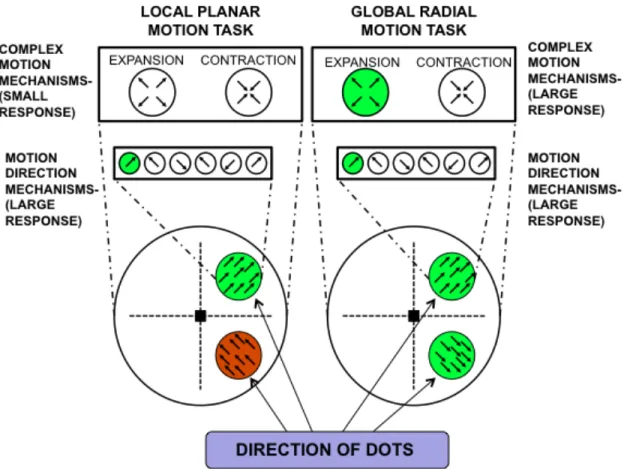
In the experiments outlined below we use perceptual learning in a dual-task paradigm to identify the visual motion mechanisms modulated during training by contrasting psychophysical performance in tasks designed to dissociate local motion direction mechanisms from the global motion pattern percept. Subjects participated in two perceptual tasks used to determine the cortical level where perceptual learning occurs. A “Global Motion Task” was used to quantify subjects’ ability to discriminate changes in the direction of radial motion (motion of dots away from or towards the center of the display) across stimulus apertures (Figure 3-1). A “Local Motion Task” was used to quantify subjects’ ability to discriminate changes in the direction of local planar motion within stimulus apertures (Figure 3-1). Task dependent learning on the visual motion tasks was examined using a threshold tracking paradigm, in which pre-session threshold estimates and within-pre-session adjustment criteria were used to maintain comparable levels of task difficulty across training sessions (See SectionThreshold Tracking Paradigm).
! %*!
Figure 3-1. Schematic diagram of the motion mechanisms associated with the global and local motion tasks. A Global Motion Task was used to engage complex motion mechanisms and quantify subjects’ ability to discriminate changes in the direction of radial motion across stimulus apertures. A Local Motion Task, wherein the direction of motion in one aperture was rotated 180o to
remove the global motion percept, was used to preferentially engage local motion mechanisms to quantify the subjects’ ability to discriminate changes in the direction of local planar motion.
!
Prior to the experiment subjects were fitted with an Arrington Research Systems, Binocular Eye Frame Mounted Scene Camera System (resolution = 0.3o), to track eye movements during testing. During the experiment subjects
were comfortably seated in front of a 40 x 30 cm computer display (NEC Accusync 120 CRT display), at a distance of 60 cm such that their line of sight was perpendicular to the display. A custom-made head and chin rest mounted on
! %+! a small table placed in front of the subject was used to reduce head motion and maintain a fixed distance from the screen. All experiments were performed in a quiet darkened room.
!
Figure 3-2. Experimental Setup. Fixation on the screen was presented either on the left or right side of screen to maximize the visual display of the stimulus and restrict the stimulus to a single visual field< The head and chin rest was used to
was used to hold the subjects head in a place while the experiment was conducted and the Eye tracker goggles were on at the same time to track the pupil movements of the eye.
!
During testing, subjects fixated at a pre-defined point (fixation) on the display while being presented with sequences of visual stimuli (Figure 3-2). Following each stimulus presentation subjects responded to changes in the visual properties of the stimuli by pressing a pre-defined key on a computer keypad. Subject responses were recorded via key press by the testing computer and stored for offline analysis. A second computer continuously monitored eye movements to ensure that subjects maintained proper fixation during the task. If
! %,! the subject’s eye position deviated more than 2o from the fixation mark, the
stimulus presentation was aborted until subjects resumed fixation. When a trial was aborted, a new trial containing the same stimulus was inserted at the end of the test sequence.
!
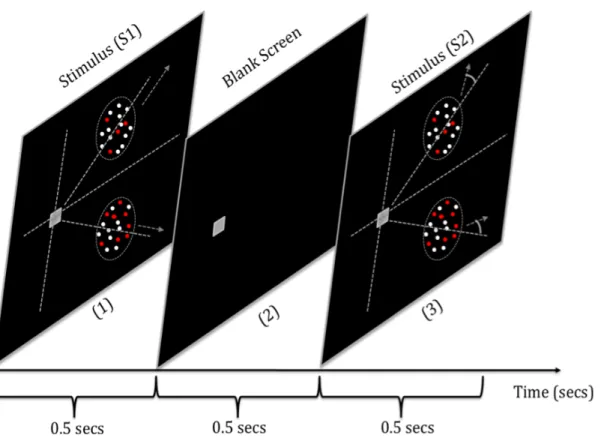
Figure 3-3. Schematic illustration of the stimulus presentation sequence. Two 500 ms stimuli were presented (S1 and S2), with a 500 ms inter-stimulus interval. The dotted lines are shown for reference and were not present during testing. The grey square at the intersection of the illusory lines is the fixation point and the rotated arrows in stimulus S2 show the direction of dot motion rotated by an angle !p.
! %-! During each trial, dots in both apertures move radially with respect to the fixation in one of the two stimulus intervals (Figure 3-3). In the other stimulus interval the direction of dot motion was perturbed coherently by an angle ±!p with
respect to the radially oriented motion. Following each paired stimulus
presentation; subjects were required to provide two responses via key press for the dual task. The subjects’ tasks were (1) to indicate whether the motion in the second stimulus was rotated clockwise (CW) or counter-clockwise (CCW)
relative to the first stimulus (2) and to indicate which stimulus interval contained a larger proportion of red dots across both stimuli. The keys used to indicate
subjects’ perceptual judgments are shown in APPENDIX A4. Subjects’ response times were recorded relative to the beginning of the second stimulus interval.
3.1.3.1 Monitoring eye movements
An Arrington Research Systems BS007 Binocular Eye Frame Mounted Scene Camera System was used to monitor eye movements as subjects
performed the task (Figure 3-4). The Eye tracker was interfaced with a Windows XP platform of PC through the View-Point Eye Tracker! software. Eye position
was measured via pupil deflection sampled at 60 Hz. Following an initial calibration, the eye tracking software automatically recorded eye position and eye velocity on the display. The values of eye position were then streamed to the computer running the visual tasks to verify eye position in real time.
! &.! The eye tracker used a Glint pupil vector method to locate the pupil. This approach is robust to x-axis or y-axis movements (in the plane of the subject’s head), but is more sensitive to the movement of head away from the camera. Hence we used a head-fixed calibration technique and physically strapped the subject’s head to the head and chin rest.
!
Figure 3-4. Arrington binocular eye tracker camera and eye Image on right with corneal reflection (glint). Arrington binocular eye tracker camera (left) The two small protrusions near the eyes are the IR-illuminators and cameras. The small cube on the forehead band of the goggles is the head camera. The goggles also have a tightening strap at the back, which helps support the goggles on the subject’s forehead. The eye image with a corneal reflection (glint) from one eye obtained by the IR-illuminator and camera used to perform the pupil-glint localization is shown on the right.
!
3.1.4 Eye Tracker Calibration
At the beginning of each test session, the eye tracker was calibrated using the Glint-Pupil Vector method to calculate the pupil position. The calibration
=>35278! 32?82@6">5!
! &%! region encompassed the visual display and was normalized from (0.00,0.00) to (1.00,1.00). Calibration was performed by having subjects make saccades to a sequence of 16 targets arrayed in a circle around the screen center (Figure 3-5). During the calibration sequence, subjects fixated on a central square. When a target was presented subjects were instructed to shift their gaze to the target and maintain fixation on the target for a period of 5 sec. For each target location the pupil-center/corneal-reflection relationship was recorded and used together with the target location in the normalized display space to map eye position to (x, y) coordinates on the screen.
!
Figure 3-5. The Eye Space Window with the Advanced Calibration settings. Eye tracker calibration. Calibration points were presented at 16 points spanning the display. In the default configuration (used here) the Auto calibration sequence presented the calibration points in random order, each for ~5 sec.
! &&!
3.1.5 Visual Motion Tasks (Global vs. Local Motion)
During the experiment, subjects performed a dual-task paradigm to determine the cortical level where perceptual learning occurs. The subject’s consisted of a either a Global or Local motion task (Figure 3-6; task-1) in which they were required to indicate whether the motion in the second stimulus interval was rotated clockwise (CW) or counter-clockwise (CCW) relative to the first stimulus interval. In task-s, subjects were required to indicate which stimulus interval contained a larger proportion of red dots across both stimuli. The time course of the events during the 2-TAFC task for the Global and Local motion tasks is shown in Figure 3-3.
The Global Motion Task (Experiment 1) was a 2-TAFC (Two temporal alternative forced choice) task which, quantified subjects’ ability to discriminate changes in the direction of radial motion (Figure 3-1) along with the dot
discrimination task. Within each aperture, the dots moved in a constant direction either radial motion or circular motion to a line connecting the fixation mark and stimulus aperture. During the task, subjects were presented with pairs of stimuli and required to discriminate changes in the direction of the radial motion or circular motion presented across stimulus apertures. Within each trial, the direction of dot motion in the test stimulus S2 was rotated CW or CCW by an angle "p, relative to a comparison stimulus S1 (Figure 3-1).
! &'! The Local Motion Task (Experiment 2) was also a 2-TAFC (Two
temporal alternative forced choice) task which, quantified subjects’ ability to discriminate changes in direction of local planar motion (Figure 3-1) along with the dot discrimination task. The stimulus was identical to Exp (1) with the exception that the direction of motion in one aperture was rotated 180o, to
remove the global motion percept (e.g. expansion-contraction). The resulting dot motion was inconsistent with a simple radial motion, while maintaining the same local directions of motion across trials. During the task subjects were presented with test and comparison stimuli and required to discriminate changes in the direction of the local planar motion across stimulus apertures. The CW/CCW change in the direction of dot motion, by "p, was applied within each aperture in
the same way as the Global Motion Task (Experiment 1).
3.2 Experimental Paradigm
Prior to testing subjects were divided into two groups corresponding to the motion direction stimuli (Global or Local) presented during training. Figure 3-7 shows the eight experimental conditions on which all subjects were tested before and after training. Nine subjects were trained to discriminate changes in the direction of radial motion (expansion and contraction). Similarly, nine were trained to discriminate changes in the direction of the equivalent local planar motion stimuli. Five subjects in each group were trained with stimuli presented in
! &(! the right visual field and the remaining subjects were trained with stimuli
presented in the left visual field.
!
!
Figure 3-6. Experimental Paradigm for the Global motion task (Exp.1) and Local motion Task (Exp. 2). During the PRE, POST and RET sessions all eight combinations of motion task (global vs. local), visual field (left or right) and motion direction (radial vs. circular) were tested. The TC (Trained condition) blocks in red dashed frame denote different tasks selected in training sessions where ‘N’ was based on subjects learning thresholds. Subject was trained on dual task paradigm (speed task with dot discrimination as Seen in "#$$%!
%&'()&*&+,-&.+!-),&+&+/!#,),%&/*) before the main experiment to train the subjects on
performing the dual task.
! &)!
Figure 3-7. Experimental conditions tested before and after training. Eight experimental conditions were consisted before and after training corresponding to all combinations of motion task (global vs. local), visual field (left or right) and motion direction (radial vs. circular). Thresholds are collected on these conditions before training (pre), after training (post) and retention (ret) in the experimental paradigm (Figure 3-6)
! &*!
3.2.1 Speed discrimination training paradigm
Before training on the direction discrimination task, subjects were trained on the dual-task paradigm to control for the effects of learning to perform the dual-discrimination task. During this phase, a speed discrimination task was used in conjunction with the dot density task to provide the same image statistics used in the actual experiment while minimizing the likelihood of improvements in direction discrimination. The speed discrimination task had the same frame-wise image properties as the direction discrimination task used in the main experiment except that the directions of motion for each dot were chosen randomly on every stimulus frame.
In a Two temporal alternative forced choice (2-TAFC) task, subjects were presented with pairs of random motion stimuli and required to indicate which of the two stimuli contained the faster motion (task-1). The second task (task-2), was to identify which of the two stimuli had a larger number of red dots across stimulus apertures. Task-2 was an attention task, which was included with task-1 to ensure that the observer attended to both apertures during stimulus
presentation. In task-2 (dot discrimination) the red dots were distributed across both stimulus apertures such the number of red dots in a single aperture was uncorrelated with the task-1 judgment across trials.
Following the presentation of each stimulus pair, subjects were instructed to respond first, to task-1 (in this case speed discrimination), and then to task-2. During testing a constant stimulus paradigm was used with task-1 levels
! &+! corresponding to either [28, 30, 32] deg/sec or [20, 22, 24] deg/sec differences in speed based on subject’s performance with 20 trails per stimulus level. For task-2, the constant stimulus levels were set to [80, 95] % change in red dot density. When an observer’s percent correct performance was # 80% for the smallest
change in speed and # 80% for the dot density task, they were enrolled in the
perceptual learning study.
3.2.2 Threshold Tracking Paradigm
During training on the direction discrimination task, a threshold-tracking paradigm was used to maintain a constant level of task difficulty. During the first experimental session, observer thresholds (Ts= 79% correct) were estimated for
all training and control tasks using an adaptive staircase pattern. Each training session consisted of nine training blocks (constant stimulus runs), where each block contained 60 trials (20 trials per level). During the first experimental
session, observer thresholds (T=79% correct) were estimated for all training and control tasks using an adaptive staircase paradigm.
For each observer the threshold estimate and standard deviation ($) obtained from the staircase procedure were used to select three task-specific levels of difficulty for subsequent constant stimulus training during the session [(T- $), T, (T+ $)]. If an observer’s percent correct performance for the (T- $) level of difficulty exceeded 80%, the training levels were adjusted downward by $
! &,! to span the range [(T- 2$), (T- $), T]. Training was concluded and post-training data collected when the thresholds stabilized over ‘N’ sessions (Figure 3-8). Subjects’ thresholds were considered to have stabilized when the number of blocks tested was greater than four time constants as defined by an exponential fit to discrimination thresholds across training blocks. Subjects were trained on consecutive or alternating days over a period of approximately ~1-2 weeks (~4-12 sessions).
During the first and last test sessions subjects’ staircase thresholds on the training and control conditions (e.g. to the opposite field of view and the untrained task (or in this case it is the circular task)), were collected to quantify the degree of learning transfer and identify the cortical level at which perceptual learning occurs. Task retention thresholds following training were quantified after 7-10 days via repetition of the post-training test and control conditions.
! ! !
! &-!
!
Figure 3-8. Diagrammatic representation of the threshold training paradigm. During a test session subjects were first tested with a staircase paradigm on the training task to obtain estimates of subjects’ threshold (T) and standard deviation ($), which were subsequently used to specify the three constant stimulus levels to be used for the first run. If the subject’s percent correct performance for the lowest level # 80% on a run, then the levels were reduced by $ for the next run. Each test session consisted of nine runs, which were subsequently grouped into three blocks (of three runs each). Discrimination thresholds were estimated for each block using a least-squares curve-fit to a Weibull function.
! ! ! ! !
! '.!
4 RESULTS
Between the two training groups, i.e. training with local or global motion, initial (before –training or pre-training) direction discrimination thresholds varied widely (4 – 35 degrees) across subjects. Of the 18 subjects trained between the two task conditions, 16 showed significant improvements in direction
discrimination thresholds with practice (paired t-test; p<0.05, See Table 4-3). Two subjects, S2 and S11 (one from each training group), showed no significant improvement in performance with training (paired t-test; p>0.05). Two subjects, one from each training group (S2 with time constant (!) = -50 and S11 with time constant (!) = -100) also had negative time constants, indicating that their thresholds did not improve with training (See Table 4-1 and Table 4-2). These subjects were hence classified as non-learners and excluded from all subsequent analyses of learning effects.
Figure 4-1 and Figure 4-2 show direction discrimination thresholds on the trained condition as a function of training block for the global-radial and local-radial motion training groups respectively. In each case threshold performance (
"
th ) was fit to a decaying exponential to characterize the time course of learning"
th=
"
pre*e
-bt+
"
postwhere
"
pre is the threshold before training ("
pre >0), b is the rate of decay (= 1/!,! '%!
Figure 4-1. Direction discrimination thresholds as a function of training block for subjects trained on the Global Motion Task. Discrimination thresholds (79% correct) are show for subjects S1-S9 as a function of training block. A nonlinear least-square exponential fit was applied to each subjects’ performance (red dashed line) to characterize the time course of learning. The best-fit parameters for each subject are shown in Table 4-1.
! '&!
Figure 4-2. Direction discrimination thresholds as a function of training block for subjects trained on the Local Motion Task. Discrimination thresholds (79% correct) are show for subjects S10-S18 as a function of training block. A nonlinear least-square exponential fit was applied to each subjects’ performance (red dashed line) to characterize the time course of learning. The best-fit parameters for each subject are shown in Table 4-2!
! ''!
Subjects
"
pre b= 1/! (blocks)"
postS1 5.63 (3.79, 7.48) 0.6083 (0.3826, 0.8341) 1.53 (1.36, 1.70) S2 1.94 (-73.57, 77.45) -0.02361 (-0.7666, 0.7194) 0.21 (-76.62, 77.03) S3 22.56 (10.90, 34.22) 0.4777 (0.1599, 0.7955) 7.26 (5.72, 8.80) S4 3.59 (-0.34, 7.51) 0.3916 (-0.2267, 1.01) 2.92 (2.22, 3.63) S5 11.32 (6.59, 16.05) 0.292 (0.0754, 0.5085) 3.39 (2.00, 4.78) S6 15 (4.51, 25.49) 0.1181 (-0.1628, 0.3989) 1.84 (-11.75, 15.42) S7 4.54 (2.11, 6.98) 0.46 (-0.0035,0.9235) 5.31 (4.49, 6.13) S8 90 (fixed at bound) 0.7709 (0.6812, 0.8606) 6.83 (4.87, 8.80) S9 10.66 (4.01, 17.31) 0.1199 (-0.0073, 0.2472) 2 (fixed at bound)
Table 4-1. Parameters for best fit exponential to subjects’ discrimination threshold with training on the Global Motion Task. Least squares estimates of subjects’ pre-training threshold ("pre), b= 1/time constant (!), and post-training
thresholds ("post) are shown together with their 95% confidence interval (in
brackets) for each subject. The negative time constant obtained for S2 indicates the subject was a nonlearner (highlighted in gray).
! '(!
Subjects
"
pre b=1/! (blocks)"
postS10 7.18 (-30.09, 44.45) 0.0417 (-0.2925,0.3759) 2.75 (-36.69, 42.2) S11 7.70 (5.18, 10.22) -0.01418 (-0.0426,0.0143) 1 (fixed at bound) S12 1.56 (0.43, 2.70) 0.1256 (-0.0089, 0.26) 5 (fixed at bound) S13 47.6 (31.52, 63.68) 0.49 (0.2798, 0.7002) 4.90 (2.85, 6.94) S14 33.2 (1.16, 65.23) 0.9017 (0.1007, 1.703) 10.7 (9.09, 12.32) S15 1.34 (-0.40, 3.07) 0.1259 (-0.4431, 0.694) 3.04 (0.86, 5.23) S16 6.98 (1.49, 12.47) 0.4213 (-0.130, 0.9727) 5.81 (4.38, 7.24) S17 10.18 (4, 16.35) 0.666 (0.1502, 1.182) 2.05 (1.15, 2.96) S18 22.79 (16.85, 28.72) 0.1666 (0.1036, 0.2296) 8 (fixed at bound)
Table 4-2. Parameters for best fit exponential to subjects’ discrimination threshold with training on the Local Motion Task. Least squares estimates of subjects’ pre-training threshold ("pre), b= 1/time constant (!), and post-training
thresholds ("post) are shown together with their 95% confidence interval (in
brackets) for each subject. The negative time constant obtained with S11 indicates the subject was a nonlearner (highlighted in gray).
! ')! Table 4-1 and Table 4-2 show the results of the least-square exponential fits to subjects’ discrimination threshold improvements with training for the Global and Local motion trained groups respectively.
! '*!
!
Figure 4-2. Average percent correct performance on the dot discrimination task (task-2) as a function of training block for subjects trained on the (A) Global Motion and (B) Local Motion tasks. Performance is reported within each group as the mean across subject’s ± 1 SE.
Performance on the dot discrimination task (task-2) ranged from 88%-96% for all subjects (Figure 4-2), indicating that subjects attended simultaneously to both apertures throughout training. Figure 4-3 shows the training-induced
changes in direction discrimination thresholds across conditions before and after training and one week following the completion of training. Results are reported across test conditions as the mean across subjects (±SE) of the (within-subject) performance thresholds.
! '+!
! ',!
!
Figure 4-3. Group averaged direction discrimination thresholds across experimental conditions. (A) Pre- and training performance and (C) post-training and learning retention (one week after post-training) for subjects trained on the Global motion task. (B) Pre- and training performance and (D) post-training and learning retention (one week after post-training) for subjects trained on the Local motion task. Performance is reported as the mean ± SE. The single asterisk denotes conditions that were significantly different (p<0.05).
!
To account for the wide range of subject’s initial discrimination thresholds, subjects’ individual thresholds within each experimental condition were
! '-! normalized to the pre-training thresholds averaged across all conditions prior to the statistical analysis. A three-way (2x2x2) repeated measures ANOVA was performed on the results of each training group with task type (local/global), visual field (left/right), and motion direction (radial/circular) as fators. Both training groups (local and global motion taining) showed significants effects of training across tasks (p< 0.05), visual field (p< 0.05), and motion direction (p< 0.05). No interactions between conditons were observed (p> 0.05). !
Table 4-3 shows the results of paired t-test comparisons (two-tailed) of normalized pre- versus post-training thresholds1. Comparisons of pre-versus
post-training thresholds revealed group-specific differences in the pattern and transfer of learning between experimental conditions. Subjects trained on global radial motions showed significant learning for the trained motion direction and visual field (denoted by (*) in Figure 4-3A), transfer to the orthogonal (circular) motions presented in the trained visual filed and to the global radial motion presented in the untrained visual field. Improvements in direction discrimination post-training, also transferred to the local radial motion stimuli in both trained and untrained visual fields (See Table 4-3A). When subjects trained on the equivalent local motion condition, the transfer in improved direction discrimination was restricted to the equivalent global (radial) motion presented in the trained visual field (Table 4-3B). Retention data collected one week following the end of training !!!!!!!!!!!!!!!!!!!!!!!!!!!!!!!!!!!!!!!!!!!!!!!!!!!!!!!!
%!All subjects’ thresholds were included in the analyses with the exception of subject S5 whose threshold for the global radial motion task presented in the untrained visual field, was excluded as an outlier (>4$ from the group mean).!
! (.! showed that no significant changes in direction discrimination between the post training session and retention session.
(A) GLOBAL TRAINED SUBJECTS: T-TEST RESULTS (D.F. =7)
Experimental Conditions T-value P-value Sig (p<0.05)
Local Radial 2.799 0.026 Yes
Global Radial 3.453 0.010 Yes
Local Circular 1.662 0.140 No
Trained Visual Field
Global Circular 2.552 0.037 Yes
Local Radial 2.516 0.040 Yes
Global Radial 1.811 0.006 Yes
Local Circular 1.788 0.116 No
Untrained Visual Field
Global Circular 1.387 0.208 No
(B) LOCAL TRAINED SUBJECTS: T-TEST RESULTS (D.F. =7)
Experimental Conditions T-value P-value Sig (p<0.05)
Local Radial 3.429 0.011 Yes
Global Radial 2.777 0.027 Yes
Local Circular 0.093 0.928 No Trained Visual Field Global Circular 0.355 0.732 No Local Radial 1.912 0.097 No Global Radial 1.418 0.198 No Local Circular 2.187 0.064 No Untrained Visual Field Global Circular 1.312 0.230 No
Table 4-3. Group analyses of pre- versus post-training direction discrimination thresholds across experimental conditions as shown in table on left for subjects trained with (A) Global radial motions and (B) Local radial motions. Difference in pre versus post-training thresholds were evaluated across subjects using paired t-tests with seven degrees of freedom. Test conditions highlighted in grey showed statistically significant decreases in discrimination thresholds following training.
! (%!
!
Figure 4-4. Diagrammatic comparison of statistically significant training-induced changes in direction discrimination thresholds across experimental conditions. Visual fields were classified as trained and untrained, based on the conditions the subjects were trained on. Color Representation: Blue denotes the trained task and condition. Orange indicates significant improvement in post (versus pre-) training thresholds (p<0.05pre-). White indicates no significant change in thresholds before and after training. Condition Annotations: The task condition annotations correspond to the task and motion type presented during training (GR: Global-Radial, GC: Global-Circular, LR: Local–Global-Radial, LC: Local-Circular).
!
Figure 4-4 shows a diagrammatic illustration of the training-induced changes in direction discrimination thresholds across tasks, motion directions, and visual field locations for the two training groups.For subjects trained on the Local Motion task, learning was restricted to the trained visual field but
transferred to the global motion task for stimuli (i.e. radial motions) that contained the directions of local motion presented within apertures during training. For subjects trained on the Global Motion task, improvements in direction
! (&! motions presented in the trained visual field and for the Local motion task in the trained visual field whose within-aperture directions of motion matched those of the trained (radial) global motion.
! ('!
5 DISCUSSION
The transfer of perceptual performance to modified forms of the same task or to different related tasks has been the primary tool for discovering what is learned and inferring the physiological basis of that learning [Fahle and Poggio, 2002]. In the approach developed here, we used the known functional hierarchy of visual motion processing together with carefully controlled tests of visual motion discrimination to determine the processing stage at which learning occurs for wide field motion patterns associated with self-movement through the
environment. By tracking threshold performance during training, the experimental approach applied here has the benefit of equating task difficulty across
observers, facilitating a comparable engagement of the underlying visual motion and learning mechanisms.
The results indicate that when subjects trained on radial motion patterns (Global Motion task), learning transferred to radial motions presented in the untrained visual field, orthogonal (circular) motion patterns presented in the trained visual field, and to equivalent local motions (oriented radially with respect to fixation) presented in both visual fields. By comparison, when subjects were trained on the equivalent local motions (Local Motion task), learning was restricted to the same visual field and directions of motion. Improvements in direction discrimination did transfer to the equivalent global motion in the trained visual field. The results suggest that training with global, and to a lesser extent local, motions leads to training-induced changes in performance across multiple
! ((! stages of visual processing. A key question, is how these results relate to current theories of task-dependent or task-relevant learning.
5.1 Reverse Hierarchy Theory
Reverse Hierarchy Theory (RHT) suggests that task-dependent learning is a top-down guided process, which begins at later stages of sensory processing, and when those stages do not suffice in showing learning even after training, then the learning progresses backwards to earlier stages of processing, which have a better signal-to-noise ratio. Within this framework, RHT makes two important predictions that can be tested experimentally (Ahissar, M. and Hochstein, S. 1997a, 1997b, 1999, 2004):
Case (A): Perceptual learning will be contingent on attention on the entire task (global level) to guide the backward (top-down) search for the highest level of processing sufficient to perform the task. This follows directly from the
assumption that high-level representations are more immediately accessible to conscious perception, whereas the more focal representations of sensory attributes that occur at earlier stages of processing can result in a higher signal-to-noise ratio. As such, RHT proposes that learning will occur at the stage of visual motion processing whose output is sufficiently discriminative with respect to the task. Thus, when spatial attention is broad, perceptual learning will occur at higher levels of visual processing whose receptive fields span the attended region.
! ()! In the context of the current experiments, an attention-driven interpretation of RHT predicts that learning in subjects trained on the Global Motion task, will be restricted primarily to higher-levels of visual processing that represent complex patterns of motion across stimulus apertures. Little if any transfer of learning to the Local Motion tasks associated with earlier stages of visual
processing (Figure 5-1, top-right) would be predicted. Even when subjects were trained on the Local Motion task, the dual-task paradigm required that they allocate their attention “globally” across stimulus apertures resulting in similar predictions for the transfer of learning following training on the Global and Local Motion tasks (Figure 5-1, bottom-right).
Figure 5-1. Comparison of experimental results with predictions from a task-specific attention driven interpretation of Reverse Hierarchy Theory (RHT). The color representation and designation of experimental conditions follows the convention detailed in Figure 4-4.
Case (B): Previous studies have shown that as a task becomes more difficult, the window of attention shrinks and learning becomes more localized