1. Introduction
Natural fibers have been immensely used by the mankind since long. As they are renewable resource so they can also be utilized for various secondary needs. Many attempts have been made to explore their potential yet a lot remains undiscovered. The natural fibers suffer from various draw-backs such as low weather-stability, fast-decaying and low chemical resistance. Amongst various methods prevalent to improve these properties, graft copolymerization of vinyl monomers onto natural backbones has been an interesting tool to reduce the ageing in textiles, enhancing the mechanical properties and modifying the texture 1-3.
Graft copolymerization of vinyl monomers onto cellulose has been extensively studiedwith monomers like acrylic acid and iso-butyl acrylate. Numerous scientists have explored the potential of this chemical technique on different natural fibers and used latest advanced means of characterization like FTIR, XRD, SEM, TGA, DTA, DSC and evaluated the properties for their variable applications. It modifies the properties of polymer back-bone and incorporates the desired features without drastically affecting the basic traits of the substrate. The present paper deals with the optimization of the reaction conditions for the graft copolymerization of methyl acrylate (MA) onto H. sabdariffa stem fiber. The important polymeric properties like swelling, dye uptake, chemico-physico-thermal resistance, moisture absorbance have been studied that help to evaluate the acquired modification. The graft copolymers thus obtained were characterized by advanced analytical techniques and evaluated for the
physico-chemico-thermal changes that improved the raw and waste biomass for better scientific application 4-24.
2.Experimental
2.1 MaterialsH. sabdariffa fiber was obtained from the Department of Agronomy, Chaudhary Sarwan Kumar Himachal Krishi Vishwavidyalaya, Palampur (H.P.) India. Ethyl acrylate, Butyl acrylate (Merck) and ceric ammonium nitrate (s. d. fine-Chem, Pvt. Ltd, Mumbai, India) were used as received. H. sabdariffa fiber was purified through soxhlet extraction in acetone for 72 hours.
2.2 Graft copolymerization
Graft copolymerization of the monomer onto H. sabdariffa was carried-out for optimization of different reaction conditions like reaction time, reaction temperature, monomer concentration, concentration of initiator system and pH in order to obtain maximum graft yield. The fiber (0.5g) was activated by swelling in 100 ml of the distilled water for 24 hrs. Mixture of ceric ammonium nitrate (CAN) and conc. HNO3 mixture was slowly added to the reaction medium with continuous stirring followed by the drop by drop addition of a definite ratio of binary vinyl monomeric mixture. The reaction was carried-out at a definite temperature for a particular time interval. On completion of the reaction, poly(MA) were removed on extraction with acetone, chloroform, methanol and water. The graft co-polymer was dried at 50°C, till a constant weight was obtained. The percent grafting (Pg) was calculated as per the reported method 2,3
Pg = Wf - Wi x 100 (1) Wi
where, Wf = final weight of the fiber, Wi = initial weight of the fiber.
2.3 Characterization
IR spectra of the H. sabdariffa and its graft copolymers were recorded with Perkin Elmer Fourier Transform Infrared (FTIR) spectrophotometer using KBr pellets (Sigma Aldrich). Scanning Electron Micrographs (SEM) of H. sabdariffa and its
Abstract
Background & Aim: The paper deals with optimization of the reaction parameters, graft copolymerization, characterization and evaluation of the transformations in Roselle stem fiber on graft copolymerization with vinyl monomer, using ceric ammonium nitrate nitric acid initiator system. Methods: Different reaction parameters such as temperature, time, initiator concentration, monomer concentration and pH were optimized to get the maximum graft yield. The graft copolymer thus formed were characterized by advanced techniques. Results: The physico-chemico-thermal resistance, moisture absorbance, swelling behavior of graft copolymers and the dye uptake behavior were studied and found to have improved. Conclusion: Hence, this first report of novel graft copolymers is to help towards various applications.
Keywords:Roselle, graft copolymerization, chemical resistance, thermal resistance
@2012 BioMedAsia All right reserved
ORIGINAL ARTICLE Open Access
ISSN 2278-1404
International Journal of Fundamental & Applied Sciences
Exploring the Diversification in Grafted Copolymer
Ashish Chauhan and Balbir Kaith
Department of Chemistry, Dr. B. R. A. National Institute of Technology, Jalandhar – 144 011(Punjab) India
*Corresponding author
Full Address :
Department of Chemistry, Dr. B. R. A. National Institute of Technology, Jalandhar – 144 011(Punjab) India
Phone no. +91-9464616773
E-mail: [email protected]
O
O O
O O
O O OH
OH
HO
OH
OH
HO
OH OH
OH 1
4
1,4 beta acetal
m
where, m =2,000 - 26,000 graft copolymers were obtained by using Electron Microscopy
Machine (LEO 435-25-20). Thermogravimetric and differential thermal analysis were performed on thermal analyzer (LINSEIS, L-81 11). X-ray diffraction studies were performed on X-ray diffractometer (Bruker D8 Advance) under ambient conditions using Cu Kα (1.5418 0A) radiation.
The continuous scans were taken and different d-spacings (Å) and relative intensities (I) were obtained. Crystallinity index (C.I.) which measures the orientation of the cellulose crystals with respect to fiber axis was determined by using the wide angle X-ray diffraction counts at 2θ-scale close
to 22.680 and 150. The counter reading at the peak intensity at 22.680 represent the crystalline material and the peak intensity at 150 corresponds to the amorphous material in cellulose. Percentage Crystallinity (% Cr) and Crystallinity index (C. I.) were calculated as follows [21,22]:
% Cr = [I22.68/ (I22.68 + I15)] x 100 (2) C. I. = [(I22.68 – I15) / I22.68] (3)
where, I 22.68 and I15 are the crystalline and amorphous intensities at 2θ-scale close to 22.680 and 150, respectively.
2.4 Physico-Chemical Evaluation 2.4.1 Moisture absorption study
Moisture absorbance studies at various relative humidity levels were carried-out as per the method reported earlier. Moisture absorbance percentage was found out by placing a known weight (Wi) of dry grafted and ungrafted samples in a humidity chamber for about two hours and then the final weight (Wf) of the samples exposed to different relative humidities ranging from 30 – 90 % were taken. The % moisture absorbance was calculated from the increase in initial weight in the following manner3,4:
% of moisture absorbance (% Mabs) = [(Wf – Wi) / Wi] x 100 (4) 2.4.2 Acid and Base Resistance
Acid and base resistance studies were carried-out as per the method reported earlier,3,4. Acid and base resistance was studied by placing a known weight (Wi) of dry grafted and ungrafted samples in fixed volume (50 ml) of 1N HCl and 1N NaOH and the final weights (Wf) of the samples were noted down after 72 hours:
% of weight loss = [(Wi – Wf) / Wi] x 100 (5)
2.4.3 Swelling Behavior in Different Solvents
250 mg. of each grafted and raw sample was immersed in a definite volume (100 ml) of water, methanol, n-butanol and dimethyl-formamide under ambient conditions for a period of 24 hours. Samples were removed from the solvent and excess solvent was removed quickly with filter papers. Final weight of the sample was taken and the percent swelling was calculated as follows 3,4:
W2 - W1
Percent swelling (PS) = --- x 100 (6) W1
where, W1 and W2 are the initial and final weights of samples, respectively.
2.4.4 Dye Uptake Behavior
0.1% Gentian violet solution was prepared in distilled water. 10% NaCl and a few drops of acetic acid were added to this solution. Dye uptake of raw fiber and its graft copolymers was carried-out by immersing the known weight of each sample in 100 ml of Gentian violet dye. Optical densities of test solutions were noted down using Digital Photo Colorimeter after particular time intervals till constant readings were obtained for seven consecutive hours and the concentrations of test solution were calculated as3,4:
It
Cont. of test solution (Ct) = --- x Co mol L-1 (7) Io
where, Io, It, and Co are optical density of standard solution, optical density of test solution and concentration of standard solution, respectively.
3. Results and discussion
3.1 MechanismCeric ion forms complex with the cellulose through C-2 and C-3 hydroxyl groups of the anhydro glucose unit. Transfer of the electron from the cellulose molecule to Ce (IV) would follow, leading to its reduction to Ce (III), breakage of –OH bonds at C-2 and C-3 and the formation of the free radical sites where the monomeric chains get grafted.Graft yield and homo-polymer formation have been found to be the functions of both the monomer and initiator concentration25.
Cellulose
Cell-OH + Ce4+ Cell-O* + Ce3+ + H+
M + Ce4+ M* + Ce3+ + H+
Cell-O* + M Cell-O-M*
Cell-O-M* + n M + Ce4+ Cell-O-(M)*
n+1 +
Ce
3(active graft copolymeric species)
M* + nM (M)*n+1
(active homopolymer moiety) (M)*n+1 + Ce4+ (M)n+1 + Ce3+
(homopolymer)
Cell-O-(M)*n+1 +
Ce
4+ Cell-O-(M)n+1 +Ce
3+ (graft copolymer)where, Cell-OH = H. sabdariffa backbone and M = monomer
3.2 Optimization of the reaction parameters
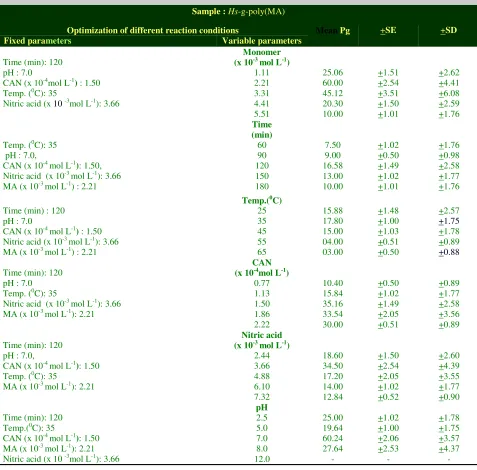
The optimized parameters for the graft copolymerization of MA (as a principal monomer) onto H. sabdariffa fiber, to obtain the maximum graft yield (60.24 %) were: temperature ( oC ), 35; time (minute), 120; CAN (mol L-1 ), 1.49 x 10⁻⁴; HNO3 (mol L-1 ), 3.36 x 10⁻³; MA (mol L-1 ), 2.21 x 10⁻³ and pH, 7.0 (Table I). The effective graft yield of 60.24% could be accounted on the basis of chemical reactivity, nature, behavior and properties (Kp, Kt , Kp/Kt and CM) of the monomers used 17-20.
3.3 Characterization
3.3.1 Fourier Transformer Infrared Spectroscopy (FTIR) FTIR spectrum of the H. sabdariffa showed a broad peak at 3424.0 cm-1 (–OH group) and peaks at 2924.7 cm-1, 1246.9 cm-1 and 1032.0 cm-1 were observed due to –CH2, C-C and
C-O stretching, respectively. However, in case of Hs-g-poly (MA) peak due to >C=O groups appeared at 1738.0 cm-1 .
3.3.2 Scanning Electron Microscopy (SEM)
In SEM, the cellulose was gold plated to have an impact. It is quite evident from the Figures I-II that there has been a sufficient deposition of polyvinyl monomers onto fiber.
Int. J. Fundamental Applied Sci. Vol. 1, No. 2 (2012):14-19
Comparison of the scanning electron micrographs of the raw H. sabdariffa fiber with the graft copolymers reveals the distinction between the ungrafted and grafted samples depending upon the Pg.
3.3.3 X -ray Diffraction Studies of Graft copolymers (XRD)
The XRD result in Table II clearly shows that the percentage crystallinity and crystallinity index were found to Table I: Optimization of different reaction parameters for graft copolymerization of MA onto H. sabdariffa fiber
Sample : Hs-g-poly(MA)
Optimization of different reaction conditions Mean Pg +SE
+SD
Fixed parameters Variable parameters
Time (min): 120 pH : 7.0
CAN (x 10-4mol L-1
) : 1.50
Temp. (0C): 35
Nitric acid (x 10 -3mol L-1): 3.66
Monomer (x 10-3 mol L-1)
1.11 25.06 +1.51 +2.62
2.21 60.00 +2.54 +4.41
3.31 45.12 +3.51 +6.08
4.41 20.30 +1.50 +2.59
5.51 10.00 +1.01 +1.76
Temp. (0C): 35
pH : 7.0,
CAN (x 10-4 mol L-1
): 1.50,
Nitric acid (x 10-3 mol L-1): 3.66
MA (x 10-3 mol L-1) : 2.21
Time (min)
60 7.50 +1.02 +1.76
90 9.00 +0.50 +0.98
120 16.58 +1.49 +2.58
150 13.00 +1.02 +1.77
180 10.00 +1.01 +1.76
Time (min) : 120 pH : 7.0
CAN (x 10-4 mol L-1) : 1.50
Nitric acid (x 10-3 mol L-1): 3.66
MA (x 10-3 mol L-1) : 2.21
Temp.(0C)
25 15.88 +1.48 +2.57
35 17.80 +1.00 +1.75
45 15.00 +1.03 +1.78
55 04.00 +0.51 +0.89
65 03.00 +0.50 +0.88
Time (min): 120 pH : 7.0 Temp. (0C): 35
Nitric acid (x 10-3 mol L-1): 3.66
MA (x 10-3 mol L-1): 2.21
CAN (x 10-4mol L-1)
0.77 10.40 +0.50 +0.89
1.13 15.84 +1.02 +1.77
1.50 35.16 +1.49 +2.58
1.86 33.54 +2.05 +3.56
2.22 30.00 +0.51 +0.89
Time (min): 120 pH : 7.0,
CAN (x 10-4 mol L-1): 1.50
Temp. (0C): 35
MA (x 10-3 mol L-1): 2.21
Nitric acid (x 10-3 mol L-1)
2.44 18.60 +1.50 +2.60
3.66 34.50 +2.54 +4.39
4.88 17.20 +2.05 +3.55
6.10 14.00 +1.02 +1.77
7.32 12.84 +0.52 +0.90
Time (min): 120 Temp.(0C): 35
CAN (x 10-4 mol L-1
): 1.50
MA (x 10-3 mol L-1): 2.21
Nitric acid (x 10 -3mol L-1): 3.66
pH
2.5 25.00 +1.02 +1.78
5.0 19.64 +1.00 +1.75
7.0 60.24 +2.06 +3.57
8.0 27.64 +2.53 +4.37
12.0 - -
-where, CAN= ceric ammonium nitrate, SD = standard deviation, SE = standard error
Figure I: SEM of Hibiscus sabdariffa Figure II: SEM of Hs-g-poly(MA)
Int. J. Fundamental Applied Sci. Vol. 1, No. 2 (2012): 14-19
decrease with increase in percentage grafting of MA onto H. sabdariffa stem fiber. Since incorporation of monomer moiety in the backbone impairs the natural crystalinity of the fiber, therefore, graft copolymerization of vinyl monomers onto H.
sabdariffa fiber resulted in impaired crystallinity and increased the amorphous region of the fiber. Thus, with increase in percentage grafting, the percentage crystallinity (68.68) and crystallinity index (0.54) decreased along-with reduction in stiffness and hardness. Crystallinity index (C. I.) is the quantitative measure of the orientation of the crystal lattice to the fiber axis, therefore, lower crystallinity index in case of graft copolymers stands for poor order of crystal lattice in the fiber. The dis-orientation of the crystal lattice to the fiber axis during grafting resulted in graft copolymer with low crystallinity and crystallinity index. This clearly indicates that the cellulose crystals are better oriented in H. sabdariffa fiber rather than graft copolymers 21,22,25.
3.3.4 Thermogravimetric and Differential Thermal Analysis (TG-DTA)
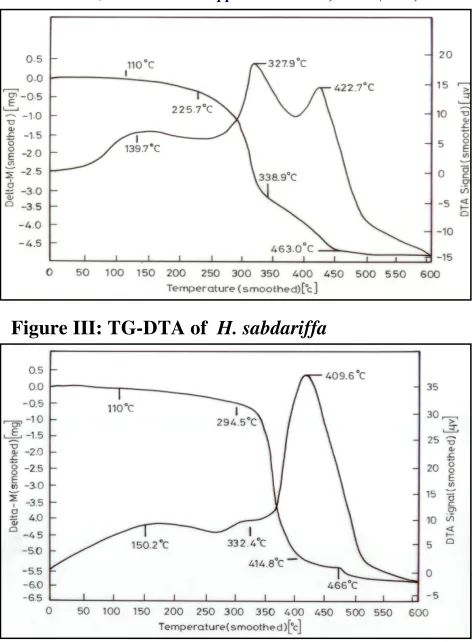
TGA of ungrafted and grafted H. sabdariffa have been studied as a function of % wt. loss vs. temperature (Table III). Cellulosic in H. sabdariffa degrades by dehydration, glycogen formation and depolymerization. In case of H. sabdariffa, two-stage decomposition has been found the former two-stage is attributed to loss by dehydration, volatilization processes, whereas, the later stage is attributed to loss by depolymerization, delignification and oxidation of the char . Graft copolymers showed two stage decomposition. The first stage refers to loss of moisture, decarboxylation and chain scissions while the second stage pertains to breaking up of covalent bonds that has raised the FDT (480oC). Thus, it is evident from the TGA data that grafted fiber is thermally more stable than the raw fibers. This may be due to the incorporation of poly (vinyl) chains on backbone polymer either through covalent bonds or mechanically, confirming the additional strength to the fiber 23,24.
In DTA studies, H. sabdariffa has been found to exhibit two
major exothermic peaks whereas, graft copolymers exhibited some minor and major exothermic peaks. The first and second transition peaks revealed the dehydration, adsorption and oxidation of the semi-crystalline host and the major peak signifies the fusion and irreversible dissociation of the crystallites (TableIII, Figure III,IV) 23,24.
3.4 Physico-chemical Evaluation
3.4.1 Moisture absorbance behavior
It was found that graft co-polymerization of vinyl monomer onto H. sabdarifa had a great impact on the moisture absorbance behavior (Table IV). It was observed that with increase in graft yield, there was a decrease in percent moisture absorbance. This was due to blocking of sites vulnerable for moisture absorbance with vinyl monomer chains, thereby, converting the fiber less sensitive towards moisture.
3.4.2 Chemical resistance
It was observed that acid- base resistance of the fiber increased with increase in percent grafting. It was due to the fact that poly (vinyl) chains grafted onto H. sabdariffa fiber had less affinity for 1 N HCl and 1N NaOH as compared to hydroxyl and other functional groups present in ungrafted fiber. Therefore, the resistance of fiber towards acid-base was found to increase with the incorporation of poly (vinyl) chains on the active sites of the backbone (Table IV) that is clear from percentage weight loss to 39 and 27 after 72h in 1N HCl and
1N NaOH, respectively.
3.4.3 Swelling behavior studies
The swelling behavior studies were carried-out in different solvents like Water, MeOH, BuOH and DMF. It has been observed that H. sabdariffa fiber showed maximum swelling in Water (59%) followed by MeOH (46%), BuOH (38%) and DMF (30%). However, the swelling behavior of the Table II: Percentage Crystallinity (% Cr) and Crystallinity
Index (C.I.) of the grafted and raw H. sabdariffa fiber
Sample Pg
at 2θ Scale
% Cr %C.I I 15.0 I 22.68
H. sabdariffa - 40.0 136.0 77.20 0.70
Hs-g-poly
(MA)
60.24 31.0 68.0 68.68 0.54
where, I 15.0, I 22.68= Peak intensities at 2θ-Scale
Table III Thermogravimetric-Differential Thermal Analysis of H. sabdariffa and its graft copolymers
Graft copolymer
Hs-g-poly-
TGA DTA
IDT FDT % Residueleft Peaks in 0C(µV)
H. sabdariffa - 225.7 463.0 20.0 139.7 (6), 327.9 (18.0), 422.7 (14)
(MA) 60.24 294.5 480.0 01.0 150.2 (9), 409.6(37.9)
where, IDT = initial decomposition temperature, FDT= final decomposition temperature
Figure III: TG-DTA of H. sabdariffa
Figure IV: TG-DTA of highest graft Hs-g-poly(MA)
Int. J. Fundamental Applied Sci. Vol. 1, No. 2 (2012):14-19
graft copolymers followed the pattern: DMF > BuOH > Water > MeOH and the trend obtained has a direct correlation with the solubility parameters like solvent basicity, the molar ratio, hydrogen bond formation and the percentage grafting. Depending on the chemical nature and the property, the pendent groups of the grafted polymers such as -COCH3 have different interactions with the solvents. Higher percentage swelling in DMF and BuOH is due to better interaction with such pendent groups that increases with increase in Pg. However, a reverse trend has been found in the case of raw H. sabdariffa. Since a crystalline polar polymer is soluble in solvent is capable of hydrogen bond formation therefore, the raw fiber has more swelling in water and MeOH followed by DMF and BuOH. Presence of –OH and –CH2OH groups in cellulosic fibers further supports the deep penetration of the polar solvents into the polymer backbone thereby, resulting in higher swelling. Whereas, in case of DMF and BuOH, the affinity of these solvents towards –OH groups is less and ultimately a decreased swelling takes place. Moreover, other factors like the fiber size, steric hindrance and temperaturealso influence the percentage of swelling17-20 (TableV).
3.4.4 Dye uptake behavior
The dye uptake behavior of the graft copolymers vis-à-vis raw fiber, was studied for seven consecutive hours to find
out the effect of grafting on dye uptake (Table VI). Graft copolymers were found to exhibit less dye uptake as compared to the backbone and was found to be a function of Pg. It was observed that dye uptake decreases with increase in Pg. Cellulose is semi crystalline polymer that easily swells due to competitive processes of adsorption through hydrogen bonding and the scission of the internal hydrogen bonds between the amorphous molecules. Presence of free reactive sites like –OH and –CH2OH in raw fiber helps in the absorption of the dye. But these sites get occupied with poly(vinyl monomer) chains and poly(binary vinyl monomer) chains in the backbone that restrain dye uptake and is Pg dependent17-20,25. Therefore, with increase in Pg, dye uptake has been found to decrease.
4. Conclusion
Grafting of poly(MA) onto H. sabdariffa stem fiber in presence of ceric ion initiator has yielded novel regenerated graft copolymers i.e. Hs-g-poly(MA) with Pg 60.24. It is evident from the characterization and chemical studies of the graft copolymers through different technique that grafting resulted in the morphological transformation that improved the physico-chemico-thermal properties of the H. sabdariffa fiber. The increase in Pg decreased the hydrophilicity and dye uptake but increased its chemical and thermal resistance. The graft copolymers thus obtained are the better means for the utilization of the waste biomass in the advancement of technology.
References
1. Kaith BS, Singha AS, Dwivedi DK, Kumar S, Kumar D & Dhemeniya A, Preparation of Polystyrene Matrix Based Composites using Flax-g-copolymers as Reinforcing agent and Evaluation of the Mechanical Behavior. Int J Plast Techno, 7 (2003) 19-125. 2. Kaith BS, Singha AS & Sharma SK, Syn thesis of Graft
Copolymers of Binary Vinyl Monomer Mixtures and Flax Fiber using FAS-KPS Redox System. Int J Chem Sci, 2(2004) 37-43.
3. Kaith BS, Singha AS & Sharma SK, Graft Copolymerization of Flax Fibers with Binary Vinyl Monomer Mixtures and Evaluation of Swelling, Moisture absorbance and Thermal Behavior of the Grafted fibers. J Polym Mater, 20 (2003)195.
4. Singha AS, Kaith BS & Kumar S, Evaluation of Physical and Chemical Properties of FAS –KPS induced Graft Co-polymerization of Binary Vinyl mono mer mixtures onto mercerized Flax. Int J Chem Sci, 2 (2004) 472.
5. Kumar V, Bhardwaj YK, Rawat KP & Sabharwal S, Radiation-induced grafting of vinylbezyltrimethyl ammonium chloride (VBT) onto cotton fabric and study of its anti-bacterial activities. Radiat Phys Chem, 73 (2005) 175.
6. Hassan MS, Atteia RM & Zohdy MH, Metal complexes of natural and synthetic fabrics grafted and vinyl monomers by gamma radiation. Polym Compos, 30 (2009)1283-1289.
7. Bavan DS & Kumar GCM, Potential use of natural fiber composite materials in India. J Reinf Plast & Compos, 29(2010) 3600-3613.
8. Monier M, Nawar N & Abdel-Latif DA, Preparation and characterization of chelating fibers based on natural wool for removal of Hg(II), Cu(II) and Co(II) metal ions from aqueous solutions. J Haz Mater, 184 (2010) 118-125.
9. Mishra A & Bajpai M, Flocculation behavior of model Table V Effect of solvents on swelling behavior of
graft copolymers vis-à-vis backbone
Sample Pg
% Swelling
Water MeOH BuOH DMF
H. sabdariffa - 59.00 46.00 38.00 40.00
H s- g - p o l y
(MA)
60.24 29.00 26.00 44.00 60.00
Table VI Dye uptake studies of the graft copolymers vis-à-vis back bone
Sample Pg
Dye concentrationof the test solution at different
time intervals (x 10- 4 mol L-1)
1h 2 h 3 h 4h 5 h 6 h 7 h
H. sabdariffa - 4.96 4.38 4.08 4.08 3.79 3.21 3.21
Hs-g-poly(MA) 60.24 5.25 5.25 4.96 4.96 4.67 4.67 4.67
Table IV Chemical resistance and moisture absorbance studies of graft copolymers vis-à-vis back bone
Graft
copolymer Pg
% Chemical resistance % wt. loss after 72hour
% Moisture absorbance at different RH after 12 hours
Hs-g-poly- 1N HCl 1N NaOH 30-35% 50-55% 60-65% 85-90%
H. sabdariffa - 55.0 43.0 0.5 0.8 1.8 2.5
(MA) 60.24 39.0 27.0 - 0.1 1.4 1.8
Int. J. Fundamental Applied Sci. Vol. 1, No. 2 (2012):14-19
textile waste treated with a food grade polysaccharide. J Hazard Mat, 118 (2005) 213-217.
10. Khan A, Shaheruzzaman GM, Rahman M, Razzaque MHA, Islam SM & Alam S, Surface Modification of Okra Bast Fiber and Its Physico-Chemical Characteristics. Fibers and polymers, 10(2009) 65-70. 11. El-Sherbiny M, Abdel Bary EM & Harding DRK,
Swelling Characteristics and in vitro drug release study with pH and thermally sensitive hydrogels based on modified chitosan. J Appl Polym Sci, 102(2006) 977-985.
12. Qu X, Wirsen A & Albertsson AC, Structural change and swelling Mechanism of pH-sensitive hydrogels based on chitosan and D, L-lactic acid. J Appl Polym Sci, 74(1999) 3186.
13. Rudzinski WE, Dave AM, Vaishnav UH, Kumbar SG, Kulkarni AR & Aminabhavi TM, Hydrogels as controlled release devices in agriculture. Design Mon Polym, 5 (2002) 39-65.
14. Huang J, Wang X I & Yu XH, Solute permeation through the polyurethane-NIPAAam hydrogel membranes with various cross-linking densities. Desalination, 192(2006) 125-131.
15. Thacker MS, Raw Materials, The Wealth of India, Malvaceae, Vol. V, H-K, CSIR Publisher, New Delhi, (1997) 80.
16. Jirawut J, Menges J & Supaphol P, Mechanical Properties of Injection Molded Isotactic Polypropylene /Roselle Fiber Composites. J Appl Polym Sci, 101(2006) 3291-3300.
17. Nicholas P & Cheremisinoff. Handbook of Engineering Polymeric Materials, Marcel Dekker, Inc., (1997) 481-500.
18. Fried Joel R, Conformation, Solution, and Molecular weight. Polym. Sci and Tech, 42(2005) 2nd Edition.
19. Brandrup JEH, Immergut. Polymer Hand Book, Wiley InterScience, John Wiley & Sons, New York, 2(1975) II – 47 -250.
20. Kurenkov VF & Myagchenkov, Polymer Materials Encylo pedia, CRC Press. Inc. Boca Raton, FL, (1996) 10.
21. Kaith BS & Kalia S, Synthesis and Characterization of Graft Co-polymers of Flax Fiber with Binary Vinyl Monomers. Int J Polym Analy Charact,, 12(2007) 401-412..
22. Mwaikambo LY & Ansell MP, Chemical modification of hemp, sisal, jute and kapok fibers by alkalization. J Appl Polym Sci, 84 (2002) 2222-2234.
23. Ouajai S & Shanks RA, Composition, structure and thermal degradation of hemp cellulose after chemical treatments. Polymer Degradation and Stability, 89 (2005) 327.
24. Princi E, Vicini S, Pedemonte E, Mulas, A, Franceschi E, Luciano G & Trefiletti V, Thermal Analysis and Characterization of cellulose grafted with acrylic monomers. ThermoChimica Acta, 425(2005) 173-179. 25. Chauhan A, Synthesis and Evaluation of Phys i c o -Chemico- Mechanical properties of polymer matrix based Composites using Graft copolymers of Hibiscus sabdariffa as reinforcing agents, Ph. D. Thesis, Punjab Technical University, (2009) Chapter 5.
Int. J. Fundamental Applied Sci. Vol. 1, No. 2 (2012):14-19