71
Copyright © 2018. IJEMR. All Rights Reserved.
Volume-8, Issue-3, June 2018
International Journal of Engineering and Management Research
Page Number: 71-76
DOI:
doi.org/10.31033/ijemr.8.3.10
Development and Implementation of VLSI Reconfigurable Architecture
for Gabor Filter in Medical Imaging Application
Megha Hegde1 and P.Agalya Sivakumar2
1
M.Tech Student, Department of Electronics and Communication Engineering, Sapthagiri College of Engineering, Bengaluru, Karnataka, INDIA
2Associate Professor, Department of Electronics and Communication Engineering, Sapthagiri College of Engineering,
Bengaluru, Karnataka, INDIA
1Corresponding Author: [email protected]
ABSTRACT
The Gabor filter is a very effective tool in visual search approaches and multimedia applications. This filter provides high resolution in time-frequency domains and thus finds use in object recognition, character recognition and pattern recognition applications. Medical Image analysis using image processing algorithms is one of the best ways of diagnosing diseases inside human body. The Gabor wavelets resemble the visual cortex cell operation of mammalian brains and hence are best suited for biological image analysis. A Tonsillitis detection system is proposed here using Gabor filtering approach. This system detects the presence of Tonsillitis from the tonsils images. A suitable VLSI architecture for the implementation of the Gabor filter was modeled in Verilog using Xilinx tool and simulated using the tonsils test images. The proposed system was successful in detecting the presence of Tonsillitis from the diseased tonsils image. The complete system was then synthesized and implemented on FPGA Artix 7. The design was capable of operating at a maximum frequency of 394.563 MHz.
Keywords— Tonsilitis, Gabor, Medical Image Analysis, FPGA architecture
I.
INTRODUCTION
The study of medical image has contributed an important role to biomedical science that supports histo-pathological examination and diagnosing the diseases and disorder factors in human body. A high resolution medical image provides a multi-orientation observation to diagnose several types of health issues. The processing of biomedical images requires more concrete texture and background that represents clear view of internal organs and view of tissues. The Digital medical images obtained from different modalities are often affected by some unwanted factors such as noise, lower resolution, blurriness and geometric deformation. There are various techniques to mitigate such types of unwanted features such as Image smoothing, Image registration, image
segmentation. The image smoothing process enhances the images by decreasing noise without affecting original information. The image registration techniques involves the process of aligning the resolution of images and the image segmentation process involves different-different process such as filtering, smoothing, classification and segmentation which helps to generate proper structural visual view from the unstructured image.
A Gabor filter is designed to enhance the biomedical image by segmentation process in which wavelet transform is used to perform multi-resolution time frequency analysis by selecting different kernel resolutions and this makes wavelets an effective tool for performing modification on image such as compression, object recognition, edge detection, filter design and etc. A Gabor filter is used in various image processing applications such as i) Texture analysis- In this Gabor filter is treated as multi-channel filtering approach that is used to identify patterns within a specific orientation and defined frequency range [1], ii) Object recognition- A Gabor filter is used to detect object from the aerial images based on the frequency and the standard deviation. In this aerial images are passed from filter and then specific information is extracted from filtered images for object classification [2]. iii) In medical image processing- For identifying the cancerous cells from Mammogram images a 2-D Gabor filters is used for extracting the space- time based texture features from the mammogram images[3], A bank of Gabor filters is used in medical image segmentation for complex image analysis[4].
In this paper a Gabor filter is designed and used is medical image processing for tonsillitis detection. The following are the key features of proposed work.
To design and develop of Gabor filter for bio-medical applications based on FPGA.
72
Copyright © 2018. IJEMR. All Rights Reserved.
The proposed system architecture will be simulated, implemented on FPGA and tested with improved design constrains like Area (Slices and LUT‟s), delay and maximum operating frequency.
A comparative analysis with the existing design using Gabor filters.
The paper is organized with Section II presenting the Background study for the proposed design which includes providing fundamentals of Gabor filtering. Section III presents the review of various literary works that have been used and designed Gabor filters. Section IV comes up with design description of tonsillitis detection system using Gabor filters. Section V gives the simulation results and detection results. Section VI concludes the proposed work.
II.
BACKGROUND
Gabor filtering
The Gabor wavelet is a Gaussian kernel function modulated by sinusoidal plane wave. The 2-D Gabor
wavelet is defined as
where ω spatial frequency,
σ standard deviation of the Gaussian function
The transformation for an input image I (u, v) is found by a convolution operation of the Gabor function and the input image as shown in equation below.
I ′ (u, v) = G (u, v) ⊗ I (u, v)
where ⊗ denotes the 2-D convolution operation. The image filtering process using Gabor filter can be applied either in spatial or frequency domain.
1. Filtering in spatial domain
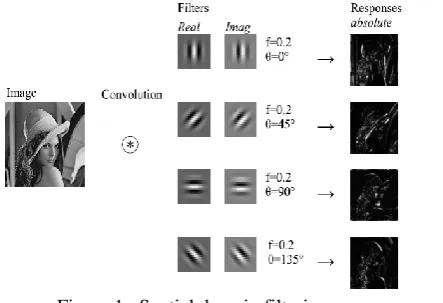
The image filter process is done by Gabor filter, and also used for the spatial domain filtering in figure. The process of image filtering is done in two steps: The image using the filter and creation of a filter. The center frequency is selected by creation filter, the main coefficients of filter is obtained by bandwidth and value of orientation. The coefficients of filter are convolved with image intensity. After the obtaining of orientation and center frequency they get different responses.
Figure 1. Spatial domain filtering
2. Filtering in frequency domain
A filtering diagram is presented in frequency domain in figure first, the presenting image is converted with the frequency domain in FFT, and the Gabor filter converts the image back to spatial domain and transfers the image using inverse FFT.
Figure 2. Frequency domain filtering
III.
LITERATUR ESURVEY
In the study of Jeyalakshmi and Ramar [4], has addressed an issue which occurs in ultrasound images because in images the speckle-noise is limited. So the speckle-noise makes tough to partition the ultrasound image. To overcome this problem [1] has introduced a novel segmentation algorithm which uses the concept of mathematical morphology. The final result of introduced algorithm shows that it is very efficient as the average sensitivity, specificity and accuracy are above 95%.
Lee et al. [5] has introduced an automatic segmentation technique for medical images which is based on the statistical technique. After uses of the morphological operations, it allocates automatically the number of objects or clusters composed, to given image and approve the Gaussian-Mixture-Model (GMM) for statistically image modes. For estimation the parameters of GMM [5] has introduced a new method is Deterministic Annealing Expectation Enlargement algorithm. The outcomes shows that proposed statistical technique can fragment exactly in different Computed Tomography (CT) images.
In the study of Phensadsaeng et al. [6] has addressed about tonsillitis ailment which is the cause of pneumonia and heart attack. To enhance data transmission rates, a new colour model VLSI architecture is presented for detect the starting state tonsillitis. The result displays that presented system is useful in cost reduction and portability.
73
Copyright © 2018. IJEMR. All Rights Reserved.
The image has more smoothly, clearly and has bestcapacity in noise immunity.
Ma and Doermann [8], addressed a problem occurs in document scanning that contain huge number of pages, like books. It is extremely possibility to provide the lowest count of training samples to the personal system that could make up for identifying the global shifts. A Gabor-Filter is based on multi class classifier technique is used to overcome these problems. The outcomes displays the Gabor-Filter effectiveness to script, font style and font face classification at the level of word.
The study of Areekul et al. [9], has familiarized the Gabor-Filter computation for separating the 2-Dimensional filters into 1-2-Dimensional pass Gaussian filter and 1-Dimensional low pass filter in the straight for an alignment for improving the fast fingerprint perception. The final result shows that the defined technique provides low memory space, lower implementation complexity and better enhancement quality.
In the study of Deng et al. [10], has defined a scheme of facial identify that based on the principal of Gabor-filter for feature extraction. To extract the features it consist eight orientation and five frequencies. A new local Gabor filter framework model has part of frequency and orientation parameters. For Gabor filter bank performance evaluation initially PCA and LDA methods are involve for facial expression detection. The result shows that the technique is effectiveness in terms of performance recognition and minimizing the dimensions. The approx. recognition rate completed was 97.33 in terms of JAFFE facial appearance database.
Kong et al. [11], defined that the biometric detection technology could solve the network society security problems. The O-palm verification technique is introduced where the lines and points can be removed from a separate for approving the individual identification. The outcomes demonstrate that proposed technique is effective in terms of personal authentication.
Qian et al. [12], have presented a novel method for enhancing image segmentation which is based on 2-Dimensional Gabor filter bank, by using image spatio-temporal and frequency domain. The outcome of study display that the presented approach is more consistent and obtains a effective image segmentation feature.
The study has carried out by Das and Banerjee [13], proposed optimal architecture of Complex Discrete Wavelet Transform for lower resource environment in image processing system. The result of presented approach delivers specific features such as minimum data path length and less computational complexity. The architecture is performed on Xilinx Field Programmable Gate Array (FPGA) type platform.
A bio-metric recognition system has contributed an important role to identify the person based on physical and behavior characteristics. The work of Verma [14], has done analytical study on the various fingerprint recognition system based on Fourier Transformation (FT) Minutiae Extraction (ME) and Discrete Cosine Transformation(DCT).and found that the existing fingerprint recognition system have higher complexities.
The outcomes of this study reveals that wavelet based system has high recognition efficiency compared with traditional approach.
IV.
SYSTEM IMPLEMENTATION
The description of the Tonsillitis Detection System (TDS) design using a Gabor filter approach is presented in this section. The section presents with the top level description and the internal system architecture of the TDS.
i. Gabor Filter Module
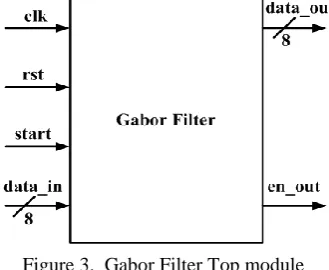
In Image processing system, Gabor-Filter is a linear filtering process which is majorly utilized for Texture analysis and feature extraction. However, image segmentation is a process of partitioning of an image into number of segments which is known a group of pixels. Thus “Gabor-Filter” is suitable tool to segment the images in detecting tonsils. This is owing to two main reasons, their ability to acquire optimum uncertainty between frequency and space-domain and equality in virtual mammal‟s cortex. The top-module of proposed Gabor Filter is given in the below Figure 3.
Figure 3. Gabor Filter Top module
The Top module of proposed Gabor Filter contains four input parameters viz; clock, reset, start-signal and data-in bits with size 8, whereas output contains eight-bits of data out with en-output signal. The following sub-section provides the detail internal architecture design of proposed “Gabor filter” where all the blocks are internally connected to each other.
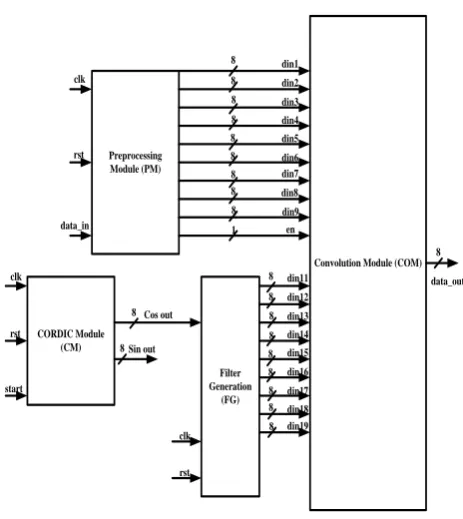
A. Internal design of proposed Gabor Filter module The internal design of proposed “Gabor Filter” module is presented in Fig. 4. The internal architecture mainly contains four sub modules which are internally connected to each other. Such three modules are;
1. Pre Processing Module 2. CORDIC Module
3. Filter Generation Module and 4. Convolution Module
74
Copyright © 2018. IJEMR. All Rights Reserved.
Convolution Module (COM)Preprocessing Module (PM)
CORDIC Module (CM)
Filter Generation
(FG) clk
rst
data_in
8 8 8 8 8 8 8 8 8 1
din1 din2 din3 din4 din5 din6 din7 din8 din9 en
data_out 8
8 8 8 8 8 8 8 8
din11 din12 din13 din14 din15 din16 din17 din18 din19 clk
rst Cos out 8
Sin out 8 clk
rst
start
8
Figure 4. Internal Design of Gabor Filter
Initially, an input-image is considered by the system in terms of data-in (i.e. ROM-1 block). Each image pixel being elected, its nearest pixels are generated in ROM-2 block. Hence, like this matrix of input pixels are created in ROM-3 block. The memory space for these 3-ROM are arranged likes as, 3-ROM-1 is residing with memory address (Mem-1 1:256), RoM-2 is residing with mem-1(1:776) and RoM-3 residing with Mem-3 (1:9).
Internally, the CORDIC processor is a pipeline structure which is useful for different angle computations. In some applications CORDIC applicable for processing of single input, during that time there is no role of pipeline registers and ultimate results can be generated by parallely arranged single clock cycles. The proposed CORDIC architecture made-up with ADDER‟s with ROM free.
The “Filter-generation” module contains 3-inputs (i.e. Clock, Reset, and D-in 8bits) and generates 9- outputs signals (i.e. d1 to d9 with 8bits). In this module, input-output attributes are defined like as d-in, d1 to d9 and counter. A provisional register is produced and stores the single bit „sig‟ value. For further computation, if Re-set is set as high, both „sig‟ and counter values are pertained into zero, otherwise counter sets into 9.
After the filter generation process, system will proceed for feature extraction of image which is carried out in convolution module. The convolution module considers the output results from the pre processing and filters generation as inputs and undergo for multiplication operation on bits acquired from both modules. For further implementation, addition operation also carried out on bits. By doing this LSB bits are discarded after the addition operation. Finally, the output will be MSB which is XORed with central pixel value.
V.
RESULTS ANALYSIS
The tonsillitis detection system using Gabor filtering approach presented here was modeled using Verilog simulated and synthesized. The Xilinx 14.7 ISE was used here for system modeling. The simulations for the designs were carried out using Modelsim6.3f. The synthesis and the final implementation of the system design was performed on Artix 7 FPGA Board Device 7A100T-3 CSG324.
Gabor Filter Module
The top module shown in Fig. 5 is the design result of Gabor filter module taking inputs 8 bits data_in [7:0], and a start signal. The outputs include data bits, data_out [7:0] and en_out.
Figure 5. Gabor Filter Top
The simulation result in digital waveform for the Gabor filter module design is displayed in Figure 6
Figure 6. Simulation waveforms of Gabor filter
75
Copyright © 2018. IJEMR. All Rights Reserved.
Figure 7. (a): Gabor Filtered images for Healthy Tonsils(a) Input Tonsils Image (b) Gabor Filtered output
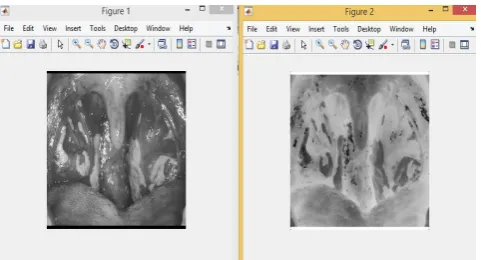
Figure 8. (a): Gabor Filter Results for Diseased Tonsils (a) Input Tonsils Image (b) Gabor Filtered output
VI.
COMPARATIVE ANALYSIS
The design performance in terms of resource utilized is compared with the previous design of [16]. The resource
Utilization in terms of total pins total registers, and total memory bits as shown in table.
Table I: Comparison of resource utilization on FPGA
Resource TSFO-S
[16]
Proposed design
Overhead
Technology Virtx-7 Virtx-7
Flip-flops 15234 8367 45.07%
LUT's 41605 19002 54.32%
Delay (ns) 10 NA --
Maximum Frequency (MHz)
172 394.563 56.34%
The table shows that although the proposed design shows resource overhead in comparison to the design of [16] the proposed design is capable of operating at higher speed as the maximum operating frequency of the proposed design is very much greater than the existing design.
VII.
CONCLUSION
Gabor filter is mainly used in medical image processing for diagnosing certain diseases through medical images. A tonsillitis detection system is designed using a
Gabor filtering approach. The complete system architecture of the Gabor filter was designed which takes in 8-bit image data and generates an 8-bit image data output. The system was modeled, simulated, synthesized and implemented on FPGA board. The Gabor filtering system designed was capable of detecting tonsillitis affected areas. The proposed Gabor filter design was able to operate at a maximum frequency of 394.563 MHz.
REFERENCES
[1] S. Arul Jothi, K. Dhatchayani, G.G. Renuga Devi, & M. Ramkumar Raja. (2017). VLSI implementation of gabor filter in image detection–research direction. IJCTA, 10(02), 133-138.
[2] Thomas P.Weldon & William E. Huggins. (1999). Designing multiple gabor filters for multi-texture image segmentation. Optical Engineering, 38(9), 1478-1489. [3] Rucha R. Thakur, Swati R. Dixit, & Dr. A.Y. Deshmukh. (2012). VHDL design for image segmentation using gabor filter for disease detection. International Journal of VLSI design & Communication Systems (VLSICS), 3(2), 211-219.
[4] Rucha D. Thakur. (2014). Real time VHDL design of high speed gabor filter for disease detection. International Journal of Advanced Research in Computer Science and Software Engineering, 4(12), 229-234.
[5] Jeyalakshmi, T. Ratha, & K. Ramar. (2009). Segmentation of uterine fibroid using morphology: An automatic approach. International Conference on Intelligent Agent & Multi-Agent Systems, 1-6.
[6] Prajith Prakash Nair & Dr. T.R.Gopalakrishnan Nair. (2017). An efficient localisation of cellular change using tuned gabor filter in prostatic cases. Advances in Computational Sciences and Technology, 10(6), 1807-1818.
[7] S. R. Dixit & A. Y. Deshmukh. (2013). Design strategies for EDGE based image representation system with VLSI. 6th International Conference on Emerging Trends in Engineering and Technology (ICETET), 115-116.
[8] Wang, Jia-Xin & Ting-Ting Zhang. (2009). CT image segmentation by using a FHNN algorithm based on genetic approach. 3rd International Conference on Bioinformatics and Biomedical Engineering, 1-4.
[9] Ma, Huanfeng & David S. Doermann. (2003). Gabor Filter Based Multi-class Classifier for Scanned Document Images. Proceedings of the Seventh International Conference on Document Analysis and Recognition, 1169-1179.
[10] Areekul, Vutipong, Kittiwat & Tantaratana. (2005). Separable gabor filter realization for fast fingerprint enhancement. Proceedings of IEEE International
Conference on Image Processing, 11-14.
76
Copyright © 2018. IJEMR. All Rights Reserved.
[12] Kong, Wai Kin, David Zhang, & Wenxin Li. (2003).Palmprint feature extraction using 2-D Gabor filters. Pattern Recognition, 2339-2347.
[13] C.C. Han, H.L. Cheng, K.C. Fan, & C.L. Lin. (2003). Personal authentication using palmprint features. Pattern Recognition (Special issue: Biometrics), 36(2), 371–381. [14] Xavier P. Burgos-Artizzu, Angela Ribeiro, Alberto Tellaeche,Gonzalo Pajares, & Cesar FernándezQuintanilla. (2009). Improving weed pressure assessment using digital images from an experience-based reasoning approach. Computers and Electronics in Agriculture, 65(2), 176–185. [15] Verma, Rakesh. (2016). Wavelet based fingerprint authentication system: A review. Electrical and
Electronics Engineering: An International Journal, 5(1), 61-72.